The 62 CA95 Basket Case Rescue Log, Start Date June 1st 2024

I'm happy with .003" both cylinders for home boy shop honing. If I read the manual for this bike .006" is max requiring repair.
Every bike that I have rebuilt has a day of reconning, that is the 1st start. If for some reason I get smoke and belch, I'll tear down the engine and send cylinders for rebore .50 over. It's always easier to tear down a fresh built engine. My "build from scratch" CA95 was one example. I got transferred from Eden Prairie, MN to Sylvania, GA. just as I was about to assemble the engine. So, I hurried up and threw it together. Once settled in my new residence I started the engine. Started right up! Oil everywhere, gushing out between the cylinder and head! I didn't install the rectangle "O" ring between the cylinder and the head.
 
I was able to hone cylinders to .25 over size. Very unusual to able to do this. Although I'm happy to be able to avoid boring and shipping costs
Glad to hear you were able to do this. My limited experience led me to seek a machinist on my prior jobs (a 305 and a 160), as well as advice to consider taper and ovality that a ball type flex hone would not correct. I did use a flex hone to clean up my bores for some scratches that I wasn't sure how deep they were and to better my chances on using a bore snap gauge. All this just to know what size pistons to order and take to the machinist.
I've learned a lot and also got some great advice here at VHT from several members.
Sounds like your clearance is in the right ballpark and further checking with the ring end gaps to verify a rebore can be skipped, hopefully works out good.

Thanks for your missing "O" ring story, it helped me chuckle at myself for a recent gasket goof up or mating surface issue that I will have to correct on my CL350 rebuild.
 
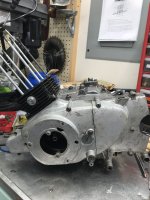
.003 Ring gap both cylinders. I want to make note it took some time to hone these cylinders to spec. As previously mentioned, the moment of truth will be first start of the engine. Additional gamble is valve seats and guides. I have 2 cylinder heads. One that came with the bike and basket of parts. The second came with the engine I purchased.
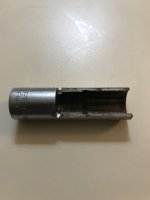
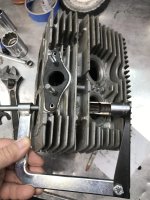
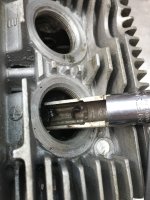
The head that came with the bike had a bent valve and a valve missing. The cam and machine faces were clean. The head that came with the procured engine had serious rust on the cam and machined faces destroyed, likely by micro bits of rod bearing. So, I plan to attempt to salvage whatever I can to build a complete head. Push come to shove, new valves and guides may be needed. I should have answers within a week or so, once I find my custom machined valve spring compression tool made from a deep well socket. I will post a pic as soon as I find it.
 
I recall my mother's remark when I was a boy when I complained that I had lost something and could not find it. She always said: It's where you put it the last time you had it. That phrase came back to me today and I found the spring compression tool. It was where I put it the last time I had it.
I've had privileges throughout my working life. This "tool" is a 1/2" Craftsman socket (50+ years old. Made in USA) The metallurgist at Eaton Hydraulics in Minesota cut it for me. IMG_3775.JPGIMG_3778.JPGIMG_3779.JPG
 
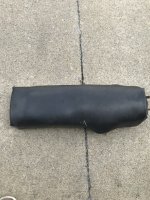
Time stamp 9-6-24. Tires, rim strips, tubes should all be here by 9-9-24. I just happen to have a replacement seat cover from a previous build I never used but kept anyway. My seat project showed up today, $22.50 + shipping. Yes, the cover is (was) a quick handmade something to make do. But underneath the bad wrap is a near perfect frame. Placed in que for restoration in the near future.IMG_3786.JPGIMG_3788.JPG
 
Time stamp 9-6-24. Tires, rim strips, tubes should all be here by 9-9-24. I just happen to have a replacement seat cover from a previous build I never used but kept anyway. My seat project showed up today, $22.50 + shipping. Yes, the cover is (was) a quick handmade something to make do. But underneath the bad wrap is a near perfect frame. Placed in que for restoration in the near future.View attachment 36478View attachment 36479

Time stamp 9-6-24. Tires, rim strips, tubes should all be here by 9-9-24. I just happen to have a replacement seat cover from a previous build I never used but kept anyway. My seat project showed up today, $22.50 + shipping. Yes, the cover is (was) a quick handmade something to make do. But underneath the bad wrap is a near perfect frame. Placed in que for restoration in the near future.View attachment 36478View attachment 36479
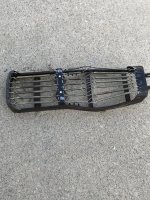
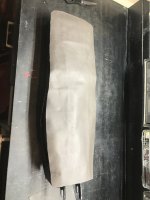
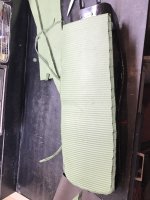
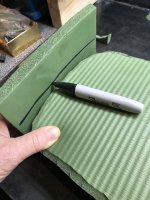
I tend to be too trusting when it comes to eBay. I also tend to begin my pieces parts clean up and prepare for assembly. I buy the above seat advertised as a CA95 seat. Then I decide to take some pictures as an example of how I refit a new cover and what I do to replace foam and vinyl that rides against the springs. After I'm finished with my tricks of the trade, I find out it's a seat for CA72 or CA77. Anyway, this is how I prepare a bare frame for a new cover. I'm not advocating my way is the way, but it works.
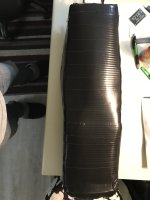
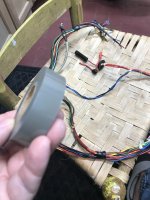
After stripping off old vinyl, I grind away any trim screws. I paint the frame black. I then cut a piece of automotive vinyl to fit between the springs and foam. Foam is exercise mat from Walmart. Once foam is cut, I use black duct tape to form the seat. The seat cover (sorry I have the wrong one) slips over the taped foam. Back on eBay as I can't use it. Anyway here are some pics.IMG_3821.JPGIMG_3822.JPGIMG_3825.JPGIMG_3826.JPGIMG_3830.JPG
 
It is hard to tell the Dream from Benly seats apart, at a glance. They are about the same length but the Dreams are wider, especially forward of the strap by a couple inches.
The Dreams have a fork on the front mount, whereas the Benly seats are a closed eyelet hole. Personally, I wouldn't mind having a Dream seat on a Benly, if it could be made or modified to fit, just for the extra width and comfort.
 
Personally, I wouldn't mind having a Dream seat on a Benly, if it could be made or modified to fit, just for the extra width and comfort.

You know, that's a thought! If for some reason the seat does not sell, I'll reposition the seat mount to fit the Honda frame and shorten the seat frame. The seat cover fit the width fine. Thanks!
 
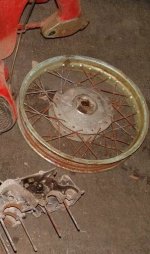
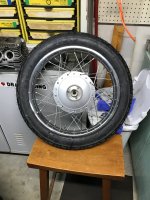
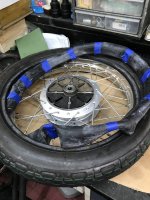
Today's job, mount the front tire. I have to share one technique I use when I mount my own tires. I fold the tube in half, length wise and wrap the innertube every 3" or so inches with painter's tape. This way I don't pinch the tube when installing the tire. Pics of how the front rim was found, laced new rim with painted hub and final results with new tire mounted. Tomorrow's job is the rear tire. Bike should be on her wheels this week.before front wheel.jpgIMG_3685.JPGIMG_3836.JPG
 
I just use a couple teaspoons of talcum powder to coat the inside of tyre and the entire tube. The tube never sticks and just slides away from the spoons or rim edge. Prevents self vulcanizing over time and heat between tyre casing and tube. After patching it's best to powder the edges where the vulcanizing liquid (glue) is exposed to the tyre inside.
If the tube is too wide for the tyre and causes wrinkles, I won't use it. Any folds in the tube will chafe through and fail.
Everyone has their tricks. The tape is one I haven't heard.
 
Thanks for the talcum powder suggestion. Over the last half century, I've pinched a lot of tubes installing tires on my projects. Dumb thing on my part for just not taking my tire mounting needs to a shop. Rear tire mounted this morning, and pics of tube wrapped and both front and back completed wheels. Wheel hub interior and brake surfaces cleaned up and reused. New brake springs and sealed for life bearings installed all around. Two dampeners good, two new dampeners for the sprocket. Currently awaiting new electrical plugs, turn signal winker, and rubber contact caps (for starter solenoid) to complete wiring harness.IMG_3837.JPGIMG_3838.JPG
 
Forgive my ignorance but tell me the utility and purpose of the blue painters tape. I have not seen that technique before !!
!
 
No ignorance at all! Occasionally I'm rouge and do creative things as directed by my inner self. I fold the inner tube in half-length wise. I use painters tape to keep the inner tube folded because it is weak and tears easily. This technique is my way of keeping the inner tube out of the way when I'm mounting tires, thus preventing pinch points. When I inflate the tire, once mounted, the tape breaks and I'm good to go. With the exception of my VT750 project several years ago, I've used this technique to mount tires every time with success. Thanks for asking!
 
Forgive my ignorance but tell me the utility and purpose of the blue painters tape. I have not seen that technique before !!
!
Personally, I would want to avoid any stickiness cause by the adhesive. The talcum powder allows things to slip and settle into it's natural position before full inflation.
The FSM even shows using a billy club to smack the partially inflated tire to allow proper seating before fully inflating. I usually just bounce the wheel a bunch then full inflate and check that bead line on the sidewalls for evenness.
 
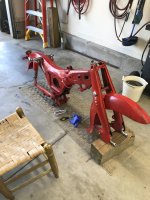
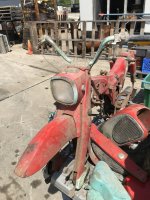
Today begins reassembly of the frame. Just a date stamp of how the bike looks today. Tomorrow, wheels. I want to mention another rogue technique about the paint and "patina". I've coated the old paint with a whisper thin coating of true marine Spar Varnish. Not Urethane, old school Spar Varnish & proper thinner. In addition, I found a nearly perfect red/orange paint to match the old, faded paint which is rubbed places some places and brushed in nasty spots. Pics of how she looked when I went to pick her up and today, just before wheel installation. What's in the bucket? The empty cylinder head soaking in Simple Green. To be power washed soon. IMG_3841.JPGIMG_2965.JPG
 
Last edited:
Nice and straight. The shape alone on these bikes get lots of comments. Interesting patina save on the paint.

Did you also bring home those 160 side covers in the bottom pic? Hard to find parts someone will want.
 
No. The scrapyard had a mid 60's CB160 next to my bike when I picked it up. I had to be honest and tell the scrapyard owner which parts went each bike.
 
Today begins reassembly of the frame. Just a date stamp of how the bike looks today. Tomorrow, wheels. I want to mention another rogue technique about the paint and "patina". I've coated the old paint with a whisper thin coating of true marine Spar Varnish. Not Urethane, old school Spar Varnish & proper thinner. In addition, I found a nearly perfect red/orange paint to match the old, faded paint which is rubbed places some places and brushed in nasty spots. Pics of how she looked when I went to pick her up and today, just before wheel installation. What's in the bucket? The empty cylinder head soaking in Simple Green. To be power washed soon. View attachment 36679View attachment 36678
Looks good in above pic…. Gonna have an interesting patina look when all together!
 
I'm the sentimental type. That's one reason I love the Honda CA95's from the 60's. I compare my time as a youth back during the 60's to physical items as well as music of the day. This 1962 CA95 was built during the year I lived as a 10-year-old in Sao Paulo, Brazil. The engine is coded 1963 although years procured parts remain unknown.

The 1966 Ohio license plate found on the bike when I purchased it from the scrap yard is age correct based rust welded fasteners to the taillight frame. My imagination tells me this bike sat somewhere disassembled, perhaps in a barn or shed since 1966. I was back home in the USA two years at that time. I preface my story to think 58 years have gone by and this bike sat while the world and I changed. The chances of an old man finding an old bike from his home state in similar condition (humor) tend to be slim.
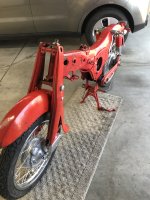
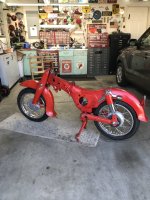
Today, as I imagine, may be the first time in 58 years, the little 62, rests on her own wheels as new mechanical life, piece by piece are put into place by an old 14-year-old boy.
Today's pics include before (scrap yard) and today. IMG_2965.JPGIMG_3862.JPGIMG_3860.JPG
 
I can see it's gonna look great. My Dream had to have repaint on the side covers and swingarm but very similar front and rear.
 
Thanks! I want to again share a gun stock finish technique my father used to put fine finishes on wood. I use the formula on the surface of the paint to seal patina and bring back the color. Simply marine grade spar varnish (not urethane) with special brushing thinner cut 50% and hand rubbed onto the surface of the paint and "patina" I love the word "patina" it gives "corrosion" a friendly name. I'm not old, I'm "aged" kind of term!
 
I rolled the bike into the back shop to begin the wiring task. Soon I will post pics of upgraded electrical connections and turn signal wiring. Objective is to complete the bike as far as possible without the engine. Then finish the engine. Speaking the of engine, the cylinder head I'm using came with the bike. The one with the bent intake valve. I've been thinking about cleaning everything up and reusing valves from the engine I bought. So, I pull the valves, clean the head near perfect. The bent valve broke the intake valve guide. Oh well, new guides and valves all around. The guides pressed out without heating the head as with a previous build. But reinstallation of new guides will need to be chilled. I want to share how I chill parts for press fit. Isopropanol alcohol 90% (from grocer or pharmacy) and a small amount of dry ice mixed in. The resulting slurry temperature will be about -100F. 60 second soak and your good to go. Can't handle parts without gloves or tongs.
 
I buy dry ice from my local grocery store called Meijer's. Airgas sells dry ice as well. I get a big block of dry ice with my Omaha Steak delivery. You only need a tablespoon in a cup of alcohol to do the trick.
 
I rolled the bike into the back shop to begin the wiring task. Soon I will post pics of upgraded electrical connections and turn signal wiring. Objective is to complete the bike as far as possible without the engine. Then finish the engine. Speaking the of engine, the cylinder head I'm using came with the bike. The one with the bent intake valve. I've been thinking about cleaning everything up and reusing valves from the engine I bought. So, I pull the valves, clean the head near perfect. The bent valve broke the intake valve guide. Oh well, new guides and valves all around. The guides pressed out without heating the head as with a previous build. But reinstallation of new guides will need to be chilled. I want to share how I chill parts for press fit. Isopropanol alcohol 90% (from grocer or pharmacy) and a small amount of dry ice mixed in. The resulting slurry temperature will be about -100F. 60 second soak and your good to go. Can't handle parts without gloves or tongs.

The resulting slurry temperature will be about -100F
Correction. I made the dry ice/isopropanol slurry today. Infrared thermometer showed -48F at the surface of the solution. Plenty of chill to freeze parts for pressed fit.
 
My project is slowed by delivery of electrical connectors, wire wrap and sealer. In the meantime, I needed to search thru my screw collection to fit side covers in preparation for final engine sometime in the near future, this is just a time stamp shot of left side covers that came with the bike on the procured engine rebuild.IMG_3904.JPG
 
So. I'm having fun fitting outer engine covers, finally got everything straight, or so I thought. I put the kick starter on to engage the transmission gears and move pistons up & down cylinders. The kick start does not engage. I search the forums and find some great recommendations and reasons why the kick starter on the CA95 all of a sudden no longer works. I had to fuss with good and bad parts to get a decent assembly. I'm 2X sure I installed the kick starter assembly correctly. I have pictures. Nothing, no engage.
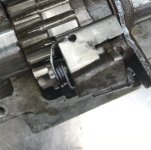
Off comes the bottom. The little spring (placed back into its hole) had popped out. The kick starter functionIMG_3907.JPG all rests with this little spring as shown.
 
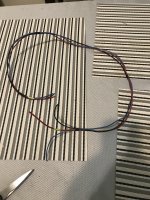
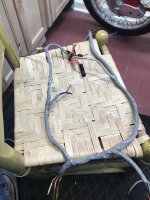
Installed the kickstart shaft and the little spring as shown popped out again. I'm waiting on yet another complete kickstart shaft assembly. While I'm waiting, I thought of working on the wiring harness. I unwrapped the harness to check for any burnt wiring, all good. I then made a separate turn signal harness, then secured the harness to the original harness to make one package. I rewrapped the harness with new harness wrap. New connector should deliver soon, but there is no need to replace original good connections as they cleaned up nice in my ultra-sonic bath. Here's a couple of shots of the harness as referredIMG_3910.JPGIMG_3914.JPGIMG_3915.JPG to.
 
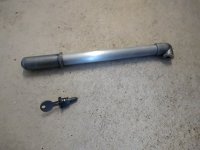
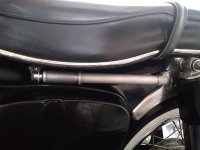
Mein Motorrad, über das ich geschrieben habe, hatte Luftpumpenschlösser. Ich habe sie verkauft, da ich nicht vorhatte, die Pumpe zu kaufen. Dein Bild ist sehr schön!
(My motorcycle I have been writing about had the air pump locks. I sold them as I was not planning to buy the pump. Your picture is very nice!)
 
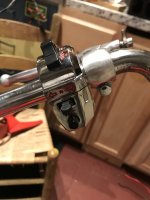
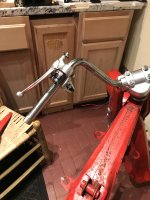
Today is wire and fit new left-hand control for lights, horn and turn signals. I wanted to capture this moment as I now have to remove this assembly to make room for handlebar turn signal holes and subsequent wiring all to fit withing the handlebars.IMG_3697.JPGIMG_3930.JPGIMG_3929.JPG
 
Just a note. I received my (3rd) kickstart assembly today and installed it. Great, it works! Finally. As I was putting the cases back together a Rolling Stones song came to mind and began playing:

Well, this could be the last time
This could be the last time
Maybe the last time
I don't know
Oh, no
Oh, no

Sometimes a sense of humor is the only sense I have left......
 
Sometimes creative work doesn't click. Turn signals. As described above, I completed and installed my shiny aftermarket left hand light/horn/turn signal assembly. I don't like it.
I would like to point out another amazing aspect about this bike, the handlebars are original and straight. My plan was to drill wire access holes in the handlebars and run wire thru the bars. I can't ruin the handlebars. So, I return to a technique to install turn signals I used 16 years ago as shown in this pic. Functional, no stuffing wire and should the next owner wish to remove them, no problem. Parts ordered.Honda 6-21-09 001.jpgView attachment 37331
 
Straight OEM bars are hard to find. I went through the same process on my Dream but went very minimal and somewhat hidden. My surface mount wires were hidden by silver HVAC tape on the underside of the bars.
That switch looks pretty good if it could be modified for internal wires. I hung my winker lamps off the brake perch clamp bolt.
 
I did the same turn signal installation on my Build From Scratch project back in 2012. here is a link to my YouTube channel

I seal the back of the switch with liquid tape. Anyway, all of my bikes, even going back to 1968, were rarely in the rain. I disliked riding in the rain and avoided rain at nearly all costs.
 
The Harley bullets look pretty good on the bike. Great trick using both filaments for brightness, since it's only intermittent it shouldn't overburden the alternator.
 
It is amazing how well some things have held up. Looks like an Auto Meter speedo too. Pretty old.
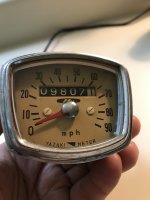
9/25/2024 Alas, the speedometer, although looks great on the outside is frozen stiff on the inside. It pains me to remove the trim and glass, but I've developed a method of doing so without distorting the metal and wasting the glass. I hope the insides are salvageable.
 
9/25/2024 Alas, the speedometer, although looks great on the outside is frozen stiff on the inside. It pains me to remove the trim and glass, but I've developed a method of doing so without distorting the metal and wasting the glass. I hope the insides are salvageable.

I, for one am hoping you'll post step by step photos of the process. Not that I have any desire to tackle a project like that, but I'd love to look over your shoulder while you're doing it. I'm enjoying following this build along.
 
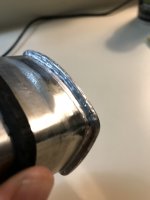
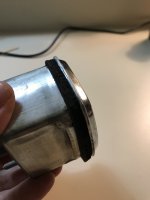
Many thanks for the kind words and following my progress. The speedometer bezel is crimped tight to the metal housing. There is absolutely no way to uncrimp the metal.
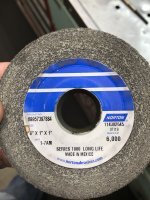
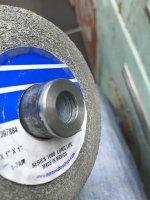
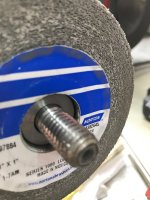
One of my secret weapons is my deburring wheel. Unlike the grinding wheel, the deburring wheel removes metal slowly and without grind marks. I use my deburring wheel to erase just enough metal from the edge of the crimp thus releasing the crimp. Once the speedometer is salvaged, I reattach the bezel with clear sealant. My repair is virtually undetectable when reinstalled on the headlight housing and waterproof to boot.

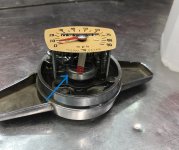
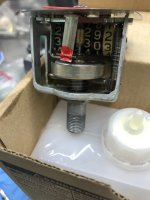
Oddly, when I took this speedometer apart the insides were perfectly rust free! Weird. I'm soaking the worm gear drive in turbojet preservation oil (another benefit of working in a plant that makes aerospace parts). I will be working the drive loose by hand until it's free. The only downside to taking apart a 62-year-old speedometer is something I didn't expect. The 10th mile numbers on the odometer are decal, whereas mile numbers are paint. So, I damaged the decal #7. Enjoy the pics of the speedometer and deburring wheel info. I use the deburring wheel along with 6"polishing wheel with green rouge to make steel look like chrome. A little coating with clear coat and it's hard to tell the difference. IMG_3974.JPGIMG_3973.JPGIMG_3975.JPGIMG_3977.JPGIMG_3978.JPG
 
The speedometer "freeze up" remains a mystery as this writing. As the pic shows, the inside of the speedometer is clean. I've tried the following "tricks". Sonic cleaning of lower body, soak lower body in rust remover, soaked lower half in Turbo-Jet oil, soaked overnight in 3 in 1 oil. The body has loosened some, but 1/4" back and forth is all I can get. 1/4" back and forth movement is an improvement as the beginning of this task, the outer drum hardly moved. My theory is debris or a rust blossom within the worm gear housing is the cause. So, now I pull out the big guns. The pic below shows the bottom half of the speedometer soaking in 50% Acetone & 50% Isopropanol. I needed a sound container, so the cup from a 59" Corvette Spinner works well. IMG_3979.JPG
 
The speedometer is now freed up and working again. Reassembly soon after I replate the speedometer housing with zinc. The rust remover made short work of the original zinc plating. Only damage is the number 7 on the 10th mile reel.

The cause of the freeze? The speedometer is mechanical. Odometer is driven by worm gears. The interface of the primary drive (speedometer drive) is one worm gear. Secondary drive transfers power to remaining drives ultimately ending at the odometer reels.

The primary worm gear and the secondary worm gear were married by "time" of 56 years idle. Soaking lower housing in rust remover, cleaning, adding lubrication, working the drive housing back and forth, then cleaning adding several different lubes. Overnight in 3 in 1 oil, then finally alcohol & acetone bath for an hour. One more lube after that, while working the drive housing back and forth did the trick. I had an old crappy speedo cable to which I nipped the end off to fit into the chuck of my drill to run the speedometer. Next post will be the finished product.
 
After a good clean out like that, I wonder if the spinning cup needs a bit of 'damping fluid', which I've heard steadies the action of the needle indicator. Perhaps a tiny blob of very lightweight grease on the worm gear parts too.
 
After a good clean out like that, I wonder if the spinning cup needs a bit of 'damping fluid', which I've heard steadies the action of the needle indicator. Perhaps a tiny blob of very lightweight grease on the worm gear parts too.
I greased the odometer worm gears with machine gun grease (the plant I retired from made fine bearings for military). I didn't think of any dampener though. If for some reason I need to go back to the speedometer I can open it up again.

Finally put a close to the speedo story. Face is reattached with acetone thinned 2-part epoxy and coated in silver enamel. I laser cut a thicker gasket than stock to make up any roughness of my seal job. Any excess gasket once installed and subsequently compressed will be trimmed. Here is a couple of pics of the finished speedo.
IMG_4002.JPGIMG_4003.JPGIMG_4006.JPG
 
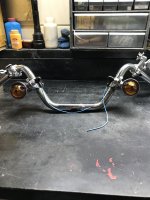
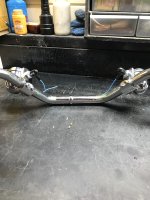
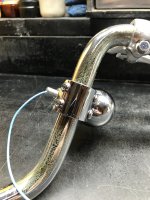
Working on turn signals. Previous posts, I mentioned the desire to not modify the straight and nearly perfect (except "patina") handlebars. Attached is an example of how I retrofit 7/8, 3-piece, frame clamps to the handlebars and use modified bullet light mounts to snug the clamp to the handlebars. Yet to come is to add an external switch, then routing external wires with chrome trim. Adding turn signals is rather easy once one figured out a way to clamp lights to the handlebar. This method of clamping mounts to the handlebars may be used to add extra lights as well. All wiring will be independent of the original harness and use a separate fuse. IMG_4013.JPGIMG_4014.JPGIMG_4011.JPG
 
Working on turn signals. Previous posts, I mentioned the desire to not modify the straight and nearly perfect (except "patina") handlebars. Attached is an example of how I retrofit 7/8, 3-piece, frame clamps to the handlebars and use modified bullet light mounts to snug the clamp to the handlebars. Yet to come is to add an external switch, then routing external wires with chrome trim. Adding turn signals is rather easy once one figured out a way to clamp lights to the handlebar. This method of clamping mounts to the handlebars may be used to add extra lights as well. All wiring will be independent of the original harness and use a separate fuse. View attachment 37572View attachment 37573View attachment 37574
Do you have anything separating the screw end of the Allen/hex screws??? Are they directly touching your handle bar chrome?
 
No. The Allen screws end short of flush within the clamp. Only the smooth side of the clamp grips the chrome handlebar providing ground for the turn signal or any additional electrical connection.
 
Back
Top Bottom