
Engine back on the bike. Cold startup confirmed oil reaching head at idle via check bolt. After warmup checked bolt again and no oil coming out at idle BUT if I revved the engine oil splashed out. So this is an oil pressure problem - low pressure at temp, idle not producing enough pressure to reach head. What can cause this?

-
Don't overlook our Welcome Package, it contains many links to important and helpful information about functions at VHT like posting pictures and sending PMs (private messages), as well as finding the parts you need.
AD
You are using an out of date browser. It may not display this or other websites correctly.
You should upgrade or use an alternative browser.
You should upgrade or use an alternative browser.
Got my CL350
- Thread starter tmross
- Start date

stl360+450
Veteran Member
Do you remember if your lower case has the rubber sealing ball? I believe this is important for controlling oil flow and, without it, the oil pressure would be reduced to the head. Would be nice to have confirmation, so I'm going to call on @ancientdad.
Otherwise, a restriction somewhere in the oil passages could reduce flow even if the pump is working properly.
Otherwise, a restriction somewhere in the oil passages could reduce flow even if the pump is working properly.

While I don't know the 350 engine nearly as well as many here, I do believe there would be some oil pressure loss if the rubber ball was left out though I don't know how much.Do you remember if your lower case has the rubber sealing ball? I believe this is important for controlling oil flow and, without it, the oil pressure would be reduced to the head. Would be nice to have confirmation, so I'm going to call on @ancientdad.
Otherwise, a restriction somewhere in the oil passages could reduce flow even if the pump is working properly.
stl360+450
Veteran Member
Thanks, Tom.While I don't know the 350 engine nearly as well as many here, I do believe there would be some oil pressure loss if the rubber ball was left out though I don't know how much.
This post explains its purpose without ever really saying what happens if the ball is missing. I think when it's missing, oil is not directed upwards as well as it's supposed to be.
Addendum: Maybe the first move is to inspect the pump for signs of wear or lack of sealing.
Last edited:
stl360+450
Veteran Member
Okay, cool. It was the first thing that came to mind as a possible culprit.rubber ball was in place.
We've seen a lot of stock piston pumps with visible wear that still pumped adequately, so I'd guess it must be in horrible shape if it's the cause but I suppose pretty much anything is possible with all the decades of bad maintenance these bikes have been exposed to.maybe worn out oil pump
ok oil filter cap o-ring replaced. there is the oil pump gasket, and o-ring on the filter cover (clutch side cover) that are original. apparently excessive cam bearing clearance can cause lead to low oil pressure. idk if I find that convincing, seems like oil is not reaching top end at idle at all, cam bearings have nothing to say about that.
posed the oil pressure question on a 350 fb group, got a lot of replies saying this is normal and isn't a problem, as long as its pumping when revved. can any 350 owners here confirm if you get oil at the check bolt at idle at temp?
I don't own a running 350 and I can tell you they're wrong. Every pumping stroke of the pump piston should produce a surge of oil to the engine circulation, which should result in oil surges out of the 6mm check bolt in the cam case near the points cover, even at idle.posed the oil pressure question on a 350 fb group, got a lot of replies saying this is normal and isn't a problem, as long as its pumping when revved. can any 350 owners here confirm if you get oil at the check bolt at idle at temp?
I'm still not completely convinced it's the pump. These pumps might not be overly efficient and have lots of pressure, but they still work adequately even when in pretty worn shape. You were asked about the excess wear in the cam bearing covers but I didn't see a reply. Are you still using those same worn cam bearing covers? That's oil loss right there and is likely contributing to the problem, and if the points side cam bearing is worn it can directly affect your points gap and timing even if there isn't enough wear for the seal to leak.ok, well i've got another oil pump on the way.
stl360+450
Veteran Member
I made a video just now to show the pump output at idle on my bike.

12ozPBR
Veteran Member
- Joined
- May 31, 2020
- Total Posts
- 938
- Total likes
- 721
My memory at idle of the oil flow from the CL350 I had was similar to the video that Brody posted.
In regards to the removable oil cover on the right side crankcase cover, there is no physical way to incorrectly install that cover or the spring loaded piece. However, is the spring in place and has it somehow been compressed so it doesn’t create a good seal when installed? I have a good spring I can measure if it helps.
In regards to the removable oil cover on the right side crankcase cover, there is no physical way to incorrectly install that cover or the spring loaded piece. However, is the spring in place and has it somehow been compressed so it doesn’t create a good seal when installed? I have a good spring I can measure if it helps.
I'm still not completely convinced it's the pump. These pumps might not be overly efficient and have lots of pressure, but they still work adequately even when in pretty worn shape. You were asked about the excess wear in the cam bearing covers but I didn't see a reply. Are you still using those same worn cam bearing covers? That's oil loss right there and is likely contributing to the problem, and if the points side cam bearing is worn it can directly affect your points gap and timing even if there isn't enough wear for the seal to leak.
Yes I'm still using same cam bearings. Next thing to replace I spose, if this bike doesn't bankrupt me first. Are there other symptoms that accompany worn cam bearings? noises? Timing is dead on the fire mark with strobe light.
I made a video just now to show the pump output at idle on my bike.
Thats what mine looks like cold. Is this cold or hot? If that is hot then I do indeed have a problem.
stl360+450
Veteran Member
I only let it run for a little bit to make sure the top end was lubricated before removing the check bolt and restarting it, so the engine was not at operating temperature.Thats what mine looks like cold. Is this cold or hot? If that is hot then I do indeed have a problem.
I would think that volume flow should increase at temperature as oil viscosity drops, but I can do another test soon, after a ride. I'll try to think of a better way to catch the oil, too!
stl360+450
Veteran Member
I took the bike out for a few miles of four-way stops in my neighborhood. It was plenty warm when I got back. I shut the motor off to remove the check bolt, restarted, and was about to cut it off with no visible oil flow out of fear of causing harm. Just as I was going to do that, oil started gurgling out. Obviously the oil is much thinner at this temperature, but hopefully this video will serve as a point of comparison.
I think most of us are used to confirming oil flow on a cold motor and then trusting that it's still there when the motor warms. Perhaps not such a good idea.
I think most of us are used to confirming oil flow on a cold motor and then trusting that it's still there when the motor warms. Perhaps not such a good idea.
Thanks for confirming that.
Yeah I'm finding out things that can go wrong with this engine that I didn't even know could go wrong.I think most of us are used to confirming oil flow on a cold motor and then trusting that it's still there when the motor warms. Perhaps not such a good idea.
stl360+450
Veteran Member
No problem. How does this compare to what you observed? Yours has absolutely no output at temperature unless revved?Thanks for confirming that.
In regards to the removable oil cover on the right side crankcase cover, there is no physical way to incorrectly install that cover or the spring loaded piece. However, is the spring in place and has it somehow been compressed so it doesn’t create a good seal when installed? I have a good spring I can measure if it helps.
Yes the "oil guide" as Honda calls it is free and springy. The FSM doesn't offer any other way to confirm functionality other than just pressing on it and seeing if it springs back, so by that metric I have to assume its functioning normally, though it'd be nice to be able to observe it in action to be sure.

BHSarc
Veteran Member
Last year I re-did my top end (K3 CB350). I went dry with my gaskets and did not use any HondaBond or RTV like stuff.I did end up having the cylinder and head resurfaced. Finally gonna start putting the top end together now and I'm hesitating again on head gasket sealant situation. For the 175 I put head gasket on dry, but with the 350 theres no o-rings around the oil passages and seems like a lot of people copper coat the head gasket and/or put a little hondabond around the oil passages to help it seal better... Thoughts on this? I'm a little paranoid about this head gasket leaking cause it had clearly been leaking when I acquired it.
Call me lucky but it worked out. Your mileage may vary

Last edited:
yeah so I went dry the 1st time and it leaked like a sieve. tore it down, replaced gasket and this time did coppercoat + hondabond around the oil passages and no leaks whatsoever. So thats one little victory I guess.
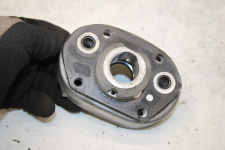
Alright I ordered another pair of end caps, but something's still not adding up for me about worn cam bearings being the cause of oil pressure loss, maybe someone can help me understand this - the theory with worn plain bearings causing oil pressure loss rests on excessive clearance between the bearing and the journal allowing oil to escape in larger quantity than designed, instead of just providing a minimal thin film to lubricate the surfaces. However, when you look at the 350 cam bearings you see there is a large cutaway where the oil enters:
If you look at an oil flow diagram for the 350 you see that this cutaway allows for the oil to spill out of the bearing and pool in the reservoirs below the cam lobes, where the lobes then splash that oil all over the rest of the valve train.
So... it appears to me this bearing was never designed to provide back pressure for the rest of the oil system, or to merely provide a thin film of oil for just the cam/bearing surface, there is a giant gap cut into the bearing for oil to spew out and lubricate the rest of the head. Given this I don't see how wear in the cam bearing, which may represent only a few thou in extra clearance, would really have that much effect on a bearing with a 2-3mm deep chunk already cut out of it. Am I missing something?
If you look at an oil flow diagram for the 350 you see that this cutaway allows for the oil to spill out of the bearing and pool in the reservoirs below the cam lobes, where the lobes then splash that oil all over the rest of the valve train.
So... it appears to me this bearing was never designed to provide back pressure for the rest of the oil system, or to merely provide a thin film of oil for just the cam/bearing surface, there is a giant gap cut into the bearing for oil to spew out and lubricate the rest of the head. Given this I don't see how wear in the cam bearing, which may represent only a few thou in extra clearance, would really have that much effect on a bearing with a 2-3mm deep chunk already cut out of it. Am I missing something?
Ok I may revise my unequivocal skepticism cause now I realize the cam rests against the end cap, partially blocking that outlet gap.
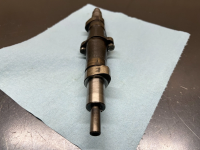
However, the FSM still allows for up to 1mm of side to side clearance, meaning a .5mm clearance between the oil outlet gap in the bearing and the spacer on the camshaft on both sides, still a relatively large gap when compared to a few thou extra clearance from a worn bearing.
However, the FSM still allows for up to 1mm of side to side clearance, meaning a .5mm clearance between the oil outlet gap in the bearing and the spacer on the camshaft on both sides, still a relatively large gap when compared to a few thou extra clearance from a worn bearing.
The 450 cam bearing covers are different and that was my first thought when seeing the level of wear on yours. My bigger problem with the badly worn one in the pic below was the effect it had on points gap and timing, the lateral movement was clearly visible when rotating the engine manually as you could see the points cam moving as well as rotating. The shinier spot at the back of the bearing surface is not worn, the roughed-up area in the foreground is significantly worn. Considering the low pressure flow these top ends get, any avenue for further oil loss can be critical.

And finally, swapped out the oil pump, no change in oil pressure at any temp.
@stl360+450 sorry to badger you about this again, its important though - this video you sent of oil at the check bolt with the engine warm, how long did you ride before checking it? I ask because if I ride around for 15 mins, the idle oil pressure at the check bolt looks exactly like your video, a nice pulsing flow. However if I ride for another 15 mins, so 30 mins total, thats when I observe no oil at the check bolt at idle. I think this is because it takes a good 30 min ride for the oil temp to reach full operating temp, and thus reach its thinnest viscosity. If you happen to take a 30 min ride on the 350 anytime in the future, could you check on that for me?
I took the bike out for a few miles of four-way stops in my neighborhood. It was plenty warm when I got back. I shut the motor off to remove the check bolt, restarted, and was about to cut it off with no visible oil flow out of fear of causing harm. Just as I was going to do that, oil started gurgling out. Obviously the oil is much thinner at this temperature, but hopefully this video will serve as a point of comparison.
I think most of us are used to confirming oil flow on a cold motor and then trusting that it's still there when the motor warms. Perhaps not such a good idea.
@stl360+450 sorry to badger you about this again, its important though - this video you sent of oil at the check bolt with the engine warm, how long did you ride before checking it? I ask because if I ride around for 15 mins, the idle oil pressure at the check bolt looks exactly like your video, a nice pulsing flow. However if I ride for another 15 mins, so 30 mins total, thats when I observe no oil at the check bolt at idle. I think this is because it takes a good 30 min ride for the oil temp to reach full operating temp, and thus reach its thinnest viscosity. If you happen to take a 30 min ride on the 350 anytime in the future, could you check on that for me?
Brody asked in an earlier post but I didn't see an answer - what oil are you using?And finally, swapped out the oil pump, no change in oil pressure at any temp.
Rotella T4Brody asked in an earlier post but I didn't see an answer - what oil are you using?
Well, that isn't the cause then.Rotella T4
stl360+450
Veteran Member
I'll try to do this — not sure exactly when I will be able to. I ordered a threaded hose fitting today that will hopefully make it less messy.If you happen to take a 30 min ride on the 350 anytime in the future, could you check on that for me?
It's true that the second video followed maybe only 15-ish minutes of riding. The motor was hot, but I suppose the sump may still not have hit the full operating temperature.
Is it the case that your cam bearings looked good at the time of the initial rebuild and were scored after the recent disassembly? Did you get any pictures of those bearings the first time you had the motor torn down?
I'll try to do this — not sure exactly when I will be able to. I ordered a threaded hose fitting today that will hopefully make it less messy.
It's true that the second video followed maybe only 15-ish minutes of riding. The motor was hot, but I suppose the sump may still not have hit the full operating temperature.
Is it the case that your cam bearings looked good at the time of the initial rebuild and were scored after the recent disassembly? Did you get any pictures of those bearings the first time you had the motor torn down?
Thank you, figured its worth making sure. Pretty much run out of solutions/parts to throw at the bike at this point, parked it in the shed and focusing on other things.
I do remember the cam bearings were not scored during rebuild, they looked quite good, no pics tho.
stl360+450
Veteran Member
I started a maintenance thread for my CB350 and posted a video there of the oil output on a hot motor — here is the link. I believe it confirms that what you are seeing is typical, i.e., at full operating temperature, the engine speed must be about 1500+ rpm for oil to reach the head.
Thanks for checking that, Good to know. After replacing half the damn oil system I had begun to suspect this is just how it is.
I am going to experiment with upjetting some more.
And it's a good reason to have your idle speed set at 1200 or slightly higher.Thanks for checking that, Good to know. After replacing half the damn oil system I had begun to suspect this is just how it is.
I am going to experiment with upjetting some more.
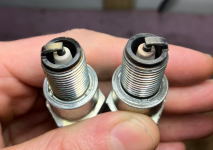
Wanted to get some opinions on these plugs, thats L and R respectively. The L cylinder plug comes out white no matter what I do. But also whats going on with the ground straps, the L ground strap is much lighter. Does that just indicate its running hotter? I've already jetted the L carb richer and set float height to 24mm. Thinking about trying a colder plug on that side maybe.

RobMan
Veteran Member
Sorry if this has been covered but have you checked for vacuum leaks?
yes, exhaustively, seems air tight.Sorry if this has been covered but have you checked for vacuum leaks?
stl360+450
Veteran Member
I would definitely say that the ground strap is showing heat on the left side, as you suggest. The right plug looks good.Wanted to get some opinions on these plugs, thats L and R respectively. The L cylinder plug comes out white no matter what I do. But also whats going on with the ground straps, the L ground strap is much lighter.
Have you tried loosening the exhaust valve clearance at all on the left cylinder? A tight exhaust valve will make the cylinder run hot.
Maybe an optical illusion, but what is the gap on those plugs? Looks small from here.
Last edited:
I would definitely say that the ground strap is showing heat on the left side, as you suggest. The right plug looks good.
Have you tried loosening the exhaust valve clearance at all on the left cylinder? A tight exhaust valve will make the cylinder run hot.
Maybe an optical illusion, but what is the gap on those plugs? Looks small from here.
I tried adding an extra .002" clearance to every valve a while back, didn't make a difference. This whole thread has been me methodically ruling pretty much everything out it could possibly be. plug gaps are spec.
stl360+450
Veteran Member
Am I remembering at some earlier point in this thread that there was mention of the head being decked? Or am I hallucinating? Is it possible that the compression ratio was increased substantially, which would also produce more heat?
stl360+450
Veteran Member
Yes. The performance of each cylinder is the combination of a multitude of factors, some of which affect one cylinder and others of which affect both. What the plugs show is the averaging of all factors.wouldn't that affect both cylinders?
Your motor seems to run hot overall, perhaps hotter on the left, and an increase in compression ratio would shift things in that direction. Removal of too much material could also affect the cam chain tension/timing. A thicker head gasket is sometimes used to compensate.
At the end of the day it's only an idea to consider. This issue has been most perplexing, yet I'd rather not see such a nice bike banished to the shed.
Interesting theory. When you say "an increase in compression ratio would shift things in that (left) direction" can you elaborate why?
I continue to have issues with the cam chain tensioner too - the 2nd brand new (larger) rubber roller has now disintegrated, this one came from 4into1, I could tell it was giving up within in a week of install. I know the plunger mechanism is working properly so its not a case of a slack chain whipping around and tearing the roller up. I asked about this over on the FB 350 group and it seems to be a relatively common issue, many recommend using OEM rollers only as they hold up better, which is what I will try, when I pull this engine for the 3rd time.
I don't know how much material the machinist removed, all I know is I've had him deck 3 different cylinders/heads (including the 175) for me now and never had any issues like this. If the compression ratio has indeed been altered, I wonder if I could offset the increased heat by using colder plugs.
I continue to have issues with the cam chain tensioner too - the 2nd brand new (larger) rubber roller has now disintegrated, this one came from 4into1, I could tell it was giving up within in a week of install. I know the plunger mechanism is working properly so its not a case of a slack chain whipping around and tearing the roller up. I asked about this over on the FB 350 group and it seems to be a relatively common issue, many recommend using OEM rollers only as they hold up better, which is what I will try, when I pull this engine for the 3rd time.
I don't know how much material the machinist removed, all I know is I've had him deck 3 different cylinders/heads (including the 175) for me now and never had any issues like this. If the compression ratio has indeed been altered, I wonder if I could offset the increased heat by using colder plugs.
stl360+450
Veteran Member
Higher compression squeezes more power out of the same initial air-fuel mixture. More power corresponds to more heat generated and the head, valves, exhaust have a harder time dissipating the extra heat.Interesting theory. When you say "an increase in compression ratio would shift things in that (left) direction" can you elaborate why?
Higher compression squeezes more power out of the same initial air-fuel mixture. More power corresponds to more heat generated and the head, valves, exhaust have a harder time dissipating the extra heat.
right but you said it would "shift things in that direction" which, in context, I interpreted to mean it would shift the heat to the left side, did I interpret that wrong?
stl360+450
Veteran Member
I see what you mean — I just meant shift the whole engine in the direction of more heat, not one cylinder versus the other.right but you said it would "shift things in that direction" which, in context, I interpreted to mean it would shift the heat to the left side, did I interpret that wrong?
However, I would say that the left header has a tighter bend to it, so that's one of many things that could lead to asymmetries.
Am I remembering at some earlier point in this thread that there was mention of the head being decked? Or am I hallucinating? Is it possible that the compression ratio was increased substantially, which would also produce more heat?
I've been thinking more about this suggestion... Occurred to me that a certain metallic pingy noise I hear under load at lower rpms is likely detonation (I thought it was a heat shield rattle all this time, then I realized it only happens when engine is warmed up to temp). So I did a lot of reading about detonation/pinging, causes are advanced ignition timing, lean mixture (overheating), and high compression. I rechecked ignition timing with strobe, and it never advances beyond the full advance mark, so I think I can rule that out. That leaves lean mix and high compression. I've still been messing around with upjetting, and managed to get some nice color on the L spark plug finally. Yet the bike is still running hot and idle still droops. So I'm starting to entertain this theory that decking the head/cylinder could have altered the compression enough to cause problems here. I also understand this will alter cam timing. I checked where the pin on the camshaft points at LTDC:
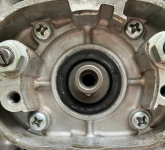
It is not exactly 6 o clock, its more like 6:20. On the other hand, when I align the cam pin so it is exactly at 6 o clock, this is what the rotor looks like:
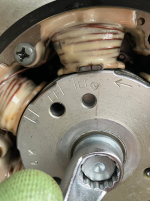
So am I correct in thinking the cam timing is retarded here? Maybe 10 deg or so in relation to rotor? My understanding is that decking the head, i.e. shortening the distance between the crank and the cam, would result in retarded cam timing. I am more interested in this as an indicator of how altered the distance between the crank and cam is, like if enough material was removed to throw the cam timing off 10 deg, then maybe thats enough to cause compression/detonation/overheating issues too? Any thoughts? Correct me if I'm wrong? I'd be interested in seeing what doubling up on base gaskets would yield.
P.S. also occurs to me that the casting marks in the end caps may not be accurate reference marks to judge cam pin orientation.
Last edited: