Got my CL350

My tank had been lined by the PO, along with the cap. I dissembled the internals of the cap, scrapping away the lining material and with a a sewing needle, cleared the vent hole in each piece of the cap.

 

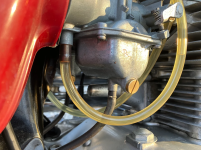
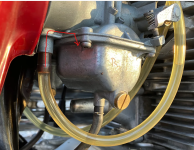
This is after about 30 mins of riding, pull over let it idle for a minute or two, idle starts sagging and stumbling occasionally. Fuel lines get all bubbly, is that normal?

I'm pretty sure its the left cylinder that's missing when it stumbles.

Also pictured toward end of vid: smoke from the crankcase breather tube wafting up... blowby?

Here is vid of it stumbling and dying. And the chirp noise i talked about.

 
Last edited:
The way the air moves through the line almost makes it look like it's sucking fuel down at a high rate, but maybe the tank really is expelling air through the carb vents.

Easy check. While it's idling like that, open the gas cap and see if anything changes.

It's hard to come up with a solid theory, but maybe the tank is breathing poorly only after a longer ride. What's the level in the tank? I would think that vapor lock would occur more quickly when the volume of air in the tank is smaller.
 
The way the air moves through the line almost makes it look like it's sucking fuel down at a high rate, but maybe the tank really is expelling air through the carb vents.

Easy check. While it's idling like that, open the gas cap and see if anything changes.

It's hard to come up with a solid theory, but maybe the tank is breathing poorly only after a longer ride. What's the level in the tank? I would think that vapor lock would occur more quickly when the volume of air in the tank is smaller.

Opening the cap while its idling low/bubbling in the lines doesn't have any effect as far as I can tell. Also, when I shut off the engine and turn off the petcock, the fuel in the lines continues to bubble like in the video for some time, as if the bubbles/vapor is originating from the fuel in the lines and not the tank. I'm going to try trimming the lines a bit to raise them up a little from the engine.

I'm going to run a fuel flow experiment - drain the float bowls/measure fuel volume when engine is cold/idling normal, and repeat when engine is at operating temp/struggling to idle. Will also tell me if left carb is getting less gas then right carb. I believe the left carb/cylinder is causing the trouble because the exhaust pressure becomes weaker than the right when idle starts struggling - the pressures are equal prior to that. And I can feel it stumbling/missing too.

Compression test does show a slightly lower reading in the left cylinder: L - 147, R - 155. (cheap tester with long hose, always given low readings but still useful to compare cylinders)

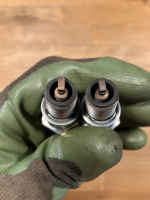
Plugs, left appears a little leaner than right:

1773146275702.png
 
Based on your observations it does sound like vaporization in the lines. I think your idea to shorten/raise the lines is good. I wonder if the fuel line you are using is thinner than the standard black Honda 5.5mm line? Or if it provides less heat insulation somehow.

The plugs don't look bad to me and your compression readings aren't too far apart, so should not cause a major problem.

Generally, the fuel line to the left carb is longer than the one to the right. Maybe the vaporization has a greater effect on the left side fuel flow for this reason.

It's interesting that the gas vapor pockets shown in your video all flow into the carbs and not towards the tank — this makes sense because the fluid pressure is higher on the tank side of the line than the carb side.
 
Last edited:
I've never run clear fuel lines so I've never seen that activity, but I'm not so sure it's actually the problem either.
 
I wonder if the fuel line you are using is thinner than the standard black Honda 5.5mm line? Or if it provides less heat insulation

Its motion pro tygon 3/16" (4.8mm) instead of 5.5mm. Seen too many others using 3/16" on these bikes without issue to say the ID is the problem (I use same stuff on 175 too), but it may indeed provide less insulation than OEM line.

I've never run clear fuel lines so I've never seen that activity, but I'm not so sure it's actually the problem either.

Yeah... I will say after taking that video I let the bike cool down for 30 mins, came back started it up, idle was back to steady healthy 1300 rpm and the fuel lines looked like this:

1773149992547.png

Pic taken while engine idling, was no bubbling, just steady normal flow. But I agree, correlation ≠ causation.
 
Yeah... I will say after taking that video I let the bike cool down for 30 mins, came back started it up, idle was back to steady healthy 1300 rpm and the fuel lines looked like this:

Pic taken while engine idling, was no bubbling, just steady normal flow.
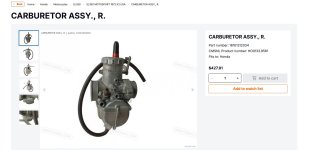
It's a different world with gravity feed carbs on an air cooled engine, and these 350 carbs that feed from underneath might be part of it since most Honda carbs from that era feed from above the float bowl.
 
It's a different world with gravity feed carbs on an air cooled engine, and these 350 carbs that feed from underneath might be part of it since most Honda carbs from that era feed from above the float bowl.
I have been looking at the carbs where the fuel line connects underneath which I have not seen before and just curious went to CMSNL and ebay to see if these are original carbs. Just doing a short search the carbs I saw feed from the top. Not saying they are not the correct carbs just odd to me.

CNSNL carb.

SL350 Carbs.jpg
 
Thats for the SL350, which apparently used a different round slide carb for some years. The CL/CB used CV carbs, the 72 models used the 722A Keihin which has bottom feed inlet.

Since its gravity fed, I would imagine the fuel pressure at the float valve would be the same whether the fuel is feeding from the top or the bottom. And in any event, once the fuel enters the inlet nipple on the 722A, it flows up through a channel and is redirected 90 deg to flow back down through the float valve, in effect the fuel follows the same trajectory as a top feeding carb.

1773155400333.png
 
I was wondering the same about the routing of the fuel lines. I route them over the top for the left carb on my 360/450, but checked the photos for my 350 and they're routed just as @tmross has them, but possibly a bit closer to the undersides of the carbs.

f377a821-9263-48b9-80c8-a41d7739c96a-1_all_236.jpg
 
Well its always something... looks like the brand new cam chain tensioner roller is already disintegrating. Wasn't able to ride for a week, took it out yesterday and 10 mins into ride i heard a periodic scraping noise, at idle every second or so, picks up frequency with rpm. Sounds like cam chain noise, I readjusted chain tensioner, still hear it. I drained the oil to see if theres any clues, and theres some little rubber chunks. Oil filter had a teaspoon worth of black paste, perhaps fine ground rubber. So I pulled off the tensioner plunger housing to inspect tensioner, only the smaller roller is visible from this viewpoint and it looks totally intact, so its gotta be the larger lower roller. (this was the roller I used - https://ebay.us/m/EqLP3t). Not good. Will put new oil in tmrw and see how it sounds. Not gonna be riding it with tensioner issues though.
 
Sorry to hear about the failure of the roller, assuming that is what happened.

I'm not sure if any members have experience with these metal components from Spectrum Moto, but I'm curious about them. I considered them with my project, but ultimately went with OEM parts.
 
yeah aint the end of the world, if I gotta open it back up I can address the leaky head gasket too.

be curious to know if metal rollers are noisy, I understood Honda used rubber cause of excessive noise.
 
well, between removing the tensioner, cleaning the filter and changing the oil that scrapey noise went away.

back to investigating this poor idle/misfire when hot issue. going to replace all ignition components one by one, currently all original so its due.
 
New coils, no change.

Quite a bit of arcing at points, i'm praying a new condenser might do something.
 
New coils, no change.

Quite a bit of arcing at points, i'm praying a new condenser might do something.
Help I received on the form that just might apply to your point arching issue as it was the answer for my case was, that because the frame was powder-coated, the bracket that holds the ignitions was unable to ground to the frame. I had scraped away some of the paint where the bracket comes into contact with the frame at the bolt holes, thus grounding. FSM does not show this as a grounding point. I went the extra mile adding a grounding connection there as well.
 
Help I received on the form that just might apply to your point arching issue as it was the answer for my case was, that because the frame was powder-coated, the bracket that holds the ignitions was unable to ground to the frame. I had scraped away some of the paint where the bracket comes into contact with the frame at the bolt holes, thus grounding. FSM does not show this as a grounding point. I went the extra mile adding a grounding connection there as well.
Yes, I’ve done the same thing on mine.
 
Good news, new condensers seem to have solved the full temp misfiring (and the points arcing), however the idle still sags when hot, so perhaps those were 2 separate issues.

I need to investigate the charging system next, might have been imagining this but I detected a subtle lift in idle rpm when turning the headlight off, 50-100 rpm perhaps. The battery is brand new and seems to be charging properly.

Other than that, perhaps fiddling with mixture screws/float height more. There seems to be conflicting explanations of what causes low idle when hot, some say its rich mixture, others say lean. In my mind I've always associated too lean with high hanging idle, so that doesn't seem quite right to me.
 
How is the off idle response when the motor is fully warm? Is that the issue or is it simply idling low enough that it will stall?

The conflicting explanations may simply stem from the fact that the idle speed drops when the mixture is too lean or too rich. That's the idea behind the max idle adjustment procedure.

Have you checked for air leaks around the boots/head when the engine is cold/warm? Unmetered air could cause a lean condition. If the air leak opens when the motor is warm then you'd be lean. If the air leak closes when the motor is warm then you'd be rich. Not suggesting this is your problem, necessarily, but attempting to illustrate how either possibility could potentially be in play.
 
How is the off idle response when the motor is fully warm? Is that the issue or is it simply idling low enough that it will stall?
off idle response is perfect. the bike runs perfect in every other way except for the idle.

I believe when I first got the bike running there was a pretty bad air leak where the intake rubbers meet the head, this caused a racing/hanging idle when the engine warmed up. After coating both sides of those intake manifold gaskets with hondabond this problem was resolved. Now I've got the opposite problem with the idle sagging lower and lower.

I checked the charging system, its getting 14.5+ volts at 5k. The battery is always fully charged.

I still think somethings up with the left cylinder, during warmup the left and right exhaust pressures are equal but at full temp when the idle starts sagging, the left exhaust pressure is noticeably weaker than the right. If I try to boost the idle speed on the left cylinder to compensate, the next time I start the bike up the left exhaust pressure will be higher than the right, and the idle hits like 1600-1700 during warmup before it starts slowly sagging down to below 1k at full temp.

Messed around with mix screws some more, they really don't like being anywhere other than 1.25 turns out, that's where the highest idle is for both cylinders.
 
Last edited:
If the air leak closes when the motor is warm then you'd be rich.
I suppose this could explain whats going on here, particularly on the left cylinder. I'll check for a leak when cold/warming up.
 
I still think somethings up with the left cylinder, during warmup the left and right exhaust pressures are equal but at full temp when the idle starts sagging, the left exhaust pressure is noticeably weaker than the right. If I try to boost the idle speed on the left cylinder to compensate, the next time I start the bike up the left exhaust pressure will be higher than the right, and the idle hits like 1600-1700 during warmup before it starts slowly sagging down to below 1k at full temp.
The combination of the things you describe makes me wonder if the left cylinder is firing intermittently at idle after the motor heats up, possibly due to fouling of the plug or a bad electrical connection somewhere.
  • Assume the motor is warm and the idle is sagging. What happens when you lift the left throttle arm? Does it sound like the left cylinder comes on all of the sudden at some point? Does the engine speed increase smoothly?
  • Have you checked for loose connections or high resistance in the caps, coils, etc ? Are the coils new or old?
 
Left cylinder appears to be firing consistently, the plugs are nice cocoa brown and don't appear to be fouling.

Caps, coils, condensers are brand new.

I just went for a very long ride, the bike performed well until the very end, idle just slowly sagging down to 1k and sounding tired.

I'm definitely not imagining the headlight effecting idle speed, its a good 100 rpm difference with it on or off.

I hooked up multimeter and tested at battery leads with the bike idling
- over 12.7 v with headlight off
- around 12.6 v with low beam
- 12.5 v with high beam.

Ignition switch off the battery is at 12.9 v.

Honestly I would be content if could have that 100 rpm back that the headlight is stealing from me. Is that dip normal? Considering the battery is fully charged, the charging system output is strong at 5k rpm (14.5+v), what could be amiss here... would a modern reg/rec help bolster electrical output at idle?
 
Also, I checked again for air leaks, using a propane torch to blow gas all around the engine, did not detect any discernible difference in idle anywhere, this engine is air tight (though not oil tight heh)
 
Honestly I would be content if could have that 100 rpm back that the headlight is stealing from me. Is that dip normal? Considering the battery is fully charged, the charging system output is strong at 5k rpm (14.5+v), what could be amiss here... would a modern reg/rec help bolster electrical output at idle?
I'm not convinced there's a connection between the idle drop of 100 rpm and the headlight on. These charging systems go backwards at idle anyway and because they are discharging, I'm not sure it would add any "load" to the alternator that would cause the dip - seems to me that it would have to be charging at idle, like a car alternator can/does, and then adding load might cause a drop in rpm. Could be just the lowered system voltage at idle might influence the spark strength and cause it, but I'm not sure that slight change would do it either. I just wonder if your carbs are just slightly worn enough that there are some small inconsistencies upon return to idle. Alternatively, you could raise the idle speed about 100 rpm and it shouldn't cause problems returning to idle, then when it gets fully warmed after a long ride maybe it doesn't stall, just droops a bit. IIRC the book idle speed is +/- 100 rpm
 
Alternatively, you could raise the idle speed about 100 rpm and it shouldn't cause problems returning to idle, then when it gets fully warmed after a long ride maybe it doesn't stall, just droops a bit.
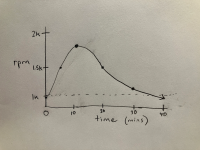
That is pretty much the current arrangement, the problem is it seems like it still just wants to keep sagging even if I give it a little boost at full temp. I drew this graph to illustrate the idle behavior on a 40 min ride, with my current settings. You can see how lowering idle to avoid that peak during warmup will only lead to an even lower idle at full temp, and boosting idle at full temp will cause an even higher idle during warmup, so its a compromise. If the idle eventually settled down to 1200 and stayed there at full temp, thats a compromise I'd be willing to live with, but it just keeps falling and falling as time goes on until its stumbling at stoplights.
1774792260210.png

Would be nice to have a spare set of carbs around to see if it is a carb issue, it may come to that cause I've pretty much exhausted any other solutions.
 
I really wonder if the left cylinder is dropping out one way or another at operating temperature. The fact that you can increase the idle during warmup but it still drops below 1000 rpm is really odd.
  • Have you tried jiggling the spark plug cap or even removing it (on the left)? Checked the cap to wire connections?
  • What about the valve clearances? Are they maybe too tight on the left?
  • Is there a big difference between cold/warm compression numbers on that cylinder?
  • Have you swapped the coils to see if one might be failing when warm?
  • And I think you already answered this question, but even when the idle is sagging, the off idle response is still good?
 
The fact that you can increase the idle during warmup but it still drops below 1000 rpm is really odd.
Yeah its like its just slowly getting choked out or starved. Wouldn't it be a little more obvious if the left cylinder were really dropping out entirely? Like wouldn't I feel the left cylinder spring to life with a little throttle, and just a rougher idle in general. I'd be more inclined to think its just slowly losing power but still firing.

Have you tried jiggling the spark plug cap or even removing it (on the left)? Checked the cap to wire connections?
No, I can try that. The connections seem good. Brand new NGK caps and coils.

What about the valve clearances? Are they maybe too tight on the left?
Clearances on the loose side of spec, just a little grabbing on the feeler gauges. I was thinking about adding an extra .01mm. Cause I know idle is way more sensitive to valve leakage than higher rpm operation.

Is there a big difference between cold/warm compression numbers on that cylinder?
Have not checked cold compression, I will do that.

Have you swapped the coils to see if one might be failing when warm?
No but I replaced the coils with new ones last week and saw no difference.

And I think you already answered this question, but even when the idle is sagging, the off idle response is still good?
Yes, bike runs absolutely perfect in every other way.
 
Wouldn't it be a little more obvious if the left cylinder were really dropping out entirely? Like wouldn't I feel the left cylinder spring to life with a little throttle, and just a rougher idle in general. I'd be more inclined to think its just slowly losing power but still firing.
I agree with what you're saying here and I trust your assessment, since you have hands on the bike. It's just something I would want to feel myself it were my bike.

If that cylinder is losing power, then the question is: How? Change in compression? Change in fuel to air ratio? Coil losing power and producing a weak spark?
 
I checked cold vs hot compression today, I used a different tester (rented from autozone) cause I don't trust mine, ended up getting similar results.

Cold - L: 162 R: 167
Hot - L :152. R: 157

So a drop of 10 psi in both cylinders at full temp. Thats peculiar, compression is supposed to go up with temp, not down. I wonder if that could explain the idle issue.

The cylinder bores and pistons were verified in spec by my machinist, new piston rings. I rechecked valves (and timing) today cold and they were still on the loose side of spec, just barely grabbing the feelers.
 
Yes I'll investigate valves. I can hear them tapping away when engines hot though. Maybe its not clearance but just leaky valves not sealing fully? That somehow leak worse when hot? I have no idea, this is mysterious. A leak down test would be appropriate here.

I'll do a wet compression test to check on rings. There does seem to be a good bit of white smoke coming out of the breather tube when engine is hot, indicating blowby. I remember when checking the ring gap on the new rings I bought from 4into1, they were at .016" which is the upper bound of the 'standard value' listed in the FSM (.008"-.016"). I didn't like that, But its in spec.

There is also of course the compromised head gasket leaking oil everywhere
 
There does seem to be a good bit of white smoke coming out of the breather tube when engine is hot, indicating blowby. I remember when checking the ring gap on the new rings I bought from 4into1, they were at .016" which is the upper bound of the 'standard value' listed in the FSM (.008"-.016"). I didn't like that, But its in spec.
It's a shame because you could have bought 1st over rings and filed them to just above minimum end gap, but hindsight is always 20/20.
There is also of course the compromised head gasket leaking oil everywhere
Which will have nothing to do with your compression readings, if the actual fire ring portion of the head gasket was leaking you'd know.
 
This may have been mentioned but have you checked for exhaust leaks where the header goes to the head? Sometimes a small leak will sound like a tappet
 
I just redid cold/hot compression and also did wet compression test, here are the results:

Cold (dry) - L: 157 ...R: 166
Hot (dry) - L: 147 ...R: 153
Hot (wet) - L: 193 ...R: 172

The hose on my tester blew off while doing the hot wet R cylinder, so that number may be higher, couldn't get the gauge to work right after that.

Anyway, 46 psi difference in the L cylinder... thoughts? Rings didn't seat correctly?
 
You can get some pretty ridiculous numbers by adding too much oil. Should only need a capful or less from a quart of oil. I don't trust that 193 as meaning much right now.

I wouldn't be inclined to rebuild or get too concerned by those hot/cold numbers for the time being, but I would second Mike's suggestion to try slightly looser valve clearances as a test.
 
Last edited:
You can get some pretty ridiculous numbers by adding too much oil. Should only need a capful or less from a quart of oil. I don't trust that 193 as meaning much right now.

I wouldn't be inclined to rebuild or get too concerned by those hot/could numbers for the time being, but I would second Mike's suggestion to try slightly looser valve clearances as a test.

Ok I'll try looser valves tmrw.

I already plan on replacing that head gasket at some point so top ends coming apart either way.
 
Added .002" to intake valve clearance (total of .004"), drove around for 30 mins, idle behaved exactly like before. Compression test (hot) yielded same numbers as before too.
Idk, I'm inclined to think this is a ring problem...

What do yall think of this smoke

 
A couple mins maybe. Once its at full temp its pretty much always smoking like that.
 
What do yall think of this smoke?
To me, that's a lot of smoke, but I defer to those with longer resumes. Do you see it from the pipes as well? Are you able to measure the head temperature?

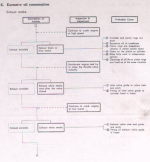
Apologies for the poor quality scan from the 350 FSM, but this is from the troubleshooting section. Makes me wonder about ring orientation.

786.png
 
No smoke from the exhaust whatsoever. Might go pick up an infrared thermometer today and get some temp measurements. Overheating would comport with the gas bubbling in the lines/tank, which just doesn't seem normal to me. The plugs look on the lean side to me as well, especially left side. Not sure where the compression drop at full temp plays into all this. I've got a leak down tester and a better compression gauge on the way.
 
Did you ever confirm oil flow to the top end by removing the check bolt on the points side of the head? Oil level is good?
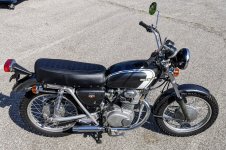
My 350 sat a long while after the initial rebuild while I was solving an oil leak. I was seeing some burn off initially from the breather after the motor reached operating temperature that was most noticeable after I would shut the bike off. I was initially concerned about overheating, but also suspected it could be due to condensation from sitting unused for most of a year. After a few rides I stopped seeing any output from the breather so I believe it was condensation in my case.
 
Did you ever confirm oil flow to the top end by removing the check bolt on the points side of the head? Oil level is good?
Yes and yes. Also can see lots of oil splashing around if I take off a tappet cover.

I'm pretty sure this isn't condensation, strong fumey smell.
 
Typically excess crankcase blow-by would be caused by cylinder/ring wear (which doesn't sound like the case here), piston ring gaps lined up on the piston or the rings turned upside down. Any chance you got a ring upside down?
 
Back
Top Bottom