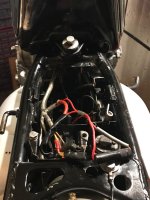
1967 CB450 K0 Resuscitation

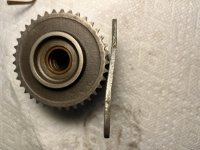
It's obviously a transmission gear with worn dogs, I guess ? Seems a little small for a bomber, what is the ID and OD ?
@jensen
OD = 36.85 mm
ID = 18.30 mm
Thickness of gears = 9.45 mm
dogs protrude = 5.6 mm

Before my Black Bomber I had a Honda Sport 90. Don't ever remember taking the transmission apart though...
 
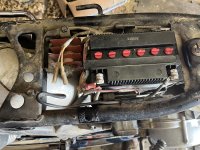
While we are on the rectifier/regulator topic, I have puzzled over how the original alternator/rectifier system works and how the addition of a new rectifier/voltage regulator would be wired in and function. I have enough of an understanding of electronics to get me into trouble and make me scratch my head over this. There are 6 coils in the alternator, 2 pairs wired in series and then paralleled with the remaining two in series and tacked onto the end in series with the other four. A blue wire goes to one side of the rectifier bridge, from between the parallel set and the final two in series. A yellow wire goes to the opposite side of the rectifier bridge from the end of the series. Those two wires I can understand. But what I puzzle over is that the yellow wire bifurcates before the rectifier and heads over to the ignition switch. Also there's a pink wire that heads from the opposite end (opposite of the yellow wire) of the alternator coil set and goes directly to the ignition switch. What does the ignition switch do with the pink and yellow wires? Join them? Send them to ground? Send them to +12V?
Back when the bike was new, the US did not have mandatory daytime headlight laws so it was optional. Honda designed the charging system for that era, and the alternator current flow through the ignition switch was the early design that allowed the rider to use 4 of the 6 alternator coils for typical daytime riding with no headlight, then for the headlight-on position on the ignition switch the other 2 alternator coils are added to the charging system output into the harness to help the alternator keep up with the added demand of the headlight. As for the new rec/reg unit, it connects to the 2 yellow wires that exist at the stock rectifier, the red to the positive terminal of the battery and the green to ground. Some come with a black wire as well which tells the unit what the system voltage is for regulating the charge rate.
Leaving the electrons, how about the starter motor... Since I have been waiting for bits to arrive I thought I'd see if the starter motor works. I tried testing it with my battery charger, just touching the charger terminal to the starter terminal. My 10 amp charger just gave a small spark and no motor movement. I didn't think it wise to push my luck and hook up a car battery to it because if the motor is seized it could burn out. So I tried to remove the starter motor without taking the left crankcase cover off. The starter motor is a longer term project so I didn't want to mess with the crankcase cover, etc, yet. There is no sprocket on the starter motor since all that was removed when the starter clutch disintegrate 50 years ago. I removed the two bolts holding the starter motor to the crankcase and tried to wiggle the starter motor out but no luck. It won't budge. I thought the only thing holding it in was an o-ring but, while it wiggles a bit, it is pretty firmly in there. Any thoughts other than just leave it alone for now?
A battery charger won't have the amperage to turn the starter motor, only a 12v battery will. If the bolts are out of the starter motor, only the o-ring and some long-term stiction are keeping it from coming out of the crankcase.

honda-cb450k0-black-bomber-general-export-usa-starting-motor-breaker_bigma000064e13_dbac.gif

I took off the hooker headers and drained the oil. The oil looked pretty good, smelled OK. No major debris in the oil. I got some Valvoline 10W-40 oil, non synthetic. Will put that in when my new drain plug seal comes tomorrow. It seems that the only motorcycle oil these days is either 10W-40 or 20W-50. Why is that?
If the Valvoline oil you bought has modern friction modifiers in it, you don't want top use it in the 450. It needs to be JASO-MA or MA2 rated so it's safe to use with wet clutches. Rotella T4 15w40 is what many of us use, it's rated for our clutches and has more zinc in it to help protect cam lobes and followers, which you should be concerned with on your 450 (as well as being very gentle during warmups until oil flow reaches the top end)
I had used copper ones with the Hooker headers
The copper ones are just fine for any pipes you use.
 
Last edited:
Back when the bike was new, the US did not have mandatory daytime headlight laws so it was optional. Honda designed the charging system for that era, and the alternator current flow through the ignition switch was the early design that allowed the rider to use 4 of the 6 alternator coils for typical daytime riding with no headlight, then for the headlight-on position on the ignition switch the other 2 alternator coils are added to the charging system output into the harness to help the alternator keep up with the added demand of the headlight.
Ha, that makes sense. Without a voltage regulator, having all 6 coils running at the same time during the daytime could overcharge the battery. And, I'm assuming that the 'extra' power from the alternator is fed back to the rectifier by the ignition switch coupling the pink and yellow wires together...(?). It seems to me that once you put in a voltage regulator you should rewire the alternator output so that all 6 coils operate continuously regardless of headlight on or off?
If the bolts are out of the starter motor, only the o-ring and some long-term stiction are keeping it from coming out of the crankcase.
Yes, that evil stiction. Problem is that prying and yanking can do a fair bit of damage so until I take off the crankcase cover and get a direct shot at the motor with a hammer and a block of wood it can just stay where it's at.
It needs to be JASO-MA or MA2 rated so it's safe to use with wet clutches. Rotella T4 15w40 is what many of us use
I didn't look at ratings but the Valvoline 10W-40 4-stroke Motorcycle oil claimed it had superior performance with wet clutches. I will, however, look for the Rotella oil. When, or if, I get the bike running again I will run it for a short spell and then change the oil again.

I'm kind of excited with this. The main reason I stopped riding the bike was because of the Hooker Headers - too loud. 50 years ago the Hooker was the only system I could get my hands on. The dealer couldn't or wouldn't get me real mufflers. It's shocking that now I can get repro mufflers... I don't know how long the repros have been available. Too bad I didn't find out sooner...
 
Well, that's probably already too much for people to want to read...

We're not FB here, here we appreciate that questions are asked extensive / comprehensive, because the more information in the question, the better answers you will get. AD was a little quicker then me this time (because he's knowledgeable and has a head start of 6 hours ;)).

If you want to know more about the setup of the generator in detail, I've written an explanation on "the other forum", here is the link

Charging System Mods and Self Inflicted Charging Problems


btw, here's a picture of the wiring with the (covered) spade connectors :

Afbeelding van WhatsApp op 2023-12-02 om 22.54.35_b774b6ef.jpg

Many other pictures and other information can be found in the threads:

- https://www.vintagehondatwins.com/f...b450-k0-a-reliable-workhorse-pick-heavy.9671/
- https://www.vintagehondatwins.com/f...d-cb450-k0-from-a-scientific-perspective.149/

And many other threads from other forum members are giving lot's of information on the CB450 K0 as well,

Jensen
 
Last edited:
We're not FB here, here we appreciate that questions are asked extensive / comprehensive, because the more information in the question, the better answers you will get
@jensen Glad you like that because I have questions...

First, thanks for the links. I had already seen and very much appreciated your maintenance thread. You are very knowledgeable and meticulous with your work!!

Also, saw in those links that at one point your selenium rectifier died and you limped home. A later post indicated that you put in a new selenium rectifier but then it appears to me that within a year you had replaced the new selenium rectifier with a solid state rectifier/voltage regulator. Is that the case? If so, what solid state rectifier/voltage regulator did you use? When you installed the solid state system did you rewire the alternator circuit so that all 6 coils are continuously sending current to the rectifier regardless of the ignition switch position?? Or just leave it as it was?

Now, the solid state rectifier/voltage regulator will take the AC from the alternator and rectify it into an RMS DC voltage and then the voltage regulator will control the output voltage so that it is less than some subscribed voltage, presumably somewhere around the 12.7V of a fully charged battery. There doesn't seem to be any current (amperage) regulation involved. What stops the system from overcharging the battery? We are now at my level of ignorance. If the battery voltage matches the voltage regulator output does it automatically stop charging because the battery voltage and voltage regulator output voltage match?

The Sparck Moto device that @ancientdad pointed me to has five wires going to it. Two are for the alternator which are originally on opposite 'corners' of the selenium rectifier bridge, one is ground, one is battery +, and the last is a switched 12V source that they call voltage sensing. My assumption is that that 'switched 12 V voltage sensing' lead is simply to turn on and power the voltage regulator. If the system was looking to assess the voltage level, it could have done it directly at the battery with the battery + lead. Correct? They could have used the battery lead but then the voltage regulator would be constantly powered but that's not good for the regulator or the battery.
 
Also, saw in those links that at one point your selenium rectifier died and you limped home. A later post indicated that you put in a new selenium rectifier but then it appears to me that within a year you had replaced the new selenium rectifier with a solid state rectifier/voltage regulator. Is that the case? If so, what solid state rectifier/voltage regulator did you use? When you installed the solid state system did you rewire the alternator circuit so that all 6 coils are continuously sending current to the rectifier regardless of the ignition switch position?? Or just leave it as it was?

Sharp eye !, yes, I replaced the fried one with a new one, but I'm preparing for a Sache EI, and therefore I need a good, stable, controlled voltage level. I use a 3-phase reg from a more modern machine (I have plenty of those, used), and the one I'm testing is from a Honda shadow. I wired it as it was a single phase, and this season I want to see if that works. A friend of my, who's an electronic engineer, helped me with the setup.

Now, the solid state rectifier/voltage regulator will take the AC from the alternator and rectify it into an RMS DC voltage and then the voltage regulator will control the output voltage so that it is less than some subscribed voltage, presumably somewhere around the 12.7V of a fully charged battery. There doesn't seem to be any current (amperage) regulation involved. What stops the system from overcharging the battery? We are now at my level of ignorance. If the battery voltage matches the voltage regulator output does it automatically stop charging because the battery voltage and voltage regulator output voltage match?

Now you know why voltage regulators have cooling ribs, made of aluminum and need a solid surface to transfer heat to. The extra energy is partly dissipated, but for our old 450's that isn't much, since the rotor isn't that strong as it used to be. The rotor is passive, and if the magnets get weak, the total energy generated by the generator is, let's say, just enough to keep the battery in condition (but kick-starting the bike is sensible).

The Sparck Moto device that @ancientdad pointed me to has five wires going to it. Two are for the alternator which are originally on opposite 'corners' of the selenium rectifier bridge, one is ground, one is battery +, and the last is a switched 12V source that they call voltage sensing. My assumption is that that 'switched 12 V voltage sensing' lead is simply to turn on and power the voltage regulator. If the system was looking to assess the voltage level, it could have done it directly at the battery with the battery + lead. Correct? They could have used the battery lead but then the voltage regulator would be constantly powered but that's not good for the regulator or the battery.

Because the output of an alternator can deliver large currents, voltage drop along the wires to the battery under charge can be a problem (U=I*R). If the regulator sense battery state at the alternator end of the system errors result due to this voltage drop. Electronic engineers often use a separate wire carrying no charging current to sense battery voltage at the battery. However, not really necessary for our bikes, since the delivered currents aren't that high, but it's common in the industry, no matter what the wattage is.
 
Last edited:
Thanks to @jensen for the electrical engineering lessons. I'm sure I'll be back revisiting this but for now: exhaust systems.

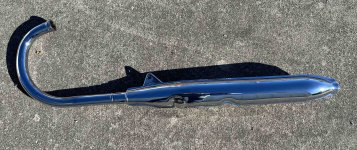
I got the exhaust headers from Thailand (ebay), they are later style with the collars. I have been following with what @Troy did. He coupled those headers with the David Silver repro K0 mufflers by shortening both the header and the muffler.

I got my mufflers today and stuffed in a header. Looks pretty nice, eh? I had already reported that I test fit the headers and they were looking doable. So, do the mufflers fit?

IMG_2905 2.jpg

Of course not... The nose of the muffler is low and seems too close to the crankcase:
tempImagenOiU1D.jpg

(That part of the frame is a bit rusty. The rest of the bike is much better...)

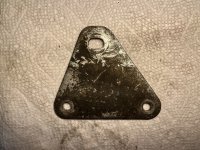
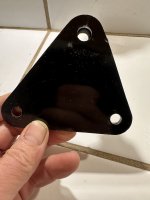
I'm using the rear muffler hangers I took off the bike 50+ years ago. They have to be good, right? But, they don't look like the hangers in the parts manual. They don't have the welded captive nut at the top. There's a left and a right. They are 'bent' as expected for a muffler hanger but are they wrong? Anybody recognize these as some other hanger? They fit on the bike and on the muffler but the muffler isn't quite pointed right. Maybe fix it with some spacer washers for front to back alignment along the axis of the bike but may have to modify the top hole in the hanger to raise the nose up and down.

tempImageREoxi3.jpg

Here you can see the curvature in the hanger. Is this 'bent' enough?

tempImage75M5bY.jpg

At this point you start asking yourself why you started this...
 
Yours look right. Pretty impressive that you still have them after 5 years.

They don't have the welded captive nut at the top.

Interesting. I had no recollection of my left side hanger having a nut on it nor did I ever make the observation that you just did by picking up that detail from the parts manual. Just went and checked and there is no nut on either of my hangers.

The one thing I remember from a couple of years ago was lots of fiddling and trial and error with the best way to get things lined up. Remember that these parts were not made by the same people and although they should work, the folks that put them both together didn't consult with one another on fitment. I just bought an aftermarket 1 piece exhaust for my S90 and it simply doesn't fit. I'm negotiating with the seller to solve the problem. Having 2 separate pieces as you do should give you more wiggle room.
 
What else you gonna spend that extra money on?
I don't know. How about sipping a margarita on a nice beach somewhere where it isn't 0F with blowing snow? Actually, it's a pretty nice day today. I need to get the Mazda Miata out for a spin... It has been laid up for a bit because it has summer tires on and it has been too cold for them.

Anyway, glad to know I have the right rear hangers!! Apparently they are very rare. Also, I guess you can't believe the Parts Manual.

So, maybe I approached hanging the muffler wrong. I was focussed on bolting the front hanger on and then making the back fit. I think maybe bolting the back on and then adjusting the front might be better.

@Troy - any recollection on what you did would be greatly appreciated. Did you have to use spacers? Drill new holes? How did you calculate how much to cut off the header and the muffler?
 
I don't know. How about sipping a margarita on a nice beach somewhere where it isn't 0F with blowing snow?
That's a great idea and is actually what I'll be doing in a week's time. Might even have more than 1. We have 5 days on the beach and then heading to Mexico City for a few days. I get bored on the beach but sure am excited to check out the history, food and culture in Mexico City.

any recollection on what you did would be greatly appreciated. Did you have to use spacers? Drill new holes? How did you calculate how much to cut off the header and the muffler?
The specifics I don't recall at the moment and the bike is tucked away tightly in it's stall for the winter so tough for me to get to it. There are a few things that I do remember though.
-Didn't drill any holes in the hangers or modify them.
-I definitely shortened the end of the aftermarket muffler for things to fit together with the header but I can't recall what the conflict was. Things weren't going together in such a way that the header and muffler were forming a straight line and lining up with the mounting holes.
-I didn't have to take very much off of the end of the header pipe. Just small trim and it because of that I couldn't use my pipe cutter without it slipping off the end. Took it to my friends exhaust shop for him to trim.

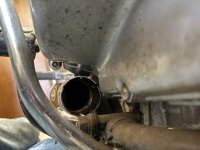
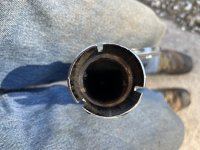
Is there any sort of obstruction inside the muffler that limits how far you can stuff the header in there? I can't remember and that might have had something to do with why I trimmed it. Post a pic looking down the inside of the muffler, maybe that will jog my memory. I also think that collar on the header came into play. I'm sorry...I know I'm not being much help here. Might be worth checking through Teebo's thread as I know he was dealing with similar things at the same time as I was.
 
That's a great idea and is actually what I'll be doing in a week's time. Might even have more than 1. We have 5 days on the beach and then heading to Mexico City for a few days. I get bored on the beach but sure am excited to check out the history, food and culture in Mexico City.
You know, we have a longtime member in Mexico City, you might PM @CarnivorousChicken and see if he'd want to meet up with you. He's lived there for a while so I'm sure he could fill you in on what to see and where to go (and not go).
 
You know, we have a longtime member in Mexico City, you might PM @CarnivorousChicken and see if he'd want to meet up with you. He's lived there for a while so I'm sure he could fill you in on what to see and where to go (and not go).
I was aware of a member there. With only 20+ million people in the city we might just bump into him :ROFLMAO:
 
I wrote this a long time ago:
@jensen, you are an incredible resource for the Bomber group!! Thanks, that thread was very useful. I had in mind to let the front hanger float but there is no way I would have thought to loosen all the engine brackets... Also, your suggestion to have the bike on the center stand seems like an obvious one in retrospect so I need to prioritize getting the center stand on but first there's some de-rusting and painting to do on it. At this rate I'll likely have all my long term projects done before I can try to start it and see if it runs...

That's a great idea and is actually what I'll be doing in a week's time.
Have a great time down there. Have a margarita for me :) .
Yes, the header can only go in so far into the muffler as it reaches a restriction. I'll post a picture tomorrow if I remember. That header is pretty thick. I was wondering if you used a hacksaw on it. I doubt that a plumbing pipe cutter would work. I have seen posts from @teebo but nothing specifically on fitting the exhaust system. I believe he went with original headers which would have some advantage. I'll look at his threads again. Actually, my original headers are buried somewhere in my brother's farm equipment shed in Southern Ontario. I looked for them a couple of times over the years but couldn't find them. Maybe I'll look more seriously this summer if I can get up there again.
 
@jensen, you are an incredible resource for the Bomber group!!
Oh ya he is. I have stumbled through this once and have only those limited experiences to draw on. Jensen knows it inside and out. Because my bike was a wreck to start with and I did almost everything myself I learned a lot in the process. Unfortunately I didn't do the best job documenting my experiences as I figured that it would never be useful to anyone in the future.
Yes, the header can only go in so far into the muffler as it reaches a restriction. I'll post a picture tomorrow if I remember. That header is pretty thick. I was wondering if you used a hacksaw on it. I doubt that a plumbing pipe cutter would work.
What follows will only make sense to the guy that is looking at all of these parts and holding them in his hands, and even then I'm not sure if I can put into words very well...

That's sort of what I recall. If the total overall length of your new aftermarket combination is longer than the original then of course there is no way it can all mount up correctly using the original hangers and mounting hardware. Starting with the non-negotiables, I would have installed the muffler to the frame and then determined how much header material needed to be removed so that the everything went together cleanly and in a straight, level line. Sorry, can't give you a number but "just enough so that it fits" is the right amount. (oh, it's all coming back to me now)

In my case I think I made a mark on the outside of the header (with tape and a sharpie) that corresponded with the constriction on the inside. With everything loosely fit as Jensen mentions, put the header on the biek but don't attempt to fit it together with the muffler. Instead overlay the header along the outside of the muffler and eyeball it to be straight and level with the muffler. Clamp them, wrap them, tape together somehow. You should be able to see how far your header extends past the mark you made and that will give you an idea of the material that needs removing. For me I needed to remove enough material that it was possible for me to get a plumbers pipe cutter onto it. ( I know, this contradicts what I said earlier. More on that later)

Then, in my case (and I hope not yours) the muffler needed a very small trim because it was a little too long and running into that collar on the header. (In other words, the distance from the constriction in the muffler was now longer than the distance from the end of the header pipe to the collar on the header.) This was what I was unable to do with my pipe cutter because the muffler has that channel removed to allow for clamping and it compresses so that the pipe cutter won't travel around the pipe properly. I took the muffler to an exhaust shop along with a case of beer and they cut it to my specification with their chop saw.

Now the most important thing I would like to say here is a disclaimer. I was fitting together reproduction parts and the header wasn't even a reproduction from the right generation of 450. I bought it because nothing else was available and I just hoped it would fit and ultimately I was able to make it fit. Your parts could have different dimensions and fitment. Take everything I say with a healthy grain of salt. Double and triple check everything because you can't make these parts longer if you make a mistake. That might sound discouraging but I'm sure you'll succeed. For the sake of the next guy in 3 years time, take pictures and record measurements. Your experiences will be valuable to somebody else some day.
 
I was aware of a member there. With only 20+ million people in the city we might just bump into him :ROFLMAO:
Send me a PM if you like with your email -- I've got a 4- or 5-page word doc with recommendations for stuff to do and see, places to eat, things to avoid, etc., happy to send it along and happy to grab a beer or coffee if I can manage!
 
Send me a PM if you like with your email -- I've got a 4- or 5-page word doc with recommendations for stuff to do and see, places to eat, things to avoid, etc., happy to send it along and happy to grab a beer or coffee if I can manage!
I suspected that would be your answer, and the bonus would be your travel guide. (y)
 
I did spend a lot of time getting my exhaust to fit. Jensen and Troy have some solid ideas.

In my case, I had stock Honda headers, but for a later model. I had DSS repro mufflers. And I didn’t have brackets at all. Fun right?

I made the rear brackets from steel plates I got off Amazon. So there was no bend at all in them. So I used washers as spacers for that part.

But I still had to align the middle bracket to frame. I didn’t think to loosen the engine as Jensen indicated. But it was very much a tedious process and gradual tightening and fitting.

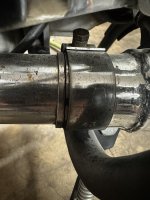
The biggest challenge was mating the muffler to header. Super tight fit and the later headers have a collar a few inches up I had to trim back.

It took time to make sure the headers would seat, the middle bracket lined up, and without stress. Then I cheated and drilled the holes for the custom rear brackets. Still had to oval out those holes to get everything in place.

Easy 2-3 evenings of work. Lots of naughty words.

Some months ago I finally found stock K0 rear brackets. So excited. Went to put them on and discovered it would require a similar process.

I put them in my parts box for a rainy day sometime in the future when I feel like punishing myself.
 
Early in the process of reviving a 67 CB450K0 I discovered that the headers are a double wall pipe. In mine the inner pipe had collapsed and was blocking the header completely, right at the point in the curve that can't be seen from either end. I located it by shoving a plumber's drain tape into the open ends. Got a replacement and chucked the failed header in the recycling bin. I'm telling you this because it might have some bearing on how much you can shorten the header pipe at the muffler end.
 
Early in the process of reviving a 67 CB450K0 I discovered that the headers are a double wall pipe. In mine the inner pipe had collapsed and was blocking the header completely, right at the point in the curve that can't be seen from either end. I located it by shoving a plumber's drain tape into the open ends. Got a replacement and chucked the failed header in the recycling bin. I'm telling you this because it might have some bearing on how much you can shorten the header pipe at the muffler end.
That's a good point and certainly something KHSE should be aware of. I doubt that his aftermarket replica headers are double walled. I know mine certainly aren't.
 
Personally I don't like the double wall headers, almost impossible to re-chrome, and, like mentioned above, extra risks involved. My bike has original single wall headers, less restriction, and a nice color blue after a wild ride ;)

I have a dozen sets or more rusted double wall headers for the K0's, K1's and K2's and waiting for a proper method to make them usable again. Maybe ceramic coating in the near future, because no plater that I know off accepted the double wall headers for chroming. It wasn't about the contamination, because I made them 100% clean, also from the inside.
 
Oops. I went missing for a day. Despite the fact that I left myself logged in...

@wentwest The headers I have are single wall but thick. They are too long and have the collar. @Troy wanted a pic of the inside of the muffler and here it is:

tempImagem0N84u.jpg

Some months ago I finally found stock K0 rear brackets.
@teebo Thanks for the info. It sounds from your experience, and the experiences of others, that doing the exhaust system is not one of those fun jobs... Probably right in there with trying to get the carbs to work properly. I'm curious if the stock K0 brackets have welded-on captive nuts at the top?? What did you do about the header collar? Take off the collar? Did you have to shorten the muffler?

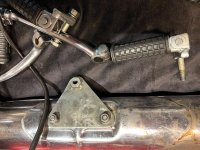
One thing with the stock rear brackets is that they are bent. Since they aren't marked, it isn't entirely clear as to which is the left and which is the right. I have 'witness' marks on my brackets so I used those marks to decide. Sitting here typing this I can't remember how I have them but I believe they are positioned to hold the muffler further away from the bike as opposed to tucking them in towards the bike. Can anybody confirm the correct way that they go on?

I'm thinking of taking off the front pegs and bolting up a piece of sheet metal that I can use to mark dimensions onto. Put the header on and mark where the end is and where the collar is on the sheet metal. Put the muffler on and mark where the internal restriction is and how long it is. Use those marks to decide how much to cut off what. Down side is to make sure I don't place the muffler in a position to later on interfere with the pegs.
 
but I believe they are positioned to hold the muffler further away from the bike

Nope. I have them positioned to tuck the mufflers in towards the bike. The back of the right muffler gets awfully close to the rear brake rod end.

Speaking of close tolerances, how did they ever design these things with such close tolerances before computer design programs?
 
One thing with the stock rear brackets is that they are bent. Since they aren't marked, it isn't entirely clear as to which is the left and which is the right.

The brackets do have a triangle shape, but not symmetrical, the hole or nut at the top isn't positioned exactly above the middle of the two holes that hold the mufflers. btw, the brackets with the threaded nut is used on the CB450 K0, the ones without the nut are mainly used on the CB450 K1 and K2. Positioning is the same, but you need an extra nut. The original bolts are MF, as the nut's on the brackets. MF means Metrical Fine thread, the thread pitch is smaller than a standard metric thread.

Brackets with the nut are rare, most are destroyed by using a bolt with the wrong (larger) pitch. The bolts are special as well, and holds the special shaped passenger footrest that are only used at the CB450 K0.
 
Last edited:
@teebo Thanks for the info. It sounds from your experience, and the experiences of others, that doing the exhaust system is not one of those fun jobs... Probably right in there with trying to get the carbs to work properly. I'm curious if the stock K0 brackets have welded-on captive nuts at the top?? What did you do about the header collar? Take off the collar? Did you have to shorten the muffler
IMG_2498.jpeg
IMG_2499.jpeg

Mine do have the nut. The bend then would be in toward the bike. You can see the asymmetrical triangle Jensen mentioned.

My mufflers had to slide farther onto the header. So I very carefully removed a portion of the collars. Each side was different.

IMG_2500.jpeg

Take your time and a couple beers. Plan on multiple sessions. Exhaust on, exhaust off. Over and over. Angles are important. All of them.

And sheesh. I see some surface rust spots on the chrome. I need to stop slacking.
 
Take off the collar? Did you have to shorten the muffler
I can’t remember why I decided to change the collar instead of shorten the muffler.

My mufflers are a very tight fit. I almost got one of those exhaust pipe expansion tools to make it slightly larger.
 
the ones without the nut are mainly used on the CB450 K1 and K2.
OK, I have a kind of weird bike then. It is a K0 by the gas tank and other bits but as you earlier pointed out it has K1 rear shocks and now you say it has K1 muffler brackets. I wonder if my bike was some kind of transition bike between 1967 and 1968? I bought it in 1969 and it seems to me unlikely that the original shocks would have worn out and been replaced in that timeframe. And I have to think that the mufflers and brackets were original equipment when I got the bike too...
using a bolt with the wrong (larger) pitch
That's something I have puzzled about. The parts manual never specifies thread pitch for any fastener. What is the 'standard' thread pitch? I saw a chart somewhere and it seemed like as the bolts got bigger so did the thread pitch. Of course, I can't find that chart now.
Mine do have the nut. The bend then would be in toward the bike.
OK, you got the mysterious nutted ones!! You know the funny thing with those is that I would expect to drive the bolt into the nut by passing the bolt through the bracket first and then into the nut but according to the parts manual, and your description, the bolt goes through the nut and then passes through the bracket. Before you use them you better check what @jensen says about the metric pitch of the nut.
How did you grind out the header collar like that? If I tried that with my angle grinder I'd probably go right through the header... I would think I'd have a better chance trying to grind the entire collar off by going straight down as opposed to laterally along the pipe.

I've made some progress. I used Deox-C on my tank and after 24 hrs it had done a really nice job. I rinsed the tank out with Atom-mac about a dozen times and then dried it with a hot gun in the filler hole. The tank is still intact, no leaks so far. I'll get the rebuilt petcock back on and make sure it holds gas. I'm now de-rusting the center stand. Once I get the center stand on I'll be back to the mufflers.
 
Personally, I don't like the brackets with the nuts, I don't use them, instead of those I use the ones without the nut. This gives me a possibility to make a slot of the top hole, and give the muffler some play in the length axis direction.

OK, I have a kind of weird bike then. It is a K0 by the gas tank and other bits but as you earlier pointed out it has K1 rear shocks and now you say it has K1 muffler brackets. I wonder if my bike was some kind of transition bike between 1967 and 1968? I bought it in 1969 and it seems to me unlikely that the original shocks would have worn out and been replaced in that timeframe. And I have to think that the mufflers and brackets were original equipment when I got the bike too..

To my knowledge, there are no transition models of the CB450 K0, never heard of them, never saw one. If you bought the bike in 1969, the bike can be 3 to 4 year old before buying. Maybe the shocks were used as a spare for another bike, in 1969, the CB450 K0 was already old fashioned, considering the style of the bike compared with the upcoming CB750 K0. I do think that Honda used both types of engine hangers, there are too many stories like yours to say that dealers switched them.

However, there are some changes over the years, for example the rear footpeg loop (frame) and many other small changes. In an earlier stage, with the Honda CB72, there is a 1962 transition model, between the 1961 and the later 1962 model.

OK, you got the mysterious nutted ones!!

btw, these brackets are not so mysterious as you think, I have a half a dozen sets or so, but mostly with a damaged nut due to the tread pitch and using the wrong bolts.

Sometimes I can save a few by re-cutting the thread and re-plate them, in the picture below a picture of an early type and the later type brackets, there is a third type, shape like the left one in the picture, no nut and a straight bottom instead of curved (like the one you show in your post). I have those as well, but not really easy to grab and make a picture of it.
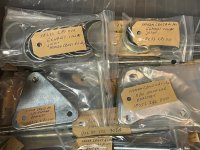
Afbeelding van WhatsApp op 2025-01-31 om 10.27.40_57e0c5ea.jpg

And here a picture how these this bracket should be mounted:
3af47ba9-e628-4e97-9d94-7b569bc5a2e6.jpg

This is a picture before cleaning. Notice the self locking nuts (stainless steel) that hold the muffler. I do not tighten them 100%, this way the mufflers can move a little from left to right in the picture.

 
Last edited:
The only thought I have to add to the thread about exhaust systems is no matter what model you're working on, DO NOT tighten anything before you get the whole set-up completely assembled in place. Screw in the bolts loosely, same with the nuts. Probably work starting from the connection between the muffler and the header getting things lined up and then finger tight.
 
I have those as well
@jensen I suspect that you are the world's leading hoarder of Black Bomber parts!! :)

DO NOT tighten anything before you get the whole set-up completely assembled
(y)

-----

Some progress, some failures, and some questions:

I got my center stand de-rusted, painted and back on the bike. For the first time in 50+ years the bike can stand up straight on its own. It's a good thing that @jensen suggested having the bike on the center stand before putting on the exhaust system because I discovered that the exhaust has to be removed to put the center stand on. It would have been very annoying to put the exhaust on and then have to take it off again to put the center stand on!!! I even got the center stand spring on without drawing any blood.

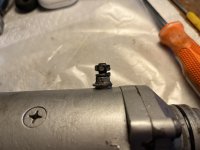
I went back to fussing about the starter motor. I had previously removed the mounting bolts but couldn't pull the motor out. Keep in mind that there is no starter sprocket/chain etc inside the left crankcase so it should have just pulled out. But, it was stuck. However, a little penetrating oil shot in towards the o-ring that was holding it and today I wiggled it out. I took the head off of the planetary gear end and everything freely turns although with some resistance. I balked at taking it further apart since I'm not sure how to do it so here's a question: It looks like if I remove the two long screws/bolts that hold the motor together that only the planetary gear end comes off, or, do both ends separate? I guess I should remove the brushes through the opening slots before separating the motor? How do you deal with the brushes' clips? The biggest problem I see right now is the 10mm nut on the motor's positive terminal is thoroughly stuck. I'm using penetrating oil on it and gave it a brief heat with a propane torch - don't want to melt anything inside the motor - but no luck yet on getting the nut off.

tempImagegWzhEg.jpg

There's a band that goes around the motor and covers the brush slots. My band was held together with a cotter pin. Any idea what size screw is supposed to go in there?

tempImageWLc0xw.jpg

I don't have wiring cables for the starter motor. Neither the one from the battery to the solenoid nor the one from the solenoid to the starter motor. They seem to be NLA. I found a link to batterycablesusa.com on this website somewhere so thought I would order them there or make them myself. But, how long are those cables and what gauge are they? Gauge 2/0 or 4/0?

Those are fairly hefty cables. I was looking at my ground wire at the battery and it seems kind of thin relative to the starter motor cable. What gauge should the ground be and where should it be grounded on the bike? Mine is grounded where the solenoid should be bolted on.

tempImageb0vWGu.jpg

Lastly, I have had an impact driver ever since I got the bike but I have finally bent and broken the phillips head bits. What is a good impact driver with JIS bits?

Thanks!!
 
Here is a pretty good article on rebuilding the starter with a lot of good photos and info.
@RobMan Thanks for that, unfortunately I have a K0 starter and they aren't quite the same. I imagine they are similar enough in most respects but I'm hoping to find something more specific to the K0 before I dig into it.
 
I don't have wiring cables for the starter motor. Neither the one from the battery to the solenoid nor the one from the solenoid to the starter motor. They seem to be NLA. I found a link to batterycablesusa.com on this website somewhere so thought I would order them there or make them myself. But, how long are those cables and what gauge are they? Gauge 2/0 or 4/0?
I used this. Very supple and easy to work with. I couldn't tell you the exact length. I just routed the cable into place, worked out the length I needed and soldered my terminals in place and finished it off with some heat shrink. In case you aren't already aware the cable to the starter motor passes between the engine and the frame. This is easiest to do if you have the engine out when you are reinstalling but I wasn't that smart. I just patiently fed the starter cable through the tight passage between frame and engine and used a little WD-40 (or something like that) to make it slide a l bit easier. If you are going to do this, you will need to leave one of the terminals off until you have fed the cable through as you will never get the terminal to fit between the engine and frame. Then solder the terminal on with the cable in place.
https://www.amazon.ca/dp/B07DPQSN68/ref=dp_iou_view_product?ie=UTF8&th=1
Lastly, I have had an impact driver ever since I got the bike but I have finally bent and broken the phillips head bits. What is a good impact driver with JIS bits?
Bought this on the advice of others here. Use it daily. A bit confusing on the listing because it amazon calls it Phillips head but if you look closer you will see that it is JIS
https://www.amazon.ca/gp/product/B07ZJ1P211/ref=ppx_yo_dt_b_search_asin_title?ie=UTF8&psc=1
 
I used this. Very supple and easy to work with. I couldn't tell you the exact length. I just routed the cable into place, worked out the length I needed and soldered my terminals in place and finished it off with some heat shrink. In case you aren't already aware the cable to the starter motor passes between the engine and the frame. This is easiest to do if you have the engine out when you are reinstalling but I wasn't that smart. I just patiently fed the starter cable through the tight passage between frame and engine and used a little WD-40 (or something like that) to make it slide a l bit easier. If you are going to do this, you will need to leave one of the terminals off until you have fed the cable through as you will never get the terminal to fit between the engine and frame. Then solder the terminal on with the cable in place.
https://www.amazon.ca/dp/B07DPQSN68/ref=dp_iou_view_product?ie=UTF8&th=1

Bought this on the advice of others here. Use it daily. A bit confusing on the listing because it amazon calls it Phillips head but if you look closer you will see that it is JIS
https://www.amazon.ca/gp/product/B07ZJ1P211/ref=ppx_yo_dt_b_search_asin_title?ie=UTF8&psc=1
I just buy a cheap set of jumper cables from whatever discount store and cut them up.

That link to the Vessel set is really nice but mostly just need the #3 Impacta.

 
@jensen I suspect that you are the world's leading hoarder of Black Bomber parts!! :)

No, I know a few people in the Netherlands and Germany that have much more parts. In the past 40 years I acquired bikes that no one was interested in, especially in the early / mid 80's the CB450 K0's K1's and K2's and CB72's where virtually worth the weight in metal, or like the US citizens say, an euro per cc. By coincidence I was interested in the CB450 K0 when I got 16 years old and bought my first Honda moped, a 4-stroke CD50H, a late cousin of the earlier CB450 K0's and CB72's due to the toaster tank. You could say that this moped was the starting point of my interest in the early toaster tank types of Honda.

I dissembled most bikes (taking less space), and stored everything in a dry and relative warm environment. I also dissembled the engines, putting all engine parts per engine in a separate box, labeled it from which engine number / frame number it came.
All electrical parts per bike type in boxes, as well as wiring harnesses.

Afbeelding van WhatsApp op 2025-02-03 om 09.13.42_6fb71edb_s.jpg

My band was held together with a cotter pin. Any idea what size screw is supposed to go in there?

Out of my memory, M3 or M4, 15 to 20 mm long, but I can make a picture if you want.
 
Last edited:
Bought this on the advice of others here.
That link to the Vessel set is really nice but mostly just need the #3 Impacta.
Thanks. Based on the price, I went with the single driver for now. I have had an old style Vessel Impact Driver for years and it was the #3 bit I broke the tip off of and the others are all warped. The biggest problem I have with my old driver is that the bits constantly fall out of it.
Out of my memory, M3 or M4, 15 to 20 mm long,
Thanks. I don't need a pic. That gives me a starting point. Problem is that most of the big box stores around here wouldn't have such small metric screws. I'll have to look around some.
That's a great CD50!! I love the bell on the handlebars!! I started out on a Honda S90 - very similar.
 
I used this. Very supple and easy to work with.
OK, you used 6 ga, 6/0 wire. Measuring the original little piece of wire I still have it looked like maybe 2 ga so if 6 works then either 4 or 2 would also work...
Can you tell me what gauge is your ground wire and where is it grounded on the bike? Thanks.
 
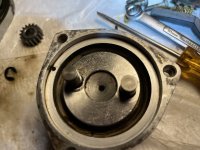
Starter motor update: I got the recalcitrant nut off. Penetrating oil wouldn't do it. I clamped a needle-nose vicegrip onto the lower nut and then packed all in, under, and around the vicegrip with soaking wet paper towels all as a heat sink. Then, oxy-acetylene torch on the nut. Worked out fine. Took the starter motor all apart except I can't get the planetary gear assembly out of the head. Beat on it a bit with a wooden hammer but it's not budging.

The planetary gear holder won't come out of the head:

tempImage3Ls5Wm.jpg

It rotates fine, but would like to have greased it.

So, what kind of grease should I use? those guys in Houston seems to put heavy axle grease on everything in the starter motor. Is that good?
 
Last edited:
Starter motor all back together. I greased it with white lithium grease. The back bearing was a bit dry but overall the motor is in very good condition, after all it was only functional for a few years and I mostly kickstarted it anyway.

I have been trying to get at the oil filter but the screws refuse to budge. I looked for tricks on the forum here and tried a few. I used a punch to reshape the screw heads a bit. That works nicely, great tip. I bought the Vessel Megadorma impact driver. Still won't move. How does that impact driver compare to the old 'manual' ones? My old manual one always worked but the tip broke off the #3 driver bit so I bought the new one. Now I'm thinking of getting another manual one... I've seen mention of a pin torch. What's a pin torch? I search pin torches and all I get are lapel pins that look like torches... I tried a small butane torch but it doesn't seem to do much. I'm thinking of using my acetylene torch but I sure don't want to melt the aluminum cover.
 
If you use a standard #3 screwdriver with a stout handle that you can safely hit with a hammer, giving those screws a few solid shots (not trying to turn them) can often help loosen the corrosion on the threads where you can't get to them with penetrant. That and the Vessel screwdriver should eventually get them loose, but as a last resort you can drill the head off them and then have an easier time removing the rest of the screws once the oil filter cover is removed.
 
I got the oil filter cover off. Bit the bullet and used my oxyacetylene torch on the screw heads, watching carefully not to melt any aluminum, and then the Megadora impact got two of the three out. The third wouldn't move so had to drill it out. The filter was surprisingly clean. Can't remember the last time it was cleaned...

Waiting for more parts to arrive. I'll paint the starter motor while I'm waiting but I'm afraid doing that will be the thin edge of the wedge and lead me into more painting and polishing. I'll try to resist that...
 
resistance is futile.
Ya, I can see how this all goes down hill rapidly. You fix something and while doing that you figure you better do that bit over there so now the bike is in more pieces and since you've gone this far you better do that and... on and on until all you have is the frame standing there.

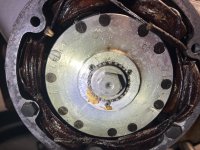
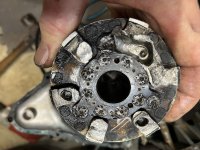
So do you remember me telling you earlier that my friend's father drilled and tapped some allen screws into the rotor because somehow the rotor got loose on its shaft during the starter clutch fiasco? Well, here it is:

tempImageVxins1.jpg

He did some punching as well. Unfortunately, both of them have long passed. But their handy work lives on.

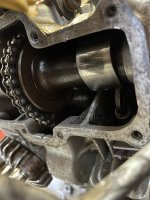
The cams look good to me. Here's the left exhaust cam. A bit of a shiny spot but I can't feel ridges etc on the can face:

tempImage8B6QyD.jpg

Some butchered threads in the intake and exhaust covers. Ya, I remember them. They were always a pain and I was pretty heavy handed in my younger days when tightening bolts. You can see a broken off bolt under the cam. There are also two 'oversized' bolts in the intake cover.

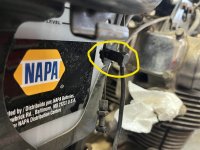
Why is this bolt and spacer circled in yellow there? Physical stop for the air cleaners? There's another one on the other side of the bike.:

IMG_2936.jpg

I still don't know where the ground wire is supposed to go. I was thinking of attaching it here. Right now I have it attached it to an upper crankcase stud.

The old carb intake insulators were rock hard so I thought I'd get the repro ones. They came in. They are pretty darned hard too. I guess I'll use the repros. Maybe they will seal better.
 
Ya, I can see how this all goes down hill rapidly. You fix something and while doing that you figure you better do that bit over there so now the bike is in more pieces and since you've gone this far you better do that and... on and on until all you have is the frame standing there.
Which is why so many stop at giving the easy stuff a little cleaning and live with the rest of it. I don't care for that approach, but that's just me.
So do you remember me telling you earlier that my friend's father drilled and tapped some allen screws into the rotor because somehow the rotor got loose on its shaft during the starter clutch fiasco? Well, here it is:
Interesting, and your word description didn't make much sense to me at first because that is not a common problem. I'd suspect the weight of the starter clutch housing rattling around on loose screws while it was still being run regularly had something to do with it. Solid fix, but a good used rotor (which would likely have been a lot cheaper at the time) would have been the better fix. Nonetheless, it obviously worked \pretty well. Hammering on a rotor in any way can lead to loss of magnetism though.
The cams look good to me.
Well, at least the left exhaust lobe looks good, which is the first one to likely get roughed up with any oiling issues or after being ridden away repeatedly without proper warmup.
Why is this bolt and spacer circled in yellow there? Physical stop for the air cleaners? There's another one on the other side of the bike.
Hard to be sure based on the parts fiche. Others with more Bomber experience will have to weigh in.

honda-cb450k0-black-bomber-general-export-usa-air-cleaner-tool-box_bigma000064f07_7a89.gif

I still don't know where the ground wire is supposed to go.
If you mean the heavy ground for the electric start, it goes to one of the 3 bolts in the upper rear motor mount bolts, generally the upper one that goes through the frame.
 
but a good used rotor (which would likely have been a lot cheaper at the time
hey, I was a poor University student and I already had to shell out for a used stator coil, :)

at least the left exhaust lobe looks good
ya, they all look like that one...

If you mean the heavy ground for the electric start, it goes to one of the 3 bolts in the upper rear motor mount bolts, generally the upper one that goes through the frame
That's what I thought, but the ground wire that is currently on there has eyelets at both ends that will only fit a 6mm bolt. The frame bolts are 8mm. Also, the current wire looks thin, maybe 14ga (?). The starter cable is usually around 2 to 6 ga. The ground wire doesn't seem hefty enough to accept the return amperage, although it is short... what gauge wire should the ground be?
 
Back
Top Bottom