1967 CB450 K0 Resuscitation

Things are slow here as in I'm slow. Been fighting off some bug. Thought maybe I had made it through winter without one but no...

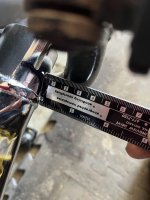
With the starter motor working I did get my compression gauge out and did cold, dry runs and got 145 psi and 155 psi. Fairly pleased with that. I had reset the valve clearances. That is such a joy (not) to do... Feeler gauges from 0.02mm to 0.04mm are so whimpy you can't really slide them in nicely from the front. I think I find that putting the gauges in from the 'side' is easier.
 
Sorry to hear you have a bug, hopefully you'll beat it down soon.
Feeler gauges from 0.02mm to 0.04mm are so whimpy you can't really slide them in nicely from the front. I think I find that putting the gauges in from the 'side' is easier.
Slipping the feeler gauge in from the side is the easiest way, but because .04mm is so small (actually the factory spec of .0015") I set them at .002", it will be fine there and you won't notice any difference in noise. And the extra .0005" won't hurt anything.
 
(actually the factory spec of .0015") I set them at .002"
Yes, 0.03mm is factory spec but it seems no matter how hard I try for it to not happen, if i use a 0.03mm feeler gauge to set the rocker arm, when I tighten the lock nut it always tightens further and is then too tight. So I cheat a bit and use a 0.04mm gauge to set the gap and, after tightening the lock nut, if 0.03mm fits and 0.05mm doesn't fit, I call it good.
 
Things are going slow here. I replaced all the screws associated with the ignition timing plate and I set the static timing. That got me to wondering again as to why the CB450 K0 uses a '180' engine versus a '360' engine. My initial thought would be that a 360 engine would be smoother running than a 180 engine so why would they even consider using a 180 engine?
 
I've always thought the 180° crankshaft would vibe less than the 360°, but how much less is in question since the 180° vibes pretty well itself.
 
This article from 1965 has an explanation.
Thanks for the article. Here's a quote from the article:

'The domestic (Japan) engine's 360 crank permits the use of a single, double-lead coil, single condenser and single set of points. All of this is slightly less expensive and well suited to Japan, where these 450s will probably be used mostly as police motorcycles and spend a lot of time slogging along at low speeds. You don't need the better balance of the 180-degree crank under those conditions'.


I've always thought the 180° crankshaft would vibe less than the 360°, but how much less is in question since the 180° vibes pretty well itself.

The article stated that 'You don't need the better balance of the 180-degree crank under those conditions.' I wonder about the term 'balance' since a well balanced engine in my mind has more to do with getting the crank counterbalanced properly with respect to the rods and pistons etc. so that it all spins without any imbalance. In my mind, the difference between the 180 and 360 would be on the power strokes where the 180 would have its power strokes closer together than the 360 and to me would seem to generate more surging in the power availability although I guess at 10,000 rpm the difference is moot. I vaguely recall something about old Triumphs having something similar to the 180 and that's what gave the Triumphs their distinctive thumping sound.
 
I vaguely recall something about old Triumphs having something similar to the 180 and that's what gave the Triumphs their distinctive thumping sound.
Actually, unless I'm mistaken all Triumph twins are 360° cranks which is what gives them that sound.
 
Actually, unless I'm mistaken all Triumph twins are 360° cranks which is what gives them that sound.

Ha, you could be right..

https://magazine.cycleworld.com/article/1962/9/1/engine-balance @wentwest had posted that Cycle World article from 1965 about the CB450 K0. I enjoyed reading it but then I got sucked down the rabbit hole of looking at other CW articles and came across one from 1962 that discusses engine balance. Seems like there's a lot going on when trying to 'balance' engines. I also found it amusing that they discussed the possibility of 4-cylinder engines showing up in production motorcycles. 1969 CB750 Four anyone?
 
A nice explanation , and in English as well

Wow, great video @jensen. Thanks!! I got a bunch of that from the CW article but it was certainly a lot clearer with the diagrams. The video brought the secondary imbalances more clearly to life. Especially the rocking motions that a 180 CB450 could generate.
 
It's somehow fascinating to imagine the forces involved in a running 4 cycle two cylinder engine, and the hold them together in your head.
Imagine learning those things about a flathead single cylinder lawn mower engine... at age 8. My head was spinning with fascination just looking at the internal parts after my father let me tear it down and then he explained it all to me. Then my parents let me wash all the parts clean, reassemble it finger tight and take it to school to disassemble and explain to my class. I guess they didn't realize what a bad decision that was for me at the time :giggle:
 
Imagine learning those things about a flathead single cylinder lawn mower engine... at age 8. My head was spinning with fascination just looking at the internal parts after my father let me tear it down and then he explained it all to me. Then my parents let me wash all the parts clean, reassemble it finger tight and take it to school to disassemble and explain to my class. I guess they didn't realize what a bad decision that was for me at the time :giggle:
That was my experience, but with a visible V-8 model. Once I put that together they couldn't stop me from taking parts of their car apart. I was about 10. The math required kept me from mechanical engineering, and I ended up in law school, taking apart words and paragraphs.
 
Wow, great video @jensen. Thanks!! I got a bunch of that from the CW article but it was certainly a lot clearer with the diagrams. The video brought the secondary imbalances more clearly to life. Especially the rocking motions that a 180 CB450 could generate.
Here's a video that covers other engine types as well.
 
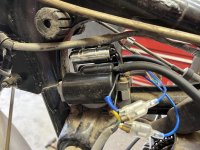
Finally got the non-resistant spark plug caps in that @jensen suggested so I replaced the ignition coils and capacitor.


tempImageSc2A0Y.jpg

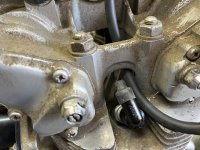
Despite having had 90 degree caps on my bike all its life, these new ones are not fitting quite as I would have liked. I think they are a little taller:


tempImageR2dT52.jpg

I can make it fit but the ignition cable will be rubbing on the archway in the head. Would you call that a major issue?

Also, I got the NGK BR8EIX plugs. They came gapped at 0.75 mm which is factory spec for a regular plug. I assume you use the same gap with these fancy plugs?

I, as probably a lot of DOHC 450 owners, have a number of stripped threads in the valve covers. Finding metric bolts to fit it has been an issue. Partzilla didn't have them when I ordered them. Probably going to head out to a local Honda dealer to see what they have in stock.
 
Despite having had 90 degree caps on my bike all its life, these new ones are not fitting quite as I would have liked. I think they are a little taller:
I can make it fit but the ignition cable will be rubbing on the archway in the head. Would you call that a major issue?
That's why I look for the 120° caps, I don't care for the tight bend and plug wire rubbing on the head either. I've seen many do it, seemingly without issue as no one has ever said anything about any problems.
Also, I got the NGK BR8EIX plugs. They came gapped at 0.75 mm which is factory spec for a regular plug. I assume you use the same gap with these fancy plugs?
Equates to .030", should be fine since .024" to .028" is spec.
I, as probably a lot of DOHC 450 owners, have a number of stripped threads in the valve covers. Finding metric bolts to fit it has been an issue. Partzilla didn't have them when I ordered them. Probably going to head out to a local Honda dealer to see what they have in stock.
You can often find more threads deeper in the holes, not all of them but most. I've done it many times, POs often get too ham-fisted with 6mm bolts in aluminum.
 
POs often get too ham-fisted with 6mm bolts in aluminum.
Ya, well, since I'm the PO I only have myself to blame...

I think @jensen indicated there were 120 degree caps with a lower resistance of 1K. I'll look around for them again. Probably use the 90 degree caps in the meantime.
 
Also, I got the NGK BR8EIX plugs. They came gapped at 0.75 mm which is factory spec for a regular plug. I assume you use the same gap with these fancy plugs?

NEVER change the gap on iridium spark plugs by any means ! And never clean them with a metal brush.
 
The center electrode is very, very sensitive (very small diameter AND brittle) and should not be touched be any tool, or scratched by a metal brush. If you change the distance by bending the bridge electrode (neg) chances are that you put mechanical load on the center electrode.
 
Last edited:
The center electrode is very, very sensitive (very small diameter AND brittle) and should not be touched be any tool, or scratched by a metal brush. If you change the distance by bending the bridge electrode (neg) chances are that you put mechanical lad on the center electrode.
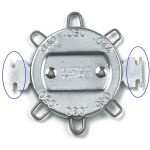
Ah, then this tool would still be safe to use as it bends the negative electrode without touching the center electrode. But honestly, I don't think I've ever actually had to re-gap any NGK plug I've ever bought.

1741541345974.png
 
Yesterday I put the new coils and capacitors on the bike but today I hooked up spark plugs to test for spark. And wow do they spark!! Way better than the old ones and that's with my old spark plugs. It will be interesting to see if the fancy new iridium ones do even better.
 
The biggest advantages of iridium spark plugs are MTBF and the insensitive to pollution. That's's why these park plugs are popular for using in two-strokes. Don't expect a much bigger / fatter spark.
 
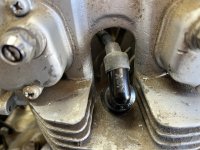
An update on my ignition cable/spark plug caps. I had indicated earlier that the 90 degree zero resistance cap might not fit well on the DOHC CB450 but after fussing with it a bit I found that it in fact fits quite well. There's no interference with the archway in the cylinder head. I need to make the cables a bit shorter but on the first try I went with being too long as opposed to too short...

tempImagexdvHgr.jpg

https://www.ebay.com/itm/1757025188...40&osub=-1~1&crd=20250307085052&segname=11051 These are the NGK LZFH caps that @jensen recommended and I got them off ebay.

I'm back to figuring out the exhaust/muffler situation. I have the later model CB450 header pipes that I got from Thailand and the repro mufflers from David Silver. The issue is that the header pipes have a collar on them. I have been following what @Troy did to fit the same items onto his Black Bomber but somehow my situation seems a bit different. @Troy left the collar on but shortened both the header pipe and the muffler. When I was considering that tactic I found that I'd have to cut a huge chunk off the muffler and that didn't seem reasonable.

I used the foot peg, that I had rotated to a good position as a reference point.

Here's the muffler loosely mounted and referenced to the foot peg. You can see that the bottom of the 'cutouts' in the muffler align with the footpeg. Well, that happens to be exactly where the 'outlet side' of the collar on the header pipe sits. So, if I leave the collar on, I'd have to cut off the entire part of the muffler containing the cutouts and at that point there's not much of the muffler left where the header would fit into it.tempImagepXDz7s.jpg

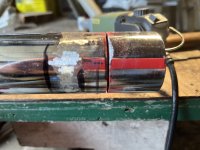
So, what to do? The collar has to come off. When I had previously considered this I tried to get the guys in Thailand to tell what was holding the collar on. All they would say was that it was welded on. So, I went at it with a small grinder and then a small cold chisel and I peeled up a bit of the collar.
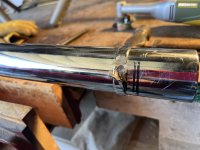
tempImageAKtrpi.jpg

After doing that, I noticed the gold colouration under the collar. Figuring they had brazed it on I went at it with an oxy-acetylene torch and the collar just peeled off.
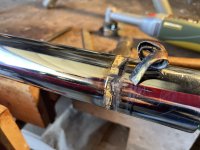
tempImagevopYqv.jpg


A little light grinding and I cleaned up the mess. All of the mess should actually wind up inside the muffler. I'll probably paint it before final assembly.

I still have to cut the header to the right length and get it all to bolt up properly.

When I was communicating with the guys in Thailand I asked them why they didn't sell a K0 header. They said the headers were very different. I told them several people had used the collared header but had to cut the header shorter and mess a bit with the collar. If they just sold the header without the collar it would be a big help. They seemed surprised by that and I think they then started selling a K0 header... You might find the K0 header on ebay now.

An exhaust manifold question: When I have the header mounted to the head without the exhaust gasket there is a limited amount of stud that protrudes. It only protrudes about half of the length of the header nut. If I put a washer and lock washer on before the header nut then even less stud would be captured by the nut. Should I just not use the washers?


tempImage1hJ2yP.jpg
 
Good work! It goes to show there's more than 1 way to get things done. I actually noticed the K0 headers show up on Ebay. I bought a set, not really sure why but I guess I was curious. I've been so busy that I haven't even opened the box yet and they are sitting my garage. Now I will need to find another Bomber to work on.
 
Should I just not use the washers?

Spring washers will fit, hence the nuts are long sleeve ones, and it's not necessary that you use all the thread windings. Before mounting the nuts, apply copper grease on the studs and after mounting them, apply some heat resistant paint in the nut, it will keep the rust out.
 
Successes and tribulations.
I had noted that the exhaust studs seemed short. It turns out there was still a copper exhaust gasket in the head, despite the fact that I had already removed one!! Two gaskets are better than one? After removing the remaining gasket and inserting a new one there's plenty of stud available to engage the exhaust nut.

Referencing the muffler and header to the footpeg worked out. I figured out how much header to cut off and then cut it with a sawzall and metal cutting blade. I was worried about getting a straight cut but it worked out quite well.

tempImageTwfcuq.jpg

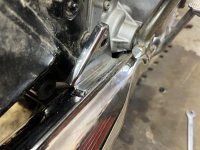
Now the big issue. I mounted the header onto the head, fairly loosely, and then wiggled the muffler onto the header and loosely mounted the rear muffler hanger. It really doesn't fit well. The muffler is too high and there's interference between the muffler and the right crankcase cover where the kickstarter is located and the kickstarter also won't clear the muffler. @jensen had suggested this process - focus on the rear hanger and then work on the front one. But that doesn't seem to be working.

tempImageq86pd4.jpg

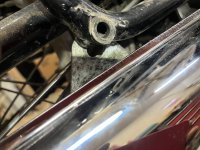
So, take two. I released the back hanger and mounted the front hanger. Now the muffler doesn't interfere with the crankcase and kickstarter but the rear hanger is now fairly 'off'.

tempImage2gp8iO.jpg

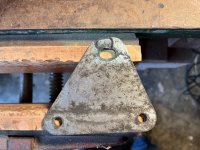
I'm considering modifying the rear bracket to get it to line up.

tempImageOfFZi0.jpg

What to do? I could hacksaw a slot into the top and hopefully capture enough of the bracket with the footpeg bolt and nut to hold it? Maybe weld a nut on after cutting the slot?

@Troy and @wentwest did you have the same problems?
 
I had noted that the exhaust studs seemed short. It turns out there was still a copper exhaust gasket in the head, despite the fact that I had already removed one!! Two gaskets are better than one? After removing the remaining gasket and inserting a new one there's plenty of stud available to engage the exhaust nut.

Sorry, it did cross my mind, but I thought that would be the first thing to look at, so not worth to mention.
 
the first thing to look at, so not worth to mention.

Ya, duh, but I did take the gasket out, it's just that another magically appeared in there...

Get a chunk of steel and make a new bracket.

The problem is that the original brackets are doubly bent in order to tuck the muffler in towards the bike. Getting that bend right would be pretty difficult with my limited abilities.
 
Ya, duh, but I did take the gasket out, it's just that another magically appeared in there...
Which actually means the person before you didn't get all the old gaskets out of the port, which is pretty common for these old bikes because the gaskets get black with carbon and *disappear*.
 
I don't have a K0 engine or exhaust system on my K0 (yet!) so I'm little help. My experience with exhaust systems lead me to think the best way to get things set up was to install all the fasteners very loosely, then manipulate the alignment of the center connection (between the header and the muffler) to get the best fit - and hope for the best, expect the worst.
 
@jensen had suggested this process - focus on the rear hanger and then work on the front one. But that doesn't seem to be working.

Yes, I stand with this method, however, I don't know if the aftermarket headers that are originally designed for a K1-K2 are the same as the K0.
Did you compare both header in detail by measuring ? Did you try to move the engine with the bolts loose ? My experience is with the original mufflers and headers only, I never have used after market headers, because I have plenty original ones (although most of them are pitted / rusted).

Well, good luck with your build, I hope everything works out fine.
 
I don't have a K0 engine or exhaust system on my K0 (yet!) so I'm little help. My experience with exhaust systems lead me to think the best way to get things set up was to install all the fasteners very loosely, then manipulate the alignment of the center connection (between the header and the muffler) to get the best fit - and hope for the best, expect the worst.
Thanks. Ya, I'll try it again.
 
Yes, I stand with this method, however, I don't know if the aftermarket headers that are originally designed for a K1-K2 are the same as the K0.
Did you compare both header in detail by measuring ?
I don't know if the headers are different between the K0 and K1. They certainly have the collar on the later ones but I don't have any original K0 headers to compare them to.

I was concerned about not getting the header flange flush into the exhaust outlet so I started with that not too loose. I'll start again with that looser and loosen the engine mounts more. Also, I have just been working the right side. I got the collar off the left header and will start on it as well. I don't want to modify those rear brackets unless I have to since they seem fairly rare.
 
OK, I started over and I think I have it real close, even close enough for now anyway... Back to the @jensen and @wentwest process of loosen all engine hangers, header loose in the exhaust port, wiggle the muffler onto the header, back hanger on loose, fuss around while slowly tightening everything down. The left side went easier than the right side, don't know why. I have both sides locked down except neither side has the front muffler hanger connected. I need to reshape the holes in the front muffler hanger to get the bolt to line up with the frame attachment point. But, I was happy enough to move on.

I put the carbs on and fired up the bike. And, after a couple of turnovers it ran!!! Sounded like one cylinder at first but then two. It ran fairly smoothly for a bit but then died and I noticed gas dripping out of the right carb so ignition off and gas off. I guess the right carb was overflowing. Something to work on tomorrow...
 
Today I pulled the Bomber out from it's hiding place in the garage to start getting it ready for spring. Changed the oil, adjusted valves and timing, charged the battery. As soon as it warms up enough outside I'll open up the garage and start it up.
Sometime this week I might get around to opening up the aftermarket K0 Headers that I recently purchased on eBay and see how they fit. I'll keep you posted.
 
Good day today. The leaking right carb fixed itself. That doesn't give me a great deal of confidence but I'll take it for now. The electric start is pretty whimpy. When cold, kickstart works better. When warm to hot the electric start is OK but kickstart still better. It took a bit to get it started from cold this morning. Reminds me of the times I would be trying to get it started at high school and all the cool kids with their Kawasaki 500 Mach IIIs would be laughing at me... But get it started I did and after twiddling the idle screws a bit I got it settled in fairly well. It runs quite smoothly at idle and revs nicely. I have a 600 foot driveway and I put about a mile on the bike just up and down the driveway in 1st and 2nd gear. I haven't really ridden a bike in 25 years since I sold my 1987 BMW K100LT. I was surprised how fast it was and how rusty I was. Also, the new mufflers are so nice. Peace and quiet compared to the Hooker headers...

Here's a video of it running:

The RPMs hang a bit after revving the throttle. Neither of the throttle plates are getting hung up on the clutch cable, fuel lines, etc and it's not influenced by moving the handlebars. Here I blip the throttle and shut it right off. The revs come down slowly, the smoke is likely from antisieze compound flashing off:

The tachometer makes a very annoying whine. Is that the tach itself or the cable? What to do about it?

I think I need new tires:
tempImageMYN3Mc.jpg

What tires do you all recommend these days? I have always used Continentals.

I've started to do a bit cleaning...
 
The RPMs hang a bit after revving the throttle.
Did you inspect the advancer when you set the points and timing? If the return springs on the advancer are stretched and even a little bit loose, the timing will not return to idle settings so the engine takes longer to slow down.
The tachometer makes a very annoying whine. Is that the tach itself or the cable?
It's a good question. Try disconnecting the cable at the engine (17mm wrench) and see if it goes away.
What tires do you all recommend these days? I have always used Continentals.
I'm running Shinko 712 and really like them, economical and great handling..
 
It's probably the tach. There's a sort of bushing inside the connector, where the cable screws on. If you take off the instruments or loosen things enough you can disconnect the cable, turn the tach face down and drip a drop or two of 3-in-1 oil between the part that spins with the cable and the housing with the threads, it should quiet down.

I put Shinko 712's on mine, too.
 
Did you inspect the advancer when you set the points and timing?
Yes, I took a look. The weights were free to move but I couldn't say if the springs have lost any spring over time. Are there new springs available that have the correct springyness?

tach face down and drip a drop or two of 3-in-1 oil
Thanks, I'll have to take a look at that.

I'm running Shinko 712 and really like them
I put Shinko 712's on mine, too.
OK, two votes for Shinko 712. Currently I have Continentals. The front is 100/90 V18 and the rear says 4.00 H18. I see Shinko 712s have the front tire but I don't see anything matching the size of rear tire I currently have. What rear Shinko tire do you use?? I hope I don't have a funny rear rim for some reason...

Do you guys change your own tires? I have never done it. Some videos make it look relatively easy while other videos look like it can be quite a fight. I'd rather do it myself because then I can clean up the inside of the rims which I'm sure wouldn't happen at a bike shop. Also, some say to balance the tires/wheels and others say don't worry about it. What do you do?

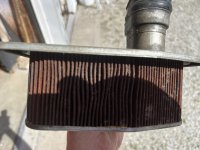
I have been puttering up and down the driveway with the air filters off but being concerned that the seat is shedding a bit of foam I decided to put the filters on. They are kind of ugly but haven't seemed to have had any effect on performance.

tempImageZy5Z8m.jpg
 
Yes, I took a look. The weights were free to move but I couldn't say if the springs have lost any spring over time. Are there new springs available that have the correct springyness?
There were never any replacement springs sold, they only sold the entire unit new. If the weights move any at all without the springs being in play to control the movement (IOW, if the springs are the slightest bit sloppy at the connection points) then they either need to be replaced, or you can cut off the loop end and bend down the last coil to make a new loop which effectively shortens the springs slightly. That usually works for most.
OK, two votes for Shinko 712. Currently I have Continentals. The front is 100/90 V18 and the rear says 4.00 H18. I see Shinko 712s have the front tire but I don't see anything matching the size of rear tire I currently have. What rear Shinko tire do you use?? I hope I don't have a funny rear rim for some reason...
Nothing funny about your rear rim, the stock rear tire was 3.50-18 and many went up a size to a 4.00-18 back then for a replacement. I bought a 100/90-18 for the rear of my bike but a 110/90-18 would also be fine.
Do you guys change your own tires? I have never done it. Some videos make it look relatively easy while other videos look like it can be quite a fight. I'd rather do it myself because then I can clean up the inside of the rims which I'm sure wouldn't happen at a bike shop. Also, some say to balance the tires/wheels and others say don't worry about it. What do you do?
If you've never changed a tube-type tire before, it can be a challenge. The biggest difficulty is not pinching the tube which would require you to pull the tire back off and either patch the tube or replace it. If you buy your tires from Cycle Gear they'll install them for you, not sure if they would if you carried your own tires in. Or you could have a local shop change them for you but you know how it can go with local shops...
I have been puttering up and down the driveway with the air filters off but being concerned that the seat is shedding a bit of foam I decided to put the filters on. They are kind of ugly but haven't seemed to have had any effect on performance.
Yeah, those are ugly and should be replaced, but you could try cleaning them in soapy water and then let them air dry afterward. After they're dry you could gently blow them out with compressed air but be careful.
 
I bought a 110/90 18 Shinko for the rear and it has worked out well. And I don't change my own tires - no room for any permanent mounting to do it. I buy tires from cycle gear online, they ship them to a local store and I bring in the wheel or wheels. You can wait but I just leave them for a day. That way they mount and balance them for $25 each (last time anyway) and I order new valves and rim strips with the tires so they get done, too.
 
So why use this size on the rear if the original rear tire size was 3.50-18??
Didn't say you should use it, but most want to put larger tires on these stock rims and the next size up is okay, but it would be the most you should go without lacing a wider rim to the hub. That's all, just mentioning a slightly larger tire size that would work because nearly everyone wants to put bigger tires on these bikes.
 
just mentioning a slightly larger tire size that would work
OK, I think the lightbulb is starting to glow. We are dealing with a mix of metric and inches. A 100/90 rear would roughly equate to what I currently have but a 110/90 would be slightly larger. You are using the same size tire front and back whereas @wentwest uses the slightly larger 110/90 in the back. Hmmm, not sure which way I'll go...
 
Back
Top Bottom