A C78 project

Tom that sound right on the stator. I think I did retap them for a different TP. My memory is not great anymore, yet that sounds right for the stator screws.
I can’t be sure the regular outer case JIS were 6 mm, as they may have been 5 mm?
 
Tom is the expert here and he made a good point about those oval heads and the stator area where upsizing the hole would be an issue. On the points cover you will have enough metal around the area, yet the stator would be an issue. There are 6 mm oval head screws available from Honda as the CL 77 I did was all 6mm I believe.
Either option will require work to refit the odd sized M5 threaded stuff.
Getting M6 is certainly something to consider as these are readily available.
Oh boy, are you gonna have fun. I did both my 64 and Charles 65.
I'm going to revisit your projects as I know there are going to be similarities with the Dream.
But wait! It's even more fun on the condenser mount with the 9mm hex head 5x.90 bolts.
Anyone want a C77 project bike...haha
 
Anyone want a C77 project bike...haha
Now, now, you are already in too deep and have to see it through, or you will be shipped off to an undisclosed location and forced to work on Swiss, French, Italian and German old bicycles, and they are all different.
Let's have a moment of thankful silence to reflect on Honda's efforts to standardize. :rolleyes:
On second thought, I should learn a few Japanese swear words.
 
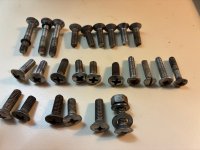
Take a look at my stash of Honda rogue screws over the years.
I also have a small tin of miscellaneous bits and pieces from my Honda shop years. I should go through it and see if there are any rare bits in there. I remember the shop had a bin that was about 18"x12"x8" deep that was full of screws and bolts and nuts of various sizes that the mechanics would rifle through to replace a missing screw on a customer bike without having to go to the parts department. I wish I had that bin...
 
I'm not that familiar with the .9 pitch but would guess that the middle row, 2nd and 4th from the right are the M5 .9 screws
 
PM an address, this coming Thursday I'm sending out a bunch of stuff. pick which ones you want. PM an address.
 
Thanks for the offer Spokes. I will hold off on any screws right now until I get further into this project and decide what direction I will take, either go up to standard M6 or re-thread to standard M5. I don't think staying with unobtainium screws makes any sense.
 
Spent a little time in the garage today even though I was supposed to be working on other projects - that was the deal for the purchase.

I been gathering info on the C77 and have been doing a bit of reading in the manuals. We know that these manuals sometimes have errors but I've read a few things that loose a little in the translation. As an example, here is an excerpt from the FSM when talking about the C77 frame construction:

1757121108520.png
I also found in the FSM that if you are looking for frame related assembly/disassembly information that you should reference the CA95 manual as the parts are similar. There is very little in the C77 FSM for the frame.

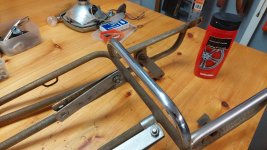
I removed the luggage rack and the sissy bar today. I think I will keep the rack but drop the sissy bar. I put a little Mother's chrome polish on the luggage rack to see how it would clean up. With a lot of effort I think it will come back very nicely.
20250905_212337.jpg

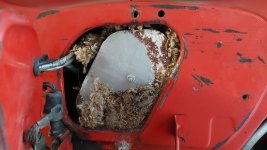
I moved on to the battery area and took it apart so I could get at the air filter. Looks like there was a house guest in there for many years.
20250904_161655.jpg
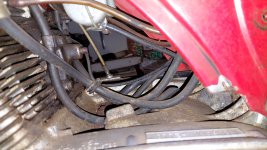
The FSM says to reach in between the frame and disconnect the tube connecting the filter and the carb - yeah right. I could get maybe two fingers near the clip but that was it.
I went to the coil side and removed the coils and the HT leads to give myself more room behind the carb.
20250904_163621.jpg
20250905_162400.jpg
I was able to disconnect the tube from the carb end. Luckily the tube was still pliable, so I was able to disconnect the air filter end by pushing the tube off the air filter with a screw driver.
Once the air filter was out, I took out handfuls of looks like burlap plus an inch thick layer of poop and pee from the bottom of the frame under the air filter.
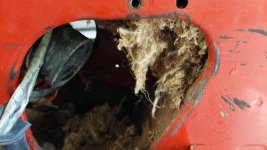
20250905_163253.jpg

The filter and tube are toast but I seem to remember seeing them for sale by vendors in Thailand. Has anyone dealt with these vendors, is the quality good?
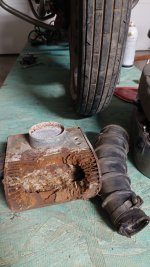
20250905_213414.jpg
I took the carb off but the slide is frozen in the carb body so I can't disconnect the throttle cable. I doused the area with liberal amounts of PB Blaster and I will let that soak overnight.

Might be a while before I get back to this as there is another house project waiting in the wings and the materials were delivered this morning so no more excuses.

 
How is the metal on that airbox? Maybe if you remove all but metal and derust, you could either use foam or automotive air filter paper to refurbish?

I can see how that except would lead to some head scratching. Fortunately, it describes a Hondo 250•300, which must be a cheap knockoff, anyways, and of no interest to you, a Honda 250•300 owner.
 
1757121108520.png
The message is kind of backwards.
The frame body of the Honda 250-300, model C72 and 77 is made from pressed steel. Strength of the frame derived from its rounded form and cross-sectional support.
The frame rigidity enhances stability. Lighter loads enhance performance.
 
it describes a Hondo 250•300, which must be a cheap knockoff, anyways, and of no interest to you, a Honda 250•300 owner.
Exactly, not my bike, haha.

I think a lot got by the proof readers in those early days. I didn't read the FSM's very often when I worked in the shops, so didn't really notice the errors so much as the focus was more on the specs. If there was some aspect of disassembly I didn't know, there was always the shop guru - "Hey Rob, how does this come apart?"
 
The message is kind of backwards.
The frame body of the Honda 250-300, model C72 and 77 is made from pressed steel. Strength of the frame derived from its rounded form and cross-sectional support.
The frame rigidity enhances stability. Lighter loads enhance performance.
You have to sometimes read a sentence several times to understand what they were trying to convey.
 
How is the metal on that airbox? Maybe if you remove all but metal and derust, you could either use foam or automotive air filter paper to refurbish?
The metal is a bit corroded from the rodent pee but still solid. Re-using the existing filter is certainly an option if a new one is exorbitantly priced.
 
I think a lot got by the proof readers in those early days. I didn't read the FSM's very often when I worked in the shops, so didn't really notice the errors so much as the focus was more on the specs.
Absolutely agree, the bikes were still new-ish and most major repairs were seldom, and when you worked on them daily the main reason you ever went to the FSM was for a spec of some sort or to learn about a change that was made between models. We knew the proofreading was poor, and on those occasions we were reading an FSM we would often joke about the wording or descriptions of things like the differentiation between a plug and a "sparking-type plug". And I always found the use of "winker" to be amusing, since in my area we called them signals because you were signaling your turn. I'm sure there are plenty of other unusual reference differences but no others come to mind ATM.
 
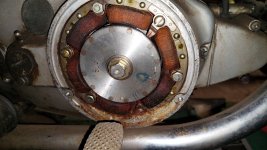
Got a few hours in the garage today and managed to remove the stator cover. Two screws came out but one was too deformed so I resorted to drilling the head off. Got the cover off and tried rotating the rotor. It didn't move at first so I put a little more pressure on the wrench and it moved a little one way and then I applied pressure the other way and the rings broke free. I was able to do a complete revolution so the engine is not seized - a small victory! There was some brown stuff at the bottom of the cover, almost looks like saw dust. I will get in there to investigate after I soak all the screws with PB Blaster.
20250913_222030.jpg
I got the tank and seat off. With the mess in the air filter area I was expecting the seat to be chewed up but it was in really good shape.
20250913_220831.jpg
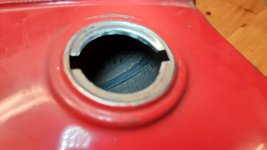
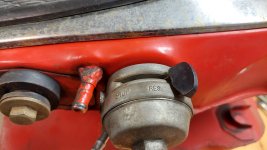
The inside of the tank was also surprisingly clean. The petcock also in good shape and moves freely but I suspect I will have to replace the seals.
20250913_221209.jpg
20250913_221352.jpg
I moved on to the handle bars and this is where things really slowed down. I couldn't disassemble the throttle as the slide in the carb was seized and so was the choke. I sprayed more PB Blaster and let it soak. I moved on to the clutch side but couldn't get the cable out of the handle as the lever scraped something and the slot the cable comes out from was deformed. Got out a small file and opened up the slot to free the cable. The carb slide still wouldn't budge but got the cable out of the hinge apparatus that pulls the cable. The choke now moves freely but not the slide - I will try some heat next to see if it frees the slide.

BTW, I found some original C77 bars on flea bay so I can get rid of the ape hangers. They have all the cut outs for the hinge as well as a hole in the bar for the throttle cable to come out.

I disconnected the wiring in the headlight and removed the handlebar clamp and put the bars aside for more disassembly in the basement.
20250913_172123.jpg
I took lots of picks of the damper assembly as I'm sure I will forget something when it comes time to put everything back
20250913_172203.jpg

I have to start bagging all of these parts and then make a list of items to purchase - the fun begins...
 
If the petcock does not leak at the lever, leave it alone. I've rebuilt 5 of these and learned the tricks. Unfortunately the rebuild kits often have poorly sized/made upper packing "A" which has a critical fit. Just soak and remove the sediment bowl, it has a simple flat seal ring. Many people get frustrated with them and use the Harley style replacement petcocks, too bad. Also beware as the three mounting screws are the extinct 5x.90 thread.
 
Your friction damper is incorrectly assembled, I'm pretty sure. They often are. There was never a rubber split packing put there, that's your sign. The top peice is bent and the friction discs are cracked (they can be repaired with super glue or epoxy).
 
If the petcock does not leak at the lever, leave it alone. I've rebuilt 5 of these and learned the tricks. Unfortunately the rebuild kits often have poorly sized/made upper packing "A" which has a critical fit. Just soak and remove the sediment bowl, it has a simple flat seal ring. Many people get frustrated with them and use the Harley style replacement petcocks, too bad. Also beware as the three mounting screws are the extinct 5x.90 thread.
So leave well enough alone - roger that!
Your friction damper is incorrectly assembled, I'm pretty sure. They often are. There was never a rubber split packing put there, that's your sign. The top peice is bent and the friction discs are cracked (they can be repaired with super glue or epoxy).
When I saw the rubber packing I went to the parts manual to verify if this was a stock item - there was no listing for it. I noticed the cracked friction disc and was going to super glue it as I'm sure these are NLA, it's good to know they can be repaired. I will be sure to consult the parts manual when re-assembling to make sure it all goes back together correctly.
 
Following along with the teardown and build. Fortunate to have Tom to guide you with his past experience which is invaluable.
 
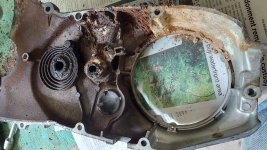
Continued with more disassembly today and got the alternator cover off after letting the PB Blaster soak in overnight. There was a ton of grease in the case. I think the PO was using grease on the chain as it was well lubricated.
20250914_154234.jpg


The lower chain case however did not benefit from all that grease. It crumbled apart when I went to take it off. The top is still solid so I will add a lower case to the list.
20250914_154246.jpg
The right muffler was in decent shape and the header pipe will clean up nicely based on a preliminary going over.
20250914_154342.jpg
20250914_170528.jpg

The left muffler did not age as well as the right and there are multiple holes on the underside. It will take a pretty big patch to get to good solid metal.
20250914_170432.jpg

I also started taking off the switches and perches from the handlebars. The PO grafted on longer wires so I think I can get away with just soldering new terminals on the wires once I remove the extensions. The grey sleeving was remarkably pliable and won't need to be changed. Took some fine steel wool to the clutch lever and it looks like it will polish up just fine.
20250914_212918.jpg

I'm realizing that these dreams are not put together to make life easy for the mechanics. To get the alternator cover off you have to remove the exhaust and right foot peg to get at the last screw on the bottom of the case. The shop rate was probably an hour to change out the clutch cable...living the dream, haha
 
Following along with the teardown and build. Fortunate to have Tom to guide you with his past experience which is invaluable.
Past pics are better than my memory. Hard to believe my project started 4 years ago. I better start popping those jellyfish capsules, Prevegen, I think.

71U2Q1w.jpg

I certainly am fortunate - I'm counting on Tom's good nature to help me along ;)
I'm just grateful for being a student here. Y'all have taught me a bunch.

That lower chaingaurd would get patched up, if mine. Mostly hidden by the muffler anyway. Mine was mostly bent bad, from running over a few cows on the farm, no doubt.
Not a happy parts hunt for them.

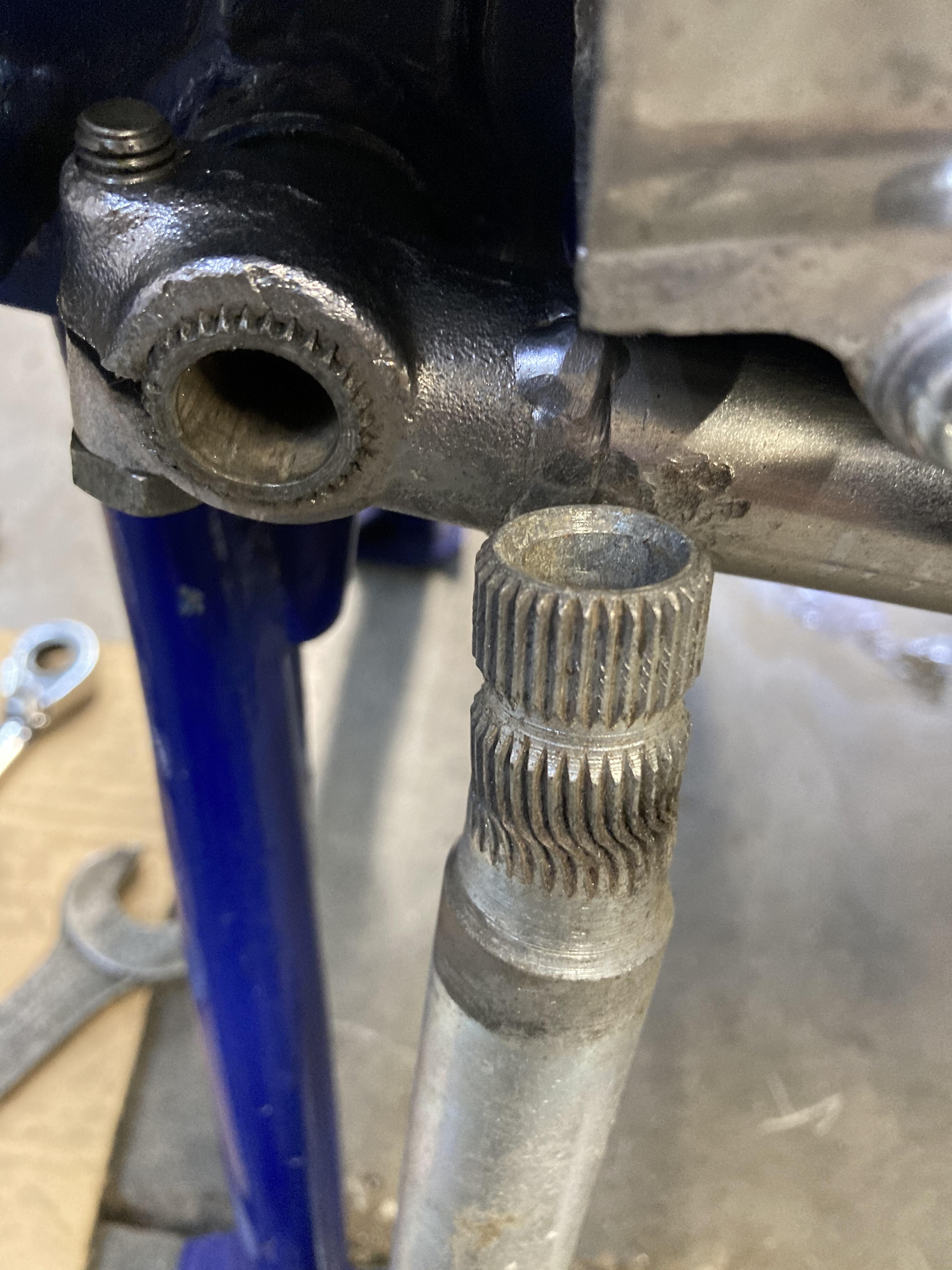
Good pic of a properly fitted rear brake arm on the splined brake cross shaft. The return spring makes them hard to fully seat and most used ones are bent, plus soft metal on the splines.
X5Zxhd2.jpg


Don't be that guy.

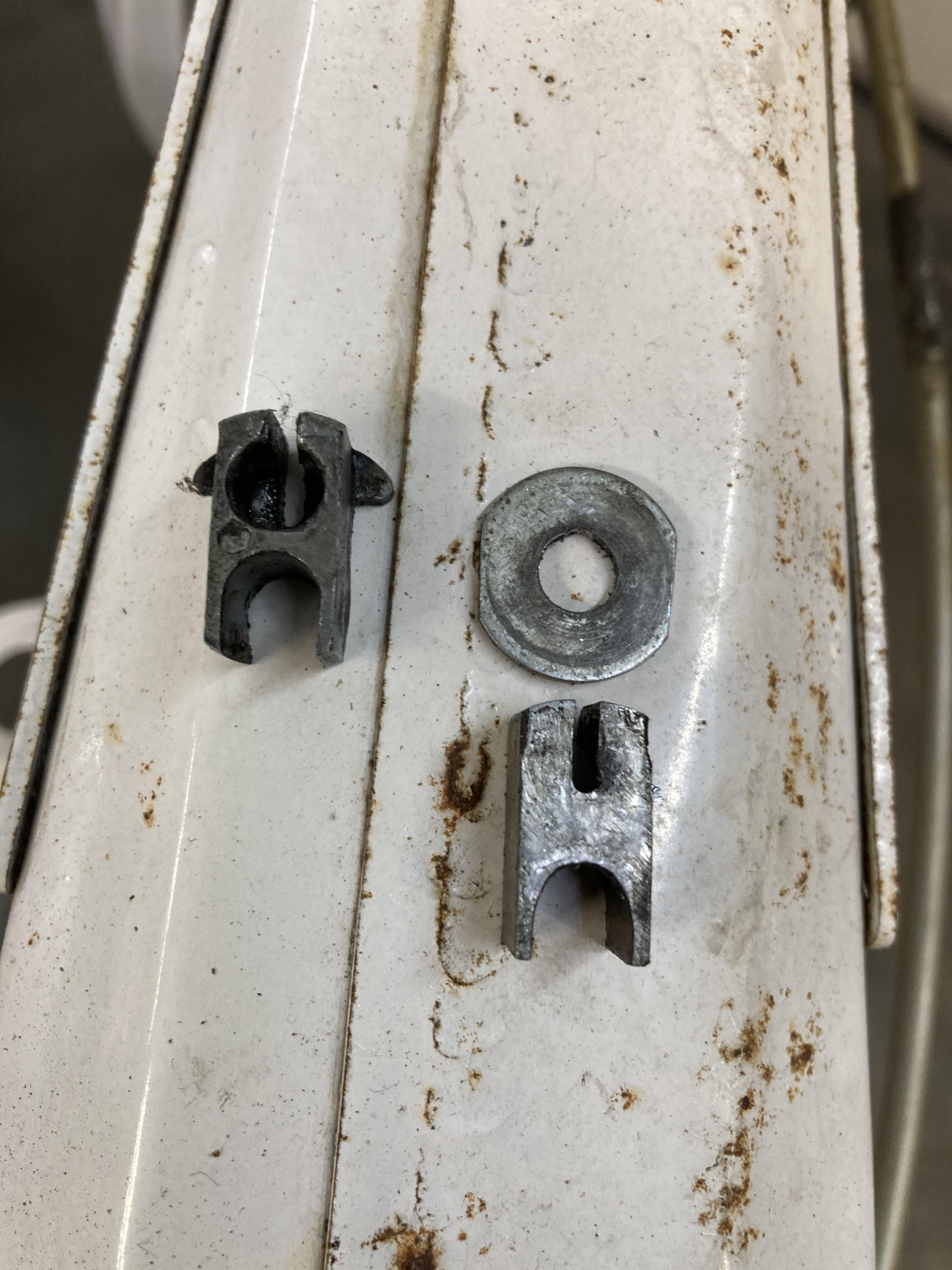
If the little ears are broken off the cable housing stop piece, that goes in the bars next to the sliding hinge, I fixed one with a steel washer with filed flats to fit the bar slot on a similar Benly throttle.

E7OCDpz.jpg
 
Just noticed, you have the straight down clutch cable, which is shorter. Maybe someone put on a later, 65, side cover. No problem.
 
That lower chaingaurd would get patched up, if mine. Mostly hidden by the muffler anyway. Mine was mostly bent bad, from running over a few cows on the farm, no doubt.
Not a happy parts hunt for them.
Thanks for the pics on proper assembly of the damper, makes more sense that way.

I checked prices for chain guard cases and they are around $300 o_O- a patch will suffice.

Good pic of a properly fitted rear brake arm on the splined brake cross shaft. The return spring makes them hard to fully seat and most used ones are bent, plus soft metal on the splines.
I haven't tackled the brake pedal yet just the linkage at the rear wheel. I will keep these points in mind when taking things apart and putting back together.

If the little ears are broken off the cable housing stop piece, that goes in the bars next to the sliding hinge, I fixed one with a steel washer with filed flats to fit the bar slot on a similar Benly throttle.
Mine is in good shape still has the ears - not a good pic but you can see the ears.
1757943550691.png
If the screw and bolt heads are any indication, I don't think this bike has been apart before. The only mangled screws were on the points and rotor covers due to normal maintenance. I believe my bike is a '66 so a straight clutch cable mount would be normal.
 
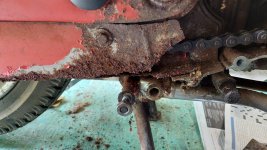
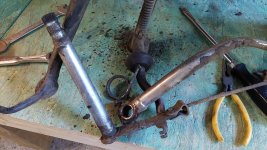
Small entry for today. I managed to remove the rear brake arm and associated parts without destroying anything. The spring that puts pressure on the brake arm prevents the brake pedal shaft from just being pushed out. To remove the spring pressure I used a clamp and drilled a little hole on the end of the clamp to catch the end of the spring. I used the foot peg bracket as the anchor point and managed to pull the spring back enough to push the shaft out about 1/4" and then let the spring go once the arm that the brake rod attaches to was clear of the spring. I'll figure something similar for the assembly.

20250915_171529.jpg

No damage to the splines or the pedal.
20250915_171857.jpg
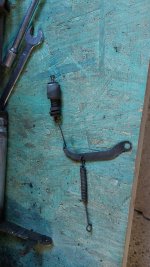
The brake light switch is not your ordinary spring to the pedal activation, so I thought best to take a pic of the set up so I can get it back together correctly with the springs in the right orientation. There is also a special shouldered bolt for that little arm.
20250915_173446a.jpg
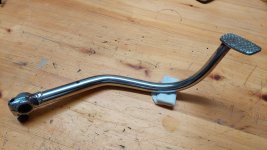
The grease and crud is actually turning out to be a bonus as it is keeping the chrome in good shape. The brake pedal after a little wipe down has just a bit of chrome flaking off near the spline area which I can paint silver as it will be hidden by the mufflers.
20250915_224441.jpg
 
Got a little time in today on the Dream. I removed the stater motor then took off the stator and drive sprocket then proceeded to loosen all of the mounting bolts. I went around and loosened all of the case screws next. I went to drain the oil, but that was already done by the PO - the head of the drain plug is mangled so that will need to be replaced. Thankfully it wasn't cross-threaded. I meant to take more pictures of the progress but got carried away removing bits and pieces.

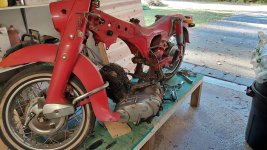
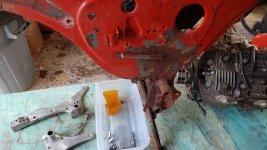
I removed one of the top engine hanger bolts and the bottom rear hanger bolts. I then put a long 1/4" nail in the lower hanger bolt area so I would have to fight taking a bolt out from each side. I let the rear engine weight rest of the 8" nail that went all the way thru to the other side of the frame. I wasn't sure if I would have to remove the front fender to get the engine out so I used a jack to raise the engine slightly and pulled out the last top hanger bolt and slowly let the engine pivot down on the lower rear nail I put though the frame. When I saw that it would clear I pulled the nail and let the engine settle on a block of wood. I then wrestled it off the block and it is now sitting on the work platform.
20251011_161239.jpg

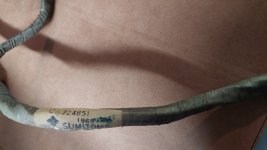
With the engine out of the way I took out the wire harness to see if it had a label with the date - it did, 1965. PO thought it was a '66, I will check some more on the serial number (C781003xxx).
20251011_161512.jpg

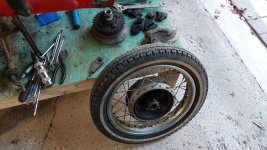
I then decided to remove the rear wheel. Took out the axle and then remove the right side with the sprocket. and the spacer on the left side. Tilting the wheel a bit and out it came. I put everything back together so I wouldn't lose any of the spacers or other parts.
20251011_163211.jpg
20251011_163417.jpg
I will replace the brake shoes but the rubber dampers are still very pliable so I will keep those.

I ordered a few parts to get things going in that department. Got the air filter snorkel and oil seal kit from Scrambler Cycle. I also finally found a set of C77 handle bars with the cut out for the hinge type throttle.
20251011_180801.jpg

Next step will be to bring the engine to the basement workshop where I can work on it during the winter.
 
Brad,

Looking good there. How did you manage to get a shipment from the US, or anywhere with Canada Post on strike? At least they are now moving to rotating strike locations next week. So hopefully some of the shipments will start to move at a snails pace here. (y)
 
Brad,

Looking good there. How did you manage to get a shipment from the US, or anywhere with Canada Post on strike? At least they are now moving to rotating strike locations next week. So hopefully some of the shipments will start to move at a snails pace here. (y)
My daughter in law brought it from the US when visiting. I have a US address I can ship to and usually someone in the extended family is coming or going to the US every few months.
 
Nice work there. The snout to the rubber boot on the aftermarket air cleaner came loose on one of mine so check it out and add a bead of JBweld or a screw just in case.
With the engine out of the way I took out the wire harness to see if it had a label with the date - it did, 1965. PO thought it was a '66, I will check some more on the serial number (C781003xxx).
Keep an eye out for the inked date stamps on hubs, brake plates, side covers, clutch basket and engine cases. It should read 40.xx.xx for a 65, not sure when they stopped using that year of the emperor (1925+) system. It must be a 65 because Charles bike is 101xxxx and all marks show 65.
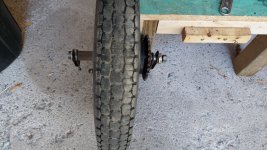
The rear hub spacer that gets lost easy, looks like a wedding ring, and sits in the outer seal of the sprocket hub.
Good on finding some original bars.
 
Good on finding some original bars.
They were off a CA77 so I will need to drill some holes for the winkers since mine is a C77 (or is it a C78 since the frame starts with C78?). I will look at some pics of some Dreams to get the location of the winker holes.
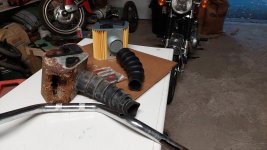
 
They were off a CA77 so I will need to drill some holes for the winkers since mine is a C77 (or is it a C78 since the frame starts with C78?). I will look at some pics of some Dreams to get the location of the winker holes.
The CA were US market, the C were other and had winkers. You may have the winker wiring in yours too. The US bikes never had winkers, unless possible dealer option.
Do you have the right side turn switch?
 
Brad it looks like you may have the turn signal wires in the one switch in post 79. I see a light blue and orange wire in that mix of the one switch
 
The CA were US market, the C were other and had winkers. You may have the winker wiring in yours too. The US bikes never had winkers, unless possible dealer option.
Do you have the right side turn switch?
Brad it looks like you may have the turn signal wires in the one switch in post 79. I see a light blue and orange wire in that mix of the one switch
The ape hanger bars had the turn signals mounted on them by using extensions on the wires. The bike also had the turn signal switch with the correct color wires. Now that I have original bars I will remove the wire extensions from the switches and just solder new terminals on the existing wires. The harness was made to accept the winkers, so no mods there.
 
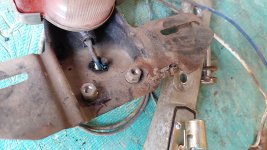
Got a few hours on the C77 this afternoon and progressed some with the disassembly. I removed the rear shocks and swing arm then moved to the support brackets and rear turn signals as well as the taillight. Looks like the taillight was developing a crack and the PO ran a bead of weld on the edge of the tail light bracket. Other than that the TL looks ok.
20251020_152558.jpg
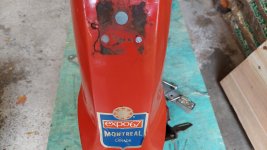
The rear fender suffered as well due to vibrations. There is an irregular crack and a dent that will need to get repaired.
20251020_152420.jpg
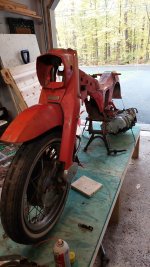
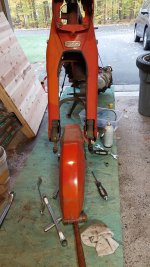
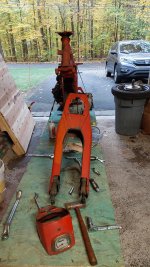
Moved the engine out of the way then I braced the rear of the frame so I could work on the front end.
20251020_154827.jpg
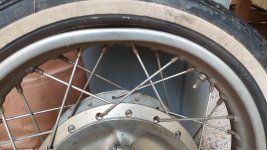
Was taking the front wheel off when I noticed the hub was damaged.
20251020_160545.jpg
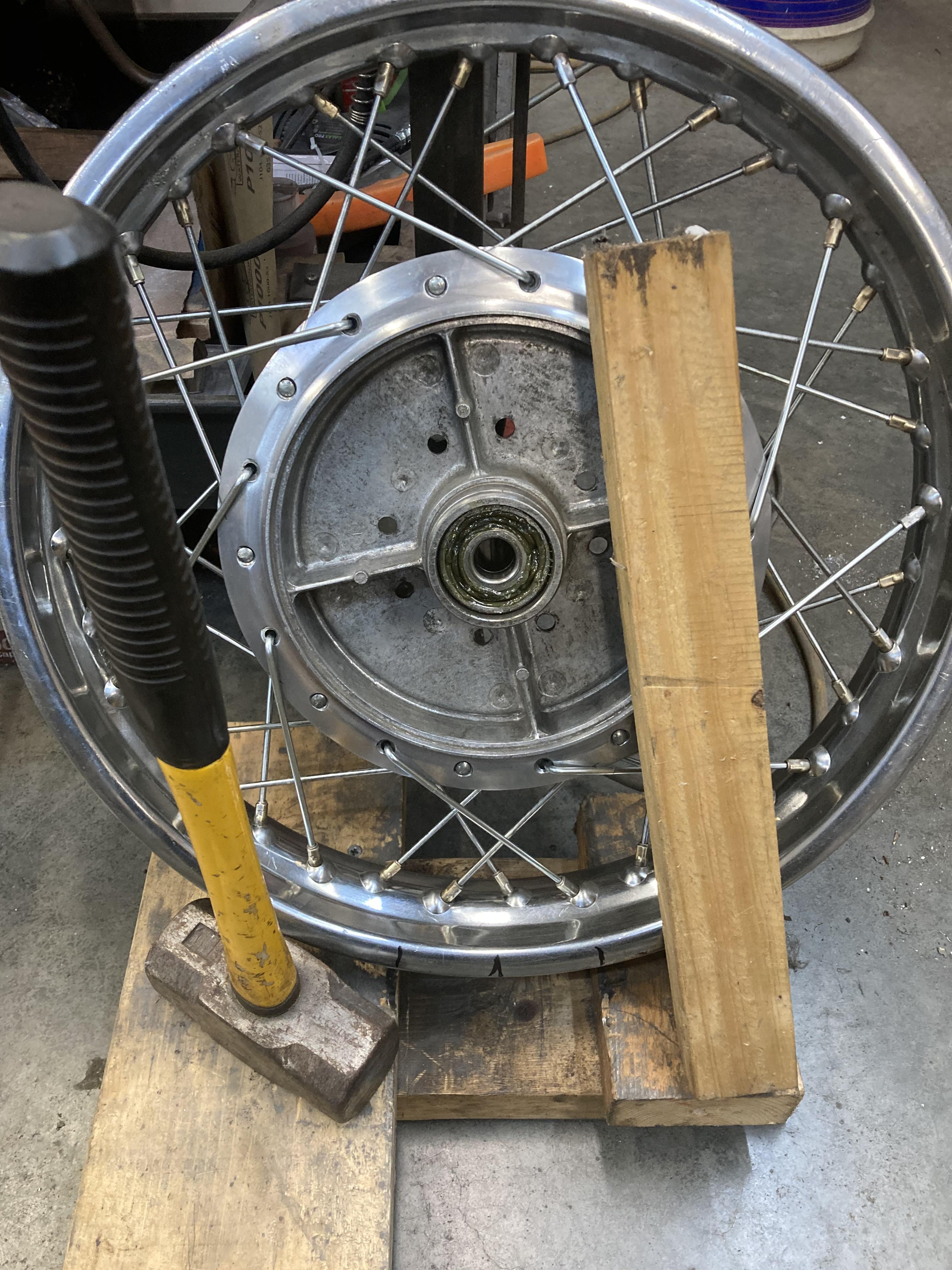
Got the front wheel out and noticed a big whamo on the rim. Maybe the hub and rim damage are related. Do you think the rim can be pounded back into shape? I think the rim and spokes will clean up nicely and would like to keep it original if possible.
20251020_161520.jpg
Moved on to the front fender and it was not easy to remove. I don't know how one would get a freshly painted fender back on without scratching it up.
20251020_163418.jpg
Headlight and front shocks were next to come off.
20251020_164633.jpg
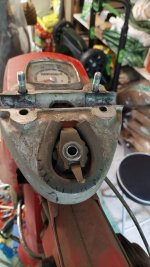
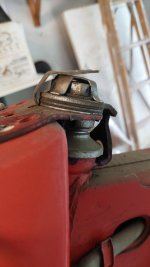
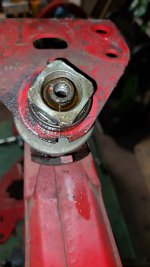
The steering stem nut is really stuck on there. In hindsight I should have loosened it once the handle bars were off. It's hard to get any leverage now that it's only the frame sitting on the main stand. I shot some PB Blaster and will let that soak overnight - enough fun for one day ;)
20251020_165733.jpg
 
Good progress. If at all possible, you have to try to keep that Expo 67 sticker on the rear fender, that is classic.

I've straightened a few steel rims bent like that with a big hammer and block of wood, they never get completely straight again but usually close enough to ride and not feel.
 
If at all possible, you have to try to keep that Expo 67 sticker on the rear fender, that is classic.
I would like to keep that sticker but there is a lot of rust on the right side of the frame. I was debating on whether to keep the original paint or take it all down to bare metal and repaint everything. I'm leaning towards keeping it original but will have to see if I can get some rattle can mixed up that will be a good match.
20251020_152528.jpg
 
I would like to keep that sticker but there is a lot of rust on the right side of the frame. I was debating on whether to keep the original paint or take it all down to bare metal and repaint everything. I'm leaning towards keeping it original but will have to see if I can get some rattle can mixed up that will be a good match.
Yeah, it's a tough decision because matching the paint on these bikes at their age is tricky at best. Such a cool artifact that it would be a shame to see it have to go, and at its age I'm sure getting that sticker off in one piece is highly unlikely.
 
Yeah, it's a tough decision because matching the paint on these bikes at their age is tricky at best. Such a cool artifact that it would be a shame to see it have to go, and at its age I'm sure getting that sticker off in one piece is highly unlikely.
Low heat and patience will probably get that decal/sticker off.
Possible a heat lamp directed at the back side of the fender and a credit card
 
Soaked in patience, that's it.
Too bad about that chunk broken on the hub. I doubt the flat spot is related per se. I'd fix the flat spot before replacing the hub. I must have done 4 or 5 spots on mine with the 2x4 and a 5lb. sledge. Mark the rim, make a cradle. Definitely do-able. soak nipples, loosen all the spokes some first and the 4 right where you smack it a lot.
yVH1LbB.jpg


Red always fades the worst. Might be worth the elbow grease to scrub and rub it to get the surface oxidation off. I'd spot repaint the side lower damage as not very noticeable down there.
These hussies shake they're hinney so much, all of them seem to fracture the fender. After welding and reinforcing, I still mounted mine on a layer of rubber.

The lower front shock pivot bolts are a #4 JIS impact bit and they are a bear.

Thanks for a pic of the rear winker bulb holders. I've never really seen one.
 
I just found this tread, and it's been a fun read to see your progress. I've got an early '65 CA77 that I'd like to install some non-US model parts on (mostly turn signals), so seeing the specific differences between yours and mine is both helpful and really neat. I agree these bikes are not very mechanic-friendly at all- it seems Honda got better at that the longer they built bikes.

(Oddly enough, my handlebars were drilled for turn signals, despite being a US model, midway through the Dream production run. These bikes sure are strange.)
 
Back
Top Bottom