1968 CL450 restoration

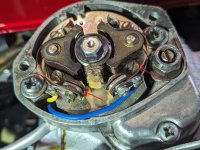
In the picture of post #150, there seems to be a gap on the left point connection between the screw mounting lug and the insulating washer. Is there something in there keeping the insulating washer from seating?

Also, the right points spring seem to be awfully close to the mounting screw, maybe it is arcing there and shorting out. I think the screw heads are a bit large.

points2.jpg
 
The only thing that really matters is that the insulators are separating the things that shouldn't be connected. In this case, this means none of the conductors in this "sandwich" should be touching the base plate.

I'm wondering if the blue points connector is tilted so that its corner is touching the plate. It's hard to discern in the photo.

PXL_20240511_221717617[1]~2.jpg

You're testing without the points cover for the time being? That at least eliminates one possible grounding location.

I agree with @boddy about the mounting screws — they seem awfully close.
 
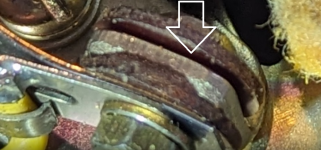
This doesn't look right, it makes me wonder if the center insulator around the small bolt is properly in place or has shifted

View attachment 32501
Yikes, that is the yellow side that I didn't tamper with... I hope that the insulator is not damaged...

Thanks @ancientdad

I will also check for arcing in between the points and the screws, but the photo did misrepresent the distance there, there is at least 4 mm clearance. Thanks to everyone who replied!

I should have an answer tomorrow!
 
So, I need a sanity check:

I checked everything mentioned above, including the insulators and mounting bolts/washers. All seemed to be in order, but the test light stays on at all times (on both sides) when I spin the rotor the full four strokes.

I decided to try something but I'm not that what I discovered means anything:

I disconnected the yellow and blue wires at the bike end and connected a jump wire to the yellow one and the positive battery terminal. Both breaker points were open The indicator light comes on when connected to the yellow side, but not on the blue side. The Blue side lights when electricity is applied to the blue wire. What I think that I proved here was that the continuity is sound in the two wires (no short there).

I then rotated the engine until the blue side was firing (closed) at the connector and connected the test light to the yellow side bolt. It did not light up. I then rotated the rotor four full turns and it never lit up. Did the same thing in reverse (power to yellow, test light on blue... same thing, never saw the test light go on.

Again, when you connect the test light to either side when connected to the bike, the light stays on all through the cycles...

What I believe that I have discovered is that the short is not in the points (which is not a good thing because wiring is not my forte).

If you agree that I have proven that the points are not the issue, what would be the next most likely culprit?
 
I disconnected the yellow and blue wires at the bike end and connected a jump wire to the yellow one and the positive battery terminal. Both breaker points were open The indicator light comes on when connected to the yellow side, but not on the blue side.
What you've described here would seem to indicate that the left points (yellow wire) are grounded despite them being open.

Did you ever confirm that the gap I pointed out between the frame of the points and the inside fiber washer is part of the problem? If the center (tubular) insulator around the bolt got out of place it could create that gap, and if so it could mean the bolt itself is contacting the metal frame of the points which would cause what you've described.

And again, pictures accompanied by words is always better.
 
What you've described here would seem to indicate that the left points (yellow wire) are grounded despite them being open.

Did you ever confirm that the gap I pointed out between the frame of the points and the inside fiber washer is part of the problem? If the center (tubular) insulator around the bolt got out of place it could create that gap, and if so it could mean the bolt itself is contacting the metal frame of the points which would cause what you've described.

And again, pictures accompanied by words is always better.
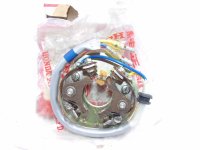
Yes, I took both sides completely apart and re-assembled them (which is no easy feat). I am sure that the inside cylindrical insulators are in place on both sides. When I put them back together they still showed the gap, but I then started searching for images of OEM points for sale and found this on e-bay:

s-l1600.jpg
The insulators seem to curl away from the frame of the points with age maybe?

The passage that you quoted was where I think that I was testing the wires running through the fabric and canvas (and rubber seal). The fact that yellow grounded was likely because I grounded the test light and completed the circuit. If that had also occurred when I connected the blue nut to the test light, then I would have suspected that the short was in the wires, but it did not.
 
I just re-did what I believe will test the wire continuity:

PXL_20240512_170841203[1].jpg

Both gaps breakers open, circuit runs through yellow wire to left point to light to ground
PXL_20240512_170857906[1].jpg

Circuit runs to left point but does not cross to the right point. Is this logic sound? I am really bad with electrical so I could have missed something.

PS The result is the same if I put power to the blue wire: right point gets power, left does not.
 
If I leave it connected as above, and turn the motor four whole strokes, the opposing point (in this case the blue) does not ever light up, which indicates that the point does not short at any point in the four strokes. However, if I connect through the bike, the light never goes off (on either side). This video shows only one rotation of the cam, but all four are the same, both sides)
Does this mean that the short is higher up in the system, or am I completely out to lunch with my diagnostics?
 
Why don’t you try to isolate the problem?
unplug the points from the harness and remove the points plate from the bike, the connect your tester between the points plate and the the blue and yellow wire, one at a time and see if the circuit breaks when you open and close the points.
something’s touching somewhere. If all clear, reattach to the bike and make sure the metal strip of the points isn’t touching a screw or the plate itself.
 
Why don’t you try to isolate the problem?
unplug the points from the harness and remove the points plate from the bike, the connect your tester between the points plate and the the blue and yellow wire, one at a time and see if the circuit breaks when you open and close the points.
something’s touching somewhere. If all clear, reattach to the bike and make sure the metal strip of the points isn’t touching a screw or the plate itself.
It was mostly because I couldn't get my head around how to do it. so I owe you a sincere thanks.

Here is what I did (demonstrated on my old plate because too many hands were required on the bike).

Using my multimeter, testing resistance, I tried what you said, essentially, one end on the wire end and one on the base plate. On the new points there was no resistance closed or open, on the old one (shown) there was resistance closed, but not open (circuit completed closed both sides).PXL_20240512_184746855[1].jpg

So, of course, I figured that I should check the points themselves:

PXL_20240512_190035946[1].jpg

Doing this worked, and it should have because both needles were on the same side of the gap.

PXL_20240512_190041791[1].jpg

Cross the gap, even closed, and there was no circuit (there was, of course on my old set).

This is where I get all embarrassed and ask: Do you need to sand the points surfaces of new points before using them. I have to assume that there is some sort of non-conducting protective film that I have to remove.
 
Absolutely did and the issue cleared up. Got the points set but still having starting issues. Looking at the carbs again.
 
OK, since the carbs were working last week, I decided to check for spark when I got home from work today. NO SPARK...

When I first tried to start it yesterday, I got about 3 fires when I first pushed the button (the first time), but then I guess the spark died.

Going in tonight to recheck the points, but I am also going to buy a new condenser. Does anyone have recommendations for a good quality one?.
 
Going to be three to 10 days before I get the condenser.

One last question: Since the spark was absent on both sides, it is most likely to be the condensor, and not the coils, right?

(both came with the bike and I'm not sure if I should be thinking of a complete electrical renewal (not my preference).
 
One last question: Since the spark was absent on both sides, it is most likely to be the condensor, and not the coils, right?
The condensers help reduce arcing (sparks) on the points when they open, so faulty condensers are unlikely to cause loss of spark.

I would verify power to the coils and make sure the points are opening and closing as expected.
 
Points are verified. How would I verify power to the coils (other than removing and grounding a spark plug while starting)?
 
Thanks @stl360+450 and @boddy

PXL_20240515_003217928[1].jpg

Results varied. Pictured was the lowest, but it wanted to hang around under 4 volts. I watched it slowly climb to 12.3 once but that was short lived and I could not repeat that measure (don't know what made that occur) but red was connected and black was not grounded when that happened). Electrical and me are not friends...


Does this result mean anything to you?
 
There is exposed metal on that connector where the red probe is positioned? I would've expected that to be touching the plastic cover...

Have you located the black wire with the white stripe? I would actually disconnect the coils from that wire and measure its voltage with the key on and kill switch in run position. Should be 12V. The negative terminal (black wire) could be positioned anywhere on the motor.
 
FR, If it is similar to CB350K4 wiring then I think that double connector you have the red probe on goes to both Coils supplying 12v, and hence both capacitors. ( there are actually two capacitors mounted end by end. ) If you then switched on the ignition then low volts going up to 12.3v which is near enough your static battery voltage with motor off is the capacitors charging. They are only a few Micro farads.
You can re-test this by turning Ign off, connecting where you have the probe in the Pic to chassis with a straight wire; to discharge the capacitors ( you may get a little spark ), reconnect your probe, turn Ign back on and the same low to 12.3V should re-occur.
so out come looks like 12.3V is at least/probably getting to the coils and capacitors.

Another test of the coils and HT line to the spark plugs is you can use your finger nail to open one of the closed points and you should get a spark across ( high voltage) connected spark plug lying on the case for a chassis/earth connection and a small one ( low voltage ) across the points . To see this you may have to do it an unlit garage.
Rotate the engine to do the other set of points

Cheers
 
The probe is inside the plastic, touching the connector and the black wire with the white stripe is visible beside the probe. I didn't think that this wire could disconnect from the coils, will check...
 
Thanks @GaryJames

Mission accomplished by the first test. Will test the coils as per the link that @stl360+450 provided, but good to know that I had a solid 13 while it charged up... Shot the photo just a fraction too late...

PXL_20240515_012135325[1].jpg
 
I started with plugs that would not fire on either side. They are gapped appropriately

Was not able to do all of the tests on Stan Lipert's diagnostics thread due to tools, but I did see that there is no leakage from the windings to the iron core in the Coils. PXL_20240516_223746037[2].jpg

The Primary coil came in at 4.9 (but the reading was squirrelly it fluctuated up to 6 depending on how the sensor was laid over the black/white wire).

PXL_20240516_223824119[1].jpg

Secondary coil was 4.5 but had the same unsteadiness. For both of these, I took the measurements as the one that I was able to maintain, and just noted how they fluctuated during poor contact.

PXL_20240516_224040242[1].jpg

It was when I tried to measure the secondary coil resistance that this went awry, as there seemed to be no completed circuit. I'm not sure if the problem is the coils or the limits of the multimeter.


PXL_20240516_224217970[1].jpg


So, what I did was put the new condenser on, put the entire unit back on the bike, and tested the plugs again. There is a weak spark, that presents more like a flame to a orangish spark on the left side. I know that this is not optimal. The right still has no spark. This is funny because when this bike ran on only one cylinder, that cylinder was the right one... so something has changed.

So here is the state of affairs:

Newish plugs (old ones with resistors) (no miles but fouled by lots of poor running)
New NGK caps without resistors)
Coils that worked before the engine rebuild
new condensor
new points (NOS)
Modern combination regulator/rectifier.

Can anyone move me forward in diagnosing this?
 
Last edited:
The secondary resistance is on the order of 15 kOhms, so maybe your meter won't go that high. If it has a manual you could check to see what it says about resistance measurements. Many meters allow you to choose the range 6, 60, 600, 6000 etc.

Do you have a [static] test light? They run about $10 and would allow you to visually confirm that the points are functioning. You could also pick up a volt meter for about the same price that would have different resistance ranges.

You could also swap the coils to see if the spark follows the coil or stays with the cylinder.
 
I don't, have those but both would probably be good additions. Thanks @stl360+450

NEW INFO... which I probably should have realized...

This past weekend I left my key in the on position for two days (this was after getting no spark). The entire time that the battery was draining it was connected to a battery tender, so when I went in two days ago to #$#@ around with it, I found that the neutral light was on very dimly. After a whole 24 hours, my glass mat battery was at 12.4v, which was when I last tried to check the spark. Orange flamey spark on left, no right spark.

I just went down now and tried it again... white spark on both sides (though the left is brighter white). Battery reads 14.1 volts after the test.

This weekend I will try to get her back together and see if this spark is temporary, but in the mean time, are there any adjustments that I could make on the right side? (I'm assuming narrowing the gap, but this is not my forte).
 
Last edited:
This weekend I will try to get her back together and see if this spark is temporary, but in the mean time, are there any adjustments that I could make on the right side? (I'm assuming narrowing the gap, but this is not my forte).
That's great. Personally, I would just leave the gaps alone since they are already in spec. People say that leaving the key on can cause a coil to overheat, so hopefully you managed to dodge that given that you had spark on both sides.

Good luck once it's back together. Hopefully you've got it now.
 
OK, this is really starting to irk me. Still doesn't start.

I pulled the plugs again to test, and still have a bright blue spark. The new problem is that the spark is not regular on either side. It hits about 75% of the time.(probably was the same yesterday but I didn't notice because I was just happy to see the sparks.

(I'm also not smelling a lot of gas so maybe a full turn out on the air fuel mixture is not enough... but lets start with the spark)

:mad:
 
You get no popping sounds of combustion from either side? Even if the spark were intermittent, you'd think it would pop or occasionally BANG. You tried with and without choke?

Turning the mixture screw out produces a richer mixture (more fuel). The float height also affects the idle mixture.
 
Did you ever confirm that that open circuit of your left coil, the secondary resistance, was due to your meter?
Perhaps the high-tension side of your coil is burned out?
It also might have burned out a coil if the points on that side were closed while the key was in the on position for 2 days.

A question for EE’s: is it possible for a coil with a burned high-tension circuit to still exhibit a weak spark at rest but fail under load?
 
I am asking for a sanity check.

The bike is still not starting, but I have found another issue that will stop me from passing the local safety inspection (and who knows, may somehow have something to do with my weak spark (though I doubt it)).

My high-beam works fine, and my low-beam does not work at all. I have tested the sealed unit, both work fine. I have tested the white and blue wires with my multimeter (Blue=12.5 V when high is in, White = 0 V when low is on) This has evaded my notice for months because I have had the headlight switch in the off position during these repeated bouts of trying to get the bike running properly.

My question: If the High-Beam works and the low beam does not, does this automatically mean that the problem is in the switch? I really don't want to go in there again if it turns out that there are other places that could be grounding out the low-beam.
 
My question: If the High-Beam works and the low beam does not, does this automatically mean that the problem is in the switch?
Yes, it's more than likely dirty contacts in your switch. The black wire feeds power to either the high beam or low beam. Since the high beam works the issue is not power to the switch, it's power to the white wire.
 
It's not automatically the switch, but an order of magnitude higher than the other possibilities.

If you didn't have your kill switch set to off, there's a really good chance you've got a fried coil. They don't do well just plugged in and fed power, and could explain your intermittent spark issue.
 
Assuming the CB450K1 uses the same style headlight switch connections (aside from the lack of kill switch on the right handlebar switch assembly), is it possible the white with yellow tracer has been confused for the white low beam wire? I've seen them transposed before but can't recall what the outcome was.
 
there's a really good chance you've got a fried coil. They don't do well just plugged in and fed power, and could explain your intermittent spark issue.

Thanks Pete. I replaced the coils yesterday so if one of the coils was fried when I left it on for a few days, that one is now off of the bike. This being said, I cannot discount that one of the new ones might be defective.

Assuming the CB450K1 uses the same style headlight switch connections (aside from the lack of kill switch on the right handlebar switch assembly), is it possible the white with yellow tracer has been confused for the white low beam wire? I've seen them transposed before but can't recall what the outcome was.
It definitely is connected to the white wire. I double checked and even tested the White-yellow wire, which is at 1.3 V no matter where the headlight lever is positioned.

PXL_20240621_211344440[1].jpg

This mount is brand new, but I still tried electrical cleaner on the switch.... no luck.

I tried to disassemble my old one to fix the starter connection, which had come off. The damage that I caused to the brass screws on that one is what forced me to buy this one. Any advice on getting these ones out? (and then back in?)
 
I'm late to this discussion, but still ... do you have a JIS screwdriver? If not, stop what you're doing and get one.
 
I'm late to this discussion, but still ... do you have a JIS screwdriver? If not, stop what you're doing and get one.
And really, all 3 JIS sizes, he'll need the #1 for that. This situation would be perfect for the T-handle with the #1 bit.
 
I do have JIS drivers, but not a T-Handle. So is this just a matter of strongarming with as much pressure as I can force, or would you recommend lubricant and/or heat?
 
Leverage is a big deal with these little screws because the slightest corrosion causes them to stick enough that the heads get destroyed easily. If you can get a little impact into the screw, like one modest whack with a hammer on the screwdriver to help break it loose, that often is the difference. A T-handle gives you really good leverage as well as a point to apply a lot of downward force to help stay tightly in the screwhead. I suppose heat would help, but you do have electrical and plastic components to avoid damaging too.
 
Update, and of course another question:

Took my handlebars off to take a look for a short or a break in the white wire. After using an impact driver on the screws above I found that the white wire was disconnected at the black plastic bar that is the switch. Should have taken a photo of the soldering job, because I am proud of how great it looked (oops).

Put it all back together and today I gapped some new plugs (because I suspected that the issue may have been to old ones, and she fired right up. A few adjustments later and I had her idling at a good rate (I have to admit to a few window rattling moments at the beginning because it was running rich and fast.

I am relieved that I have finally got this thing running and am hoping to get it on the road this week. One last concern that is likely to thwart my plan:. There is a noise, like a chain pulling and something squeaking that you can hear while the bike is running. On my laptop you can hear it throughout this attached video, but on youtube it has mostly been lost, except for at the end of the video, when I cupped my hand around the microphone (you will see my hand on the way to cupping). Please let me know if this sound is normal (my first 450).

 
Last edited:
Double check your cam chain plunger isn’t stuck. A loose chain may be the source of the rattle.

With engine off and cool, loosen the adjuster jam nut/lock bolt. If no snap or click is heard, insert a nail or small screwdriver in the back of the adjuster just to ensure it’s not hung up or jammed in some way. It’s open to dirt fouling so you’re just ensuring no issues there. Snug the bolt and jam nut after…not a monster reefing down! Just snug is fine.
 
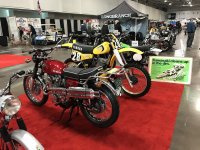
Still dicking around to try to get this bike to be a regular rider, but first an update.... I entered it in the Toronto Motorcycle Supershow last year and received a third place plaque in the Vintage "Asian" Category (behind two Kawasakis). Luckily, it did not have to run properly for me to trailer it to Toronto in mid winter. I then entered it in the local show in 2026 and it was completely ignored: it is not British...

E3A2B2C4-1D51-44AC-9DD7-24E812A7FB5F_1735856591304.jpg
PXL_20260424_205048848[1].jpg

Since that time it has not been ridden much because of a carburation problem.

I have another video:


As you can see, the revs come up quickly, but do not subside when I throttle off. The cables are fine, I think that this is something else, but I am not sure what. I made sure that the sliders moved freely in both top-caps, but right now that is my theory... Sliders sticking.

Before I go into some unnecessary work/hardship... could somebody please let me know if I have missed the remedy completely? I have read that this could be a vacuum issue, but, of course, no vacuum tubes on the Keihns.
 
Last edited:
Can't recall if you checked your spark advance. If the advance doesn't snap back due to weak springs, this can cause the idle to hang. Some have remedied this by cutting off half a loop of one of the springs to shorten it.
Thanks @boddy ,

I did check the spark advance, a year ago. Should that be the first thing that I re-check, or should I continue with the sticking slider theory?
 
Back
Top Bottom