

-
Don't overlook our Welcome Package, it contains many links to important and helpful information about functions at VHT like posting pictures and sending PMs (private messages), as well as finding the parts you need.
AD
You are using an out of date browser. It may not display this or other websites correctly.
You should upgrade or use an alternative browser.
You should upgrade or use an alternative browser.
1968 CL450 restoration
- Thread starter Flight Risk
- Start date

wentwest
Veteran Member
It's really not a lubrication problem, it's often a spring problem. Those springs are supposed to pull the weighted levers back when the revs drop, but after decades of pulling they are just losing their strength. Replacements are not easily found, so you can try shortening them and bending a new hook. Do just one at a time, they both act on both weights the way things are built. You can see the effect of the worn springs if you use a timing light while the engine is running. There are long discussion about this - try using a Google search of this site.

You should take a long hard look at a vacuum leak. The Kehins 100% operate on vacuum - that’s what the sliders are.Thanks @boddy ,
I did check the spark advance, a year ago. Should that be the first thing that I re-check, or should I continue with the sticking slider theory?
Generally, this leak will be between the carb and the head. Usually it’s th boot not clamped or seated well. Second most common would be a leak between the isolator and the head.
Set the engine to idle and spray some carb cleaner around those areas. When it hits the leak, RPM will bounce up.

You could remove the top of the carb and check that the piston moves freely in the top. You might also look at the plastic cover in the top to make sure it is not cracked or leaking.
Flight Risk
Veteran Member
Update: Carb Cleaner around both the head end and the carb end of the Insulater/Boot did not increase RPM at idle.
I have pulled the spark advance: True confession, I purchased a used Spark Advance on E-bay a few years ago, and I just installed it because it was clean, keeping my original as a backup. What I did not do was take it apart and lubricate it, thus my logic jump to lubrication. The springs originally in my bike had 10 curls a side (though one is stronger than the other because it hammers the cam harder when it springs back). The one that I purchased and installed had two shortened springs (one a curl shorter than the other (8 and 9 curls respectively), but they both make the same noise when I click them against the cam.
I am currently cleaning and lubricating both spark advance units and I will see if either of them corrects the issue. If not, the tank gets emptied and the top covers come off the carbs for inspection.
Thanks @boddy and @EzPete for your help. Will post again when I know.
I have pulled the spark advance: True confession, I purchased a used Spark Advance on E-bay a few years ago, and I just installed it because it was clean, keeping my original as a backup. What I did not do was take it apart and lubricate it, thus my logic jump to lubrication. The springs originally in my bike had 10 curls a side (though one is stronger than the other because it hammers the cam harder when it springs back). The one that I purchased and installed had two shortened springs (one a curl shorter than the other (8 and 9 curls respectively), but they both make the same noise when I click them against the cam.
I am currently cleaning and lubricating both spark advance units and I will see if either of them corrects the issue. If not, the tank gets emptied and the top covers come off the carbs for inspection.
Thanks @boddy and @EzPete for your help. Will post again when I know.
Flight Risk
Veteran Member
OK, Spark advance cleaned and lubed (I put in the one with the shortened springs because they provided more tension) and I re-set the timing. I may eventually try the un-shortened spring one because carburation issues seem to be limiting me to under 60 miles per hour and that may also be too tight springs in the advance, I believe (but first things first).
No change. I did notice that the engine responds appropriately while it is warming up. Once the engine is warm, it stops returning to idle quickly when the throttle rolls off, and the RPMs go high rapidly as I roll the throttle on.
Next step:
I drained gas and removed the tank (man I hate doing that, and so does my driveway).
The sliders move freely in the top-caps, however, could this be the problem:
Right side only, left side is dry...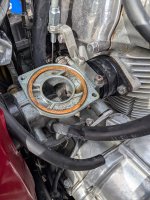
That is gasoline under the slider. I'm not sure how this happens, but I don't think it is normal and I think it likely is the cause of the high RPMs.
Symptoms:
1/ The spark plug on the right is forever more carbon encrusted when the engine decides to stop running due to no spark. Clean the plugs (both sides) and the show starts over... Plugs will likely be fouled and not creating spark again within 50 miles.
2/ Both of the idle jets are set at 3/4 of a turn from full off (reduced from about 1.5 turns the other day because of fouled plugs).
3/ When both cylinders are firing at cold idle (the right (I believe) sometimes does not fire) then the engine responds appropriately to the throttle, but once the engine is warm the RPMs soar easily and only slowly come down.
I have not filled the tank and tested since removing the gasoline from under the slider, because I don't want to drain it again when somebody smarter than me tells me what I have to do next.
Has anyone seen this before and is this something that I might be able to fix?
No change. I did notice that the engine responds appropriately while it is warming up. Once the engine is warm, it stops returning to idle quickly when the throttle rolls off, and the RPMs go high rapidly as I roll the throttle on.
Next step:
I drained gas and removed the tank (man I hate doing that, and so does my driveway).
The sliders move freely in the top-caps, however, could this be the problem:
Right side only, left side is dry...
That is gasoline under the slider. I'm not sure how this happens, but I don't think it is normal and I think it likely is the cause of the high RPMs.
Symptoms:
1/ The spark plug on the right is forever more carbon encrusted when the engine decides to stop running due to no spark. Clean the plugs (both sides) and the show starts over... Plugs will likely be fouled and not creating spark again within 50 miles.
2/ Both of the idle jets are set at 3/4 of a turn from full off (reduced from about 1.5 turns the other day because of fouled plugs).
3/ When both cylinders are firing at cold idle (the right (I believe) sometimes does not fire) then the engine responds appropriately to the throttle, but once the engine is warm the RPMs soar easily and only slowly come down.
I have not filled the tank and tested since removing the gasoline from under the slider, because I don't want to drain it again when somebody smarter than me tells me what I have to do next.
Has anyone seen this before and is this something that I might be able to fix?
Last edited:
An auxiliary fuel tank helps when you are trouble shooting, so you don't have to install the gas tank. You can buy them online or make your own.
Are the float levels set correctly? Could be the float level is too high. You can measure the float level or use a clear piece of tubing connected to the float bowl drain opening to see where the gas in the bowl rises to.. I had a random piece of plastic pipe that I force threaded into the drain plug opening. The plastic end was ground down a bit so I could start threading it into the hole.
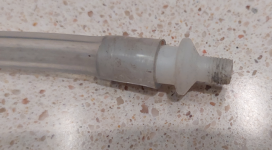
Are the float levels set correctly? Could be the float level is too high. You can measure the float level or use a clear piece of tubing connected to the float bowl drain opening to see where the gas in the bowl rises to.. I had a random piece of plastic pipe that I force threaded into the drain plug opening. The plastic end was ground down a bit so I could start threading it into the hole.
Flight Risk
Veteran Member
Float levels are definitely correct. I did have an issue with them early on.

12ozPBR
Veteran Member
- Joined
- May 31, 2020
- Total Posts
- 938
- Total likes
- 721
It seems odd to me that your throttle cables are set with apparently no slack to loosen any further tension at each carb? Do you have most of the slack taken out at the handlebar adjustment? It makes me wonder how you have these carbs synced correctly. On my 450 I have adequate adjustment in both directions both at the carbs and on the handlebars, and it’s always a back and forth dance between all of the adjusting points to get the sync correct.

Flight Risk
Veteran Member
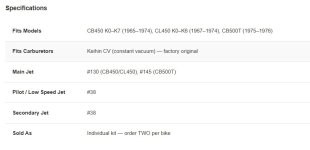
I used the those guys in Houston Carb rebuild kit for the older CL450 models.
Flight Risk
Veteran Member
It seems odd to me that your throttle cables are set with apparently no slack to loosen any further tension at each carb? Do you have most of the slack taken out at the handlebar adjustment? It makes me wonder how you have these carbs synced correctly. On my 450 I have adequate adjustment in both directions both at the carbs and on the handlebars, and it’s always a back and forth dance between all of the adjusting points to get the sync correct.
View attachment 57184
Yes, this is true. Any tension taken off would have to come from the top.

stl360+450
Veteran Member
My experience has usually been that the cable adjusters at the carb are not in the same position, because the throttle cable runs along one side of the frame and that makes the paths to the carb have different lengths after the the split. This is what @12ozPBR was wondering about.Yes, this is true. Any tension taken off would have to come from the top.
You have confirmed that the throttle arms move in unison when you open the throttle?
Flight Risk
Veteran Member
I have confirmed that the cables/throttle bodies on each side move at exactly the same time, and the right side has more tension as noted by the larger gap at the RH adjuster. The camera focused on the left side, so it looks like they both are touching the locking nut, but the left side is the only one that actually touches, there is about a thread and a half in the gap on the right. The cable after the split is physically longer on the left side (I did not buy this cable, it came with the project).
These carbs were bench synched, so there should be no need to put any more slack in, but over time the cables will stretch and there is lots of room for taking up tension.
The new jets were not really needed to make the bike run, but I wanted new for my restoration. I think my next move is to pull the carbs and put the old jets back in. Unless there is another alternative...
These carbs were bench synched, so there should be no need to put any more slack in, but over time the cables will stretch and there is lots of room for taking up tension.
The new jets were not really needed to make the bike run, but I wanted new for my restoration. I think my next move is to pull the carbs and put the old jets back in. Unless there is another alternative...
Last edited:

Jays100
Veteran Member
Some old floats may leak, may be why the one side is acting crazy while the other is okay. It would be be worth dropping that bowl, removing the float and giving it a good shake. It’s very obvious if there’s fluid inside. Would only take about 15mins start to finish.
BTW, Scrambler Cycle carries them.
Something to consider anyway.
Also check the bowl gasket isn’t distorted and fouling float movement. Ask me how I know…
BTW, Scrambler Cycle carries them.
Something to consider anyway.
Also check the bowl gasket isn’t distorted and fouling float movement. Ask me how I know…
12ozPBR
Veteran Member
- Joined
- May 31, 2020
- Total Posts
- 938
- Total likes
- 721
The throttle plates may move at exactly the same time but if the cables remain under tension 100% of the time it could be keeping one or both slightly open at rest resulting in a run up in RPMs. The throttle STOPS on each carb should control the plate opening at idle, preserving your bench synch. Ideally I like my cable at each carb to have a touch of slackness ensuring that the throttle plate closes based on the stops. A slight twist of the throttle immediately provides tension and then synchronized opening can be assessed and tuned. I find that having room in or out at all the cable adjustment points helps dial this in best. It usually takes some back and forth between all adjustment points to get it right, all the while being mindful of not altering the ability of the stops to control idle. Additionally I find I can “feel” the synch adjustment better with a finger and thumb on each throttle arm than trying to do it visually.I have confirmed that the cables/throttle bodies on each side move at exactly the same time, and the right side has more tension as noted by the larger gap at the RH adjuster. The camera focused on the left side, so it looks like they both are touching the locking nut, but the left side is the only one that actually touches, there is about a thread and a half in the gap on the right. The cable after the split is physically longer on the left side (I did not buy this cable, it came with the project).
These carbs were bench synched, so there should be no need to put any more slack in, but over time the cables will stretch and there is lots of room for taking up tension.
The new jets were not really needed to make the bike run, but I wanted new for my restoration. I think my next move is to pull the carbs and put the old jets back in. Unless there is another alternative...

Flight Risk
Veteran Member
Thanks to all of you, and all of these things will be redone as I completely rebuild the carbs again (with the old jets that still worked). Over the past two years I have done the synching by feel, float height and ensuring that it is the idle screws that stop the throttle more than once ( I have burned through 4 sets of exhaust gaskets in the process (high pipes...) and going on to set number five),
I fear that my frustration is showing, but please know that I do appreciate all of the input you have offered. I think that the right side main jet may be the problem. Hopefully I am not crying here again in three weeks
I fear that my frustration is showing, but please know that I do appreciate all of the input you have offered. I think that the right side main jet may be the problem. Hopefully I am not crying here again in three weeks
Last edited:

Most of us feel some of that same frustration from not being able to tell you the one thing you need to get it fixed.I fear that my frustration is showing, but please know that I do appreciate all of the input you have offered).
I would definitely go back to all of the original brass.I think my next move is to pull the carbs and put the old jets back in.
Flight Risk
Veteran Member
OK, I have finally had some time to re-do the carbs:
I reset the cables on the carbs (with carbs uninstalled, then synched for movement after install, then after each other component was installed (I actually had to uninstall and reinstall my tank because the cable was binding a little bit under it), so the cables and carbs move in synch.
RESULTS:
With old brass, engine ran even faster at idle and was uncontrollable with choke, so I quickly abandoned for the brass that I removed (after second rebuild and ultrasonic cleaning).
LATEST RESULTS:
Cold start on a humid morning, 20 degrees Celsius (36 Fahrenheit), choke fully engaged
- Floats sound and set to the right height (20 mm from below gasket)
- Everything cleaned (ultrasonic)
- 130 and 38 jets (the new ones reinstalled because using to use the old ones was worse than the new ones that still give me trouble (yes, I did this twice and the new ones run better, but still not good)
- no cracks in caps
- sliders slide easily (had to scour the right side which was only slightly sticky on the top slide face)
- Bench synched again
- Fuel mixture set at 3/4 turn out
I reset the cables on the carbs (with carbs uninstalled, then synched for movement after install, then after each other component was installed (I actually had to uninstall and reinstall my tank because the cable was binding a little bit under it), so the cables and carbs move in synch.
RESULTS:
With old brass, engine ran even faster at idle and was uncontrollable with choke, so I quickly abandoned for the brass that I removed (after second rebuild and ultrasonic cleaning).
LATEST RESULTS:
Cold start on a humid morning, 20 degrees Celsius (36 Fahrenheit), choke fully engaged
- Bike started easily and ran at just above 2000 RPM
- I let it warm then pulled the choke open a bit... RPM increased a lot - assumption... running lean - re-engaged choke fully, engine slowed
- Added 1/4 turn out to fuel mixture screw (so one full turn out) - Idle slowed to about 1500 RPM - open choke and engine speed increases - assumption... still running lean
- Added 1/4 turn out to fuel mixture screw (1.25 full turns) - Idle slowed to about 1000 RPM - open choke and engine speed increases as above, bumped throttle will not return quickly to pre-bump speed despite the throttle coming down properly on both carbs- assumption... still running lean but looking better
- Added 1/2 turn out to fuel mixture screw (1.5 and 1.75 full turns)- Idle still 1000 RPM - open choke and engine speed increases as above and bump still causes runaway engine to about 3000 RPMs - assumption... still running lean ... frustrated
- Replayed the above, 1/4 at a time, until I got to 4.25 full turns outward on mixture screw - at this point the throttle and idle are both running at acceptable speeds, but the engine still runs away when I bump the throttle.

BHSarc
Veteran Member
I have a CB350 K3 but your symptoms sound a lot like what I was having back in May. Ran decent cold but as it warmed the idle RPM's would go up, blip the throttle, then I'd be stuck at 3,000 RPM and it takes forever for it come down.
I played with a lot of things.
Out of frustration I decided to re-do the points timing even though the gaps & the static marks were all good. I loosed up the points and the points plate, moved it all out of whack, and methodically re-set them.
And my problem was gone. I do not know why but I no longer cared. I've ridden a few hundred miles since & the problem has not come back.
Just a thought.
I played with a lot of things.
Out of frustration I decided to re-do the points timing even though the gaps & the static marks were all good. I loosed up the points and the points plate, moved it all out of whack, and methodically re-set them.
And my problem was gone. I do not know why but I no longer cared. I've ridden a few hundred miles since & the problem has not come back.
Just a thought.
Flight Risk
Veteran Member
At this point I'll try anything, but that may take a few weeks to find the time for. ThanksI have a CB350 K3 but your symptoms sound a lot like what I was having back in May. Ran decent cold but as it warmed the idle RPM's would go up, blip the throttle, then I'd be stuck at 3,000 RPM and it takes forever for it come down.
I played with a lot of things.
Out of frustration I decided to re-do the points timing even though the gaps & the static marks were all good. I loosed up the points and the points plate, moved it all out of whack, and methodically re-set them.
And my problem was gone. I do not know why but I no longer cared. I've ridden a few hundred miles since & the problem has not come back.
Just a thought.

Danager4792
Veteran Member
I’m going to assume that these are 14H carbs. I would personally set the fuel mixture screws back to 3/4 turns out. In my experience, anything past 1 turn will foul your spark plugs.
What experimenting have you done with the idle arm screws?
What experimenting have you done with the idle arm screws?
Flight Risk
Veteran Member
Yes, these are 14H carbs @Danager4792, and my experience with fouling of plugs above 3/4 turns out is the same. I should pull a plug and see what occurred during testing.I’m going to assume that these are 14H carbs. I would personally set the fuel mixture screws back to 3/4 turns out. In my experience, anything past 1 turn will foul your spark plugs.
What experimenting have you done with the idle arm screws?
I had to look up what an "Idle Arm Screw" is, and Google AI informed me that it is the fuel mixture screw. I did replace the fuel mixture screws during the rebuild but other than that there have been no changes or modifications. Is there something else under the Idle Arm Screw category that I have been ignoring? Read "ignorant of"
stl360+450
Veteran Member
For me, the idle arm screw would refer to the stop screw that controls the rest position of the carburetor throttle arm. They are used to adjust how far the throttle plate is open when the throttle cable is loose.
The brass mixture screws adjust the orifice within the idle circuit of the carb body to control the flow of fuel in the venturi.
The brass mixture screws adjust the orifice within the idle circuit of the carb body to control the flow of fuel in the venturi.
What Dan meant, as Brody already affirmed, is the idle speed screw but it's located in each throttle shaft arm on the outsides of the carbs.I had to look up what an "Idle Arm Screw" is, and Google AI informed me that it is the fuel mixture screw.
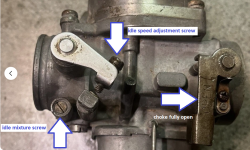
Unfortunately, without knowing it you might have changed things because aftermarket mixture screws aren't often made exactly the same as OEM. Most hard parts in carb kits are not made correctly, it's unfortunately the way of the carb kit world now.I did replace the fuel mixture screws during the rebuild but other than that there have been no changes or modifications.
Flight Risk
Veteran Member
Ah, Yes. The bench synch process that I used for that is:
- I took an old high e-string from an acoustic guitar (very fine) and placed the end of it between the bottom of the butterfly valve and the case,
- I slowly turned the Idle adjustment screw 1/4 at a time until I could pull the string out. When I could, I backed it up 1/4 and went with 1/8 turn to fine tune.
- When the string comes out, there is an audible ping from the valve hitting the case so I have an audible and visual confirmation that the bottom still closes tight
- I did this for both carbs (then made sure that they lift together as I installed)
Flight Risk
Veteran Member
What Dan meant, as Brody already affirmed, is the idle speed screw but it's located in each throttle shaft arm on the outsides of the carbs.
View attachment 58434
Unfortunately, without knowing it you might have changed things because aftermarket mixture screws aren't often made exactly the same as OEM. Most hard parts in carb kits are not made correctly, it's unfortunately the way of the carb kit world now.
Great insight about the mixture screws.... I was using the new ones throughout because the rubber was better on them. I switched to the old ones a half hour ago after reading Dan's reply. Forgot to close the choke when I started the engine... engine still started at a reasonable RPM (maybe 1200), then within 10 seconds reved itself up to 3000. This was with the mixture screws screwed back in to 3/4 turn.
Last edited:
Flight Risk
Veteran Member
When I get a break in the rain I will try the whole process again and let you all know how it goes. Are there any things that I should know/do differently, based on what I did last time?
Danager4792
Veteran Member
Here's something that @66Sprint (RIP) instructed me to do over the phone one time when I was having high idle issues with my 71 CL450.When I get a break in the rain I will try the whole process again and let you all know how it goes. Are there any things that I should know/do differently, based on what I did last time?
1st: Back your idle speed adjustment screws all the way out, so that they are not touching the throttle shaft arms anymore.
2nd: Attempt to start the bike with the idle speed screws all the way out, in theory the bike should not start.
3rd: While attempting to start the bike, turn the throttle some so that the throttle plates open a little bit. The bike should technically fire up.
4th: Hold the throttle at your designated RPM, in this case being 1000 to 1200RPM.
5th: While holding the throttle at your designated RPM, either you or a friend can reach down and tighten the idle speed screws so that they touch the arms again.
6th: Let go of the throttle, it should now have sustained itself at your targeted RPM.
If you decide to take the carbs apart again, be sure to remove the idle speed screws and stretch the springs that holds them in place. When the idle speed springs get loose, the idle speed screws won't have any tension. They will "turn themselves" whenever you blip the throttle and they land on the arm shafts.
Last edited:
Sounds like a throttle cable issue...Check throttle cable again:.. engine still started at a reasonable RPM (maybe 1200), then within 10 seconds reved itself up to 3000. This was with the mixture screws screwed back in to 3/4 turn.
1. Routing, especially where it splits left and right under the frame. Turn handlebars left and right full lock while running...should be no change in engine speed.
2. Make sure both left and right cables are seated into the plastic "splitter"
3. Make sure the clutch cable is not rubbing against the left carb throttle shaft/spring. My aftermarket clutch cable was longer than OEM and as a result was rubbing
(I zip tied my clutch cable to the right carb cable bracket)

RobMan
Veteran Member
Plus one on this, my clutch cable was rubbing on the left throttle and I added a nylon cable clamp to one the rear valve cover bolts to hold the cable away. Still runs close but not touching3. Make sure the clutch cable is not rubbing against the left carb throttle shaft (I zip tied my clutch cable to the right carb cable bracket)

Greybeard70
Member
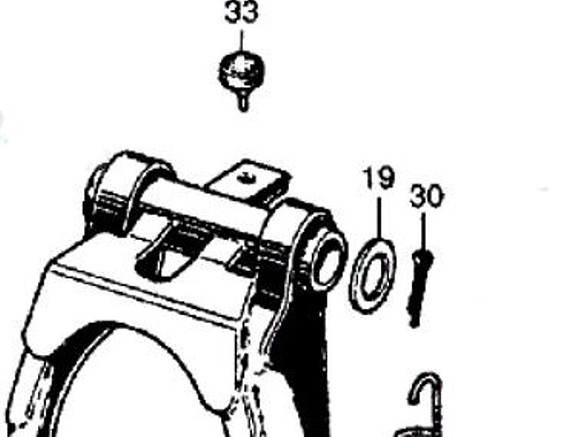
I ordered these on Amazon to replace the rubber Bumper #33.
Beautiful bike you have there! I had a '69 CL450 many years ago.
Are you for sure talking about your kickstand, or do you mean the center stand? I don't see a kickstand present in your pictures. If you are talking about the center stand, do you have the rubber bumper in place? See item #33 in this diagram:
Those are available in different thicknesses from Ace Hardware if you have one of those where you live. You could also order the original Honda OEM part, of course.
For the brake lever hitting the step bar, the one on my 1970 SL350 does the same thing. Like you, I could see no way to adjust it, and there was a mark on the lever from the contact between the two parts. I cut about a 3/4" long piece of rubber hose and slit it on one side. Then I put that around the brake lever and glued it in place. The brake lever still hits the step bar, but it does so silently now. The home made bumper pad is not noticeable.
Ray
Flight Risk
Veteran Member
Ha! That's exactly what I did! Mine is noticeable because I used zip ties to hold the rubber instead of glue
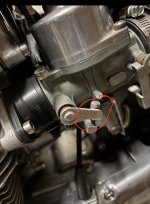
(and I did mean Center Stand.... Being more exacting in my English would serve me well.)Google AI is wrong. Very wrong. There’s a screw that the idle arm rests on. Turn in, idle goes up.Yes, these are 14H carbs @Danager4792, and my experience with fouling of plugs above 3/4 turns out is the same. I should pull a plug and see what occurred during testing.
I had to look up what an "Idle Arm Screw" is, and Google AI informed me that it is the fuel mixture screw. I did replace the fuel mixture screws during the rebuild but other than that there have been no changes or modifications. Is there something else under the Idle Arm Screw category that I have been ignoring? Read "ignorant of"
Flight Risk
Veteran Member
Thanks Dan, Brody, Tom and everyone else who chimed in. What I have learned from this whole experience is that the videos that I followed out of Texas were not my friend, and gave me less than perfect tips about Bench-Synching carbs. 3/4 of a turn out on the idle adjuster screw and she was running well, with no runaway (as Dan predicted). I still have some issues but it is running better than it ever has (still wants to stall occasionally and misses the odd cylinder every few minutes. Also rumbling and backfiring a little too much on downshift. I used a points setting video from the same source when I set them up, and learned things like "In my opinion the point gaps are not as important as when the spark fires". I think that I will be resetting the points (properly, measuring the gaps) and see if I can make this a bike that actually kick starts.