1968 CL450 restoration

The used gasket seems very thick, that's in itself is not a problem. But if you replace it with a thinner gasket, beware of the axial play of the camshaft between both bearings.

If you have an old cover, you can cut off the bearing part and fit it in between (partly) the camshaft and the cylinder head. This makes sure the forces on the soft aluminum bearing surface on the other side don't damage over time. I made a bronze bush to slide in between the camshaft and head. This way it's possible to turn the engine if needed.
 
Last edited:
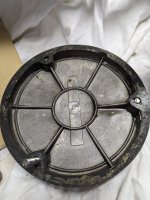
The used gasket seems very thick, that's in itself is not a problem. But if you replace it with a thinner gasket, beware of the axial play of the camshaft between both bearings.

If you have an old cover, you can cut off the bearing part and fit it in between (partly) the camshaft and the cylinder head. This makes sure the forces on the soft aluminum bearing surface on the other side don't damage over time. I made a bronze bush to slide in between the camshaft and head. This way it's possible to turn the engine if needed.
The old gasket is .75mm thick. I have one that is .68mm as a replacement. Still trying to find a new one that is as thick as the old one. I may have to buy some material and make one, but I hate doing that.
 
While we're on the topic of gaskets, the stator cover gasket that was on the bike was over 1mm thick and this appeared on the I side of the cover.1000001939.jpg
I have not sourced a thicker gasket for this one either. But this is a huge digression. The cam bearing cover is the task at hand.
 
All Jensen is saying is to be thorough and check end play, that's all. I think the thinner gasket is fine for sealing.

Honda has used some cam end-play shims that were waaaay too thin and they simply disappear inside of the engine. That's what happened to me anyway. The thinner gasket is fine without shim for sealing. It's an easy check for peace of mind and if the clearance is slightly larger, generally the motor doesn't care. It does care if too little clearance however and a risk at the extreme would be cam binding and non-contact of the sealing surface - never seen that happen.
 
Re stator cover gasket, any leaking issues I've encountered in that area are typically to do with the o-ring seal on the three mounting screws, not the gasket. There's nothing but clearance underneath so is insensitive to thick or thin gasket.
 
Re stator cover gasket, any leaking issues I've encountered in that area are typically to do with the o-ring seal on the three mounting screws, not the gasket. There's nothing but clearance underneath so is insensitive to thick or thin gasket.
Yeah, I think that rotor bolt mark in the cover was caused by the bolt coming loose. I've never seen a rotor bolt touch a cover when properly tightened and with any type of gasket on the cover, even when people just use sealer with no gasket.
 
Yeah, I think that rotor bolt mark in the cover was caused by the bolt coming loose. I've never seen a rotor bolt touch a cover when properly tightened and with any type of gasket on the cover, even when people just use sealer with no gasket.

OK, so add tighten Stator bolt to the list of things to do. Thanks!
 
Cutting out my own gaskets is really not that hard, and often the best solution when you're in the middle of a job and just want to keep going. Sometimes you can get the exact shape you need by smearing a coat of vaseline or even motor oil on one of the contact surfaces and then pressing it against a sheet of gasket paper. Then just cut along the edges of the oil stain. I have a very old leather punch with about 6 sizes of hole punches and that's what I use to make the bolt holes, and a pair of nail scissors works well to cut the shape.
 
OK, so add tighten Stator bolt to the list of things to do. Thanks!
Or at least check the tightness. If it was loose at one time and made that mark, it's likely it was discovered because of the sound it made and was tightened.

To be clear, it's actually the rotor bolt. The stator sits still around the rotor.
 
Oh boy, the proverbial can of worms is here! Be sure (can’t stress this enough) the woodruff key isn’t damaged. That’s the key that times the rotor to the crankshaft. The taper fit is the primary lock of rotor to crankshaft, the key ensures it’s assembled to the correct rotational position and your timing marks align.

If you’re sharp eyed, you can see if it’s good by removing the rotor bolt and peering into the little square window without taking things totally apart. But if that key is damaged, you’ll be timing your ignition to a wrong adjustment.
 
So, back to it today...

When I chose not to rebuild the engine myself, I forewent to option of shining up all of the covers. I felt that I should at least do that for the ones that I had to take off for this oil leak.

PXL_20240414_131711220[1].jpg

I then fitted the new gasket

PXL_20240414_131731003[1].jpg
When I went to fit it in place, everything went very well. The cam slipped easily into the bearing and I replaced the old JIS screws with brand new ones.

PXL_20240414_132523243[1].jpg

This was when I checked the FSM for the gap required between the cam and follower so that I could re-adjust the valves..... 0.03mm.

My gauge feeler set goes down to 0.04mm.... Doh.

Now that I have buffed the intake cam cover, I have created a bit more work for myself when I open up the points, because this will not do anymore (and I'm glad that you can only look at one side at a time, because the others are not going to get this) :)

PXL_20240414_132413259[1].jpg

The only place that I could find a .03mm feeler gauge in the area was Amazon.... delivery should be on Wednesday, so I am limited to buffing until then.

After the valve adjustment:

I will readjust the cam chain tensioner,

I then have to check the rotor bolt to make sure that it is fitted properly (The "non-professional professional" mechanic did not have my carbs when he rebuilt the engine so I doubt that he ran it for a test at that time. He may have noticed and fixed the issue when I took it back, but he never said anything to me, and if you have been following this thread, I have reasons not to trust him. That inner damage to my stator cover is fresh, but the bolt is snug).


Next after that will be the points.
 
Last edited:
Good progress, the polish work looks nice. You don't have to use the factory valve adjustment spec, it's hard to find a .0012" (.03mm) feeler. I set them at .002" (.05mm), it's fine with a tad more clearance as it's only .0008" more.
 
Had a bit of time yesterday to continue, but no photos...

Set the intake valves (both sides) to .03mm, as I had already purchased the feeler gauge on Amazon. It seems to me that they were already set to .03mm as I could not get the feeler in without opening the adjustment screw. Both nuts were tightened back into place with the feeler still in place between the cam lobe and the follower, and the feel was still perfect afterwards.

Polished the intake valve cover and replaced it.

Next step: Rotor inspection... expect photos for that but I have a honey-do list today so it might have to wait.
 
I reconsidered the rotor inspection, because I think that it is in properly. What I did was took some thick aviation sealer and rubbed it all over the bolt on the rotor end. I then took the cover, without a gasket and pressed it into the proper place...

PXL_20240421_150225747.RAW-01.COVER[1].jpg
PXL_20240421_150334496.NIGHT.RAW-01.COVER[1].jpg
PXL_20240421_150426555.NIGHT.RAW-01.COVER[1].jpg
No sealant on the damaged area says to me that the issue is likely fixed, so cleaned the old sealant off of the edges and the bolt, and moved onto the points. Any advice on whether I made the right choice above would be appreciated.

PXL_20240421_185215221.RAW-01.COVER[1].jpg

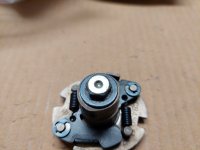
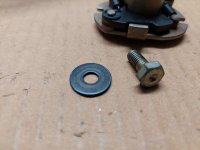
The hexhead came out easily, but the bent up washer stayed in place:

PXL_20240421_185255236.RAW-01.COVER[1].jpg
PXL_20240421_185318280.RAW-01.COVER[1].jpg

This brings me to my next point... the ends of the cam shaft and the spark advance are not flush, which I expected them to be. I did not take a photo, but you can see how bent the washer that the shop put in is. Am I right in thinking that these should be flush and therefore I need to check that my spark advance is installed properly? or is this normal?

The nut that I bought with the washer needed re-threading, as does the cam (cleaning I think), but I'm not sure if I should do the cam with it still in the bike. Also not sure about how much torque it needs to install properly.

Stopping here until I hear back.
 
Okay, the end of the camshaft is shorter than the advancer.
The points cam, the moveable outer, is slightly shorter than the advancer inner.
The inner tube of the advancer, the one tightly fit against the cam is the tallest.

This difference in the various heights both secures the advancer tightly to the camshaft, yet allows the outer points cam to freely move by the weights.

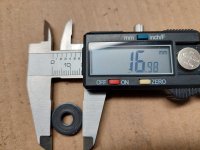
the distorted washer should be flat and of large enough diameter to cover the points cam. The factory bolt is a hex with a center divot to engage the Honda touch tachometer (though I’ve never seen one). The Allen headed screw should be replaced to a hex headed if only to properly load the washer.

Someone will post a pic, they’re everywhere! The FSM has a good pic as well.
 
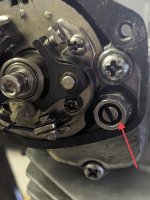
Reading over your progress (good job so far!) I noticed something that you should also fix while you are working under the points cover. I think ancientdad also mentioned it elsewhere in your thread awhile ago. In the photo below, the red arrow is pointing at your eccentric adjuster. The tick mark on the end of the adjuster, beside the screwdriver slot, should point away from the spark plug when properly setting valve clearances. You should correct this one by loosening the locknut, spinning the adjuster 180 degrees, and resetting your clearance on this cam follower. Also maybe check your other three eccentric adjusters and make sure they are all pointing away from the spark plugs. One last thing… the locknut on this adjuster is one of the chrome ones intended to be used for one of the exterior shafts, not this interior adjuster under the points cover. While checking your other three you may find and could swap it out if the plain nut was incorrectly installed on another eccentric adjuster.
IMG_3747.jpeg
 
Thanks everyone.

I bought a used spark advancer on e-bay after I found out that this bolt was missing, so I now have the bolt and hardened washer (and a spare spark advancer if I need it). Don't know how much pressure should be placed on it though (did not find in FSM, Hanes or Clymers).

As for the last two posts that I did... at least I won't have to redo the polishing of covers, but I do have to remove the intake valve cover again and readjust valves as the tick mark on both eccentric adjusters on the left side are facing the plugs. Thanks @12ozPBR for clarifying Ancientdad's earlier statement. I was really busy when he noticed that and meant to get clarification (but forgot).

AD also mentioned exterior washers I believe, and I think that he means the ones on the mounting bolts. I'm not sure if that makes any difference, other than esthetics. Will be readjusting the valves (and now adjusting the exhaust valves) so that I can correct the adjuster issue.

Warm weather is coming and I really want to get this done!
 
Last edited:
Re-adjusted the valve spacing in all four cylinders because I had the covers off.

After that I had planned to adjust the contact points, but I had a niggling feeling because the bike would run well at idle, but not when I rode it, (and I realize that this could have been the bent washer that I removed above interfering with the advancer). I decided to take a look at the spark advancer to make sure that it was installed correctly and in working order. Considering that the entire engine has just been rebuilt, the advancer seemed a little dirty and I decided that it might be a good idea to clean it up and lubricate it.

PXL_20240427_153429524.RAW-01.COVER[1].jpg

Because there is nothing on this in the shop manual, I sought the advice of the friendly guys at those guys in Houston:


PXL_20240427_155316736.RAW-01.COVER[1].jpg
PXL_20240427_165518467.RAW-01.COVER[1].jpg
The dirty one on the right is obviously the one that I pulled, the clean one is the one that I purchased with the bolt and washer (read back in the thread). Everything on the dirty one swings nicely, but I noticed that lower spring seems to have some malformation at the base end. (The new one has zero lubrication so would also need to be rebuilt.)

This leads me to a question...

The video talks about alignment markings on the cam and body of the advancer, but it does not show this actual advancer. According to the video there is either a hole or a notch on the body that must be aligned on the same side of the spark advancer as the alignment mark on the cam:

Screenshot 2024-04-27 130034.png

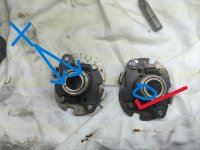
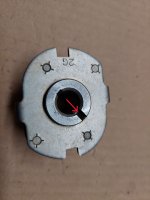
What I noticed in my two advancers is that there is no hole or notch on the back, but when aligned with the rotation arrow imprinted on the base plate at the top right corner, the notches on the cam are opposite to each other:

Advancer arrows.jpg

So, my question is: how do I find out which one is right?
 

Attachments

  • PXL_20240427_155245576.RAW-01.COVER[1].jpg
    PXL_20240427_155245576.RAW-01.COVER[1].jpg
    2.4 MB · Views: 0
Thanks again Jays

I'm pretty sure that I understand, but just to be clear... There are notches in the inner and outer cam protrusions which have to align. This means that my old one is correct and the new (used) one is wrong. Correct? (photo below).

Correct advancer.jpg
 
Yes, your advancer is correct. Another way to verify is look at the back of the advancer for the locating notch. The outer cam pip should align with the notch on the back.
advance1a.jpg
 
Thank you both. I have the advancer rebuilt and the points set now. Points took over an hour and a half of fiddling. Tomorrow I hope to get the carbs, airbox, muffler and tank back on, then an oil change. Not sure that I will have time for all of that but I'm optimistic. Hoping to have it on the road by next weekend!
 
Yeah, feeling your pain on that front. I’d like to say it gets better, but that’s untrue. It does get easier however.
 
I got it all back together yesterday and took it out in the driveway to fire it up...

It will fire, but only if I goose the throttle, and it runs rough. Will not idle (again) (I wish that I could upload video)

Once it stops raining for long enough, I will try playing with the idle mixture to see if that is the issue, but it seems to be exactly like it was after I got it home from Toronto (and that required me clearing my idle jets. I can't imagine that that is the issue again, and I really don't want to pull the carbs (again). I probably should have run a preemptory wire through the idle screw again while the carbs were off... :(
 
(I wish that I could upload video)
You can, just not here. YouTube accounts are free and easy to upload to, as long as you have a Gmail address you have a YT account, a Google Sheets account, a Google Drive account, a Google Photos account and more.
 
And there's Vimeo, Streamable, DailyMotion and others as well, plenty of free services out there to host the video and then you can link it here.
 
You may have luck from a method I learned from 66Sprint. Hold your throttle at 1100-1200RPM’s so that it doesn’t die. While the throttle is being held, reach down and tighten the idle screws until the screws touch the arms. Then let go. It is easier if you have someone hold the throttle for you. But you must be sure that both throttle plates are opening at the exact same time.
 
OK, two videos here. The first is when I had it running but after 2 minutes of riding the timing seemed to go off (this video is only of the idle). I would like it to purr like this again at idle and hopefully work at speed:


The second was taken this evening. For your situational awareness, the idle mixture screw is out at about 1.25 turns from fully screwed in, and it is the same setting that was in place in the first video above.


Is this just a carb issue, or can any of our well-tunes ears detect anything else?
 
In the second video it's only running on one cylinder. When properly tuned, these bikes like the throttle kept close to the idle position during cranking for the most efficient start-up. Since there are no accelerator pumps in these carbs, turning the throttle only allows more air into the engine and reduces the vacuum draw that helps them start. I'm out of town right now and don't have time to re-read the thread, but have you gone through the full tune-up? Cam chain adjustment, valve adjustment, points and timing?
 
Thanks Tom,

I did just adjust the cam chain tensioner, adjusted the valves and the points (in that order). Did not adjust the points gap, just the timing...
 
Last edited:
OK two questions @ancientdad (and no hurry because the absolute earliest that I will be able to do anything in tomorrow night, and likely not even then).

1/ When I rebuilt these carbs, I kept the old jets but replaced everything else. The first time that I tried to start it, last fall, it ran on only one cylinder. It was a guitar string into the idle jets (both sides) that cleared that up. Would you now replace the jets? (I think that I know the answer, but I have to ask).

2/ Have you ever tried replacing (or clearing jets) by just loosening the clamps and turning the carbs on their sides? Seems like something people would have tried...
 
Last edited:
OK two questions @ancientdad (and no hurry because the absolute earliest that I will be able to do anything in tomorrow night, and likely not even then).

1/ When I rebuilt these carbs, I kept the old jets but replaced everything else. The first time that I tried to start it, last fall, it ran on only one cylinder. It was a guitar string into the idle jets (both sides) that cleared that up. Would you now replace the jets? (I think that I know the answer, but I have to ask).
Generally, it is advisable to keep the old jets as long as they are not damaged. The sizing of the orifices in many aftermarket jets are suspect.

2/ Have you ever tried replacing (or clearing jets) by just loosening the clamps and turning the carbs on their sides? Seems like something people would have tried...
You can remove and replace jets with the carbs in their standard position. It just takes some patience, coordination, and small screwdrivers.
 
Thanks Tom,

I did just adjust the cam chain tensioner, adjusted the valves and the points (in that order). Did not adjust the points gap, just the timing...
You'll want to check that gap. It can take a bit of fiddling back and forth to get both within spec, but you can be properly timed and incorrectly gapped and lose spark.
 
Update on 4 days that started well... ending in contact point frustration...

First things first. By disconnecting spark plugs, I determined that it was my right cylinder that was firing.

  • Drained the left carb bowl and removed it.... ran a guitar string up into the Main jet (did not remove pilot jet and could not get the string in)
  • Put everything back together and tried to start it. It started and idled properly, but any increase in RPMs started the popping noises...


Right after shooting the video, I put it away for the night. The next day it would not start at all. (And I have not been successful again)

I decided to recheck the contact breaker points, using the FSM and actually setting the gaps, instead of using the technique in the link above.
  • The gaps were well below spec on both sides

Fixing (breaking?) my points:

So, following the FSM I have now redone the points about 12 times. The process:

  1. Set gaps on both sides at as close to .3mm as I could,
  2. Adjusted the base plate until the test light turned on at EXACTLY when the LF mark passed the pointer (counter-clockwise),
  3. Rotated the stator counter-clockwise until the Fire marker for the right cylinder gets to the pointer,
It is on this last step that things go wrong, as contact is made well after the fire mark gets there (see photo).

PXL_20240507_002412754.RAW-01.COVER[1].jpg

The manual does not identify how to adjust the right cylinder (if it can even be adjusted). I tried backing it up to the F mark and pushing the contacts together, but when I do this, the slider pulls away from the cam. I then have to start over. Please tell me what I am doing wrong!!!
 
Last edited:
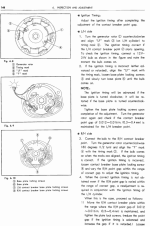
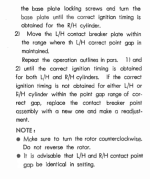
The left point is adjusted by rotating the points plate, as you mention. The right point is adjusted by loosening the screws that fix the point to the plate and moving it to adjust the moment at which the right points open. This preserves the adjustment on the left points. I'm including the relevant parts of the FSM below for you to read over.

Screenshot_20240506-205822.png

Screenshot_20240506-205841.png
 
Update on 4 days that started well... ending in contact point frustration...

First things first. By disconnecting spark plugs, I determined that it was my right cylinder that was firing.

  • Drained the left carb bowl and removed it.... ran a guitar string up into the Main jet (did not remove pilot jet and could not get the string in)
  • Put everything back together and tried to start it. It started and idled properly, but any increase in RPMs started the popping noises...


Right after shooting the video, I put it away for the night. The next day it would not start at all. (And I have not been successful again)

I decided to recheck the contact breaker points, using the FSM and actually setting the gaps, instead of using the technique in the link above.
  • The gaps were well below spec on both sides

Fixing (breaking?) my points:

So, following the FSM I have now redone the points about 12 times. The process:

  1. Set gaps on both sides at as close to .03mm as I could,
  2. Adjusted the base plate until the test light turned on at EXACTLY when the LF mark passed the pointer (counter-clockwise),
  3. Rotated the stator counter-clockwise until the Fire marker for the right cylinder gets to the pointer,
It is on this last step that things go wrong, as contact is made well after the fire mark gets there (see photo).

View attachment 32379

The manual does not identify how to adjust the right cylinder (if it can even be adjusted). I tried backing it up to the F mark and pushing the contacts together, but when I do this, the slider pulls away from the cam. I then have to start over. Please tell me what I am doing wrong!!!
Did you mean .3mm? FSM stayed .3-.4mm for points.

But for the right, you’d adjust the gap to fire at the correct time.

You could have challenges with that because it has to be within that range. I’ve had challenges with some points.
 
Did you mean .3mm? FSM stayed .3-.4mm for points.

But for the right, you’d adjust the gap to fire at the correct time.

You could have challenges with that because it has to be within that range. I’ve had challenges with some points.
Thanks Teebo and yes, I meant .3mm (I guess that I had .03 for the tappets on the brain, but I adjusted to between .3 and .4 mm).
The left point is adjusted by rotating the points plate, as you mention. The right point is adjusted by loosening the screws that fix the point to the plate and moving it to adjust the moment at which the right points open. This preserves the adjustment on the left points. I'm including the relevant parts of the FSM below for you to read over.

View attachment 32386

View attachment 32387
Thanks to you too STL. I have the 1968 Manual and I guess that was too early for them to have discovered what they wrote in point 4 of yours.PXL_20240507_025855796.RAW-01.COVER[1].jpg

Will try starting with the right hand side.
 
Thanks Teebo and yes, I meant .3mm (I guess that I had .03 for the tappets on the brain, but I adjusted to between .3 and .4 mm).

Thanks to you too STL. I have the 1968 Manual and I guess that was too early for them to have discovered what they wrote in point 4 of yours.View attachment 32388

Will try starting with the right hand side.

You did it correctly by starting with the left and rotating the base plate to adjust the left. Bottom of step “g” in your manual it says to then rotate 180 and adjust the right by changing gap.

The right needs to stay within .3-.4 though. If it doesn’t then it’s step 4 in the pages stl360 provided. With stock points it’s sometimes just steps 1-3, but occasionally 4. I’ve had some non-stock points where it’s impossible to have both within range. That’s a different process.
 
I decided to recheck the contact breaker points, using the FSM and actually setting the gaps, instead of using the technique in the link above.
  • The gaps were well below spec on both sides
This is why we tell people not to use videos and that source (those guys in Houston), which is wildly popular, is a great example - they have the most common Honda FSMs for download but they do not follow the factory procedure, not sure why they bother to make them available to their fanboys when they also tell them not to do things the way the factory recommends. Their "quick and dirty" method might work some of the time, but the correct procedure from the FSM is the most reliable and keeps things in spec if done properly. What I wanted to share with you while I was out of town is a paragraph I wrote some time ago (below) but did not have with me on my laptop at the cabin in NC. It's essentially the same as others have already mentioned.
--------------------
The proper method involves first turning the engine until the breaker cam opens first the left set of points to the fully open position and setting the gap of that set of points at .014", then turning the engine until the right set of points is fully open and setting them at .014", then adjust the left side timing by rotating the points plate so the left points break at LF. You then lock the points plate and check the timing on the right cylinder to see if the points break at the F mark and if they do not, you adjust the gap to get the right points to break at F. If after that adjustment is made, the gap on the right points is less than .012", you go back to the beginning and reduce the left points gap to .012", set that timing by rotating the plate to open at LF, then check the right side again and adjust the right points to open at F.

Rinse and repeat as needed to get both sides correct, and you will arrive at the proper timing with points gaps within the factory spec, which will ensure the dwell necessary for a good spark will also be adequate. It can be fiddly but once you learn the procedure, it's easy.
 
This is why we tell people not to use videos and that source (those guys in Houston), which is wildly popular, is a great example - they have the most common Honda FSMs for download but they do not follow the factory procedure, not sure why they bother to make them available to their fanboys when they also tell them not to do things the way the factory recommends. Their "quick and dirty" method might work some of the time, but the correct procedure from the FSM is the most reliable and keeps things in spec if done properly. What I wanted to share with you while I was out of town is a paragraph I wrote some time ago (below) but did not have with me on my laptop at the cabin in NC. It's essentially the same as others have already mentioned.
--------------------
The proper method involves first turning the engine until the breaker cam opens first the left set of points to the fully open position and setting the gap of that set of points at .014", then turning the engine until the right set of points is fully open and setting them at .014", then adjust the left side timing by rotating the points plate so the left points break at LF. You then lock the points plate and check the timing on the right cylinder to see if the points break at the F mark and if they do not, you adjust the gap to get the right points to break at F. If after that adjustment is made, the gap on the right points is less than .012", you go back to the beginning and reduce the left points gap to .012", set that timing by rotating the plate to open at LF, then check the right side again and adjust the right points to open at F.

Rinse and repeat as needed to get both sides correct, and you will arrive at the proper timing with points gaps within the factory spec, which will ensure the dwell necessary for a good spark will also be adequate. It can be fiddly but once you learn the procedure, it's easy.
It can be fiddly and at times it takes multiple passes. I get a little OCD and try to get both sides close. But there have been times when they weren’t, but still within range.

Then as a sanity check, when I think it’s right, I rotate the engine a couple times and recheck it.

Then, of course, needs to be checked dynamically. That’s always been pretty easy for me though. Typically just tweaking the base plate rotation.
 
But hey… at least not like the video of the guy who adjusts valves on a running engine. Start engine, adjust valves until they stop clacking.

Don’t be that guy.
 
But hey… at least not like the video of the guy who adjusts valves on a running engine. Start engine, adjust valves until they stop clacking.

Don’t be that guy.
Back when I was an impressionable 18 year old, I saw a guy I worked with do it and so I've done it myself. Never had any adverse reactions from the few times I've done it, but it is something that is too easy to be inaccurate with and cause a tight valve which obviously leads to bad things.
 
UPDATE ---- and a new question now...

I fiddled and fiddled, unsuccessfully went through the steps 9 times. The plate wanted to be set to the extreme right and the base plate was stopped by the adjuster bolt before I said was able to make both left and right adjust properly. It was at this point that I got fed up and decided to throw in my NOS points that I bought 5 years ago. Had trouble getting the wires through, but eventually did.

New problem.... the NOS points seem to have a short, as even if the breaker points are completely open I get power to the test light (both sides).

For your situational awareness, getting the wires through the housing was non-trivial, and at one point I decided to put them through the hole from the back instead of trying to get the plastic through from the front. This meant detaching the wires from the base plate and springs. This was a mistake because when the springs blew the nut into my socket wrench I dropped the spring washer and the flat washer onto the floor. I cannot see the flat washer on the yellow wired side, so I am unsure how it goes back together. Here is the order that the blue wired side now connected:

bolt head>Flat washer>insulator disk against base plate mount>insulated cylinder through base plate>Insulator disk against base plate mount, flat washer>springs>Blue wire connector>spring washer>nut.
 
Last edited:
OK, @stl360+450 has reminded me that a picture is worth 1000 words so...PXL_20240511_221829940[1].jpg

The new points as they sit. Only the blue wire has been removed and replaced, the yellow should be as it came from the factory. The whole thing is shorting and I don't know where, the details are 2 posts up. I altered that post because I forgot to include the blue wire in the order.

@stl360+450 - I noticed that the link you provided has the flat washers between the spring and the connector. That is actually the way my blue wire on the old points were set (yellow is different):

PXL_20240511_221717617[1].jpg
Can anyone tell me if there is a definitive place that his flat washer should go? (though I a starting to think that this isn't actually my problem because all of these different configurations seem to work. I was pretty sure that the insulators fell into place correctly, but I may have to go back in.

Help please :unsure:
 
Last edited:
Back
Top Bottom