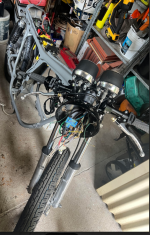
My CB200 Vintage Racer Build

Trancebuild

Member
Joined
Dec 21, 2023
Total Posts
23
Total likes
8
Location
Australia
So I am now into the electricals on my 73 CB200 build using the existing harness I repaired and cleaned with all tested continuity. I'm unsure on when the running instrument and tailight should be activated.
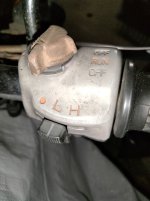
To complicate it further I am using aftermarket switch controls and have tested successfully Headlight Hi/Lo beam, turn signals, Starter button, Run/kill switch, front/rear brake switches. Seems when the key
is on park I get a hot brown wire and as per one of many wiring diagrams these loop in park mode with brown/white. I get why park mode is needed.

Questions:
1. Is the instrument / tailight suppose to also run when key switch is on? this is not working.
2. As an alternative can I loop the brown / white wire with my switched + black wire as a running instrument / tailight when key is ON?
3. Is it safe to join stator wires yellow and white/yellow when using combined regulator/rectifier and OEM points?
4. Is there an available head scratching imoji :unsure:

In all fairness to you all a before an after with a birds nest to finish. :)

1762564861278.png 1762565534217.png

1762565011933.png

1762565196449.png
 
Last edited by a moderator:
As far as I'm aware ADRs require Headlight and Taillight for daylight running. Not sure if that applies to your bike, and I can't remember whether my 1978 Xl175 had that, but I think my 1982 VT250F2 did, all a bit hazy now though.
 
Questions:
1. Is the instrument / tailight suppose to also run when key switch is on? this is not working.
Can't speak to the Australian version, but the US version does not have an Off switch for the headlight (and resulting gauge lights and taillight) as it comes on with the ignition switch and only goes off briefly during engine cranking with electric start. On a US model, often times when the headlight doesn't come on it's because the contacts in the starter button switch don't reconnect when the button is released. But since you aren't using the factory switches, you can decide how you want things to work based on your local regs.
3. Is it safe to join stator wires yellow and white/yellow when using combined regulator/rectifier and OEM points?
For the charging mod, yes. Any good quality rec/reg unit will limit charging to 14.5v to 15v max, totally fine with points ignition.
4. Is there an available head scratching imoji :unsure:
More likely a better one on your phone than here :ROFLMAO:
In all fairness to you all a before an after with a birds nest to finish. :)
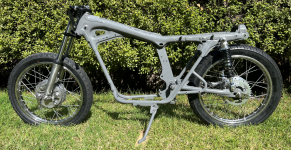
That's just a little wren's nest compared to some of the bigger bikes!
 
Can't speak to the Australian version, but the US version does not have an Off switch for the headlight (and resulting gauge lights and taillight) as it comes on with the ignition switch and only goes off briefly during engine cranking with electric start. On a US model, often times when the headlight doesn't come on it's because the contacts in the starter button switch don't reconnect when the button is released. But since you aren't using the factory switches, you can decide how you want things to work based on your local regs.

For the charging mod, yes. Any good quality rec/reg unit will limit charging to 14.5v to 15v max, totally fine with points ignition.

More likely a better one on your phone than here :ROFLMAO:

That's just a little wren's nest compared to some of the bigger bikes!
Thanks all
So I am going to join the instrument and tailight Broan/white to Black so when key is on they are on. I have a spare switch to turn them off during the day.
I will double check the REG/REC quality for the mod although engine is still apart to check voltage.

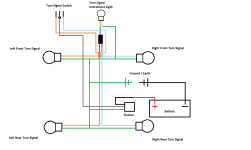
5. Oh I have also started installing my LED turn signals as well as LEDs for instrument cluster. Even though I am using a Narva LED Flasher 68245bl the instrument flasher was not working.
Unknown to me an active turn signal needs the non active turn signal for earth so when I installed the first turn signal the dash turn signal started working.

Now I thought the Narva flasher I bought prevented any current backflow causing LED's to not work at all. On my build they work and flash but I see they dont turn off completely and remain a dull lit effect (Ghosting ???).

Does this mean I may still need this diod mod? 1762811479254.png
 
Last edited:
Seen this happen when grounding isn't done right.
My grounding is to the frame via the Green wire as well as battery neg. Here is the thing, I placed a diode on each of the rear LED's positive and solved the problem. Tried to replicate mod on fronts and still a problem of voltage leakage.

My diagram also has a diode mod to solve the turn signal instrument lamp. I just have to solve the fronts voltage leakage. And its the second LED compatible flasher relay I have tried. One 3 wire then a two wire relay.

Am I missing something?


turn_signal_circuit_diode_mod.png
 
Do you have a ground strap directly from battery negative to the frame? If not, and you have added the combo rectifier/regulator, you likely have no actual path to ground. On the stock cb200/cb200t the only path to ground is through the case of (I think it was the original regulator). The combo units at least from sparcmoto , and some for tractors from eBay,don't allow ground through the electronics housing.
You have to run a wire directly from the battery negative to the frame to return a ground path.
I also don't see any diode symbols in your diagram.
 
Do you have a ground strap directly from battery negative to the frame? If not, and you have added the combo rectifier/regulator, you likely have no actual path to ground. On the stock cb200/cb200t the only path to ground is through the case of (I think it was the original regulator). The combo units at least from sparcmoto , and some for tractors from eBay,don't allow ground through the electronics housing.
You have to run a wire directly from the battery negative to the frame to return a ground path.
I also don't see any diode symbols in your diagram.
Yes sorry I left out the diode symbols. I have a ground strap from the battery to the frame and test well from all parts of the frame.
 
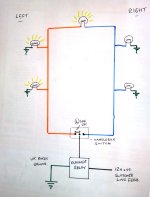
FWIW, this is a simplified diagram of the stock indicator circuit. This works as is, with LED indicator bulbs and a suitable LED compatible flasher relay. A problem arises if an LED repeater bulb is fitted in place of the stock repeater bulb, this is the only place that a diode is required, as in my second drawing. Note that some folks fit in line resistors so that LED indicator ( flasher ) bulbs will work with the original flasher relay, as nasty kludge in my opinion.

1764842427477.jpeg
1764842455891.jpeg
 
OK I have already implemented your diode mod you showed on the right to address the Instrument turn signal LED using N4004 diodes. I had to place them in line to fix the rears also. Scratching my head for the fronts as the same mods dont fix the leakage. Could it be the diode type? N4004??

Let me keep at it and will give an update.
 
The diodes I used were some that I'd literally had left lying around from an electronics hobby kit, I actually don't have much clue about the fine details of electronics. I am puzzled by your reference to in line diodes to fix the rear indicators, I don't understand how that would work, what problem it would solve ??
 
1N4004 vs any 1N400x diode should have little impact, the 1N4004 is rated for 400V max, plenty safe. Putting another diode in line with the LED's would add another voltage drop of 1.1V... are the LED's set up for 12V? Does this bike have front running lamps?
 
1N4004 vs any 1N400x diode should have little impact, the 1N4004 is rated for 400V max, plenty safe. Putting another diode in line with the LED's would add another voltage drop of 1.1V... are the LED's set up for 12V? Does this bike have front running lamps?
Sorry for the late reply and thanks for the advice. I have wired it as per Richard Pitman's diagram and the fronts and odometer now show no voltage bleeding. However the rears still do even though I have wired them correctly I think. I will double check. Also, replaced the flasher with another LED compatible one and rears still show voltage bleed.
 
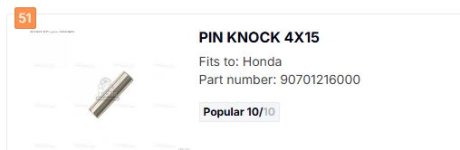
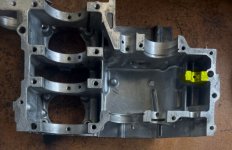
Another topic as I am slowly tackling the engine rebuild and taking stock of the existing and new parts for it. I noticed the crank knock pins and there are the usual size that lock the bearings in place however there is an additional smaller one that I have no idea where it goes. Any thoughts as my research does not show specific location. Dimensions are 4mm x 14.83mm. This is smaller than the usual knock pins I have and have just found this related to the kick start rod. Upper crankcase pic shows where it could go for the kickstarter but the pin goes all the way in not serving its purpose.
51 - kick start knock pin.JPGcb200_upper_crankcase.jpg
 
Last edited:
No CB200 experience but looking at the parts diagram for 1974 CB200 the knock pin is number 36 and goes in the tapered end of the crank.With that said I would defer to anyone with actual hands on experience.


CB200 Knock Pin.jpg
 
No CB200 experience but looking at the parts diagram for 1974 CB200 the knock pin is number 36 and goes in the tapered end of the crank.With that said I would defer to anyone with actual hands on experience.


View attachment 56190
Thanks RobMan amd I did look at this however my stator rotor is still attached to the crank but good spot though. I will keep searching.
 
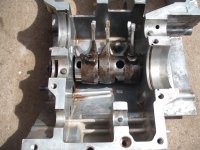
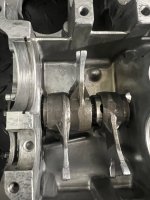
Yes I took photos of every possible step during disassembly but could not recall what position the shift drum was in other than the shift fork arrangement.

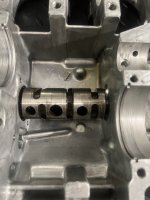
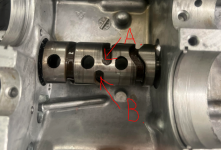
So here is another one for you. Does it matter what orientation the shift drum is in to pin in the forks? If so is it A. or B. ?

I ask this as I cannot get it to shift properly and cant seem to find neutral. At least I have the shift forks correct.

A.
IMG_7171.jpeg

B.
IMG_7172.jpeg


IMG_7173.jpeg
 
What an interesting thread. I have some similar issues to sort on my 1977 CB200, which I think spent a period in its past as a ‘cafe racer’. I’ve almost got it back to normal, but still need to route the control cables through the handlebars,

Alan :)
 
Last edited:
So here is another one for you. Does it matter what orientation the shift drum is in to pin in the forks? If so is it A. or B. ?

Not sure that I understand the question. I'd assumed that provided that the shift forks were fitted in the correct order and alignment it could only go back together one way ?


1777792074715.jpeg
 
Specifically I'm concerned about the drum itself. The shifter forks must be installed when the drum is in the neutral postion so I have read.
This is what I need some guidance on. How do I know its in neutral by looking at it or am I making this out to be more complex than it is.

1777860376367.png

I will re-assemble this time with the shifter drum in Neutral position as per your photo I hijacked :) . Wish me luck.
 
Last edited:
Hi All,
Any chance I can check in with you on the CB200 shifter drum install again? Just need to confirm what gear the drum needs to be in when installing the shifter forks?
As per this pic the drum is in neutral but Im struggling to know which end of the slot does the centre fork pin insert to? A. or B.

1778803585595.png
 
I am not familiar with your engine but in looking at the pics you have provided, the center shift fork pin should go in point A since that center fork points towards the mainshaft. If the was inserted at point B it would not be able to rotate enough toward the front of the engine to engage the mainshaft gear.
 
I am not familiar with your engine but in looking at the pics you have provided, the center shift fork pin should go in point A since that center fork points towards the mainshaft. If the was inserted at point B it would not be able to rotate enough toward the front of the engine to engage the mainshaft gear.
Yep its looking like that thanks as in position B. the centre fork does not have much movement from my testing. I'm going with position A and will re-test the shifting.
 
Back
Top Bottom