


Mr. Bill's Honda 450's
Member
I am restoring/plishing covers and cam towers/bearings and I was stopped by a question I had where selecting clear coat for polished covers is concerned and temperatures reached at full heat soak.

It is safe to assume that the exhaust cam towers and exhaust cam covers get the hottest since the oil supply passes up though the front of the cylinder and head and is thrown off the exhaust cam onto the front cover. This is where the lions share of heat is generated. At idle after good run on a hot day the heat soak is expected to go from ~180F to close to 300F. Say your riding a favorite state Rt. at 55-65mph for 20 min. hills curves and then the one lane road construction traffic jamb has you stopped for a while. You know your about to cook cook everything with no air flow. My previous restorations the first plac I noticed browning of the clear was the exhaust cam towers.
My question:
I would like to know what the head and especially the exhaust cam tower exhaust and cover temerature is at maximum operating temperature during a stop. Anyone with a running Cb450 and an IR gun can have some fun anf get this data quickly. Or if anyone has had this concern, been there done that, please share. I have seen a number of polished clear coats the browned out from heat and the thing that is missing from a good clear selection decision here is good data.
For example Cerakote clears all have color stability to 300F. At which point they start to yellow. Cerakote Clear-Aluminum is made specifically for polished aluminum formulated to not have that irridesence or rainbow at an angle, an easy but quite expensive ultra pure clear. I want to use this now but I am being careful about temperature threasholds on cleared enging parts. Cerakote ceramic clear has enough ceramic to boast the 500F temeprature and will not fail until 700F but it still is a 300F clear and will also begin to yellow at >300F, and it is not a crystal clear due to the higher ceramic content.
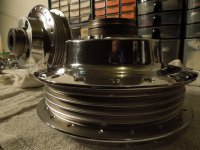
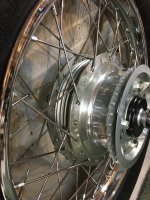
I have used VHT on my forks, Front spool and rear hubs and covers with good result. It is chemical, gas,oil resistant but VHT is tricky, any more than two double wet on wet coats and it starts to look yellow and is brittle and can be chipped easily when cured. I had to be extremely careful lacing the wheels to prevent chips. Ive used it for years but like most High Temperature (ceramic) clears it tends to be a little on the yellow side and not actually clear. I alway felt disappointed as polishing a 50 year old cover takes literally can take part of your life to get all of the defects out and worked to a high luster. All of my parts were vapor honed to establish a clean virgin substrate and worked up from there. Sandblasting embeds silca and not recommended. My wheel project turned out well but you can see the yellow tint in two double wet on wet coats. This is Ok and not many would pick up on this but the engine is a very high visability item and I'm going to spring the $180 for a quart of Cerakote this time. Would just like to know how hot covers get.

It is safe to assume that the exhaust cam towers and exhaust cam covers get the hottest since the oil supply passes up though the front of the cylinder and head and is thrown off the exhaust cam onto the front cover. This is where the lions share of heat is generated. At idle after good run on a hot day the heat soak is expected to go from ~180F to close to 300F. Say your riding a favorite state Rt. at 55-65mph for 20 min. hills curves and then the one lane road construction traffic jamb has you stopped for a while. You know your about to cook cook everything with no air flow. My previous restorations the first plac I noticed browning of the clear was the exhaust cam towers.
My question:
I would like to know what the head and especially the exhaust cam tower exhaust and cover temerature is at maximum operating temperature during a stop. Anyone with a running Cb450 and an IR gun can have some fun anf get this data quickly. Or if anyone has had this concern, been there done that, please share. I have seen a number of polished clear coats the browned out from heat and the thing that is missing from a good clear selection decision here is good data.
For example Cerakote clears all have color stability to 300F. At which point they start to yellow. Cerakote Clear-Aluminum is made specifically for polished aluminum formulated to not have that irridesence or rainbow at an angle, an easy but quite expensive ultra pure clear. I want to use this now but I am being careful about temperature threasholds on cleared enging parts. Cerakote ceramic clear has enough ceramic to boast the 500F temeprature and will not fail until 700F but it still is a 300F clear and will also begin to yellow at >300F, and it is not a crystal clear due to the higher ceramic content.
I have used VHT on my forks, Front spool and rear hubs and covers with good result. It is chemical, gas,oil resistant but VHT is tricky, any more than two double wet on wet coats and it starts to look yellow and is brittle and can be chipped easily when cured. I had to be extremely careful lacing the wheels to prevent chips. Ive used it for years but like most High Temperature (ceramic) clears it tends to be a little on the yellow side and not actually clear. I alway felt disappointed as polishing a 50 year old cover takes literally can take part of your life to get all of the defects out and worked to a high luster. All of my parts were vapor honed to establish a clean virgin substrate and worked up from there. Sandblasting embeds silca and not recommended. My wheel project turned out well but you can see the yellow tint in two double wet on wet coats. This is Ok and not many would pick up on this but the engine is a very high visability item and I'm going to spring the $180 for a quart of Cerakote this time. Would just like to know how hot covers get.


