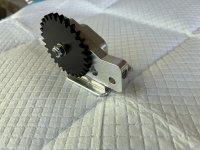
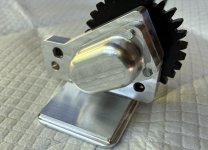
Introducing A Better Oil Pump, New For 450 & 500T

Hi Jay,

The pump is a work of art.
Jumping way back to where you tapped oil pressure, right exhaust cam bearing. I woud love to know what the pressure is beginning of the system before the sludge filter with gear pump. I know this is difficult to do without hacking into the lower right side cover with a welded bung.or NPT. Hold that thought. I am assuming that pressure before all design restrictions leading up to cams and down to crank and transmission would be ~10-15 psi and possibly higher at upper rpms. Anyone done this and have numbers yet?

I've taken another look at the centrifugal filter efficiency. In a Pm to you I ignorantly built a case for the little "I think I can" centrifuge efficiency and at the same time proposed a better filter system because I already knew the obvious. I have been working hard on this project. The truth is the "sludge filter was never good, even with lower performance of the piston pump. This type of filter has efficiency dynamics rooted in careful calculation. Effective precipitation of sediment is a concert of of flow rate at rpm with diameter and cavity size. The piston pump would give it a modest opprtunity for the residence time needed to precipitate... something? The system leaked off pressure at the spring loaded mechanical seal on the cover and the diameter is too small to precipitate anything other than contaminents with a specific gravity of steel. Most of what you see in there is from the bore and and power transmission wear, maybe some larger carbon that is 1.0 sg. As mentioned earlier in another post at low rpm it can start to wash out. The pulsation of the piston pump does not help. In reality the centrifugal filter would have to be twice the diameter for all model applications to have a higher efficiency. I'm sure that Honda engineers sacrificed function for form here. Later bikes had much more effective cartidge filters and then followed by spin ons with anti siphon back checks.

Now the bad news. Increase the flow withthe gear pump and now the centrifuge requires twice the rpm to have the same dismal effect. I estimate about 18k to 22krpm for the same sedimentaion as the factory set up based on diameter, cavity size and new flow charactaristics.
You still rock Jay!!

A really good filtration system is needed to meet the new demand. I don't like any of Cappinelli's products. Thier filter conversion trieds to make good use of the right side cover space which is a novel idea, and I was consideringa version of this but again marginally effective unless your racing, want to keep the weight way down and you know that it is refreshed with every meet. Oil port modifcation and options are there but it all seems kind of weird to me. Bypass surgury with similare restrictors?? I bought a couple of cam chain followers from them and they had more play than my worn ones.

I'll post soon.
 
...at some point. With the weather the way it's been the last week or so and with at least 15 to 20 little things left to do aside from finishing the top end of the engine, it will be a bit before that gauge moves off zero.

This post is closer to it

 
...at some point. With the weather the way it's been the last week or so and with at least 15 to 20 little things left to do aside from finishing the top end of the engine, it will be a bit before that gauge moves off zero.

This post is closer to it

Thank you. It will be this summer before I finally hear the music on both 450's. I will eventually post some of my work. I have been agonizing over these two 450's off and on since 2012.
Got into this oil filter side project because it was speaking to me. More like yelling at me. Just wanted the pressure with Jays pump so I could range the gauge.

Your build looks great. Wish I had more time to read some of the great stuff here!
 
In the 350/360 oil transfer piece mod thread the centrifugal filter was way more efficient than a spin on or cartridge filter removing sub 10 micron particles, the smallest 'paper' filters remove 'most' of the time. (unless you have a massive filter?)
Any bypass filter will send totally unfiltered oil through the system at high rpm or when cold.
The fact that the centrifugal filters get a 'mat' of iron and aluminium built up inside it (plus whatever else is in oil) tells me they are large enough diameter to trap particles.
The oil may not be staying in the centrifuge very long but it is making multiple passes, plus, the actual flow path requires oil to change direction with a 'hard wall' redirecting it.
Someone posted a link to centrifuge efficiency, 40mm isn't ideal but is better than paper.
Pre-filters on construction equipment (Case, JCB, Cat, etc) are about 8"~10" diameter and centrifuge most dust out in a single pass, even very very fine stuff in my experience (plus, it's the basis for Dyson vacuum cleaners)
I'll stick with my centrifuge
 
Generally the higher output pump fully circulates the total oil volume within minutes. It’s a dilution v flow v volume calculation, FWIW. Then, repeats all the while the engine turns (whether running or not). This gives the centrifuge effect many, many opportunities for particles to be trapped, and are trapped.

Further, the higher flow more efficiently washes out wear particles keeping them in suspension for the filter to do its work.

With all that, keeping your oil frequently changed is still recommended.
 
Main reason to change oil frequently isn't it gets dirty but it breaks down from shearing action of transmission and primary drive.
Anyone who's tried a 'car oil' (non JASO-MA) in a bike knows it lasts about 700 miles maximum before it's consistency of 3in1
It does clean motor out pretty good, but, you may need a new clutch with oil change
 
My comment was based on almost 40 years of proffessional experience with centrifugal separation devices as a Biomedical service engineer. I have an above average understanding of the concept of separation.
A modified oil system; A constant with anything engineering is if you change any of the parameters in a system, then the entire system needs to be re-evaluated. Engine builders and Hobbyists make this mistake often. Myself included. If the system is flawed to begin with, which in the case of the centrifugal oil filter and the piston pump, in context with this post the CB450 was. Honda engineers abandoned it, obviously the space required to make it truely efficient and the fact that it consumes crankshaft energy to do work was more than likely a hands down consideration. The system as a whole was clearly flawed as proven through the desire to "build a better pump". Did the filter work, it appeared to because you saw something in there. Was it efficient and cleaning the oil, no. All the time, no. The data Jay provided for "Building a better pump provides important flow charatistics that allow for clearity in further evaluation.
A centrifugal filtration system is partical separation device with a specific interrelated dependencies: rpm, diameter, cavity depth, point of entry/exit and flow rate in correct concert that permits enough residence time for each particle with a given specific gravity to precipitate out of a given fluid.
Dyson vacuum cleaners are really cool aren't they? You get to watch curly little hairs rotate while a subsequent foam filter (smarter competitors use two in series) do the lion share of the work on the really small stuff.
I invite anyone to actually do the calculations for each type of particle ( Carbon, Aluminum, Steel, Oil) for the given rpm and centrifugal diameter, cavity size, and flow rate on any of these Honda's.
One more consequence is the way the oil enters the cavity. To be efficient must enter opposite of the outlet. The honda centrifugal filters do not. Incomming and outgoing oil mix and the mechanical seal is a parasitic pressure drop. The pulsations of the piston pump throw it to the back while the pulse is disturbing already precipitated lighter material. Every time I look at these pretend centrifugal filters, I have to...LOL.
In the effort to restore one of my 450's to a 100 point machine, I may retain the stock oil system. Given all the new information, time and money invested, I'm not comfortable with it and won't be riding it much. I will be preparing a side cover and fabricating a redy to go filter system for this and shelving it. The second 450 with get get a high flow, anti drain back, 98% efficiency at 20 micron, easily servicable and remarkably aesthetic system with no parasitic pressure loss. I will ride the hell out of this one.

There's the wrong way, the right way and a better way.
 
I went to law school instead of engineering school because, even then, I knew that my mind just didn't stay focused on the many considerations you raise in this post. Somehow I could "what if" my way through legal abstractions pretty easily, but the hard realities of engineering just ran me off the road into the weeds.

Carry on! We need this sort of thinking.
 
I went to law school instead of engineering school because, even then, I knew that my mind just didn't stay focused on the many considerations you raise in this post. Somehow I could "what if" my way through legal abstractions pretty easily, but the hard realities of engineering just ran me off the road into the weeds.

Carry on! We need this sort of thinking.
Thank you.
 
It may be worth noting that Honda continued to use centrifugal oil spinners for quite a while after introducing replaceable paper filters on the horizontally split CB750 in 1969. The paper filters were common elements of the contemporary fours, all of which shared the horizontally split cases.
  • The XL250 and XL350 singles used trochoidal gear pumps and centrifugal filters through at least the late 70s. The XL350 was introduced in 1974.
  • The CB360 is regarded by most as a redesign of the CB350T. Honda replaced the piston pump of the CB350 with a trochoidal gear pump, but retained the centrifugal filter. The 360 was also introduced in 1974.
  • The CB500T, introduced in 1975, replaced the CB450, but kept the later style CB450 piston pump along with an oil spinner.
In fact, I believe Honda continues to use centrifugal oil filters on some of the smaller bikes in the modern lineup, although, admittedly, I have almost no experience with modern motorcycles.

I would really enjoy seeing the results of scientific tests or simulations of the old filtration systems, but failing that, one can only engage in armchair engineering.

I'm sure most of us have picked up an old Honda and opened that oil spinner only to be amazed at the amount of sediment the POs managed to accumulate in there before the bike was set aside or quit the game. Makes one wonder if the lack of owner maintenance could be or have been one strike against using such systems in certain applications.
 
Last edited:
FWIW, Scania Engines (Used in Mack Trucks in the 80's) have a centrifugal filter on their medium duty diesel. It worked very well too. A lot of reasons are what PJ talked about in the previous posts.
 
Makes one wonder if the lack of owner maintenance could be or have been one strike against using such systems in certain applications.
When you think of the time that these bikes were sold, '60s and '70s for the most part, it was during an era in which cars and bikes were still entirely mechanical and most vehicle owners back then had more mechanical understanding. A much larger portion of owners then knew how to adjust their own points and carburetors, replace their own spark plugs, coils, caps, rotors and wires and did some minor mechanical repairs. I think the design was fairly appropriate yet cost effective for the era, and IMO it was a couple decades later when the vintage bike craze began in earnest that the younger owners of them were far more removed from learning to do those typical maintenance items and they simply bought these bikes assuming they were more like the "modern" vehicles they owned at the time, so between a lack of fundamental understanding of the systems and a lack of any real mechanical experience those things were often ignored from then on.
 
Thanks for posting!
For perspective, the drill motor is spinning the pump at an idling engine equivalence.
I just checked the max speed of my drill on high speed, and it's 2000 rpm peak. I had the variable speed trigger tied at about halfway so the pump input speed in that video is roughly 1000 rpm, give or take. Not sure what the ratio is for the pump gear to the clutch basket gear, but the primary drive ratio is 3.3:1
 
An open side at the output doesn't say much, the resistance is building up pressure, and pressure will work against the pumped volume.
 
Well actually, with positive displacement pumps like this, there’s little difference in flow with or without resistance.

It is absolutely correct though, that Centrifugal type pumps are significantly sensitive to resistance.
 
Well actually, with positive displacement pumps like this, there’s little difference in flow with or without resistance.

It is absolutely correct though, that Centrifugal type pumps are significantly sensitive to resistance.
The main reason is the internal leakage of the pump, and that's depending on the tolerances of the build. What happens if you close of the output with a pressure sensor (protected with an pressure relief valve) ? what pressure will be reached when the oil cannot flow ? The pressure that can be reached without damaging parts is a good validation of your pump. This test should be done with hot oil, and a hot pump.

 
The main reason is the internal leakage of the pump, and that's depending on the tolerances of the build. What happens if you close of the output with a pressure sensor (protected with an pressure relief valve) ? what pressure will be reached when the oil cannot flow ? The pressure that can be reached without damaging parts is a good validation of your pump. This test should be done with hot oil, and a hot pump.


Motorcycle (BMW I suppose) engine at Polish racing workshop:

 
The new gear mounting method solves a number of issues.
It makes it easier to interface into my test rig
Fewer small parts to package
Makes installation easier with no small snap ring tool needed (though still required for clutch disassembly)
 
Black oxide coating. No material change.

That was a quality issue with the supplier for corrosion resistance. To help control costs, he heat treated with another customer’s batch and got black oxide as well.
 
I wish there were a less messy way to apply the sealant! The rest of the batch built are much cleaner in application.

The pump shown here will replace the Gen 1 pump on my test bike. In turn, that gets a wear evaluation and rebuild.
 
There has been a question raised about the Gen 2 v 3 pumps.

For a comparison to all pumps:
Gen 1 pump achieves slightly higher flow than 6 Lpm, 6.1
Gen 2 pump is rated right at 6 Lpm
Gen 3 pump is rated right at 6 Lpm but reaches rated flow 100 rpm less

Ciao’!
J
 
Back
Top Bottom