Introducing A Better Oil Pump, New For 450 & 500T

Jay, I suspect that hole has a purpose in insuring oil flow to the "bearing surface" area of the cam @ the tachometer drive pinion, even if it is just a way for the oil to return to the sump afterwards.....
Back in the day, we would slightly enlarge the hole in the left end of the pinion to increase oil flow inside of the left end of the exhaust camshaft, and thus to bearings, tappets and cam lobes..........
I would NOT plug that hole as the oil goes first to the left side (internally) of the cam and might need that pressure release outlet at the far right end to fully fill back to the right side bearing surfaces.....
 
Last edited:
What makes me crazy throughout this whole process (and it is ongoing) is the seeming inconsistency of oiling hole placement. This small hole is a case in point in that if it helps on one cam, why wasn't it included in the other?

@ Steve, if you closely examine that bearing in your hand, the picture is woefully inadequate, the supply feed is ~10mm distance from that small hole and in line. In effect, it siphons oil pressure from feeding the cam internals, or, it moves oil from one side of that web to the other, or???, but where does it go? So far, the only thing I've been able to determine is an oil spray (using the term loosely here) in the general direction of that torsion tube. But then, why only that one and not both? ugh. I wholeheartedly agree that enlarging the holes/cutting off the end of the little distribution tube inside the cam is a worthy mod. Its on my list to call, I need parts in front of me to really sort it out (remember picture brain?), otherwise I just get confused.

There is such a rich diversity of experience here, I'd be interested in hearing how others have modified their oiling systems, cause and effect kind of thing!
 
Last edited:
Jay, as you and I have discussed at length on the phone (but not here as yet), I followed some of Terry Naughtin's experience and opened up the 2 holes in the end of the tach drive tube although Terry cut the end of the tube off while still using the tach drive-style cam bearing. Later, once he converted to the Cappellini pump, he used all intake cam bearings on both cams (left intake bearing on the right exhaust end, right intake on left exhaust end) so no tach drive or tube at all but the Eaton trochoid-style pump Cappellini uses has significantly more pressure. It's still a mystery why Honda would do some of the things they've done, and that additional orifice does seems weird. I checked all my other cam bearings and as you said, only the tach drive bearing has it.
 
Traveling again, sitting in my hotel room watching episodes of “Engine Masters”. Essentially, it’s a show dedicated to product comparisons back to back on an engine dyno. Much of the stuff they do, while interesting on its own doesn’t translate to our higher tech overhead cam, highly stressed engines. But there is one episode that talked about windage trays.

Windage losses in an engine essentially amount to aerated oil acting like viscous air the crankshaft must rotate through. They can be quite high, horsepower robbing high.

The premise was that free power was to be had in the oil pan, they were right. Another problem they uncovered was oil pressure decayed past a certain rpm and oil level. When they reduced oil level (volume in the sump), the pressure curve increased with rpm, as it should.

From earlier posts, I note the gear pump reached a point and didn’t increase. That run had an increased oil level, by approx 500cc/1pt to aid oiling at startup, which it does. Perhaps that extra is now causing the very problem it was meant to solve.

Further, what if the windage tray isn’t protecting from windage loss?

I hate to say it but the car guys may have a point in that there is some development needed. I believe there is free power to be realized by a more efficient windage tray. One that’s closer/form fitted to the crank, has “louvres” to skim off the attached oil and wraps a bit farther around.

A side benefit that is critical, is to keep air out of the oil at all rpm’s.

Has anyone any knowledge, done work, or know of work done in this area? Preferably with either lap times, run times or dyno runs. You know, empirical data needed.
 
Last edited by a moderator:
Jay, I have no empirical data but I can tell you that a longtime member of the other forum (Lefty) was pretty well-read on many performance subjects and he once posted about an oil "scraper" to reduce the oil clinging to/spinning with the crankshaft. I'd imagine there's something to it and it might be an interesting idea to work on at some point.
 
I found that thread, looks like we were thinking along those same lines.

it doesn’t appear he did anything with his thoughts, or at least didn’t share if he did.
 
I found that thread, looks like we were thinking along those same lines.

it doesn’t appear he did anything with his thoughts, or at least didn’t share if he did.

I contacted Lefty to let him know about VHT and he said he was taking a break from bikes for a while. That was probably about a year ago, and he hasn't posted on the other forum anytime recently either.
 
Looking forward to seeing more interest and activity for Jay's new oil pump, and there's great installation feedback in the thread above. (y)
 
Thanks Boomer!
The 350 is a different animal to fit, the main housing is inordinately complex. As soon as I can get the 450 settled (almost there) will free up bandwidth for the 350. Initial thoughts are to make a casting. A wild thought was to make a lost wax/investment casting tool from my 3D printer … which isn’t working … I broke it, got the repair/upgraded parts and still can’t make it work!

anyone have Creality Ender 3 Pro experience?

Any update on the 350?


Sent from my iPhone using Tapatalk
 
Jay took this video of his 450 with stock oil pump and a clear plexiglas cover over the exhaust valve area. I thought it would be of interest for 450 owners to see the oil movement in the area. I'm sure a video of the same engine with Jay's new oil pump would show quite a bit of difference based on his calculations. (ignore the noisy engine)

 
Yeah, I was a bit surprised at the quantity of oil from the stock pump, shows it isn't as bad as one might think. I have to believe his pump would show a lot more splashing around and getting slung forward. I'd be curious to see the comparison between pumps with respect to how quickly the oil gets there visually on a cold start too.
 
My amateur take on this is that the oil drains back to the crankcase and out of the stock piston type pump pretty easily, so when you start the cold engine it has to prime itself and then pump the oil up to the head and all the way to the left exhaust valve, and that takes time. The pump Jay created has a different system entirely and it much more likely to hold oil in the system, so that it starts pumping as soon as the engine turns over and delivers oil to the farthest places pretty quickly.

That's this year's operating delusion. Could be complete BS.
 
Yeah, I do appreciate healthy speculation if I understand the comment, it helps us all. So, evidence is needed to verify claims. Its really no problem because I think that way as well and I would rather under promise and over deliver, then the other way around.

I will try to take the gear pump video this weekend, you'll be able to see in living color, the difference in oil delivery between the two pumps. Its still winter here in New England, I've not been motivated to work in my unheated garage (the excuse I'm sticking with!). Sure that was my plan anyway!
 
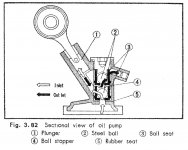
The top check valve/ball serves two purposes. The first is a piston pump won't function without the dual check valve design, which requires a reciprocating change in volume between them. The second is to keep oil primed in the engine - in a 50 year old bike, the seal and ball integrity is likely compromised so that over time, oil will eventually leak/drain past. Overnight, unlikely. Over a week?, likely.

I don't have the bandwidth to disassemble the pumps I have but can eventually get to it. Does that interest anyone?
 
I suspect the oil loss in the studs feeding the top end goes into the other orifices to the crankshaft and transmission galleries at the right crankcase cover as gravity takes over when the engine is shut off and bleeds off that way, above the check valves in the pump, which creates the time requirement for full top end supply.
 
I stand corrected in my theory. So is it that Jays' pump using the two interlocking cogs is simply a more effective way of delivering more oil, more quickly than the piston system? I know that after I installed it I had to fix a few leaks and seeps that weren't a problem before.
 
I stand corrected in my theory. So is it that Jays' pump using the two interlocking cogs is simply a more effective way of delivering more oil, more quickly than the piston system? I know that after I installed it I had to fix a few leaks and seeps that weren't a problem before.

Yep, the volume of oil delivered by Jay's gear pump is continuous (as opposed to the piston pump's delivery only on the "compression" stroke of the piston) and a greater total than the piston pump. What areas did you have to seal up?
 
As implied by AD, the gear pump reaches useful pressures much faster, and can provide significantly higher pressures. Perhaps these two pressure changes have revealed leaks you didn't know you had, with more pressure at lower temperatures making the oil find gaps that closed up as the engine warmed.
 
I will try to take the gear pump video this weekend, you'll be able to see in living color, the difference in oil delivery between the two pumps.

I'd be interested in seeing the footage from startup for both pumps, which would illustrate the quicker delivery of the gear pump in addition to the greater flow. Do you have that footage for the piston pump from your previous test?
 
stl360+450, I don't have the gear pump footage as yet.

That is, the bike with the piston pump would idle allowing me to get that, but, the bike with the gear pump would not idle, it was being cantankerous as it had sat for a couple of months. I do have another bike with a gear pump so will use that instead - a '70 CL450 and is my daily driver.

Saturday here is supposed to be rainy and relatively warm so will capture it then and post shortly after.
 
stl360+450, I don't have the gear pump footage as yet.

Do you think you'll have video of startup with the gear pump or will you only be able to capture a snapshot once it's idling? I was also curious if you already captured startup video with the piston pump.

I was able to hear the top end quiet down noticeably after installing the gear pump on my bike, but I never thought to listen for that with the original piston pump.
 
Do you think you'll have video of startup with the gear pump or will you only be able to capture a snapshot once it's idling? I was also curious if you already captured startup video with the piston pump.

I was able to hear the top end quiet down noticeably after installing the gear pump on my bike, but I never thought to listen for that with the original piston pump.

I first noticed the quieting of (what I believe is) the "hissing" sound of the cam chain on my completely stock CL450K4 while in high school. When I'd start it in the mornings before leaving for school, while sitting on it waiting for it to warm up (which ironically was drilled into me by my father during that long era of carburetors and manual chokes, for both proper running mixture and oil circulation) I noticed that after about a minute or so the "hissing" sound got much quieter. Though I did not truly understand the oiling situation in a 450 at the time having never been into a top end at that point, it just made sense to me based on my growing knowledge of engines in general and my father's belief in proper warmup. With stock exhaust it's pretty easy to hear on a 450 engine in good tune (cam chain tight, valves properly adjusted, timing and carbs set correctly so it idles decently when cold). The changing sound could be from the cam lobes on the followers since they get the oil flow directly when it fills the camshafts, hard to say without having a complete cutaway engine to watch all the parts involved, but there is definitely a change in sound when oil arrives, whatever it might be.
 
Do you think you'll have video of startup with the gear pump or will you only be able to capture a snapshot once it's idling? I was also curious if you already captured startup video with the piston pump.

I was able to hear the top end quiet down noticeably after installing the gear pump on my bike, but I never thought to listen for that with the original piston pump.

I'll try to get it for the whole sequence. I have a tripod and a camera and hopefully I can capture it all with clarity. The last was with my iphone but that won't work this time with everyone's requests as I don't have any adapter to the tripod. With the new setup, I can do it several times if needed.

I guess I need a gopro.
 
I'll try to get it for the whole sequence. I have a tripod and a camera and hopefully I can capture it all with clarity. The last was with my iphone but that won't work this time with everyone's requests as I don't have any adapter to the tripod. With the new setup, I can do it several times if needed.

I guess I need a gopro.

Don't go to any extra trouble on my account since I'm already a believer, but I think a startup video demonstrating the superior delivery time could be a good selling point, in addition to the greater oil flow.
 
Don't go to any extra trouble on my account since I'm already a believer, but I think a startup video demonstrating the superior delivery time could be a good selling point, in addition to the greater oil flow.

He needs to do it for that very reason, and we'd certainly enjoy seeing the difference. Exhaust valve cover is easy enough to get to as well. I think someone should 3D print some clear valve covers so we could all run one, it would make warmups easy and we'd know how soon we could ride away. Then put a GoPro on the bike facing it and go blast a half mile of max acceleration and see what it looks like... probably a solid oil film.
 
In response to the question about what leaked after I installed Jay's pump, as I remember it was the gasket around the exhaust valve access cover, the gasket around the cam chain tensioner housing and some greater seepage from what I think is the tach drive. I also had to reseat the gasket on the left side cover, but that may have been because the screws weren't tight enough. I try to tighten them just enough to keep a seal, but sometimes I leave them a bit too loose and then there are leaks. Leaks are better than stripped threads.
 
As it's gotten warmer I have been taking my 450 out for some short rides with Jay's pump. The first ride was about 7 miles, all in the city, with plenty of stop lights and 4-way stops. No issues. Today I took the bike out on a 12-mile ride that included about 4 miles on I-55 at speeds ranging between 60 and 75 mph. Felt good.
 
Jay took some video of the gear pump on cold startup - in this case, really cold because the bike had sat untouched for a few weeks, the temperature at the time was 45° F and it took a bit to get it running.

 
Based on what I've heard on a stock exhaust bike over the years, I'd say his pump gets the oil there in about half the time, maybe a little less than half. It would be great to see a video of the stock pump flow on a cold startup for comparison
 
Yep, I think I'll add that link to my mention of it in the Welcome Package link so new 450/500T owners will actually believe it.
 
And that's why I use 10W50 or 10W60 oil, it sticks much better, and over a longer period on the surface of the cam and cam lobes. As I have the standard 16 mm pump and did over 20.000 miles without any measurable wear on the cam lobes, the full synthetic oil must be doing something right. I will buy and install the new pump from Jay and see what will happen over a longer period, but I will keep with the choice of using synthetics and a 10W50 / 10W60 weight.
 
Finding the bandwidth to get the two videos has been a challenge. The first vid of the piston pump was with my phone and its better quality but didn't show from startup, only once running. Now, all of my bikes are converted to the gear pump and no looking back!
 
And that's why I use 10W50 or 10W60 oil, it sticks much better, and over a longer period on the surface of the cam and cam lobes. As I have the standard 16 mm pump and did over 20.000 miles without any measurable wear on the cam lobes, the full synthetic oil must be doing something right. I will buy and install the new pump from Jay and see what will happen over a longer period, but I will keep with the choice of using synthetics and a 10W50 / 10W60 weight.

Hey all - allow me to sidetrack this thread for a moment - I'm considering going to synthetic (71' CB450) I like the idea of the 10W50 (I'm currently using Shell Rotella T4 15-40, but it's no longer available and no one can tell me when it's coming back).

Switching to Synthetic in this blend - am I committing to a clutch plate replacement at the same time?
 
As long as the synthetic has no mileage improvement additives, preferably one with a motorcycle wet clutch rating, it will not affect your clutch plates. The other thing to think about is oil foaming and shearing, which is why Diesel oil is popular. like Rotella T6 15W40, as it has additives, like MC oils, to reduce this in the transmission.
 
@WintrSol Do you have a synthetic, or synthetic blend you like?

My experience is a slipping clutch but I didn’t experiment beyond that and went back to Rotella, Delvac and others. Now I’m using the Costco diesel oil with good results.
 
I usually use Amsoil, because I get a discount, but in a pinch, I'll get T6; both are rated for motorcycles with wet clutches. Both full synthetic, too, as 'blend' can mean any amount of synthetic in plain oil, and I don't want to study that hard.
Anything with an 'energy saving' sticker, or the like, are usually bad for your clutch.
 
I'm not sure why I've never read through this thread before, funny how things escape our attention...

Back in the fall I picked up a CB450K0 in rough shape, seized engine. I've spent the winter gathering parts and having the engine rebuilt. Total tear down and rebuild (not by myself). Reassembly is just beginning. Would the consensus from those much wiser than myself (probably everybody here) be to attempt to get one of these oil pumps into that engine if Jays100 has one that he would sell to me? Alternatively, I have also seen a thread somewhere (the other forum perhaps) about a modification to the existing pump that will increase oil flow.

I don't intend to ride this bike hard and wont be putting a ton of miles on it but now is the time to do things right and avoid any future worries.

Cheers
 
This pump will fit any 450 engine and it's a vast improvement in total oil flow as well as much quicker flow to the cams and followers, roughly twice as fast getting oil to the top end than the stock pump regardless whether you're using the old 16mm pump (the 4 speed model) or the 19mm pump like the later 450s used. Since it's a gear type pump design it pumps oil constantly instead of every piston stroke like the stock pump, which only happens roughly every 3 engine rotations. Yes, the 450 engines will survive with the stock pump when all other aspects of the engine are in good condition and properly maintained (I run the hell out of my red 450 and it has the stock later version pump), but more oil flow to the most critical parts can't hurt either.
 
Yes, the 450 engines will survive with the stock pump when all other aspects of the engine are in good condition and properly maintained

With this said, it is worth pointing out that in your case Troy, there was an update issued back in the day for the stock pump on the K0 CB450. It involved removing some material from the underside of the pump where the sump screen is. If you are going to use the stock pump from the K0 you would want to verify that update was done. Also as Tom mentioned you can fit a K1-K7 pump to your bike relatively easy I believe.

Of course the best option might be to buy this new pump from Jay if he has one available for sale and it fits the budget parameters for your project.
 
Thanks for the positive feedback, PM sent to Troy. I have a 2nd set of pump parts and they're available now.

One of the things I'm noticing at oil change now, is the layer of sludge in the centrifugal cup is deeper (Cleaned @ every oil change). The reason not mentioned before now is I hadn't had any working hypothesis as to why. Here's where I am now....

The "instantaneous flow" that is, at any given time, of the piston pump is quite high, at other times zero. With a constant flow that's instantaneously lower, again, at a given time, the gear pump allows the centrifuge system to work better. Inmate Jensen did some considerable work on this by comparing particle count of the centrifugal system v. the Cappellini paper filter system. If so, please weigh in as well.

Note that the Gear Pump total flow is 2x the piston pump oil flow.

The other hypothesis is my engine just produces more debris. Nah, that can't be it, of course not!
 
The other hypothesis is my engine just produces more debris. Nah, that can't be it, of course not!

That old tired sludged-up thing? Nah... :)

Thanks for the continued good info about your pump's performance Jay.

(please note, we are not considered inmates here, but at that other forum they do attempt to keep members hostage and unable to openly or privately discuss other locations that might be of help to them)
 
Back
Top Bottom