Mr. Bill's Honda 450's
Member
Hi Jay,
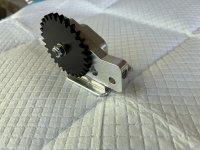
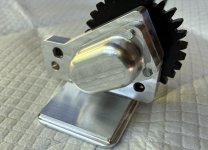
The pump is a work of art.
Jumping way back to where you tapped oil pressure, right exhaust cam bearing. I woud love to know what the pressure is beginning of the system before the sludge filter with gear pump. I know this is difficult to do without hacking into the lower right side cover with a welded bung.or NPT. Hold that thought. I am assuming that pressure before all design restrictions leading up to cams and down to crank and transmission would be ~10-15 psi and possibly higher at upper rpms. Anyone done this and have numbers yet?
I've taken another look at the centrifugal filter efficiency. In a Pm to you I ignorantly built a case for the little "I think I can" centrifuge efficiency and at the same time proposed a better filter system because I already knew the obvious. I have been working hard on this project. The truth is the "sludge filter was never good, even with lower performance of the piston pump. This type of filter has efficiency dynamics rooted in careful calculation. Effective precipitation of sediment is a concert of of flow rate at rpm with diameter and cavity size. The piston pump would give it a modest opprtunity for the residence time needed to precipitate... something? The system leaked off pressure at the spring loaded mechanical seal on the cover and the diameter is too small to precipitate anything other than contaminents with a specific gravity of steel. Most of what you see in there is from the bore and and power transmission wear, maybe some larger carbon that is 1.0 sg. As mentioned earlier in another post at low rpm it can start to wash out. The pulsation of the piston pump does not help. In reality the centrifugal filter would have to be twice the diameter for all model applications to have a higher efficiency. I'm sure that Honda engineers sacrificed function for form here. Later bikes had much more effective cartidge filters and then followed by spin ons with anti siphon back checks.
Now the bad news. Increase the flow withthe gear pump and now the centrifuge requires twice the rpm to have the same dismal effect. I estimate about 18k to 22krpm for the same sedimentaion as the factory set up based on diameter, cavity size and new flow charactaristics.
You still rock Jay!!
A really good filtration system is needed to meet the new demand. I don't like any of Cappinelli's products. Thier filter conversion trieds to make good use of the right side cover space which is a novel idea, and I was consideringa version of this but again marginally effective unless your racing, want to keep the weight way down and you know that it is refreshed with every meet. Oil port modifcation and options are there but it all seems kind of weird to me. Bypass surgury with similare restrictors?? I bought a couple of cam chain followers from them and they had more play than my worn ones.
I'll post soon.
The pump is a work of art.
Jumping way back to where you tapped oil pressure, right exhaust cam bearing. I woud love to know what the pressure is beginning of the system before the sludge filter with gear pump. I know this is difficult to do without hacking into the lower right side cover with a welded bung.or NPT. Hold that thought. I am assuming that pressure before all design restrictions leading up to cams and down to crank and transmission would be ~10-15 psi and possibly higher at upper rpms. Anyone done this and have numbers yet?
I've taken another look at the centrifugal filter efficiency. In a Pm to you I ignorantly built a case for the little "I think I can" centrifuge efficiency and at the same time proposed a better filter system because I already knew the obvious. I have been working hard on this project. The truth is the "sludge filter was never good, even with lower performance of the piston pump. This type of filter has efficiency dynamics rooted in careful calculation. Effective precipitation of sediment is a concert of of flow rate at rpm with diameter and cavity size. The piston pump would give it a modest opprtunity for the residence time needed to precipitate... something? The system leaked off pressure at the spring loaded mechanical seal on the cover and the diameter is too small to precipitate anything other than contaminents with a specific gravity of steel. Most of what you see in there is from the bore and and power transmission wear, maybe some larger carbon that is 1.0 sg. As mentioned earlier in another post at low rpm it can start to wash out. The pulsation of the piston pump does not help. In reality the centrifugal filter would have to be twice the diameter for all model applications to have a higher efficiency. I'm sure that Honda engineers sacrificed function for form here. Later bikes had much more effective cartidge filters and then followed by spin ons with anti siphon back checks.
Now the bad news. Increase the flow withthe gear pump and now the centrifuge requires twice the rpm to have the same dismal effect. I estimate about 18k to 22krpm for the same sedimentaion as the factory set up based on diameter, cavity size and new flow charactaristics.
You still rock Jay!!
A really good filtration system is needed to meet the new demand. I don't like any of Cappinelli's products. Thier filter conversion trieds to make good use of the right side cover space which is a novel idea, and I was consideringa version of this but again marginally effective unless your racing, want to keep the weight way down and you know that it is refreshed with every meet. Oil port modifcation and options are there but it all seems kind of weird to me. Bypass surgury with similare restrictors?? I bought a couple of cam chain followers from them and they had more play than my worn ones.
I'll post soon.