CL450 Exhaust Restoration

FrisianWheel

Veteran Member
Joined
Jun 3, 2020
Total Posts
327
Total likes
97
Location
Berlin, Germany
I recently found a CL450 exhaust on eBay and since these mufflers are extremely rare and expensive in Europe I've bought it for relatively small money. The heat shields, all brackets and the tail pipe was missing but it turned out to be a decent find. The seller wrongly tagged the offer as 'CB450 exhaust' which might has helped to keep the price low.

The plan is to restore the exhaust and put it on my red and silver CB450 project bike as it already mimics the style of the beautiful CL77 or 72. The main challenge with a restoration is probably to find a chrome plater who is willing to throw a used muffler in his tanks or to find one you can afford as the market for plating in Germany (and probably in most parts of Europe too) is getting more reluctant towards individual petrolheads. So I decided to choose a different path.
A while ago I already experimented with zinc plating and was fairly happy with my modest results. So I thought why not expanding on this experience and found out that a certain type of chrome is suitable and safe for home usage because it doesn't contain acids. I will try to document my chrome plating efforts in this thread. I know of course that it won't be like a 'hard chrome' or chromeVI and that it will be hard to avoid blueing at the downpipes but I just like experimenting. I will use a stick anode rather than a whole tank filled with expensive fluid.

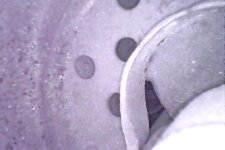
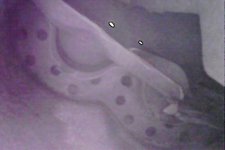
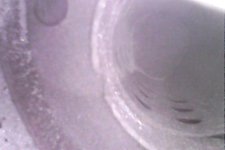
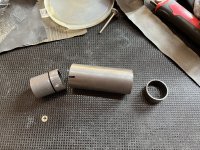
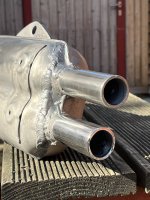
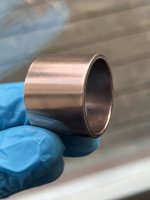
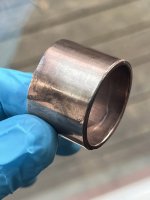
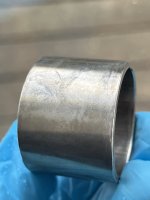
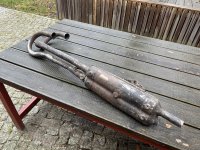
The muffler before and after glas bead blasting. The sheet metal on the inside looks not too bad to me and it also doesn't rattle...
e1.jpege2.jpeg
inside1.jpginside2 .jpginside3.jpginside4.jpg
 
Last edited:
So far so good, I like the progress. If those welds in the last picture are yours (and it sure seems so, considering the backside of the stock muffler never looked that way originally), you've learned quickly. I'd be completely happy with weld quality like that if I'd done it myself, and I doubt mine would look that good.
 
So far so good, I like the progress. If those welds in the last picture are yours (and it sure seems so, considering the backside of the stock muffler never looked that way originally), you've learned quickly. I'd be completely happy with weld quality like that if I'd done it myself, and I doubt mine would look that good.

Thanks Tom but I wish I would be able to make such welds on sheet metal already. No, the exhaust has been opened before and I really would like to know why. The body seems to be quite solid. Does anybody know a bit more about the inside of these exhaust or has some pictures. I suspect that something has been removed as there isn't too much inside...

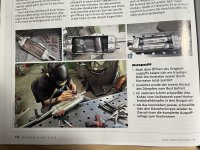
On the other hand, I recently read in a German magazine that someone TIG-welded two Harley mufflers inside a CL450 exhaust. According to the picture that shows the entrails it seems that there's actually not more inside than what I can see...

hd.jpg
 
Last edited:
That would explain why it has no rattles then! When I was in high school my father cut my CL450K4 muffler open to weld a loose baffle so they've had the problem for a long time. I bought that bike new and probably could have gotten it replaced under warranty as it was only about 4 months old at the time, but I sold it not long afterward during that couple years where I was changing bikes every 4 to 6 months. At least someone took care of that problem for you already.
 
Inside the 350 mufflers there isn’t much - one large perforated chamber and another that seems to just be a twisted pipe.

The CL350 mufflers have even less, just a few baffles to jostle the air back and forth.

Either way, certainly following to see your results! I have just repaired a set of CB 350 mufflers and also haven’t found a chrome shop willing to touch them.
 
That would explain why it has no rattles then! When I was in high school my father cut my CL450K4 muffler open to weld a loose baffle so they've had the problem for a long time. I bought that bike new and probably could have gotten it replaced under warranty as it was only about 4 months old at the time, but I sold it not long afterward during that couple years where I was changing bikes every 4 to 6 months. At least someone took care of that problem for you already.
I've read it several times already that the CL pipes are notorious for rust caused by condensation. Therefore I'm wondering if it would make sense to drill one or more (if required by the internal structure) holes into the body to avoid future rust problems. I guess it must be at least 3 or 4 holes because of the three 3-shaped stabilizers. It also would be difficult to find the must efficient spots from the outside... sigh...
 
I've read it several times already that the CL pipes are notorious for rust caused by condensation. Therefore I'm wondering if it would make sense to drill one or more (if required by the internal structure) holes into the body to avoid future rust problems. I guess it must be at least 3 or 4 holes because of the three 3-shaped stabilizers. It also would be difficult to find the must efficient spots from the outside... sigh...
And that's the reason they actually came with 'drain' holes in the bottom, maybe only one on the 450 but the individual mufflers on the 350 both had one. I suspect the bikes that were only ridden short distances and didn't burn off all the condensation were the ones that started to rust sooner.
 
And that's the reason they actually came with 'drain' holes in the bottom, maybe only one on the 450 but the individual mufflers on the 350 both had one. I suspect the bikes that were only ridden short distances and didn't burn off all the condensation were the ones that started to rust sooner.
I remember seeing a rubber hose coming off a small spigot/tube of the mufflers as part of a nice,original CL350 in the past:now it makes sense.
 
So, here are some first chrome plating test results. The procedure for chroming with my equipment is basically to apply a copper layer first. The main function of this layer is to stop the material from rusting. Then a second layer of nickel needs to be applied which works as separator between copper and chrome. When the nickel is applied and has no oxidation or burns chrome can be applied. Well, and here is my problem. While nickel plating it seems it starts to oxidize already. I'm sure there is something I'm doing wrong as there are also temperatures to pay attention to and procedures in between but I will figure it out...

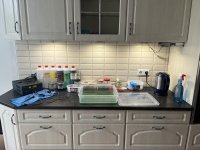
kitchen.jpg

This kitchen isn't used at the moment so I can leave my stuff there. It's probably not a good idea to mix it up with food and drinks.

pure.jpg

the pure material

copper.jpg

copper is easy to apply and very forgiving

nickel1.jpg

a bit of nickel and you can see the oxidation already

nickel2.jpg

after nickel plating, not good enough...
 
If you’re having trouble finding resources, you might try posting on the r/electroplating subreddit. It’s relatively small but as a niche sub they’re pretty responsive and helpful.

I tried doing some basic nickel plating and was having issues, they helped me move forward.

What kind of power supply are you using? I was vastly over powering my relatively small pieces and that was causing them to “burn”. Switched to adjustable and found some basic rules of thumb that seemed to help.

I’ve also heard of bubblers like you’d see in a fish tank helping to make sure the solution continually mixes around the piece helping with uneven finishes.

edit: I see the supply now - is it adjustable current?
 
It's fun and so interesting to read these kinds of posts. It makes me want another shop space just for this and welding, painting and machining.
 
If you’re having trouble finding resources, you might try posting on the r/electroplating subreddit. It’s relatively small but as a niche sub they’re pretty responsive and helpful.

I tried doing some basic nickel plating and was having issues, they helped me move forward.

What kind of power supply are you using? I was vastly over powering my relatively small pieces and that was causing them to “burn”. Switched to adjustable and found some basic rules of thumb that seemed to help.

I’ve also heard of bubblers like you’d see in a fish tank helping to make sure the solution continually mixes around the piece helping with uneven finishes.

edit: I see the supply now - is it adjustable current?

Thanks for your advice. I will have a look at the forum but will probably bother the seller first. He seems to be a supporting guy... It also sounds like you've plated with a tank while I use different stick anodes. The advantage is obviously that you're not limited in size while it seems to me that you have to deal with immediate oxidation. Anyway, it is a new craft that I need to learn. I can't expect that it works in an instant.

The power supply is adjustable from 2,7 to 15 volts and has 40 amps max. output.
 
Good luck with your repair/replating exhaust project. I have been working on repairing and replating my CL350 exhausts for a long time so this is a great opportunity to learn and I will be following with interest.

I finally found a specialty welder and plater who will work on used exhausts for my CL350.

Of relevance to your project, the plater I am working with, as well as other platers, do not use the typical copper, followed by nickel, followed by chrome, when it comes to exhaust plating because the difference in thermal expansion of the three metals will lead to delamination and pealing. They just do nickel, then chrome, on exhausts, so it will be interesting to see if the copper layer you are using creates any issues.

Some platers have stated, that the shiny appearance really comes from the highly polished nickel more than the chrome and that the chrome’s primary contribution is to prevent the nickel from oxidizing.

There are lots of stripping and deoxidizing baths immersions and polishing steps to re-chroming.

Flash rusting/oxidizing isn’t just a issue in painting but replating as well.
 
Good luck with your repair/replating exhaust project. I have been working on repairing and replating my CL350 exhausts for a long time so this is a great opportunity to learn and I will be following with interest.

I finally found a specialty welder and plater who will work on used exhausts for my CL350.

Of relevance to your project, the plater I am working with, as well as other platers, do not use the typical copper, followed by nickel, followed by chrome, when it comes to exhaust plating because the difference in thermal expansion of the three metals will lead to delamination and pealing. They just do nickel, then chrome, on exhausts, so it will be interesting to see if the copper layer you are using creates any issues.

Some platers have stated, that the shiny appearance really comes from the highly polished nickel more than the chrome and that the chrome’s primary contribution is to prevent the nickel from oxidizing.

There are lots of stripping and deoxidizing baths immersions and polishing steps to re-chroming.

Flash rusting/oxidizing isn’t just a issue in painting but replating as well.
I can attest to CL350 K2's comments regarding copper plating on exhaust systems.
I took my CB350 K4 headers to be chromed by a shop that specialises in doing work for vintage and classic restorers.
I asked him to copper first but he strongly demurred for exactly the reasons CL350 K2 sates.
 
So uhhhh, where are these specialty shops that will replate used exhaust parts?

Ed,

This is the best string on exhaust plating I have found on VHT. https://www.vintagehondatwins.com/forums/index.php?threads/chrome-plater-wanted.7163/#post-118438

The plater I found in my region is Bar Plating in CT. https://www.barchromeplating.com/ They are booking out 8-10 weeks and I haven't gotten my exhaust set back from them yet so I can't comment on there work.

CL350 K2
 
Good luck with your repair/replating exhaust project. I have been working on repairing and replating my CL350 exhausts for a long time so this is a great opportunity to learn and I will be following with interest.

I finally found a specialty welder and plater who will work on used exhausts for my CL350.

Of relevance to your project, the plater I am working with, as well as other platers, do not use the typical copper, followed by nickel, followed by chrome, when it comes to exhaust plating because the difference in thermal expansion of the three metals will lead to delamination and pealing. They just do nickel, then chrome, on exhausts, so it will be interesting to see if the copper layer you are using creates any issues.

Some platers have stated, that the shiny appearance really comes from the highly polished nickel more than the chrome and that the chrome’s primary contribution is to prevent the nickel from oxidizing.

There are lots of stripping and deoxidizing baths immersions and polishing steps to re-chroming.

Flash rusting/oxidizing isn’t just a issue in painting but replating as well.

I am aware of the copper issue on exhausts but just want to learn how to achieve functional and good looking results with the standard procedure before I dive deeper into exhaust plating. I will most likely do only nickel with polishing in between and chrome but a good looking nickel layer is key as you've mentioned already. Therefore I need to know if possible impurities are caused by a missing copper layer or just poor handling. The good thing its that it seems that the very most of the original nickel layer is still on the exhaust. We'll see how much will survive the polishing procedures but my priority is conservation before shininess.
 
This is very interesting. Does wearing gloves prevent contamination from the oils of our skin? Thanks for sharing.
 
Yes, fat would prevent the ions from docking onto the metal but the gloves also remind you that you’re dealing with harmful fluids. Although my electrolytes contain no acids (yet😁).
 
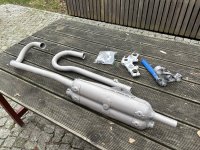
I've made some progress on the exhaust and I think I can say that the mechanical works are mostly done, except the polishing. I also have all parts complete now, so I can focus on the polishing and plating process but first I will have to practice a bit more with the nickel plating because I need to improve the quality.

p1.jpg
p2.jpg
p3.jpg

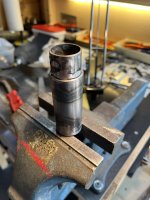
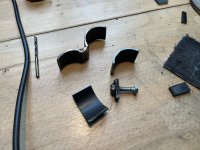
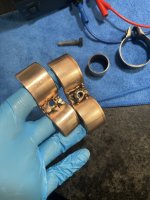
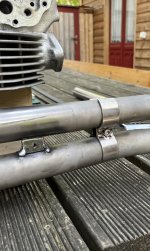
Although CMS had the two parts for the middle exhaust bracket available, I thought I save my money and do it myself with a piece of steel pipe. The end result is copper and nickel plated. I also had to ad a new fixing thread for the front heat shield.

p4.jpg

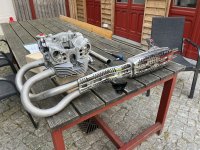
The back heat shield arrived yesterday from sunny Florida. Don't ask me about the total cost incl. shipping and customs. The initial low cost for exhaust start to put itself into perspective. :confused:
 
Nice work. I think the satisfaction of hand made parts is more than monetary value. It's almost a shame to cover those nice pieces with the heat shield.
 
The back heat shield arrived yesterday from sunny Florida. Don't ask me about the total cost incl. shipping and customs. The initial low cost for exhaust start to put itself into perspective. :confused:
Well, I know I didn't send it to you so someone here in Florida had some early CL450 parts... I just wish I had an early CL450 myself! Smart to use the head to properly align the pipes for fitment. (y)
 
I have owned a CB450 back in the 80's and it was a good runner.
I would like to own a later CL450.
 
It is really nice that you can find a decent metal workshop/fabricator (not sure of the American word for this) in the States. The exhaust heat shields look great!
Some of the shops have competent people working with metal and I am always amazed about the quality and the end look of some of the welding work that I see posted online from time to time.

Whereas, when I do it it looks like wet sand droppings :oops:.
 
Yeah, it's been a while but anyway, here I am...
There are some good and bad news on my red 450 long term project bike but I'll report on this in my project thread later (link below).

Recently I've managed to mount the muffler on my other 450 in order to test it before plating and it turned out that the muffler is way too loud. It didn't come as a surprise as I've seen that there isn't much left inside (they have been opened by the PO) but hearing them at full throttle makes you think. I wouldn't mind if the police wouldn't too but I have to bite the bullet and do something about it. My plan is to open them again and TIG weld DIY baffles inside the muffler. Ambitious perhaps as I've just started to arc weld but I don't care. Would be cool if anyone has some pictures of the original muffler intestines or the baffle distances.

And on a side note; I was really surprised how much the exhaust system changes the feeling and perception of the bike and I don't mean the loudness.

IMG_4035.jpg
 
Back
Top Bottom