CL350 oil rotor circlip engine damage

turtlestars

Member
Joined
Mar 1, 2025
Total Posts
45
Total likes
30
Location
Missoula, MT
Hi guys!
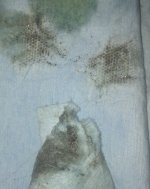
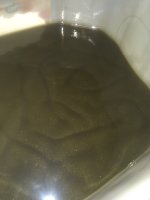
Been riding a 72 CL-350 I rebuilt a few years back and it's been doing great with regular oil changes, keeping the cam chain and valve clearances and timing adjusted regularly, etc. I've put a few thousand miles on it, and I've done a handful of oil changes since its rebirth, and nothing out of the ordinary. Recently though I pulled the generator cover off for some maintenance, and y'know how a small amount of oil usually drips out? I've been noticing that oil in there is a bit. . . shinier? with some small glittery bits of metal dust in it.

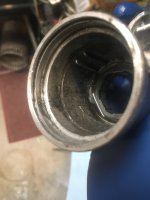
I didn't think too much of it at the time, and kept riding for a while until I did an oil change the other day, and when I pulled the cap off the right side crankcase cover to get to the filter, I noticed the circlip that holds the filter cap onto the rotor was snapped in half. half of it was gone. This frustrated me because the last time I cleaned out the oil filter, the clip was missing altogether and I had to get a replacement for it that time. Now that replacement was snapped in half? When I pulled the cap, there was significant amounts of crunchy metal paste in there, and this set off some alarm bells. Something is wearing down in here way more rapidly than it should be.

I started searching online, and a lot of people suggested that this happens when the cam chain tension is neglected, and it flops around and violently shreds the area it travels within. I found this unlikely since I keep it tensioned religiously though, making sure to do so at the point where all the valves tappets are loose, and I don't ever really hear it rattling around in there. Someone suggested maybe it's an oil-flow issue to the top end and the cam bearings are grinding down? I had an oil leak from behind the points cover to deal with anyhow, so I loosened the rocker shafts and with all the valves closed, pulled the left side cam-case-cover. The bearing surface was a little scored, but definitely not enough to account for all the metal flakes in the filter.

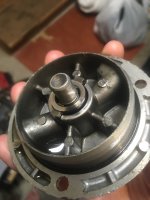
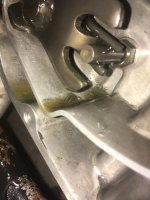
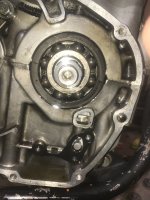
Ugh. At this point I was fearing I'd have to tear the whole engine down to find the culprit. Before I did that though, I thought I'd at least pull the right side crankcase cover and see if there's anything suspicious in the oil pump pickup screen. Upon pulling the cover, I heard something fall into the bowl of oil I had under the bike, and when I fished it out, it was a mangled up chunk of what looked to be the oil-filter-rotor-cap circlip! Somehow it had broken/popped out of its place and got lodged between the clutch basket and the oil filter rotor, and was just SITTING THERE GRINDING THE TWO DOWN every time the engine was running. My god.
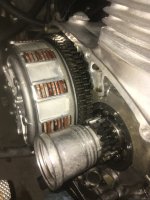
IMG_5319.JPG
I think I found where the metal shavings in the oil were coming from. What a relief. It got me thinking though, that I should confirm I have every piece of the circlip, so there isn't anything left in there to potentially cause more damage.
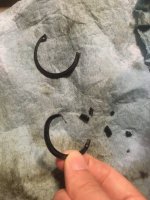
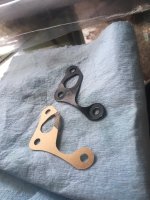
IMG_5312.JPG
The top one is what remained in place holding the cap to the rotor. the one I'm holding is what I found that had fallen out of the engine. These are not two halves of one clip, but portions of two separate clips. I remembered how last time the clip was completely missing and I had replaced it. I'd thought it strange that I would've not put a clip back in there from the time before. Turns out, from what I gather, I HAD put one in there the time before, and it must've jumped out of its spot and ended up where I just found it. I should've investigated further at that time, but instead just put in a new clip, which now is broken also, along with many miles worth of shredded engine. Lesson learned. I strained all the oil from this oil change, and all the oil I had leftover and not yet disposed of from previous oil changes, and all I could find was what's in the picture above. I think there's one or two tiny flakes of a clip, and a few chunks of rubber cam-chain tensioner roller. Ugh.

So at this point, I have a few questions I was hoping y'all could help me with: 🙂

  • Why has this clip broken twice, and how can I keep it from happening in the future?
  • Is there a good way to try to flush out the remaining bits of this hardened spring steel from the crankcase, to keep them from further damaging my engine? (I was thinking maybe compressed air in the lower crankcase?)
  • If that's not possible, and even if it is, does the presence of chunky shredded aluminum in the lower crankcase, the oil filter rotor, and the left side generator cap warrant a complete engine tear-down, to clean all potential abrasive metal dust/shavings out of all the bearings and other moving parts? (I fear the answer is yes)
  • I was also considering possibly pulling the engine and flipping it upside down to split the case to find the remaining bits, but I worry flipping it would cause them to just fall into the more upper parts of the engine, defeating the purpose entirely.
  • Also I replaced the cam-chain tensioner with an NOS one when I did the rebuild a few years ago, but now that I found chunks of it in the oil, if I have to tear the engine down would it be worth it to put in a KA Slipper while I'm at it, along with a new (possibly flat-link) cam chain? I didn't replace the cam-chain during the rebuild because it only had 5 or 6 thousand miles on it, according to the odometer, and was pretty tight upon reassembly.
I haven't yet pulled the clutch basket/oil pump/rotor, and I'm crossing my fingers the missing bits might just be behind those parts. But I'm starting to thing the best option is to tear everything apart to make sure there's nothing left anywhere, and to clean and verify the integrity of all the moving parts. I just hope if I go through all that work, that this doesn't just happen again, since it's happened twice already.

Thank you for reading my long story, and thank you for any thoughts/wisdom on this matter! I probably could've written it shorter, but I like to be thorough.
 
First of all, is the metal paste aluminium or steel ? (a magnet will tell).

Did you assemble the circlip in the right way ? (a circlip has one smooth side and one sharp side).
How far did you stretch the circlip when you did assemble it ? Did you use circlip pliers ?
 
Last edited:
A close inspection of the circlip groove is in order. Using the old clip rotate it thru the groove after inspecting. When I install circlips I use an ice pick to insert in one hole and try rotating the clip pulling towards the gap to insure it's fully seated.
 
Hi Jensen, thank you for the quick reply.

I don't have very powerful magnets where I'm at right now, but with the magnets I do have, nothing in the debris was sticking to them, so I'm assuming it's aluminum.

I had removed the remains of the circlip without paying attention to the orientation it was in there with, so i'm sure I didn't pay much attention to its orientation when installing it. Thinking about it now, I imagine the sharp side should point outward toward the right side of the bike, since it has less contact area (just on the edges) so a hard square edge would provide the best support?

I think with all internal circlips, I stretch it just enough to clear the edges so it can go in. It definitely was seated in there, I remember inspecting the edges on installation and they lined up in the groove, and it was seated in the groove all the way around.

My best guess is maybe I had put it in backwards?
 
The clips get fatigued and break, hard to find new ones in the correct size.

When the clip breaks the cover is forced out and a lot of oil just flows back into the crankcase leading to top end lubrication issues.

The cover and the connection piece need to be checked for wear, they need to be smooth and not ridged.

Be sure to use a new o-ring for the filter cover.
 
, but I like to be thorough.
This trait will serve you well going forward.

Hmmm, where did all the aluminum come from? A complete break down and clean out is probably best.
Might be easiest if I repost my cranky crank clean out rant here, on your new, all in one build thread.

I've been to that circlip circus a couple three times too. They are pricey and hard to find.

Also check the outer oil filter cover that contains the oil transfer piece. It's critical to oil pressure and flow.
 
Thank you all for the replies! I'm about to go out in the garage and pull the oil filter rotor for closer inspection of the groove, and I'll report back what I find.
Ballbearian, my thinking is the aluminum came from the wear on the clutch basket and the rotor, (at least, I think it looks pretty ground down in that first pic?). Your posts on irrigating the crankshaft look really great. I didn't think about that really when I first split the case years ago, but if I do it again now, I'll be sure to check it out. Regarding the oil transfer piece, you're referring to this guy, right?

IMG_5322.JPG
The service manual I have doesn't really provide any info on inspecting or servicing this part, but the springy bit in the middle feels like it has. . . excessive play left to right, but maybe that's by design for oil to pass through it? If pressed in/out, it seems to move ok, but it feels like there might be some grit in that free space on the sides, might need to pull the little retainer on there and check it out.

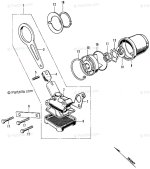
Boomer 343, when you talk of the cover and connection piece being smooth and not ridged, are you referring to the contact surfaces where the new o-ring will go, nbr 16 in this fiche?

1753565663807.png

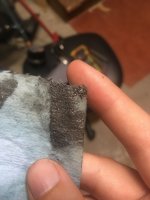
Also here's a pic of the non-metalic metal shavings wiped from the rotor, for what it's worth.
IMG_5324.JPG
 
Correcto, on oil transfer piece in outer cover. We have a whole sticky thread post on those and slight modification for better oiling. Good read to understand it's critical function.
That wipe looks bad and screams for total clean out. Unfortunately, it's usually cam chain tunnel wear that makes that much glitter.

I just posted about the Oring.

You are not alone.

May have to repost some posts and pics from your intro that got lost. Ancientdad is amazing but there are things beyond even his control.
 
From the parts diagram #16 is the o-ring that needs to be replaced, The cover #10 needs to be checked for smooth contact surface.

You can quite often turn the clip that keeps the transfer piece in place and align it with one of the tabs then tilt it past the clip. Easier that removing the clip.
 
I took the filter rotor off. Here's another pic of the remaining glitter I didn't get quite wiped out:
IMG_5325.JPG
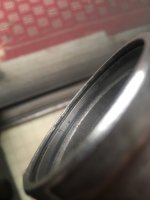
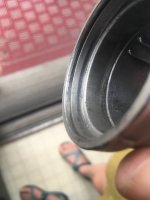
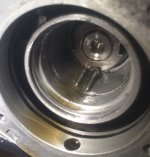
I cleaned the filter and the cap in the sink with hot water and dish soap for now, and here's some pics I took of the groove, and contact surfaces. It's a bit tricky to get good lighting/photos of it.
IMG_5326.JPGIMG_5327.JPGIMG_5328.JPGIMG_5329.JPG
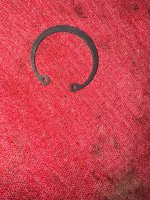
There's a bit of a gouge it looks like on the rotor adjacent to that groove that I bet I could file/sand down, but I think that's outside past the o-ring sealing surfaces, which I'm thinking are the shiny rings. What do y'all think on the condition of those surfaces? I'm leaning towards probably fine, so long as I can keep them debris free, and keep them sealed together with a tame, properly installed not-fatigued circlip? a bike junkyard a half hour from here has this guy available:
IMG_5427.jpg and they tell me it's 45mm, but it looks a bit different from the last one I got from them in April, that's now broken in half:
IMG_0485.jpg
Ballbearian, I can definitely hunt through all my old photos if you think there's anything specific you'd want to look at from the rebuild? I have put a few thousand miles on it since then with no issues in the oil until the past few months, for what it's worth. If/when I tear it all down, I'll definitely check out the cam chain tunnel, but do you think the shavings are more than just the wear that's visible on the clutch basket and outside of the oil filter?
 
Yeah, for being a turtle she's pretty quick and hard to keep up with. (y)
haha, my username is really just a reference to a crazy bizarre profound dream I had once, a long time ago, about floating through galaxies on the back of a cosmic turtle. It was magical :)
 
If you get more "significant amounts of crunchy paste", you should show us. The filter parts look ok and you should clean it every oil change. Change oil fairly often for awhile. Like 300 miles, the next time, until the glitter subsides. These bikes don't have much, to start with. Check level without screwing in dipstick, like the manual says.

Longdistancerider's comment about seating the circlip is really good advice, he also has a sticky thread about cam chain adjustment and crank position that is great. That info could be used to quickly remove, inspect and replace the tensioner, if you suspect that it is going bad.

Seems like more glitter than a worn clutch would make.
Call me a happy pessimist but I've been dreaming of the end of this world age for several decades.
 
Hope to pull the oil pump/clutch assembly soon, but that would mean I need a new oil pump gasket, right? Have y'all had any luck with cutting DIY gaskets for these bikes? I have a Cricut machine, and I feel like that could be a fun project, but what material is best to use for something like that? Isn't the oil pump gasket a lot thinner than the rest of the ones on this bike? I wonder if there's a library of gasket templates, that would be cool.
 
Isn't the oil pump gasket a lot thinner than the rest of the ones on this bike?
Yes it is, and unless you have the correct thickness gasket material I wouldn't attempt it.
I wonder if there's a library of gasket templates, that would be cool.
As well as a MASSIVE undertaking when you look at CMSNL and even limit it to the most popular models sold.
 
Hope to pull the oil pump/clutch assembly soon, but that would mean I need a new oil pump gasket, right? Have y'all had any luck with cutting DIY gaskets for these bikes? I have a Cricut machine, and I feel like that could be a fun project, but what material is best to use for something like that? Isn't the oil pump gasket a lot thinner than the rest of the ones on this bike? I wonder if there's a library of gasket templates, that would be cool.
I made some extras last time around from thinnest gasket paper I could find at auto parts store. You can make an impression by pressing down hard over corrugated cardboard, then cut it out.
 
I made some extras last time around from thinnest gasket paper I could find at auto parts store. You can make an impression by pressing down hard over corrugated cardboard, then cut it out.
For such a critical part, has it been holding up ok with whatever material you were able to find locally? Could I measure the thickness of the one in there already, or would that be compressed and not useful info? I don't know where I'd get an accurate spec for that thickness other than buying and measuring an OEM gasket (which seem available easy enough online) or if the spec is known by one of y'all.
It bums me out the specs aren't readily available online, esp when there are so many gasket manufacturers putting out "High quality gaskets that meet or exceed OEM specifications" -- like you did the work to get those specs? would you care to share? haha, I'll join your forum! 😍 -- yeah, yeah, trade secrets, I get it.
 
I know this is a semi-lift, but if you have trouble sourcing a NOS circlip, you can buy a circlip off of McMaster Carr with the right nominal Size and have a machinist with a surface grinder bring it down To the correct thickness.

i did that a few years ago when I had trouble finding one and I’ve been running it ever since. Many thousands of miles.
 
Bingo.

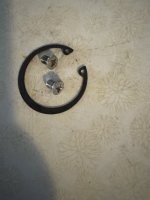
IMG_5335.JPG IMG_5337.JPG
I think all the bits of the two clips are now accounted for, including all that little debris in there.
Ugh, these pictures make me think I should repaint my frame sometime.
I feel like gaskets are a kind of voodoo to me - dry, wet, sometimes they leak, sometimes they don't, different materials. . . the general consensus is gaskets should always be replaced and never reused, right?
Also, while the clutch is off I'll go ahead and inspect the friction discs and plates and clutch springs, per the manual. Is there anything else I should look out for while I'm in there before I button it back up? I crudely measured the end-play of the clutch assembly at somewhere between 0.68 and 0.96 mm, if that's worth anything, and I'll open up and inspect the oil filter cover/transfer piece in a bit.
 
Good for a gasket pattern there.

Check now for the rubber sealing ball in the crank bearing journal.
The crank bearing journal. . . wouldn't the cases have to be split and the bearing removed to see that? Where should I be looking from the side of it?
IMG_5350.JPG
 
 
Yeah, the rubber ball can only be seen by splitting the case. However you can probe Into the hole you'll find at the top of the upper port, probe should stop @1/2-3/4" if the ball is there.
 
I don't have very powerful magnets where I'm at right now, but with the magnets I do have, nothing in the debris was sticking to them, so I'm assuming it's aluminium

You don't need to, just solve the paste in petrol. Place the magnet in a small zip-bag and stir the bag into the solution. You can wipe of the particles from the zip-bag, and reuse the magnet again.

so I'm assuming it's aluminium

Assumption is the mother of all ......, be sure, and try again with the method above. Hard steel particles (for example a circlip :unsure:) are way more devastating when circulating in the oil then aluminium particles.

If you have an old crashed hard-disk, open it up, and you will find two rare earth magnets inside.
 
Last edited:
From what I can tell with the bent end of a clothes-hanger, there is a rubber ball in there. (What's it's purpose?) - That gasoline metal-paste magnet idea sounds genius, I'll give it a shot later today!
 
From what I can tell with the bent end of a clothes-hanger, there is a rubber ball in there. (What's it's purpose?) - That gasoline metal-paste magnet idea sounds genius, I'll give it a shot later today!
I figured you probably did. The ball blocks the drilling passage. There's a matching passage below the ball that connects the oil pump output to the main feed, the only way to drill the passage left the area where the ball sits. Why a ball and not a plug? Because oil debris and residues will build up under the ball and extremely difficult to clean out when rebuilding the engine.
 
Funny enough, I happen to have a HDD that's gone bad, so I opened it up and snagged those magnets out of there, thank you for that suggestion!
I didn't do the gasoline idea, but I rubbed them strong magnets up against what paste I had left on the paper towels, and even on what was left under the oil filter screen after I pulled out the obvious busted clip parts. Legit, nothing stuck to them. Kinda surprised me. Seems like all the black debris under the screen there is probably cam-chain rubber roller bits? - The pieces I had identified as parts of the previous clips did stick, but nothing else.

As far as that pump gasket, thank you for the tip on the Fel-Pro 3045, my local NAPA had some in stock for cheap, and it seems just about the same thickness as the one that was in there prior. I really enjoyed getting to test out our new-to-us Cricut machine with that material, it seemed to work pretty perfectly? :)
IMG_5353.JPG
from an outline I found online, scaled to match, and the little leg on it seems just a hair wider, which I like since the other one was just about torn off. The holes line up perfectly, and if they didn't I could tweak it in Illustrator or something. 😊 Once I get all the oil cleaned off of the pump housing, I'll squeeze it back together dry (right?) and I guess hope for the best?
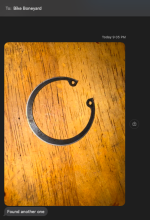
I bought that clip that was available locally, and bummer, it was the wrong size. I knew it looked off! She's going to do some more digging to see if she has another one, and will swap it out. Her business is literally called Bike Boneyard. Like an elephant graveyard, just parts upon parts upon parts, pretty rad. Anyhow it would seem 45mm refers to the bore, not the diameter of the clip at rest, or the groove. I guess it's more like 47mm wide; squeeze it down to 45 to fit in the bore, then it snaps back to about 47 in the groove. If no luck, I'll probs have to try the sanding down a mcmaster-carr one trick.
------
Holy heck as I was typing that she got back to me with one. How lucky! 🎉
Screen Shot 2025-07-28 at 9.38.57 PM.png
Gotta be sure to get it in there in the right orientation. What a shame to keep breaking these NLA parts.
 
I got everything back together and it seems to be working good! It was fairly tricky to find which edge was stamped/beveled-ish on the circlip, but judging by which side each wear-ring was on, I figured heck if it's survived this long in an engine installed in that orientation, I'm going to put in in the same way. And I think with that in mind, I could faintly make out the slightly rounded edge on the inward facing side.
Also now I have a pretty slick pipeline for drawing gaskets in illustrator and cutting them out with Cricut. what a PITA to get working properly, but i also made a new generator-cover gasket (it's just a circle 😊 13mm ID 14mm OD, ) That's a perfect fit and seems to be holding up well! That being said. . .
I had a spare right side crankcase cover gasket from a Vesrah kit that seems to be holding up well after 40mi so far, but I didn't have a spare for the left side, which I'd pulled first when I rebuilt the starter motor, and have been noticing a small oil leak from after replacing it like, twice now. Anyhow I bought one from these guys and I think it's leaking . . . . ish?
IMG_5382.JPG
It's pretty hard to see in that photo, but are paper gaskets ever supposed to look kinda shiny/wet like that? Is it foolish to use a paper gasket in this application vs one of the more. . . plastic-y ones? it's not. . . forming a drip (yet) but I wipe it with my finger and there's a bit of oil residue. By comparison, that DIY generator cover gasket looks pretty dry 😁
I've carefully scraped the surfaces with a razor, even flattened some high spots on the edges that felt kinda like burs. I've scrubbed it with acetone soaked green scotch-brite, wiped everything clean with acetone, and checked it the best I could with the closest thing I have to a straight edge (a carpenter's combination level), and made sure to tighten the screws in a criss-cross pattern, incrementally. Also I removed and re-tIghtened a couple of those screws after a couple heat cycles, which seemed to fix a bit of a leak/drip that was forming earlier from this gasket.

Gaskets really seem like voodoo magic to me, and I'd appreciate any input from y'all on this one. Short of splitting the cases to resurface the mating surface. Oof.

Also I pulled the generator cover after maybe 20mi and so far the fresh oil is super fresh still and has no metal or glitter dust in it 🥳
 
Paper gaskets don't seal oil well, you want an oil proof material. Paper material is brown usually while oil proof is colored as blue/green/black/etc. It's also thicker, over .020"
 
Aren't some of Honda's OEM gaskets paper? like for the oil pump? Or is it really more of an obsolete tech?
Oil pump gasket is paper, any seepage thru the fibers just drop into the oil. Most of the case type gasket materials have a sealer imbedded in the material to aid in sealing the fibers.
 
The original gasket that I removed was 0.4mm thick. I made some extras from Felpro tan fiber sheet at 0.66mm thick. Also bought some ebay aftermarket ones that were rubber impregnated fiber at 0.75mm. Even these were probably acceptable.

I used my 0.66mm ones and seriously doubt that extra 0.26mm is a problem for the sloppy deflection of the pump push rod, pivot, piston whose pivot is several centimeters away, probably mere arc seconds of angular deflection.

If your cricut pattern is spot on, that is very cool and much easier. Well done.
 
Thanks yall for the advice on the gaskets! oil seems to be pumping good? I did tweak the shape of the pump gasket a bit to get the best alignment with the screw holes and a more perfect fit on the orifice. Anyhow I'm at about 60mi and decided to check the filter. ugh still glittery.
00EF01CC-D5C5-442C-9C23-312C5B095DC4.jpeg
1D7E5C66-26A4-429B-BCF6-C862F8037790.jpeg
Is this residual and I should keep checking over the next few miles to see if it clears up? Or is it cause to tear it down and inspect everything? To be honest I really couldn't tell if any of it was magnetic, a small amt did stick to magnet, but easily came off and idk if it was just from rubbing it on there. Should I change the oil again at this point?
 
Also my bike is running better than ever right now, and I dare say perfect? (knock on wood) - I attribute it to adding another shim to the spark advancer to tighten that clearance a bit :)
 
ugh still glittery.
I agree but is it new or old junk that is rinsing through. 60 miles isn't very much but is it getting less and less? I hate to waste oil so I try to clean out as much as possible by other means.
What was in the bottom of your oil drain pan?
If you make a sort of gutter with a cut up plastic water bottle inserted under the oil cup that hangs outside the cover, you can spray the oil cup clean with carb spray. May help to lean the bike that way a bit.
 
Also my bike is running better than ever right now, and I dare say perfect? (knock on wood) - I attribute it to adding another shim to the spark advancer to tighten that clearance a bit :)
There is the proof in your pudding. Say on dare, perfect, it's good for morale.

Was the shim on one of the weight pivots? Good catch.
 
Thanks yall for the advice on the gaskets! oil seems to be pumping good? I did tweak the shape of the pump gasket a bit to get the best alignment with the screw holes and a more perfect fit on the orifice. Anyhow I'm at about 60mi and decided to check the filter. ugh still glittery.


Is this residual and I should keep checking over the next few miles to see if it clears up? Or is it cause to tear it down and inspect everything? To be honest I really couldn't tell if any of it was magnetic, a small amt did stick to magnet, but easily came off and idk if it was just from rubbing it on there. Should I change the oil again at this point?
It could just be residual, yes, and if it's running well and you don't hear any unusual noises then ride it more and check the filter again later. As long as the screen on the bottom of the pump doesn't get clogged you'll be okay until then, and hopefully the accumulation of glitter will diminish.
 
There is the proof in your pudding. Say on dare, perfect, it's good for morale.

Was the shim on one of the weight pivots? Good catch.
Hey Ballbearian, I shimmed the advancer in accordance with this thread. I had a wonky piece of brass I had cut into a washer shape under the points-cam in the past, but I replaced it with actual shims off a different advancer, and things seem a bit smoother.

AncientDad, I am noticing what sounds a like a small bit of excess valve tappet clearance, probably from when I replaced the left side cam-cover gasket that was leaking. I checked the valve clearance before running, but I'm guessing it's just settling in, and will recheck it probably tomorrow morning.

Filtering the oil sounds like a good idea, I'll jump on that tonight and see what comes out.
 
Hey Ballbearian, I shimmed the advancer in accordance with this thread. I had a wonky piece of brass I had cut into a washer shape under the points-cam in the past, but I replaced it with actual shims off a different advancer, and things seem a bit smoother.
Thanks TS, for sharing that rather bizarre discussion. I'm glad to hear of an appreciable improvement in timing consistency, as others also have stated, but much of it does seem rather illogical to me. .004-.005" seems like the end play desired. Since advancer breakdown or parts are not available, that end play spec is useful. Advancer body shaft to cam bore clearance would seem to be a more likely culprit. I do understand how the two clearances are related, but they are different.

I only use the static method to get the bike to start, then I use a strobe to dial in the timing, often requiring moving each point on it's plate. I guess if one solely used the static method having excessive radial slop in the advancer cam would cause issues. I know there are limits in my perception and observation of my strobe flashes. It works for me and no worries about over advancing that way.

Who knows if my mid-range stumble (3-4K rpm) is a quirk of mid advance curve action smoothness, but I hope to find and fix all electrical based carburetor problems first, before going to the carb jet rodeo.
 
AncientDad, I am noticing what sounds a like a small bit of excess valve tappet clearance, probably from when I replaced the left side cam-cover gasket that was leaking. I checked the valve clearance before running, but I'm guessing it's just settling in
I take that to mean you did recheck the clearances after you replaced the cam bearing cover gasket? In a general situation where there wasn't any previous carbon buildup on the valve seats/faces due to tight valve(s), there shouldn't be any change in sound as it runs a while. If the adjuster shaft moved just slightly as you tightened the lock nut that can happen, and if lock nuts aren't quite tight enough the adjuster shafts can move and change adjustment slightly later on as it runs.
 
Ancientdad, yeah, my usual valve adjustment procedure is to leave the bike overnight so the engine is cold, then check intake valves with a .002in and .003in gauge, then exhaust with a .004in and .005 gauge, with the goal being the 2 and 4 slide through and the 3 and 5 don't (intake/exhaust respectively) - so if they both side through, I loosen the lock nut, adjust, then tighten the locknut, and check again. If neither slides at that point, I loosen the locknut, adjust, tighten, and try again, kinda going back and forth. So I'm always checking the valves after I've tightened the lock-nut good and firm. That was the case before I rode those 60mi, and they were in spec, and it was riding great.
I rechecked them post-60mi riding, and now the right exhaust valve was loose, the left exhaust was tight, and the left intake was loose. And it was riding great lol. Prior to replacing the left cam case cover, I'd check them every time I tinkered with the timing, maybe a dozen times over the past 500mi and they always seemed to hold spec, so not sure what happened this time around, maybe I didn't get the nuts tight enough, it sounds like you're saying heating/cooling cycles shouldn't be throwing it out of spec like that, so I'm not sure.
Anyhow, I re-adjusted the valve clearances, rechecked the ignition timing and points gap, (the timing seems to wander sometimes a degree or so out of spec each time I check it with a test lamp statically or a strobe light dynamically, so I'm always nudging it a bit each direction). And now it's definitely not running as smooth as before, it feels like it's out of balance, more vibration, the engine/exhaust sounds a bit clunkier, it's not riding as smooth/snappy. After adjusting valves/points/cam chain tension, yeesh. Hence the constant fiddling. I didn't touch the carbs since it was running great, so I'm thinking this is more ignition / valve related.

Any thoughts on like, a torque spec for the valve adjuster nuts?
Also is it best to adjust cam chain with engine cold, or hot? Is there a way to verify that it's adjusted/in spec? I feel like I loosen and tighten the adjuster and get zero feedback, and just assume it's working 😬

I'm still worryin' abt possible cam chain/tunnel wear, I'm thinking abt replacing the condensors (been filing little nibs off the points contact surfaces every so often to keep them in spec), and tbh I'm wondering if the advancer/cam-lobe shaft wear/clearance is loose and that could be affecting points/timing consistency issues. Funny I added a shim for the end-play on it per that bizarre thread mentioned earlier and it was running great, and now it's running kinda rough again. Probably had no affect at all haha.

Sorry for rambling, this is kinda just the constant back and forth with this bike, and I get bummed when trying to fix one concern makes something good not-so-good, and I fiddle more to the same effect.
 
Back
Top Bottom