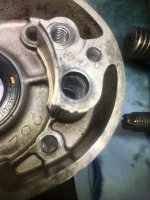
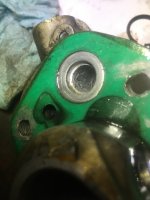
CL350 oil rotor circlip engine damage

Ancientdad, yeah, my usual valve adjustment procedure is to leave the bike overnight so the engine is cold, then check intake valves with a .002in and .003in gauge, then exhaust with a .004in and .005 gauge, with the goal being the 2 and 4 slide through and the 3 and 5 don't (intake/exhaust respectively) - so if they both side through, I loosen the lock nut, adjust, then tighten the locknut, and check again. If neither slides at that point, I loosen the locknut, adjust, tighten, and try again, kinda going back and forth. So I'm always checking the valves after I've tightened the lock-nut good and firm. That was the case before I rode those 60mi, and they were in spec, and it was riding great.
I rechecked them post-60mi riding, and now the right exhaust valve was loose, the left exhaust was tight, and the left intake was loose. And it was riding great lol. Prior to replacing the left cam case cover, I'd check them every time I tinkered with the timing, maybe a dozen times over the past 500mi and they always seemed to hold spec, so not sure what happened this time around, maybe I didn't get the nuts tight enough, it sounds like you're saying heating/cooling cycles shouldn't be throwing it out of spec like that, so I'm not sure.
Well, I can't speak for how tight you're tightening them but when decently tight they shouldn't move. I rev my 450 high every time I ride it, and it uses the same exact design for valve adjusters. Mine don't move between adjustments and I thrash my bike, so yours shouldn't either.
Anyhow, I re-adjusted the valve clearances, rechecked the ignition timing and points gap, (the timing seems to wander sometimes a degree or so out of spec each time I check it with a test lamp statically or a strobe light dynamically, so I'm always nudging it a bit each direction).
It's possible the advancer return springs are just a tad sloppy and allowing the points cam to rotate slightly under the tension of the points rubbing block (heel of the points where it rides on the points cam lobe), the timing shouldn't vary when rotating the engine back and forth during adjustment.
Any thoughts on like, a torque spec for the valve adjuster nuts?
Did you check the FSM for the value? I don't use a torque wrench on any part of the bike except engine assembly, the rest I do by feel after decades of tightening (and early on, occasionally breaking off) bolts. The shaft is hardened steel so the nut would probably strip before the end of the shaft broke off if you overdid it.
Also is it best to adjust cam chain with engine cold, or hot? Is there a way to verify that it's adjusted/in spec? I feel like I loosen and tighten the adjuster and get zero feedback, and just assume it's working 😬
You should do the cam chain before any other tune-up operation, then valves, then points and timing. So yes, doing it cold is part of the complete routine. Are you setting the crankshaft to the position 90° past LT on compression stroke for proper adjustment? At that point all valves are virtually completely closed, so no undue tension on the cam chain so the adjuster will perform correctly.
I'm wondering if the advancer/cam-lobe shaft wear/clearance is loose and that could be affecting points/timing consistency issues. Funny I added a shim for the end-play on it per that bizarre thread mentioned earlier and it was running great, and now it's running kinda rough again. Probably had no affect at all haha.
Any slop in the points cam on the advancer shaft is to be considered, and should be minimal to (basically) none you can feel. Now, if there is wear on the points side cam bearing cover with respect to its fit with the camshaft bearing journal, and if that wear is enough that it allows the camshaft to rotate in both a circular fashion as well as a somewhat "orbital" fashion, then it will directly affect the points gap as it moves laterally and will make setting timing properly next to impossible.

You'll get it sorted, just keep at it.
 
Here is the old factory bulletin on cam chain adjustment. Hope it helps.

rXwQ9de.jpg
 
AncientDad, thank you for your thorough explanations, and thanks Ballbearian for that bulletin! that's the spot I've been adjusting cam chain tension at, and I verify all the rockers are loose enough to jiggle a bit at that spot. Also yep that's the order i do tune-up in: cold engine sat overnight, chain tension, valve clearance, ignition timing/points gap, so I'm glad we're all on the same page. Funny enough I noticed I forgot to put the clutch cable back after I pulled it a bit away from the left side intake tappet cover so I could get in there with a feeler gauge, and it was rubbing on the left carburetor idle speed screw arm. I pushed it back in front of that shaft and for a minute thought it was riding better (maybe the added resistance was affecting carb balance?) but I've ridden it some more and I think it's still feeling off balance kinda. Vibrating more than usual, and just feeling kinda off on power, idk, I'll double check the valve clearances and try to re-balance the carbs maybe tomorrow. It also seems to be running hotter than usual, but maybe that's related to summer weather lately.
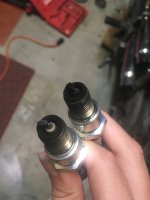
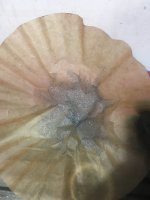
Ugh anyhow abt 65mi later and there's still a bunch of shavings in the filter, and drippin out the left side when I remove the stator cover. I'm worried the problem's not getting better and may be getting worse. Even if it was valve clearance or ignition timing or advance or points gap, that wouldn't cause metal shavings in the oil would it? compression's still around 155 on both cylinders hot w throttle wide open (harbor freight compression gauge), but right spark plug is pretty much fouled compared to left which is dark but not too bad? (I'm attributing that to hot weather and dusty mountain roads I been taking it on, but really I've never seen them quite this dark before). I'd also think dark plugs would run cooler, not hotter?
2BAF1E43-C030-4734-BE5C-C20B5915EE7E.jpeg
69B7DF78-DE9D-48DC-A75C-20C217314CC3.jpegCF825760-4B6E-4E82-81CF-904860923CD0.jpeg
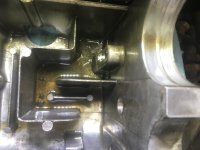
Also, I noticed this which I hadn't before: Is this amount of lateral clearance on the crankshaft normal? I could guess that might contribute to vibration but idk, I didn't see an end-play spec in the manual. There's no wear marks on the cover from the rotor bolt for what it's worth.

Thanks again everyone, I'm starting to think I should tear it down.
 
Last edited:
Wow, that does seem like too much end play in the crank. I'm surprised you could move in and out so easily. It's almost like some thrust washer or clip is missing. Do you have a parts catalogue with the exploded parts diagrams? There could be something going on, on either end of the crank. Internally there are knock pins to locate the crank bearings in their case journals. I don't know but would explore methodically and step by step.
Jensen asked before if the ground metal was aluminum or steel, use a magnet to tell.
I've sloshed around a pint or so of gasolene in the case to help flush out junk, perhaps some of that metal was left over from the last oil drain and fill. Now I'm thinking there may be other issues at hand.
I hope some other more experienced engine builders weigh in on this.
 
Also, I noticed this which I hadn't before: Is this amount of lateral clearance on the crankshaft normal?
First, you might consider making the text bold (for your link to the video) because I read it a couple of times before I noticed that the word "this" actually was a link. Makes it easier for the old and feeble-eyed like myself. And no, you shouldn't have that much end play in the crankshaft, basically none since I'm sure the spec is in the thousandths of an inch or millimeter if there is one.
Thanks again everyone, I'm starting to think I should tear it down.
Starting to look like a winter project.
 
You sure that's the crank moving and not your rotor on the end of the crank?

Might be worth removing the rotor to check, or making sure the oil slinger is secured and checking if it moves when you tug on the rotor bolt
 
Sorry about the link! I'll make it more obvious next time for sure, I am certainly learning lots of forum etiquette on VHT :)

When I was pushing on the generator rotor last night in the video, it was with the oil filter cap and cover still on. When I took it off and opened the filter up, the nut was tight in there still, and when I pushed in on the filter rotor, it pushed the generator rotor out a bit on the other side. I could kinda wiggle the crankshaft left to right with both ends exposed, but the filter bowl wasn't loose.

Anyhow this evening I went to check it again and it didn't budge at all?????? 🤨 - maybe it was just from being rode real hot and the clearance was from heat expansion? I really didn't give it any time after riding before I went to check it out. I didn't have a torque wrench handy when tightening the oil filter nut when I put the pump/clutch assembly back together, and just went "damn tight" by feel, but maybe it wasn't tight enough to keep things secure when hot? aye aye aye. Maybe it's running too hot?
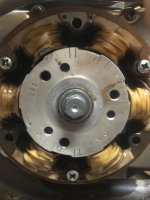
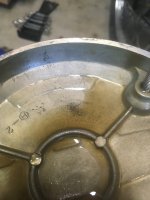
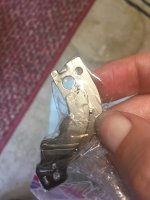
Also sorry I take it back; at the location mentioned in the above bulletin, I definitely feel the valve springs let off, and all valves are loose and wiggle-able, except right intake. That one doesn't feel free until a bit later at this location:
C05295DC-B558-443F-8294-EDC1E850FAC9.jpeg
and it becomes wiggle-able exactly as the left exhaust becomes un-wiggle-able. That's where I've been adjusting cam chain tension. Is this normal, or is there usually more overlap where all valves are closed? is there something funky with my right intake valve/lifter to keep it tight that long, or could the sprocket have jumped a tooth? Valve clearances are still spot on at both T marks. (0.002in intake, 0.004in exhaust)

Also the metal shavings are still showing no interest in my HDD magnets. and there's a lot of little black flecks in there too, and idk if their burnt bits from the combustion chamber, or tiny flecks of cam chain tensioner.
 
Last edited:
There may be, probably, both crank and cam chain problems.
If you put a wrench on rotor bolt and a wrench on advancer bolt and can feel chain slack as you rock them, then the tensioner is bad, or middle idle rubber wheel too.
If any crank parts are missing, like convex washer #14 in the diagram on post #7, or other thrust related parts then crank has been floating and could grind up who knows what. I also noticed ring marks around the oil filter cup in your early posts, like it had been rubbing as it turned.

The end play just disappearing could be debris (metal) jamming up on bearings as it sat. It did not fix itself, for sure.
Sorry to sound gloomy.
 
I think gloomy is good, it's keeping possibilities open :) I definitely put #14 back in correctly when reassembling (the concave side in towards center of engine and the convex side out towards the right of engine) and with the nut still locked in there, I'm thinking it's still there? Might pull the cover again and re-inspect. I think you're right though, with the crank loose, I could imagine the cam chain sliding left and right with it, chewing up the case despite correct front/back tension.

I had attributed the wear rings on the outside of the filter cup to the busted circlip being wedged in there grinding on it. When I pulled the right side cover initially, it fell from what sounded like about that height. Now though, who knows, yeah.
 
I put wrenches on the generator rotor and cam shaft bolt and turned in either direction, and there's not much slack in the cam chain as far as I can tell cold. Maybe 3/4 of a degree of the crank either direction.
I spun the engine for a few seconds a couple times with the starter, thinking maybe it could dislodge whatever's made the endplay disappear, but no dice. Trying to decide if I should drain the oil now and pull the covers, generator rotor, oil slinger, etc and inspect the bearings etc now, or run it some more and try to reproduce that end play first.

I'm seeing a total tear-down in the future, just not sure if I should keep trying to narrow it down first, or just go for it now and see what turns up.
 
Per an earlier suggestion, I swirled some of the flecks around in gasoline and dipped a magnet wrapped in ziplock in with them. Needless to say the flecks all sank lol so it was a bit tricky, but there were a couple black flecks that appear to stick to the magnet, and a bunch that didn't. If that's helpful at all, I'm not sure. And that's all what was just rinsed out of the generator cover. 8CEDC81C-5144-4A75-9651-9E4AE979F750.jpeg340280C2-0570-438E-B3E1-AF1C1E83DEC8.jpegAF6BE03C-C6EE-4B7E-8998-587D2D8D1614.jpeg
I'm sure y'all are tired of seeing engine debris, but just wanted to show the volume sampled vs what was magnetic. I haven't tried this with the oil slinger contents yet bc those are all wiped across paper towels, not as easy to collect.
 

Attachments

  • 998281C0-DECF-47DF-B7BB-AF3FD7EB635E.jpeg
    998281C0-DECF-47DF-B7BB-AF3FD7EB635E.jpeg
    1.5 MB · Views: 1
  • F7125D0F-267D-4309-BE2C-1FC0AC5A5AF0.jpeg
    F7125D0F-267D-4309-BE2C-1FC0AC5A5AF0.jpeg
    1.6 MB · Views: 1
Good attitude.
Hopefully this motor is worth rebuilding. Won't know till it's apart. Don't think I'd ride it anymore, it could leave you stranded and just add more wear.
Good time to read up on disassembly procedures in the FSM and also check out parts catalogue diagrams and lists.
You've obviously got the aptitude for this and there is great help here.
 
Yeah, I think I'm gonna aim to start tearing it down. I'm running through all the pre-checks I can think of beforehand.

Any advice on getting the engine out / back into the frame without scratching it? Also thinking abt loosening some bolts before I take it out, to take advantage of the bike's mass/stability to torque against.
Probably going to need a new gasket kit. Any recommendations on head gaskets? Is copper worth considering? I think I put a NOS one in there last time.
Can i re-use the oil seals if they're not leaking? or would they be more prone to fail, having been installed, removed, and reinstalled?
If the pistons and rings are still good and in spec, can I just reassemble them in the cylinders, or should I have the cylinders re-honed?
should the cylinder studs be replaced? I've heard things about possible stretching over time, idk.
If it is the cam chain tensioner that's causing havoc, would y'all recommend the KA Slipper unit? any recommendations on a preferred cam chain?
I've been using permatex aviation on the case halves. Is a certain hondabond/yamabond/threebond better, or should this still be fine?
Is blue lock-tite sufficient for the cam sprocket bolts? I see people recommend red often, but here I am again tearing it down haha, and red seems like a pain.

Anything else y'all can think of? I'll probably want to get a new lock-strip thingy for the oil pump bolts, new lock washers for the oil-slinger nut and the gear-shift/neutral-detent bolt thing on the top of the crankcase. . . Any other lock/wear parts I should preemptively look for replacements for before I get into it?

Also I like to run my bike around red-line (indicated) on the highways at 80mph, and I'd like to try to provide the best insurance for the engine to be able to continue doing that (at least for short stretches) without blowing up. Any particular parts I should keep in mind to prolong the bike's health at/near red-line? It's certainly felt really comfortable there before, but of course now it's spitting metal shavings, so idk. My first thoughts are valve springs, reciprocating mass, oil flow, cam bearings/journals, keeping temps cool, and wind resistance, but I might be over-thinking it. Also I think I might not even be at red-line, as with my current sprocket setup, online calculators say at 80mph I'm really only at abt 8100 RPM.

Thanks y'all for the motivation to try to figure this out, and I'm also hopeful it can be brought back to good working order.
 
Removal has been detailed in other threads, drain the oil and leave the drain plug out will avoid some scratches. I put down masking tape and then duct tape over that ... makes removal easier.

KA slipper is very quiet and a good upgrade, finding a flat linked chain is the issue, using a regular chain will increase the initial wear but I can't comment beyond that as the only one I did was years ago with a flat chain. I would suggest if you go with the stock rollers to buy Honda and also replace the pivot and pin that is in the bottom case. Check for wear in the case. I would suggest also chaining the cam chain and flushing the crank while it is out.

Copper gaskets transfer heat better but can be difficult to seal. Racers like them because they are reusable. I have a new one sitting on my shelf and have not found the need to use it. I'm not bold, a racer ... just old.

Cylinder studs don't need to be replaced. I use light oil on the threads and torque to 16ft/pounds.

To keep the oil flowing at extended high rpms do the Crazy PJ mod ... also documented here.

And if you are really into it do the ball bearing (right AD?... VBG) conversion on the camshaft .....

Time and money ......
 
Also thinking abt loosening some bolts before I take it out, to take advantage of the bike's mass/stability to torque against.
Probably going to need a new gasket kit.
Good thinking and it makes it much lighter to remove everything you can. Clutch, oil pump, primary gears, shifter shaft, rotor, stator, starter clutch and starter. Exhaust studs too.
Definitely a gasket kit, a seal kit is a good idea. If lubrication was compromised from plugged crank oilways, the piston skirts and bores may be needed. Hope your small end rod bushings are good, crank work is pricey.
I'd stick with Hondabond.
All your pictures and questions are a real pleasure and a great example. I will look forward to your future postings.
 
Sounds like you're pretty informed all around so you're in better shape than others who decide to rebuild their engine. Take your time and be precise and don't try and muscle things, nothing on this engine needs brute force.

I'm a fan of a 17x34 gearing. The 17t front gear can be found for an affordable price. I use rear sprockets from cb360 which came stock with 34t but you can buy aftermarket for not much $. With that gearing you can cruise 80/85 no problem and get better gas mileage.

For street riding I prefer the rubber cam chain tensioner rollers (buy new, Honda may still supply the big one and the little one is available online).

Replace the endless cam chain if you plan to do a full rebuild (which I think you are). The KA cam chain slipper doesn't require a flat chain (DID gold is what THR sold as a kit/set) and isn't necessary for street use.

I use whatever budget gasket set is available. Good practice to replace seals but if they're doing their job and you want to be lazy or cheap and risk it then it's on you. Camshaft seal is a must tho, I always replace that one. Put some time into checking your crank condition.

I didn't do the oil slinger mod that's detailed on the forum and never had any issues with 20-30 mile highway runs on my 350.

Service the head if you have the time and budget, but if the valves are sealing then ok not to.

The only thing I hoarded when my 350s were my go to bike was points and advance mechs. I went thru a few heads (bad luck), had a valve guide crack on one and a valve seat basically fall out on another... so good used heads or pay for a valve job with new seats and valves. To spend on the head but not a lot, if your valve seats aren't too pitted then dropping in new valves from Chris Schumann was worth it. He sold them on eBay, not sure if he still does.
 
or pay for a valve job with new seats and valves. To spend on the head but not a lot, if your valve seats aren't too pitted then dropping in new valves from Chris Schumann was worth it. He sold them on eBay, not sure if he still does.
Chris is on FB a lot and showing much work, so probably. I'd love to have him do my head. He does it all, seats, valves, even beehive springs. Also love Boomer's BB cam bearing mod.
 
Chris's valves on ebay ship from Portland OR, is that where he's based? Heck I could almost take a day trip over there to drop off the cylinder head to replace valves/guides haha, I like road trips.

I've seen people recommend the original style rubber cam roller for street use, but also mine appears to be (still need to confirm) getting shredded? (black rubber chunks in oil, as well as constant black flecks in filter with metal shavings) -- I'm sure it's because I put an NOS one in there and the rubber was old, but it just makes me hesitant abt doing that again.

I found this flat chain on DCC that seems to be the same as the tsubaki camellia people used with KA Slipper in the past, though it doesn't list a brand. Would just need to be shortened to 94 links (I think?) - and now I'm seeing a thread from last year where crazypj says he's seen ka slipper's wear signficantly after one race season, so idk. Maybe that was with a regular chain.

Maybe any modern tensioner would work, I just have to get the crank endplay sorted out to keep them from eating themselves lol.

Also I'd have to double check, but I think my sprockets are 17/34 too! good mix of power and speed and smooth highway rpm :) my tach just is a bit optimistic I think and tells me it's redlining at 70+ in top gear. I've tried a digital tach that's inductive but it was cheap and idk if I can trust that either.
 
Last edited:
Maybe any modern tensioner would work, I just have to get the crank endplay sorted out to keep them from eating themselves lol.
Bingo. I think 4into1 has repops that are good, maybe our vendor Scrambler, IDK, worth looking. The crank may have eaten your tensioner somehow, you'll find out.
 
Good thinking and it makes it much lighter to remove everything you can. Clutch, oil pump, primary gears, shifter shaft, rotor, stator, starter clutch and starter. Exhaust studs too.
Exhaust studs too? I've never removed those before, but tbh it'd probably be a good idea, the left sided ones are longer than the right for some reason, they look not fully seated, and fairly rusty. I'd be curious to make left match right better, as right seems good length. Also getting those round/finned clampy bits onto the studs seems to be such a pita lately, like the studs might not be entirely aligned right, requiring lots of tapping left/right to get them on. How do you remove them? Just with a double-nut kinda situation?
 
Gettin' this thing apart!
I'm short on time right now, but I'll post a couple pics:
17708B83-41EA-437E-8CE2-56AF5C02E86C.jpeg
that center wheel sure is shot to ****. funny how nice the outer tensioner one is though!

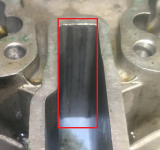
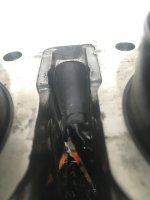
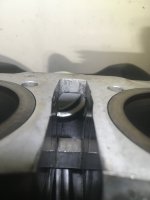
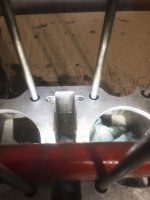
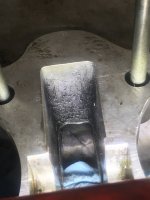
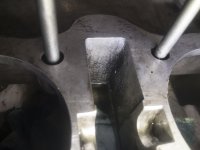
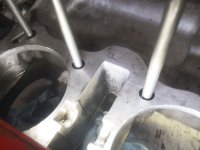
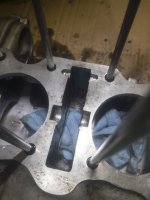
It is so tricky to get shots down in that tunnel. This is the upper crankcase part of it. Part of me thinks that's not just how the casting process makes it look in there 😬😬😬
0C7CCFF4-1B29-499E-B7DF-11F3F2AB864E.jpeg

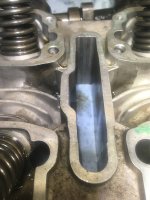
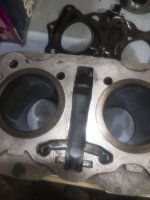
the cylinder and head look fine in the tunnel, so I'm thinking it's lateral crankshaft play, since all the wear appears to be down there? Here's the cylinder and head though fwiw.
10FD9AE2-04E7-45CD-80CC-532C829089E0.jpeg
373128DE-3541-4D1F-8F0C-5FF3E37A6EF1.jpeg

I'll split the cases and inspect everything maybe next weekend, but this is what I got so far!
 

Attachments

  • 52813198-7B21-4F34-87C1-A5B1E4296F7F.jpeg
    52813198-7B21-4F34-87C1-A5B1E4296F7F.jpeg
    1.5 MB · Views: 2
Better pictures of the cylinder base gasket area of the crankcase, as well as the tunnel through the cylinder and head with better lighting, will be helpful. But this is an example of the chain being really loose at one point. We expect to see some wear on the sides but when the chain slaps forward that far it must have been pretty loose at one point.

1757357273733.png
 
For what it's worth, I ran my finger over that spot and it was pretty smooth to the touch, not noticeably worn in, so I'm thinking it's closer to a contact-mark than a gouge. The fronts and backs of the rest of the parts making up the tunnel were smooth and not noticeably worn as well, so I didn't bother to take pictures. When I'm back home, I'll take more time and clean it up some more and take better more detailed pics.
The tensioner itself seemed to work great, releasing strongly when I undid the bolt and holding firmly when I tightened it back in. I've been keeping the tensioner adjusted frequently and at the right spot, so I'm happy to see those front/back tunnel sections are as good as they are, and I'm thinking those marks are from the bike's past. Bummer I don't really have the same photo from the first rebuild to compare.

I'll peel/scrape off the gaskets and get more comprehensive pictures in the near future.
 
The lower middle wheel is falling apart, that's where the black bits came from. Your careful attention to the tensioner probably minimized other damage. The ugly will be found when the cases are split.
 
Ok, I took some time to take a million photos, and ended up with 34 I'd like to share. I'm thinking of posting a link to a zip file, then making a post with a list of each picture, and specific notes I have about each one. Does that sound reasonable, or is there a better way? I could post the thumbnails for all of them, I just don't want to make a mile long post with all the pictures, or hog 60MB of forum space if there's a better option.
 
Ok, I took some time to take a million photos, and ended up with 34 I'd like to share. I'm thinking of posting a link to a zip file, then making a post with a list of each picture, and specific notes I have about each one. Does that sound reasonable, or is there a better way? I could post the thumbnails for all of them, I just don't want to make a mile long post with all the pictures, or hog 60MB of forum space if there's a better option.
You can do what you like, but to me it's far less effective for us when we have to go through each picture separately when they're in a zip file or other grouped arrangement outside of the forum. I assume you're operating from a phone based on the mix of attached and embedded pics and honestly, if done from a computer you'd find it easier to reduce the sizer a little before uploading. While I appreciate your concern for forum server space used, 60 Mb is not huge for the total of pictures and you could resize them to about 3 to 4 Mb each if they're larger than that. Most of the pics I post are between 1.5 and 3 Mb and they enlarge nicely enough for our purposes. You can host your pictures at lots of places like Google Photos, Imgur and others (though Imgur's upload and linking methods have gotten more complicated recently). It isn't like you post hundreds of pics, and this is an important situation.

I find it a lot easier to help members when I can see their pictures right in their thread.
 
Chris's valves on ebay ship from Portland OR, is that where he's based? Heck I could almost take a day trip over there to drop off the cylinder head to replace valves/guides haha, I like road trips.
Be sure to contact Chris first. If he's not expecting you there'll be no answer at the door other than the dogs going nuts.
 
Cam Case:
cam case front.JPG cam case underside rear.JPG
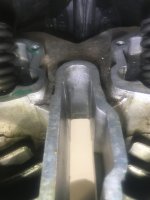
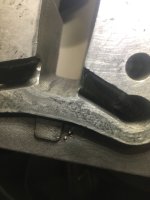
The gouges in the cam case seem deeper than in the head.

Head:
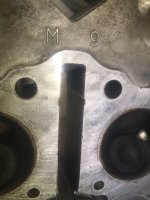
head front.JPG head rear 1.JPG head rear 2.JPG
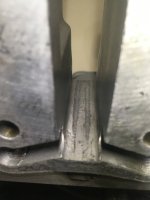
Ok, on closer inspection they seem deeper than just contact marks.
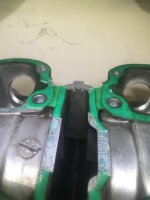
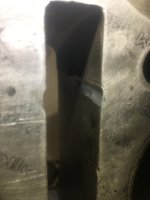
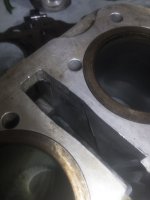
Also of note, there's these notches on the sides of the tunnel. I imagine those are worn in, and not there from the factory?
head gouges 1.JPG head gouges 2.JPG

Cylinder:
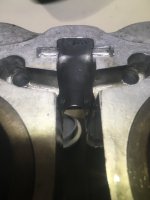
cylinder top front.JPG cylinder underside front.JPG cylinder top rear.JPGcylinder underside rear.JPG cylinder top 1.jpg cylinder top 2.jpg
Is the tunnel supposed to be a bit widened out like that? It looks clean, but I just expected it to be more of a straight rectangle.

Looks like I can only attach 15 files! I'll continue in another post.
 
Last edited by a moderator:
Upper Crankcase:
upper crankcase front.jpg upper crankcase front 2.jpgupper crankcase front 3.jpg
upper crankcase rear.JPG upper crankcase rear 2.jpgupper crankcase rear 3.jpg upper crankcase cylinder base.jpg

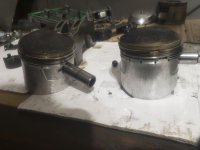
Then I just have some other random things I thought were noteworthy, like the pistons seem to look ok as far as I can tell at first glance:
pistons 1.jpg pistons 2.jpg

I still see some glitter hiding under the splash plate. I wish there was an easy way to remove that guy and put it back on. And glitter on the cam chain roller.
under splash plate 1.jpg under splash plate 2.jpgroller glitter.jpg

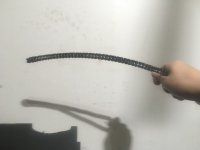
When I first rebuilt the engine, the odometer read only 6900 miles, so I didn't bother to replace the cam-chain, since it felt tight still, from what I could tell. Since then I've added 5400 more miles. I still haven't decided what I'm going to replace the tensioner with, but should I replace this chain either way? Idk how best to measure wear on it, but this is how much it sags when held horizontally lol.
cam chain wear.JPG

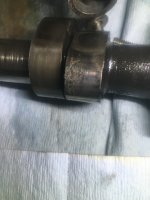
Also, should I expect this wear on the cam lobes/rocker to affect anything? How does wear like that occur?
cam lobe wear.JPG cam rocker wear.JPG
 
Last edited by a moderator:
Lastly, just wanted to confirm these weird spongy marks are normal, I'm assuming part of the casting process?
weird casting marks 1.jpg weird casting marks 2.jpg weird casting marks 3.jpg

And here's the left and right sides of the lower crankcase. I can take some of the upper too, but they look about as clean. Just thinking if lateral crankshaft play were to cause any wear, where I should look for that.
lower left.JPG lower right.JPG

Let me know if there's other spots I should look. Just trying to figure out where all the metal shavings are coming from. I have a parts washing tank, so everything will eventually get a good rinsing/scrubbing (as good as filtered recirculating washing-solvent can get, I guess?) so I hope that takes care of residual glitter. Just hoping to prevent more from generating.

Today I think I'm going to start cleaning and measuring everything for wear, per the service manual.
 
Last edited by a moderator:
Easy way to test condensers is to run the engine with the points cover off. Points won't have any arcing with good condensers.
 
Most of it looks pretty typical to me for an engine that didn't get nearly enough maintenance along the way. The "spongy" areas are just casting "flaws", nothing to be concerned about unless someone sees something I don't. I would absolutely replace the cam chain regardless which tensioner you decide to go with.

Is #11 present on the left end of the crankshaft? And all the #12s as well?

honda-cl350-scrambler-1972-k4-usa-crankshaft_bigma000149e13_b33d.gif
 
Leave the windage tray in place, clean it up with a couple cans of brake cleaner with a straw nozzle. You can also fill it up part way with varsol and let it soak. The only spots that are hard to access are on either side, usually there is enough space to put the straw down but if not I use a diamond bit on a dremel to open up a space. Basically anything that doesn't get flushed isn't going anywhere.

Replace the cam chain and the lower pivot (two pieces) that the tension unit is attached to.

Flush the crank sludge traps as well.
 
Ok, finally got my iphone to talk to my laptop.
Yes, 11 and all three 12's are in place. I just have the crankshaft sitting in the lower crankcase for now, so it's not lined up or anything.
IMG_5678.JPG IMG_5679.JPG
 
Last edited by a moderator:
There was a whole bunch of glitter down in the lower crankcase. I also found this a good time to use the bore-scope a friend got me, and there was a bunch of glitter down under the windage tray too, that wouldn't come out when flushing with solvent. I used a pipe-cleaner kinda thing, and now the lower crankcase is free of all the glitter I could find.
IMG_5681.JPG IMG_5684.JPG

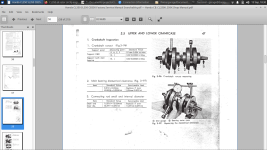
Tryna get started on some measurements, and am starting with crankshaft runout, and remember how annoying trying to use a dial indicator is. In this step in the FSM, how important is it to support it just from the two center bearings when doing these measurements, vs just supporting it in the crankcase?

Screenshot_2025-09-15_18-30-25.png

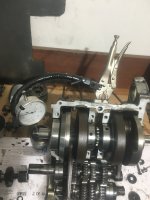
So far, I don't have a good support setup for just those two bearings. Been trying to rig up the center bearing holder support guy on its own, but it's been tricky and still is giving inconsistent measurements. When supporting all the bearings though in the upper crankcase, so far A, B, F, G, and J are all in spec, E is just 0.001in out of spec at 0.005in. At the moment, I've got the dial indicator clamped to one of the cylinder studs, to minimize movement between the indicator and the base.

IMG_5683.JPG
Any tips on using a dial indicator more precisely? This is from harbor freight. I also don't have micrometers for what it's worth, and do most measuring with dial calipers. I'd love to know if I'm wasting my time with this, and if there are other measurements I should focus on.
 
In the 20 plus 350 engines I have pulled apart I found one crankshaft that I would hesitate/wouldn't use. I just give the cranks a quick check and make sure to lube the bearings before assembly.

And calipers are not a substitute for micrometers .... I have calipers and they get a close estimate ... sometimes.
 
Flush the crank sludge traps as well.
Not only the round traps but the hole from the trap through the flywheel and through the crank pins feeding the big end rod bearings. It helps to stand the crank on it's ends vertically then flush while rotating the rods, until all grit flushes through.
Pic of straw in the hole.
k2AilBV.jpg
 
I'd love to know if I'm wasting my time with this, and if there are other measurements I should focus on.
You might be sort of wasting time. It's rare to have alignment issues but your glitter may have caused excessive wear or oil starvation to rods, both big and small ends. I wouldn't bother measuring until all cleaning of oilways and bearings is flushed completely out. Any grit will throw off your measurements.

All the oil passages in the case halves are suspect too. I think the lubrication flow diagrams in the FSM are pretty lacking on detail, but it's all we got, and deserve close look to see the flows, splits along the route. The main bearings are so beefy and get their meal before the sludge traps so I'd probably not worry on those too much.
Also, your cams and rockers showed wear, so checking oilways from upper case all the way into and through cam box is needed. When assembled there is a 6mm bolt just rear of points cover to check vertical oil rise to cam box. This is also good to clean out now while dis-assembled.
Check piston to bore wear in your oil pump too. Recommend doing the oil transfer piece modification (sticky thread).
Finally, check inside sides of case halves for wear from tranny gears and shafts, perhaps end bearing knock pins allowed contact and wear there. Got to find the source of all that glitter.
 
Replace the cam chain and the lower pivot (two pieces) that the tension unit is attached to.
For the lower pivot, are you referring to 9 and 10 on this guy?

Also thank you Ballbearian for all those tips on spots to check, I really appreciate it! I'll flush the crankshaft thoroughly next time I get to it. And like you said, FSM can be a bit lacking, especially when trying to find the source of the glitter. I've checked that bolt by the points cover recently and there was good steady oil flow after a few seconds of running, but I'm not too clear on how to confirm it's making it past that spot and actually through the cam case as completely as it's supposed to. Also worth noting that the left and right cam covers were seemingly hotter than normal when I was riding last, so I'm suspicious there could be an oil supply deficiency. I'll have to analyze the oil passages more in the FSM, and inspect each segment in the engine.
As far as the inside case halves, are you talking about what's shown in the last two pics of post #83? and by end bearing knock pins, are you referring to the little #12 pins from AncientDad's post about the crankshaft, but for the mainshaft and countershaft? They were all in place, but I could clean and inspect their spots to see if there's any notable wear.

I'm working on trying to get oil seals and gaskets and etc for the eventual rebuild, and was curious that CMSNL would have the countershaft seal in stock, while partzilla lists it as unavailable. CMSNL also has a lot of NOS looking parts, and I'm curious if I can trust that an oil seal available on CMSNL, that's unavailable on partzilla, would be new from Honda, vs NOS? Is there a way to tell that this countershaft oil seal is new, vs old? Just since Partzilla doesn't have it, I don't know if it's just pending restocking, or if it's discontinued from Honda. Or should I just go for an aftermarket set?
 
Last edited:
how to confirm it's making it past that spot and actually through the cam case as completely as it's supposed to
I used clear tubing to watch oil pulses come out that bolt hole, then removed tappet covers and watched oil drip from rockers and shafts, using the starter motor.
As far as the inside case halves, are you talking about what's shown in the last two pics of post #83? and by end bearing knock pins, are you referring to the little #12 pins from AncientDad's post about the crankshaft, but for the mainshaft and countershaft? They were all in place, but I could clean and inspect their spots to see if there's any notable wear.
I forgot those pics. Looks good. Just trying to be thorough. Do be careful with the knock pins, a wrong long pin can punch the case pocket when torquing case halves together.
 
I'm working on trying to get oil seals and gaskets and etc for the eventual rebuild, and was curious that CMSNL would have the countershaft seal in stock, while partzilla lists it as unavailable. CMSNL also has a lot of NOS looking parts, and I'm curious if I can trust that an oil seal available on CMSNL, that's unavailable on partzilla, would be new from Honda, vs NOS? Is there a way to tell that this countershaft oil seal is new, vs old? Just since Partzilla doesn't have it, I don't know if it's just pending restocking, or if it's discontinued from Honda. Or should I just go for an aftermarket set?
CMSNL and David Silver typically add a P (for pattern part) to the end of a part number if it's an aftermarket replacement, so if the part number is standard Honda then it's likely to be NOS, but unless it's from the worst seal manufacturer out there it should be fine.

This set from 4into1 will be fine, I just bought the same set for the 450 engine I'm building.

 
Last edited:
alright so going off of this picture in the FSM:
1759189296314.png
I shined light through each passage and could see cleanly through them with a borescope. I checked the little holes that go up to the top end and they were clear too. They're so tiny by comparison! The passages along the studs through the cylinder and head are crystal clear too, and I'll thoroughly inspect the cam case here in a bit. I can see how the two inner needle bearings get lubricated through the passageways, but how do the two outer ball bearings stay lubed?

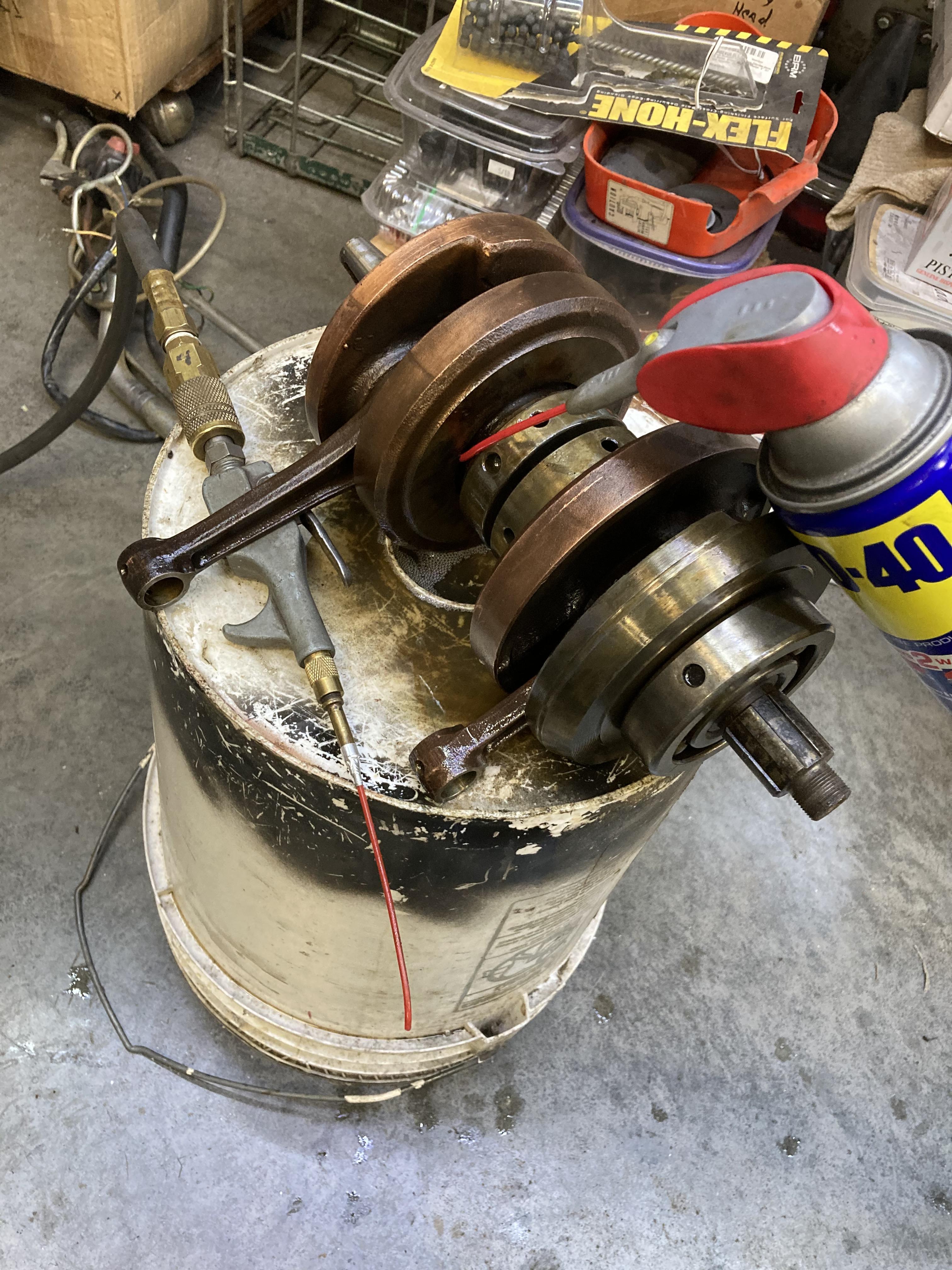
I used a dental pick, wd-40 and some compressed air pretty much as Ballbearian did, and holy cow there was some sludge in there. I didn't think to do this during the first rebuild, so I'm not sure how much of it is from the bike's past vs from me riding it, but all of the sludge appears to be magnetic :(
IMG_5805.JPG
The sludge traps are shiny and clean now, and I'm trying to spray wd40 into the crank pin / big end bearing, but I can't tell how effective it is. The passage seemed free when I probed it with the dental pick, so now I'm just. . . trying to rinse anything I can't really see in there, and the borescope is definitely too big to snake in there. Standing the crank on its end as suggested does help me see what all is running out of the big end, and swinging the rod around and jiggling it up/down helps some stuff come out easier, and it's running mostly clear now, so I'm hopeful that did a good job.
IMG_5807.jpg
After coating all of the crank in wd-40 and loosening sludge all over, what's the best way to rinse/re-lube the bearings and the whole thing? It's still got some little flecks of crud on the outside that aren't rinsing off too easily with wd40. I have a solvent tank parts washer, but idk if it's the best idea to use the recirculating dirty solvent in there all throughout the crankshaft crevasses and oil passages or not? Also should measuring the crank take place after re-lubricating it?
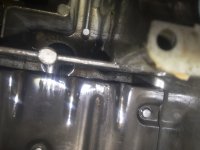
 
Last edited:
The sludge traps are shiny and clean now, and I'm trying to spray wd40 into the crank pin / big end bearing, but I can't tell how effective it is. The passage seemed free when I probed it with the dental pick, so now I'm just. . . trying to rinse anything I can't really see in there, and the borescope is definitely too big to snake in there. Standing the crank on its end as suggested does help me see what all is running out of the big end, and swinging the rod around and jiggling it up/down helps some stuff come out easier, and it's running mostly clear now, so I'm hopeful that did a good job.
IMG_5807.jpg

After coating all of the crank in wd-40 and loosening sludge all over, what's the best way to rinse/re-lube the bearings and the whole thing? It's still got some little flecks of crud on the outside that aren't rinsing off too easily with wd40. I have a solvent tank parts washer, but idk if it's the best idea to use the recirculating dirty solvent in there all throughout the crankshaft crevasses and oil passages or not? Also should measuring the crank take place after re-lubricating it?
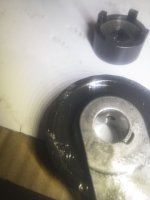
I salute your thoroughness. You're doing what few bother with on these now quite old and neglected machines. Oil must flow from crank centers out to big end rods or a rebuild is futile.
Cam ends need oil and rocker shafts/rockers. Don't get your cam bearing gaskets on backwards, I did.

Yes, on the #12 for crank knock pins, also check knock pins on tranny shafts for keeping gears from shaving aluminum on cases when abnormal side movement. Hopefully most of the glitter only came from the crank etc.

I'd just let the WD40 dry out then oil with assembly lube.
You could let solvent settle out and filter it before re-use.

Well done, Audrey
 
Hey all again!

did some more inspecting and found the bores that the rocker shafts sit in, in the end-caps are pretty not-smooth. Though they're usually clamped down stationary except when adjusting, so I'm not sure if that matters too much? Also, is lubrication to the tach-driveshaft the only spot that matters if the cam-cap gaskets are one way or the other? It looks like like the oil passages kinda flow around the gasket in the other spots that would be direction-dependent.
IMG_5823.JPG IMG_5815.JPG IMG_5813.JPG

That last one I think is for the shift lever shaft - does the scoring in there matter too much? The shaft seemed smooth otherwise.

Also, cleaning out the crank sludge traps was super great, lots of crud in there. I'm thinking I should be that thorough with every part of the engine, to get rid of any remaining glitter. (Still not sure where it all came from) - This leads me to wonder, is there similar merit in disassembling the transmission shafts, and thoroughly cleaning out their bearings, and any crud that may be between the gears/shaft? I already took apart the mainshaft and it seemed pretty clean, and scrubbed/rinsed the bearings with solvent, and now I'm worried that I won't be meshing the gears back up between the two shafts exactly as they were since i didn't mark corresponding teeth. Should I get new circlips for those shafts instead of reusing the old ones? And is backlash and other things measured after oiling/greasing/assembly-lubing the parts, or while they're all still dry? Also for what it's worth, how do the transmission gears stay sufficiently oiled? I see the oil feed to the mainshaft needle bearing, but can't seem to figure out how the rest of it stays lubed other than just splashes.

Sorry, I might be over-thinking these things but wanted to see y'alls thoughts. Thank you!
 
Last edited by a moderator:
Back
Top Bottom