CL175K0 Build, Barn Fresh-Adjacent

Tony Clifton

Veteran Member
Joined
Nov 18, 2025
Total Posts
133
Total likes
164
Location
Seattle
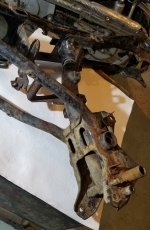
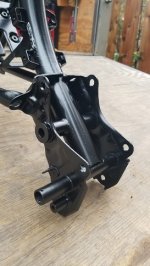
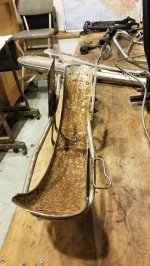
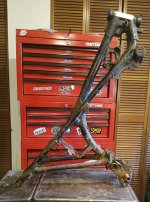
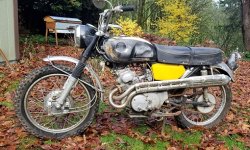
Leftover from building race bikes I have most of a rusty bike for which I was going to use the frame (pictured) and other good and bad parts. My plan was to sort through and select the good stuff, but then a couple of days ago I bought this nearly complete roller (pictured) for a few hundred dollars which has a lot of hard to get stuff I was going to have to hunt down, like a good exhaust, side covers, tank, and front fender. So much for thinning the herd.

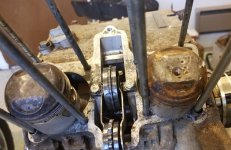
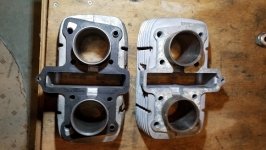
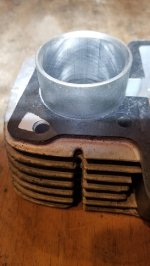
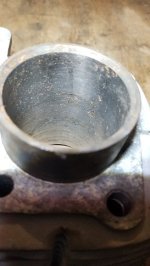
The "complete" bike has a frozen engine, the other engine I have is pictured and as you can see it suffered some insults to the L cylinder. I have good sleeves and heads so we'll sort it out. Otherwise it seems fine and has been stored indoors for many years.
Frame 1.jpg L Side.jpg Pistons.jpg
 
Ok I'll try to get this show on the road a little bit. Please go easy on me as it pertains to the "aesthetic" on this bike, I feel compelled right off the hop to explain: this bike is intended to be a runner, and the goal is to use it in an event next September which means to avoid last minute stupidity I should assemble this thing and get it out for sea trials long before long lead times for parts becomes an issue. Also, I am only a painter and polisher under duress. My own aesthetic is that of a patina lover and new paint is suspicious and disappointing.

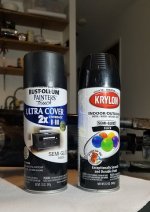
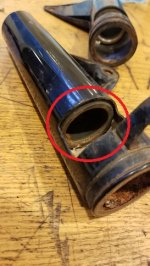
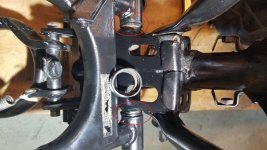
Here's a photo of the rustiest part of the frame, I'd like to avoid painting it but may bite the bullet and spray on one of those rattle cans. I note most of the frame is not visible when complete, so I'm not going to overthink it. Anybody have thoughts on this proposal, should I wire brush/Dremel what have you the rust down, clean real good and spray it on? Or maybe judiciously removing the surface rust leaving the paint alone and calling it good?

Rusty frame.jpg Frame paint.jpg
 
Last edited:
Tony welcome!! Hey that roller is a good find. Those exhausts are hard to obtain. Is the muffler solid?? They always seem to be rusted with holes toward the rear … hope yours is intact!
 
Tony welcome!! Hey that roller is a good find. Those exhausts are hard to obtain. Is the muffler solid?? They always seem to be rusted with holes toward the rear … hope yours is intact!
Correct you are...quite rare. This one appears to be in great condition, though I haven't done anything with the "new' bike yet except look at it. You can see the light surface rust all over the bike consistent with what I would expect from the seller's story, which was this bike was his uncle's and sat in a garage for many years.

I didn't PLAN on buying another bike nor did I WANT to but the things this bike has that I was going to have to source includes side covers, tank, petcock, front fender, headlight, exhaust system, carbs, and probably a bunch of small things. It also has a better seat and so forth than the one I planned on using. For a few hundred smackaroos and a forty minute drive I just couldn't stop myself...I entered that fugue zombie state and got into my truck.


Muffler.jpg
 
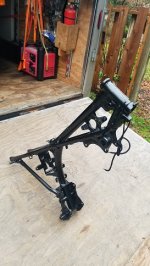
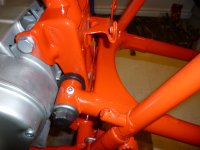
Motivated to continue steady progress on this build I painted the frame. 51 degrees and threatening rain, it held off long enough for me to prep and paint.

As compared to the lazy prep more suitable to painting an old tractor I threatened in a previous post, I actually took a few hours to be as fastidious as possible (for me anyway) at removing rust and old paint. Lots of wire wheel and Dremel work, also acetone works well at removing decades-old grime.

Next step: mount the frame on a rolling workbench, rebuild the steering stem and forks along with the "swinging arm" and shocks, I'd like to make it a roller as the first order of business just to make life easier.

Frame 2.jpg Frame 3.jpg
 
Okay, I prepped and painted the swingarm and passenger footpeg mounts, temp was only 45 degrees so the result was they look a little frosty but otherwise ok. So I will hit them with a final coat of semi-gloss when it warms up.

I have a couple of choices shown below for cylinders, one is very clean looking and the other needs a more judicious hone and probably a bore. The less desirable one is also the prettiest, as per norm. I'm taking them to a reputable machine shop today that does lots of work on vintage vehicles to get these cylinders measured and evaluated, and armed with that info I can order pistons. I have some "3 over" pistons and rings already but I would be happier to use one of these cyulinders without such an aggressive rebore.

Cylinders.jpg Cylinder 1.jpg Cylinder 2.jpg
 
By 3 over on the pistons I'm assuming they are .75mm or .030" oversize. If you mean 3mm over then that's a big jump.
You assumed correctly! We like to talk in terms of"one over" or "two over" with the "four over" being the 1mm overbore. I don't know what a girl would do after that except buy those big 3mm over bore pistons that still allow a bike to qualify for 200GP in AHRMA but coupled with some flavor of Megacycle cam that those guys like to pair them with they blow up fairly regularly.

In the event, the machinist said "two over" and since I already have in hand "three over" OEM pistons and rings, that's what they'll be. Once again, sloth drives the show...heh....they'll be done this week
 
Given the cost of original Honda pistons and rings these days, when you can find a set from the same supplier vs two sellers. Third over is a simple choice. You likely will never use the bike enough to ever need the go to 4th over at a future point. It is still an option down the road though for someone if needed.
 
Given the cost of original Honda pistons and rings these days, when you can find a set from the same supplier vs two sellers. Third over is a simple choice. You likely will never use the bike enough to ever need the go to 4th over at a future point. It is still an option down the road though for someone if needed.

You're thinkin' like I'm thinkin'. In fact, the identical race bike has "three over" OEM pistons in it, and that poor machine has been absolutely flogged for ten full seasons and an additional five partial seasons. Literally winding out at the top of the rev range for 15-20 minutes at a time, race after race, and with a Pertronix electronic ignition for maximum RPMs. If THAT bike is still running strong, I'm not gonna worry about future overbores! hee
 
Does anyone have special sauce methods for rejuvenating rubber doodads? I remember doing tons of research about softening up that bandolier of CB400F carb connectors involving wintergreen oil and so forth, I probably did it with some success, can't remember. I see there's a need here though


Rubber items.jpg
 
One part oil of wintergreen with I think 2 parts of rubbing alcohol (70%) will soften the rubber. It can actually swell the rubber quite large so don't leave it in too long. I used a ziploc baggy to keep the alcohol from evaporating (and also to keep the house from smelling like a giant peppermint).
 
OK, pretty good progress today. I needed some parts from the donor bike such as that funny little stud/cotter pin thingy at the bottom of the steering stem that is part of the steering friction damper, also the upper shock covers are needed.

This bike has been subjected to a long term agricultural situation and you can tell...some fasteners that are not threaded into the bike frame itself have been replaced with SAE bodges and there is a wide assortment of mismatched, chowdered bolt heads. I spent some quality time with my manual impact driver, not enjoying every second of it.

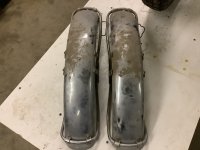
Because a PO shoved a big 3.00 knobby tire into the front, the fender is all bowed out and he needed some sheet metal fender "extenders" to make it work. Some real crap. What's up with this Mae West fender, shouldn't the side struts be relatively straight from front to back? Someone chime in, the internets don't have any straight-on pics of the fender.

Front fender.jpg
 
All that work, just to get to starting to put on a front wheel :cautious:

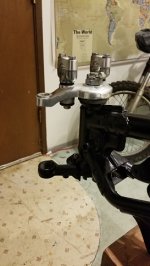
I mocked up the front, need to grease in the ball bearings and Bob's yer uncle...the forks though, one's kind of apart and I haven't dug into 'em

Triple tree mockup.jpg
 
Here’s the two off mine. I just noticed the cable guides are different🤨. My frame numbers are 1013Xxx and 1012XXX. Didn’t pay close enough attention which is which……anyway. Hope this helps.
IMG_0127.jpegIMG_0123.jpeg
 
Here’s the two off mine. I just noticed the cable guides are different🤨. My frame numbers are 1013Xxx and 1012XXX. Didn’t pay close enough attention which is which……anyway. Hope this helps.

View attachment 53033View attachment 53034

Very helpful Grumpybugger, thanks very much...apparently this shape is a feature, not a bug as they say. I'm glad not to have to strongarm these struts into a new position. I think it will all be fine once an appropriately sized tire is mounted.
 
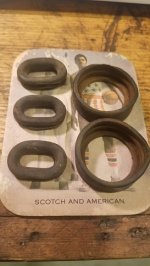
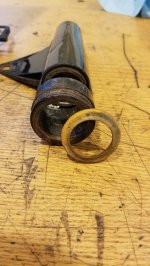
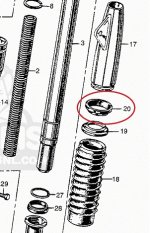
OK, here's the next parts puzzle for you smart guys to impress me. I note in the parts diagram a "Lower Cushion" which ostensibly resides up against the adjacent (I think) front fork dust seal. When I removed these forks from the bike, there was no sign of this lower cushion. The photo below shows the dust seal (part 19) which fits into a groove at the base of the fork cover, but that's it. Also I don't think there's anything such a cushion could rest upon. What am I missing?

Forks diagram.jpg Lower cushion.jpg Fork upper.jpg
 
OK, this project moves apace. Trying to create a list of all the things I don't have yet. Here's a puzzler...when placing the swingarm into what will be its position in the frame, there is not enough of a gap to allow placement of the rubber dust seals. It's not a tight fit but it's a bit snug, definitely there is not enough room for the seals. Is this normal, or is the fact this frame and swingarm are from different bikes causing an issue?

I'm just going to leave this dust seal out for now, they don't protect any bearings per se, just some bushings where very little movement occurs. I have to keep this project going!

Swingarm rubber.jpg
 
The dust seal doesn't sit inside that gap. The small inner section of the rubber cover with the hole sits around the inner or outer H section of the fork. You need those seals if your riding the bike or you will get dirt into the bushing area. The inner bushings are plastic, so not a top grade item and if they are still good you want to keep them that way.

Here you go and take your time. Mistakes are costly in both time and money. I have restored a few of these CL175K0's and can assist if I know the answer.

CL77 Rear swing arm with the same set up.

P1080710.JPG
 
Last edited:
The dust seal doesn't sit inside that gap. The small inner section of the rubber cover with the hole sits around the inner or outer H section of the fork. You need those seals if your riding the bike or you will get dirt into the bushing area. The inner bushings are plastic, so not a top grade item and if they are still good you want to keep them that way.

Here you go and take your time. Mistakes are costly in both time and money. I have restored a few of these CL175K0's and can assist if I know the answer.

CL77 Rear swing arm with the same set up.

View attachment 53167

Ah yes, that makes perfect sense and I've remedied my error. Thanks so much for setting me straight.

I can see how a zerk fitting at that location would be a great idea, I believe my CB77 has the same, evidently the "later" models like the CL175 came greased for life from the factory :)
 
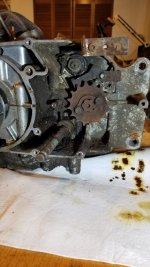
I suppose I should get both wheels mounted so it's a roller before I install the engine. I expect to get my newly refreshed cylinder block back this week so I need to get on it. Here's a pic that doesn't really do justice to just how thick and gross the congealed grease is on this thing.

Gunky engine.jpg
 
No plans to split the cases and check the internals such as crankshaft oiling passages and shift forks and gear dogs?
 
No plans to split the cases and check the internals such as crankshaft oiling passages and shift forks and gear dogs?
I am pondering that. Stay tuned.

I'm more worried about oiling than shifting of course. The odometer reads 11,968 so who knows. Intense dialogue is scheduled for tomorrow evening with my vintage Honda colleagues. We'll have beer in order to make the best decisions.
 
Working every day on this thing, good thing I'm retired, I shudder at the thought of some poor slob trying to make a living

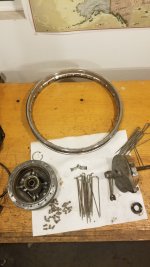
Have to lace up a rear wheel, my other option was too rusty and crunchy and I HAVE laced a wheel before, what could possibly go wrong? heh
20251211_173629.jpg
 
I shudder at the thought of some poor slob trying to make a living
That slob is me. Between driving my son to far flung hockey rinks and running a business all I can do is occasionally glance at the motor waiting for me on the bench as I race past it several times each day. I typically take a lot of time off over the holidays and work on bikes but with a big vacation coming up in mid-January I'm not sure I'll have that luxury either.
 
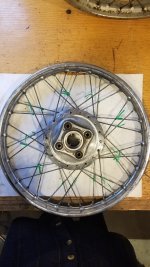
Forging ahead...laced up the rear wheel, piece of cake. I sat an identical laced wheel in front of me and carefully duplicated the pattern. Also remembering how much easier it was if one didn't allow the spokes to swing this way and that after inserting them into the hub holes, I used wire twist ties to loosely hold them in place. After all spokes were inserted I carefully laid the wheel outside of them and began a few threads for each spoke.

I was reviewing a YouTube video posted by a guy who has a channel fixing old Hondas and after the initial lacing he explained he was going to send it off to a shop for final truing and mounting of a new tire. I was like, what? Pffffft

Laced wheel.jpg
 
Nice job. Not too difficult like you say, if you have the spoke pattern in a pic or another wheel to reference. Without the wheel bearings that's about as far as you can go now.
 
I froze the wheel bearings and heated up the hub real well with a heat gun one side at a time, the innermost bearing that is held in with a circlip needed a little persuasion with a just-right sized socket but it went well.

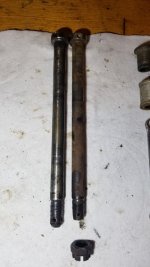
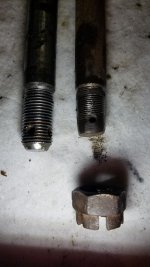
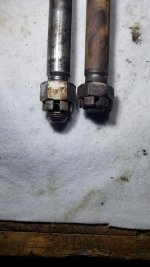
Here's another one of those puzzles that occur when the selection of parts is from various 160/175 sloper or vertical engined bikes, I have these two rear axle bolts...one is about 1/2 inch shorter than the other and the longer one has coarser axle nut threads. I think the shorter, more finely threaded bolt is the best one for this build based on my measurement. Is the longer one for a ("newer") vert bike? I dunno. I'm not real thrilled with the munged up teeny tiny threads on the shorter one but it will work.

Axle Bolt 1.jpg Axle Bolt 2.jpg
 
I trued the rear wheel, it's not too bad. I forgot to take a photo of my poor man's truer/balancer, it's the same pair of ball bearing rollers that they all have but it's not on a stand, I just place the rollers on two 5-gallon buckets. I don't need the stand taking up room year-round.

I mounted a race takeoff, it may remain as the rear tire. There is usually a goodly amount of tread in these Bridgestone Battlax BT39-SS available for a street bike purpose. I think there are still a couple of rock-hard Avons on a bike or two. They don't seem to ever wear out, they're too ornery.

In the event, these are good rain tires, we run 'em in the rain and I have never seen anyone selling rain race tires small enough for small bike vintage racing. They have amazing grip in the rain after they've warmed up a bit.

Speaking of warming up, I placed the tire in a racing tire warmer made for SV650s before mounting the rim given there's no sunlight to warm a tire. I don't use tire warmers for any vintage bikes I currently race but bought some when I was endurance racing modern bikes like the SV or CB600F2.

Here's a photo of an el-cheapo free-to-me tire changing station I made, it's just a car wheel Les Schwab gave me for free mounted on a chunk of square tube so I could mount it in my truck's receiver hitch. Sure beats three guys struggling over a 55 gallon drum garbage can at the track! An idea stolen from the internet years ago of course. It clamps the wheel down tight so you can reef on levers and curse while the wheel stays put.

Tire changer.jpg
 
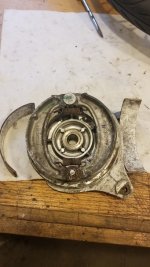
Quite happy with my momentum getting this rear wheel assembled I mounted the sprocket and grabbed the rear brake panel and then...this happened. The pads fell right off the shoes. Actually I'm happy this happened before the wheel went on and they were put to the test for the first time :oops:

Evidently these linings were glued on with drywall compound or similar. I have a vintage car/truck brake shoe riveter in the corner of my ship so I can see the value in a mechanical connection for these things, dunno why Honda thought otherwise.

Honestly, I'm considering cleaning these things thoroughly and reattaching them with a thin layer of JB Weld. They have plenty of life left and it's not like I'm going 'round the world on this thing. A couple of rivets in each one wouldn't be a bad idea either.

Brake shoe.jpg
 
Last edited:
Bikes exposed to high dampness for a long time often get corrosion on the aluminum frames under the linings and if left long enough, the results you've seen. Bonded linings are actually quite common, but for the price of a set of shoes I wouldn't attempt reattaching them myself.
 
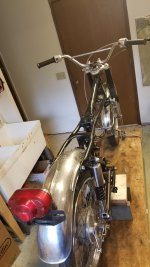
I installed the rear wheel in the frame so now I have a roller. No engine and chain so of course I'm not tightening anything down but constant progress is the theme here. Kind of like the Navy and Marines in the Pacific in 1944...constantly moving forward and always attacking!

I suppose attaching other things to the frame and getting the wiring harness on there would be good now but I have to get after these carbs which you can see are the usual victim of decades of neglect. I haven't pressed the machine shop since I haven't really needed the engine yet but getting it back this week would be nice.

I don't have experience with these "power jet" carbs but there doesn't seem to be much difference between the other Keihins I've worked on.

Wheels.jpg Carb.jpg
 
I installed the rear wheel in the frame so now I have a roller.
Did you put off the shoe replacement or resole the ones you had?

I was reanimating an '82 XT250 for a friend several years ago and on the first trip around the block I pressed the rear brake and it locked up instantly. I had to release the brake pedal by hand (lift it) and found the shoes were separated when I removed the wheel and checked the drum. Thankfully it was a low speed test ride, but the minivan behind me did not appreciate my abrupt stop!
 
Did you put off the shoe replacement or resole the ones you had?

I was reanimating an '82 XT250 for a friend several years ago and on the first trip around the block I pressed the rear brake and it locked up instantly. I had to release the brake pedal by hand (lift it) and found the shoes were separated when I removed the wheel and checked the drum. Thankfully it was a low speed test ride, but the minivan behind me did not appreciate my abrupt stop!
I did the JB Weld stunt as previously threatened, and it seems clear that I couldn't get them off with a chisel on a bet. However, my buddy has some shoes in his stash so I will go with those. Mainly I just wanted to put the wheel on and keep the overall project charging ahead.

I have no illusions and this isn't my first rodeo...I fully expect to put things on and take them off several times, it's just how these things go. I also learn more details about these bikes while doing so, and doctors say that people with much experience in life benefit by exercising their brains thusly.

Like, when I freeze my wheel bearings and heat up the hub and drop them in and stand back with smug satisfaction just before realizing I forgot to drop the wheel collar into the hub, I just say, oh, look at the big brain right there. :censored:
 
Fair enough. I've had to redo my share of things, some examples of which are documented in the dark corners of this forum.

Just out of curiosity, how did you put pressure on the shoes as the JBWeld cured? The best method I can think of offhand would involve installing them and using the brake lever, but with the new adhesive, I wouldn't expect them to seat properly right away.

I like the idea of using your buddy's shoes.
 
Just out of curiosity, how did you put pressure on the shoes as the JBWeld cured?
I didn't put any pressure, it's a snug fit with massive surface area. But yeah, I'll go with the other shoes.
 
Last edited:
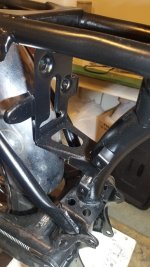
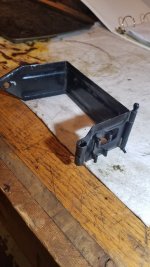
OK you cool cats, help a brother out...I'm trying to mount this battery box swinging door or whatever you want to call it and the parts diagram is of zero value, doesn't even recognize the existence of such a thing. I know it's threaded to a bracket on the left side but am bereft of knowing anything that's supposed to happen on the right side. Could one of you post a photo or two of what is supposed to be happening behind that side cover? Looks like a fuse or something is supposed to clip onto the right side, maybe, I have no idea...?

Batt Box 1.jpg Batt Box 2.jpg
 
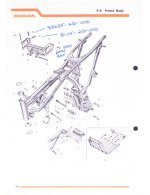
It’s a special number of bits which make up the parts in the round bracket on the end. Look up the parts fiche and it will show you the parts. If you don’t have them then you will need to manufacture substitute pieces.

CL160 parts fiche uses same parts


img001.jpg
 
Last edited:
OK you cool cats, help a brother out...I'm trying to mount this battery box swinging door or whatever you want to call it and the parts diagram is of zero value, doesn't even recognize the existence of such a thing. I know it's threaded to a bracket on the left side but am bereft of knowing anything that's supposed to happen on the right side. Could one of you post a photo or two of what is supposed to be happening behind that side cover? Looks like a fuse or something is supposed to clip onto the right side, maybe, I have no idea...?
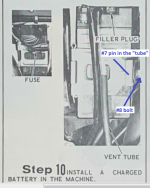
I managed to find a similar picture of the battery box assembled but it's from the 160 that preceded your CL175K0. Similar parts and a small look at how they're assembled at the removable "door" where the long cotter pin is the hinge. This is from the 1967 dealership setup guide for assembling the new 160 out of the crate. Actual orientation is different between them but this is as close as I could find in a picture of things assembled

1766066686173.png

honda-cl175-scrambler-1968-k0-usa-frame-cl175_bighu0020f6s2101_eb94.gif
 
Fellas, thanks for your help on that bracket. I'll be on the lookout for a rod with a threaded hole in the middle but it looks like a bodge would suffice as well.

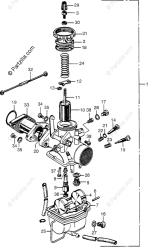
Next issue: these "power jet" carbs. This is my first exposure to them, and the parts books/service manuals just confuse. I was hoping the Glenn's Honda book I have would be of value here but that particular book is bereft of knowing the presence of a sloper 175 with a five speed, they don't seem to understand the first sloper was a five speed before the switch to vertical engines so I don't really trust what I read in there. In fact, in the section that displays photos of the various models, it states the sloper CL175 has a four speed tranny which is obviously wrong.

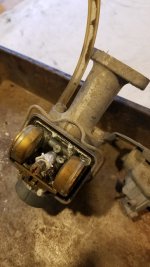
Here's the dilemma: The first carb I reduced to parts revealed a #140 jet in the "A" orifice as labeled on the photo below, and a #160 jet in the "B" orifice. An identical carb set I have contained the opposite, a #160 in A and #140 in B. This is of course in addition to the main jet which is a #90.

The shop manual says nothing about stock jet sizes, and is silent on the existence of "power jet" carbs. Are these the carbs that were stock on the CL175K0, or not? I have a pile of these carbs but according to all the literature I have, they don't exist!

So, does anyone have an opinion about what stock jet sizes are for the main jet, power jet A and power jet B?

Power jets.jpg
 
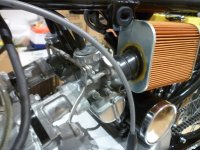
I believe the correct carbs are PW22 on some of the early models. There maybe a difference depending on the serial # of the builds which is a guess on my part. I did a 1968 CL175KO that I sold this year and helped restore another one which my buddy Joe currently has in his basement show room. Neither bike had the power jet or those jets shown in AD's fiche link. My carbs also didn't have the hose from the air box to the upper carb body either.

Grumpybugger is doing a couple of these bikes and his do have those hoses to the upper carb body and his bikes look possibly stock based on the condition he bought them in.

Here is the front side of a Honda OEM NOS filter which is void of the air passage to the upper carb body.

P1060963.JPG
 
Thank you, gents. What the fiche tells me is that both of the power jets on each carb should be the same size. I think. However, the parts diagrams don't state what the standard size is, it simply lists literally dozens of different jet sizes, including several sizes for the slow jet. The Glenn's manual doesn't describe the jet sizes because the writers stubbed their toe identifying the first CL175 as a five speed sloper, so it's not mentioned at all. They DO say the CB 160 is a 20mm carb with a main jet #90, slow jet #38, and what they describe as an "air jet" #150. The official Honda shop manual is absolutely silent on jet sizes, strangely enough.

I'll continue to look for more info about these power jet carbs, evidently they are an enigma wrapped in a riddle, foisted on the public in the middle of the night by Ollie North or someone.
 
Back
Top Bottom