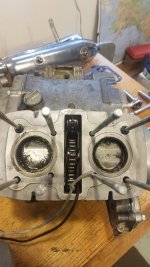
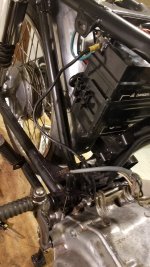
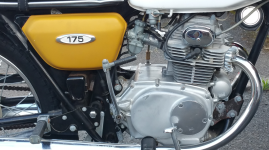
CL175K0 Build, Barn Fresh-Adjacent

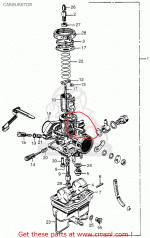
What the fiche tells me is that both of the power jets on each carb should be the same size. I think.
Referring to the fiche linked by @ancientdad, the power jets are both labeled 38, but the range of jet sizes listed under 38 ranges from 150 to 170. I would not assume that they should be identical just based on the fiche.

It seems that user @Cromwell might be able to contribute to the conversation about the power jets, based on this thread.
 
I would not assume that they should be identical just based on:: the fiche.
Correct you are. I don't see "STD" listed on any of those jets.

According to the fiche, only the CB175K0 and CL175K0 have power jet carbs, and I assume being between two worlds, that is to say with the older style design and sloper engine yet containing a five speed transmission in a one year only assemblage, it has confused some folks who write service manuals. I glanced at the carb for a CA175K0 and noted the presence of the air passages necessary to operate power jets, but no jets shown, because this issue isn't confusing enough:

CA175 Carb.gif
 
Correct you are. I don't see "STD" listed on any of those jets.

According to the fiche, only the CB175K0 and CL175K0 have power jet carbs, and I assume being between two worlds, that is to say with the older style design and sloper engine yet containing a five speed transmission in a one year only assemblage, it has confused some folks who write service manuals. I glanced at the carb for a CA175K0 and noted the presence of the air passages necessary to operate power jets, but no jets shown, because this issue isn't confusing enough:
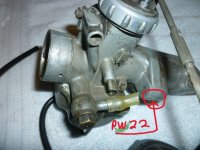
I have fully rebuilt and restored two of these bikes (mine) was the 1968 CL175KO and neither had the "power jets" so you may have either a later production model, or someone switched out the carbs. The PW22 model is stamped on the body as shown below. Determine which carb model you have and what is stamped on your carb bodies would be a help. This is the carb number listed as correct for the CL175K0 in the FSM specs section. Model PW20’s are for a 160 twin motor BTW and look like the PW22’s.

Track down Grumpybugger. He has two 1968 CL175K0's he is starting to restore .One of his bikes for sure has the air filter with the rubber hose to the carb. So he likely is a much better source rather than speculating here!

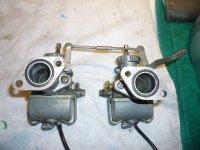
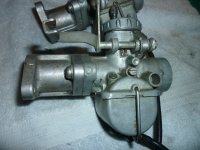
Carbs removed from my early production bike with #802 motor serial number. Carb model PW22 and clearly no power jets on these carbs. Joes carbs (Also a 1968 CL175K0 are the same design and model # PW22 too, also with no power jets in his carbs.

P1060880.JPG
P1060879.JPG
P1060887.JPGP1060883.JPG
 
Last edited:
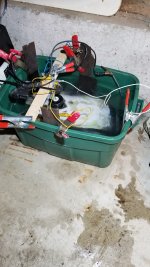
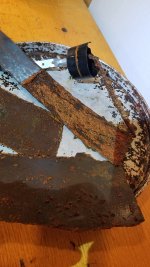
Electrolysis went well...there really wasn't a lot of rust in the tank and this method seemed to work fine. One less task to worry about.

Discovered one of my buddies has an ultrasonic cleaner so I've been soaking the carbs in that.

Electrolysis results.jpg
 
Here is something that has perplexed and vexed me for years, parts fiches ignoring that the gasket between the petcock body and the petcock bowl is a triangular shape as compared to a simple o-ring. You can see in the photo the gasket is shaped thusly, it's not an o-ring. But all parts fiches and photos of this gasket with the proper part number simply show an 0-ring, like the screenshot below from a DSS page. How can I buy the proper gasket if the powers that be refuse to acknowledge its existence?

BTW, I have tried to use a correctly sized o-ring for the application and the result was shite.

Petcock gasket.jpg DSS petcock.jpg
 
Here is something that has perplexed and vexed me for years, parts fiches ignoring that the gasket between the petcock body and the petcock bowl is a triangular shape as compared to a simple o-ring. You can see in the photo the gasket is shaped thusly, it's not an o-ring. But all parts fiches and photos of this gasket with the proper part number simply show an 0-ring, like the screenshot below from a DSS page. How can I buy the proper gasket if the powers that be refuse to acknowledge its existence?

BTW, I have tried to use a correctly sized o-ring for the application and the result was shite.
Note the middle section of that part number, it has been superceded over the years to a part almost the same but not quite, likely because the overall dimensions of that new part number fit lots of other things now and aside from the lack of taper, is the same size otherwise. No part originally made for bikes the ages of ours had an alpha-charactered middle number, all the part numbers were full numeric when our bikes were built so that "crossover" is for a later bike.
 
Note the middle section of that part number, it has been superceded over the years to a part almost the same but not quite, likely because the overall dimensions of that new part number fit lots of other things now and aside from the lack of taper, is the same size otherwise. No part originally made for bikes the ages of ours had an alpha-charactered middle number, all the part numbers were full numeric when our bikes were built so that "crossover" is for a later bike.
The CMSNL site seems to be the place to go if trying to see the parts fiche, but unhelpfully they sometimes list two parts with the same part number, or five, or twenty, depending on how common such a part is across the model lineup. For this particular gasket, #5 on the fiche, there are five separate offerings, all with different parts numbers and prices, but photos of the part just show an o-ring. All of them are $7.65 except one of them which is $38.86.

Cross checking with DSS, searching for the part numbers displayed on the CMSNL fiche reveals the same...several $3 gaskets and one for $47.08. Naturally one might surmise that the really expensive one is the real OEM item, but DSS provides no photos and neither site points out which one is OEM. I'll bet a dollar to a doughnut that the $3 gaskets are just o-rings.

So the bottom line is there is just no way to know what to order. I'm certainly not in favor of spending forty or fifty bucks for a small rubber gasket which there is an even money chance it ends up just being a standard o-ring. I'll probably soak the things I have in some wintergreen oil and iso alcohol and whisper sweet nothings at them.
 
I'll probably soak the things I have in some wintergreen oil and iso alcohol
Once the o-ring is of the right mushy consistency, I would insert it in the petcock and snug the bowl up to it so that you can shape it while the alcohol evaporates. Might take several days or a week to evaporate but hopefully it retains the triangular shape.
 
Looking around on ebay with the part number for a CB450 K1-5 16955-283-000 and found this for sale for a reasonable price and free shipping. Hard to tell by photo is the seal is round or not but is the original packaging. Ad says fits CB CL SL 175 among others so maybe contact seller and ask them to check if round or triangular shape.

 
Finally got my freshly bored cylinders back from the machine shop so I find myself out of excuses for not finishing and mounting the engine

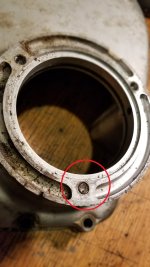
Puzzling over the oil filter cover I encountered this Houston We Gotta Problem:

Issues.jpg

Apparently a PO had trouble with these, the circled one is snapped off and the other two though clear display the injury of some drill bit shoved in there so the M6x1.0 tap just wallers around, I was gonna find a bottoming tap if necessary but instead I'm gonna rob the hopefully good side cover off the donor bike
 
Just took a peek in the garage. I've got an extra but unfortunately it's not in very good shape. Hope your spare works.
 
Multitasking...trying to strap in the wiring harness and everything else that doesn't need the engine...here's the negative battery connection on this otherwise nice harness

As Al Davis would have said..."Just win, baby!" heh

Battery Wire.jpg
 
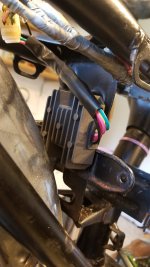
I've installed a Sparck Moto regulator/rectifier behind the battery box, this bike doesn't have a voltage regulator but still. I also took the opportunity to do the white/yellow wire combining as to ensure more chooch as described by @Richard Pitman in his wiring diagram on the Technical page. We'll see what happens. In any event the wiring is simplified by this mod and combined with no starter the wiring overall is welcomingly sparse with this fine vintage machine.

Rectifier.jpg
 
You’re probably going to need to rotate that reg/reg.

I so badly wanted to mount mine there on the 160 which has the same battery box style - the starter solenoid won’t fit in the orientation to keep the starter and battery cable routing.
 
Yeah I don't have those

This thing is kickstart only, speedo and three lights, 1neutral 2high beam and 3turn signal
Interesting. I guess it makes sense to use the same battery tray on both frames.
 
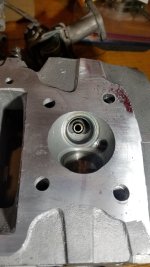
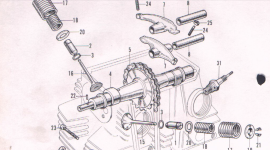
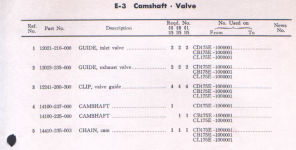
I'm attempting to prepare to fit used valves into this new CL175K0 OEM head and ended up going down one of those unfortunate rabbit holes. The exhaust valves seem like a good fit and there doesn't appear to be anything I need to do there. The intake side on the other hand...these valves are just too snug to insert. I'm looking at obtaining a 5.5mm valve guide reaming tool, boy what a mess with the parts numbers and so forth. Also, the parts fiche seems to describe valve guide seals for the exhaust side but none for the intake side. And of course trying to understand what these parts look like with the crappy illustrations in the fiche is unhelpful. And there is the "unobtanium" factor, or folks who want $20 apiece just for a washer.

I see that CMSNL sells a "non OE alternative" kit that appears to replace two or more parts, but it's un-possible to tell how to put it all together. I don't have an example to look at.

For those of you with experience with the CL175K0, do you know of a source for these valve guide seals? Half the parts are unavailable, Kibblewhite just has confusing information, DSS doesn't have em, CMSNL doesn't either, nor does those guys in Houston (they don't even mention the need for valve guide seals, hmm), Partzilla doesn't have em as well. Help me, my brothers and sisters.
Valve Guide2.jpg Valve Guide1.jpg
 
This is a screenshot of our CD, CB, CL175 Parts Manual, all engine numbers 100001 and up (K0) and it does not show valve stem seals.

1769638787863.png


1769639052397.png
 
Yeah I should have been looking at that instead of Glenn's and the retailer parts fiche, thanks for the image. I just glanced at the parts for the CL160 and there were no valve stem seals so I bet it's a sloper thing.

It's a bit difficult mulling over parts for this one year only make/model, I note that half the shop manuals and parts diagrams include mistakes. For example the Glenn's book which is otherwise very helpful describes the K0 as a four speed.
 
Before you ream out the valve guides, give a brass bottle brush and some WD-40 a go. Tolerances there are so tight, even a little bit of corrosion or deposits from cleaning can bind up the valve.
 
Before you ream out the valve guides, give a brass bottle brush and some WD-40 a go. Tolerances there are so tight, even a little bit of corrosion or deposits from cleaning can bind up the valve.
Good idea...the head HAS been sitting on a shelf for many years
 
It's a bit difficult mulling over parts for this one year only make/model, I note that half the shop manuals and parts diagrams include mistakes. For example the Glenn's book which is otherwise very helpful describes the K0 as a four speed.
Yeah, it's unfortunate that many of the more desirable models from the '60s suffer the poor translations, typos and omissions in the documentation department, the CA/CB/CL72/77 models do as well. With no worldwide network the lack of interconnected information then didn't help either, had to rely on printed copies shipped to dealerships.
 
Project update: Finally got the engine buttoned up and mounted in the frame. But what's this?...hmmmm....kickstarter isn't chooching. It just feels what I can only describe as "sickening." So I am removing the engine and splitting the cases after all. Not a big deal, I didn't have the exhaust mounted or anything like that.

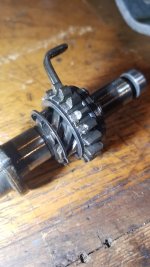
And....here is the big reveal. The kickstarter gear features about 1/3 of the gear teeth chowdered and nasty.

Obviously I should have tried cycling the pistons with the kickstarter long before mounting in the frame but I am neither the sharpest tool in the shed nor the brightest bulb in the box

Otherwise nothing looks untoward in the engine guts, it looks to have remain sealed from the elements during its decades-long slumber in the garage

Kickstart gear.jpg
 
Well that's ugly. Glad it seems to be the only damage, and it might have been caused by someone accidentally engaging the kickstarter while the engine was running. Hopefully not too much shrapnel left inside.
 
Well that's ugly. Glad it seems to be the only damage, and it might have been caused by someone accidentally engaging the kickstarter while the engine was running. Hopefully not too much shrapnel left inside.
I've decided to save money I'm simply going to remove one circlip, remove the pinion gear and "reclock" it 180 degrees, also turn it around so the broken teeth stay out of the fray


Kidding, as far as YOU know :rolleyes:
 
I also note that the design on this pinion guarantees that the maximum amount of contact allowed between the pinion and its matching gear is less than half the width of the teeth

I'm not impressed with that design, and maybe this is how they ALL are, but it seems risky and a quite likely failure point

I note @Richard Pitman had the same thoughts in a different thread
 
It does have its weak point, though probably a cost cutting effort to help Honda keep these bikes inexpensive back then. Aside from the unintended engagement causing damage, they seem to hold up fairly well even with the younger crowd who gets into vintage bikes, goes e-start delete and loves to show off the kickstarter.

I think Richard's bigger issue was the length of the SL175 lever, fairly longer than the CB/CL.
 
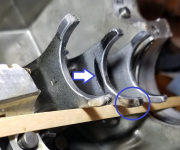
Any scuffing or evidence of overheating on the shift forks? Be a shame to get it back together only to find the gears won't engage.
 
Any scuffing or evidence of overheating on the shift forks? Be a shame to get it back together only to find the gears won't engage.

A shame indeed!

The shift forks look remarkably pristine, which if one wishes to assign veracity to the odometer that displays only 2915 miles then it's to be expected I suppose

I do have some experience with burned shift forks, as that was the cause of my CB77 shifting giving up the ghost miles from home years ago. That engine had many miles, it even wore out that copper bushing thingy on the transmission shaft. Or maybe it was the copper bushing that stopped it from shifting. Relying on my memory is a fool's errand

I will say one thing about that, if one has a CB77 stuck in gear in town, it's very fortunate to have it stuck in 2nd gear, because starting off is fine and it'll go 35 mph no problem
 
Obviously I should have tried cycling the pistons with the kickstarter long before mounting in the frame but I am neither the sharpest tool in the shed nor the brightest bulb in the box
Most people here can think of something similar that they should have caught earlier and lost time fixing later.

Sometimes the brightest bulb in the shed helps you find the sharpest tool in the box and that's good enough.
 
That engine had many miles, it even wore out that copper bushing thingy on the transmission shaft. Or maybe it was the copper bushing that stopped it from shifting. Relying on my memory is a fool's errand

I will say one thing about that, if one has a CB77 stuck in gear in town, it's very fortunate to have it stuck in 2nd gear, because starting off is fine and it'll go 35 mph no problem
That C bushing is the Achillies heel of the 305s.
 
It does have its weak point, though probably a cost cutting effort to help Honda keep these bikes inexpensive back then. Aside from the unintended engagement causing damage, they seem to hold up fairly well even with the younger crowd who gets into vintage bikes, goes e-start delete and loves to show off the kickstarter.

I think Richard's bigger issue was the length of the SL175 lever, fairly longer than the CB/CL.
The SL175 has a ratchet type kick start mechanism, the ONLY difference between the SL and the CB/CL 175 engines ( and possibly some of the internal gear ratios, certainly not the camshaft as some sources mention ). I wondered if the SL mechanism was more robust than the CB/CL setup, which does look like a disaster waiting to happen. The longer SL lever is just set to high for a short arse like me, mechanism seems to work OK with a CB lever, so not sure why Honda did that.
 
Steady progress continues....a lot of little things. Struggled with getting the rear brake return spring on for two hours. But that's ok because I'll be able to practice putting these assemblies on in the proper order many times in the near future, should history repeat itself

Throttle cable I had installed was revealed to be at least a couple inches too short and so I dug into my cablemaking stuff to find a longer middle cable, between the throttle tube and the carb junction piece. Found a good one but I needed to solder on a new end fitting, this cable soldering setup I have results in real nice DIY cables

Solder pot.jpg
 
Three steps forward, two or three steps back

Everything mounted except the seat, tank, and air cleaners, my goal was to turn the engine over enough to see oil weeping out of the left rearmost acorn nut on the head. Rather than attempt to fire it up, I removed the spark plugs and ran it on my DocZ roller starter which is erstwhile used to start race bikes with no starter or kickstarter. I ran it in second gear for ~15 seconds at a time four or five times but haven't seen any oil yet. Unfortunately I DID see oil but not where I wanted to...a prodigious amount was dripping from the head/cylinder interface

I have a head gasket issue and/or a plugged oil passage as that oil pressure is going to want to go somewhere. In any event another engine removal and head removal seems likely. Any suggestions?

First attempt.jpg
 
did you remember to fit the hollow dowels and O rings between head and barrels around the appropriate studs
 
did you remember to fit the hollow dowels and O rings between head and barrels around the appropriate studs
Yes, I remember doing that, here are pics of the two halves. The rearmost corner studs have dowels and o-rings while the front corner studs have identical dowels and NO o-rings, is that correct?

Further investigation continues

Head inspection.jpg Head 2.jpg
 
So, I thought I'd found my smoking gun after re-flattening the head on a sheet of wet/dry sandpaper on the granite slab...you can see how the area outside the front left stud hole sort of "tails off." There are some marks in that corner that I assumed were casting imperfections, but for all I know this OEM NOS head from David Silver Spares was a "factory second" though I doubt it.

Anyway, back to the smoking gun...I note this stud is NOT one of the two corners requiring an o-ring and therefore is NOT a stud in which its passageway also doubles as an oil gallery, would you all agree? In other words, my expectation is that there is no oil anywhere in the vicinity of that stud and any un-levelness would be a threat to a compression leak as compared to an oil leak, any thoughts on that?

In fact, peering into those two stud channels that feature O-rings, I can't see any holes where the oil leaves the channel and enters the head. A mystery. That illustration of the oil path to which we oftern refer is crude and barely shows what's going on, but it appears the oil rises in those two (only) stud holes and magically enters the head...somewhere, somehow. Does it enter the center of the cam and then squirt out all over? Is the oil return path the cam chain galley and nowhere else?
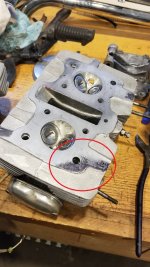
I have another OEM head like the other one and could disassemble the one I have, ream the valve guides, lap the valves and reinstall them, but that's a lof of work if it doesn't improve the result. The other OEM head also does not exhibit this slight un-flatness at the corner, it seems uniformly flat as an outcome of some sanding on the granite.

Head corner.jpg
 
This is a modified* CB200 head, but the principle is the same. Oil comes up the stud, from a tiny drilling in the top of the crankcase. The hole, that I have indicated by sticking a 3mm drill bit in, communicates with the stud via an oil way. If you put the gasket on back to front, that hole is blocked.
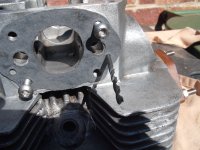
Oil then enters a passage on the surface of the rear of the cam bearing, and then through another drilling into a scroll machined in the surface of the actual cam bearing. And from there, as you said, down the centre of the cam to lube the cam lobes via holes drilled in the lobes.

(* CB200 head modified to take CB175 left hand cam journal. Simply, 3mm hole as in photo & a 1mm hole in the crankcase at the base of the stud.)

1772829405890.jpeg
1772829481060.jpeg
 
OK, I got this thing put back together and made sure it was pumping oil, it started and seems to run fine. Likes full choke to start and initially was demanding full choke to keep going, but that seems better now. Keeping in mind this is a new head and new pistons/rings and cylinders, so some breaking in will occur and unusualness is to be expected somewhat

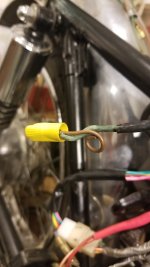
Currently I'm chasing down a problem with the turn signals which were working fine but now aren't, I'm suspicious the trouble may be related to there not being an actual beefy ground cable from the battery directly to the frame. One of you cats with the CL175, where is your normal grounding point? Usually there's a ring connector from the battery to an engine mounting bolt, I'd like to know where the "stock" location is.
 
I just had to know and so I grabbed a piece of 12AWG and squeezed appropriate eye rings on each end, hooked it up and the turn signals are fine now

"No matter what I do, it always feels better when I stop doing it."

Ground cable.jpg
 
Back
Top Bottom