stl360+450
Veteran Member
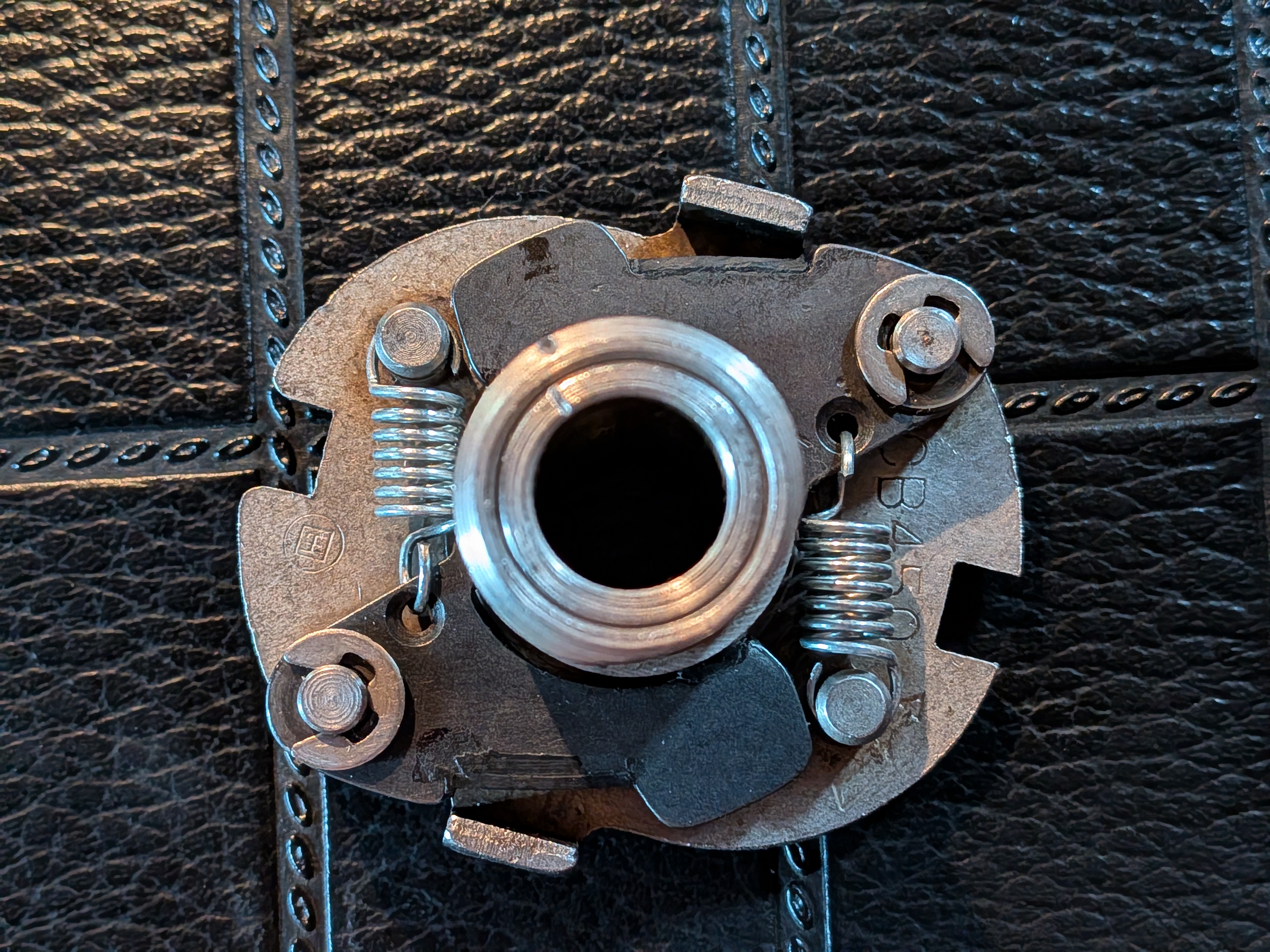
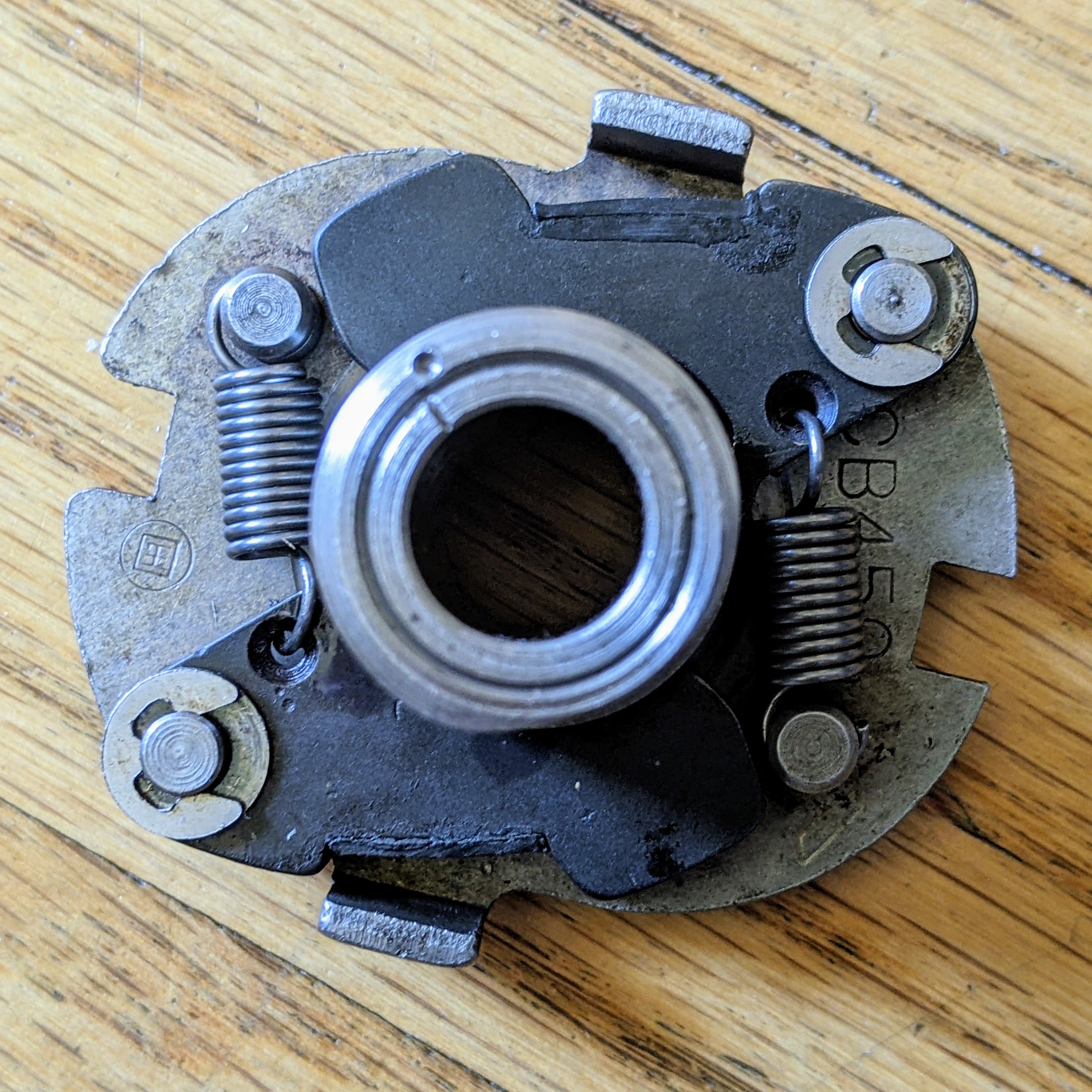
This post summarizes some experiments I have conducted recently with various potential replacement springs for the OEM Kokusan spark advancer of the dohc CB450. The unit I am using for my tests is shown below.
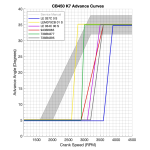
I recorded a video for each experiment in which both a mechanical tachometer and the rotor are visible and then used the video to estimate the engine speed (at the crank) at which the advance curve starts, along with the total advance angle, and the engine speed at the end of the advance curve. The videos will be kept on Youtube for the foreseeable future in case anyone is interested in looking at the raw data. In some cases, I accidentally nudged the adjustable advance angle on my timing gun, so I will point out now that the video may show an offset advance angle, but this is okay because the curve is of interest here, not the actual advance angle. So, in the graphs that will be presented below, the base advance angle will be adjusted to approximately 5° (LF mark) for each curve. Also note that the graphs will be piecewise linear. My goal is to estimate the start of advance, the amount of advance, and the end of advance, rather than the exact curve across the advance range. The tachometer does not provide an accurate measurement of instantaneous engine speed, so the engine speed is increased slowly during each test in order to isolate the starting point of the advance curve as accurately as possible.
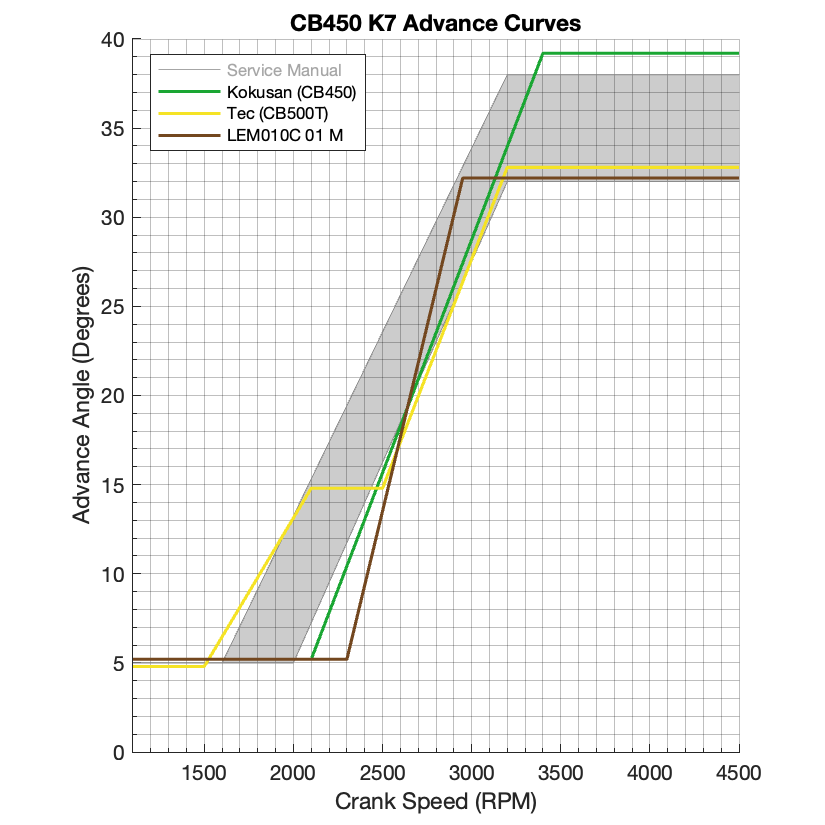
As a point of comparison, I wanted to start with two unmodified OEM spark advancers. One is an NOS Kokusan CB450 spark advancer that was used for the first time in my tests. The other is a used Tec spark advancer purchased on eBay that came from a CB500T. The advance curves are shown below along with the range of advance angles that appears in the factory service manual for the CB450. Each of these units provides an advance curve that is essentially within the desired range, although it is worth noting that the total advance angle must have been reduced for the CB500T as part of its design (fuel efficiency, I guess). The other point of interest with the CB500T curve is that it seems to have two steps. I will embed the video of the NOS Kokusan test and provide a link to the Tec 500T test.

The embedded video for the Kokusan advancer test is below.
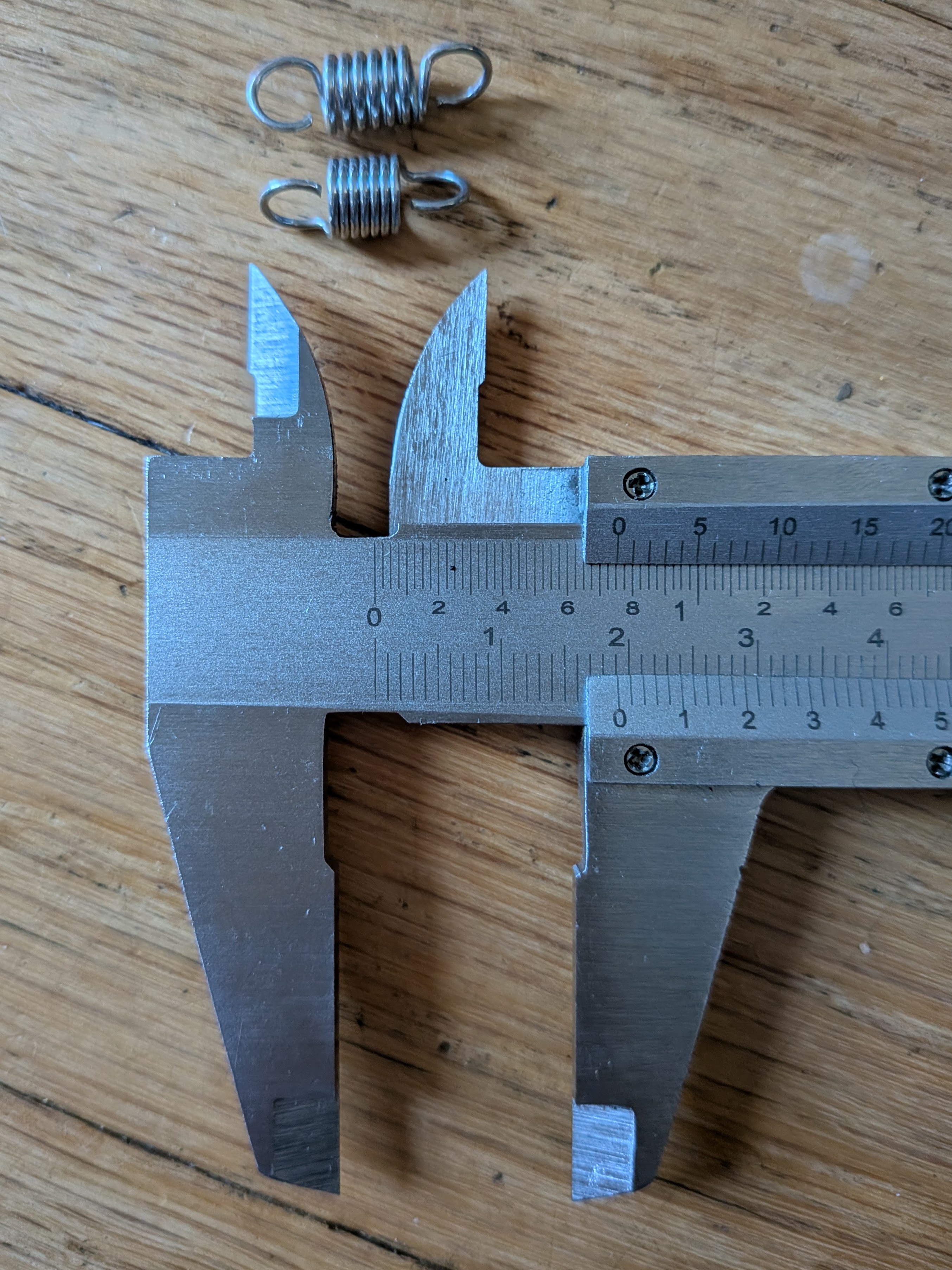
The second part of my testing focused on readily available extension springs that might make suitable replacements when the factory springs are worn out. I have yet to find an off-the-shelf solution, although some of the springs that were tested seem to perform reasonably well, despite the fact that they produce a substantially higher start to the advance curve. I won't try to discuss the specifications of the different springs here, but will provide a list of the different models below. The crucial aspect of the OEM spring design from my point of view is that its initial tension (also called the minimum load) affects the start of the advance curve, while the spring rate (or stiffness) determines the width of the advance interval. The problem I have encountered with the available spring designs has been finding the right combination of these two parameters. The springs with low enough initial tension to begin the advance curve at, say, 2000 RPM have such a low spring rate that the spark advancer goes from base advance to full advance almost instantly, producing a jerky experience for the rider and making low speed maneuvering a bit of a challenge. Springs with a high enough rate to provide a wide advance interval typically have high initial tension, which delays the start of the advance curve beyond the desired range.
The springs used in the tests are listed below along with a link to the corresponding Youtube video.
I have looked over the available options from McMaster-Carr and the Lee Spring Company for designs that might yield an earlier start and a longer advance interval, but I don't see anything suitable among the available options. The Lee Spring Company does make custom springs, so it might be worth looking into that at some point to see if they can produce a spring that will fill this role.
I recorded a video for each experiment in which both a mechanical tachometer and the rotor are visible and then used the video to estimate the engine speed (at the crank) at which the advance curve starts, along with the total advance angle, and the engine speed at the end of the advance curve. The videos will be kept on Youtube for the foreseeable future in case anyone is interested in looking at the raw data. In some cases, I accidentally nudged the adjustable advance angle on my timing gun, so I will point out now that the video may show an offset advance angle, but this is okay because the curve is of interest here, not the actual advance angle. So, in the graphs that will be presented below, the base advance angle will be adjusted to approximately 5° (LF mark) for each curve. Also note that the graphs will be piecewise linear. My goal is to estimate the start of advance, the amount of advance, and the end of advance, rather than the exact curve across the advance range. The tachometer does not provide an accurate measurement of instantaneous engine speed, so the engine speed is increased slowly during each test in order to isolate the starting point of the advance curve as accurately as possible.
As a point of comparison, I wanted to start with two unmodified OEM spark advancers. One is an NOS Kokusan CB450 spark advancer that was used for the first time in my tests. The other is a used Tec spark advancer purchased on eBay that came from a CB500T. The advance curves are shown below along with the range of advance angles that appears in the factory service manual for the CB450. Each of these units provides an advance curve that is essentially within the desired range, although it is worth noting that the total advance angle must have been reduced for the CB500T as part of its design (fuel efficiency, I guess). The other point of interest with the CB500T curve is that it seems to have two steps. I will embed the video of the NOS Kokusan test and provide a link to the Tec 500T test.
The embedded video for the Kokusan advancer test is below.
The second part of my testing focused on readily available extension springs that might make suitable replacements when the factory springs are worn out. I have yet to find an off-the-shelf solution, although some of the springs that were tested seem to perform reasonably well, despite the fact that they produce a substantially higher start to the advance curve. I won't try to discuss the specifications of the different springs here, but will provide a list of the different models below. The crucial aspect of the OEM spring design from my point of view is that its initial tension (also called the minimum load) affects the start of the advance curve, while the spring rate (or stiffness) determines the width of the advance interval. The problem I have encountered with the available spring designs has been finding the right combination of these two parameters. The springs with low enough initial tension to begin the advance curve at, say, 2000 RPM have such a low spring rate that the spark advancer goes from base advance to full advance almost instantly, producing a jerky experience for the rider and making low speed maneuvering a bit of a challenge. Springs with a high enough rate to provide a wide advance interval typically have high initial tension, which delays the start of the advance curve beyond the desired range.
The springs used in the tests are listed below along with a link to the corresponding Youtube video.
- Lee Spring Company: LE 037C 0 S (stainless steel). YouTube
- Lee Spring Company: LEM070CB 01 S (stainless steel). YouTube
- Lee Spring Company: LE 034C 00 S (stainless steel). YouTube
- McMaster-Carr: 9433K665 (stainless steel). YouTube
- McMaster-Carr: 7383N377 (machine wire). YouTube
- McMaster-Carr: 7383N395 (machine wire). YouTube
I have looked over the available options from McMaster-Carr and the Lee Spring Company for designs that might yield an earlier start and a longer advance interval, but I don't see anything suitable among the available options. The Lee Spring Company does make custom springs, so it might be worth looking into that at some point to see if they can produce a spring that will fill this role.
Last edited:


 No shame, it's part of the plan.