CB450 Spark Advancer Springs — Search for Spark

stl360+450

Veteran Member
Joined
Aug 6, 2021
Total Posts
5,162
Total likes
2,693
Location
St. Louis, Missouri, USA
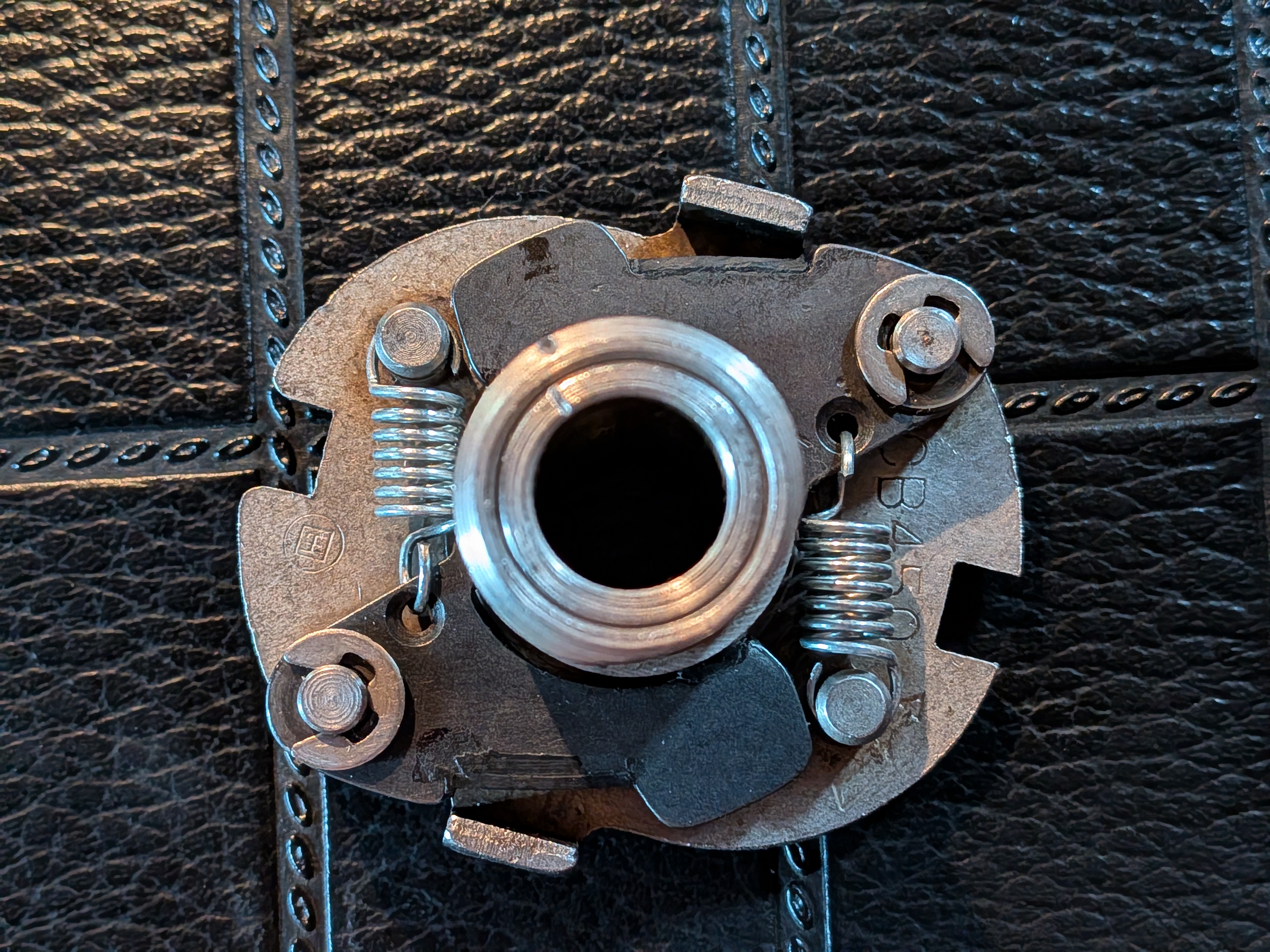
This post summarizes some experiments I have conducted recently with various potential replacement springs for the OEM Kokusan spark advancer of the dohc CB450. The unit I am using for my tests is shown below.
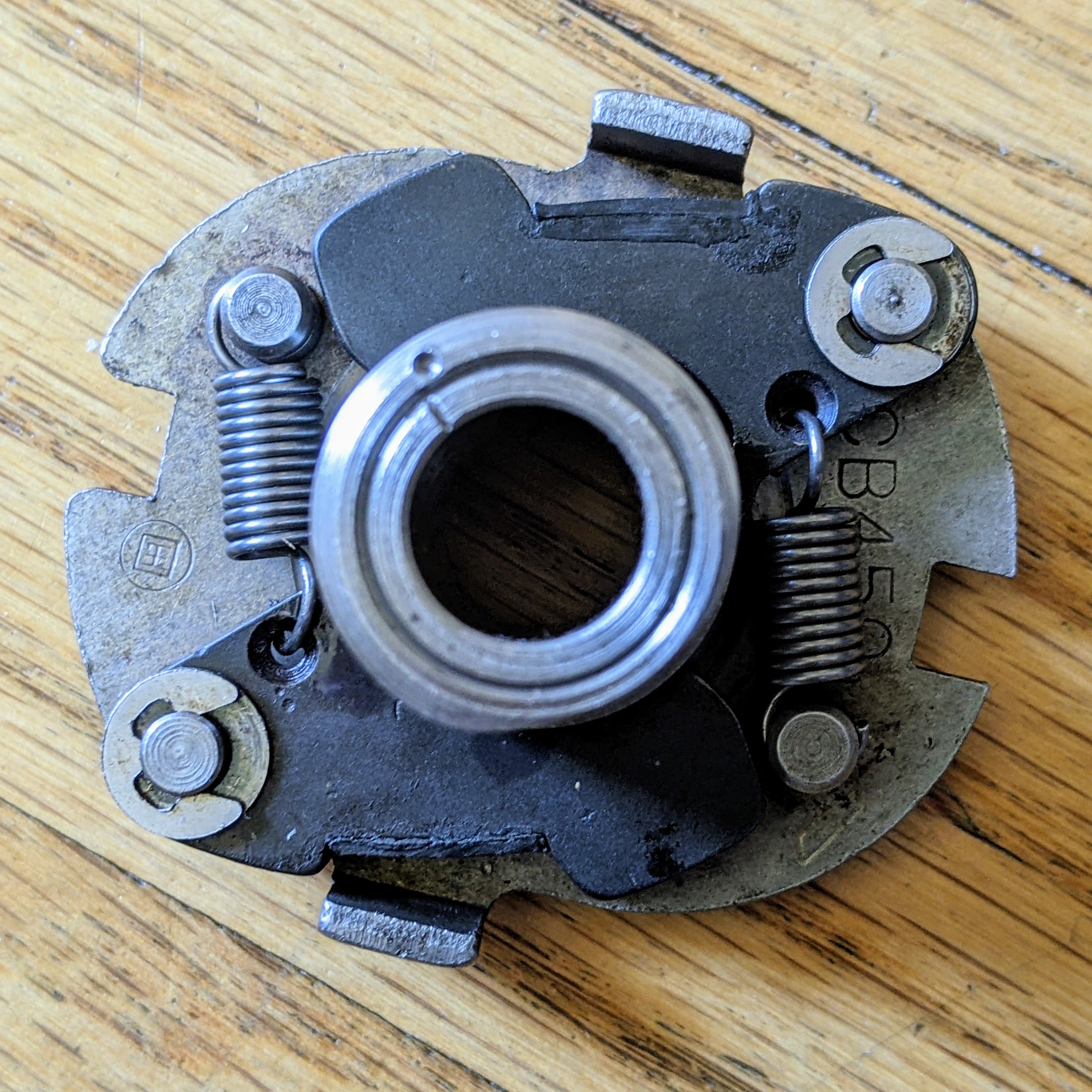
oCgcIr5.jpg


I recorded a video for each experiment in which both a mechanical tachometer and the rotor are visible and then used the video to estimate the engine speed (at the crank) at which the advance curve starts, along with the total advance angle, and the engine speed at the end of the advance curve. The videos will be kept on Youtube for the foreseeable future in case anyone is interested in looking at the raw data. In some cases, I accidentally nudged the adjustable advance angle on my timing gun, so I will point out now that the video may show an offset advance angle, but this is okay because the curve is of interest here, not the actual advance angle. So, in the graphs that will be presented below, the base advance angle will be adjusted to approximately 5° (LF mark) for each curve. Also note that the graphs will be piecewise linear. My goal is to estimate the start of advance, the amount of advance, and the end of advance, rather than the exact curve across the advance range. The tachometer does not provide an accurate measurement of instantaneous engine speed, so the engine speed is increased slowly during each test in order to isolate the starting point of the advance curve as accurately as possible.

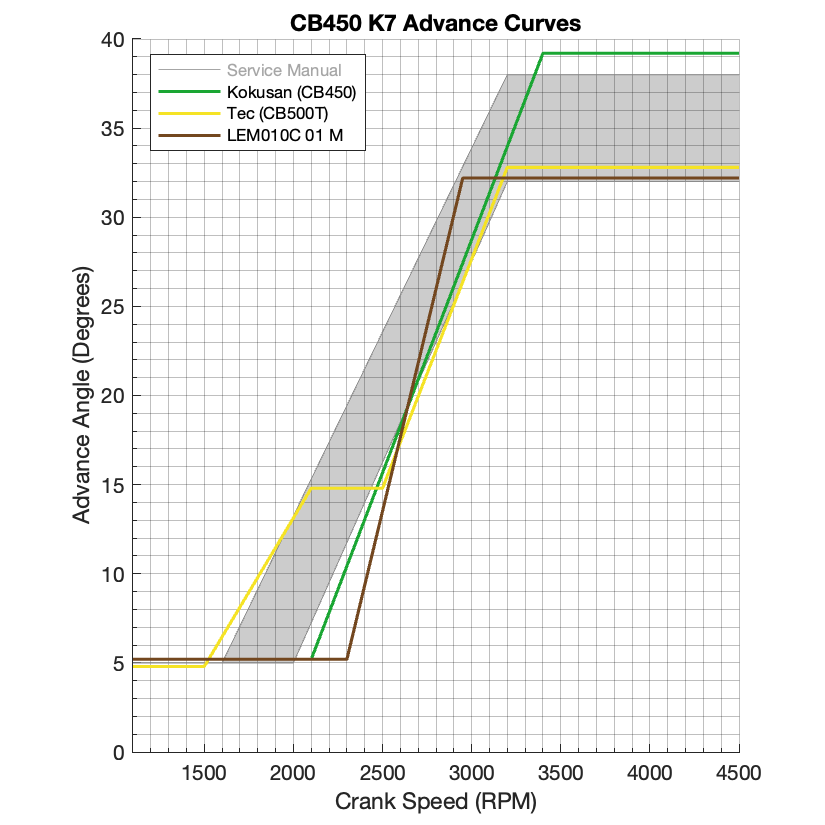
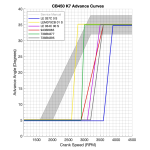
As a point of comparison, I wanted to start with two unmodified OEM spark advancers. One is an NOS Kokusan CB450 spark advancer that was used for the first time in my tests. The other is a used Tec spark advancer purchased on eBay that came from a CB500T. The advance curves are shown below along with the range of advance angles that appears in the factory service manual for the CB450. Each of these units provides an advance curve that is essentially within the desired range, although it is worth noting that the total advance angle must have been reduced for the CB500T as part of its design (fuel efficiency, I guess). The other point of interest with the CB500T curve is that it seems to have two steps. I will embed the video of the NOS Kokusan test and provide a link to the Tec 500T test.

OEMcurves.png

The embedded video for the Kokusan advancer test is below.


The second part of my testing focused on readily available extension springs that might make suitable replacements when the factory springs are worn out. I have yet to find an off-the-shelf solution, although some of the springs that were tested seem to perform reasonably well, despite the fact that they produce a substantially higher start to the advance curve. I won't try to discuss the specifications of the different springs here, but will provide a list of the different models below. The crucial aspect of the OEM spring design from my point of view is that its initial tension (also called the minimum load) affects the start of the advance curve, while the spring rate (or stiffness) determines the width of the advance interval. The problem I have encountered with the available spring designs has been finding the right combination of these two parameters. The springs with low enough initial tension to begin the advance curve at, say, 2000 RPM have such a low spring rate that the spark advancer goes from base advance to full advance almost instantly, producing a jerky experience for the rider and making low speed maneuvering a bit of a challenge. Springs with a high enough rate to provide a wide advance interval typically have high initial tension, which delays the start of the advance curve beyond the desired range.

The springs used in the tests are listed below along with a link to the corresponding Youtube video.
  • Lee Spring Company: LE 037C 0 S (stainless steel). YouTube
  • Lee Spring Company: LEM070CB 01 S (stainless steel). YouTube
  • Lee Spring Company: LE 034C 00 S (stainless steel). YouTube
  • McMaster-Carr: 9433K665 (stainless steel). YouTube
  • McMaster-Carr: 7383N377 (machine wire). YouTube
  • McMaster-Carr: 7383N395 (machine wire). YouTube
The estimated advance curves for these springs are shown below. I have used many of these springs on my work commute over the last several weeks. The steeper curves (yellow and green) feel jerky. The springs corresponding to the purple and red curves feel reasonably good to me and, after finishing all of these tests, I am still using the McMaster-Carr 9433K665 springs (red curve). Yesterday I took the bike on the highway between exits and it also felt good at 60+ mph. I have not made any test rides with the LE 037C 0 S springs or the other two McMaster-Carr springs.

ADVcurves.png

I have looked over the available options from McMaster-Carr and the Lee Spring Company for designs that might yield an earlier start and a longer advance interval, but I don't see anything suitable among the available options. The Lee Spring Company does make custom springs, so it might be worth looking into that at some point to see if they can produce a spring that will fill this role.
 
Last edited:
Nice work Brody, and kudos for the patience to go through all those changes and document the results of each.
I plan to continue looking for other options, but thought it would be good to document what I've done so far. It was satisfying to see that the NOS advancer behaves close to what the FSM indicates.

I'm curious to hear feedback about the curve for the springs I'm using now: 9433K665. They feel okay for normal riding, but I'm guessing Honda choose to have an earlier advance for a reason. The 450 was tuned for peak power output, so hopefully the curve I'm using just reduces the power a bit. I'm not in that transition much at all, so it doesn't seem like it should make a huge difference.
 
Thank you Brody got taking the time to run all these tests and to document the results. Visual works a lot better for me than trying to visualize something from a document. I have added to my watch list.
 
Consider using the LEM(Yellow) spring with the 9433(Red).
That's an interesting idea, Jim, and I will check that out.

I have also been considering increasing the mass of the weights in order to pull down the start of the advance curve for the stronger springs. I need to get some spare parts if I go that route, since it would be hard to undo, but my thought would be to tap the weight for short screw, adding weight via the head.
 
Nice work Brody, it's a lot of work to change out the springs of the advancer and re-time for each iteration. It will be interesting to see the outcome of the yellow and red springs and also increasing the mass of the weights.

If you have extra weights, maybe drill a hole in the weight and fill with lead solder. Multiple holes of varying diameter might be a way to gradually increase the mass.
 
Nice work Brody, it's a lot of work to change out the springs of the advancer and re-time for each iteration. It will be interesting to see the outcome of the yellow and red springs and also increasing the mass of the weights.

If you have extra weights, maybe drill a hole in the weight and fill with lead solder. Multiple holes of varying diameter might be a way to gradually increase the mass.
Thanks! Lead is a good idea, too. I need to determine the mass of the weights to see how much effect this will have. I had already looked up that the lead to steel density ratio is 11.3:7.8, whereas lead to aluminum would be 11.3:2.7, but I haven't even figured out what the weights are made of yet.

I am watching for advancers that are being sold for parts to acquire spare weights.

It has taken weeks of free time to gather data and do some short rides. One spring that is not included here was so tight that I gave up on my ride to work after a few blocks and returned home to swap bikes — it was functioning like a governor. I fouled some plugs this way also. But the advancer bolt has taken the most abuse — bought a new one to use after I'm done testing.

Very nice write up! Thanks!
Thank you!
 
I'm impressed by your commitment to this. It's quite an undertaking. Selfishly I'm crossing my fingers that you are able to come up with something that those of us with a much simpler understanding of these matters can easily plug and play into our own bikes.

Many thanks.
Me too, I admit to unashamedly poaching good ideas where ever I run across them and the advancer springs are an area of concern on my bike so watching this thread with interest,
 
Me too, I admit to unashamedly poaching good ideas where ever I run across them and the advancer springs are an area of concern on my bike so watching this thread with interest,
Thanks, Rob. That's what the forum is all about. One thing is for sure, if you can get an NOS advancer, you will likely be in good shape, but these springs I'm running now feel pretty okay.

I'm looking forward to trying the ideas suggested my Jim and boddy also. I actually just found an advancer on eBay that was parts only. So extra weights are headed my way.
 
Last edited:
One observation about modifying the weights.
  • Reducing the mass of the weights should raise the start point of the advance curve.
  • Adding mass to the weights should lower the start point.
 
Last edited:
A smaller wire diameter, or, additional coils will yield a softer rate . Also interconnected with installed length (L1) with the same information.
Therefore, the red spring curve is the proper rate but the installed load too high.

To calculate: determine the L1 needed by measuring an at rest advancer. The spring data will give a rate, so load is compared to the data you have by the change in length multiplied by the rate.

If the red spring rate (its graphed slope) is good but installed start point to advance is too high, find another spring with the same rate, but is longer in length.

Note Wire diameter as well as coil diameter are profound influencers on finding a proper spring.
 
A smaller wire diameter, or, additional coils will yield a softer rate . Also interconnected with installed length (L1) with the same information.
Therefore, the red spring curve is the proper rate but the installed load too high.

To calculate: determine the L1 needed by measuring an at rest advancer. The spring data will give a rate, so load is compared to the data you have by the change in length multiplied by the rate.

If the red spring rate (its graphed slope) is good but installed start point to advance is too high, find another spring with the same rate, but is longer in length.

Note Wire diameter as well as coil diameter are profound influencers on finding a proper spring.

Thanks for checking in, Jay. Yes, given all of the physical characteristics, one can calculate the spring rate k using the formula below, where G is the shear modulus of the material, d is the wire diameter, D is the coil diameter, and N is the number of active coils. The precise number of active coils can be somewhat tricky, since this number must also account for partial loops and the design of the ends of the spring.
1760757048262.png
It's worth noting that the length of the spring has no effect on the rate, although it does have an effect on the initial tension. The installed length for the advancer I'm working with is in the neighborhood of 20mm. Put a short spring in and it gets stretched, adding to the initial tension that must be overcome to start the advance curve. If the spring is too long, it won't provide any initial tension and the advancer may not return to idle speed. What I've been noticing is that the off-the-shelf springs don't really provide complete freedom of design — there seems to be somewhat fixed relationships between the rate, initial tension, and length that prevent one from having complete flexibility in their design. Some variation, yes, but not full control. Some of the companies do allow customers to design custom springs and this may ultimately be the best way to come up with a good solution for the CB450 advancers, but I noticed that some design configurations are flagged as out of bounds.

There are still some intriguing ideas to play with using off-the-shelf materials, including Jim's idea to pair different springs for an intermediate curve. I also like the idea to add mass to the weights. Because the centrifugal force increases proportionally to the square of the rotation speed, a change in the mass of the weights effects a nonlinear relationship between the start of the advance curve and the average slope of the advance curve that should be advantageous.
 
For off the shelf springs, you won’t be able to engineer an exact replacement unless you get luck that is. For my own work I assumed Honda used music wire, dimensionally matched off the shelf and worked from there.
 
Since you have an original spring you can calculate k by measuring d, D, and N and find G in a table somewhere? Then, can't you make your own spring by winding wire around suitable diameter mandrels to get the k you want by changing D and N? Changing d to get the initial response? I ask this never having made a real 'spring' before but I have made coils by winding wires on mandrels.
 
Since you have an original spring you can calculate k by measuring d, D, and N and find G in a table somewhere? Then, can't you make your own spring by winding wire around suitable diameter mandrels to get the k you want by changing D and N? Changing d to get the initial response? I ask this never having made a real 'spring' before but I have made coils by winding wires on mandrels.
It sounds easy enough, but I don't have any confidence that I could do that by hand with any consistency. My impression is that it would be quite hard to do. I have never tried, though, either.

My first efforts focused on measuring original springs and I based my initial purchases on those measurements. Unfortunately, I haven't found anything close enough to replicate the advance curve precisely.

As I find the time, I will continue the search while exploring other ideas with mixed springs or modified weights.
 
Just for fun I have been looking at automotive advance springs and nothing jumped out until I ran across this where a company makes the springs for the old 60's Honda's, S500, S600 ect and the springs look very much the same as the 450 from the picture but no specs so who knows. I did download the parts manual for the 600 and it didn't show a breakdown of the advance unit but I did notice the carburetors look very familiar.


S600 Springs.jpg
 
Just for fun I have been looking at automotive advance springs and nothing jumped out until I ran across this where a company makes the springs for the old 60's Honda's, S500, S600 ect and the springs look very much the same as the 450 from the picture but no specs so who knows.
That's very interesting, Rob. Thanks. Might be worth a try, although they are a bit pricey and I don't have any prior experience with that company. It would be helpful to know their length, too.

In some ways, a quick solution would spoil my fun, while also solving an annoying problem for anyone in need of springs.
 
They may have the specs/dimensions on the springs if you email them and let them know what you need them for. I saw them and wondered if Honda reinvented the wheel for the automotive division or they shared some common parts. I was trying to find a PDF of a service manual to compare the advance curves but no luck in a quick search.
 
I've had a lot of time to think about advancer springs since my first round of experiments in October 2025 and I kept coming back to the fact that off-the-shelf springs did not seem to have a suitable combination of free length, spring rate, and initial tension. A custom spring order would be costly due to minimum order amounts and the risk of a large number of revisions. This led me to the idea of making springs and then to the idea of relieving the initial tension on existing springs by plastic deformation (over-stretching). The spring rate of an extension spring is given by
1781373868507.png,​
which, notably, does not include the length. Jay pointed this out in an earlier post. Over-stretching, then, can relieve some/all of the initial tension and, if not overdone, will hopefully preserve the original spring rate reasonably well. My measurements of OEM springs yield a wire diameter of approximately 0.8mm, a coil diameter of approximately 5mm, and about 10 active coils which produces a spring rate in the vicinity of 3.7 N/mm, assuming a shear modulus of 80 GPa for music wire (ASTM A228). The rest length of the springs on the CB450 advancer is about 20mm, so the over-stretched length should ideally be just a little smaller, say 19mm, to make sure the advancer returns to its rest position at idle. This eliminates some of the springs I considered previously because, with a free length of 19mm, they would likely be too long after the initial tension was relieved.

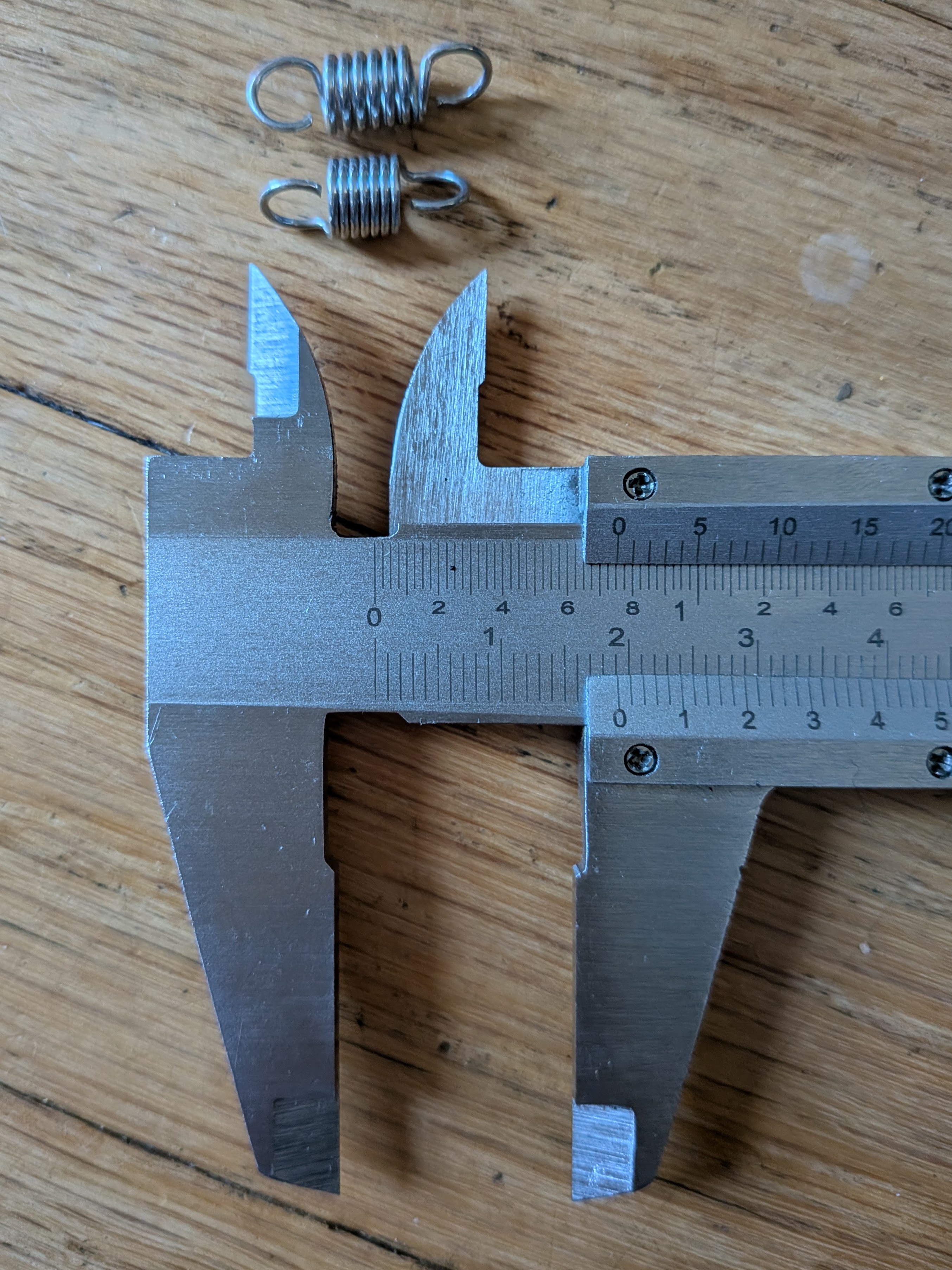
The test I will report on below uses LEM080C 01 M springs from the Lee Spring Company, which have an advertised rate of 3.842 N/mm and a free length of 15.49mm. I stretched them by hand (carefully!) and kept checking the free length until it was just over 19mm. I then installed them on one of my spare advancers. They felt good and would snap back appropriately when I twisted the points cam. Probably they should be baked to relieve the internal stress from the stretching process, but, for this test, I proceeded without baking the springs. The next picture shows an unmodified spring along with a stretched spring.

JPEI4EP.jpg


And now the spark advancer with the modified springs — it looks like they are under more tension than they really are. In fact, they would be under significant tension had the springs not been over-stretched.

JTrZeLA.jpg


The [rough] advance curve based on the start and end of the advance range is shown below in comparison to my previous tests on OEM units and the target range shown in the factory service manual.

LiT8yeU.png


Finally, I will embed the Youtube video with my test data. Near the beginning of the video I also recorded the off-idle response with these springs. At the very end of the video the engine nearly stalls after the advancer test. I noticed that the static timing was slightly retarded, so I attribute the near stall to that and will advance the timing slightly to correct. I plan to test these out on the road over the next week or so.

 
Last edited:
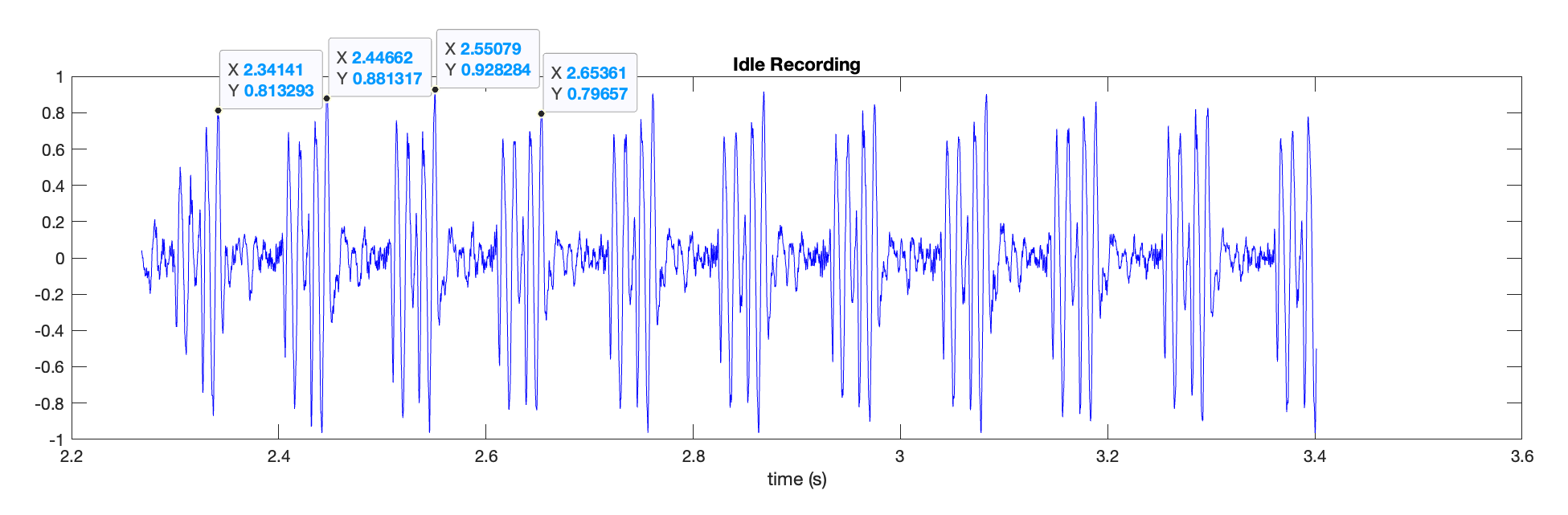
I took the bike out around my residential city neighborhood this morning in advance of some expected storms. I will share a cellphone recording of the motor here. There is substantial wind noise due to the phone hanging out in an open pocket of my riding jacket.
 
I took the bike out around my residential city neighborhood this morning in advance of some expected storms. I will share a cellphone recording of the motor here. There is substantial wind noise due to the phone hanging out in an open pocket of my riding jacket.
Is it actually the wind that seems to make it sound like it's missing occasionally during each acceleration?
 
I think that's just how the wind noise affects the overall recording, including the motor sounds.
If so, it certainly is deceiving. My GoPro in an open-backside mount on my helmet has wind noise but it doesn't ever cause the engine to sound like that. I'd suspect you could feel it too, if it really was missing... but it definitely sounds odd.
 
Sounds like it is skipping at different points to me as well but you would definitely feel it if it was missing as much as it sounded so must just be sound quality.

FWIW on my 450 wearing a full face helmet I tilt my head a bit either way to listen to the individual exhaust notes to listen for any problems. I would also like to get my son in law to ride it up and down the road a few times so I could hear how it sounds off the bike.
 
My runways aren't too big in the neighborhood, but here is an isolated clip of acceleration from stop up to about 45mph. It sounds pretty nice to me with my headphones on (stereo!).
 
Thanks for taking a listen. I put the phone in a backpack and had a sock over it for the second recording. To get really clean audio I think it needs to be held in a fixed position rather than hanging out loose on a pocket or backpack.
It definitely sounded muffled but free of wind noise.
 
Interesting information, glad it's being updated or I would have missed it again.
I was considering making springs from music wire but knowing alternatives are available is much much easier than winding springs.
Thanks, PJ. I'm actually working on winding springs, too, but am only in the initial stages of that particular undertaking. I'll embed a video of the first halfway decent extension spring that I made. I was not worrying about the number of turns for this one and I'm still learning how to do good hooks.

 
Back
Top Bottom