A meticulous restoration of a CB72 '67 (and a SS50Z K3)

The LED lamp has a diameter of 18 mm, round, and I could use an O-ring to clamp it in position. I experimented with the LED lamp and reflector, it seems that that the projected light image on a wall, 3 meters away is good, as long the position of the LED-lamp is perfect. For both reflectors (aftermarket and NOS) this point seems to be more or less the same, and I suggest that the aftermarket is a good copy of the original. If I design it in a way that I can move the LED-lamp a little in and out, it would make it possible to adjust the position of the LED in a way that the projected light image can be adapted to the specific reflector, so I can have a maximum light output from whatever headlight unit I decide to use.
I'm also glad that I bought the 2700 K variant, the light colour is the same as a normal light bulb, which is so characteristic for bikes from this era. I hope that the LED bulb fit's my CB400F, because the space in that headlight shell is limited, and less deep then the shell in the CB72 and C77 dream housing.

Since I'm also starting to do some preparatory work on the C77 dream, would it be a good idea to start another thread ?
 
Last edited:
I measured the distance of the original filament and the depth of the reflector to position my modified H4 socket in an old sealed beam on the Dream. It does affect the focus. The US version sealed beams had a deeper, and better true parabolic shape to the reflectors. They also took up what little room there was in the Dream nacelle. My LED bulb has no heat sink or fan, only the blade connectors and it barely fit.
A separate Dream thread would be great. I've been anxiously anticipating it for a while.
 
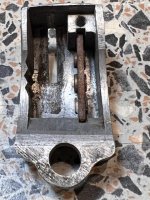
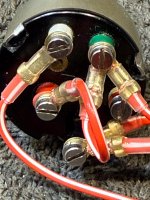
While I were at it, I just kept on going and serviced all CB72 and CB450 K0 handlebar switches.

Afbeelding van WhatsApp op 2025-11-16 om 21.58.43_fd97606d (Klein).jpg

Afbeelding van WhatsApp op 2025-11-16 om 21.58.43_61376737 (Klein).jpg

Afbeelding van WhatsApp op 2025-11-16 om 21.58.43_94d3e97a (Klein).jpg

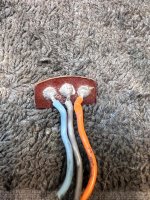
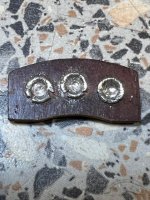
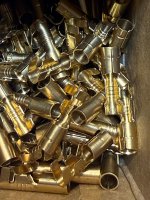
The same style contacts but much smaller. This is the special winker switch of the early CB72. Compare with the standard contacts:

Afbeelding van WhatsApp op 2025-11-16 om 22.01.39_17bf1721 (Klein).jpg

Afbeelding van WhatsApp op 2025-11-16 om 22.01.39_eb0e1cb0 (Klein).jpg

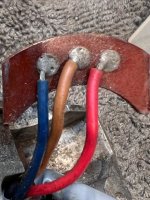
I'm 99% sure that these wires were soldered by Honda, and I copied the angle in x, y plane and the angle in the z-plane. The reason Honda choose these angles are obvious, this way the wires will fit ease;y into the housing.

I did cut the wires of all contacts, heated up the old solder, and removed the wires. Then cleaning the area's, taking out the old solder, clean it again, put new solder in the contact area, and connect the correct wires.

Afbeelding van WhatsApp op 2025-11-16 om 21.58.42_6427789c (Klein).jpg

Afbeelding van WhatsApp op 2025-11-16 om 21.58.43_58f2dbf3 (Klein).jpg

And after an hour or three, all contacts are cleaned, and lubricated with dielectric grease for protection against oxidation. Meanwhile the housings are soaking in de-greaser, and when clean, I have to assemble all switches.

Afbeelding van WhatsApp op 2025-11-16 om 21.58.43_4458f464 (Klein).jpg

Next is to replace the wires with heat resistant wires of the generator. As I mentioned in a few posts earlier, I will extend the generator wires to make it possible to connect directly onto the rectifier, using just one connection per wire instead of two.
 
Last edited:
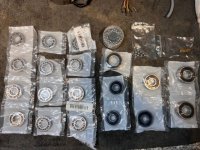
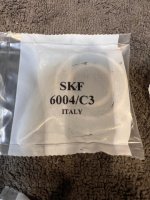
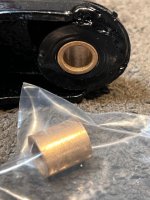
Today my ordered bearings came in, I ordered 3 sets of camshaft bearings (12 in total, need to re-build 3 heads), all wheel bearings for the CB72 and the C78, 1/4 inch balls (180 pcs, steering head bearings), 10 balls for the CB450 clutches and two bronze bushings for the left side main stand bolt for my CB72 '66, and one for the CB72'61 1/2. I am always surprised how cheap these parts are, the 6004 C3 bearings were 2,25 euro each, all the wheel bearings no more then 4 euro each, 180 1/4 inch balls for 4 euro, and the bronze bushings for the dazzling price of 2,75 euro each.

Afbeelding van WhatsApp op 2025-11-18 om 22.34.30_f7ebfb85 (Klein).jpg

Afbeelding van WhatsApp op 2025-11-18 om 22.34.30_eb867088 (Klein).jpg

Afbeelding van WhatsApp op 2025-11-18 om 22.34.30_32a2a64d (Klein).jpg

The bronze bushings are standard sizes, in this case 14 mm OD, 10 mm ID, and 16 mm width, I use only one busing per bike. Due the the sidestand the centre stand bolt is longer. I replace the original bolts with stainless steel bolts (A4), nuts and rings. This area is almost unprotected for water and dirt, so stainless steel is a nice functional replacement.

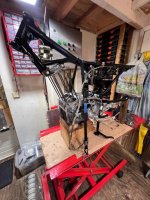
After mounting the main stand and spring I turned the frame 180 degrees (on the bridge), and put the bike on the main stand. This way I can start re-work the wiring harness after I installed the steering stem, T-piece and headlight case (temporally).

Afbeelding van WhatsApp op 2025-11-18 om 22.34.30_e31abf39 (Klein).jpg
 
Last edited:
Finished the wiring plan, and I don't have to add extra wires to the main harness. The generator get's it's own wire harness, connecting directly to the voltage regulator with just one connector. Now I can use the pink and yellow wire for other functions. The yellow wire will become the front break switch connection, and since the yellow wire is also going to the generator area, the rear brak switch can be wired to it as well. The pink wire will be used for the control voltage to feed the relay's and the proximity switch for the side stand. The wiring to the starter, winkers, horn and neutral switch stay the original colours.

This way I can keep the main wire harness in one piece, just repairing a few small issue's and replace the sleeve at the front, and read rear part, but have all the functionality as mentioned a few posts ago.

After implementation I will add the complete wiring harness in the thread, including pictures how it connects to relay's and switches. Meanwhile I'm also busy with the dream wiring, trying to add the same functionality as on the CB72 with winkers. However, the main switch works different, so not a one to one copy. But, on the other hand, the 6-position C78 dream key switch has almost the same logic as the (Dutch / German only) 5-position key switch of the to build Dutch CB450 K0 with winkers.
 
Last edited:
Plans are materialised, drawings are made, everything checked, so now the fun par starts, the actual build up off the wire harness for real. Like mentioned earlier, no need to add extra wires, so no need to take the harness apart. Just repairing what is damaged an doing some measurements to see if everything is in good shape.


Afbeelding van WhatsApp op 2025-11-21 om 21.23.56_c03bd0c6 (Klein).jpg

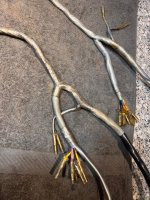
To part of the harness that goes to the headlight shell, was hardened and broken on several places, so the first thing I did was to remove that part and replace it by a new sleeve.

Afbeelding van WhatsApp op 2025-11-21 om 21.23.56_4ceeeaf4 (Klein).jpg

It was a bit of a challenge, but I managed to get all wires through the sleeve, and I was able to insert the wires of the horn through the sleeve instead of using tape.

Afbeelding van WhatsApp op 2025-11-21 om 21.23.57_e2845958 (Klein).jpg

Unfortunately, I can't get silver tape and sleeve for a reasonable price, so grey it is.
 
Last edited:
It was a bit of a challenge, but I managed to get all wires through the sleeve, and I was able to insert the wires of the horn through the sleeve instead of using tape.
Couldn't have been much room to pull all of those female connectors through the sleeve. Did you tie individual threads to each wire to pull them through one at a time?
 
Couldn't have been much room to pull all of those female connectors through the sleeve. Did you tie individual threads to each wire to pull them through one at a time?

The ones with a connector were easily pushed through, one by one, starting with the wires with the largest connectors (green and black), the ones without a connector were soldered together with a pull wire, and pulled through. The wires for the horn, however, were a bit puzzling, but I managed. Unfortunately there wasn't enough old tape to reach the sleeve. I tried to use a longer sleeve, to reach the taped area, but that was a mission impossible :ROFLMAO:
 
Last edited:
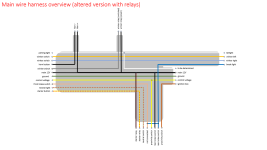
Below a drawing of the main wire harness of a CB72 with winkers. The drawing is an exact copy (if you see any mistakes, please respond, and I will change it if correct) of how the harness is wired, and especially for the VHT-forum, I used the correct wire colours. The names of the connections are for the altered version only, in the standard bike the function is different! If someone want a diagram with the correct, standard functionality (please ask, and I will add it). The only change I had to make is drawn outside the sleeved area (grey), and that's the connection between the pink and blue wire. Like mentioned earlier, the generator has it's own wire harness, direct from generator to the regulator, with just one connector. This is the reason why I can wire the control voltage and front break switch within the existing harness. There is only one wire without a real function, and that's the green wire. In the standard bike, the green wire is used for the headlight voltage, I use it as a ground (the standard harness doesn't have a ground wire, the frame itself functions as a ground "wire". There is another wire, which is partly not used and that's the white wire, maybe I'll find a use for that one, maybe not.

It's clear to see that the black wire (main 12V power) is thicker then the other wires, just as in the real wire harness. In the headlight the black wire has a white ferrule. the other black wire, without ferrule is the horn button wire (which is also thinner).

wire harnes.png
 
Last edited:
There is only one wire without a real function, and that's the green wire. In the standard bike, the green wire is used for the headlight voltage, I use it as a ground (the standard harness doesn't have a ground wire, the frame itself functions as a ground "wire".
Do you plan to use the green wire to ground certain parts of the frame or will you connect individual components to the green wire.
 
Do you plan to use the green wire to ground certain parts of the frame or will you connect individual components to the green wire.
I'll use the green wire to connect the headlight shell, steering tube and thus the handlebar switches directly to the battery ground. Same with the rear mudguard and taillight section.
 
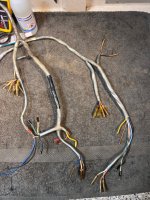
For comparison between the wire harnesses I dove in the box of spares, and found a nice used '(Dutch) CB72'62 harness, and a used (American) CB72'66 harness.

Afbeelding van WhatsApp op 2025-11-23 om 10.16.47_f9ab9fdd (Gemiddeld).jpg

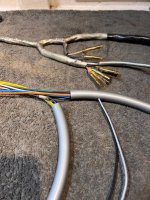
Interesting detail is the difference in the wiring for the brake switch. In the '62 harness the extension is part of the harness itself, including the correct sleeve. I don't know it this is done by a PO, but the quality and how it's done reads Honda all over.

Afbeelding van WhatsApp op 2025-11-23 om 10.16.49_a5437b6b (Gemiddeld).jpg

Yesterday evening I couldn't force myself to change the connectors of my restored wire harness, that's why I was looking into the spares, to, hopefully find a harness in worse shape, but all I could find where complete harnesses in relative good shape. It feels like destroying good parts, so I decided to make another one from scratch for my CB72'66. It seems to be much work, but in-all, I can make it as I like, without destroying an authentic and complete, very hard to get, original CB72 wire harness.

I have all the wire colours, connectors and sleeves, so that shouldn't take too much time and effort.

Afbeelding van WhatsApp op 2025-11-23 om 10.16.49_4c60fc69 (Gemiddeld).jpg

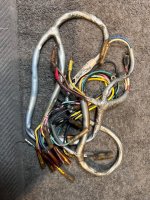
The (only) US harness is in bad condition, it's partly over-sprayed with black paint, there are some traces of short circuited area's and the shielding is hard as rock. The connector covers are hardened as well, so all connectors are toast. But this harness lacks the winker wires, so either I have to open up the whole harness and add the winker wires, (I don't want to do that) or keep it as a spare for what-ever occasion (but has to be restored as well). This harness is from California, so the sun and heat are the reason for the quality. Apart from the hardened parts, this harness is uncut, every connector is there, the shielding is broken, but complete, and the tape is still in good shape too.

I'll try to scratch the paint of the wires, fix the short cut area, and refurbish the connectors by cutting off the plastic sleeves from the connectors and replace with new sleeves. If a connector is beyond repair, I will replace it as well.

Well, the overall speed in the project seems to slow down, but in the mean time I prepare the parts for the engine rebuild and add some hardware to the frame as well.
 
Last edited:
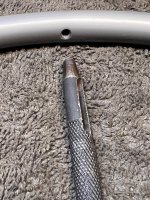
Those plastic sleeves on the connectors are hard to remove as they are fused into the wire - a delicate process to remove and replace without damaging the insulation.
 
Those plastic sleeves on the connectors are hard to remove as they are fused into the wire - a delicate process to remove and replace without damaging the insulation.

Yes, indeed, it takes some patience, heat and a sharp knife. The ones that are damaged should be replaced anyway, I'll see how far I can get...
 
I don't think it's interesting for others following my struggling with the changes and slow progress in the process. I'll go further with the build as soon as the wiring is finished.
 
I don't think it's interesting for others following my struggling with the changes and slow progress in the process. I'll go further with the build as soon as the wiring is finished.
It may be tedious but few attempt to actually re-create a harness. There is much skill involved to be learned, so it is interesting.
 
Building-up, or assembly from a drawing is a straight forward job. If the drawing is made, 80% of the work is done. The next step was getting the parts I needed for the wire harness. One of the advantages of working at a machine builder is having acces to suppliers that normally don't advertise on the net. One of our wire suppliers was so kindly to accept a private order, so I ordered all the wire colours I needed.

One of the most difficult things in making a wire harness is finding the correct parts, wire-colors, sleeving and tape. The next difficult thing is making the internal connections. These connections should be reliable, preferably not soldered, small in extra diameter, flexible and not sensitive for moisture.

Over the years I tried a few methodes, and the one that tick all the above boxes is crimping.

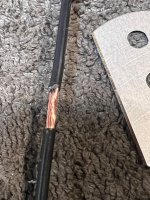
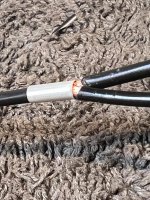
The first step is to cut away the isolation over a length of 1,5 cm / 1/2 inch on the main wire, in this case the main power wire (which is black for the Honda CB72). I do this carefully with a razor blade, trying not to cut any copper wires.

Afbeelding van WhatsApp op 2025-12-02 om 08.48.21_d008b328 (Gemiddeld).jpg


Afbeelding van WhatsApp op 2025-12-02 om 08.48.20_51b367f0 (Gemiddeld).jpg


Afbeelding van WhatsApp op 2025-12-02 om 08.48.20_b81fc7f1 (Gemiddeld).jpg

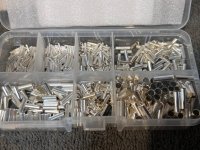
I use aluminium crimp ferrules to crimp both wires together, these are available at every "do it yourself" shop. I slide the ferrule over the wire behind the cut, with the seamed side toward the cut-away.

Afbeelding van WhatsApp op 2025-12-02 om 08.48.20_7e351db1 (Gemiddeld).jpg

Then I slide the second wire into the ferrule

Afbeelding van WhatsApp op 2025-12-02 om 08.48.21_91cb6c2f (Gemiddeld).jpg

This way the wires interconnect with each-other. Next step is to crimp the ferrule with a special crimp tool (these tools can be very expensive when for professional use, but good, cheap copy's can be found anywhere on the net).

Afbeelding van WhatsApp op 2025-12-02 om 08.48.21_d4971df8 (Gemiddeld).jpg

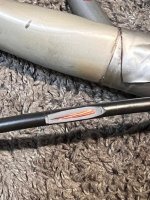
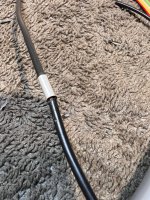
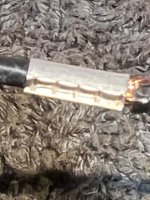
After crimping I cover the area with a transparant heat shrink tubing with adhesive. After heating the tubing covers the open area and te glue keeps everything together and makes is moisture resistant.

Afbeelding van WhatsApp op 2025-12-02 om 08.48.21_78430aff (Gemiddeld).jpg

Afbeelding van WhatsApp op 2025-12-02 om 08.48.21_6e780ad7 (Gemiddeld).jpg

At the CB72 harness there are 3 of those connections on the black wire, it is mandatory to do this in a logical order, beginning from the headlight side and working your way to the back.

Afbeelding van WhatsApp op 2025-12-02 om 08.48.22_21379c6b (Gemiddeld).jpg

And when finished, the wire harness is ready for taping.

Afbeelding van WhatsApp op 2025-12-02 om 08.48.22_e80b858b (Gemiddeld).jpg


Afbeelding van WhatsApp op 2025-12-02 om 08.48.20_e8d400f5 (Gemiddeld).jpg

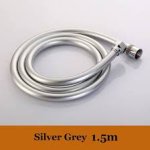
btw, after looking around, and thinking out of the box, I found the correct colour sleeve, without paying an arm and a leg. This tubing is less then 1 euro per meter, and is used for plumbing (water). It's a little thicker then the original sleeve, but very flexible.

The total costs of all the parts I used for one wire harness is less then 30 euro's, including all the connectors. The relays where 2,50 euro a piece (average), so another 15 euro's, makes a total of 45 euro's. The tools are costly, but I happened to have them in my possession (crimp tools, cutting tools, soldering station, etc). On top of that I spend 12 to 16 hours (designing, searching for parts, making drawings assembling, etc).

I total I spend 110 euro's on materials, but I have enough for at least 5 complete wire harnesses in the future.
 
Last edited:
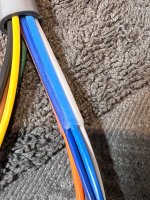
Looks very clean, neat and strong. Did Honda solder or crimp their three way wires?

Getting the exact length of wires is challenging if working from an old curly stiff original.
 
Looks very clean, neat and strong. Did Honda solder or crimp their three way wires?

Getting the exact length of wires is challenging if working from an old curly stiff original.

Honda did more or less the same thing, exept they didn't crimp, but "flossed" the connecting wire around the main wire, and used tape to cover it. This leads to increase in diameter, which I don't like.

For this bike I'm gonna use the new wires, but my CB72 '62 will stay original, and the wire harness is repaired with old wires and connectors. It won't be a rider, so no need to do that extra mile. The wire harness for my European the CB450 K0 will have the original wires also, not a rider either. The new wires will be used for the CB450 K1's and CB450 K2.
 
Nice write up, thanks for the detailed steps and photos. I can see using the ferrules to also do repairs when you need to only replace a section of wire, it would keep the diameter of the repaired area small.
 
Today, I managed to complete the harness (except for the tape, still waiting to get it delivered). With the heat shrink tube I bundle some wires to keep everything nice and taut. Like earlier mentioned, the heat shrink has adhesive, and when heated to a certain temperature, this tube, glue and wire melt together.

Afbeelding van WhatsApp op 2025-12-02 om 22.15.12_1be54cc6 (Gemiddeld).jpg

This is the bundle that goes to the rear mudguard, it has the white wire (taillight), dark blue wire (break light), the orange wire (winker left), the light blue wire (winker right), and an additional green wire (ground). This green wire is included in the original wiring harness, but I added this wire as an solid ground for the rear mudguard. This wire has the largest Guage of all the wires I use and connects the headlight shell, headlight, speedo and steering tube with the ignition brackets, engine bolt, frame, battery ground and the rear mudguard.

Afbeelding van WhatsApp op 2025-12-02 om 22.15.12_36455582 (Gemiddeld).jpg

This is the bundle that goes to the engine generator, rear brake switch, neutral switch, starter relay and side stand switch.

Afbeelding van WhatsApp op 2025-12-02 om 22.15.13_41be8bc9 (Gemiddeld).jpg

The end result of the wiring harness without the tape. I already taped the mid-section to keep the bundle compact. The wires from the generator to the voltage regulator will be a direct connection, and outside this wire harness, same for the ignition wires.

Afbeelding van WhatsApp op 2025-12-02 om 22.15.13_33597819 (Gemiddeld).jpg

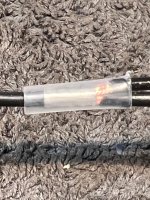
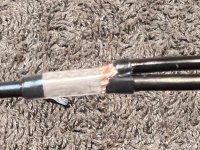
A close up of the "fused" wires with the heat shrink tube. These wires are for the horn, both are black, one comes from the main voltage (black), the other one goes to the horn switch (black). The button itself switches to ground. In the 60's, Honda switched almost everything to ground with the switches, that's why it's so important to have a ground wire that connects all main parts of the bike, since you cannot rely on the connection with bolts on painted area's or corroded bolts.

Afbeelding van WhatsApp op 2025-12-02 om 22.15.13_ecc98004 (Gemiddeld).jpg

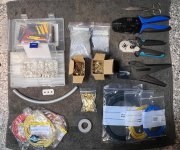
Here an overview of all the things I need for building / assemble / repair a wire harness. From left to right and from top to bottom:

- A bag of coloured heat shrink tubes, a box of wire ferrules, and a box of transparant heat shrink tubes in different sizes.
- Bullet connectors, tubes for both types (male / female), and double bullet connectors.
- Pair of scissors, crimping pliers for the bullet connectors, crimping pliers for wire ferrules and stripping pliers for wires.
- Red, yellow and brown heat resistant wire (for replacing the generator wires), tape, and "normal" wires in different Gauges (2 square mm, 1,5 square mm and 1 square mm, equivalent with 14 AWG, 15 AWG, and 17 AWG) in all kind of colours.

The heat resistant wire type is Olflex from LAPP, a German company who makes all kinds of special wires. It can withstand 180 deg Celsius (356 F). it's silicon based, and can withstand oil, grease and many other chemicals. It goes without saying that this wire is the most expensive wire I had to buy, it's 3 euros per meter. (the Guage is 15 AWG).

I always replace the generator wires with these type of wires, also for the CB72 and the dream.
 
Last edited:
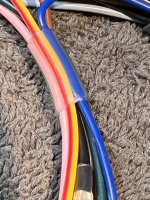
I found the correct colour sleeve, without paying an arm and a leg. This tubing is less then 1 euro per meter, and is used for plumbing (water). It's a little thicker then the original sleeve, but very flexible.
That would be the grey outer sleeve ? I wondered if something like that could be found in a UK plumbing supplies outlet ?
 
That would be the grey outer sleeve ? I wondered if something like that could be found in a UK plumbing supplies outlet ?

Silver grey, not grey. Grey you will find everywhere, it's the silver grey that is difficult to find. It took me a while to find the correct colour code but for your information, it is RAL 7001 and I have no idea if you can get it in the UK.

The first lead was this add at Amazon:

Naamloos.jpg

The picture shows, what could be the correct colour, but seemed a little too shiny, and only one diameter, so I tracked down the supplier, which is a Hungarian company. I called the company to ask them were they bought that stuff, it was somewhere in China, so dead end. But china is Temu, and Ali, so I did a thorough picture search through their websites, and found other pictures which were showing that silver grey was the correct colour, being RAL 7001.

With that information I did do an extended search on RAL 7001, tube and some other keywords, and found a Dutch supplier. I called the supplier, but they only did B to B, however, they wanted to make an exception for me, and I could pick it up after giving them a six-pack of our finest beer, given that I got 3 meters of every diameter, so 12 meters in total, the price per meter was less that 1 euro per meter.

A long story short, it took me few hours to learn that it has a RAL colour, and with that code, I could do a precise search. I got a box with different diameters. Every 50 cm of the tube is printed, but I can work around it.
 
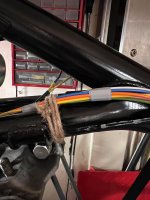
Yesterday I routed the harness in the frame to see if everything is fitting at the correct positions.

Afbeelding van WhatsApp op 2025-12-04 om 17.09.06_17019a3e.jpg

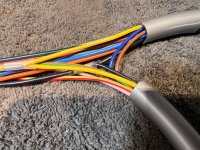
This is the big "split" between two sleeves, one goes down the frame tube, the other one goes to the ignition switch, mudguard and battery.

Afbeelding van WhatsApp op 2025-12-04 om 17.09.06_706d5fa8.jpg

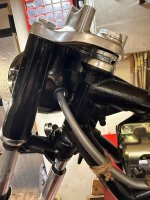
The main wires to the headlight are routed different than Honda intended. Just like the later bikes, I want the harness vertically going up from the bottom of the stem to the headlight shell. The bending of the harness (old route), will now be torsion around it's vertical axis. This is way better for the critical area between frame and front fork. The only issue is that the wires are longer, needing more wire, more sleeve length. But when you make your own harness, one can add whatever length.
 
Last edited:
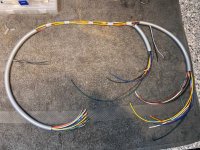
And after preparing the bikes for winter, I had some time left to work on the CB72. All in all, a productive weekend.

Afbeelding van WhatsApp op 2025-12-14 om 17.27.00_39f24227.jpg


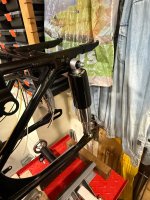
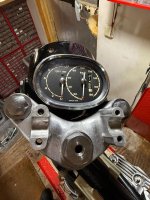
Put the rear shocks in place (the rubbers will be mounted later), mounted the steering stem (T-piece), added the fork ears, headlight shell and speedo. This will all be temporary, but needed for finishing the wire harness.

Afbeelding van WhatsApp op 2025-12-14 om 17.26.59_9aeca8ab.jpg


Afbeelding van WhatsApp op 2025-12-14 om 17.26.59_aba20a31.jpg

31455 km, roughly 20.000 mls from new. I hope I will add at least the same amount, but I guess that won't be the case.


Afbeelding van WhatsApp op 2025-12-14 om 17.27.00_9e2c7aa8.jpg
 
Is the tach/speedo interchangeable with the CB450K0? It doesn't have the neutral and high beam indicators but...
 
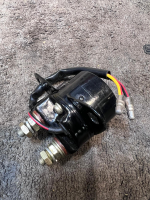
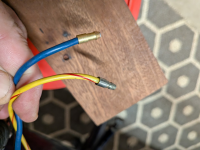
Jensen, given your excellent attention to detail on the electrics, I wonder what you might have learned about the older-style soldererd bullet connectors (as shown in your picture of the starter solenoid below)?

I confess that when repairing some connectors on my CA95 a few years ago I simply fitted the new 3.9mm crimp connectors and hoped for the best. However, now I look closer I see they are not really compatible (although the newer male bullet ends are roughly the same size as the originals, they do not 'click' together with the original female end).


1765899701484.png


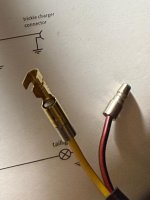
I have not been able to find out anything about the earlier connectors, but they appeared to be similar to the Lucas connectors used on old British motorcycles. Out of curiosity, I got a set of these and - having learned how to fit them - I belated realised they did not fit: both ends of the Lucas connectors are 4.7mm but the Japanese version is 4.7mm at the wire end and narrows to 4mm at the tip.

Lucas style (top) vs Japanese (bottom)

1765899976904.png

Have you (or anyone else!) ever come across replacements for the Japanese connectors?
 
Jensen, given your excellent attention to detail on the electrics, I wonder what you might have learned about the older-style soldererd bullet connectors (as shown in your picture of the starter solenoid below)?

I confess that when repairing some connectors on my CA95 a few years ago I simply fitted the new 3.9mm crimp connectors and hoped for the best. However, now I look closer I see they are not really compatible (although the newer male bullet ends are roughly the same size as the originals, they do not 'click' together with the original female end).


View attachment 53581


I have not been able to find out anything about the earlier connectors, but they appeared to be similar to the Lucas connectors used on old British motorcycles. Out of curiosity, I got a set of these and - having learned how to fit them - I belated realised they did not fit: both ends of the Lucas connectors are 4.7mm but the Japanese version is 4.7mm at the wire end and narrows to 4mm at the tip.

Lucas style (top) vs Japanese (bottom)

View attachment 53582

Have you (or anyone else!) ever come across replacements for the Japanese connectors?
Yes, I use the 3.9 mm bullets for those connectors. Here a few pictures of how these fit onto my starter relays connectors:

Afbeelding van WhatsApp op 2025-12-16 om 23.11.08_24da9e32.jpg

Afbeelding van WhatsApp op 2025-12-16 om 23.11.08_671d3f78.jpg

Afbeelding van WhatsApp op 2025-12-16 om 23.11.08_7258b990.jpg

Enough for a few harnesses, a perfect fit, and click in the right position. The quality is very good, look at the wall thickness of the connectors in the box. 100 pcs for 10.00 euro, I buy my stuff at Rick Donkers (Dutch website), if he doesn't have it, it doesn't exist, https://www.rdae.nl/kabelschoenen-div/ongeisoleerde-kontakten/cylindrisch-rond/
 
Last edited:
I had some spare time so I started with the connections from the key-switch to the relays. I chose a red/white wire for the control voltage.

Afbeelding van WhatsApp op 2025-12-16 om 23.11.08_3f824080.jpg

All contacts are crimped, and protected by transparant heat shrink tube.
 
Hi Jensen, hope you are well.

I am following this thread with interest as as you know I am doing a 1965 CB72 full restoration with no prior knowledge of Honda engineering.
Have you done anything after wiring, I have reached page 10 but there does not seem to be any further pages.
 
Hi Jensen, hope you are well.

I am following this thread with interest as as you know I am doing a 1965 CB72 full restoration with no prior knowledge of Honda engineering.
Have you done anything after wiring, I have reached page 10 but there does not seem to be any further pages.
The last post is from last Tuesday, it reflects the progress. Changing the wiring is a time consuming job (and boring), but has to done before moving to the next stage. In the meantime I am also (re)building a few CB450 engines for others.
 
OK thanks, I look forward to your engine rebuild as I will be starting that after Christmas.
Have a happy Christmas and a prosperous new year.
 
Thank you, happy Christmas for you too !.Hmm, I wasn't planning to document the engine rebuild, there are so many other threads on this forum that show the same. I like to write about things doing different, to add knowledge to the forum, not to add another engine rebuild. But if more people are interested, I can document the rebuild as well.
 
I certainly would be interested in your build. I know there is always something to learn about these twins and everyone will approach a build differently.
 
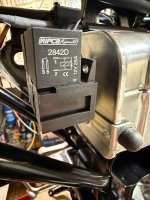
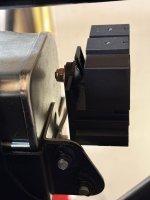
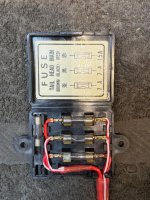
I found a nice position for the three relays that switches the main voltage and trickle charger. Located behind the right hand side cover, the relays stay cool and dry. Plenty of room for the relays, wiring and fuses.

WhatsApp Image 2025-12-22 at 22.13.13.jpeg


WhatsApp Image 2025-12-22_4.jpeg

WhatsApp Image 2025-12-22_3.jpeg

I made a small bracket that connects to the air filter bolt and the relays. With a rubber bushing, vibrations are less harsh, keeping the relays in good shape. The relays are placed in holders, and can be swapped easily.
 
Back
Top Bottom