A C78 project

I just found this tread, and it's been a fun read to see your progress. I've got an early '65 CA77 that I'd like to install some non-US model parts on (mostly turn signals), so seeing the specific differences between yours and mine is both helpful and really neat. I agree these bikes are not very mechanic-friendly at all- it seems Honda got better at that the longer they built bikes.

(Oddly enough, my handlebars were drilled for turn signals, despite being a US model, midway through the Dream production run. These bikes sure are strange.)
I've been following your thread as well - can never have too much info or pics. If you want more pics of anything, like turn signals or anything else, just let me know, I'll be happy to oblige.

When I took the turn signals out, the left turn signal wire was running from the harness on the right side of the frame to the inside of the rear fender and crossed over to the left side with just a couple of tabs holding the wire in place. Once on the left side there was a channel for the wire to run in to get to the mounting location.

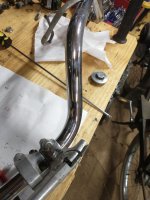
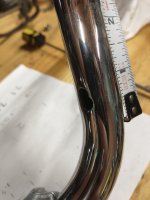
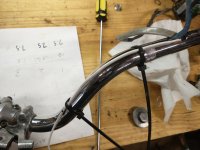
If you could measure how far up from the base of the bars the holes for the front signal wires are located that would be a big help.
 
Alright, hopefully these help. If you measure from the inside, the center of the hole to right when the bend starts is about 3/4 of an inch.
I also took a wire and measured along the bar, from the center of the turn signal hole to the center of the bars (right in the middle of the hole for the control wiring). That came to 7 1/2 inches.


IMG_20251022_175319327.jpgIMG_20251022_175411313.jpgIMG_20251022_175831102.jpg
 
Took the front forks apart and found that the JIS screws holding the shocks on are indeed "a bear" as per Ballbearian. I'll let them soak overnight with some PB Blaster.
20251022_152805.jpg

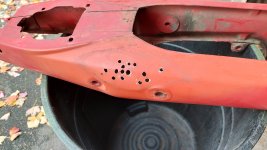
The front fork had what looked like mud from a wasp inside. When I took a screw driver to knock it out I found a hole in the fork. When I knocked all the pieces out I was left with swiss cheese for a fork. What looked like mud was actually Bondo. Not sure why all these holes were in the fork as the metal seems solid all around the holes. If there was a dent that the PO tried to pull out I'm sure it didn't need that many holes. I will be looking for a new fork as I wouldn't trust this one.
20251022_152056.jpg

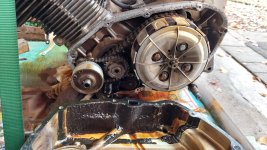
With that discouraging news I thought I would take off the clutch cover to see if any dynastic dates were visible that would give me a year of manufacture. Got the case off easy enough but there was a load of sludge in the lower area. It was almost like tar.
20251022_154402.jpg

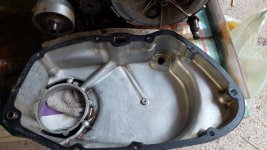
No date stamps but it did clean up fairly easily. Likely the insides are just as bad.
20251022_162622.jpg

I can see many hour in front of the parts washer in my future. :ROFLMAO:
 
That fork looks pretty solid other than all the holes. If you have trouble finding a replacement you could just make a pattern of the inside of the fork. Someone on here recently made one using some malleable material which later hardened solid to form the curves on the inside of a dented fender. They then used it as a buck to reform the dented metal. In your case you could use it to fabricate a perfect metal patch and weld it into the inside of that swiss cheese area. It would be a solid repair that would be hidden on the inside and allow easy refinishing of the outer holed area.

Just a thought. ;)
 
That fork looks pretty solid other than all the holes. If you have trouble finding a replacement you could just make a pattern of the inside of the fork. Someone on here recently made one using some malleable material which later hardened solid to form the curves on the inside of a dented fender. They then used it as a buck to reform the dented metal. In your case you could use it to fabricate a perfect metal patch and weld it into the inside of that swiss cheese area. It would be a solid repair that would be hidden on the inside and allow easy refinishing of the outer holed area.

Just a thought. ;)
At this point I have nothing to lose, so I may as well sand down that area and see what I'm dealing with. If it's solid all around a patch might work but I think it would have to be done on the outside. The space to work from the inside is very limited.
 
I'm kinda shocked at those holes there. I wonder what the story was. The fork looks pretty good overall. They must be inherently fairly strong, rare to see one bent.
 
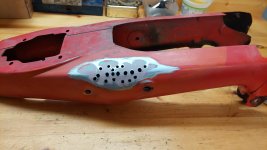
I sanded down the forks in the damaged area and found all the metal to be in good shape with no rust, just a lot of Bondo and a few more holes emerged. I'm guessing the fork was somehow dented and the easiest way to pull the dent out would be to "weaken" the metal and lever it up using the holes and pushing from behind. I'm wondering if a welder could close those holes without burning through or I could try the car battery and coat hanger method of welding :eek:
20251023_213227.jpg

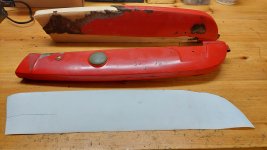
I went on to clean the chain case and assess my next steps since the lower case is severely rusted. I took the top case and traced the outline on a piece of paper. I then transferred that to a block of wood and then planed the edge to fit inside the case. I will use that piece of wood to shape a patch from a piece of 22 gauge metal. The pieces are piling up for the welder - rear fender, front fork, chain case, might be more.
20251023_213323.jpg
 
A great plan boddy. Your redemption fu is strong.

Having no rust is a big plus on the fork. Form a patch on the outside then tack it to the inside and you won't blow through. Trick is to go slow so heat doesn't build up and warp, just a few welds at a time, with time to cool between. Wire brush the bondo remnants off first, to avoid contamination.

Chaingaurd patch should overlap an inch and test fit with a few poprivets, later drill out and add more holes in the outer to tack weld in multiple places, with patch inside. I'd use JBweld to blend edges, like bondo. Made in two pieces, the very bottom edge can be a lap for final adjustment.

It'll be so nice, you'll wish it wasn't so hidden down there, to show off your work. :) :cool:
 
I have converted both the stator and points cover to 5mm x .80 by simply running a tap in nice and slowly. Mc master Carr sells oval head screws. Otherwise there are or maybe we’re sellers on eBay selling the correct pitch screws.
 
A great plan boddy. Your redemption fu is strong.

Having no rust is a big plus on the fork. Form a patch on the outside then tack it to the inside and you won't blow through. Trick is to go slow so heat doesn't build up and warp, just a few welds at a time, with time to cool between. Wire brush the bondo remnants off first, to avoid contamination.

Chaingaurd patch should overlap an inch and test fit with a few poprivets, later drill out and add more holes in the outer to tack weld in multiple places, with patch inside. I'd use JBweld to blend edges, like bondo. Made in two pieces, the very bottom edge can be a lap for final adjustment.

It'll be so nice, you'll wish it wasn't so hidden down there, to show off your work. :) :cool:
Thanks for the tips, very good advice. It still remains to be seen if I would want to show off my work ;)
 
I have converted both the stator and points cover to 5mm x .80 by simply running a tap in nice and slowly. Mc master Carr sells oval head screws. Otherwise there are or maybe we’re sellers on eBay selling the correct pitch screws.
Thanks. I just picked up a made in Japan metric tap and die set that looks very old. It had all the tap and dies for the older non-ISO JIS screws. Maybe I'll try making some 5x.9 screws or if that doesn't work I can tap to 5 x.8.
 
Last edited:
Lots of inspiration to be had...had 2 CB77's back in the '60s, makes me want to search for another one :)
It's funny (for me anyway), I had a CA72 early in my riding life and though I liked it at the time (but I was only 15), the thought of another one just doesn't grab me now. But it was pretty cool then.

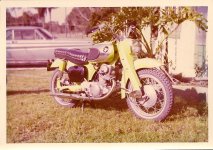
1964 CA72-250 Dream.jpg
 
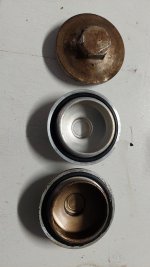
Spent a couple of hours on the dream over the last 2 days just puttering with a few things. Thought I should get to washing some parts, as soon it will be too cold in the unheated garage to do much. The inside of the engine has a brown coating all over everything. I'm thinking this is old oil, as in some cases it washes off pretty easy, example are the valve cover caps.
20251026_160809.jpg

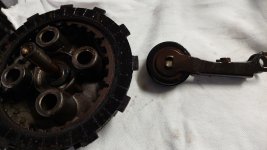
Metal parts do not clean up as well. It's almost as if they are rusty as well as the brown goopy oil.
20251026_161432.jpg
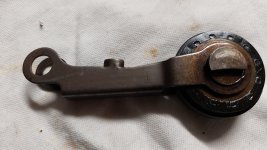
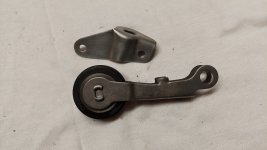
This is the tensioner after cleaning. I will try some Evaporust to see if that brightens it up.
20251027_221628.jpg
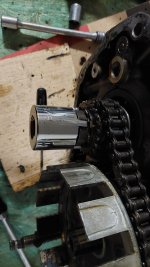
I also need to order or make a tool to remove the nut on the primary drive sprocket. The engine has seen better days and was definitely not following the maintenance schedule. Tried to remove the dipstick and it crumbled. I will try a chisel at this point or maybe drill a couple of holes in the top of the dipstick and see if I can make a bar with two pins to match the holes and get it loose. Notice the heavy pitting on the case. I will fill those holes and then paint the cases to hide all of these blemishes.
20251026_153818a.jpg

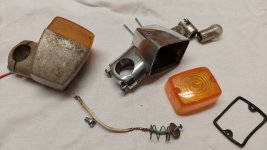
Needed a little win so I started cleaning up one of the front winkers. The lens was heavily scratched so I sanded down the plastic with some 400 grit wet & dry then with some 1200 grit. Put it on the buffing wheel to bring back the shine. Can barely see the scratches now. I will tackle the electrical tomorrow.
20251027_195654.jpg

One bite at a time...;)
 
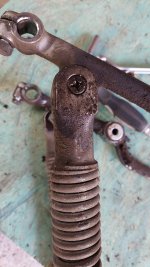
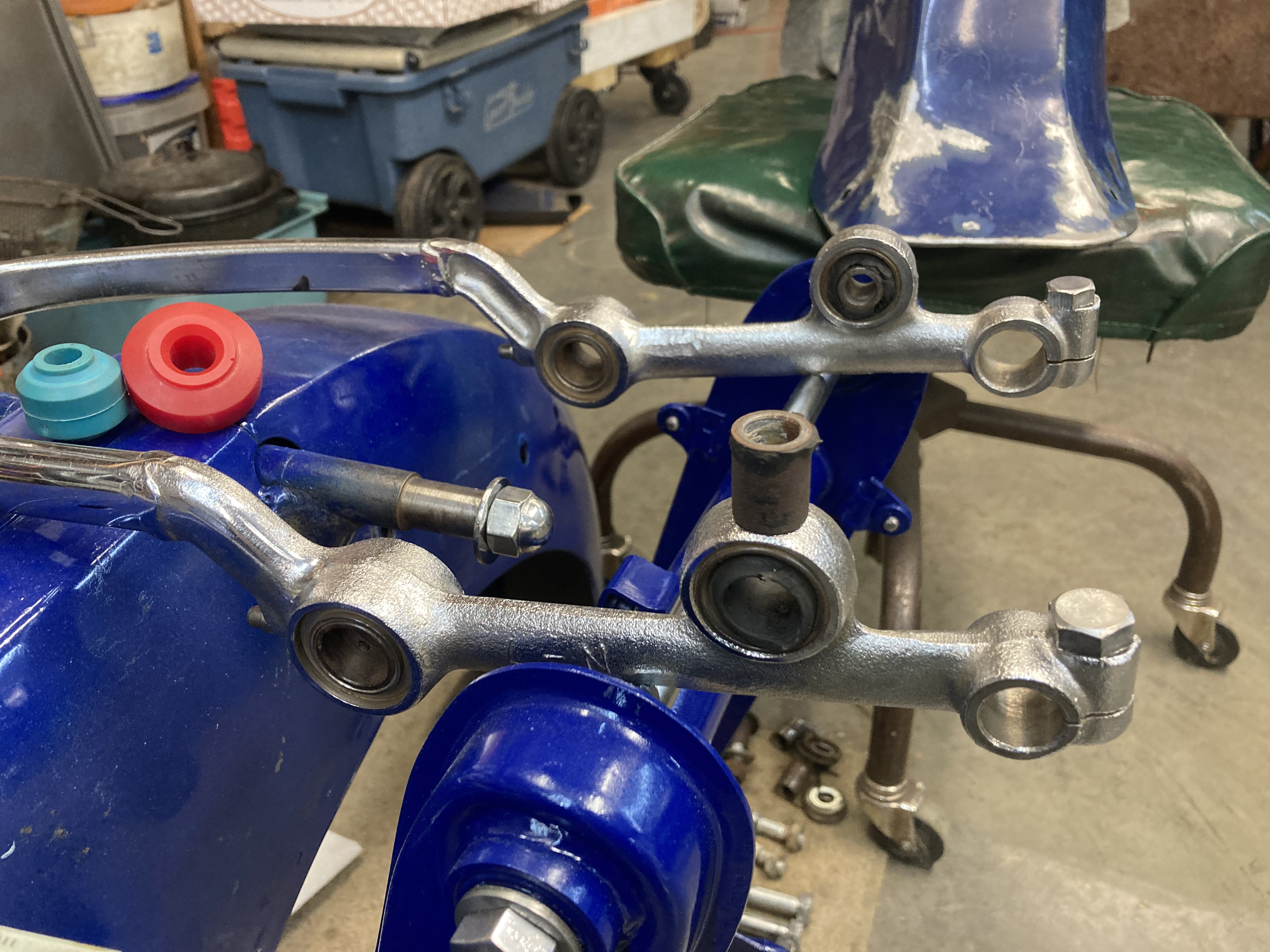
Could you please take a picture of the front "swing arm". I would be very interested how was it to remove. I believe the one on my Dream is twisted. I have been very reluctant to try to take it apart. Any information would greatly be appreciated. I fear breaking anything taking it apart and not being able to get it back to running shape. Thanks in advance.
Took the front forks apart and found that the JIS screws holding the shocks on are indeed "a bear" as per Ballbearian. I'll let them soak overnight with some PB Blaster.
View attachment 51326

The front fork had what looked like mud from a wasp inside. When I took a screw driver to knock it out I found a hole in the fork. When I knocked all the pieces out I was left with swiss cheese for a fork. What looked like mud was actually Bondo. Not sure why all these holes were in the fork as the metal seems solid all around the holes. If there was a dent that the PO tried to pull out I'm sure it didn't need that many holes. I will be looking for a new fork as I wouldn't trust this one.
View attachment 51327

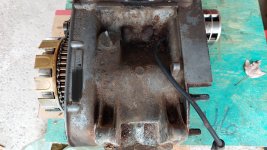
With that discouraging news I thought I would take off the clutch cover to see if any dynastic dates were visible that would give me a year of manufacture. Got the case off easy enough but there was a load of sludge in the lower area. It was almost like tar.
View attachment 51328

No date stamps but it did clean up fairly easily. Likely the insides are just as bad.
View attachment 51329

I can see many hour in front of the parts washer in my future. :ROFLMAO:
 
It is loads of fun. First raise the bike, at least put a jack under the front of motor, wrap a towel between link arm and fender paint. Remove front wheel.
Second, remove upper shock bolts which also mount the fender.
Third, remove link arm bolts to the forks and remove lower rear fender mounts from forks.
Both fender and link arm can be lowered together to remove and separate.

You should be able to assess the link arm for twist or bent, at this point. The nasty #4 JIS bolts holding shocks to link arm can be done in a vise, if needed.
If you are able to get the fender out first, great. I couldn't without risking scratching the fender. Perhaps if the bike was very high on a lift, that may be possible.

I may eventually have to do mine again to replace the pressed in rubber bushings for the lower shock mounts. The steel center in one bushing was separated and I just inserted it back in and filled extra liquid rubber on it.
s5YrAYl.jpg
 
I also need to order or make a tool to remove the nut on the primary drive sprocket. The engine has seen better days and was definitely not following the maintenance schedule. Tried to remove the dipstick and it crumbled.
So, now we're blaming the engine for not following the maintenance schedule rather than the previous owner(s)? That hardly seems fair. 😂

Can you get PB blaster on the inside of the dipstick given that the side cover is off? Outside, too. And did you try heat?

That signal housing and lens polished up very nicely.
 
Thank you for the response. Now all I have to do is get to it !!! I have the JIS screw drivers and impact. I bet a extra set of hands would be great for this, just not a very good and stable way to lift the front of the bike. Changing the front tire had me nervous. Thanks again.
It is loads of fun. First raise the bike, at least put a jack under the front of motor, wrap a towel between link arm and fender paint. Remove front wheel.
Second, remove upper shock bolts which also mount the fender.
Third, remove link arm bolts to the forks and remove lower rear fender mounts from forks.
Both fender and link arm can be lowered together to remove and separate.

You should be able to assess the link arm for twist or bent, at this point. The nasty #4 JIS bolts holding shocks to link arm can be done in a vise, if needed.
If you are able to get the fender out first, great. I couldn't without risking scratching the fender. Perhaps if the bike was very high on a lift, that may be possible.

I may eventually have to do mine again to replace the pressed in rubber bushings for the lower shock mounts. The steel center in one bushing was separated and I just inserted it back in and filled extra liquid rubber on it.
s5YrAYl.jpg
 
Could you please take a picture of the front "swing arm". I would be very interested how was it to remove. I believe the one on my Dream is twisted. I have been very reluctant to try to take it apart. Any information would greatly be appreciated. I fear breaking anything taking it apart and not being able to get it back to running shape. Thanks in advance.
I basically did the same thing as Ballbearian, except I removed the front fender first. I then separated the front fork from the steering stem and then took out the link arm and shocks as a unit - didn't know I could have pulled the everything out with the fork still on, FSM has very little details on this.
 
So, now we're blaming the engine for not following the maintenance schedule rather than the previous owner(s)? That hardly seems fair. 😂

Can you get PB blaster on the inside of the dipstick given that the side cover is off? Outside, too. And did you try heat?

That signal housing and lens polished up very nicely.
Yes I am blaming the engine, it should have refused to start, haha.
My second attempt with PB Blaster and a crescent wrench snapped off the remainder of the tang. It's time to drill or chisel :mad:
 
Just because I'm curious, what are the turn signal bodies made of? Aluminum or pot-metal, at the very least I'm guessing some kind of metal?

In any case, loving the progress so far.
 
Dropped a few pieces from the clutch side into some Evaporust for a few hours and they came out well after a rinse and little scotch brite.
20251028_213143.jpg20251028_213029.jpg

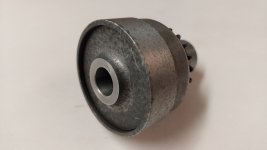
The oil spinner was not so cooperative. The retaining spring was a pain to get out, it was stuck in the groove by a paste of aluminum. PB blaster and scraping finally got the clip out. Getting the cover off is proving to be impossible. Looking inside it looks clean and no build up of crud. I think the PO took the spinner off, rinsed it out without ever taking the cover off.

I tried wooden dowel through the back side to try to hammer it out but it won't budge. Don't really want to use a metal drift as I don't want to damage the surface that rotates on the shaft. So far I tried PB Blaster, heat and hammering with a dowel. I am open to suggestions.
20251028_193603.jpg
 
Just because I'm curious, what are the turn signal bodies made of? Aluminum or pot-metal, at the very least I'm guessing some kind of metal?

In any case, loving the progress so far.
The bodies are made of aluminum and are easy to polish up. I could also go with a satin look if I used some fine steel wool. I will do the other in a satin finish to compare both finishes.
 
Dropped a few pieces from the clutch side into some Evaporust for a few hours and they came out well after a rinse and little scotch brite.
View attachment 51604View attachment 51605

The oil spinner was not so cooperative. The retaining spring was a pain to get out, it was stuck in the groove by a paste of aluminum. PB blaster and scraping finally got the clip out. Getting the cover off is proving to be impossible. Looking inside it looks clean and no build up of crud. I think the PO took the spinner off, rinsed it out without ever taking the cover off.

I tried wooden dowel through the back side to try to hammer it out but it won't budge. Don't really want to use a metal drift as I don't want to damage the surface that rotates on the shaft. So far I tried PB Blaster, heat and hammering with a dowel. I am open to suggestions.
View attachment 51606

Few cycles in the ultrasonic? I’ve had some luck with that doing enough to break down some of those gunked in pieces.
 
Thanks. I just picked up a made in Japan metric tap and die set that looks very old. It had all the tap and dies for the older non-ISO JIS screws. Maybe I'll try making some 5x.9 screws or if that doesn't work I can tap to 5 x.8.
FWIW, I wound up making the few 5 x .9 screws that I needed. Just used extra long partially threaded bolts, cut off the threaded area and the threaded the rest. Find it odd that my ultra cheap tap and die set actually had 5 x .9
 
For the welding stuff. Using an aluminum block as a backer makes it pretty easy to fill holes with a mig welder. For the chain guard, kind of depends on how much of this type of stuff you do, but an air flanger/puncher is a good toolbox addition. I don't do much auto panel replacement anymore but it sure makes creating lapped joints easier and then you don't need to blend them much. If you are doing lapped joints, make sure to use a weldable primer on both parts so that you are not leaving raw metal in the seam to rust.

Something like this, likely could find something used pretty easily
 
Few cycles in the ultrasonic? I’ve had some luck with that doing enough to break down some of those gunked in pieces.
Thanks, unfortunately I don't have an ultrasonic cleaner. I will keep soaking in PB blaster in the mean time.
 
FWIW, I wound up making the few 5 x .9 screws that I needed. Just used extra long partially threaded bolts, cut off the threaded area and the threaded the rest. Find it odd that my ultra cheap tap and die set actually had 5 x .9
When I picked the set up the other day there was a slot for the 5x.9 but in there was a 5x.8. So I have two 5x.8's and no 5x.9 tap. :mad: I can at least make a bolt as you suggest.
For the welding stuff. Using an aluminum block as a backer makes it pretty easy to fill holes with a mig welder. For the chain guard, kind of depends on how much of this type of stuff you do, but an air flanger/puncher is a good toolbox addition. I don't do much auto panel replacement anymore but it sure makes creating lapped joints easier and then you don't need to blend them much. If you are doing lapped joints, make sure to use a weldable primer on both parts so that you are not leaving raw metal in the seam to rust.

Something like this, likely could find something used pretty easily
I was just going to prepare the pieces for the welder as I don't have the equipment for that sort of stuff. I would love to be able to do it myself but at this stage in my life I can't justify buying the necessary equipment.
 
I was just going to prepare the pieces for the welder as I don't have the equipment for that sort of stuff. I would love to be able to do it myself but at this stage in my life I can't justify buying the necessary equipment.
I feel the same way. I was once a good gas welder, did tons of oxy/acetylene welding when I was young. My father always had a set of full sized tanks and torches and I learned as a young teenager. Did a little bit of old school stick welding but never owned one. I now have my father's tanks and torches but the set needs a new oxygen regulator and both tanks are empty, and I seldom have the need to justify spending the money just to gas weld again (and be totally out of practice decades later). And I sure can't afford a MIG or TIG setup, plus the steep learning curve to actually do decent work.
 
I was fortunate to have a job in college driving trucks for a crop duster where they taught me to MIG weld. Used to build roll cages and narrow axles for my Jeep and streetrod hobbies. Makes life a lot simpler when you can "just weld something up". Honestly don't spend much time welding anymore, but the MIG is always there if I need it. FWIW - little sheet metal stuff, the cheapest flux core "MIG" welder you can find works just fine. So the entry point to starting to glue stuff together is about $150. https://www.harborfreight.com/welding/welders/mig-flux-welders/easy-flux-125-amp-welder-57861.html The Hobart I have is a lot bigger and more powerful, but not needed for most folks use.
 
I was fortunate to have a job in college driving trucks for a crop duster where they taught me to MIG weld. Used to build roll cages and narrow axles for my Jeep and streetrod hobbies. Makes life a lot simpler when you can "just weld something up". Honestly don't spend much time welding anymore, but the MIG is always there if I need it. FWIW - little sheet metal stuff, the cheapest flux core "MIG" welder you can find works just fine. So the entry point to starting to glue stuff together is about $150. https://www.harborfreight.com/welding/welders/mig-flux-welders/easy-flux-125-amp-welder-57861.html The Hobart I have is a lot bigger and more powerful, but not needed for most folks use.
And for me, that's the thing - I wouldn't be welding sheet metal often, more like pieces of square tubing for some sort of bracket/structural thing or mounting stuff on a frame. But my days of those needs is fading, not many projects requiring it now that my drag bike roller is pretty much done. Shoulda/woulda/coulda if I'd done that 5 to 10 years ago when I had a bigger need, no reason for me to invest in it now.
 
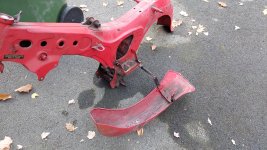
Did some yard work then was allowed to work on the Dream, haha. I took the frame and front fender and pressure washed all of the mud from the undersides. Still a bit of grease on the surfaces but it will be a lot easier to clean without grinding in the dirt.
20251029_165411.jpg

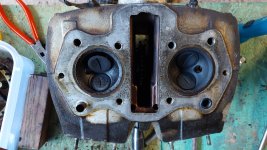
I moved on to the engine to get a few more parts off. Got the top plate off the other day but needed to get the breather plate off without bending it. After a little persuasion with an an exacto knife with a chisel blade it let loose. I loosened the camshaft nut then undid the link for the cam chain. Removed the two 10mm nuts under the spark plugs and then removed the head. It came apart fairly easily as I think the head gasket was leaking. There was oil on the mating surfaces.
20251029_161327.jpg
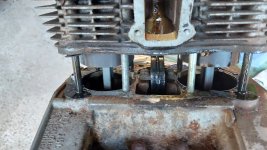
The cylinders fought back a bit as the base gasket wouldn't let go. Finally after a few whacks with a rubber mallet the seal broke and I was able to lift the cylinders off. The bores didn't look too bad but will check them out later once I clean all the grime off.
20251029_161340.jpg
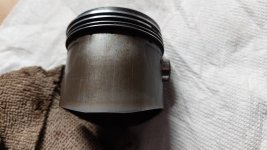
Center roller is hard as a rock so that will be replaced. Pistons are original and don't seem to be scuffed very much. The rings move freely in the landings. There is just this brown crud all over everything. A good clean and inspection will be done.
20251029_163015.jpg

With the cylinders and head off I tried to rotate the crankshaft but since the primary drive chain is still attached I'm also turning over the transmission. I only did maybe a half revolution but everything feels kind of notchy. I'm hoping the crank is ok and it's just crud in the transmission. The PO said that the kick start didn't work, so maybe that has something to do with the notchiness. A surprise is waiting for another day. ;)
 
Did some yard work then was allowed to work on the Dream, haha. I took the frame and front fender and pressure washed all of the mud from the undersides. Still a bit of grease on the surfaces but it will be a lot easier to clean without grinding in the dirt.
View attachment 51629

I moved on to the engine to get a few more parts off. Got the top plate off the other day but needed to get the breather plate off without bending it. After a little persuasion with an an exacto knife with a chisel blade it let loose. I loosened the camshaft nut then undid the link for the cam chain. Removed the two 10mm nuts under the spark plugs and then removed the head. It came apart fairly easily as I think the head gasket was leaking. There was oil on the mating surfaces.
View attachment 51630
The cylinders fought back a bit as the base gasket wouldn't let go. Finally after a few whacks with a rubber mallet the seal broke and I was able to lift the cylinders off. The bores didn't look too bad but will check them out later once I clean all the grime off.
View attachment 51633
Center roller is hard as a rock so that will be replaced. Pistons are original and don't seem to be scuffed very much. The rings move freely in the landings. There is just this brown crud all over everything. A good clean and inspection will be done.
View attachment 51634

With the cylinders and head off I tried to rotate the crankshaft but since the primary drive chain is still attached I'm also turning over the transmission. I only did maybe a half revolution but everything feels kind of notchy. I'm hoping the crank is ok and it's just crud in the transmission. The PO said that the kick start didn't work, so maybe that has something to do with the notchiness. A surprise is waiting for another day. ;)
Brad,

I may have a brand new centre rubber wheel, if I can locate it and your welcome to it for the cost of shipping. My CL77 was a no kickstart working situation too. It was the crud built up on the shifter drum that had locked the transmission shift forks on the shift drum. Kind of a weird situation, yet that was the issue on my motor.

Correction: I gave the extra parts to the fellow who bought my bikes this year. Sorry. I do have a good used CL175 wheel, yet at 57 year old so your better with a replacement. If your stuck it is 52.5 O.D. and 11.5 I.D. for the shaft. if it will fit your application.

That one side of the piston looks good.

Go Jays Go! :D
 
Last edited:
Brad,

I may have a brand new centre rubber wheel, if I can locate it and your welcome to it for the cost of shipping. My CL77 was a no kickstart working situation too. It was the crud built up on the shifter drum that had locked the transmission shift forks on the shift drum. Kind of a weird situation, yet that was the issue on my motor.

Correction: I gave the extra parts to the fellow who bought my bikes this year. Sorry. I do have a good used CL175 wheel, yet at 57 year old so your better with a replacement. If your stuck it is 52.5 O.D. and 11.5 I.D. for the shaft. if it will fit your application.

That one side of the piston looks good.

Go Jays Go! :D
Thanks for the offer David. I will measure up mine tomorrow and see if it might work.
 
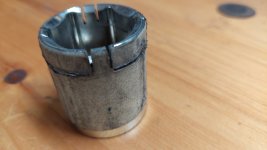
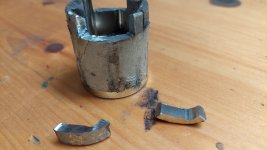
When I saw the asking price of this tool I decided to make my own. Most other sites did not provide measurements so did a hard pass.

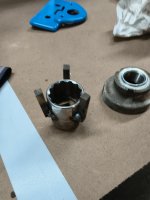
Bought an 1 1/8" socket today for $10 and made myself a primary drive lock nut tool. Started with taping the socket and then marking out the teeth (6mm wide and about 9mm deep). Used a Dremel tool with a cut off wheel to cut out the teeth.
20251030_163932.jpg
Once almost cut through I just broke off the unwanted pieces.
20251030_165257.jpg
Took maybe 30 ~ 40 mins to make. Not the most elegant tool but it will get the job done and will last my lifetime ;)

20251030_165623.jpg
 
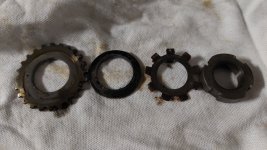
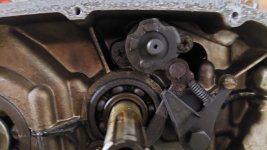
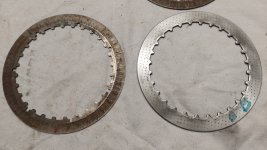
Plodding along. Got a few more pieces disassembled. Started with the primary drive lock nut. Came off without any cuss words. Next were all the pieces behind the lock nut. (Photo is for me to remember the order)
20251031_150437.jpg
Got the clutch off next and took more pics before I take apart the shift mechanism.
20251031_151921.jpg
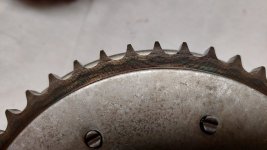
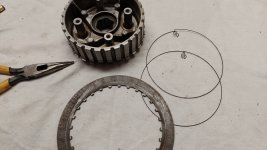
The clutch basket and sprocket look ok with not much wear on the basket or teeth.
20251102_173829.jpg20251102_173852.jpg
Managed to get the two retaining wires out in one piece so they can go back in.
20251102_173711.jpg

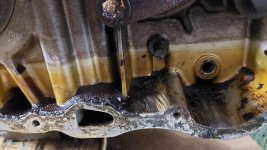
Here's a shot of the different water marks as the bike sat for many years. The bottom layer is almost like grease. My theory right now to explain all the brown parts is that the oil was contaminated with gas. It was probably run like that because the brown stuff is everywhere. When the gas evaporated there was basically no oil on any of the internal parts, either bone dry or a sludge.
20251031_150901.jpg
The good news is that so far things clean up and the parts look serviceable.
20251102_211457.jpg

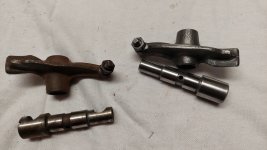
Started to take the head apart and the rockers were nasty looking, but after a trip to the parts washer and then a bath in Evaporust they clean up well with a bit of Scotchbrite for a final polish. So far no abnormal wear found.
20251102_210200.jpg
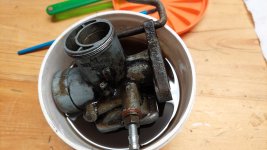
I had an old can of carb cleaner (the kind you throw into a tank of gas) that I threw the carb into and it has been soaking for a few days but the process is really slow in cleaning up the gunk.
20251031_172204.jpg
I went to buy some Berrymans chem dip but they won't ship to Canada. Looking online, it seems the only thing available here is a Gunk product but it doesn't get very good reviews.

Questions for fellow Canucks, what do you use to chemically clean your carbs?

I could buy and ultra sonic cleaner but I don't really want to spend the money for what is likely going to be this one carb.

The choke slide seem to be working but for those that have taken them apart - is it worth the hassle to disassemble to clean a bit more in there?
 
Plodding along. Got a few more pieces disassembled. Started with the primary drive lock nut. Came off without any cuss words. Next were all the pieces behind the lock nut. (Photo is for me to remember the order)
View attachment 51893
Got the clutch off next and took more pics before I take apart the shift mechanism.
View attachment 51895
The clutch basket and sprocket look ok with not much wear on the basket or teeth.
View attachment 51900View attachment 51901
Managed to get the two retaining wires out in one piece so they can go back in.
View attachment 51902

Here's a shot of the different water marks as the bike sat for many years. The bottom layer is almost like grease. My theory right now to explain all the brown parts is that the oil was contaminated with gas. It was probably run like that because the brown stuff is everywhere. When the gas evaporated there was basically no oil on any of the internal parts, either bone dry or a sludge.
View attachment 51896
The good news is that so far things clean up and the parts look serviceable.
View attachment 51897

Started to take the head apart and the rockers were nasty looking, but after a trip to the parts washer and then a bath in Evaporust they clean up well with a bit of Scotchbrite for a final polish. So far no abnormal wear found.
View attachment 51898
I had an old can of carb cleaner (the kind you throw into a tank of gas) that I threw the carb into and it has been soaking for a few days but the process is really slow in cleaning up the gunk.
View attachment 51899
I went to buy some Berrymans chem dip but they won't ship to Canada. Looking online, it seems the only thing available here is a Gunk product but it doesn't get very good reviews.

Questions for fellow Canucks, what do you use to chemically clean your carbs?

I could buy and ultra sonic cleaner but I don't really want to spend the money for what is likely going to be this one carb.

The choke slide seem to be working but for those that have taken them apart - is it worth the hassle to disassemble to clean a bit more in there?
I went through the same thought process long ago. Bought an Ultrasonic and never regretted it. I use it all the time and then you have an excuse to keep buying old bikes.
 
I concur. I put off buying an ultrasonic cleaner for years. Once I finally did, it paid for itself in about a week.

Here's the thing- you don't need to use it for JUST carburetors. Any gunked up part that will fit in the basket is fair game. My only recommendation is get the largest capacity one you can afford. It gives you more flexibility.

As far as the choke disassembly goes- if it moves easy and the little door on the choke flap moves easy as well, leave it alone. That's not really a "precision" part, and the way it goes together makes it easy to lose stuff. I think the washer on at least one of mine is peened over anyway, so it's one more potential thing to break.
 
As far as the choke disassembly goes- if it moves easy and the little door on the choke flap moves easy as well, leave it alone
Thanks, I was leaning that way but just needed the confirmation to leave it alone.
I put off buying an ultrasonic cleaner for years. Once I finally did, it paid for itself in about a week.
Bought an Ultrasonic and never regretted it
I will look into them, thanks.
 
Back
Top Bottom