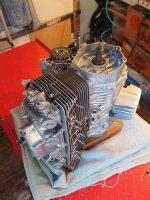
A 1975 CB400F high mileage complete engine rebuild

I've been watching all along, I just have nothing to offer since I've never been into one before. It's like the SOHC 400/450 bikes and engines, I was gone from Honda shops by the time they were being sold. I literally never saw one new at a dealership. I owned a CB400F for about a year and loved it, but moved on to a larger bike well before it needed any work. Yet another bike I wish I still had.
 
This discussion motivated me to make a Google search and I stumbled onto a sort of relevant thread at sohc. Apparently, some racing folks remove the springs altogether and use washer shims to position the rockers.
 
Thanks, that answers the question. Correct positioning of the springs and shimming for those which requires a better position if needed. 12mm shims are easy to get, in 0.25, 0,50 and 1.00 mm, and maybe ditch all the springs and shim everything.
 
Seems that you're on a roll in terms of having time to spend in the shed! Looking at the new followers, I can imagine how nice it must feel to assemble a 47-year-old machine with so many new parts in critical places. Are you reusing the original rocker arm shafts? Do you lube the rocker arm shafts?

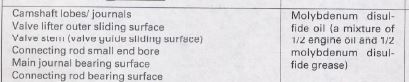
I'm guessing you used the same mixture to lube the cam lobes as for the bearings? And is that straight oil in the baths or something special for assembly?

MY CB600 FSM specifies a 50:50 mix of engine oil and moly grease as an engine building lubricant, same as Jensen's description.

BQmMa4T.jpg
 
Thanks, that answers the question. Correct positioning of the springs and shimming for those which requires a better position if needed. 12mm shims are easy to get, in 0.25, 0,50 and 1.00 mm, and maybe ditch all the springs and shim everything.

It's an interesting, if imperfect design for the 350F/450F with the springs to position the rockers. The only four that I've done top end work on is my 750F2, which has a completely different design.
 
Yes, not everything what Honda makes is the first time right. I got a few shims with ID of 12 mm, in different thicknesses (0.5, 1.0, 2.0 mm). After putting the springs in the right way, as supposed, it was already much better, however, 2 positions need shimming anyway to align perfectly.

Yesterday, I assembled the clutch and tightened the bold of the primary gear.

IMG_0358.jpg

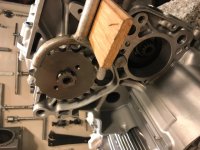
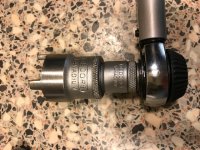
Since the torque of the clutch centre bold and the primary gear bold is very high (40-45 Nm), I needed something to hold the secondary gear. Luckily I have some tools for that.

IMG_0357.jpg

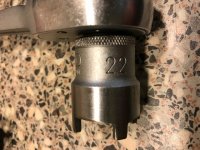
Another self made tool to tighten the centre nut of the clucht centre, it's the same tool for the crankgear of the 450's.

IMG_0359.jpg

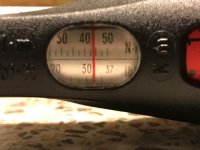
It's fitting my torque wrench, so everything is torqued down the right way.

IMG_0361.jpg

My torque wrench is just capable for these kind of high torque value's. The scale is in Nm and LB-something foot.
 
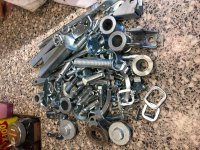
Today, I got my last batch of plated parts back, finally !

IMG_0363.jpg

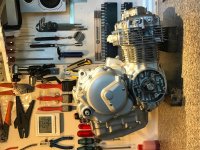
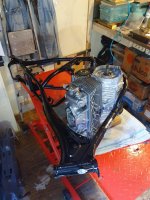
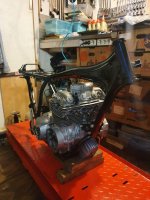
The engine is almost complete, but before I assemble the oil pump and sump, I will mount the engine in the frame (or in this case, the frame over the engine). This way the height of the engine is reduced and make things easier.
 
Don't know about this weekend, but surely within a few weeks. In the meantime, I got a phone call that the the fuel tanks and other stuff of my 450 builds are almost finished (1 K0, 2 K1's and a K2 being build at the same time), I'm looking forward to start that project !, and I can re-start this topic: https://www.vintagehondatwins.com/f...-an-inquiry-into-Differences-and-Similarities

I had almost forgotten about that thread, but I'm looking forward to that one as well. That's a lot of 450s!
 
Three layers of 40 mm thick PIR isolation gives a R-value of 5,4 m2K/W, this means that in the summer it's cool, and in the winter it's warm. In the winter I use Halogen illumination, 3 times 50W, in the summer I use LED illumination, 3 times 7,5W. Not additional heating other then a A+ fridge. And when it's really cold over a longer period, I have an electric heater of 500W for the nights to keep the temperature above 16C.
 
Sounds like your shed might be set up better than my house. The mention of LED lighting in the summer made me wonder: do you use LED bulbs in any of your bikes?

Any work planned on the 400F this weekend?
 
Yes, I used a LED headlight, tail light and signal lights, but I got rid of the headlight. The battery was overheating, the balance was disturbed. I only run a LED tail light and signal lamps, but I have to run the light all the time. The dynamo is charging too much with the lights off. I know this seems strange because most people are complaining about the low charge output of these bikes. I think it has to do with two things, one is the rpm ranges I ride the bike, and the other thing is low contact resistance in all the connectors. btw, I run the original selenium rectifier setup, the original one which was delivered with the bike when new.

No, I didn't have time to work in the shed, not one single hour, however, I rode my bomber the last week a few times to work, to customers and to party's. Friday alone, I did over 600 km with the bike, so I added a little less than 1000 mls on the odometer last week. The weather is outstanding, so I took the opportunity to ride instead of wrenching.
 
A temporary set-back, two step forward, one step back. Had to re-open the engine to fix an issue due to a bad designed and produced after market part (n).
 
No, I didn't have time to work in the shed, not one single hour, however, I rode my bomber the last week a few times to work, to customers and to party's. Friday alone, I did over 600 km with the bike, so I added a little less than 1000 mls on the odometer last week. The weather is outstanding, so I took the opportunity to ride instead of wrenching.

The 600km is an impressive distance for one day. Given the nice weather it sounds like more than a fair trade of wrenching for riding.

A temporary set-back, two step forward, one step back. Had to re-open the engine to fix an issue due to a bad designed and produced after market part (n).

Sorry about the setback. What was the offending aftermarket part?
 
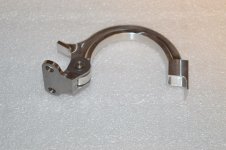
The cam-chain tensioner, the horse shoe part. I'll do a full story in pictures as soon I have a little more time. Since it's positioned in the middle of the engine, splitting the cases was unavoidable.
 
The cam-chain tensioner, the horse shoe part. I'll do a full story in pictures as soon I have a little more time. Since it's positioned in the middle of the engine, splitting the cases was unavoidable.

Ugh. That's a pity. I hope the nice weather is still going strong and you can continue to mix riding with wrenching in a suitable combination while this is sorted out.
 
The last week I spent every evening to split the cases, sort out the issue, adjusting the cam chain tensioner, and build up the engine again. Sometimes you have to bite the bullet....
 
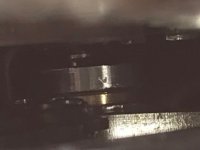
After putting the cases together and completing the engine, I turned it around by turning the primary shaft that drives the clutch. there was a knocking noise from the bottom case, and I couldn't imagine that this would be normal. I took off the oil pan and took my borescope to see what caused this knocking noise. I couldn't see anything out of the ordinary, so I paused the build.

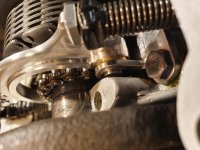
I went in my mind through the build step by step, and after a few days there was only one possibility left and that was the new after market cam chain tensioner. This was the only part that differed from the original part in dimensions. Once thinking this direction, I turned the engine by hand and counted the knocks per revolution of the crank, pinpointed the frequency and after a few times I was almost certain that it was or the cam chain or the primary chain. With the borescope I focussed on that area and, although I couldn't see it well, I decided to split the crankcases (see the images). What I could see is that clearance between the pins of the primary chain and the pivot of the horse shoe was very small, almost zero, or less..

IMG_0369.jpg

IMG_0371.jpg

The process of splitting a fresh rebuild engine is no fun at all, but one has to be sure. But it only takes a few hours and I decided to go for it. After opening the cases the cause was clear, indeed the pivot of the cam chain tensioner horse shoe was indeed hitting the pivots of the primary chain.
s-l1600.jpg

I took the cam chain tensioner (see picture) with me to my work, where the nice tools are. First of all I found that the horse shoe part was binding on the pivot. I took the pivot out by removing the circlip, but the pin was very hard to get out. After pressing it out I found that the bronze bushings not aligned, so I took a reamer 6.00 mm and reamed the bronze bushings. After this the horse shoe was still binding, and found that the two holes (horse shoe part, and mounting bracket) where not aligned. I reamed them as an assembly and after that it didn't bind any more, and the horse shoe part was pivoting around the pin instead of the pin pivoting in the bracket.

But the problem of the knocking wasn't solved with this, the pivot is too long. Comparing the width of the hole assembly with the original Honda part shows that it it way too large. I decided to ditch the circlip and shim the pin from the other side. The pin cannot slide out since it is hold in place by the case.
after_1.jpg

after_2.jpg

after_3.jpg

The protrusion of the pin is now 0.9 mm less than before, and now there is a gap of 0.2 mm between the primary chain pivots and the pivot pin of the horse shoe. All parts including the primary chain are NOS, original Honda parts, so the only correct conclusion is that the after market part is designed wrong and the quality of production is way below what can be expected.

 
Will you run it with the gap of 0.2mm between the pin and the chain pivots? And did you investigate the variation in chain pivot heights as the cam chain is rotated? (I assume so.)

I saw two replacement parts available (possibly the same manufacturer), one from CMSNL and another (made in South Africa) from 4-into-1. The original was too worn to be reused?
 
Good catch Jensen, but then you wouldn't have run it like that anyway. Always better to be sure.
 
Yes, the original part was worn beyond repair. This was also the main reason, together with replacement of the cam chain to split the cases.

Yes, I will run the engine with the clearance of 0.2 mm, this is enough. If it touches in the future it will wear quickly, I'll take that risk. The pivoting pin is softer then the primary chain. Due to the turning by hand the pin was already damaged (you can see this at the pictures).

I did research yesterday, and it seems that I'm not the only one with this issue, as you can see there is a difference between my horse shoe mounting bracket and the one pictured. If you look closely, you can see that the later mounting bracket is stepped, mine isn't. Or they sold me old stock, or I bought it before the design change. I will look into this, because I can find the seller in my administration and I will send out an email to him.

After finishing the engine I placed it in a way that the oil filter connection area was horizontal, so I could pour the 2.8 liter oil via the oil filter holes into the oil gallery and oil pump. This way the crank and cam are primed with fresh oil. This process takes a few days, because the only force on the oil is gravity.

18d5b601-19d5-4fd3-87f4-d48a2888906e.jpg

To close the engine, I placed an oil filter and housing and set the engine aside. I got the oil filters for free in a batch, they're old but still very usable. I trust these filters more that the aftermarket cam chain tensioner ;).


31a8847b-076d-4598-a658-29755a7fc82d.jpg

1c6effa0-d674-4d59-bf2e-a71edbb46099.jpg

Next step is joining the frame and engine.

cc530fd1-e3d7-4b22-86e8-c0524f9e944c.jpg

This picture is a good presentation of how I experienced building the engine of the four. I have to say I like the twins better....
 
This picture is a good presentation of how I experienced building the engine of the four. I have to say I like the twins better....

Very relatable. One of the reasons I really enjoy working on my only single, an XL350. Interesting picture, by the way. Does it show frost on cobwebs, in addition to the barbed wire?

Also, did you mean to post a picture of another horseshoe bracket or were you referring to a previous post?
 
Does it show frost on cobwebs, in addition to the barbed wire?

Yes, it does indeed. Another hobby of me, taking photographs.

s-l1600_det.jpg

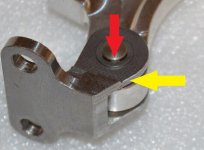
Above a detailed picture of the redesigned part. The yellow arrow is pointing to a step in the mounting bracket, mine hasn't as you can see on the pictures in the thread. This makes the bracket smaller, thus less risk. The red arrow is pointing at the pin. The distance between circlip and the flat surface of the pin is smaller compared to mine, another action to make the chances of contact between pin and primary chain smaller.
 
Hi Jensen, great story and great build. Can't wait to see it finished and running. I saw you mentioned earlier not a lot of replies, but I've been scrolling through here just absorbing the information. I've never done a full rebuild of anything bigger than a single cylinder 2T bike before, but reading through stuff like this is great knowledge to learn from. I don't have much to add, so I normally don't reply to these kinds of threads, but I figured this time around I will just so you know there are people out there who are reading and it appreciating it. They just might be like me, someone who respects and enjoys it but doesn't have much to add. :)

Also, the top end looks very similar to the setup of the CB550 I have. I've read elsewhere you have to be very careful when installing the rockers and it's recommended to use rubber bands to keep them up so you don't destroy the valves. The configuration looks practically identical to the CB500/CB550. How did you go about installing them?

You also said you did an endless chain for your build, how did you get it through with the cases already together? Or did I misunderstand?

Hey wow, I guess I did have something to add!
 
You also said you did an endless chain for your build, how did you get it through with the cases already together? Or did I misunderstand?

He had the entire bottom end apart, plastigauged the crankshaft in post #28 slipped it over the crankshaft during assembly later.
 
Yes, a complete rebuild including splitting the cases (twice) :lol:

I installed the rockers without the adjusting bolts and nuts. This way the valve always has enough room without binding in anyway.
 
Last week I connected the oil filter setup I use form y CB450 K0 to the engine of the CB400f. Before using I changed all the paper filters and cleaned the primary metal filter. I connected the pressure hose at the point where normally the oil pressure switch is placed. The sucking hose was getting it’s feed from the oil level stick. I let it run for a week continously, and today I took the valve cover off to see if the oil reaches the top-end.
 
Yes, it did, but I was unable to edit the post due to problems. Also adding pictures wasn't working... But now it is working again, so here the missing pictures and text...

IMG_0393.jpg

An overview of the setup. The hose is connected to the pressure side of the oil pump instead of the pressure sensor. The other hose is sucking oil out of the cases via the oil level stick. The setup contains a metal shield oil filter for large particles (1st stage filtering), then a high pressure gear pump, followed by a normal oil filter (second stage filtering), and the last filter is a micro-filter as a third stage. From the micro-filter the oil is flowing back into the engine.

IMG_0394.jpg

Rear view of the setup

IMG_0395.jpg

The oil is flowing out of the oil pipes in the head, thus oil is reaching the top end.

IMG_0396.jpg

An overview of the assembled head

IMG_0399.jpg

This way I checked if oil reaches the head, and make sure that dust and small particles are washed out.
 
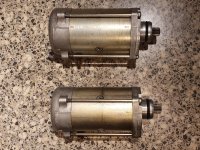
Tonight I did rebuild my startermotor and, while I was at it, my spare too. Both run flowless, always good to know i have a spare lying around.
 
That's unfortunate, but I'm glad to see that the oil is flowing nicely.

Yes, that's a relieve for me also. It's a lot of work to open up the cylinder head again, but it is worth the effort. Now I'm sure that everything is ok. Another benefit is that the (cold) oil is pressed through the oil gallery's. If there was a leak, it would have been visible after a week (24/7) under pressure.

You have spares of everything, it's an enviable position

Yes, it's always nice to have spares, especially if the parts are swappable quickly. I bought this starter motor a long time ago, picked it up for a low price. I didn't need it then, so not necessary to pay a high price..

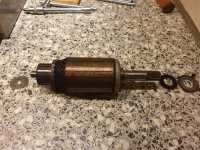
The brushes where good, so I kept them, but I have a new set, just in case. Internal O-rings, bronze bearings, oil seals (hard to find, kinda special size) and the O-ring at the outside are replaced by new ones. Since these starter motors are covered, they seem pretty good after all those years. I swapped the rotor from my original starter motor for the spare rotor, since the gear splines where better on the spare. The rest of the parts where good to go. I didn't have to replace hard to get parts, so both starter motors are fully functional. These motors are simple, they don't have gears in it like the starter motors of the CB72. The CB400f engine has the gears build in the engine itself, lubricated by the engine oil. The only issue with disassembly were the stubborn bolts that keep the motor together., but a week in penetrating oil solved that issue too. I have a very small bearing puller, the rear bearing of the rotor is a bronze pressed in bearing. Since it was a standard size I replaced them both as well. Without that puller, it would be almost impossible to replace those bearings.


20220711_214227.jpg


20220713_220442.jpg
 
Yes, it's always nice to have spares, especially if the parts are swappable quickly. I bought this starter motor a long time ago, picked it up for a low price. I didn't need it then, so not necessary to pay a high price..

It's a good lesson from this thread how you gathered parts over several years to prepare for the rebuild.

I still get stuck at times waiting for delivery of a part I should already have on hand, but I have been trying to plan ahead more with spare gaskets, bulbs, etc.
 
Are there vintage bike nights or equivalent in your area? This bike will need to be showed off in person when you're finished.

I have yet to install a frame over a motor, but it looks to be a pretty slick procedure in this sort of situation.
 
Hopefully yes, I want to break it in this year....

Somehow I can't turn my pictures, I took them with my android phone, normally I use my apple.
Picture alignment is dependent on the phone position when shot, that's why I don't post any phone pictures. Cheap digital camera, downloaded to computer and posted from there.
 
Hopefully yes, I want to break it in this year...


I'm still absorbing the work you did this winter. What a great thread and photos! Good inspiration for me to get back and finish my CA78 rebuild.
 
Last edited by a moderator:
Are there vintage bike nights or equivalent in your area? This bike will need to be showed off in person when you're finished.

No, no vintage bike rides in my area. I like to ride my bikes, showing-off is not my thing. Once, I did a concours with my 100 % original 1962 CB72, even the tires where original. The jury wasn't able to distinguish original from cafe-racer. Next to that, a Japanese bike doesn't draw much attention, Italian bikes, German bikes and American bikes do.

I have yet to install a frame over a motor, but it looks to be a pretty slick procedure in this sort of situation.

If possible, I always go this route, it's easy.
 
Back
Top Bottom