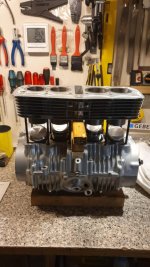
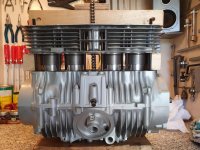
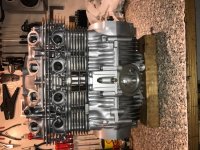
A 1975 CB400F high mileage complete engine rebuild

Hi,

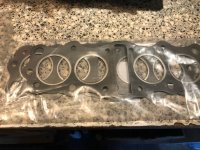
The last weeks I could work a few hours on the top end. It was a lot more work then expected, especially when you think when using new parts, it would be juts plug and play.

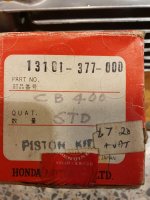
After unpacking the NOS cylinder it was clear that removing the wax would be a time consuming job, the was literately everywhere, even in the oil holes to the top-end. I bought this cylinder many years ago, actually I bought two of them, one in a very good shape (the one I use) and one that was oxidized (the aluminium). I also removed a lot of casting material out of the "air gallery" around the cam-chain tunnel. I decided to buy a new cylinder because standard pistons are really cheap, nobody wants them. Boring and honing wasn't necessary too, so no expenses there. Both cylinders did cost me around 300 euro in total, including shipping. Pistons and rings were 60 euro in total. When looking what I paid for this, I also saw these came from Greece, and I bought them 11 years ago together with a NOS complete generator and rotor.
IMG_0218.jpg
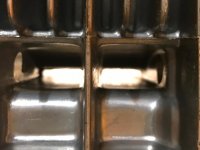
The air holes around the cam chain tunnel showed a blot of casting material, so much that one hole was completely clogged, there still is casting material in the air flow, but much better then when I started.


IMG_0220.jpg


IMG_0222.jpg
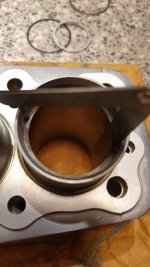
I did not yet clean the bores, but you can see the wax in the bore as a yellow / brown layer. I tried several chemicals, one was better then others, but still a lot of work to clean the cylinder.
 
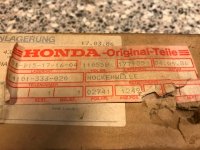
The next step was to assemble the head with NOS valves, NOS valve springs and new, modern valve seals (only for the intake valves, the exhaust valves didn't have seals at that time...). A long time ago I bought a huge box of NOS CB four engine parts, mainly valves, springs, and rocker arms. The price was low, because non of the parts where bagged, and none of the parts had part numbers. It took me a while to identify the parts (compare with my used parts and Ebay pictures, CMS pictures etc), but I found all valves for my CB400f (and two extra sets....), 7 rockers, so I had to buy one to complete the set. All the outer springs where in there too, The inner springs where not, so had too buy those. I was also able to sell the the rest, mostly early CB750 and CB500/550 stuff. I paid 150 euro for everything, and sold 3 complete sets of rockers for the 750's. Each rocker went for 25.00 euro, so 600 euro's in total. There are still a lot of those parts left (rockers, springs, valves, valve guides) which I have to sell the coming years.

IMG_0214.jpg

IMG_0215.jpg
The head is done buy someone who is knowing what he's doing (ex HRC mechanic), so I'm curious about the power increase ...


IMG_0216.jpg


IMG_0217.jpg

All parts are ready for uniting after 12 years or so, and as soon I have some time on my hands I will assemble the top end and bottom end....
 
This weekend I started with the pistons, all NOS.
WhatsApp Image 2022-04-01 at 20.37.55.jpg


Before placing the rings, I measure the gap of every piston ring with a feel gauge.

WhatsApp Image 2022-04-01 at 20.52.09.jpg

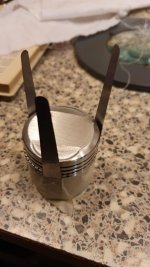
I use old feeler gauges to place the lower rings over the grooves.

WhatsApp Image 2022-04-01 at 21.10.29.jpg

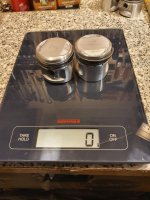
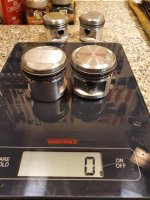
I balanced the pistons, and gave them the exact same weight. As a pair 1-4 and 2-3 they are also exact the same, important because as a pair they have to be in balance with the other pair.

WhatsApp Image 2022-04-02 at 21.56.33.jpg

WhatsApp Image 2022-04-02 at 21.56.44.jpg

One piston seems different, but has the same measurements, and weight after I took 1.3 gram of aluminium shavings off. Now the pistons are all within 0,1 gram equal weight, including pins.


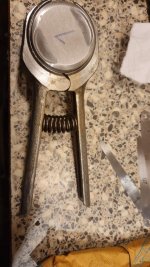
I tested the diameter of the tools I have for the CB72/77 and the piston ring compressor was working well.

WhatsApp Image 2022-04-01 at 21.22.32.jpg


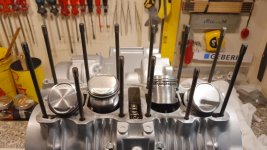
The next step is to mount the pistons, and without the studs in place, it is a fairly easy job.

WhatsApp Image 2022-04-03 at 20.50.09.jpg

And finally adding the studs. I had to replace 5 of them..

WhatsApp Image 2022-04-03 at 21.27.30.jpg

And now ready for the next step, putting the cylinder in place

WhatsApp Image 2022-04-03 at 21.31.57.jpg

Next weekend the cylinder and head installation will finally end the work on the engine for now. First the engine has to be build in the frame, before going further, adding weight to the engine....
 
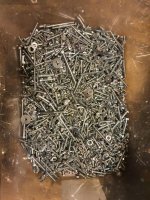
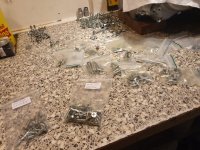
Yesterday I got my stuff back from the plater, 50 kg (110 lb), only bolts, nuts, and some small stuff. Most parts are CB450, but also many early stuff from the CB72's / C77's and some CB750 Four parts. Now I have to sort them....

308748d8-8e9b-46e0-9960-54f2a8cd8846.jpg

fc27d67c-2b1b-4864-8b38-0272765e0076.jpg
 
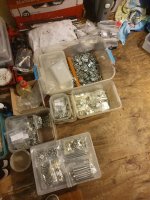
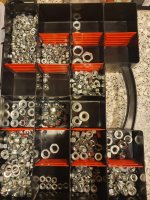
Last week I had to sort the plated hardware. I need some parts for my CB400f, but most parts are from CB450's and CB72's.
A lot of work to sort them all. JIS, metric and specials all mixed together means lot's of measurements to be done to define what is what.


9950a964-2a80-4108-88be-1049ff4cb594.jpg

02285004-39c5-4b94-9858-17d3501e246e.jpg

68e6b665-9584-4b7d-a3db-2b89f45832aa.jpg

When all hardware is sorted, I'll pick up where I left with the engine.
 
This is the result of 20+ years disassembling CB450's and CB72's engines and bikes, and this was the second last batch (50 kg's (110 lb). One batch to go, but that one is no more then 3 kg and only specials.
 
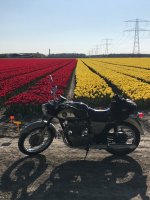
Since the CB400f isn't ready to ride (unfortunately it takes longer then planned), and I needed a way of transportation to my work (wife needed the car for four weeks), I rode the bomber as a commuter for the last two weeks (120 km or 75 mls /day). Since I regularly take a longer way home, I added 2000 km or 1250 mls to the odometer in the past two weeks. Lucky the weather was sunny and dry. As a Dutch citizen, I'm used to what we are famous for, and ride the fields of tulips every day (in the season). Specially for those who do not live in the Netherlands I made a few pictures during my daily routine.

IMG_0271_s.jpg


20220502_181358_p.jpg
 
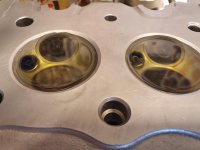
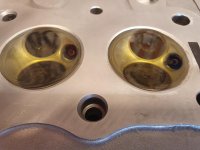
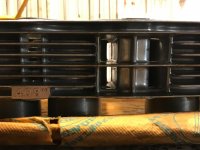
Finally, all hardware is sorted and had some spare time to work on the engine. Before assemble the head and cylinder, I first checked if the valve job was ok. Therefore I put some gasoline in the combustion chambers and let it sit for 48 hours. These pictures were taken just before I removed the gasoline, and showed that the valve job and cylinder-head work is good to go. No droplet leaked out via the valves, compression will be perfect.

20220520_134113.jpg

20220520_134123.jpg

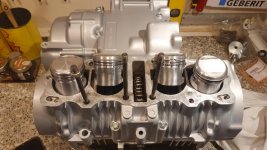
Meanwhile, I did put the cylinder on the studs, pistons in, and waiting for the cylinder head quality check.

20220522_111726.jpg

Next step, when I have time, I'll re-unite the engine with the cylinder head, put the camshaft in and adjust the cam timing.
 
I don't think that the reporting style of this build is attractive for others, or that this is a four on a twins forum, or both. Pulling the plug out of this thread.
 
I don't think that the reporting style of this build is attractive for others, or that this is a four on a twins forum, or both. Pulling the plug out of this thread.


Please don't pull the plug.
 
I don't think that the reporting style of this build is attractive for others, or that this is a four on a twins forum, or both. Pulling the plug out of this thread.

I think many have been following with keen interest. The quality of your work is enviable, both with the rebuild and the documentation. As someone with far less experience/skill, I mostly follow silently to learn by observation.
 
With 4600+ views of this thread I can say there is interest Jensen, it's just that most of our members are reading and observing while making mental notes for their own work and skills. I've been mostly silent as I've watched each step with great appreciation for your workmanship and attention to details.
 
Hi,

Thanks for the heads up. It's not about the amount views, it's about the interaction. Somehow, there is almost none, and I wonder if anybody has interest in the fours on a forum devoted on the Honda Twins, which is fully understandable. However, many of the things I document are useful for any engine rebuild or to be discussed otherwise. Or maybe it's just the way I document, as a boring, endless, stream of small steps. Anyway, I was asking myself for whom I am investing the time to do the write-up.

On the other hand, forums like this become extinct, due to FB and indifference of people and society's in general, that's what disturbs me the most looking at the endless stream of simple questions on FB, but lately also on this forum. Anyway, for the time being I will document until the engine and bike are finished.

Jensen
 
You raise a couple of fair points in the second paragraph. It seems that a large contingent of members join forums solely for their own benefit, to find a rare part or get help with one problem, and rarely come back once that issue is resolved. That can be a bit disappointing. I joined to learn and threads like this are helpful.

One possible explanation for the lack of interaction (in my opinion) is that you know so well what you're doing, commenters have little to add other than praise and admiration. I've also been somewhat intimidated to ask simple questions.

I have one four (CB750F2) and I would guess that maybe a third of the members have owned or own one. I'm very interested to follow the rebuild through to the end, so thank you for continuing.
 
I've been fascinated to read this thread and hope that it continues. I always wanted a 400/4 back in the day, and this influenced my later purchase of my CB600. I've not posted on this thread because I have nothing useful to add, except to express my interest and awe at the quality of your work.
 
I also really enjoy the system of organization and solutions you offer... like feeler gauges for installing rings on pistons. I will try this next time, to reduce the stress of losing grip and scratching the piston. As for twins vs fours, I have a 350f I would like to rebuild the engine someday.
 
Hi,

Thanks for the heads up. It's not about the amount views, it's about the interaction. Somehow, there is almost none, and I wonder if anybody has interest in the fours on a forum devoted on the Honda Twins, which is fully understandable. However, many of the things I document are useful for any engine rebuild or to be discussed otherwise. Or maybe it's just the way I document, as a boring, endless, stream of small steps. Anyway, I was asking myself for whom I am investing the time to do the write-up.

On the other hand, forums like this become extinct, due to FB and indifference of people and society's in general, that's what disturbs me the most looking at the endless stream of simple questions on FB, but lately also on this forum. Anyway, for the time being I will document until the engine and bike are finished.

Jensen
Thank you Jensen. I like all engines from 1's to 16's, inline to Vee's to horizontally opposed. The different engineering approaches used to solve design problems are quite creative at times while at other times leave you scratching your head wondering what they were thinking.
 
I found a few spare moments, and finally some progress in the shed.

IMG_0314.jpg

After 12 years this is a big step !


IMG_0317.jpg

Next job is to add the camshaft and mount the cam sprocket in the correct position. To do that I have to install the points plate and some other parts for setting the timing.

IMG_0318.jpg

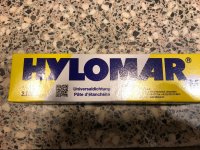
I know, I know, on the www it is not advised to use a liquid sealant between the foot gasket and head gasket. However, I do use it, always. Hylomar is a non silicon based liquid gasket and closes off the gasket itself.
Using always OEM gaskets (NOS), and experienced the strong points and weak points of these gaskets, I use the liquid gasket to avoid sweating of the gaskets. It works for me, and it never failed. No sweating, no leakages, no issue's.

IMG_0315.jpg

I try to liquefy only the the circumference of the gasket, to avoid that liquid sealant can enter the engine. This is a safe way to use it, and I don't have to be afraid that sealant residue's will interfere with the oil distribution. The excessive liquid sealant will be removed by me after the first few heat cycles.

Unfortunately I didn't have the time to make pictures during the process, because after applying the liquid sealant, the parts should mate as fast as possible to avoid drying out (there is pretty much solvent in Hylomar which evaporates quickly)
 
The previous owner could not have found a better person to take over the care of this machine.

You mention in a few places about acquiring various pieces you wanted for the rebuild in larger bundles containing parts for other models. When you sell off parts you don't need, do you do that locally through swap meets, etc. or do you sell via eBay or equivalent? And did you sell off the 750 camshaft(s) already?
 
The bike is a rarity in my collection of bikes, and therefore special. I got it by accident, as a gesture because the first owner developed a balance disorder, as described in the opening post. I promised him to take good care of the bike, soon after the collection of the bike, he passed away. Yes, I take good care of the bike, but way too slow, that's why I want to finish the build and start using the bike as a rider.
Unfortunately, I traded the 750 stuff for 450 stuff, as I do most of my acquiring, by trading. Parts are hard to get, and difficult to put a price on it, this way pricing discussions can be avoided. I will start selling parts in the near future, when this bike is done.
 
I promised him to take good care of the bike, soon after the collection of the bike, he passed away.

I was wondering if you were able to maintain any contact with him after you took ownership. I was given my 360 by the original owner after decades of disuse and I had only just gotten it running when he passed, but it felt good that I had sent him pictures along the way. I will keep that bike as long as I can, as I imagine you might with this 400F.
 
Yes, I will keep and ride the bike it as soon as it is finished. The bike was almost given to me, the price was low compared with the market prices 12 years ago. I rode the bike for something like 20.000 km before dismantling, and however it's not a twin, it sure is fun to ride. Many thumbs up from others too, more then on my 450's.
 
IMG_0322.jpg

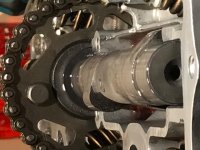
The installation of the camshaft was pretty straightforward, however, the time it took to get it done, was more or less the same time I need to assemble whole CB450 cylinder head. I used an endless chain, and there's only one way to get the job done. It takes a while to find that method.

IMG_0325.jpg

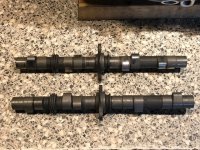
The old and new cam as a comparison. the cam lobes of the old camshaft are 37.8 mm, the cam lobes of the new one is 38.5 mm, so the lift will be better.

IMG_0320.jpg

IMG_0323.jpg

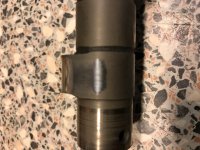
a direct comparison between both cam lobes shows the differences quite well.

IMG_0328.jpg

Before putting the cam in, I lubricated the bearings.

IMG_0329.JPG

Finally, after 3 hours of fiddling everything is done,

IMG_0331.jpg

Securing the cam sprocket bolts is very important, therefore I use loctite 638, that will hold the bolts in place for a while.
 
The installation of the camshaft was pretty straightforward, however, the time it took to get it done, was more or less the same time I need to assemble whole CB450 cylinder head. I used an endless chain, and there's only one way to get the job done. It takes a while to find that method.

I always have a hard time fishing the cam chain through the head on my 450, so I can relate. Once, with a brand new cam chain, it took me more than a couple hours to get the master link in place.

The old and new cam as a comparison. the cam lobes of the old camshaft are 37.8 mm, the cam lobes of the new one is 38.5 mm, so the lift will be better.
Is the used cam still within spec? And would the difference between the cams lead to a substantial difference in terms of the compression? (Thinking about my 750F2 with this question.)
 
Once, with a brand new cam chain, it took me more than a couple hours to get the master link in place.
Yes, for this four everything is new, the 450's however, one hour for me, setting up the distribution is long.

Is the used cam still within spec? And would the difference between the cams lead to a substantial difference in terms of the compression? (Thinking about my 750F2 with this question.)

Yes, the cam was in good working order, and not damaged in a way that it needed to replace. However, in the constant hunt for parts I ran into the opportunity to lay my hands on a few new camshafts for a very reasonable price (actually it was a steel).

I have so many parts, combined with an extra engine I stumbled into the past 12 years, that I can build another engine. For example, I have at least 2 extra OEM gasket set, including a few spare head gaskets.

IMG_0326.jpg

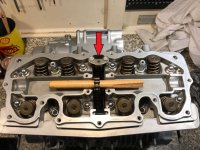
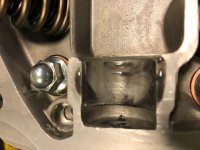
I also found an assembly error while mounting the camshaft and sprocket in place. Comparing with the parts list and pictures in the manuals I found out that the camchain slipper placeholder was mounted wrong (see arrow).

IMG_0317_s.jpg

Yesterday I did turned this the other way to give more room to the sprocket and slipper as it was meant by Honda. Using a torque wrench with this work is very important, for example the cam sprocket bolds (M6) are high grade steel, and should be torqued with at least 20 Nm, which is very high compared with the standard torque for any given M6 bolt.
 
btw, the grade of these (special) bolts are 12.9 grade, and the maximum torque is 17.7 Nm. As shown, I also used Loctite 638, to make sure that the bolts won't interfere with the rest of the engine. Loctite 638 can be seen as a lubricate, so I used 15 Nm to adept for this (+/- 20%). Standard torque tables can be found everywhere on the internet, and it's handy to print out a complete table and hang it above the workbench, next to the ladies :).
 
Before putting the cam in, I lubricated the bearings.

What do you use to lube the bearings? Does it contain graphite?

I also found an assembly error while mounting the camshaft and sprocket in place. Comparing with the parts list and pictures in the manuals I found out that the camchain slipper placeholder was mounted wrong (see arrow).

Yesterday I did turned this the other way to give more room to the sprocket and slipper as it was meant by Honda. Using a torque wrench with this work is very important, for example the cam sprocket bolds (M6) are high grade steel, and should be torqued with at least 20 Nm, which is very high compared with the standard torque for any given M6 bolt.

After you put the red arrow over it, it's easy to guess it should go the other way around based on the shape of the holder. Sorry I didn't notice from the previous post.

How do you brace the cam sprocket while applying torque to the cam sprocket bolts?
 
What do you use to lube the bearings? Does it contain graphite?

50% oil (10w60) and 50% Lithium based molybdenum sulphide grease (MoS2)

How do you brace the cam sprocket while applying torque to the cam sprocket bolts?

I hold the crank via the crank bold (generator side).

(I don't know what's going on, but it's very hard to edit my posts, and on top of that, the time I can edit is very short, every time I have to log in again ??)
 
Thanks for those answers. (I couldn't use reply with quote.)

I'm experiencing strange posting issues as well, although I haven't been asked to log in again. Ancientdad is also having a few issues.
 
Another evening in the shed, so time for the top end assembly:

IMG_0333.jpg

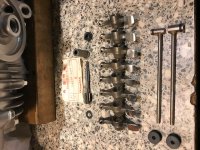
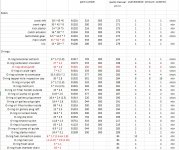
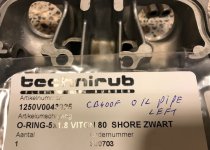
New rockers, and new rubber grommets to hold the oil lines. And new O-rings too, btw. In an earlier post I showed this list of ordered parts O-rings and seals.

O-rings and seals.jpg

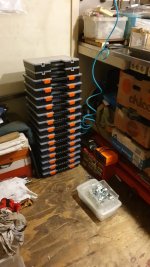
And this is how they come to me, every type of O-ring is bagged, and given an article number, with the excel list in hand, I write on the bag what is what, and this way I'll never have to stop because I'm missing a critical part such as an O-ring.

IMG_0335.jpg


I order all the O-rings, seals and grommets in the material what I think it's best for the application when it comes to material and hardness choise in case of rubber. In this case the choise for the O-rings for the oil pipes have to withstand heat, oil and petrol residue's, so Viton it is. For this application I like a harder type of O-ring, so 80 shore.

IMG_0339.jpg

IMG_0337.jpg

IMG_0338.jpg

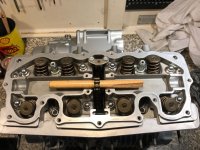
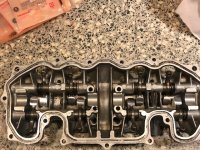
and after a few hours, the top end is completed, and ready to fit (now I have to locate the rest of the missing bolts, I have them somewhere...)

IMG_0341.jpg

Next time I'm in the shed, I will adjust the valves and (static) points timing.

And after that I need two more nights to finish the engine, and then the next phase can be started, start building up the bike by first put the frame around the engine. I think building up the bike will go much faster then building the engine. All parts are cleaned and ready to assemble, kinds straight forward.
 
Seems that you're on a roll in terms of having time to spend in the shed! Looking at the new followers, I can imagine how nice it must feel to assemble a 47-year-old machine with so many new parts in critical places. Are you reusing the original rocker arm shafts? Do you lube the rocker arm shafts?

I'm guessing you used the same mixture to lube the cam lobes as for the bearings? And is that straight oil in the baths or something special for assembly?

Did you record the hardness of the o-rings for each application? I see a column in your spreadsheet for the material, but not the hardness. (By the way, I like how you split the Honda part number across three columns.) What is the overall range of hardness used? I gather that 80A for the oil lines was among the hardest?
 
I listened to the advice of AD to spend less time at work :)

The bike did run 102.000 km's (63.000 mls) and that's a lot. I could reuse the parts (cam, rockers etc), and compared with the rockers in your 350 my used old ones seem to be in much better shape then the rockers in your bike. However, many parts are very hard to get, and I think this is the last time I will rebuild this engine, as I don't want to be in here again. It's fun, but I like the CB450- and the CB72's engines more.

Yes, I do record the material and hardness of O-rings per application, having a choice from different materials like NBR, EP, FKM (Viton), CR, FVMQ an VMQ, and hardnesses (60 shore- 90 shore).

Yes, using a mixture of oil and MoS2 grease standard in every application when building an engine. After the first run, the oil is really black from the MoS2, but after the first oil change, all MoS2 will be gone. The oil I use is a synthetic 10W60 (Castrol), as I use the same oil in the engine after rebuild, but then the lighter version, the 10W50 oil.

As an R&D engineer I'm working at a large machine builder, building machines to produce dishwashing pods and laundry pods. Many detergents used in those machines are very aggressive in high concentrations. Doing research on all kinds of pumps leads automaticity to knowledge about, and experience with all types of sealing, O-rings, etc.
 
I listened to the advice of AD to spend less time at work :)

We're not getting any younger, that's for sure.

It's fun, but I like the CB450 engine and the CB72's better.

Agreed, 4 cylinders are great to own and enjoy but twins are far more fun to work on. I was fortunate over the years to only have to rebuild a few 750 and 900 engines along with 3 Gold Wing bottom ends (due to my own transmission destruction). I'll take a twin any day.
 
Finally, after 3 years we got a new CTO (the former CTO quit his job 3 years ago), which is my direct manager, since I'm the head of R&D. He's in for 3 months now and takes a lot of work and responsibility of my shoulders, which leads to a better balance between work, family and hobby's. I'm working for a global company with 1200 employees, with offices and factory's on every continent. Those three years were a rough ride, making 60+ hours every week. Now I'm down to 40-50 hours a week, and during the weekends my laptop is turned off. I learned one thing in the past three years, I have no ambition to be a CTO in a middle to large machine builder company's.

P8290018.jpg

It will take just a few months more to get there.

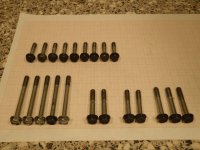
BTW, this is the way I make sure using the right bolts in the right place, I do this with all my rebuilds, it's cheap and efficient:

bouten kop_2.jpg

Overall view of the top of the bolts used for the cylinder head

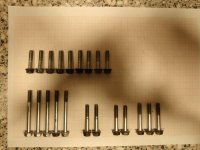
and for the length:

bouten kop_1.jpg

The paper is mm paper, the length can be derived counting the raster.
 
Now I'm down to 40-50 hours a week, and during the weekends my laptop is turned off. I learned one thing in the past three years, I have no ambition to be a CTO in a middle to large machine builder company's.

Good news for you and good news for the 400F! My job is heavier during the academic year and usually lighter in the summers, leaving a fair amount of time for hobbies in the warm months.
 
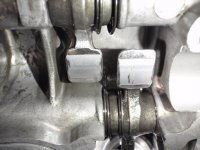
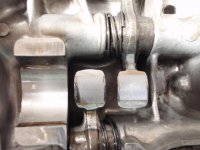
Yesterday, my eyes pointed out something strange, something which I did not expect. I took pictures and it seems that the alignment is not according to my standards.


IMG_0344.jpg

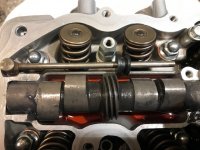
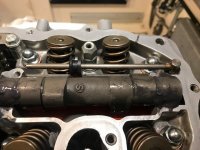
This is what I expect, an alignment of the rocker, precisely centred in the axis of the valve stem


IMG_0343.jpg

However, this is how some rockers are aligned.


Shimming will be necessary to make sure the force is directed exactly on the centre of the valve stem.
 
Yesterday, my eyes pointed out something strange, something which I did not expect. I took pictures and it seems that the alignment is not according to my standards.

Shimming will be necessary to make sure the force is directed exactly on the centre of the valve stem.

It does appear to be off-center. Did you examine it with the tappet adjuster screw removed as well?

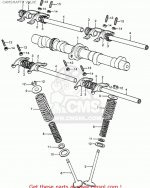
Looking at the parts fiche, it appears to me that the rocker arm springs do not follow the same pattern in your photo above (post #86). Could this be related? Or am I misunderstanding something?

The pattern in the fiche seems different for intake and exhaust sides.

Screenshot_20220606-044012.jpg
 
Thanks for your alertness, but I'm sure I followed the parts manual step by step during the assembly, so time to dive into the books. I use the number 3 parts manual in combination with the FSM and a Dutch book. Thinking that you're spot on, I started with thinking that I forgot to look carefully.

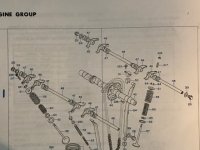
This is what is printed in my parts manual nr. 3, printed in '76:
IMG_0346_t.jpg


IMG_0347.jpg

As can be seen clearly, the springs are mounted the same as mine, logic, because I use this parts manual as a reference.

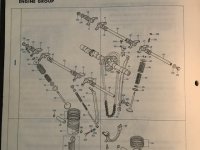
I happen to have also another parts manual, number 4, printed in '77, and this parts manual shows this:

IMG_0348_t.jpg

IMG_0349.jpg

As can be seen clearly, the springs are mounted the same as mine, as bothy drawings seems to be an exact copy of each other (except for the numbers in the drawing).

Then I checked the FSM :

IMG_0352_t.jpg

As can be seen, in the FSM, only one rocker arm assy is drawn, that's why I used the parts manual as a reference.
So, both my parts manuals, and the drawing in the FSM are showing the assembly in the exact way I assembled them.

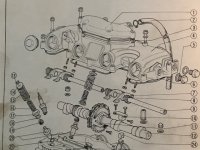
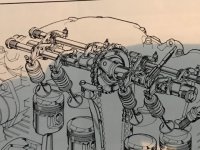
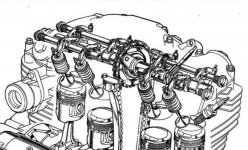
However, in the exploded view from the engine, at the first view pages, the drawing shows otherwise:

IMG_0350_t.jpg


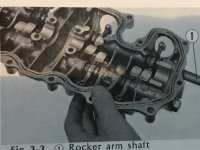
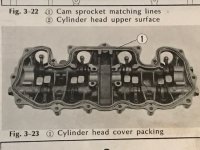
But the FSM also shows pictures, and here I found differences compared to the drawing in the FSM, as well in both parts manuals.

IMG_0351_t.jpg

and

IMG_0354_t.jpg


Not easy to spot, but both pictures are showing a different pattern for the springs.

Thanks STL360+450, very much appreciated for your alertness ! This is what I meant a few posts back, you don't have to be an expert on the matter to discover flows in an assembly or a setup.


I will open up and change the assembly tonight to see if this will be sufficient, but I'm afraid that's not the whole story because I found this misalignment on both sides , inlet side and exhaust side.
 
Perhaps there was some change during the production run? The picture below was grabbed from the 350F FSM and also shows the springs in different locations between intake and exhaust. Did you take disassembly photos?

Screenshot_20220606-095513.jpg
 
I will open up and change the assembly tonight to see if this will be sufficient, but I'm afraid that's not the whole story because I found this misalignment on both sides , inlet side and exhaust side.

Given that all of the followers are interchangeable, perhaps you can also rearrange them to achieve the best result.
 
Followers are exactly the same in with and shape, checked it before assembly. Yes, many pictures but not from that part..

Edit: I found a picture !, it was in another directory:

P1270026.jpg

P1270020.jpg

These pictures where labelled as "rockers", and not as "overview". The pictures show clearly that Honda did assemble in a different way as in the FSM and part manuals.
Tonight I will open it up, and change the positions to see if the alignment will be better. Two steps forward, one step back.

I'm happy I always look to the function of a certain assembly, to check my own work. This assembly didn't add-up, so raising questions, and solutions...
 
I'm no help, I've rebuilt many SOHC CB750 engines but never any of the other 4 cylinders.
 
Don't worry AD, I appreciate that people take the time to read and respond. By doing that, I'm much more motivated to put time in a complete and detailed documentation of the build.
 
Back
Top Bottom