A 1975 CB400F high mileage complete engine rebuild

In the morning I took the CB400F for work, it was a sunny day, but a little chilly, autumn is in the air. I used my heated gloves to keep my hands warm, and took the highway to work (my normal route is under construction). After 50 km of highway I left it, and did the last 20 km at back roads.

Afbeelding van WhatsApp op 2025-10-01 om 22.31.18_fae428d5.jpg

The way back, after a long working day, totally unexpected, the CB400F did quit on me.

Hmm, last week the CB450 K0 started leaking oil, and today. Since nothing worked any more, I suspected the main fuse. A blown main fuse was found quickly, but why? As mentioned earlier (probably in another thread), I always carry some tools and a multimeter with me. The sun was shining, it was warm, so time for a good check of possible reasons. I called my wife to say I would probably be late for dinner, and started unpacking my stuff.

Afbeelding van WhatsApp op 2025-10-01 om 22.08.45_b0cc6705.jpg


Afbeelding van WhatsApp op 2025-10-01 om 22.08.45_f7f4556f.jpg

Totally burned away, it must have been a short circuit indeed, it's a fuse of 15A. After checking a few things, I pushed in a replacement fuse (15A), and everything was working again. The normal current with lights out is 3,5A, and with lights on, around 7A, so again, it must have been a short circuit somewhere. I tested every circuit, but was unable to find anything that could have caused it. I packed my stuff and drove home without any problem (and still had dinner with my wife and son).

After dinner I did some extra measurements, but no result. Tomorrow, I will remove the headlight to seen something can be found what explains the blown fuse.


My bikes are probably taking revenge on me for not using them for a long time :ROFLMAO:
 
The way back, after a long working day, totally unexpected, the CB400F did quit on me.
I'm glad you were well-prepared for the situation! Was there anything notable about the circumstances at the moment the fuse blew? Or were you just moving along at a constant speed? Just curious.

Happened to me once turning right at a four-way stop with the blinker on. I had to use a rental scooter to get a fuse and was never able to determine the cause. I attributed it to the fuse being old (corrosion), but yours must be relatively new based on the recent rebuild.

I'm glad the replacement fuse got you home.

Addendum: I'm not sure I've seen your helmet before, but it's nice! (y)
 
Last edited:
Happened to me once turning right at a four-way stop with the blinker on

I was turning right, uphill (not an actual hill, but a dike), with my blinker on, using the rear brake to lower my speed. That's why I will check the wiring in the headlight, maybe I'll find something there. I cleaned the fusebox, but did not replace the fuses, I actually bought a few spares within the same range and size. However, I do use the highway more then average, maybe high frequency vibrations have something to do with it (typical 4-cylinder vibrations). At the highway the rpm-range is between 7000 and 9000 rpm (switching between 4th, 5th and 6th gear).

Addendum: I'm not sure I've seen your helmet before, but it's nice! (y)

Thanks, it's period correct, but a little noisy.
 
Last edited:
Maybe it was just a poorly made fuse that was internally barely connected and the bumpy road was the coup de gras.

I once flipped on the lights while accelerating on the Suzuki and blew one. Never found a problem and never happened again.
 
I also learned another thing, working on my bike at the roadside for at least an half hour. No one stopped by to ask what was wrong and offered help. Not that I needed help, but I expected, just as I do when I see a motorcycle rider in need, stopping by. There were many motorbikes, sports bikes, and lot's of BMW's GS's, but they were all in a hurry. Since I carry tools, I always offering my help to someone with a motorcycle when in need. I even carry sets of modern fuses that don't fit my bikes, I carry a multimeter, and some spare nuts and bolts as well. I also have a long fuel hose, making it possible to donate fuel from my own tank.

You learn every day, but these are the things I don't want to learn.
 
I also learned another thing, working on my bike at the roadside. No one stopped by to ask what was wrong and offered help. Not that I needed help, but I expected, just as I do when I see a motorcycle rider in need, stopping by. There were many motorbikes, sports bikes, and lot's of BMW's GS's, but they were all in a hurry. Since I carry tools, I always offering my help to someone with a motorcycle when in need. I even carry sets of modern fuses that don't fit my bikes, I carry a multimeter, and some spare nuts and bolts as well. I also have a long fuel hose, making it possible to donate fuel from my own tank.

You learn every day, but these are the things I don't want to learn.
Unfortunately, the world is becoming a less friendly place. It is not uncommon to see hundreds of cars pass by someone broken down on the roadside here in the US, because there is an increasing level of distrust. Many have been kidnapped, women raped and some even killed because they stopped to help someone, so most do not anymore.
 
That's sad, but not the main reason in the Netherlands I guess. I think that most people don't understand anything about what they have between their legs (motorbike), thinking they aren't able to help. Or being in a hurry, because dinner is waiting at home ;)
 
I agree that it's probably a majority of riders that would not be much help to a stranded rider and the prevalence of mobile phones makes it easier for stranded riders to get assistance, or at least call home with a request to keep dinner warm.

You are way more prepared than I am on a typical ride, but your commute is longer. It's good of you to lend a hand to others when you can. (y) I take it on a case by case basis — if it feels safe I will stop to see if there's something I can do to help. I remember one time someone was having trouble starting their scooter in a parking lot — they had accidentally flipped the kill switch and didn't even know what it was.
 
Somewhat uncertain, I took the CB400F to work yesterday. Since I couldn't find the reason of the blown fuse, I have some trust issue's, but the ride was perfect, not a glitch. While riding I was thinking what could possibly be wrong with the electrics, and I realised that the last thing I changed was the points ignition to the E-ignition. So, after arriving at work I took the fuel tank off, checked every connector, but still couldn't find it. On the way home nothing happened either, and, how closer I came to where I live, the more I start pulling wires, making short corners, braking, playing with the lights, but everything worked fine.

I took the bike to work today again, no issue's, even in the wet (it was raining the whole morning), luckily I could store the bike in a dry and warm place during the day.

Afbeelding van WhatsApp op 2025-10-14 om 21.50.26_39284e91.jpg

Afbeelding van WhatsApp op 2025-10-14 om 21.50.26_b38068e2.jpg
 
But you didn't go ride on an unpaved road. I wouldn't either, as nice and clean as it is.
Actually, I'm amazed at how clean it is considering he rode to work in the rain. Road splash always gets bikes dirty regardless how clean the pavement is, especially the exhaust where it dries too fast to rinse any dirt away.
 
Actually, I'm amazed at how clean it is considering he rode to work in the rain. Road splash always gets bikes dirty regardless how clean the pavement is, especially the exhaust where it dries too fast to rinse any dirt away.
All of his bikes, all the time. I don't know how he does that. It must be a Dutch thing.
 
Actually, I'm amazed at how clean it is considering he rode to work in the rain. Road splash always gets bikes dirty regardless how clean the pavement is, especially the exhaust where it dries too fast to rinse any dirt away.

It must be a Dutch thing.

Indeed, it is a Dutch thing, and it is called ZOAB, which stands for Zeer Open Asfalt Beton (Very Open Asphalt Concrete) and is a type of asphalt with many small voids. Very Open Asphalt Concrete (ZOAB) is a Dutch invention. It was first tested in the Netherlands in 1972 and has since been widely used on the main road network. This porous structure reduces traffic noise and prevents spray, making it safer during rain. It is the most commonly used asphalt on Dutch highways and B-roads and is also known as "whisper asphalt." Due to the open structure, water with dirt will drain through the top layer to the sides. Ones in a while the ZOAB is cleaned with a high pressure water truck.

zoab.jpg

As you can see in the above picture, water is directly absorbed by the ZOAB, and takes the dirt through the top layer, to the side of the road.

The properties of ZOAB:

- Noise reduction, the open structure dampens traffic noise, resulting in a quieter road.
- Water drainage, rainwater drains into the voids, reducing spray, which increases road safety.
- Rutting resistance, ZOAB is highly resistant to the formation of ruts (potholes) in the road surface.
- Comfort, it provides a comfortable driving experience.
- Composition, it consists of a mixture of stones, sand, filler, and bitumen, with a high proportion of coarse aggregate and a relatively low proportion of finer components, resulting in a high void ratio (approximately 20%).

Types and Variants:

- Single-layer ZOAB: This is the standard form of ZOAB.
- Durable ZOAB (DZOAB): An improved, stronger, and more durable variant that has been available since 2007.
- Two-layer ZOAB (TZOAB): This is a variant with a coarse base layer and a finer top layer, which provides even greater noise reduction. This reduces the need for noise barriers.

When it rains I avoid the non ZOAB roads, I don't like to clean my bikes. Luckely, 90% of the roads are made of ZOAB.
 
Last edited:
I also learned another thing, working on my bike at the roadside for at least an half hour. No one stopped by to ask what was wrong and offered help.

Sad to hear that. When I had my little breakdown last year, down a little back road, the two separate motorcyclists who were passing by both stopped to offer assistance. Middle aged chap on a 1980's Triumph twin, other was a young kid on 125 of some description. Nothing they could do as it happened, points end of the cam had broken off and I was waiting for the breakdown service to arrive. While I was waiting, a car driver who was also a motorcyclist came over and kept me company for while. Other cars slowed for a look, but I waved to say that I was OK.

There do seem to be two types of motorcyclists over here, those who wave and those who don't. I suspect that it's the ones who wave who would be most likely to stop and offer help. And then there are also some antisocial prats about who just seem determined to alienate society against motorcyclists in general.
 
Indeed, it is a Dutch thing, and it is called ZOAB, which stands for Zeer Open Asfalt Beton (Very Open Asphalt Concrete) and is a type of asphalt with many small voids. Very Open Asphalt Concrete (ZOAB) is a Dutch invention. It was first tested in the Netherlands in 1972 and has since been widely used on the main road network. This porous structure reduces traffic noise and prevents spray, making it safer during rain. It is the most commonly used asphalt on Dutch highways and B-roads and is also known as "whisper asphalt." Due to the open structure, water with dirt will drain through the top layer to the sides. Ones in a while the ZOAB is cleaned with a high pressure water truck.

View attachment 51065

As you can see in the above picture, water is directly absorbed by the ZOAB, and takes the dirt through the top layer, to the side of the road.

The properties of ZOAB:

- Noise reduction, the open structure dampens traffic noise, resulting in a quieter road.
- Water drainage, rainwater drains into the voids, reducing spray, which increases road safety.
- Rutting resistance, ZOAB is highly resistant to the formation of ruts (potholes) in the road surface.
- Comfort, it provides a comfortable driving experience.
- Composition, it consists of a mixture of stones, sand, filler, and bitumen, with a high proportion of coarse aggregate and a relatively low proportion of finer components, resulting in a high void ratio (approximately 20%).

Types and Variants:

- Single-layer ZOAB: This is the standard form of ZOAB.
- Durable ZOAB (DZOAB): An improved, stronger, and more durable variant that has been available since 2007.
- Two-layer ZOAB (TZOAB): This is a variant with a coarse base layer and a finer top layer, which provides even greater noise reduction. This reduces the need for noise barriers.

When it rains I avoid the non ZOAB roads, I don't like to clean my bikes. Luckely, 90% of the roads are made of ZOAB.
Jensen, nice to know where that asphalt was invented, we use it in NZ as well but only for roads that have a certain amount of traffic like motorways and some heavy use suburban. It is very good to drive and ride on rain or not, but when raining there is much less tyre spray coming up to the following vehicle And braking distances are good compared to sprayed on tar and chip surface.
 
As you might know, I'm working in a Machine Building Company, where we produce machines. During that process, we produce a lot of scrap metal, and this scrap metal will end-up in a the scrap-metal bin. We have one for steel, stainless steel, and aluminium. These bins are placed on my route to the secret test centre of our machine modules (secret in a sense of no customers aloud), so every time I walk-by the bins, my curiosity forces me to take a look at what's thrown away.

In general, there is only scrap, but this time, in the steel bin, I saw this :

Afbeelding van WhatsApp op 2025-10-18 om 10.16.17_4f67c938.jpg

Guess where these tools are now ? (after asking nicely the operation manager):

Afbeelding van WhatsApp op 2025-10-18 om 10.16.16_babbb462.jpg

OK, these tools are not new, and some had a hard live, but still all very useable for me. Cleaning and de-rusting are the next steps.
 
Last edited:
It was a nice day today, time to ride my bike to work, and, because we love pictures :

Afbeelding van WhatsApp op 2025-11-05 om 20.09.11_d1051c75.jpg

Afbeelding van WhatsApp op 2025-11-05 om 20.09.12_26079969_bew.jpg

Riding into the sunset from work to my home, the skyline of Amsterdam bathing in orange.

Afbeelding van WhatsApp op 2025-11-05 om 20.09.11_40954234.jpg

On these kind of occasions I would like to have my SLR with 300mm at hand.

Afbeelding van WhatsApp op 2025-11-05 om 20.09.12_17c8fda4.jpg

And a large moon behind me.

Got home in the dark, and another 160 miles (260 km) added to the odo
 
Getting colder in the morning, I need to use my heated gloves otherwise my hands are frozen. The battery's are integrated in the glove itself, in the beginning I was a little skeptical but the battery's last at least one hour on setting 2. The moisture in the air with fog makes everything extra cold, but the bike performs perfect in this cold and damp weather.

Afbeelding van WhatsApp op 2025-11-07 om 09.45.30_0495baaf.jpg

Afbeelding van WhatsApp op 2025-11-07 om 09.45.30_ec8d61de.jpg

After 45 minutes of riding, the sun made the fog disappear a bit, and it got a little warmer too.

Afbeelding van WhatsApp op 2025-11-07 om 09.45.30_c6cb1012.jpg

Hopefully I can take the bike until the end of this month, because spring and autumn are the nicest seasons to take the bike. Wearing full gear, I find the summer too hot mostly.
 
Last edited:
Ice and snow, a little unexpected, and too soon, but the riding season is over, too much salt on the roads. I took the exhaust off the CB400f for cleaning and polishing, and made the bike winter ready by draining the carbs. The CB400f will get some upgrades and repairs during the winter, but only minor things like a LED headlight, and new front fork seals (the right one is leaking a bit, A short list for this winter.....

Afbeelding van WhatsApp op 2025-11-21 om 21.23.54_9f05828f (Klein).jpg

Afbeelding van WhatsApp op 2025-11-21 om 21.23.56_7daf8d78 (Klein).jpg

Afbeelding van WhatsApp op 2025-11-21 om 21.23.56_19bf4de2 (Klein).jpg
 
Brrrrrr. Winter is a good time to catch up on bike maintenance. Keep us up to date. I was also thinking about LED lights but at the moment I'll be looking at the head and working on the front wheel.
 
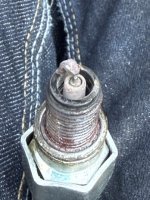
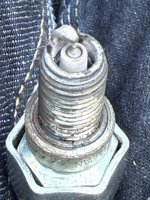
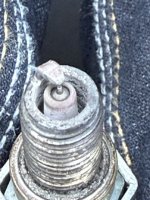
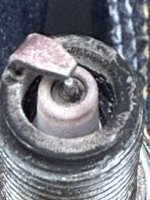
Every year I check the condition of the spark plugs (before winter), and until last year no surprises. However, the bike didn't "feel" 100% the last ride, and the pictures reveals why :

CB400f cylinder 1.jpg

cylinder 1

CB400f cylinder 2.jpg

Cylinder 2

CB400f cylinder 3.jpg

cylinder 3

CB400f cylinder 4.jpg

Cylinder 4


Cylinder 1, 2 and 4 within the expected range, but cylinder 3 too hot. This means carbs out before the next season. I luckily checked them after the blown fuse, they were all ok, so whatever happened, it happened the last rides. I think some clogged jet, we'll see.
 
I don't envy you having to take those carbs off to do a cleaning, but I'm sure you have your technique to make it easy.
 
I hate hot cylinders. Let us know what you find. I'll be looking at my carbs, hopefully in the near future. I'll get new intakes first because mine are all ancient.
 
I don't envy you having to take those carbs off to do a cleaning, but I'm sure you have your technique to make it easy.
I hate to do it, but heating up everything around the carbs is the only way. I had to remove them anyway, to set the needles in a different position.
 
Yesterday I took the CB400F for a ride, it was nice weather, not too warm, and no insects. The whole week and weekend it was nice, and added 400-isch km's on the odometer of the CB400f, and 200 kms at CB450 K0. I also took the CD50H for a trip to my parents, but that's only 40 km's in total. I promised myself to ride the CD50H to my work this year, but the temperatures must be a little higher (this morning there was ice on my windscreen of my car).

IMG_3937 normaal.jpeg

BTW, I love those pipes, it's the signature of this bike, a one of a kind styling.

The designer is Soichiro Irimajiri (also responsible for the design of the legendary CBX1000), but not publicly known like other designers like Giogetto Giugiaro (Bertone), Marcello Gandini (Lamborghini), Battsita Pinin Farina (Pininfarina) or Bill Mitchell (Chevrolet Corvette Sting Ray 1963 and the Camaro).
 
Yesterday I changed the set-up of the bike, making it more gentle for my back. I did make the rear suspension softer (lowered the spring tension by two clicks), changing the rear wheel tire pressure from 2.3 to 2.0 bar, en the front wheel tire pressure from 2.0 to 1.8 bar. I also changed the front fork oil from 7.5W to 5W, making the damping softer. I'm confident with the set-up for now, but I think I will add a little more oil to the front fork (I added 140 cc yesterday) when it bottoms out, just 10 cc extra per leg, to make it more progressive when needed.

The bike was set-up very harsh with high tire pressure, 7.5W front fork oil, 160 cc per leg, and a way stiffer rear shock setting. It was perfect for sharp high speed cornering, and behavior at high speeds on high way's, but very nasty to drive slowly around town, or B-roads with potholes and all kind off tree-roots below the tarmac surface.

It feels like saying goodbye to motorcycling the way I like to experience it, but I'm realistic enough to accept the fact that I'm getting older, thereby taking more into account that the more careful I'm with my back from now on, the longer I can enjoy my motorcycling years to come. I'm not in pain, not before, and not after a ride, but it is wise to give my back a more gentle treatment, fitting better with my age and medical history, as I ride many hours on my bikes, and planning to do so for many years to come.

The CB450 K0 will get the same treatment, however, it is already softer en more gentle to my back, so not so drastic changes will be acquired to the set-up like the CB400F.

I'm looking forward to my C78 dream, because that bike will be my last bike I can ride before I have to say goodbye to motorcycling (hopefully not within the next decade's).
 
Last edited:
It feels like saying goodbye to motorcycling the way I like to experience it, but I'm realistic enough to accept the fact that I'm getting older, thereby taking more into account that the more careful I'm with my back from now on, the longer I can enjoy my motorcycling years to come. I'm not in pain, not before, and not after a ride, but it is wise to give my back a more gentle treatment, fitting better with my age and medical history, as I ride many hours on my bikes, and planning to do so for many years to come.
You're in the position I was 20+ years ago, though the deterioration of discs in my lower back began well prior to that so pain has been a way of life for me the last 30 years, only worse with age. I don't ride as often as I used to, but the Ikon shocks have helped my situation since installing them last year.
 
Working on a CB750 F2 engine, what a difference with the status of my CB400F, This bike has "only" 60.000 km on the odometer, while my CB400F engine had 73.000 mls on the odometer before disassembly. The difference between regular and good maintenance and no maintenance at all.

IMG_0411 normaal.jpeg

IMG_0410 normaal.jpeg

Top of a valve :(
 
Last edited:
I've never seen that type of damage to a valve tip before. It's painful to see!

Did you acquire the F2? Or are you helping someone else with the bike? Is it of European origin?
 
Well that's ugly. I've been telling people for years that excessive valve clearances can lead to this, but that is far worse than usual. I'm sure you won't mind if I borrow that picture to use as a worst-case scenario example for others in the future.
Ofcourse, people might learn from it. Btw, the issue was visible from 5 out of 8.
 
I've never seen that type of damage to a valve tip before. It's painful to see!

Did you acquire the F2? Or are you helping someone else with the bike? Is it of European origin?

No, I didn't, it is from someone here in the village. I rode with him (he, on his Norton) to an oldtimer bikeshow in the summer. He bought the bike because he had good memories from the past. I help him to get this bike on the road again. I don't know much about the bike, the engine is just a little larger then my CB400F, and some things are different, like the camshaft bearings. Luckily, those things are ok-isch, however, one lobe was clearly a little too tight, but good enough for a rider. Furthermore the head has lot's of issue's, replacing 7 out of 8 valves is one of them, and, as expected, at least 7 valves guides are ready for the scrap. I strongly advised him to replace the piston's as well (std still in it). The camshaft was well lubricated, so I don't expect issue's with the crank -bearings. The rest of the bike is fixable without throwing much money against it, but these parts (head and cylinder) are the issue of this bike.

I did read-in a little bit on the CB750 F2's, and it seems that these bikes all have the same issue's with the valve guides, the bike just runs too hot, and on top of that, someone in the marketing department thought that a black painted engine was a good idea. Painting the head and cylinder isn't a good idea, and on top of that, black is the worts choice when it comes to heat dissipation at a air cooled engine.

btw, it wasn't the first time I saw valves that are butchered due to excessive valve clearance but it was the first time of my life that I had to use the Dremel to remove the mushroom at the top before I was able to remove them :cry: because else I couldn't get the valves through the valve guides (5 out of 8).

IMG_0411.jpeg

Here the enlarged picture of the head, these 5 valves had to be "dremeled" out, never done that, there is a first time for everything I guess. All the valve seals were hardened as stone, I needed to heat them up to take them off, and the all came off in pieces. The strangest thing is that the four intake valves were the worst, "only" one exhaust valve showed excessive wear.
 
Last edited:
It's very nice of you to assist your neighbor with the rebuild, especially given that you have other projects going.

I didn't know much about the F2 when I bought mine and I probably wouldn't have purchased it if I had researched it first. It was likely abused in the past, too, with less on the clock than this one, yet no mushroomed stems. The guides were shot and I eventually replaced the head with a rebuilt one from Cycle X through their exchange program. I also scrounged +0.5mm pistons on eBay.

it was the first time of my life that I had to use the Dremel to remove the mushroom at the top before I was able to remove them
🤯 Gotta do what you gotta do sometimes.
 
I've seen valve tips like that quite often on bikes that didn't get serviced, some people won't do anything until it stops working..
CB750 F2 was a bit renown for it though, but, it is the quickest stock CB750 with re-designed head to fit larger valves than is possible on earlier ones.
Forks were way too flimsy for weight of bike, I remember first one we had at shop as a demo bike, forks would flex so bad under heavy braking there was about 2" difference front to back where wiper didn't touch fork tube (braking from around 120mph)
The brakes were very good though when new, even with 'small' diameter rotors
CB400F, pretty sure I mentioned it before, pipes look great but right side ground clearance is restricted, every one I saw had some scuffing from cornering.
Not as bad as 550F, that would lift wheel until collector wore away
 
I'm glad you were well-prepared for the situation! Was there anything notable about the circumstances at the moment the fuse blew? Or were you just moving along at a constant speed? Just curious.

Happened to me once turning right at a four-way stop with the blinker on. I had to use a rental scooter to get a fuse and was never able to determine the cause. I attributed it to the fuse being old (corrosion), but yours must be relatively new based on the recent rebuild.

I'm glad the replacement fuse got you home.

Addendum: I'm not sure I've seen your helmet before, but it's nice! (y)
After this incident, it never happened again, so I think it's safe to say that resonance was the issue that blew my fuse. I did read an article that did some research on fuses, and why modern fuses are build up differently. It seemed that resonance of the part within the glass tube (especially the longer 30 mm ones) results in mini cracks, and when there are enough, it will give up.

  • Aged Fuse Clips: After 40+ years, the original brass clips often lose their tension. If the fuse is loose, it will vibrate within the holder, causing arcing (sparking) and heat. This often melts the fuse box or causes the fuse wire to snap.
  • Engine Harmonics: At specific RPMs (typically around 7,000–9,000 RPM), high-frequency vibrations can cause the brittle filament inside the glass to fracture, even without an electrical surge.
  • Corrosion: Old Honda fuse caps often oxidize. This creates resistance, which generates heat and makes the internal wire even more susceptible to mechanical failure.
The fuse died in the afternoon, while in the morning I did a very long high way ride (1 hour), on a 130 km/hr highway. The engine runs then around 8000 rpm, responsible for high frequent vibration (it is not coincidence that my fingertips are white and cold when riding at 7000-8000 rpm over a longer time).
 
Last edited:
Check out these valves. Intake and exhausts from a Ford 300 inline six running propane that I rebuilt a few years ago.

20211222_143426.jpg20211222_130656.jpg
 
Both of those are pretty ugly. About how many miles on it in that time? Just curious, don't want to hijack Jensen's thread.
 
WhatsApp Image 2026-06-23 at 09.31.42 (1).jpeg

Plus the 100.000 km before the reset of the odometer, makes a total of 190.000 km. Proud to own a bike that saw so many km's without big issue's (ok, ok, I did rebuild the engine, and replaced some parts, but the gas tank, still has the original paint, just like the side-covers. The chrome mudguards, exhaust, and muffler are the same as they left the factory in 1974). I wish I could rebuild my own body to the same level as this bike, I would be like 18 now !

WhatsApp Image 2026-06-23 at 09.31.42 (2).jpeg

Somewhere in the middle of the fields, on the bottom of the sea, on my way to work, I reached this milestone. I don't know if I ever will reach the 200.000 km, because 10.000 is a lot to cover for the coming years, next to the other bikes who need a ride once in a while.

WhatsApp Image 2026-06-23 at 09.31.43 (1).jpeg

Hopefully the bike will survive the electric madness, and own it's own place in the coming future.
 
Beautiful, Jensen! Nice framing in all of the pictures. You even centered that last nine digit on the odometer!

I'm glad to see that the 400F is continuing to get regular exercise and it's nice to have an update on this thread.

I fear a bit for all of our bikes. No doubt your 400F is ready for another 50+ years of service with continued maintenance. Hopefully it doesn't end up like the movie Firebird 2015 AD (1981).
 
Back
Top Bottom