1976 Honda CB360T - First Bike and First Round of Maintenance!

Joined
Aug 20, 2024
Total Posts
38
Total likes
21
Location
Oklahoma
Hey Everyone!

I got a little carried away in my new member post so a lot of this is a repost of what I put in there, but I've tried to a little more info here.

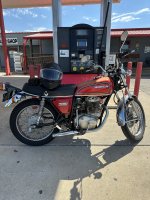
I just picked up a ‘76 CB360T last week and I’m planning to do the following maintenance on it, fortunately it runs right now but it’s idle is rough and I’m getting some smoke out of the carburetor after it's been running for a few minutes,

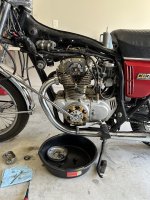
1. Drain oil, remove right crankcase and clean oil filter, replace right crankcase cover with hex head screws for easier access next time. I'm planning to leave the oil drained while I complete the following maintenance, do you see any issues with this?

2. Adjust cam chain

3. Adjust valve clearance

4. Set ignition timing

5. Clean carburetors

6. Replace pod air filters from previous owner with original reproduction filters

7. Add oil back into engine

8. Let engine idle for 10 minutes, then sync carbs

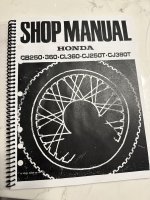
So that's probably more than I can chew for my first maintenance on a motorcycle ever, but I think it will help my idling issues and the smoke from the carbs. I’ve been relying pretty heavily on the those guys in Houston YouTube channel for how to do most of these procedures, and I had the .pdf copy of the service manual printed and bound at QuikPrint since it’s like 170 pages, but has a lot of good information that’s nice and quick to have on hand instead of having to get all the info from a video or going back to your laptop (to much) while I’m working through all this. I've already started to see a lot of mixed opinions about those guys in Houston so im trying not to rely on them so much and follow the Service manual more closely instead, any additional resources would be great!

I'm planning on doing all of this at the same time probably over the course of a week while the bike is on bike stands in my garage.

Anyways, open to all suggestions/advice to the maintenance list, thank you!

Proper mufflers are coming next once I get through this list!
76 Honda CB360T.JPG Honda CB360T Service Manual.JPG
 
Welcome to the club. Thats a really good looking example. I've got a 74 360G.
Just curious.....you didn't get any push back from the printer about copyright issues with the manual? I've thought about doing it, but was afraid they'd refuse.
 
Welcome to the club. Thats a really good looking example. I've got a 74 360G.
Just curious.....you didn't get any push back from the printer about copyright issues with the manual? I've thought about doing it, but was afraid they'd refuse.
Thank you! I did not get any push back from them at all, I didn't even think of a possible copywrite issue but that makes sense, fortunately they were very helpful and recommended clear plastic front and a plastic backing to keep it clean.
 
Don't wait until you do the rest of the stuff to put oil back in. That's an easy recipe to a big, expensive, oops.
Throw in a check of the tires for date code, pressure and wear.
Check brake lever and pedal free play and wear.
Might as well wipe down the chain and lube/adjust that as well.

If you're going to idle it to bring to temp, have a big shop fan blowing on the engine hard, these things need air like they need oil. If you don't have one, just idle for the couple of minutes it takes to get your helmet on, gloves on, then ride easy for a bit.
 
Don't wait until you do the rest of the stuff to put oil back in. That's an easy recipe to a big, expensive, oops.
Throw in a check of the tires for date code, pressure and wear.
Check brake lever and pedal free play and wear.
Might as well wipe down the chain and lube/adjust that as well.

If you're going to idle it to bring to temp, have a big shop fan blowing on the engine hard, these things need air like they need oil. If you don't have one, just idle for the couple of minutes it takes to get your helmet on, gloves on, then ride easy for a bit.
This is a great point, after a few days of working on this bike it would be very easy to forget to finish the oil change. I’ll be checking the brakes and chain too!

Thanks for the heads up on the idling as well!
 
You might fine this useful:
 
Hey everyone,

So, I got all the parts, tools, and lubricants needed to begin this round of maintenance and everything has been going smoothly up until the ignition point adjustment and timing.

Cam chain has been adjusted, no problems here at all.

Valve clearance has been checked and adjusted according to the service manual specs, no problems here either.

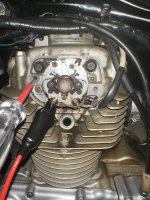
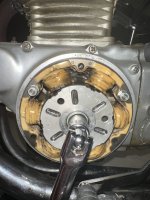
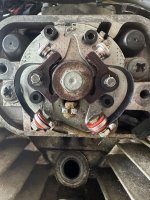
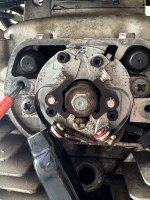
I've just replaced the left and right points with new ones, the ones that were installed were in rough condition, and I've done an initial adjustment with a feeler gauge to put the point gap in line with what the service manual says. I'm working with my test light now to check that the left point is opening when the rotor lines up with the "LF" mark and the index point, however I'm not able to get the test light to light up at all. The clip is attached to the left bottom point and the engine is on a compression stroke, but no matter much I move the point gap in or out, the test light doesn't want to do anything. I know I have power because clip from the test light will spark if I touch the ground and the bottom of the point at the same time, also I pushed the points all the way together at one point and got a couple sparks as well, I'm not sure how the adjustment is supposed to go from here. Any advice on setting these? Any best practices I should be using with the test light?

I know this isn't a favorite resource here, but I've been using the those guys in Houston youtube video on how to set the points as a reference for doing this, but always just deferring to the service manual if they say something different. All advice is welcome, and thanks in advance!

Points.jpeg Generator.jpeg
 
those guys in Houston believes the points gap doesn't matter. If Honda believed that, then in the FSM they would have simply told us to set the points to break at LF and never bother to mention that we should set or check the gap. But they didn't, and like everything else Honda said and did back when these bikes were designed and built by them - and not by anyone from those guys in Houston - they described the proper procedure for the ignition system adjustment according to their design. And considering their accomplishments in the decade leading up to the design and manufacture of the 360, I'd say they knew what they were talking about.

That said, the pic on the left seems to show that your test light clip might be shorting on the head, and/or the left points wire terminal is touching the metal of the points frame. If so, it would act as if the points were closed all the time so you would never see the test light turn on whether the key and kill switch were on or not (and during this adjustment effort, the key and kill switch were on, right?). So first, I'd be sure of proper continuity between the points and points wire terminals without them touching any ground surface, then turn your rubber-covered alligator clip 90° and clip it over the nut using the rubber cover to prevent contact with the head behind it. Turn the key and kill switch on and use a screwdriver to either open the points, or if they are open already, jump across the points to see if there's power there, and you should see a spark. If that happens then your connections are good and you should be able to get a test light lit when the points are open.

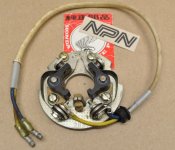
Here is a picture of the proper points wire terminal connections and how they should be oriented to avoid the need for another well-worn internet wive's tale and requisite band-aid, using 2 points cover gaskets, or a piece of electrical tape on the cover, because otherwise it shorts out one cylinder. They didn't do that from the factory because when the parts are properly assembled there's no need for it. No it's not a 360 plate and points, but they're assembled and wired the same.

350 points correct.jpg

When you locate the left points wire terminal on the inside of the left points attachment location it raises the end of the terminal away from the points cover and eliminates the need to do any band-aid fix so it will run on both cylinders. It also helps eliminate the possibility that the fatter end of the terminal where the wire is crimped will be kept away from the lower end of the metal frame of the points by the fiber insulating washer to avoid shorting to ground there.

Once you've confirmed clean, short-free connections at both points wire terminals, then you can go on with the proper timing adjustment procedure, which is this below. If the tedious aspect of the adjustments necessary takes a while (and it can at times), you can use a tip from Mike in Idaho and put a piece of paper between the other set of points to avoid overheating that ignition coil so you can take your time and get it right.

[The proper points/timing adjustment method involves first turning the engine until the breaker cam opens the left set of points to the fully open position and setting the gap of that set of points at .014", then turning the engine until the right set of points is fully open and setting them at .014", then adjust the left side timing by rotating the points plate so the left points break at LF. You then lock the points plate and check the timing on the right cylinder to see if the points break at the F mark and if they do not, you adjust the gap to get the right points to break at F. If after that adjustment is made, the gap on the right points is less than .012", you go back to the beginning and reduce the left points gap to .012", set that timing by rotating the plate to open at LF, then check the right side again and adjust the right points to open at F.

Yes, it can take a few tries to get both correct, but that is the procedure since there is only one plate that both sets of points are mounted on, so when you rotate the plate to advance or retard the left timing it affects both.]
 
First off, thank you for the incredibly detailed and clear response, this is invaluable advice and has been very helpful.

I did have the kill switch in the "OFF" position for the first 10 or 15 minutes I was trying this last night and once I figured that out and turned the bike on things starting much moving along much better. Gotta learn things the hard way right?

Thank you for the picture of how the points terminals should be connected to the points, I definitely think the terminals were touching the base plate and grounding out. I just removed the whole base plate and reattached the points wire terminals to match the arrangement you've shown, making sure those terminals aren't touching the base plate.

IMG_8470.jpeg

When I have the ignition on and I spin the generator past the "LF" mark, the left points spark and it looks like im getting power, however I still can't get the test light to light up. Thank you for the advice on the arrrangement of the clip and to make sure the clip isn't shorting out on the base plate behind it. I reoriented the clip and pushed the plastic cover over the clip after its attached to the left point nut to make sure it isn't touching the back of the plate, im still getting a spark from the point when I rotate the generator, but nothing on the test light. Could I still have a short some where on the points/base plate if im getting a spark on point but nothing on the test light?

IMG_8472.jpeg
 
First off, thank you for the incredibly detailed and clear response, this is invaluable advice and has been very helpful.

I did have the kill switch in the "OFF" position for the first 10 or 15 minutes I was trying this last night and once I figured that out and turned the bike on things starting much moving along much better. Gotta learn things the hard way right?
Those lessons usually stick better, yes. And we've all done them. Can't tell you how many times I kicked my ass off before realizing my SL175's kill switch was off (when I was 16).
When I have the ignition on and I spin the generator past the "LF" mark, the left points spark and it looks like im getting power, however I still can't get the test light to light up. Thank you for the advice on the arrrangement of the clip and to make sure the clip isn't shorting out on the base plate behind it. I reoriented the clip and pushed the plastic cover over the clip after its attached to the left point nut to make sure it isn't touching the back of the plate, im still getting a spark from the point when I rotate the generator, but nothing on the test light. Could I still have a short some where on the points/base plate if im getting a spark on point but nothing on the test light?
Hard to say, and this might be a spot where a video could help us see what you're seeing. The left points gap looks a bit large to my eye in the pics above, but not large enough that the points would never close, so the test light should be on. And I'm sure you've checked the test light to be sure it lights when 12v is applied. The reason the test light turns on when the points break is because when the points are closed, the flow of 12v goes to the coil to saturate the windings to create a spark at the plug on discharge (which is the moment the points break). Once the points break, the coil discharges to the plug and the circuit is open which then allows the 12v to flow to the test light.
 
And I'm sure you've checked the test light to be sure it lights when 12v is applied. The reason the test light turns on when the points break is because when the points are closed, the flow of 12v goes to the coil to saturate the windings to create a spark at the plug on discharge (which is the moment the points break). Once the points break, the coil discharges to the plug and the circuit is open which then allows the 12v to flow to the test light.
This was it! My test light must have shorted out when I was touching the point and the breaker plate at the same time, luckily the light I bought had a spare light/fuse and after I replaced it, I was able to get the light to turn on and set the ignition timing! I was in the middle of making a video and tried this out and it worked.

Setting the left point wasn't that difficult, but I did have to do some back and forth to get the right point properly set and aligned with the "F" on the generator. Rereading the manual and these comments helped keep that process straight, but yeah it's tricky. I checked the points gap one last time after the points were opening on time and everything looks good now.

Now on to break down the carburetors and clean them out, I'm sure I'll be back for more advice on that process but I'm really happy the ignition timing is set, thank you again for the help with this. It really is the little things that you overlook that get you.
 
This was it! My test light must have shorted out when I was touching the point and the breaker plate at the same time, luckily the light I bought had a spare light/fuse and after I replaced it, I was able to get the light to turn on and set the ignition timing! I was in the middle of making a video and tried this out and it worked.
When in doubt, always go back to the beginning and check everything. Test lights are usually reliable but when they do fail you can chase your tail endlessly if you keep trusting it. Glad you got it sorted and it worked out.
Setting the left point wasn't that difficult, but I did have to do some back and forth to get the right point properly set and aligned with the "F" on the generator. Rereading the manual and these comments helped keep that process straight, but yeah it's tricky. I checked the points gap one last time after the points were opening on time and everything looks good now.
And now you know that the those guys in Houston "shortcut" or "quick and dirty" method is really pointless (pun intended). Doing it according to the FSM is NOT difficult, it just takes a little time to read and understand the process, then apply it properly and amazingly, those Honda engineers weren't actually idiots after all. :giggle:

And oh by the way, don't pay any attention to their theories about valve clearances either, they'd have you setting them at 3 times the clearance Honda suggests and down the road you could easily have mushroomed valve stem tips because of it.
 
Hey Everyone,

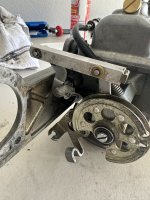
All right, so I took apart and cleaned out the carburetor's and this process has been going smoothly up until now. I'm putting the carburetor's back together on the base plate and getting the linkage hooked back up and it looks like the connecting hardware where the sync adjustment screw is has been bent out of its normal position. I think the PO tried to tighten down the sync screw too much and end up over torquing it and bending it out of position. It made getting the sync screw hooked up with the other carburetor almost impossible.

I did my best to bend it back into its original position and was able to bench sync both carb's, but now I'm having an issue with the link set not snapping back into position (video below), it looks like it hangs up on something but still im able to nudge it back into position. I definitely don't want this happening when the bike is running, so any advice on what might be causing this? Is it my linkage between the sync screw or something else causing this to stick? I tried looking for some good pictures of this linkage in the FSM and parts PDF, but the blown up view isn't the best for diagnosing this possible linkage issue.

Picture of the sync screw linkage I bent back into place

IMG_8482.jpeg


Alright, after taking the carbs apart and adjusting the linkage to where it has a full range of motion again (the base plate screws were tightened down with too much play in the carb bodies causing the linkage not work right) I'm running into another issue now.

I've got the bike all back together and it started right up with no issue, the idle speed was set wayyy too high though and it was revving at 4k rpm right when I started it. I shut it off, adjusted the idle speed screw, and it was running perfectly. I took it around the block and pulled over on the side of the rode to see if any smoke or anything was coming from the carb's. No smoke, looks great. I get back on the bike and shift it into first and begin to give it some throttle and the bike starts puttering a bit, I try to accelerate and can't get it above 5 - 10 mph. I pull back over and shut it off and try to see if anything's wrong, I check the spark plugs and make sure they are properly hooked up, they look fine. I start it back up but to get it started I have to give it some throttle to get it idling and running in neutral. I shift back into first and try to get it going again and same thing happens, it starts sputtering and not getting any really power in first gear and can't barely get to 10 mph, I try shifting into second gear and it still just kind of putters while i'm giving it gas until I let off the throttle and it dies.

My first thought is, it's the carburetors, maybe I didn't clean them well enough and something I knocked loose got jammed in one of the jets, or maybe the float bowl height is off, any thoughts on this?

The work I've done on the bike is cam chain adjustment, valve clearance adjustment, new points and ignition timing set, clean and rebuild carburetors. Anything else I should check?

Appreciate any and all feedback or recommendations! Hope everyone had a great Labor Day Weekend
 
Alright, after taking the carbs apart and adjusting the linkage to where it has a full range of motion again (the base plate screws were tightened down with too much play in the carb bodies causing the linkage not work right) I'm running into another issue now.

I've got the bike all back together and it started right up with no issue, the idle speed was set wayyy too high though and it was revving at 4k rpm right when I started it. I shut it off, adjusted the idle speed screw, and it was running perfectly. I took it around the block and pulled over on the side of the rode to see if any smoke or anything was coming from the carb's. No smoke, looks great. I get back on the bike and shift it into first and begin to give it some throttle and the bike starts puttering a bit, I try to accelerate and can't get it above 5 - 10 mph. I pull back over and shut it off and try to see if anything's wrong, I check the spark plugs and make sure they are properly hooked up, they look fine. I start it back up but to get it started I have to give it some throttle to get it idling and running in neutral. I shift back into first and try to get it going again and same thing happens, it starts sputtering and not getting any really power in first gear and can't barely get to 10 mph, I try shifting into second gear and it still just kind of putters while i'm giving it gas until I let off the throttle and it dies.

My first thought is, it's the carburetors, maybe I didn't clean them well enough and something I knocked loose got jammed in one of the jets, or maybe the float bowl height is off, any thoughts on this?

The work I've done on the bike is cam chain adjustment, valve clearance adjustment, new points and ignition timing set, clean and rebuild carburetors. Anything else I should check?

Appreciate any and all feedback or recommendations! Hope everyone had a great Labor Day Weekend
One thing to add to this, I reused all of the original brass carb parts EXCEPT for the float needles and float needle plugs. The old float needle plugs that the needle sits in were really torn up and the original float needles seemed to not have as much spring any more. I don't think I can reuse the old float needle plugs, but i should just put the old float needles back in?
 
My first thought is, it's the carburetors, maybe I didn't clean them well enough and something I knocked loose got jammed
Might seem silly, but did you check the choke? Is it possible you somehow bumped the lever in some way? Sounds like it was running rich suddenly and that would do it, as well as make things even worse when you tried to rev it harder.
 
Just went out and double checked the choke, its not engaged, valves to the air filters are open, and the linkage appears to be working as well.

It was running strong for 5 or 10 minutes and then all of a sudden no power (when I try to accelerate), and I have to twist the throttle to get it to start but it seems to be idling fine.

It looks like one the cover screw holes for my generator cover is stripped as well and I can't tighten one of the three screws for the cover, its leaking a little bit of oil from the cover but not much. Any best practices on how to fix the stripped screw hole? The screw it self and small gasket on the screw are in good condition.
 
Alright, I took the carbs off the bike and checked the jets again, it looks like I didn't do a great job cleaning these because one of the jets (unfortunately can't remember which one, but it was the smallest one by far) was pretty clogged and it looked like their was some additional debris in the float bowl area. I cleaned all the jets again in both carbs and wiped out the float bowls. Got everything assembled again and the new factory air filters back on. I'm going to see how it runs after work today and hopefully this fixes my acceleration problem but we'll see.

I'm not going to rush it and I want to get this done correctly. On the plus side, I'm getting really comfortable/good at working on these carb's! I've learned a lot about my bike during this round of maintenance and I want to make sure I take good care of it.
 
Quick update on this bike and maintenance process:

From my last post, I got the carb's back together after another thorough cleaning and they have been working great, it turns out my issue was with the ignition points... It looks like i didn't tighten the point hardware enough and when I opened the cover to check them the left point was no longer mounted and was just hanging by the wire. I reset the timing (I'm getting pretty good at that too) for both points and properly tightened those down with some new hardware and bike has been running great great for the past month. I think I've put close to 400 miles on it since the last post and have really just been loving it.

Well, it was running great great, up until yesterday when I was out for a ride and in the middle of a ride I lost power and my bike came sputtering to a stop. I pulled over into a parking lot as it died and tried to see what was happening. I tried restarting the bike a few times and it was turn over and want to start but it sounded like it was out of gas, so i checked the tank and there was still 3/4 of a tank full in there... which made me think the carb's were clogged up again. I ended up calling a tow truck (free with my insurance) to haul it back to my house and I took the carb's apart last night and they were definitely clogged. I knew they were clean when i put them back together last time, so I checked the fuel tank and saw the issue was a fair amount of rust in the tank, with some larger flakes floating around the bottom of the tank. Definitely should of checked the tank for rust earlier but it had been running fine up until now. I think all the riding I've been doing over the last month must have knocked some of this old rust loose now that I've been filling and emptying the tank with gas from regular riding.

So now I'm going to get some Evapo-Rust and work on cleaning out the tank tonight, I'll keep you all updated and hopefully will be back up and riding again soon! Hopefully this will fix it and will get the bike running again and keep the carb's from plugging again.
 
Can't say I've ever heard of a set of points coming completely loose from the plate, yeah I'd say that cylinder wouldn't run for sure. :ROFLMAO: Glad you made good progress, keep us posted.
 
Evaporust gets really expensive for enough to clean a tank. There’s a thread by @Danager4792 on his use of Rust 911 dealing with the same issue.
 
Evaporust gets really expensive for enough to clean a tank. There’s a thread by @Danager4792 on his use of Rust 911 dealing with the same issue.
Good lookin out, it’s cheaper than evaporust and works the same.

 
Good lookin out, it’s cheaper than evaporust and works the same.

I had just dug it up after taking a deeper look at Jenny Craig's tank.
 
Hey Everyone,

So the good news, I got my gas tank completely cleaned out and free of rust, carb's cleaned and reinstalled with proper air filters, and the bike has been running great.... up until last night.

It's still nice out where I am so I went out for a ride and while I was cruising along around 35 MPH, my bike made a bit of a noise and completely shut off while I was riding, I coasted into a parking lot and tried to assess what was going on. I knew i had just cleaned the carb's and gas tank so I checked those out first so make sure I was getting gas to the engine. They appear to be fine and I can see gas in the fuel filters so I didn't look like that was the issue, so I tried starting the bike again and it turns over a couple times and then backfires really loudly. I check the carb's again and it looks like the right carb has come loose from the clamp holding it to the engine. No problem, I probably just didn;t tighten that enough and it came loose while I was riding. I had a screwdriver on me, so I re-tighten the carb on and try to start it again, the bike turns over again and then backfires once more. I check the carb's and again and it looks like the engine backfiring has knocked the carb loose again... now I'm getting a little worried. I end up calling a tow truck and having the bike hauled back to my house.

I'm checking over the bike now and my first thought is maybe the timing is off and the spark plug is firing at the wrong time, or maybe the valve clearance is off and those need to be adjusted. Simple enough, so I open up the generator cover, ignition points, and valve cover (picture below). I try manually turning the generator over and it won't move forward, it seems like its stuck on something. I'm able to turn it backwards (clockwise) like 10 or 15 degrees and it makes a clicking noise, but I still can't turn it forward. I tried looking in the spark plug holes into the pistons and it looks like the valves are possibly open and kind of blocking the view into the piston...

What do you think could be causing this? Did my cam chain break or maybe one (or multiple) valves? Any idea's on where I should start looking for the issue? It looks like im going to need to take the top part of the engine apart (EDIT: valve cover) to properly diagnose and fix this, but would love any and all feedback before I proceed.

Thank you in advance! Hope everyone had a Happy Thanksgiving!

IMG_8977.jpeg
 
Last edited:
I'd start with pulling the cam/rocker cover first (since that top end can be disassembled in the frame) so you'll at least see what you'll be up against.
 
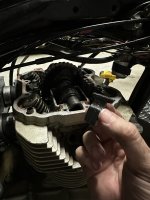
Well, I took the cam/rocker cover off and it looks like the issue is the cam chain guide has broken into pieces and has fallen into the engine... I pulled on the top of the guide and was only able to pull the first inch or so of the guide out (picture below), the rest is in the guide channel or fallen further down.

I'm going to work on getting the rest of the guide out with a magnet, but there appears to be additional metal debris up around the valve springs, I'm not sure if it's from the guide or something else.

I can order and replace the cam chain tensioner and guide no problem, but I could use some advice on what I should do next to ensure that I don't have any broken parts banging around in the engine. Do I need to take the top end of the engine off next? If there are other threads or ressources going through this process I would love to know about them.

Again, I appreciate the help, and if I should repost this on a different thread please let me know. Thank you all.

IMG_8978.jpeg
 
Looks like you’re going to have go inside the engine to replace the cam chain guide and also find out where the rest of the broken parts went. If the engine won’t turn then something got into a place where it doesn’t belong and you will need to get it out of there. While you’re in there, do a thorough inspection of the innards so as to avoid any further unpleasantness.
 
Well, it looks like I've got a December project.

I'm going to start by draining the oil and removing the right-side engine cover to inspect the oil filter and see if anything has fallen into that portion of the engine. Now that I have the cam/rocker cover removed and some of the pieces out, I'm now able to manually turn the engine over, which looks to be a good sign. The cam chain appears to be alright which is also good.
 
That is good but you will still have to get into the bottom end to see what might possibly be rattling around in there. The rest of your cam chain guide is down in there somewhere and you’ll have to get it out.
 
Back
Top Bottom