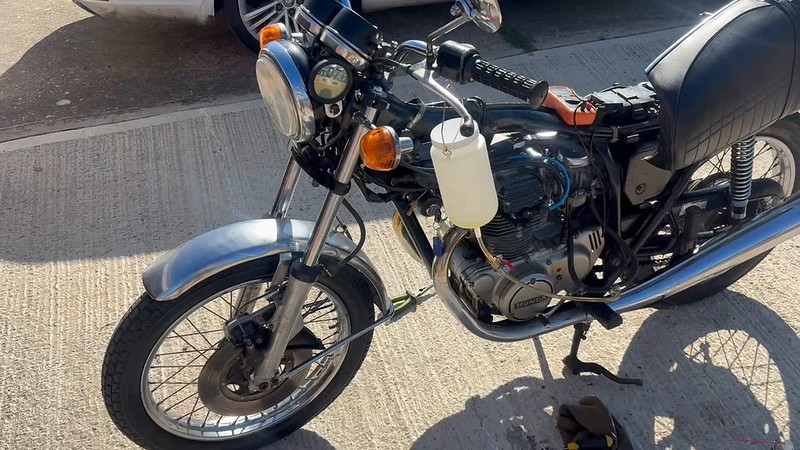
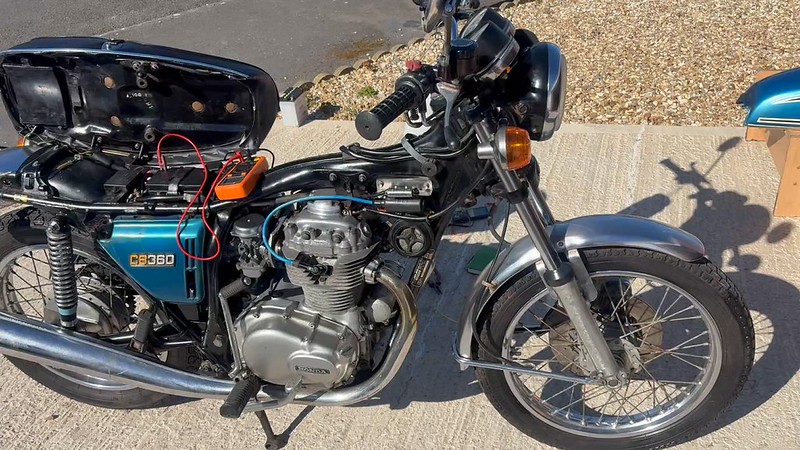
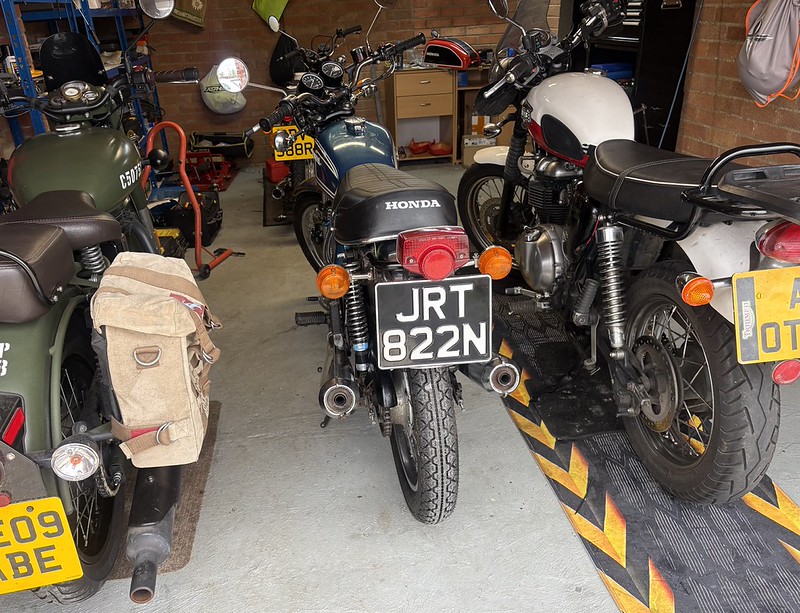
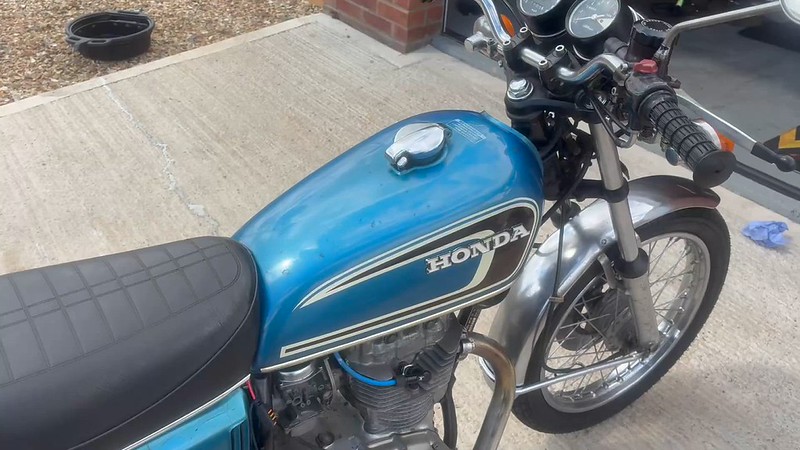
1975 CB360

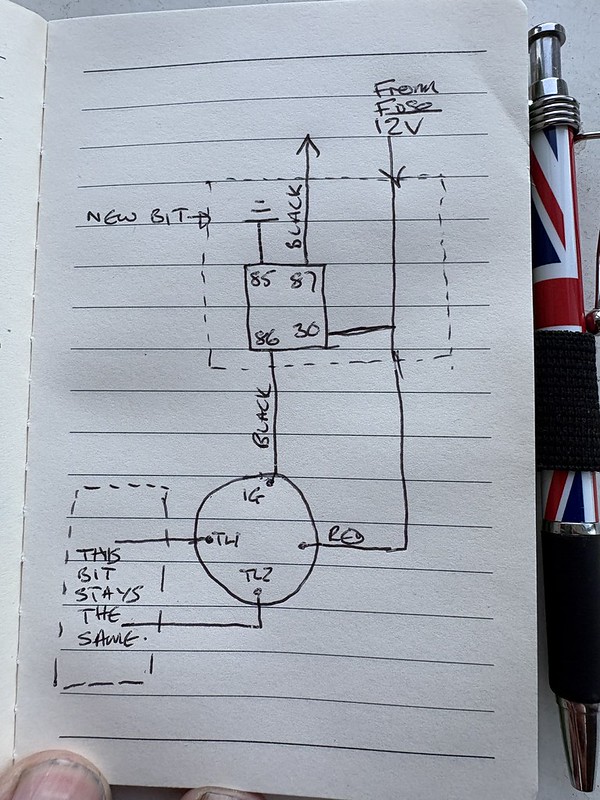
I’ve had something of an epiphany following on from Boddy’s idea about cleaning the ignition switch contacts - and in a similar vein to what I did on my 1963 Volvo Amazon. If the switch does turn out to have an intermittent high impedance I could bypass it with a 4 pin relay - which would be trivial. The switch only had 3 positions: off - on -park. There are only 2 wires that matter in this respect: the red from the main fuse and the black wire going out to almost everything else (apart from the two alternatives for the tail lamp that should just work as they are).

So, if I just interrupted the black wire and ran it to pin 86, then from pin 85 on to a frame earth as the trigger, as well as the splitting the red wire and taking a branch to pin 30 of the relay and on to the black wire via pin 87.

I‘ll draw a picture and add it on at the end of the post once I’ve had a cuppa (it is only 05:50 here).

I have to make sure the switch is where the problem lies first!

Any ideas?

Alan

Addendum. Like this:

IMG_6555 by Alan Othen, on Flickr
 
Last edited:
I’m not sure that image post worked, let’s try again:

IMG_6555 by Alan Othen, on Flickr

… perhaps someone would let me know if it worked this time?
 
Last edited:
I can't help feeling that you are making life complicated for yourself. I've just looked on Ebay, and pattern CB360 ignition switches are available for less than 20 quid. The handlebar light switch would need taking apart to clean the contacts, and there is a little spring and ball bearing that could easily vanish, but it is doable.

( I have fitted a relay to my Hornet, to power a pair of Fiamm horns mounted under the seat, same principle applies, low voltage input from horn button pulls the relay closed, high power across the other two contacts, battery +ve direct to horns, Reckon it makes the MOT tester jump when he tests my bike :LOL: )
 
I can't help feeling that you are making life complicated for yourself. I've just looked on Ebay, and pattern CB360 ignition switches are available for less than 20 quid. The handlebar light switch would need taking apart to clean the contacts, and there is a little spring and ball bearing that could easily vanish, but it is doable.

( I have fitted a relay to my Hornet, to power a pair of Fiamm horns mounted under the seat, same principle applies, low voltage input from horn button pulls the relay closed, high power across the other two contacts, battery +ve direct to horns, Reckon it makes the MOT tester jump when he tests my bike :LOL: )
Thank you - see below - I think you may well be right and I was planning for a few too many contingencies (must be the Army officer in me!).

Alan
 
This little motorcycle is so perplexing! I started off this morning expecting to check out the ignition switch, find it had an intermittent fault and triumphantly fix it with a relay (I’d even found a new relay in the spares shed ready).

I thought I’d run a few checks first. The motorcycle did start (slightly reluctantly) and ran much the same. Battery voltage was 12.8v and I monitored the voltage getting to the coils at 11.5v. There was negligible voltage drop from the coil feed to the points. The bike ran, a bit roughly, for a few minutes and stalled - not wanting to restart. At least I’d established a baseline, and with a voltage drop on 1.3v between battery and coils I probably didn’t have a rogue ignition switch.

I decided the next best thing to do would be to swap the coils from side to side. Actually this would put them the way they were supposed to be, the PO told me he’d got them the wrong way round and so had just swapped the plug leads over - should work.

So, 10 minutes of fiddling around had the coils the way Mr Honda intended. Hey presto: the motor started easily and was ticking over at 4,000 RPM, soon adjusted down to 1,500 RPM:

IMG_6559 by Alan Othen, on Flickr

It sounded much better. Ticking over much better, running cleanly, no popping or banging on either cylinder. We had been here several times recently, so I left the motor ticking over for 15 minutes, with the occasional burst to check all was well without annoying my neighbours too much:

IMG_6560 by Alan Othen, on Flickr

It was still running well after 15 minutes of continuous operation, so I turned it off and re-started - which it did instantly. Charging is now back to 13v and all sounds much better.

All I have done is swap over the coils, I can’t think of any reason why, but it all seems fine now. Perhaps this is another false dawn, so I’ll leave the tank off for the time being and start the motorcycle a few times during the day to see if the fault state reappears. I’m going to let the bike cool down and see if it will cold start in an hour or so; in the meantime Bob and I can walk along the beach to the Post Office to register the CB360 as an historic vehicle (being over 40 years old) and so exempt from tax and the MoT (roadworthiness test).

Putting the coils back to the correct way around has another advantage: I can route the leads, wiring loom, throttle and clutch cables correctly (I found a copy of Mr Honda’s routing diagram).

Alan :cool:
 
Last edited:
Keep in mind the fact that the motor is air cooled. It may be a good idea to run a box fan towards the motor if you're letting it run in place for such a long time, especially in warmer weather.
 
Keep in mind the fact that the motor is air cooled. It may be a good idea to run a box fan towards the motor if you're letting it run in place for such a long time, especially in warmer weather.
Good point, but it doesn’t get very warm here in England. Today is a nice day, it is 17C (61F). I am mindful of what you say though.

Alan
 
Good point, but it doesn’t get very warm here in England. Today is a nice day, it is 17C (61F). I am mindful of what you say though.

Alan
Looked like you were running it outside, too, which obviously helps. In a confined space it's best to make sure there is air going over the motor.

Yours is a nice example of the CB360!
 
Today was one of those days when almost everything went well. It has been a lovely, sunny day, and the CB360 seems to have suddenly decided to work properly.

When Bob and I got back from our lunchtime walk along the beach to the Post Office I started the 360 again - and it ran perfectly. It is hard to understand why changing the coils from side to side suddenly fixed everything- perhaps I inadvertently fixed something without noticing when I put it all back together?

This afternoon I decided it was time to change the oil. What a palaver that is: having to take an exhaust and a foot-peg off then remove the engine side to get to the sludge trap.

IMG_6562 by Alan Othen, on Flickr

Everything looked pretty good - although I thought the oil was probably pretty old. I’ll probably change it again at the end of the summer - next time I’ll have a new gasket stood by.

I’m still not absolutely convinced this isn’t a false dawn - I’ve thought I had this motorcycle sorted out a couple of times over the past week, but this time it does feel different (much better). The historic vehicle registration should only take a week, so then the motorcycle will be back on the road for the first time in 15 years. The CB360 won’t need it again, but I may well get it MoT tested in the next couple of weeks just to make sure I have everything right.

Alan

:cool:
 
Looked like you were running it outside, too, which obviously helps. In a confined space it's best to make sure there is air going over the motor.

Yours is a nice example of the CB360!
Many thanks. I agree it is a nice, original motorcycle.

:cool:
 
I’m becoming more confident that the CB360 is indeed fixed. Much of today was spent servicing and preparing the Royal Enfield Pegasus for its MoT test next week, but I did find time to start the Honda, and do a few tidying jobs between other things.

Just before I finished for the day I got the CO tester out and checked the two cylinders separately:

IMG_6567 by Alan Othen, on Flickr

I couldn’t find any specification for CO emissions (I suppose no one was worried about that in 1975); in lieu of a number I set both sides at 1.5% CO, which sounded reasonable and the motor seems happy with.

Alan :)
 
Last edited:
CO was never mentioned during any of my time at Honda shops. The restrictive caps for the mixture screws didn't show up on Hondas until the late '70s IIRC
 
CO was never mentioned during any of my time at Honda shops. The restrictive caps for the mixture screws didn't show up on Hondas until the late '70s IIRC
That is much as I’d expected - here in the UK, CO didn’t start being a thing until about 1979. I was pleasantly surprised to find that the CB360’s emissions were fairly low - quite a few 1980s motorcars would struggle to achieve 1.5% and still run smoothly.

I was really just using the meter to make sure both carburettors were the same today.

Alan
 
Last edited:
I’ve allowed myself a small indulgence with the CB360 project (mainly because the project costs so far had been only £24 for a new battery):

IMG_6573 by Alan Othen, on Flickr

… I’ve bought it a nice pressed aluminium black and silver number plate. Only vehicles registered before 1979 are allowed to wear these, and although the motorcycle almost certainly had the yellow acrylic type you may see on my other bikes when new, I thought this would be a nice finishing touch for the CB360.

:)
 
I've done the same on my CB175 and CL175. The SL175 has a more flexible yellow plate, to suit its off road credentials.

Black, with pressed silver lettering, is readily available, but I had more of a search to find black with white lettering, which is what I thought was the original style.

1777902581797.png
 
I've done the same on my CB175 and CL175. The SL175 has a more flexible yellow plate, to suit its off road credentials.

Black, with pressed silver lettering, is readily available, but I had more of a search to find black with white lettering, which is what I thought was the original style.
Still so much larger than ours here (well most states here, can't speak to all of them).

1777903074449.png
 
Still so much larger than ours here (well most states here, can't speak to all of them).

View attachment 57401
Absolutely yes. I found this photo of my Triumph America, with the Virginia ‘OTHEN‘ plate from 2007:

image001 by Alan Othen, on Flickr

… not only were Virginia (and probably all other US) plates far smaller, but one had almost free rein in selecting vanity plates at very small cost. I had Virginia plates ‘OTHEN’ on my motorcycle and ‘DAD & DAN’ on my truck.

Happy days :)

Addendum: perhaps I should explain that Dan is my son, now a 21 year old.
 
Last edited:
In the UK, the legal size for a motorcycle licence plate is 9" x 7", and apparently the police in some UK regions are quite strict about this, probably more so if they've pulled a rider over for some other offence.

The plates on all my bikes are smaller than that, and I've never had an issue, either from the police or at MOT test time. My plates are perfectly legible, some riders take the proverbial, with tiny plates, non standard fonts, and even 'stealth' coatings to try to defeat roadside cameras.
 
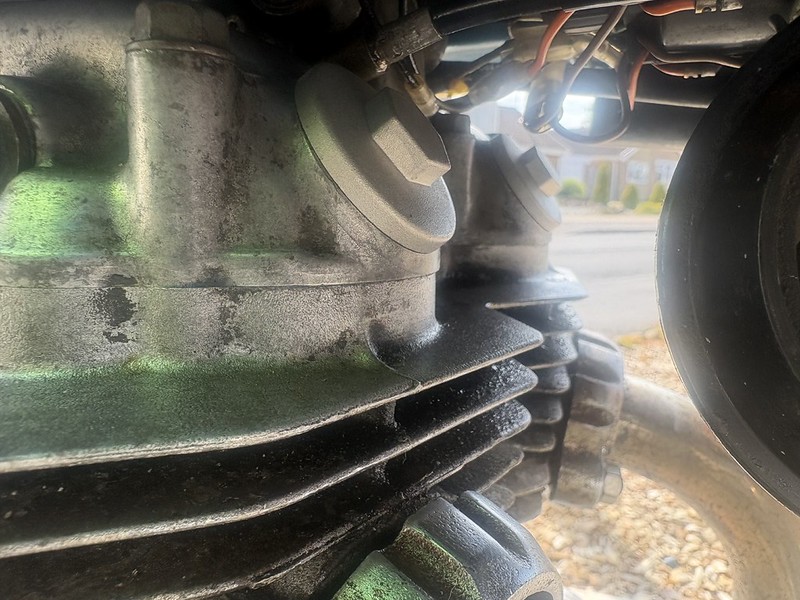
Readers may recall a small issue from about a week ago: there was a slight leak from the left side exhaust tappet cover, where some gorilla had over tightened it and rounded off the hex drive. I’d had to knock that cover out with a chisel, as you may see here it was pretty rough and still leaked a bit:

IMG_6577 by Alan Othen, on Flickr

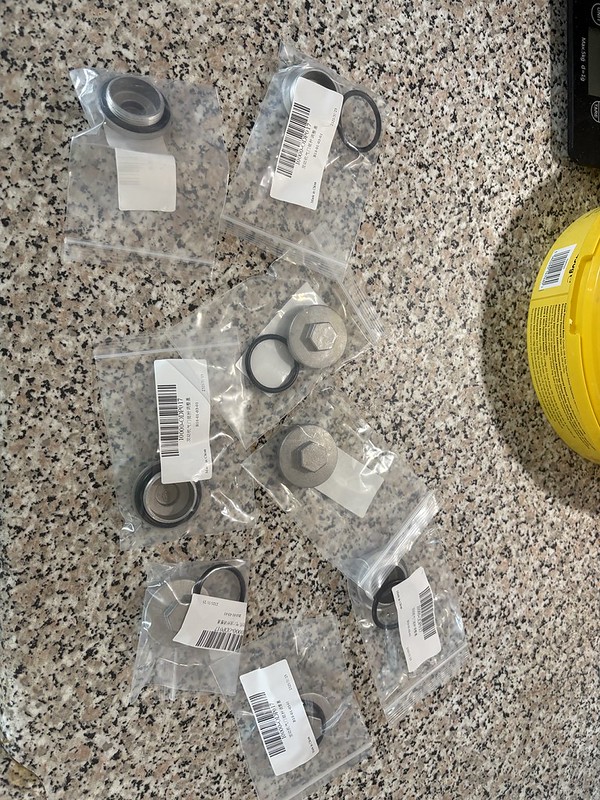
The replacement set I’d ordered on eBay (direct from China I think) at only £11 (delivered) arrived today. They seemed really good quality and were fitted in a trice:

IMG_6578 by Alan Othen, on Flickr

I‘d been slightly unsure how many covers would be included in the kit as the ad was rather ambiguous.

IMG_6576 by Alan Othen, on Flickr

I’m pleased to say there were two complete sets (total eight) caps included - that is less than £2 each!

Another small job completed.

:)
 
Last edited:
I’ve noticed that the starter clutch only engages when it feels like it. I’ve ordered a little kit of springs and rollers from David Silver for only about £25 and it looks like a pretty simple job to fit them. Is there anything to look out for with the CB360?

Alan :)
 
I’ve noticed that the starter clutch only engages when it feels like it. I’ve ordered a little kit of springs and rollers from David Silver for only about £25 and it looks like a pretty simple job to fit them. Is there anything to look out for with the CB360?

Alan :)
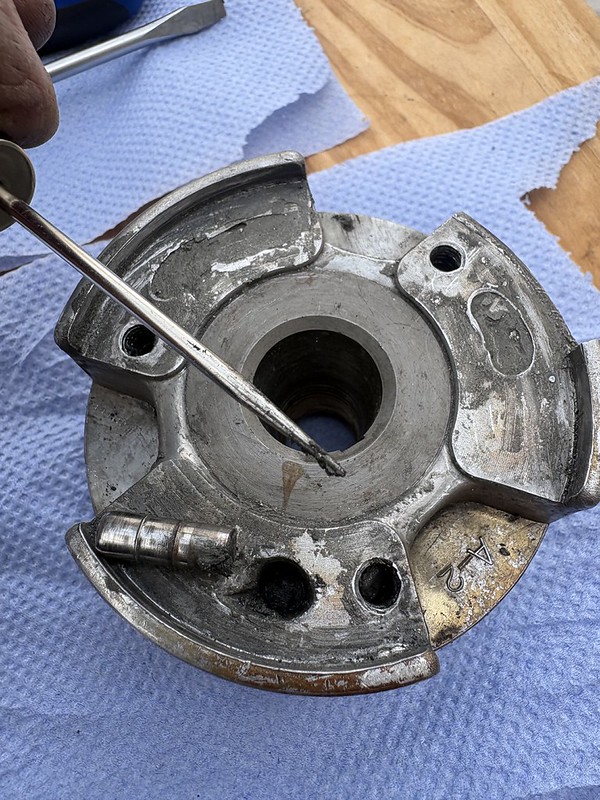
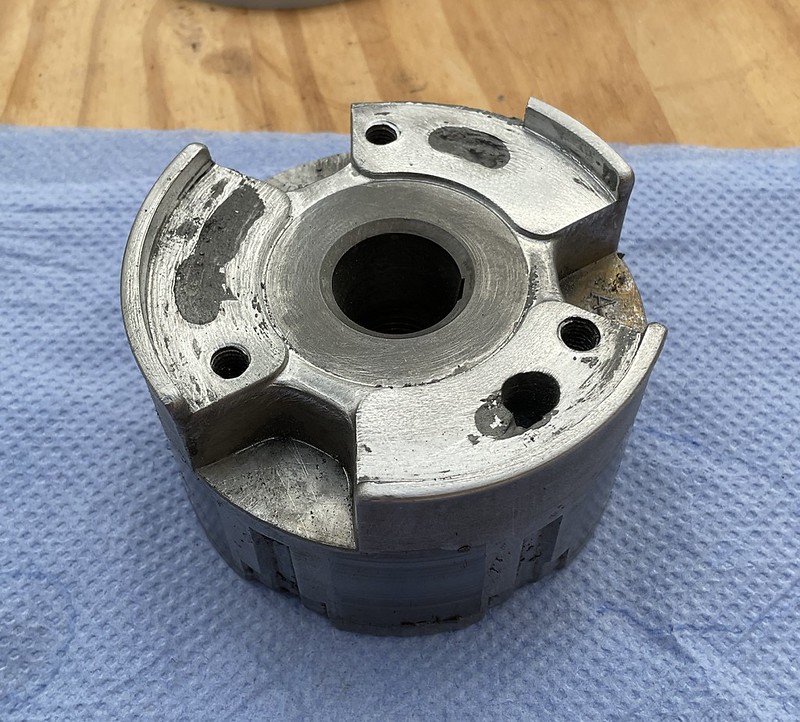
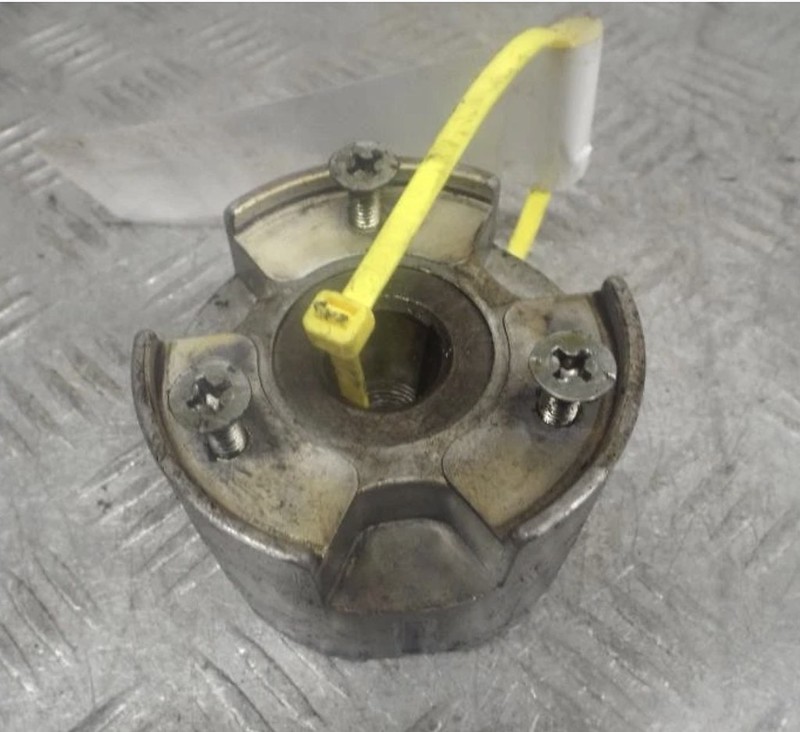
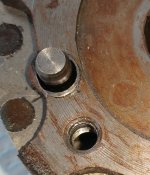
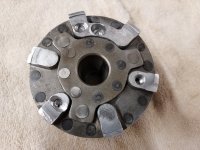
Did the kit include the 3 caps for the springs? You should replace all 3 parts (caps, rollers and springs). If the 3 JIS screws holding the outer housing to the rotor are loose, be sure to check the screws and threaded holes in the rotor for wear, as well as the hole for the locating pin. Hopefully none of the tabs are broken off your rotor.

starter clutch damage rotor.jpg

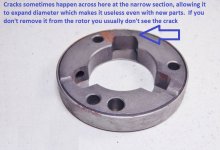
And check the inside of the outer housing for cracks like this: (they aren't visible until you disassemble things)

starter clutch housing.jpg
 
Did the kit include the 3 caps for the springs? You should replace all 3 parts (caps, rollers and springs). If the 3 JIS screws holding the outer housing to the rotor are loose, be sure to check the screws and threaded holes in the rotor for wear, as well as the hole for the locating pin. Hopefully none of the tabs are broken off your rotor.

View attachment 57433

And check the inside of the outer housing for cracks like this: (they aren't visible until you disassemble things)

View attachment 57432
Yes, the DSS kit includes the caps as well - I was being a bit lazy and not typing the whole 9 yards, that is all.

Many thanks for the tips - I haven’t had a shooftie inside the cover yes, so I don’t know what state things are in. I found a YouTube video that made it look fairly straightforward, and I’ve done similar jobs on Kawasaki quads in the past, so I’m not expecting any great difficulty.

I haven’t bothered to buy the DSS rotor removal tool - it looks to me like an ordinary 16mm bolt will do - here in the UK that is the size normally used for securing towing hooks, so I’ll probably borrow one from my car.

Alan :)
 
Last edited:
I’ve been reading up about possible damage to the rotor Ancientdad, thank you for the information.

If the screws have worked loose and the threads worn could I fit helicoils to restore them, or will I be looking for a replacement rotor? I can’t see new rotors for sale, but there appear to be plenty of of used items.

Alan :cool:
 
Last edited:
If the screws have worked loose and the threads worn could I fit helicoils to restore them, or will I be looking for a replacement rotor?
It depends on how long the screws were loose and the amount of damage done to the threaded holes. I've seen some go to 1/4"-24 screws and tap the rotor as such, but some are bad enough that the holes aren't repairable. I suppose helicoils could be used but I'd certainly be adding some loctite.
 
Many thanks chaps, I’ll have a look at CMSNL and DSS. Rotors seem to sell for £50-£80 second hand, but of course the item may be no better :) .

I’m away in Bristol for the rugby this weekend, so I’ll pull it apart and have a look on Monday.

:cool:
 
The rotor is available at about 2 weeks notice at both.

DSS: £323.
CMSNL: $332 = £243, but there may be some import duty to add?

Let’s see what the one from my motorcycle looks like on Monday :)
 
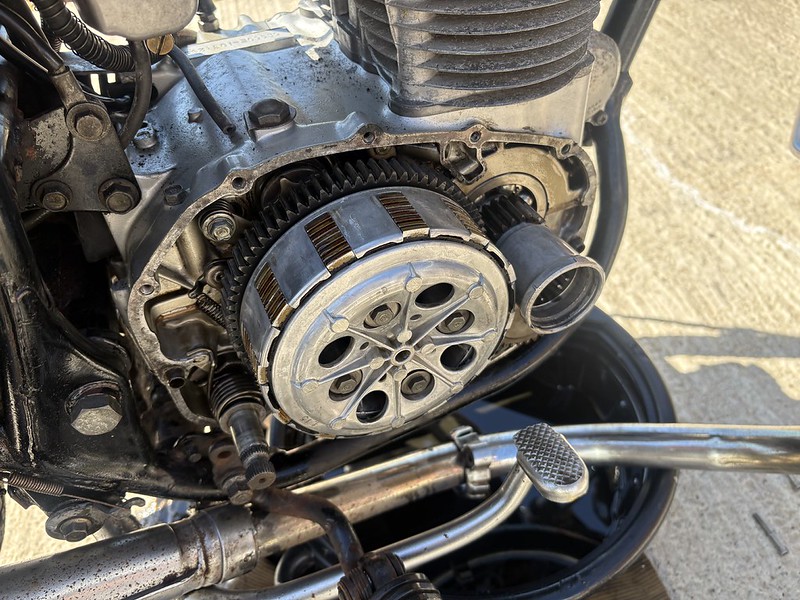
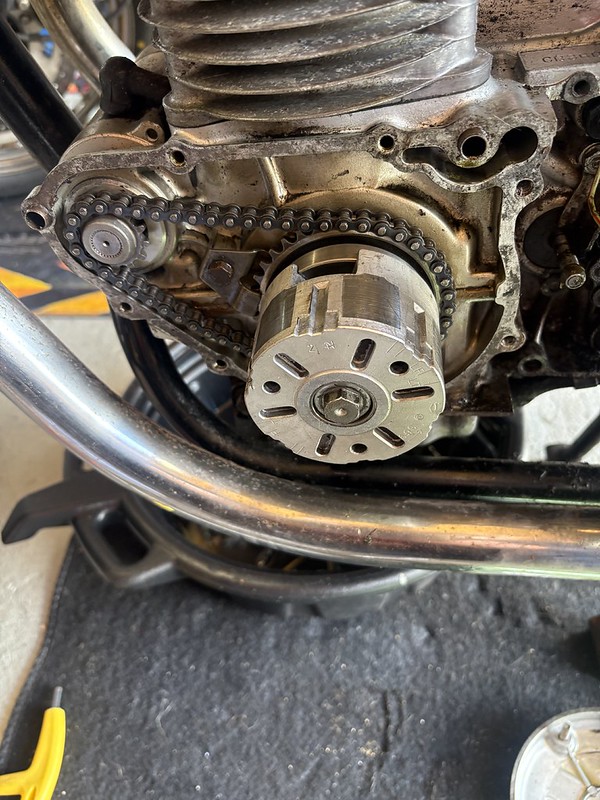
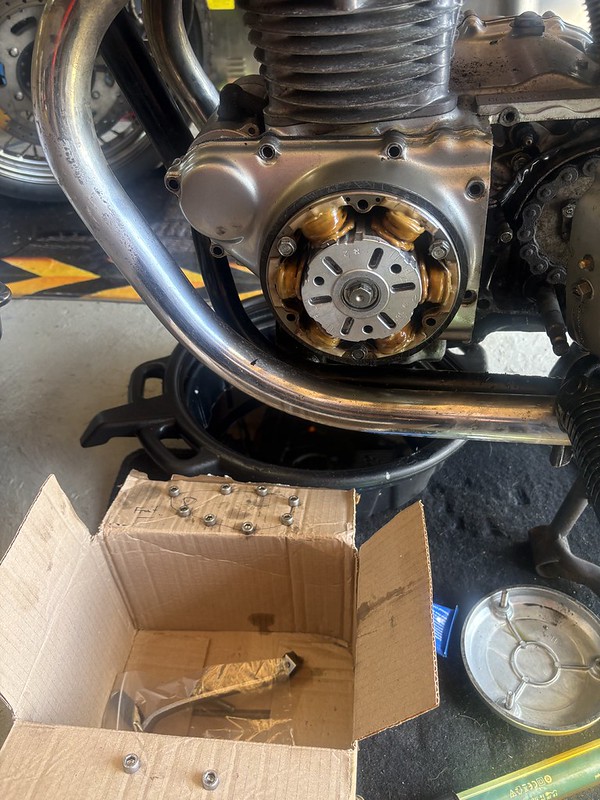
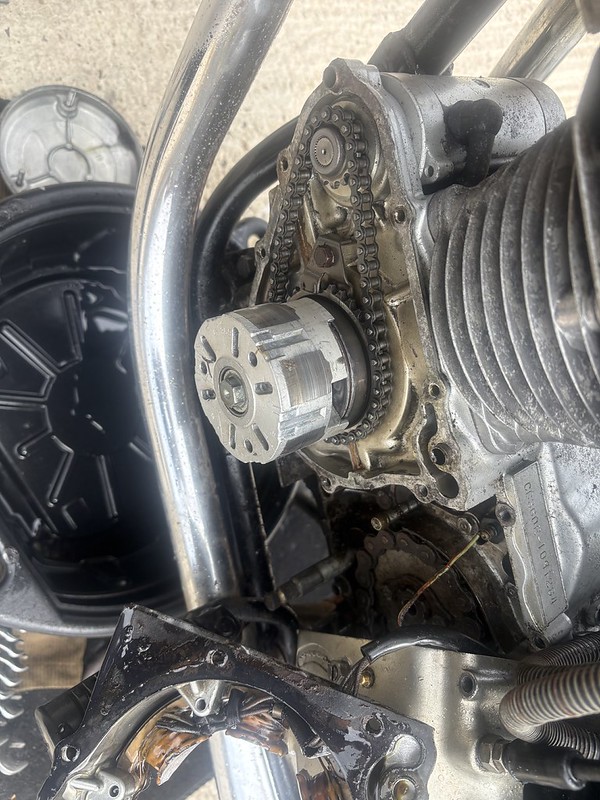
Right chaps, I took the CB360 apart to find out what is wrong with the starter clutch today - there is good news and bad.

First it came apart easily, I’m grateful to a PO for replacing the JIS screws with Allen bolts:

IMG_6605 by Alan Othen, on Flickr

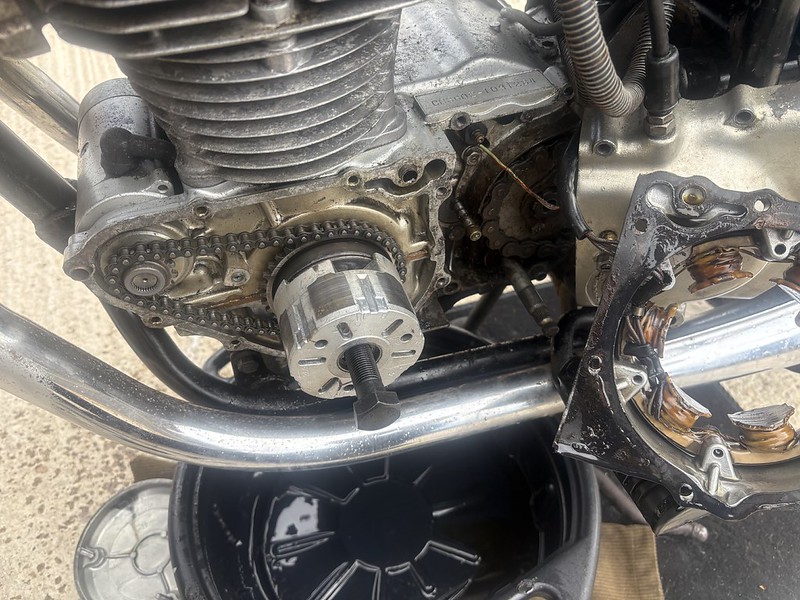
… this 16mm bolt I found got the rotor off the crankshaft easily.

IMG_6606 by Alan Othen, on Flickr

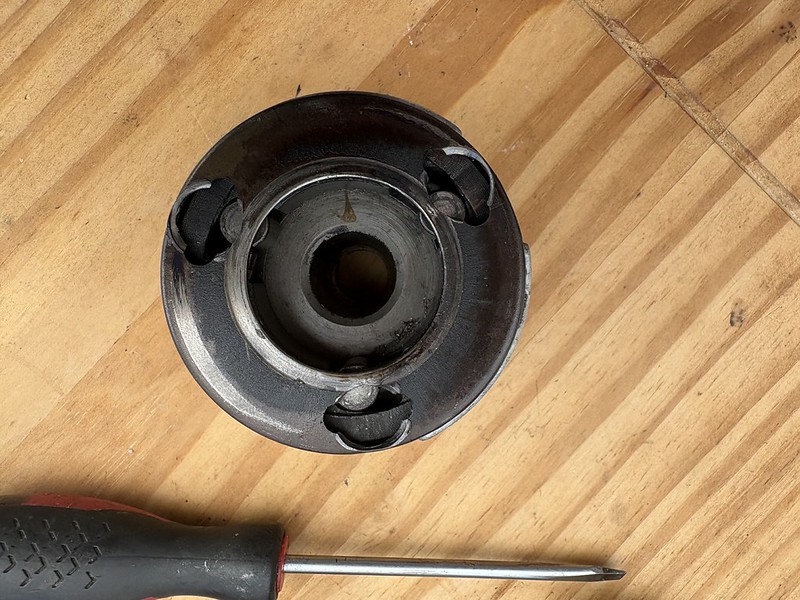
The problem showed up at the back of the starter clutch straight away:

IMG_6607 by Alan Othen, on Flickr

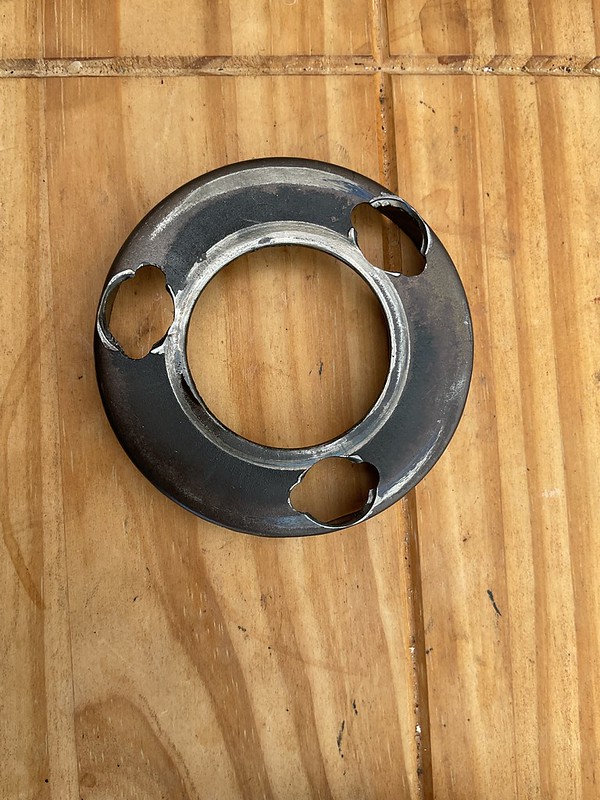
I didn’t think those holes on the cover were in the right place as I couldn’t see the 3 JIS screws.

IMG_6608 by Alan Othen, on Flickr

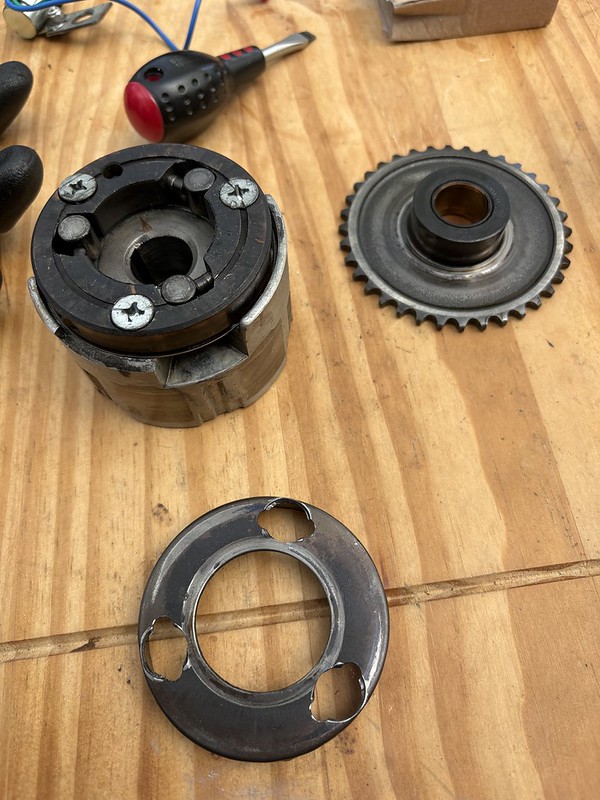
I‘m guessing the pressed plate with the 3 holes should be firmly attached to the clutch body, and not able to spin round on its own?

IMG_6609 by Alan Othen, on Flickr

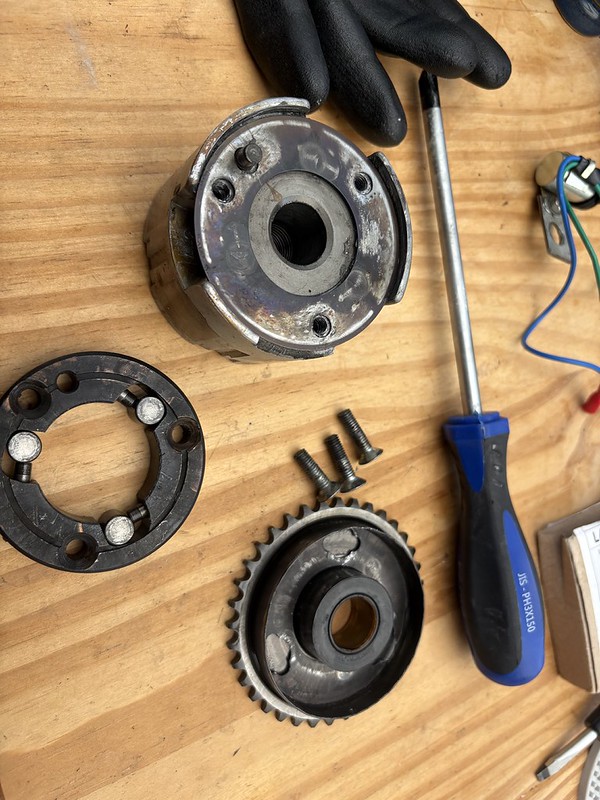
The rollers, springs and cups seem to be in okay condition, but I have new ones to fit anyway. The three screws were all fairly loose, but their threads and the threads inside the clutch seem okay - but will need some thread lock if used again. The locating dowel was very loose indeed and will probably need to be glued in with some 2 part epoxy or Liquid Metal if re-used.

IMG_6610 by Alan Othen, on Flickr

So, it looks like the 3 screws worked loose, which then allowed the pressed part of the clutch housing to separate from the major part, which then flopped around a bit so the starter didn’t engage - and so the problem just got worse:

IMG_0632 by Alan Othen, on Flickr

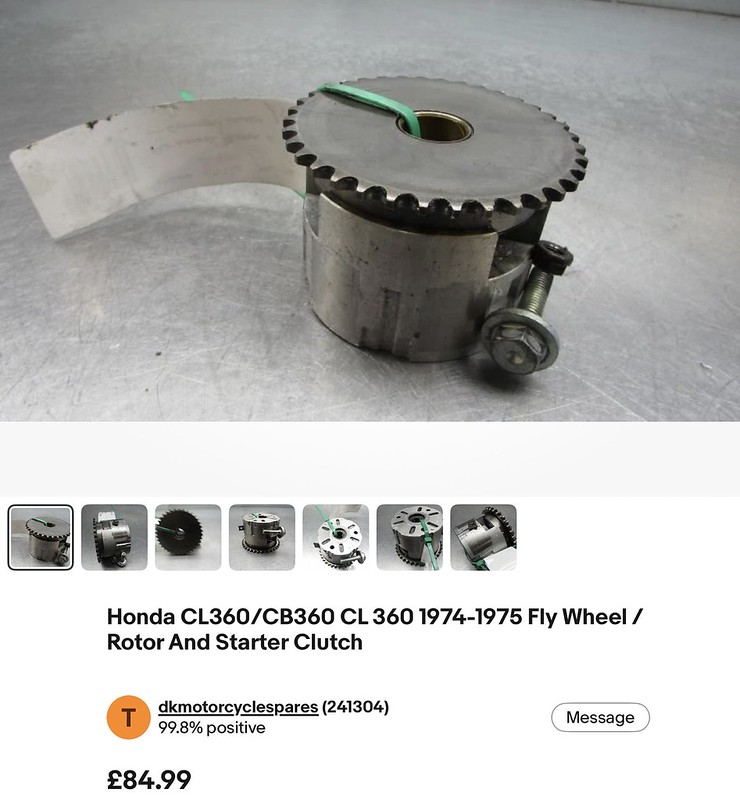
How do I fix this one? What I’ve done is found what seems to be a complete rotor and clutch assembly on eBay for £85 (about $110), which looks okay from the photos.

IMG_0633 by Alan Othen, on Flickr

It should be here on Wednesday. I’m thinking I might end up making one good rotor/clutch out of the two I have plus the new springs, rollers and caps.

Any comments or ideas would be much appreciated. If I manage to fix this for £85 I’ll consider that a win.

Alan :)

Addendum: here is a thought, I suppose what I could do is glue in the locating pin so it doesn’t flop around, press the two parts of the clutch back together in the vice such that the holes are correctly aligned (probably with some 2 part epoxy or Liquid Metal to hold it more firmly), change the springs, caps and rollers and reassemble to see if it works. What do people think? Is that worth trying, or do I just be more patient and wait until the replacement shows up on Wednesday?
 
Last edited:
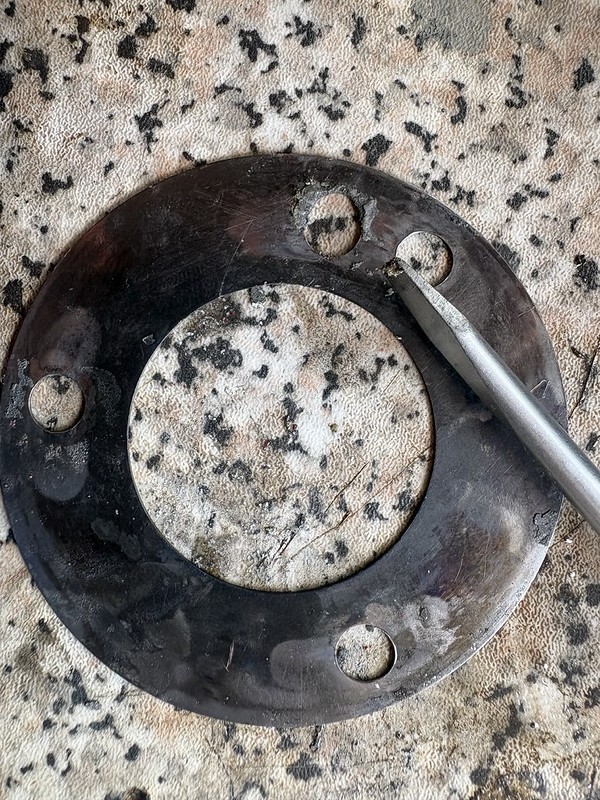
Following on from the post above chaps. I’ve just been cleaning up all the components in a bath of IPA and noticed that on the spacer plate around where the locating pin should sit there is some sort of hard residue:

IMG_6611 by Alan Othen, on Flickr

… and the same on the on the starter clutch around the same locating hole:

IMG_6612 by Alan Othen, on Flickr

I‘m wondering whether it is Liquid Metal or something similar, and that someone has been here previously to fix it? It is clear that the locating pin hole is quite elongated, which has obviously been allowing the assembly to wiggle around a bit relative to the crankshaft. If that is the case then it does seem a little odd that the 3 JIS screws don’t seem to have been secured with thread lock.

I’m pondering how to fix this. I think the best plan will be to wait until the secondhand replacement assembly turns up on Wednesday, see what condition it is in and decide then which parts to re-use.

Comments and ideas?

Alan :)
 
These areas of buildup looks like some kind of sealant or other substance that the PO might have thought would help "glue" things together after discovering it had been run too loose for some time. I suspect the substance in those spots might have caused the rollers to get stuck and sit still which of course would keep the clutch from grabbing when it should have.

1778515289376.png
 
These areas of buildup looks like some kind of sealant or other substance that the PO might have thought would help "glue" things together after discovering it had been run too loose for some time. I suspect the substance in those spots might have caused the rollers to get stuck and sit still which of course would keep the clutch from grabbing when it should have.

View attachment 57563
Thank you for those comments. Bear in mind that the rollers don’t run directly against that face, but against the steel spacer plate that I pictured above. I do agree that there does seem to be some sort of sealant or similar there though, so it seems entirely likely that some residue has got into the rollers or springs and gummed them up a bit.

I do think someone has been here previously and had a go at fixing a long standing issue - but that could have been 16 years ago when the bike way last on the road.

I’m not too displeased about this - I’ll get it sorted.

Alan :)
 
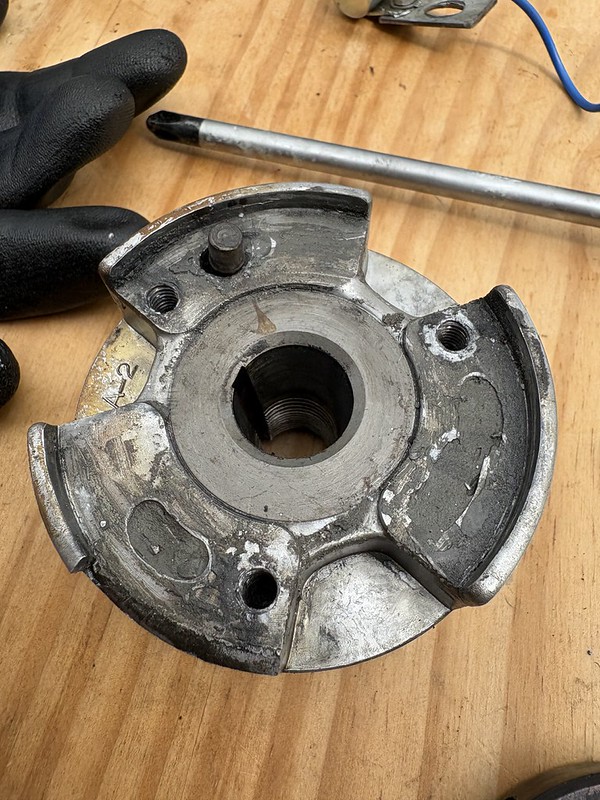
First, thank you to ancientdad, your comments in the post above put me on the right track to working out what has happened here. I spent 20 minutes with a brass wire wheel in the drill cleaning back the surface of the rotor on which the starter clutch fits:

IMG_0636 by Alan Othen, on Flickr

… then compared with it with a photo of a good secondhand item I saw for sale on eBay, taken from a similar perspective.

IMG_0634 by Alan Othen, on Flickr

… and it became obvious what had happened previously. One may notice instantly that the 3 tapped holes are in different places on the rotor - on mine (the upper photo) they are close to the edge of the raised areas, whereas on the other they are in the centre.

So, at some time in the past the has been a failure of the 3 JIS screws holding the clutch onto the rotor. Some previous owner has filled those holes (using one of them to mount the locating pin) with some sort of filler - a Liquid Metal type material - and then drilled and tapped 3 more M6 holes to mount the JIS screws. My guess was this happened 16 years ago and was the reason the motorcycle was taken off the road at that time (that is only speculation on my part). It looks like the JIS screws, the springs, caps and rollers were probably changed at the same time as a PO attempted this repair as they look quite new.

It is hard to know whether this repair ever worked properly. It would seem (from the amount of filler I had to clean off the face of the rotor) that the steel spacer plate wasn’t sitting flat and square against it - that may have pushed the clutch housing too close to the sprocket, resulting in the pressed part of the casing separating from the major part (see the early part of the disassembly a few posts above). My guess is that having spent some time and engineering effort to effect this repair, it never quite worked right. Rather than buy a new rotor to fix it properly perhaps the PO from 16 years ago shelved the motorcycle. That sounds plausible as 16 years ago the motorcycle would have only been 35 years old, and thus had little value as a classic or historic vehicle.

I have discovered this little Honda’s hidden secret. I doubt that the chap I bought the motorcycle from was aware of it (but his ‘mate’ that be bought it from, and had owned it for some time probably did - we will never know). I’m a little disappointed I suppose, but this isn’t the end of the world. I should have a good used rotor and clutch assembly here tomorrow, and it should be easy enough to get it all buttoned up and running as it should. I’m not that displeased though - in other respects the CB360 has been in good order and has responded well to a bit of tidying up and putting back together the way Mr Honda intended.

If my only project costs end up being £24 for a battery and £85 for the rotor/starter clutch, a tenner for the tappet caps plus some oil, fasteners, connectors and solder I had anyway - as well as a bit of my time (which comes free) them I’ll be pleased to have this bike back on the road for £120.

This is why we enjoy our classic cars/motorcycles/guns/bicycles/other machines - it is so satisfying to work out their issues and sort them out.


:)
 
I’ve reassembled the starter clutch (dry - without thread lock or gluing in the locating pin):

IMG_6614 by Alan Othen, on Flickr

… and it does work. I’m not sure I’d trust it with the crankshaft spinning at 8,000 RPM inside it though - so I’ll wait for the replacement to arrive :) .
 
This is why we enjoy our classic cars/motorcycles/guns/bicycles/other machines - it is so satisfying to work out their issues and sort them out.
Well put. I wonder what caused the failure that prompted someone to attempt that repair. Perhaps a new rotor was installed and the mounting screws for the starter clutch were not staked or otherwise secured, causing the whole thing to come apart when used.
 
Well put. I wonder what caused the failure that prompted someone to attempt that repair. Perhaps a new rotor was installed and the mounting screws for the starter clutch were not staked or otherwise secured, causing the whole thing to come apart when used.
I hadn’t thought about that - but you may well have a point. The JIS screws look relatively new and don’t have any marks suggesting they might have been staked - there was no sign of any thread lock either.

I know the engine had had a new cam chain and tensioner some time in the past (again, that could have been 16 years ago), so maybe this was all part of the same recommissioning job back in the day?

:)
 
First, thank you to ancientdad, your comments in the post above put me on the right track to working out what has happened here. I spent 20 minutes with a brass wire wheel in the drill cleaning back the surface of the rotor on which the starter clutch fits:

IMG_0636 by Alan Othen, on Flickr

… then compared with it with a photo of a good secondhand item I saw for sale on eBay, taken from a similar perspective.

IMG_0634 by Alan Othen, on Flickr

… and it became obvious what had happened previously. One may notice instantly that the 3 tapped holes are in different places on the rotor - on mine (the upper photo) they are close to the edge of the raised areas, whereas on the other they are in the centre.

So, at some time in the past the has been a failure of the 3 JIS screws holding the clutch onto the rotor. Some previous owner has filled those holes (using one of them to mount the locating pin) with some sort of filler - a Liquid Metal type material - and then drilled and tapped 3 more M6 holes to mount the JIS screws. My guess was this happened 16 years ago and was the reason the motorcycle was taken off the road at that time (that is only speculation on my part). It looks like the JIS screws, the springs, caps and rollers were probably changed at the same time as a PO attempted this repair as they look quite new.

It is hard to know whether this repair ever worked properly. It would seem (from the amount of filler I had to clean off the face of the rotor) that the steel spacer plate wasn’t sitting flat and square against it - that may have pushed the clutch housing too close to the sprocket, resulting in the pressed part of the casing separating from the major part (see the early part of the disassembly a few posts above). My guess is that having spent some time and engineering effort to effect this repair, it never quite worked right. Rather than buy a new rotor to fix it properly perhaps the PO from 16 years ago shelved the motorcycle. That sounds plausible as 16 years ago the motorcycle would have only been 35 years old, and thus had little value as a classic or historic vehicle.

I have discovered this little Honda’s hidden secret. I doubt that the chap I bought the motorcycle from was aware of it (but his ‘mate’ that be bought it from, and had owned it for some time probably did - we will never know). I’m a little disappointed I suppose, but this isn’t the end of the world. I should have a good used rotor and clutch assembly here tomorrow, and it should be easy enough to get it all buttoned up and running as it should. I’m not that displeased though - in other respects the CB360 has been in good order and has responded well to a bit of tidying up and putting back together the way Mr Honda intended.

If my only project costs end up being £24 for a battery and £85 for the rotor/starter clutch, a tenner for the tappet caps plus some oil, fasteners, connectors and solder I had anyway - as well as a bit of my time (which comes free) them I’ll be pleased to have this bike back on the road for £120.

This is why we enjoy our classic cars/motorcycles/guns/bicycles/other machines - it is so satisfying to work out their issues and sort them out.

:)
Ah, it all makes sense now. I've never actually seen anyone create new threaded holes and fill the old ones before, certainly creative and if done better at the time it might have worked fine. Good to move on with a decent condition used rotor.
 
Ah, it all makes sense now. I've never actually seen anyone create new threaded holes and fill the old ones before, certainly creative and if done better at the time it might have worked fine. Good to move on with a decent condition used rotor.
I tend to agree: if the PO had executed this repair a bit more carefully then it would probably have worked well. If he/she hadn’t left so much surplus filler on the face of the rotor, such that the steel spacer sat flat and level - and had used some thread lock on the 3 JIS screws that might well have done it. A little bit of me wanted to finish off the job like that and fit the old rotor/clutch today, but I managed to restrain myself until the (hopefully) good condition used item arrives tomorrow.

:)
 
I tend to agree: if the PO had executed this repair a bit more carefully then it would probably have worked well. If he/she hadn’t left so much surplus filler on the face of the rotor, such that the steel spacer sat flat and level - and had used some thread lock on the 3 JIS screws that might well have done it. A little bit of me wanted to finish off the job like that and fit the old rotor/clutch today, but I managed to restrain myself until the (hopefully) good condition used item arrives tomorrow.

:)
Wise move, better to work with something unmolested than try to right someone else's wrong (though I agree that the challenge to make it work would be fun!).
 
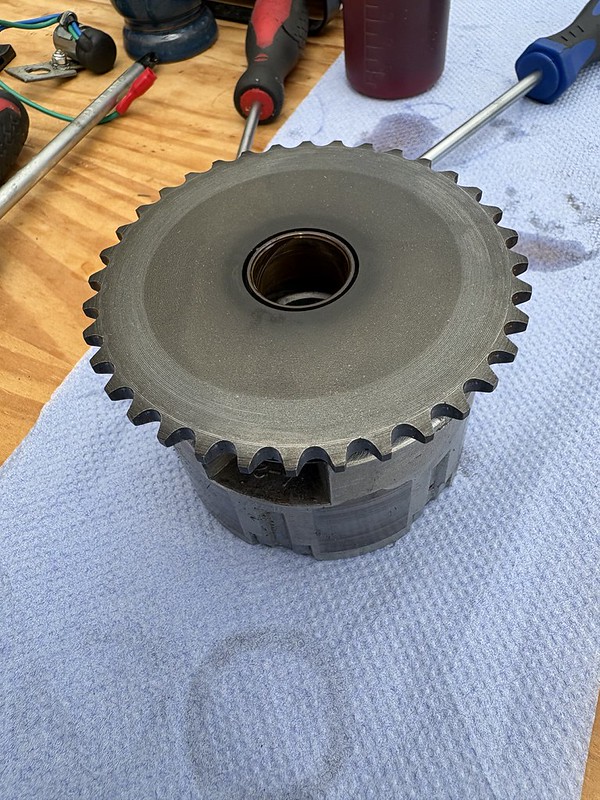
The replacement rotor/starter clutch assembly was delivered this morning, and I’m pleased to report the used parts were in first class condition. I noticed two of the JIS screws were each backed out about 1/4 turn from their staked positions, the third was still done up. I gave everything a wash and dry with acetone and reassembled, this time using some medium strength thread lock and tightening the screws up to their staked marks. The fitted springs, caps and rollers looked to be in excellent condition, but as I’d already bought new ones I changed them anyway.

IMG_6617 by Alan Othen, on Flickr

Everything went back together easily.

IMG_6618 by Alan Othen, on Flickr

Fortunately the gasket had come off in one piece (as the gasket set hadn’t arrived in the mail). I did give the mating surfaces a layer of lithium grease, which should make removing them easier, should it ever need to come apart again.

IMG_6619 by Alan Othen, on Flickr

As the cover was off anyway, I fitted a new thrust bearing to the clutch actuating mechanism. It was a cheap part from DS, and may well improve things if the machine is getting a bit tired.

IMG_6620 by Alan Othen, on Flickr

… and the starter now works fine. I wonder for how many years that hasn’t worked properly? In the video I mentioned the right side float bowl was overflowing, which was irritating as it wasn’t doing that before I fixed the starter. Later on I blew through the fuel line for that cylinder, which seems to have fixed the problem :)

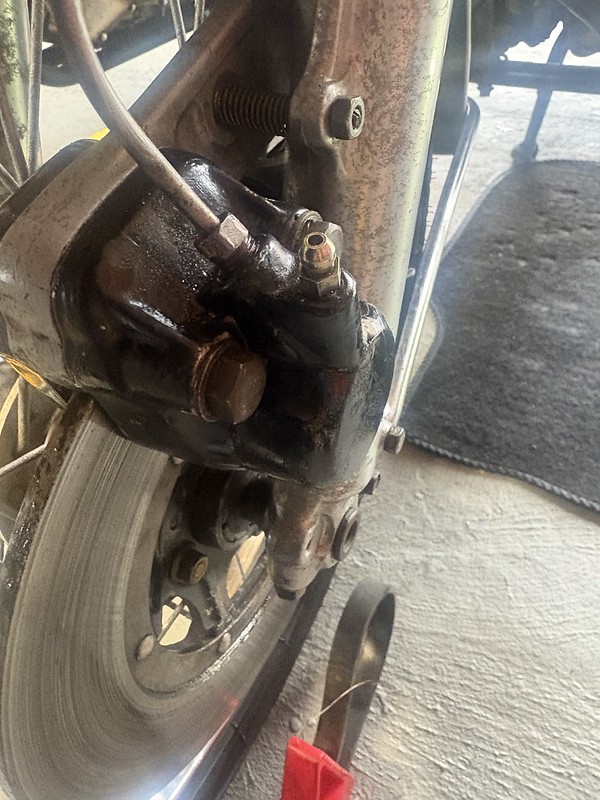
In other news, I’d tried to change the brake fluid about a week ago, but the bleed nipple didn’t want to move and I didn’t want to force it. Every day since I’ve been spraying on a bit more RP 90, giving it a few taps with a light hammer and trying it with an 8mm socket. I’m pleased to report that today it freed itself, so the nipple is swapped for a new one and the fluid changed:

IMG_6621 by Alan Othen, on Flickr


The rain has started again this afternoon (this is England in the spring remember), so a proper test ride will have to wait until tomorrow.

This recommissioning project has gone well, and cost very little. One more change I’m planning is to add a voltmeter to monitor charging before I decide whether to change the rectifier for the new item I bought a little while ago.

Hopefully that will be more or less it for this project now: I’ll just enjoy riding it a bit as soon as the historic vehicle registration arrives.

:cool:
 
Last edited:
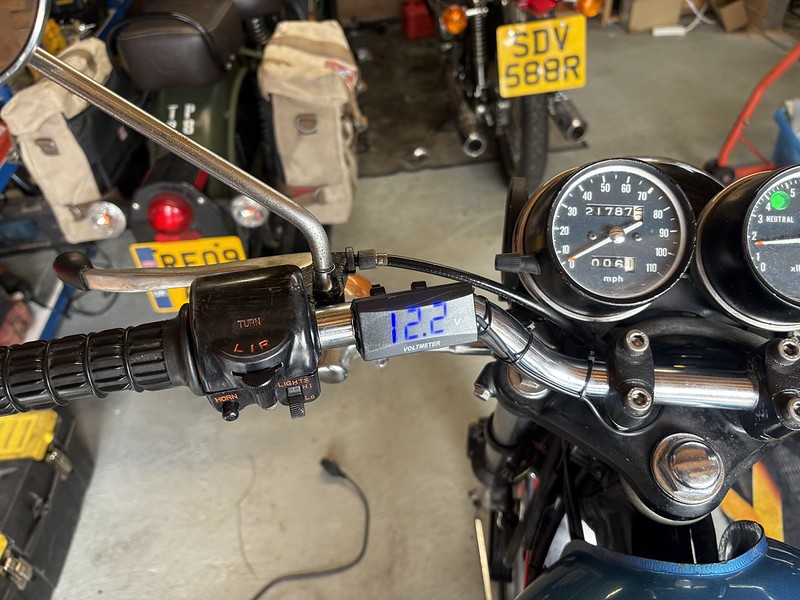
I have fitted a voltmeter to keep an eye on the charging system, it is connected just after the ignition switch:

IMG_6625 by Alan Othen, on Flickr
… and:

IMG_6624 by Alan Othen, on Flickr
One may see the system voltage is wandering around a bit between 12 and 12.9v (those two photos were taken seconds apart with no change in the engine speed). Now that could be the contacts in the switch being a bit less than perfect, or it could be Mr Honda’s voltage regulator (the cigar box under the air filters) getting a bit tired. I can investigate the switch by comparing a multimeter reading at the battery terminals and that voltmeter with the engine running. If the switch seems to be okay then that regulator will be the prime suspect.

I‘m minded to change the rectifier to the new one I bought just recently. It is a 4 wire design, but claims to be a rectifier/regulator, to see if that makes any difference - then try isolating Mr Honda’s voltage rectifier to see if the new item really does regulate the voltage. Perhaps I’ll have to order one of the 5 wire R-Rs we discussed a while ago direct from the USA (Sparckmoto - the company ships to the UK).

In other news the right hand float bowl overflowing issue that I thought had fixed itself yesterday has returned this morning. It looks like I might be able to drop the float bowl without removing the carburettors again. I’ll have a go at that this afternoon.

Alan :)
 
Last edited:
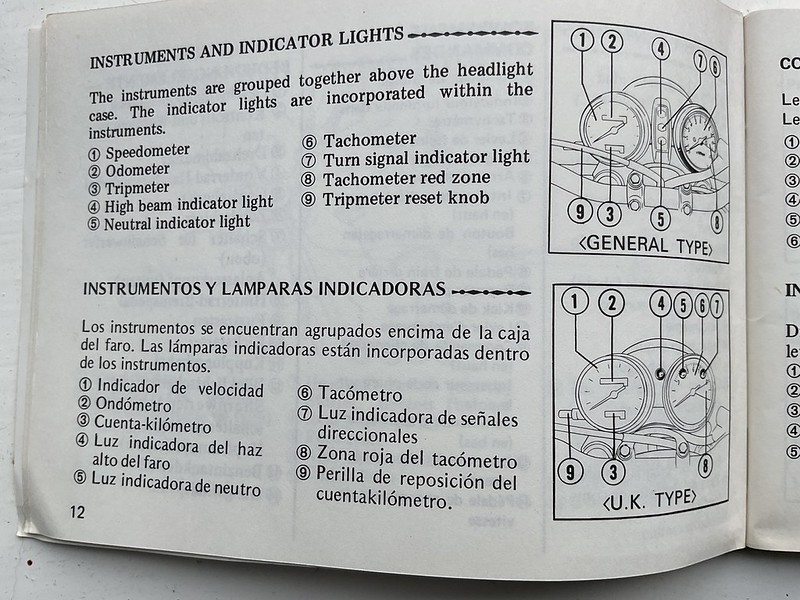
Did this bike emigrate from the US? I'm just noticing that the gauges do not seem to match what I would expect for a 1975 CB360, but it's possible I'm not aware of all of the variations. I saw that you have the Owner's manual — I'd be curious to know what gauges are pictured within it.

My 1974 CB360G has the neutral, turn, and high beam indicators in a small central box between the gauges. Here is an eBay example.

972.png

This seems to have been retained for the 1975 model, although the later CJ360 seems to go back to the older style with the turn and neutral indicators in the tachometer housing and the high beam indicator atop the headlight shell, as with your current setup.

Your speedometer faceplate also shows increments of 5 mph rather than 2 mph and labels every 10 mph rather than every 20 mph.

I've been thinking a lot about these differences whilst trying to source appropriate gauges for my CB450K7, which also used the small central box for the indicators.

Obviously, the style of gauges is immaterial, but this could bring the mileage into question and, if you're lucky, maybe the bike has less miles on it than indicated.
 
Did this bike emigrate from the US? I'm just noticing that the gauges do not seem to match what I would expect for a 1975 CB360, but it's possible I'm not aware of all of the variations. I saw that you have the Owner's manual — I'd be curious to know what gauges are pictured within it.

My 1974 CB360G has the neutral, turn, and high beam indicators in a small central box between the gauges. Here is an eBay example.

View attachment 57627

This seems to have been retained for the 1975 model, although the later CJ360 seems to go back to the older style with the turn and neutral indicators in the tachometer housing and the high beam indicator atop the headlight shell, as with your current setup.

Your speedometer faceplate also shows increments of 5 mph rather than 2 mph and labels every 10 mph rather than every 20 mph.

I've been thinking a lot about these differences whilst trying to source appropriate gauges for my CB450K7, which also used the small central box for the indicators.

Obviously, the style of gauges is immaterial, but this could bring the mileage into question and, if you're lucky, maybe the bike has less miles on it than indicated.
The CB360 would seem to have been a UK bike all of its life, indeed from the (original to the motorcycle I think) owner‘s manual it looks like this was a version just for Britain, as you may see in the lower drawing:

IMG_0643 by Alan Othen, on Flickr
I‘ve no idea why Mr Honda would have fitted different instruments for the UK market - perhaps he was using up some left over parts at the factory?
:)
 
I‘ve no idea why Mr Honda would have fitted different instruments for the UK market - perhaps he was using up some left over parts at the factory?
So many mysteries after all these decades, who knows? Unfortunately the principals involved are long since gone.
 
Interesting! I didn't realize that some manuals are printed with multiple languages. That clears up one mystery, but, as Tom suggests, it also invites other questions.

I wonder if the central indicator box could have been related to new industry or government standards, but can only speculate.

Thanks for sharing the documentation from the Owners manual.
 
Interesting! I didn't realize that some manuals are printed with multiple languages. That clears up one mystery, but, as Tom suggests, it also invites other questions.

I wonder if the central indicator box could have been related to new industry or government standards, but can only speculate.

Thanks for sharing the documentation from the Owners manual.
The copy I have seems to be the Euro manual, printed in English, French, Spanish and German. I suppose back in 1975 the UK had recently jointed the EEC (which later became the EU, and we have left - maybe just in time) and so things were becoming more standardised; except we use miles whereas all the other Europeans would be in KM. Perhaps therein lies the answer? Mr Honda had to provide more or less standard European market motorcycles, but with MPH speedometers and odometers for Britain… and maybe had some left over in the parts bin that could be fairly easily swapped?

This is just conjecture on my part of course, but it sounds sort of plausible.

:)
 
Just caught up with this interesting thread. My UK CB250G5 had then same clocks as this CB360, ie no separate idiot light cluster.

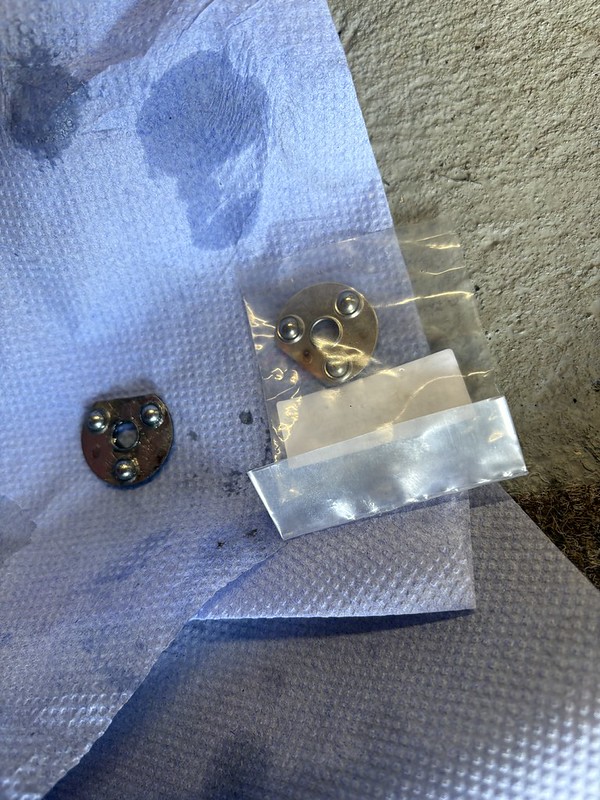
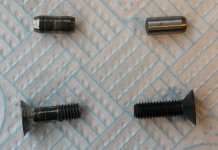
Also, bit late to the party, but one of my 175s had a totally knackered starter clutch, here's a pic of the screws and locating pin compared with new parts.1778773659693.jpeg
Locating hole in the rotor completely worn oval.
1778773718668.jpeg
Replaced with a better part from DK breakers ( CB200 same as 175 ). Made a daft mistake on reassembly, used grease to stick the springs and plungers in place while rebuilding. Clutch would not then engage when starter operated, has to swill all the grease out then OK.
 
Just caught up with this interesting thread. My UK CB250G5 had then same clocks as this CB360, ie no separate idiot light cluster.

Also, bit late to the party, but one of my 175s had a totally knackered starter clutch, here's a pic of the screws and locating pin compared with new parts.Locating hole in the rotor completely worn oval.
Replaced with a better part from DK breakers ( CB200 same as 175 ). Made a daft mistake on reassembly, used grease to stick the springs and plungers in place while rebuilding. Clutch would not then engage when starter operated, has to swill all the grease out then OK.
Many thanks - the starter clutch design does seem to be a perennial problem with these Honda twins.

Another question on a slightly different matter if I may. Some time ago you said you had successfully deleted the Honda voltage regulator (the cigar tin under the air filters). Was that using a 4 wire or 5 wire aftermarket rectifier-regulator, can you remember?

Alan :)
 
You'll want the 5 wire.
Rec/Reg will have:
Yellow - Connect to Pink from Alternator
Yellow - Connect to the Yellow and White spliced together from the Alternator
Green - Connect to Negative terminal or solid ground
Red - Connect to Red/White
Black to anywhere in the black 12V+ circuit (likely have to add a splice here).
 
Back
Top Bottom