
bilbikek411
Veteran Member
Yeah,that's looking very good Brody 


Thanks, Bill!Yeah,that's looking very good Brody
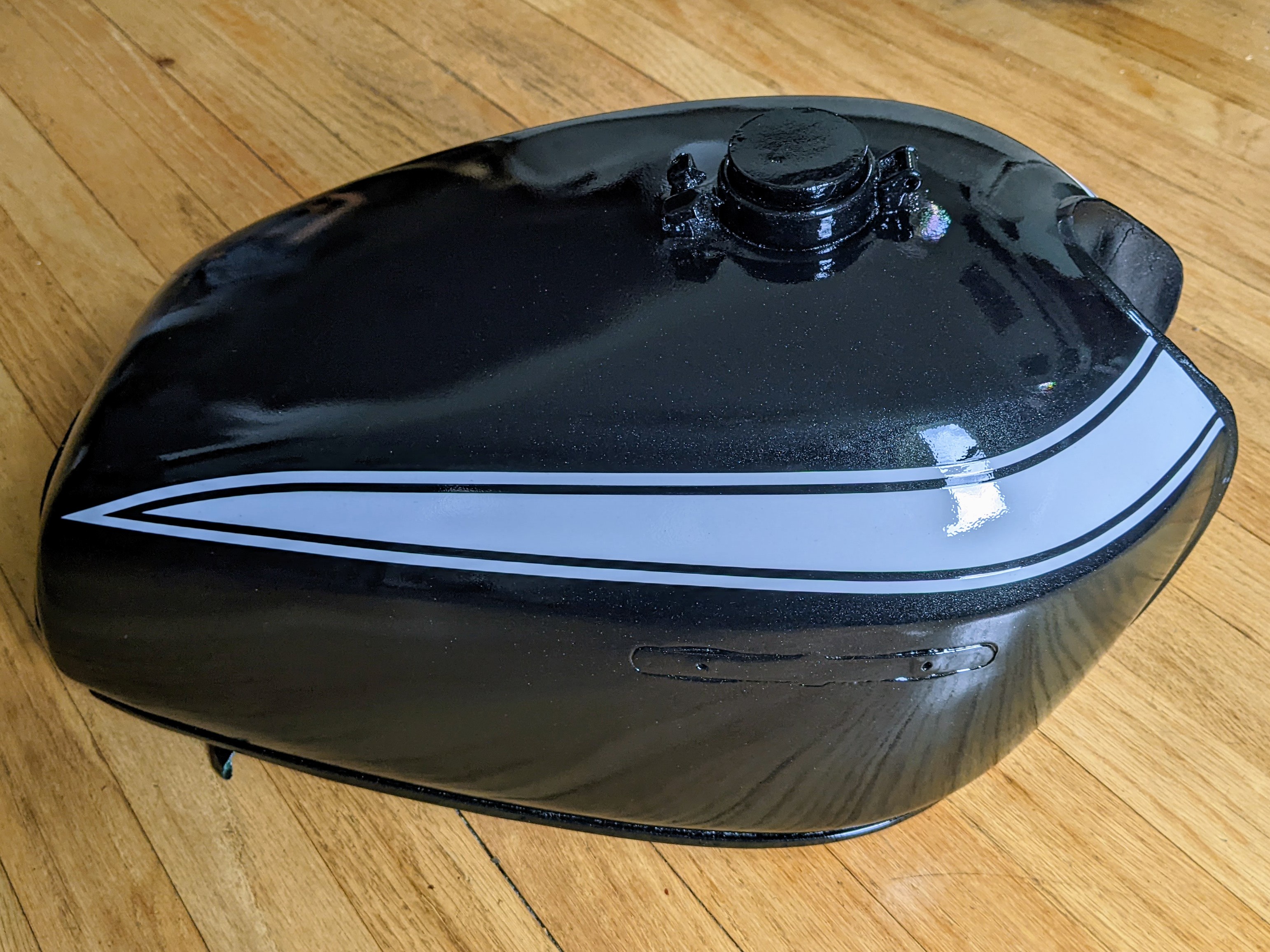

I was afraid to go too heavy with any single coat with the humidity we have here, but I certainly can't argue with your results. Your tank turned out great. And that's without polishing? Just self-leveling after wet application? Thanks for the advice.I sanded off the hazy looking clear and bought a fresh can(I specified Fresh!)of 2K clear and went with heavy coats on a warm,dry day;it came out very good. 2K clearcoat likes to be applied quite wet,imo.
Polishing is my weakest skill in this area, but I'll do my best. I will let it cure for a week or so and then I'll do some light cutting, polishing, and buffing. Usually I'm satisfied with a mild orange peel — oranges wish they had a peel like this tank has now!Do you think you can rub the orange peel out?
Brody,get a Dry day & put it on with heavy sweeping motions.I was afraid to go too heavy with any single coat with the humidity we have here, but I certainly can't argue with your results. Your tank turned out great. And that's without polishing? Just self-leveling after wet application? Thanks for the advice.
Polishing is my weakest skill in this area, but I'll do my best. I will let it cure for a week or so and then I'll do some light cutting, polishing, and buffing. Usually I'm satisfied with a mild orange peel — oranges wish they had a peel like this tank has now!
I think it would go much better in a climate controlled environment.
One thing I miss about not living close to an Air Force base as a retiree is access to the auto hobby shop and some hobby shops even had paint booths you could use for a nominal fee. A friend of mine painted a car I was selling and it looked so good I hated to get rid of it but I did.I think it would go much better in a climate controlled environment.
That is very cool. I could maybe get away with painting in my detached garage, but it would take some effort. I have a couple of those floor A/C units and if both of them were running in the garage I could probably create a hospitable environment.One thing I miss about not living close to an Air Force base as a retiree is access to the auto hobby shop and some hobby shops even had paint booths you could use for a nominal fee. A friend of mine painted a car I was selling and it looked so good I hated to get rid of it but I did.
They blow warm air out a window though a flexible duct, so I assume the moisture is dispersed in that exhaust because they do not have a drain line or any container that can be removed. I believe they both have a dehumidifier setting as well. The normal usage for me is for small upstairs rooms where the central A/C is ineffective.Depending on how quick you want to get this painted it might be worth it. Are the AC units ones that collect moisture in a container or you have to setup a drain line outside?
That's a good idea. I think I'll let it cure for a bit and see what I can do with it first. I'm able to ride the bike with a spare tank for the time being, so no real rush.You could just use the dehumidifier setting for a few hours and if the garage is not to big and reasonably sealed should get the humidity down to a lower and stable level.

The humidity is a killer. I tried to get everything as dry as possible when I did the tank on the CX and it's starting to haze already My dehumidifier filled a 5 gal bucket in the time it took to dry to the touch and still - it'll be time to wet sand and recut/polish very soon. Failing that, it'll be waiting until winter and respraying. CB tank - no issues, but I did that during a cold snap and heated the shop up with infrared heaters to get it to 70 degrees. The application temp window for that stuff is something like 71-75 degrees per the instructions. I think we get about 4 hours of that per year.I was afraid to go too heavy with any single coat with the humidity we have here, but I certainly can't argue with your results. Your tank turned out great. And that's without polishing? Just self-leveling after wet application? Thanks for the advice.
Polishing is my weakest skill in this area, but I'll do my best. I will let it cure for a week or so and then I'll do some light cutting, polishing, and buffing. Usually I'm satisfied with a mild orange peel — oranges wish they had a peel like this tank has now!
I think it would go much better in a climate controlled environment.

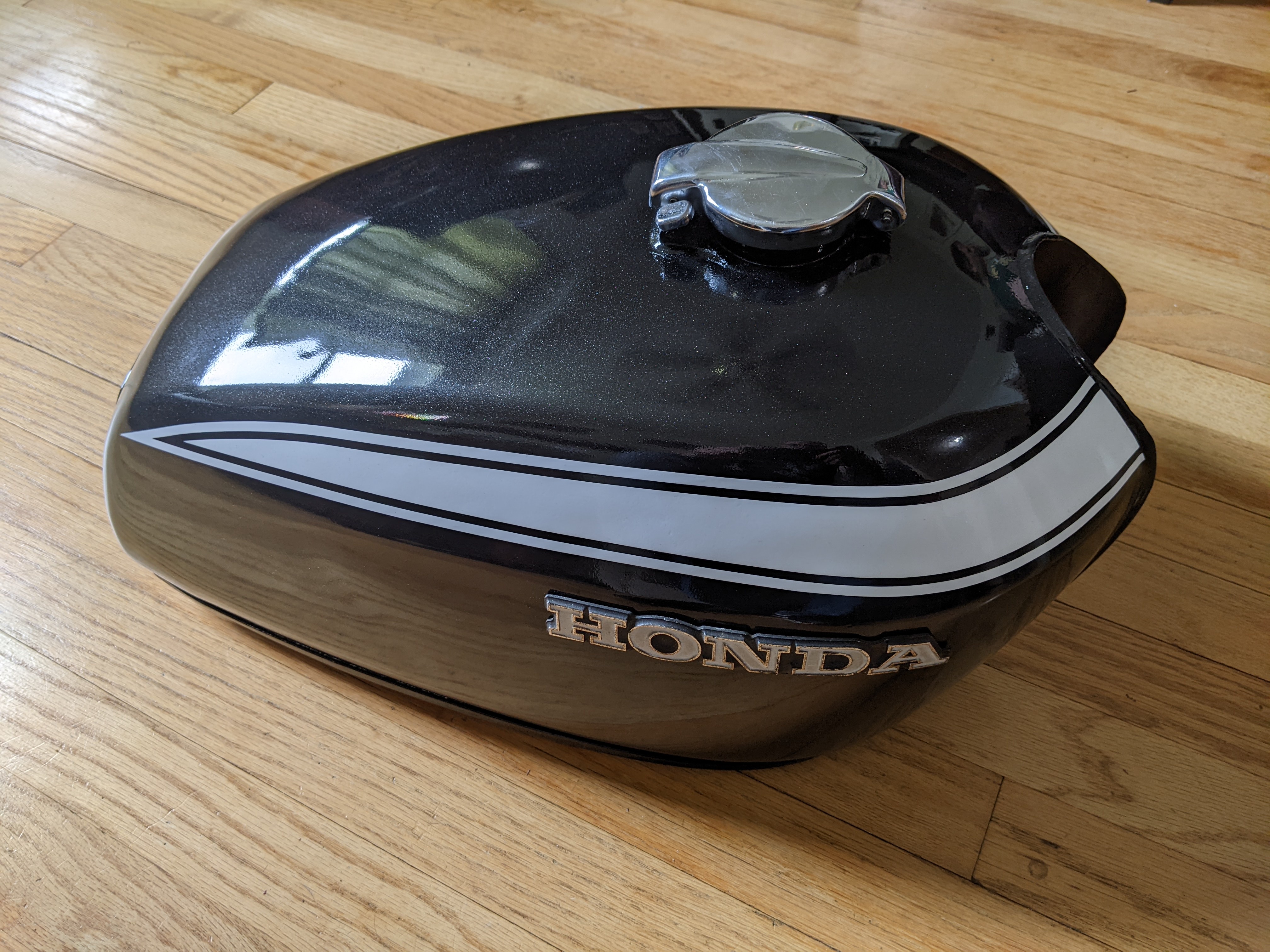
Thanks, Tom. I hope it will polish up nice.Other than the orange peel that you should be able to minimize with some effort (and possibly fully remove if you're careful), it looks good. I noticed right away it wasn't a solid color and when you enlarge the pic you can easily see the fine metallic in it. It should look great out in the sun once rubbed out.


I realize it's hard to quantify, but what did you feel that made you decide to change them? Did the feeling give you the impression it was advancing more too soon?On a separate topic, short rides recently continued to leave me with the impression that the replacement springs I chose for the spark advance are too soft. It's hard to put the reasoning into words, but I decided to make a change while swapping the tank and side covers. The previous springs were 20 mm long, with a coil diameter of 6 mm, and a wire diameter of 0.7 mm. There are about 12 active coils. The new springs are also 20 mm long and have the same 6 mm coil diameter, but use a wire diameter of 0.8 mm and have about 11 active coils. They also feel stiffer by the finger-pull test, as they should. I only went up and down the block so far, but liked the way that felt. I plan to ride the bike to work tomorrow morning and will report back afterwards.
I think it was similar to the feeling that my worn out stock springs gave, which I would describe as bouncy. When starting from a stop, it felt better to bring the motor speed up quickly to stay near/at full advance and avoid the bouncy feeling in between. This likely also means it was advancing early, but I think the advance angle tended to oscillate slightly as it increased. I should pull out the timing light to investigate more scientifically.I realize it's hard to quantify, but what did you feel that made you decide to change them? Did the feeling give you the impression it was advancing more too soon?
If you have a way to set up a camera for while you're checking the timing with a strobe, it would be interesting to see that on video.I should pull out the timing light to investigate more scientifically.

I think I could probably do it without marking the rotor, similar to what I did in this thread for a CB200 rotor. I would need to work with extracted frames from a video, though, so it would be time consuming.With a protractor, mark the rotor for degrees advance and a tachometer, then an advance curve chart could be plotted.
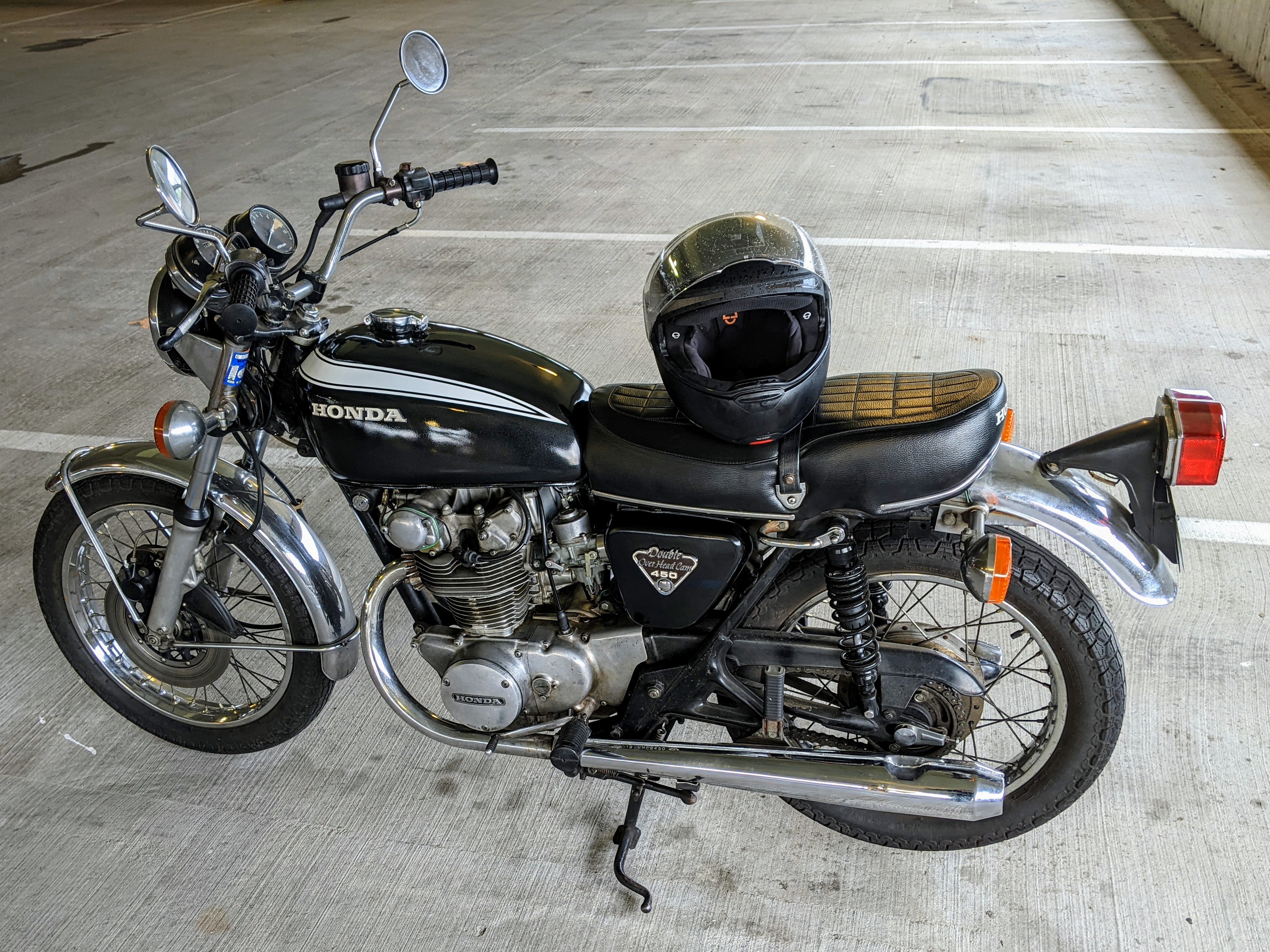

I always get a kick out of the drivers who pull up alongside at a stop light and say "I had one of those!" and then proceed to say something that makes it pretty clear they had a different model or maybe even a different brand motorcycle.Few people can even properly identify these bikes much less validate a factory color.
When I'm on my Dream, I get, "Is that an Indian?"I always get a kick out of the drivers who pull up alongside at a stop light and say "I had one of those!" and then proceed to say something that makes it pretty clear they had a different model or maybe even a different brand motorcycle.
Gotta be the fishtails.When I'm on my Dream, I get, "Is that an Indian?"
That's pretty funny. I mean, there are Indians that look like souped up bicycles.When I'm on my Dream, I get, "Is that an Indian?"
Possibly because of the red frame, I've been asked if my 450 was a BSA, a CB77 or a CL77, or even a 350. Pretty clear these people are looking at the overall picture and not the unique engine design that would give it away to pretty much any Honda enthusiast.Things I've been told are like "I had one of those, but mine was a _______." You can fill in the blank with just about anything: Yamaha, Nighthawk, four-cylinder, two-stroke, 750, etc.
Yup. And I imagine, like me, you're still happy that the bike is being appreciated and, in most cases, recognized at least as a vintage motorcycle.Possibly because of the red frame, I've been asked if my 450 was a BSA, a CB77 or a CL77, or even a 350. Pretty clear these people are looking at the overall picture and not the unique engine design that would give it away to pretty much any Honda enthusiast.
Yes, and it always generates interesting conversation if the circumstances allow. It amazes me that happens even at the Speedway gas station local bike hangout on Sunday mornings, most who go there are pretty familiar with bikes overall. And it comes from older guys too sometimes. And it's always fun to watch a 20- or 30-something walk by it, stop for a second and look at it, then walk on because either they have zero idea what it is, or they simply don't recognize the real age of the bike and the significance of it still being around.Yup. And I imagine, like me, you're still happy that the bike is being appreciated and, in most cases, recognized at least as a vintage motorcycle.

Not exactly the same, but it just occurred to me that my Dad did the same thing with the CL360s that came in the unpopular (at least in the Tampa area then) Muskat Green Metallic in the first year and the dealership owner gave him 3 to 5 sets at a time to repaint Candy Red with stock stripes. And of course they sold really well, "resale red" as the custom car guys call it.The fact that the decal has the right shape hopefully adds a bit of respectability to the non-factory color.
It was during Honda's heyday in the early '70s so I don't think there was any concern about the customer wondering if it was a factory color or not, and I honestly don't recall if they left any of them the original green. The color was so disliked at the dealership that we all called them "green weenies", but of course like the Black Bomber what was once considered hideous is now well-liked for nostalgic reasons. I just remember them selling like crazy after they were painted red. When I was visiting Seattle in 1994 I came across a green CL360 parked in the street downtown, and I hadn't seen one in so long I was dumbfounded by it and took a picture. It had less than 1000 miles on it too. I always wonder what became of it.Those look really good, too. It's interesting to me that they wanted all of them to be red. Do you think they wanted customers to think red was the factory color?
Yes I would, but when you consider just what @Danager4792's CL450 went through and how many layers of re-paint are (were) on it, it would be incredible to find one of those dozen or so red 360s my father painted this long after. But it would be really cool for sure.Would be interesting to see one of those tanks pop up online in a forum, on eBay, or wherever. You'd know exactly where it came from.
Good to see you back Brody, lots going on since you were last here regularly.I want to follow up on some earlier posts regarding replacement springs for the CB450 advance mechanism. The first spring that I tried has a length of 20mm, an outer diameter of 6mm, and a wire diameter of 0.7mm with about 12 active coils. After a little riding, I opted to go up to a slightly beefier 20/6/0.8mm spring with about 11 active coils. Both springs gave the same impression while riding, which is that they are likely too soft — it feels like the advance curve may be too steep and there is only a small range of engine speeds between no advance and full advance.
Another symptom has been rapid fouling of sparkplugs, which prompted me to get out the timing gun last week. I found that the timing at idle was good, with the cylinders firing very close to their respective F/LF marks. Raising the engine speed, however, I found that the left cylinder goes beyond the full advance range. It overshoots the full advance range by an amount close to the distance between the full advance timing marks. The right cylinder was advancing even further. I suppose I might be able to correct the full advance by bending the tabs on the advance mechanism, but that probably wouldn't affect the herky jerky feel of these springs in use.
Eventually, I will have a look at other springs and I will probably try some shorter springs (15mm), which seems closer to what @Jays100 found suitable in his work on this. For now, I decided to reinstall the CB500T advance mechanism. I set the static timing and checked with the timing gun again, finding that both cylinders were firing on time at idle while staying between the timing marks at full advance. I haven't been able to ride it much since making that change, but will be interested to see if my impression of the advance curve is changed for the better.

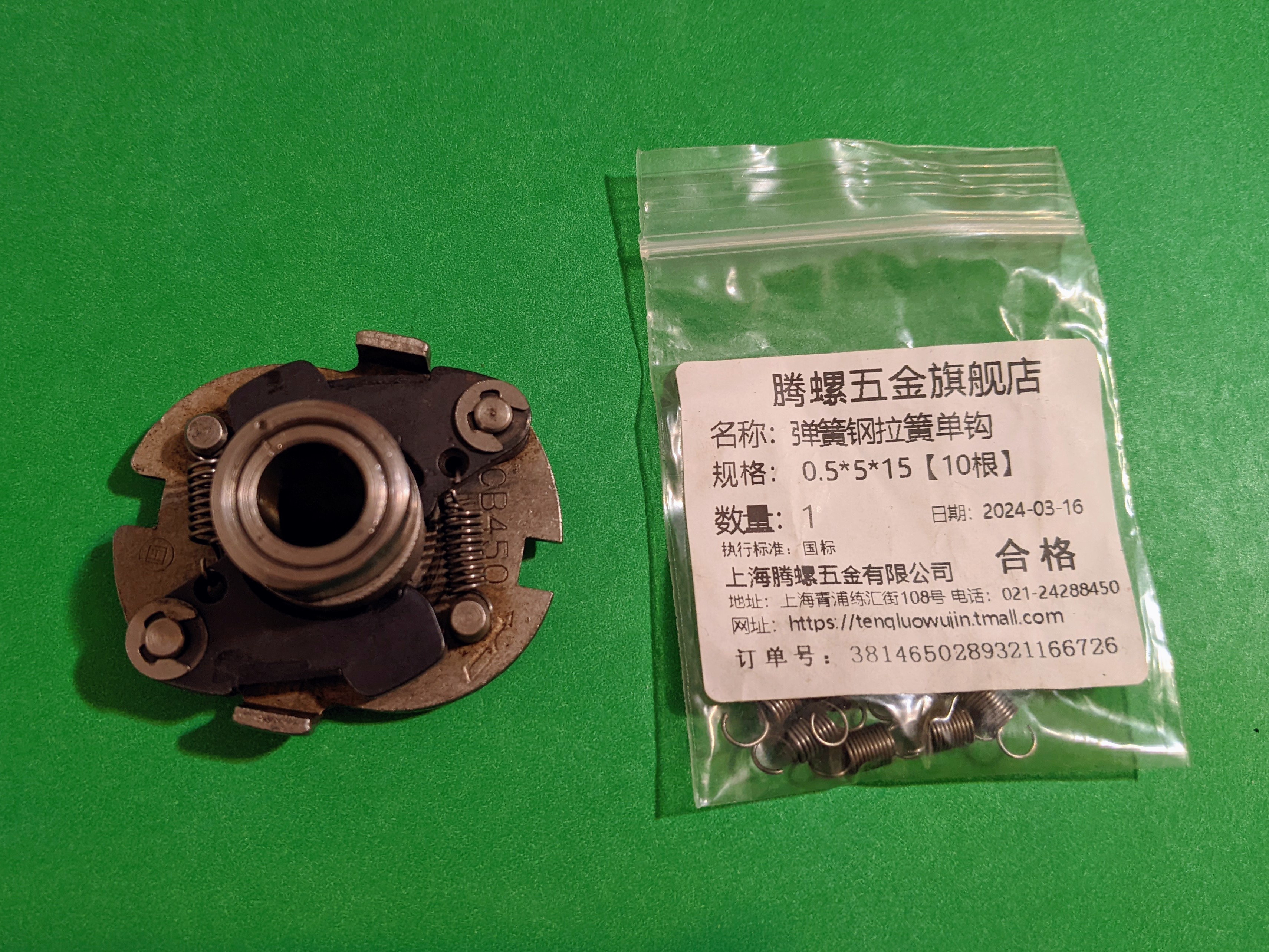
I also ordered two more sets of springs on eBay that will hopefully provide a couple of stiffer options if these don't get it done. They're expected in early October.Boldly go sir, looking forward to hearing feedback on the ride and the springs!

Apparently 'flat' with not enough advance to perk it up.A quick report on the latest experiment is that the new springs are likely too stiff. With no load, the engine speed had a barrier around 3k RPM, but it could be pushed through slowly and the motor could then rev out. (I let it warm up at idle first!) It would return to idle. I was still planning to ride it the four miles to work, but thought better of it after a trip around the block. Rode the XL instead.
Yes, although it eventually would advance, but I suspect much later than desired.Apparently 'flat' with not enough advance to perk it up.