1970 CL450 K3 Rebuild

Very kind of you AD. I’m already finding a few complete case options that might work. I’m trying to look closely at the kick starter area for cracks but the photos aren’t great.


Very kind of you AD. I’m already finding a few complete case options that might work. I’m trying to look closely at the kick starter area for cracks but the photos aren’t great.


Second one is gone, first one is a CL450K1 - I want that entire bike, not just the crankcases!

You really only need the lower case, they're not matched sets so do not worry about that.
 
Second one is gone, first one is a CL450K1 - I want that entire bike, not just the crankcases!

You really only need the lower case, they're not matched sets so do not worry about that.
The state of my gasket surface on the top case is not great. I would feel justified getting a set if it was in much better shape.
 
The state of my gasket surface on the top case is not great. I would feel justified getting a set if it was in much better shape.
Probably smart thinking then. I'm on a budget so I'm always thinking that way, but of course I can't see your stuff either LOL
 
$350 is
I did start out with a budget but that’s long gone. I can confidently say this will be my one and only VHT. Might as well make it a good one.
bahahaha. I recall those words. Your internet search algorithm will begin to whisper sweet nothings to you and the N+1 problem will rear its head. You will begin to sort out ways to create more space, kick the wife and kid’s cars out of the garage “just this weekend while I reorganize” and a bike will spawn in its place.
 
Just curious if you ever heard back from the guy on Market Place about the engine? I logged in and as you say the add has been up 17 weeks so if the person still has it they might be willing to make a deal for say $250 or so depending on how it looks in person.
 
bahahaha. I recall those words. Your internet search algorithm will begin to whisper sweet nothings to you and the N+1 problem will rear its head. You will begin to sort out ways to create more space, kick the wife and kid’s cars out of the garage “just this weekend while I reorganize” and a bike will spawn in its place.
:LOL: Never say never. The online bike search is a constant in my life. My problem is that I like too many different styles. I've owned a few moto/adventure bikes. I had a sport bike for a brief period which I'm lucky to have survived. I've always wanted a Honda Scrambler and am so happy to now have one. Now if I ever happen upon a 750 or 850 Norton Commando...
 
Just curious if you ever heard back from the guy on Market Place about the engine? I logged in and as you say the add has been up 17 weeks so if the person still has it they might be willing to make a deal for say $250 or so depending on how it looks in person.
Unfortunately not. The app shows that he hasn't read either of my two last messages and I don't want to send any more and come off desperate. It would be a great option, especially if it weren't seized.
 
This is strange. After a quick cleaning and lubrication I noticed the same spacing issue of the bearing on the new (to me) countershaft that I had purchased. The inner race of the bearing is again slightly offset from center. No side view included because it looks identical to the one previously posted. I measured the spacing within a couple thousandths of each other. There is a difference in the performance of the new bearing when the orientation is changed. In the vertical position it spins freely with little resistance. In the horizontal position there is slight resistance along with a rattling noise. It seems like the bearings want to settle when horizontal. What's strange to me is that the countershaft looks unused. There is no oil staining, no burnishing on the bearing surfaces, and all corners and edges look very crisp and sharp. All this to say, I think I'll be looking for another countershaft.
IMG_1593.jpg
 
It's definitely used, either it comes from a low miles engine, or it came from a well maintained engine (or a combination of both). The radial tracks around the left oil hole are visible, and the surface of the seal on the right side is polished by the seal and maybe a little by the PO.

There is no oil staining, no burnishing on the bearing surfaces, and all corners and edges look very crisp and sharp.

Oil straining is an issue that comes with old oil / low quality oil, burnishing on the bearing surfaces of the bearing tells me that the engine was never apart, that the torque of the crankcase bolds was perfect, and that the PO maintained his secondary chain (correct slack / tension) and sprockets very good. Corners and edges are sharp due good shift behaviour, to low miles and or regular / scheduled oil changes. The surface of the sealing area is smooth, again a sign that the PO was serious about maintenance, good oil, and keeping the area clean. The sprocket area is nice too, again a sign of good maintenance and regular lubrication with heavy grease / copper grease.

The bearing is C3 bearing, and has some play when new.
 
I just now realized that I never specified which of the two shafts in the photo was recently purchased. The shaft on the top of the photo came from my used motor and I do see all of the things you mention while looking at it. It could be my inexperience eyes, but I don't see the radial tracks around the left oil hole of the (new to me) shaft on the bottom. I do trust your expertise and only would only like to confirm the shaft on the bottom was the one you were focusing on.
 
The lower one is the better one, the one you bought as a replacement for the upper one. I'm talking about the lower one, the one you bought.

shaft.jpg


The yellow arrow is pointing to the bearing area, and it's clearly visible for me that visible stripes are orientated in a radial way, it means that the shaft is used.
The blue arrow is pointing to a surface that is lightly polished in a radial direction, this is due resonance and friction between the crankcases and the bearing surface,
The purple arrow is pointing to a surface that is polished by the oil seal, please compare with the old one for the position.

The small red arrow is pointing to a circlip that holds the bearing in place, see also the exploded view (thanks CMSNL) below (nr.27)

exploded view.jpg

And finally, and I had to enlarge the picture a little bit, you see where the sprocket "broke"the sharp edges (see below).

detail shaft.jpg

I really think that, looking at the shaft quality, the bearing is fine. Just clean with clean fuel, and test the bearing again. I can't imagine that the bearing is bad, unless the balls or bearing inner surface area is rusted.

Do you happen to know how to test a bearing ? You never asked what C3 means, do you understand what it stands for ?
 
Last edited:
Thank you for the comprehensive breakdown and I trust your experienced opinion. It was difficult to see some of the things you pointed out even to the naked eye so this confirmation was very helpful.

I really think that, looking at the shaft quality, the bearing is fine. Just clean with clean fuel, and test the bearing again. I can't imagine that the bearing is bad, unless the balls or bearing inner surface area is rusted.

I am hopeful this is the case and intend to carry out my due diligence before moving forward.

Do you happen to know how to test a bearing ? You never asked what C3 means, do you understand what it stands for ?

No I did not know what a C3 bearing was until I did some research - https://iskbearing.com/news/knowled...-an-essential-guide-to-precision-in-machinery. Apparently it is designed with a greater internal radial clearance to account for thermal expansion. This is great news as it would explain why the inner cage/retainer looks off center. When I initially measured the spacing between the bearing retainer and the inner ring with a feeler gauge, I worked my way up in size until I felt slight resistance. I did not notice any axial movement of the retainer because i never put any real force into it. I went back to inspect both bearings and sure enough the retainers move radially as they should. I was also unfamiliar with proper testing procedures so after more research I found the following. Please correct me if you see anything incorrect.

Visual inspection - Check for any pitting, scratches, cracks, or corrosion. This one is obvious and no real issues were found.
Radial internal clearance - This is one is a toughie. The spec I found for a double roller bearing was 0.04 – 0.05 mm. While I do have small enough feeler gauges, using them is a difficult task. Any tips? Is this even practical for this application?
Screenshot 2025-07-27 094037.png
Noise/vibration - When spun in the vertical position, the bearing sounds very healthy. When the shaft is in the horizontal position, as it would be in the motor, the bearing has a noticeably different sound which is difficult to describe. Almost springy any not quite clicky. It sounds like what you would imagine a bearing with additional clearance would sound like. Under normal conditions it would be filled with oil and likely function properly.
Runout - I can't see any wobble when rotated and I can't feel any movement under axial load in both directions.


Lastly, the original shaft has an oil element and stopper (nr. 8 & 7) while the new shaft does not. Are these parts necessary to use in the new shaft if I intend to plug the oiler by using a thread sealant on (nr. 6) as recommended?

Screenshot 2025-07-27 105916.png
 
Apparently it is designed with a greater internal radial clearance to account for thermal expansion.

yes, and just as important, misalignment compensation.

When spun in the vertical position, the bearing sounds very healthy. When the shaft is in the horizontal position, as it would be in the motor, the bearing has a noticeably different sound which is difficult to describe. Almost springy any not quite clicky. It sounds like what you would imagine a bearing with additional clearance would sound like. Under normal conditions it would be filled with oil and likely function properly.

What you call vertical, is actual horizontal, the bearing is mounted vertical in the crankcases, not horizontal.

Radial internal clearance is not important in this application, if the bearing surface doesn't have pitting, the balls aren't rusty or showing signs of pitting, I would just use it as is.

Lastly, the original shaft has an oil element and stopper (nr. 8 & 7) while the new shaft does not. Are these parts necessary to use in the new shaft if I intend to plug the oiler by using a thread sealant on (nr. 6) as recommended?

In your new shaft the oil hole is present, you either close that side or you place the parts from your old shaft into the acquired one. The oil stopper is used to regulate a certain oil leakage to lubricate the chain with engine oil. The system is out-dated and there is a risk that oil level in the engine will drop quicker that you expect.
 
I received a replacement crankcase from a K1 on Friday and spent most of my weekend cleaning it to get a better look at the condition. I did inspect the area around the kick start and no cracks were found. The only thing post worthy is a stain on the mating surface between the two halves. It looks like there was a leak which created some staining. Is this anything I should be worried about?

IMG_1599.jpg

IMG_1601.jpg
 
You might run that half across a piece of glass with some fine lapping compound on it to see if it's flat, but I doubt you'll find anything wrong. Honda's crankcase mating surfaces were an industry standard back then while so many other bikes all leaked oil as a way of life, and Hondas did not. I've never encountered a bit of seepage from a horizontally-split set of Honda crankcases ever, unless you see gouges from where a gorilla was working on it.
 
You might run that half across a piece of glass with some fine lapping compound on it to see if it's flat, but I doubt you'll find anything wrong. Honda's crankcase mating surfaces were an industry standard back then while so many other bikes all leaked oil as a way of life, and Hondas did not. I've never encountered a bit of seepage from a horizontally-split set of Honda crankcases ever, unless you see gouges from where a gorilla was working on it.

Good suggestion. I just don't have a sheet of glass or any other flat surface handy. I do feel more comfortable with it after hearing about the quality of craftmanship and your experience. The largest blemish I found is shown below. At a certain angle it almost looks like a crack. In person, I can't see any continuation of a crack on the front of the case. It still needs a bit more cleaning to get a better look.

IMG_1613.jpg

IMG_1604.jpg
IMG_1614.jpg
 
Yeah, that's not likely a crack though I will say it's in the area of the front motor mount, but it would take quite the hit to the stout frame of the 450 to cause that if it is. I've seen so many of these with pseudo-cracks in them I just ignore anything that isn't obvious, these crankcases don't have a reputation of developing cracks in them. And I've seen some abused engine bottom ends in my time. If someone can warm the area to see if it really is a crack that might ease your mind.
 
Looks like residual sealer, try rubbing real hard it with a finger. Or use a razor blade dragging it over the area.
I think you are right. There is some light oxidation too. It had been separated and the transmission was removed before being loosely put back together. No telling how long it sat like that. I scrubbed it with a shop rag and solvent and there was something being transferred to the rag even though the surface didn't seem to change much. I will put some effort into getting it nice and shinny after I finish cleaning the internal walls.
 
Yeah, that's not likely a crack though I will say it's in the area of the front motor mount, but it would take quite the hit to the stout frame of the 450 to cause that if it is. I've seen so many of these with pseudo-cracks in them I just ignore anything that isn't obvious, these crankcases don't have a reputation of developing cracks in them. And I've seen some abused engine bottom ends in my time. If someone can warm the area to see if it really is a crack that might ease your mind.
The marks on the motor mount was what initially caught my eye. I can't tell if it took an impact or not. There are so many random marks that I'm guessing were cleaned up imperfections from the original casting? The upper doesn't have any matching damage but it could very well be from a different motor. I am not familiar with that process of checking for cracks. Does that expand a crack so you can see it more easily?
 
I think you are right. There is some light oxidation too. It had been separated and the transmission was removed before being loosely put back together. No telling how long it sat like that. I scrubbed it with a shop rag and solvent and there was something being transferred to the rag even though the surface didn't seem to change much. I will put some effort into getting it nice and shinny after I finish cleaning the internal walls.
WD-40 and green scotch-brite (better yet the HDX knock offs at Home Depot). Get the big pads, cut them to 1/4's, put on a ballgame or a podcast, spray the pad with WD-40 and mindlessly scrub. Takes about 3 innings or one episode of Landman to get a case done.
 
The marks on the motor mount was what initially caught my eye. I can't tell if it took an impact or not. There are so many random marks that I'm guessing were cleaned up imperfections from the original casting? The upper doesn't have any matching damage but it could very well be from a different motor. I am not familiar with that process of checking for cracks. Does that expand a crack so you can see it more easily?
Warming the aluminum will help a crack expand and should help verify.
 
WD-40 and green scotch-brite (better yet the HDX knock offs at Home Depot). Get the big pads, cut them to 1/4's, put on a ballgame or a podcast, spray the pad with WD-40 and mindlessly scrub. Takes about 3 innings or one episode of Landman to get a case done.
I don't know why I'm afraid to use anything abrasive on gasket surfaces. If that is the best practice then it will definitely save me some time. It will have to be a podcast because I finished Landman a while back. Billy Bob is too good.
 

post 28
 
I don't know why I'm afraid to use anything abrasive on gasket surfaces. If that is the best practice then it will definitely save me some time. It will have to be a podcast because I finished Landman a while back. Billy Bob is too good.
The green ones with WD won't get abrasive enough to do anything other than polish aluminum. The plastic of the scrubbers breaks down too fast to do anything harmful. Once its cleaned up, you can flip it upside down on any flat surface and use some feeler gauges to see if there's any significant warpage or defects. I just use my kitchen countertop.
 
Hi all. I hope everyone had a nice holiday season. Since my last time in the forum my wife gave birth to our first child, I received my professional engineering license, and finished a ton of drywall and trim work on the house. I finally have a few precious hours a week to devote to reassembly and I'm looking forward to documenting my progress to make sure everything is done correctly. Currently going through my boxes of parts to catalog everything and make sure I have what I need to begin. Here we go!
 
Hi all. I hope everyone had a nice holiday season. Since my last time in the forum my wife gave birth to our first child, I received my professional engineering license, and finished a ton of drywall and trim work on the house. I finally have a few precious hours a week to devote to reassembly and I'm looking forward to documenting my progress to make sure everything is done correctly. Currently going through my boxes of parts to catalog everything and make sure I have what I need to begin. Here we go!
Congrats on all that happened while you were away, especially the birth of your first child. (y)
 
Thank you all for the kind words! What nice welcome back to the forum.

You've been busy! And it's going to get busier. Good luck in all the things you are doing, but I gotta say you've got more important things to do than rebuilding a motorcycle. I'm exhausted just thinking about it.

I appreciate that. It has been busy, but it’s all good momentum. This project is more of a mental reset than another obligation. If it weren't for my wife's encouragement, who knows when I would get it back on the road.
 
Hi all,

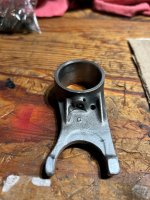
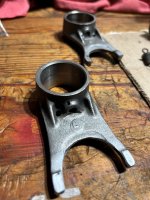
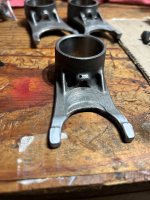
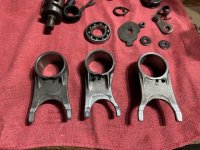
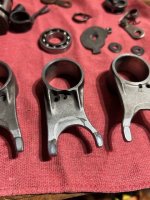
While cleaning and inspecting everything necessary to put the crankcase back together, I noticed each shift fork has a wear mark. The wear marks are at the base of the forks. I'm curious what the expert consensus is.

Fork1.jpgFork2.jpgFork3.jpg
 
That wear at the base of the fork actually looks like part of the manufacturing process. There is no way any of the gears could reach that part of the fork.

The tips aren't worn or discolored based on the pics, so I would just check that none of the forks are bent and you are good to go.
 
These forks actually look better than the ones I ended up using and my 450 shifts great IMO and easy to find neutral. I did buy a new shift drum stopper {pizza cutter} and neutral stopper.
 
That's interesting. I never considered the marks at the base could be from the manufacturing process. Maybe they needed to flatten some high spots in the casting? When I look at the right shift fork, (last photo) I can't imagine a movement that would create the pattern which appears to drift vertically. The links to the posts were very helpful. Thanks @stl360+450. The other side of the middle fork is the concern. I read that if the gear has worn into the fork at all it likely means that the fork is bent and out of tolerance. I'll be replacing the center fork unless others consider it unnecessary.
Forks_backside.jpgFork(C).jpg

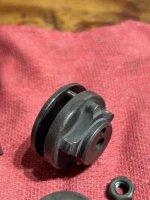
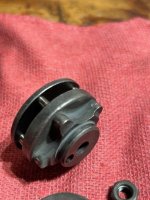
I have a new pizza cutter ready to go and the detent star looks okay with a very small groves (about 0.3 mm).
Detent_Star1.jpg Detent_Star2.jpg

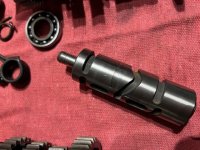
The inner walls on the shift drum looks perfect. Light scuffing/staining on the sliding surface which I will remove with light emery cloth.
Shift_drum.jpg

Nothing jumped out at me while inspecting the gear sets but please let me know if you see something of concern.
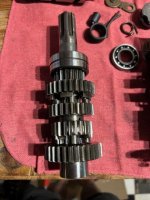
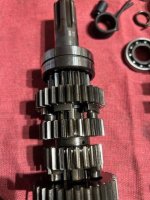
Mainshaft1.jpg Mainshaft2.jpgCountershaft1.jpg Countershaft2.jpg
 
I'd replace the middle shift fork too for the reason you mentioned. Everything else looks good to me, but the areas of the gears that might be of concern are viewed from the sides - the engagement dogs and openings in the gears where they mesh would be the areas to look for wear.
 
Thank you for the suggestions AD. I hadn't thought to look there but I disassembled both the main and countershaft to get a closer look at each gear. Good news, no sign of wear on any of the engagement components.

Today I'll be putting the transmission back together. After that I can begin reassembly of the bottom end! Before I do, I'd like to share what I've checked off so far to get a sanity check that I haven't missed anything critical. Please share any suggestions for reassembly that are not stated in the FSM.
  • Cleaned the crankshaft including oil galleries per Jensen's post and other kind folks recommendations. New cam chain w/ extra links.
  • Cleaned and inspected gearshift drum and shift components. New pizza cutter, replaced shift forks where needed, and replaced gearshift spindle.
  • Replaced countershaft and plugged the drive chain oiler. All gears visually inspected for wear from engagement dogs.
  • Cleaned and inspected kickstart components.
  • Reinstalling clutch plates (looked new), considering replacing clutch springs as they are just within spec.
  • New oil filter cap, made the necessary modifications to use Jay's oil pump.
  • New o-rings, circlips, oil seals, fasteners, and gaskets.
All knock pins and set rings will be accounted for (I'm realizing now that I may be missing one or more of the hollow dowel pins). Cam chain will be installed before the bearing cap is installed. I'll be cleaning the mating surfaces thoroughly with acetone and use a thin layer of Hondabond HT. All fasteners will be lightly oiled and torqued to spec.
 
Thank you for the suggestions AD. I hadn't thought to look there but I disassembled both the main and countershaft to get a closer look at each gear. Good news, no sign of wear on any of the engagement components.

Today I'll be putting the transmission back together. After that I can begin reassembly of the bottom end! Before I do, I'd like to share what I've checked off so far to get a sanity check that I haven't missed anything critical. Please share any suggestions for reassembly that are not stated in the FSM.
  • Cleaned the crankshaft including oil galleries per Jensen's post and other kind folks recommendations. New cam chain w/ extra links.
  • Cleaned and inspected gearshift drum and shift components. New pizza cutter, replaced shift forks where needed, and replaced gearshift spindle.
  • Replaced countershaft and plugged the drive chain oiler. All gears visually inspected for wear from engagement dogs.
  • Cleaned and inspected kickstart components.
  • Reinstalling clutch plates (looked new), considering replacing clutch springs as they are just within spec.
  • New oil filter cap, made the necessary modifications to use Jay's oil pump.
  • New o-rings, circlips, oil seals, fasteners, and gaskets.
All knock pins and set rings will be accounted for (I'm realizing now that I may be missing one or more of the hollow dowel pins). Cam chain will be installed before the bearing cap is installed. I'll be cleaning the mating surfaces thoroughly with acetone and use a thin layer of Hondabond HT. All fasteners will be lightly oiled and torqued to spec.
Looks good. Be absolutely sure you get the small end bearing caps on the transmission shafts on their knock pins during shaft installation to avoid punching one through the upper case (and develop transmission issues later).
 
Just a quick note from my “D’oh!” File…

When reassembling, pay really close attention to the orientation of the gears. It’s almost impossible to determine from the parts fiche, but the gear closest to the roller bearing can be installed while flipped the wrong way, and everything will work fine until there’s any kind of load and then you’re stuck in first.

Requires a complete tear down of the bottom end to correct.
 
@ancientdad Yikes. Will do! I remember reading through a post recently where a PO had missed a knock pin for one of those bearing caps and it was backing off the shaft and obviously causing trans issues. I hadn't thought about a misalignment. The engagement depth on the outer race is pretty shallow so I can see how that could happen.

@EzPete Oh man that story is pure nightmare fuel. I took a ton of photos to help but not enough to stop my anxiety. Do you think you could confirm the orientation of that gear. I think the gear you're describing is the low gear? The low gear seems to have a distinct offset. I have mine installed so that the teeth are offset towards the center of the motor. Does this sound correct? Happy to upload a photo if that helps.

@boddy Thank you for the advice! Added to my list.
 
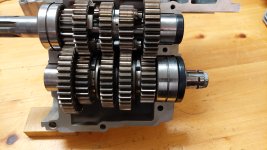
Here's a shot of the CB450 transmission...I can see where it would be easy to flip that gear. Maybe check for wear marks on one side versus the other.

20240722_093701.jpg
 
Back
Top Bottom