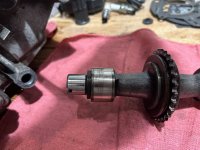
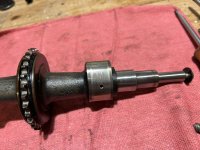
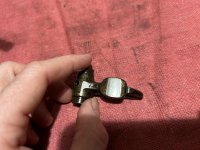
1970 CL450 K3 Rebuild

bald&pale

Well-known Member
Joined
Apr 11, 2025
Total Posts
76
Total likes
35
Location
Houston, Texas
I purchased a DOHC CL450 a few weeks ago with some serious compression issues. It was a barn find from the previous owner who was able to get it up an running after having sat leaned over on the side stand for 35+ years. I did a compression test and found it to be 80 psi in the left cylinder and 95 psi in the right.

I took the bike home and started the disassembly process following the service manual. I have most of the top end disassembled, the cam chain has been broken, intake cam has been removed, but the advancer baseplate is giving me trouble. I was able to pry it out by 1/8 inch with a putty knife but now it won't budge. I found another forum with the same problem. It included this video HOW TO remove timing advance rusted to camshaft but I'm still having a heck of time getting it to move. I sprayed it down with PB blaster and will give it some time. Does anyone have any suggestions?

The image below shows the baseplate with bolt and harden washer still on. I put those back on after I was done working so it didn't get lost. I've read these are not easy to replace.
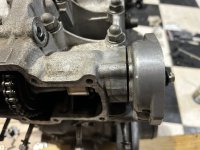
C0B92391-A76A-4548-8FC6-75D9BCFB85C0_1_102_o.jpeg
 
Take a look at my thread starting at post 115. I had one really stuck on my donor engine that took a lot to get loose. Some great advice and patience finally worked for me.

 
You need to throw that putty knife as far away from you as possible. Hopefully you haven’t damaged the gasket surface.
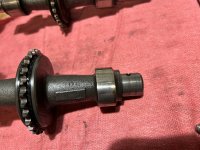
By advanced base plate are you talking about the whole cam bearing/points enclosure (the part you show partially pried off) or the advancer mechanism?

If it’s the former:

Rotate the cam to the spot that all the valves are closed. It’ll come right off.
 
In this forum you can find tons of information especially regarding the engine.
It is highly recommended to get drowned in them before starting to disassemble the engine.
I've two engines to be refurbished (K1+2) and one K0 nearly completed in parts.
It's no rocket science, but if you're doing it wrong, it could be messed up.

I'll follow, please keep us updated.
 
You need to throw that putty knife as far away from you as possible. Hopefully you haven’t damaged the gasket surface.

By advanced base plate are you talking about the whole cam bearing/points enclosure (the part you show partially pried off) or the advancer mechanism?

If it’s the former:

Rotate the cam to the spot that all the valves are closed. It’ll come right off.
Thank you for the help. To clarify I mean the whole cam bearing/points enclosure. I will absolutely take your advise and toss the putty knife. The last thing I want to do create any damage to the mating surface.
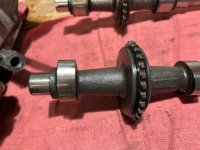
The cam shaft will not freely rotate. I have the cam chain broken but no moment… thoughts?
 
In this forum you can find tons of information especially regarding the engine.
It is highly recommended to get drowned in them before starting to disassemble the engine.
I've two engines to be refurbished (K1+2) and one K0 nearly completed in parts.
It's no rocket science, but if you're doing it wrong, it could be messed up.

I'll follow, please keep us updated.
I’m very grateful for the recommendation. I went through a dozen or so threads on engine assembly/disassembly before beginning. So far I’ve followed the service manual and tips from this forum and watched a few videos. Although I’m careful not to follow the videos exactly as some members have stated they do some things wrong. I’m taking my time and being patient while taking hundreds of photos to help with reassembly.
 
Thank you for the help. To clarify I mean the whole cam bearing/points enclosure. I will absolutely take your advise and toss the putty knife. The last thing I want to do create any damage to the mating surface.

The cam shaft will not freely rotate. I have the cam chain broken but no moment… thoughts?
Because the cam bearing is all cockeyed now.

Tap that bearing housing back in to square it up, remove the cam chain and you’re going to need to rotate that cam by hand. It may take a large flathead levered off the bottom at the cam chain gear and you go one tooth at a time while it clears a lobe, but you’ll feel it immediately loosen up dramatically when it gets to the right spot. You can even help it by loosening up the valve adjustments.

It should be pretty easy to wiggle the cam bearing right off at that point.

You’ll have to remember to do the same on the install. Makes it so much easier
 
Thank you for the help. To clarify I mean the whole cam bearing/points enclosure. I will absolutely take your advise and toss the putty knife. The last thing I want to do create any damage to the mating surface.

The cam shaft will not freely rotate. I have the cam chain broken but no moment… thoughts?
First, a picture of the end of it would help, but let's get more clarity. We try to help new members understand that we can't see what you see, so lots of pictures showing all aspects of the problem area are helpful. The advancer is stuck on the end of the camshaft, yes?

If so, you need to use some penetrant and heat to help loosen the advancer on the shaft and get it removed before you do anything else. But you're basically doing it out of order, much like those guys in Houston did in their first AND second 450 teardown video, trying to disassemble the head while it's still on the cylinder studs. Which is why you'll see no those guys in Houston videos allowed here. Because this is what they do, and what we do not do.

continued hackery.png

450-1.jpg

Break the chain, slip the chain out of the head on both sides, then lift the head off the engine and put it on the bench. THEN you can rotate the cams to the point where no valves are open. Then the cam bearing covers will slip right off easily, without doing any damage, and as soon as you get that advancer off the end of the exhaust cam you'll easily remove the last cam bearing cover.
 
Take a look at my thread starting at post 115. I had one really stuck on my donor engine that took a lot to get loose. Some great advice and patience finally worked for me.

Sorry, EzPete helped me realize that wasn’t very clear in my first post. The part that is stuck is the entire enclosure and not the advance backing plate. Thank you for the help though!
 
First, a picture of the end of it would help, but let's get more clarity. We try to help new members understand that we can't see what you see, so lots of pictures showing all aspects of the problem area are helpful. The advancer is stuck on the end of the camshaft, yes?

If so, you need to use some penetrant and heat to help loosen the advancer on the shaft and get it removed before you do anything else. But you're basically doing it out of order, much like those guys in Houston did in their first AND second 450 teardown video, trying to disassemble the head while it's still on the cylinder studs. Which is why you'll see no those guys in Houston videos allowed here. Because this is what they do, and what we do not do.

View attachment 44443

View attachment 44444

Break the chain, slip the chain out of the head on both sides, then lift the head off the engine and put it on the bench. THEN you can rotate the cams to the point where no valves are open. Then the cam bearing covers will slip right off easily, without doing any damage, and as soon as you get that advancer off the end of the exhaust cam you'll easily remove the last cam bearing cover.
Understood. Here is a photo of the end. The advancer was not stuck. I'll be sure to include more photos in future posts.

91420BA8-18CB-44B8-978F-6AEF4C763625_1_105_c.jpeg

I was able to tap the housing back into the head to square up the bearing. This freed up everything enough to allow the cam to rotate. I now have enclosure and cam removed. FFEW! Hopefully I dodged my first bullet.
 
Because the cam bearing is all cockeyed now.

Tap that bearing housing back in to square it up, remove the cam chain and you’re going to need to rotate that cam by hand. It may take a large flathead levered off the bottom at the cam chain gear and you go one tooth at a time while it clears a lobe, but you’ll feel it immediately loosen up dramatically when it gets to the right spot. You can even help it by loosening up the valve adjustments.

It should be pretty easy to wiggle the cam bearing right off at that point.

You’ll have to remember to do the same on the install. Makes it so much easier
Thank you so much. I followed your advise exactly and was able to remove the cam.

I'm worried my boneheaded move with the putty knife has done some damage. I can see a very slight grove that is not easily seen in the photo but it is there. Is there a proper way to check or improve this? Obviously it can't be machined flat again. I'm so angry with myself because I knew better.

8E7FE8EC-5810-4D6D-BE0E-2225325743EE_1_102_o.jpeg62ABFC38-1E50-4DF0-B31E-3EC9B36DF1F5_1_102_o.jpeg
 
Hopefully I dodged my first bullet.
Remains to be seen. Take a close look at the bearing surface inside the left exhaust cam bearing cover to be sure there aren't any scratches or gouges in it. The way these heads are designed, you can't force anything. It is all intended to come apart and go back together easily and smoothly when done correctly.

I did not do a disassembly tutorial and I guess I need to, but I did this to help with proper reassembly later.

 
When it comes to removing the rest of the components, I’d really recommend getting the FSM out and reading through it ahead of time. If you can, grab the pdf file and have it printed at FedEx Office on hole punch paper and put it in a binder. (Under $20 OTD) do it one side print and you’ve got the reference right there with you and it’s way easier to get to when you’ve got greasy hands, etc. plus blank pages for notes.

And don’t mix up any of the valve train components, including torsion tubes - those have specific sides.
 
I'm worried my boneheaded move with the putty knife has done some damage. I can see a very slight grove that is not easily seen in the photo but it is there. Is there a proper way to check or improve this? Obviously it can't be machined flat again. I'm so angry with myself because I knew better.
No offense, but one picture isn't well-focused on the area in question (cell cameras tend to focus on the closest or largest thing) and the other doesn't enlarge enough to be sure. With the leftover pieces of gasket material on the surface it also makes it harder to see any low spots. Clean up the surfaces as best you can, then take a picture at a slight angle to the gasket surface so we can see it in 2 dimensions.
 
When it comes to removing the rest of the components, I’d really recommend getting the FSM out and reading through it ahead of time. If you can, grab the pdf file and have it printed at FedEx Office on hole punch paper and put it in a binder. (Under $20 OTD) do it one side print and you’ve got the reference right there with you and it’s way easier to get to when you’ve got greasy hands, etc. plus blank pages for notes.

And don’t mix up any of the valve train components, including torsion tubes - those have specific sides.
I think I've had enough fun for today. I'm not going to touch another bolt until I print it out as you recommend.
 
No offense, but one picture isn't well-focused on the area in question (cell cameras tend to focus on the closest or largest thing) and the other doesn't enlarge enough to be sure. With the leftover pieces of gasket material on the surface it also makes it harder to see any low spots. Clean up the surfaces as best you can, then take a picture at a slight angle to the gasket surface so we can see it in 2 dimensions.
No offense taken. I'll clean off the gasket material then take some better photos another day.
 
No offense taken. I'll clean off the gasket material then take some better photos another day.
I realize the old "for reassembly, just reverse the order of disassembly" thing doesn't help when you're not familiar, and the Honda FSMs were written for their mechanics and not intended for public consumption, but it's still the most accurate source we have 50 years later.

You can gather some idea of disassembly when you go through this link about reassembly.

 
Last edited:
As recommended by @ancientdad I have inspected the bearing surface inside the left exhaust cam bearing cover and do not see or feel any scratches/ gouges. I will upload a few photos for more experience eyes to confirm. I am still working on cleaning off the gasket material to get a better look at the mating surface on the head. Any suggestions to get it clean and shiny again? I've seen people use scotch bright pad and break clean. I'm too scared to use a razor blade like others suggest.

I have read through the entire FSM and plan to print it out at my office today. I'm at the point in disassembly where the torsion bar is next.

The FSM provided has been annotated with a comment that reads: "Inside the head, insert a big screwdriver between the two ends of the torsion bars. Use the screwdriver as a wedge to carefully pry them apart - usually one of them can be pushed out far enough to slip off its locating pin and be pulled out. Then you can drive out the other one from the opposite side."

Would someone please confirm if this mothed is correct?
 
The FSM provided has been annotated with a comment that reads: "Inside the head, insert a big screwdriver between the two ends of the torsion bars. Use the screwdriver as a wedge to carefully pry them apart - usually one of them can be pushed out far enough to slip off its locating pin and be pulled out. Then you can drive out the other one from the opposite side."

Would someone please confirm if this mothed is correct?
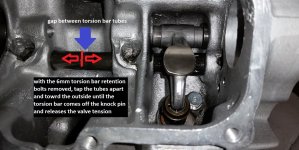
Again, the Honda FSMs were intended for their techs, not for the general public, and the only reason we have them now is because 50 years has passed and Honda no longer cares. There is likely little to no mention of that function in the FSM as Honda taught their techs many unexplained aspects of these engines at the 2 week Honda training school. This is a picture to explain that procedure, and the torsion bar tubes are hardened steel so they can take it. Pardon my misspelling of "toward" :)

torsion bar removal.jpg
 
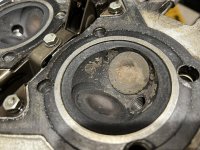
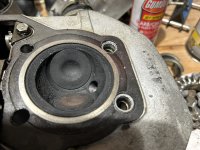
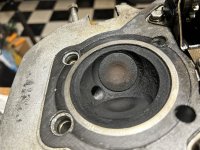
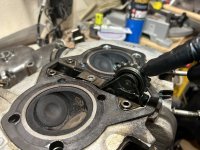
I took some photos of the combustion chambers for opinions. IMG_0816.JPEGIMG_0815.JPEG
These photos are of the left side of the engine.
IMG_0818.JPEGIMG_0819.JPEG
Now the right side

I'm not sure what caused the different deposit within the left side. Maybe running too lean? What is the recommended cleaning process to removed carbon so that I can look for pitting?
 
I expected the cylinder jug to be freely removed once the head was off, but it seems to be stuck to the gasket and will not easily release by hand. Are there any recommended pry points or a method to separate the cylinders without causing any damage the cooling fins?
 
I expected the cylinder jug to be freely removed once the head was off, but it seems to be stuck to the gasket and will not easily release by hand. Are there any recommended pry points or a method to separate the cylinders without causing any damage the cooling fins?
Use the solid front of the cam chain tunnel to apply some force with a rubber hammer, and if you remove the cam chain tensioner assembly from the back of the cylinders you can carefully tap on it for opposite direction force but be cautious of the gasket surface. You're taking the right approach by never prying on anything without asking first, just to be sure. The cylinder base gaskets can become hard as a rock and will be similar to the cam bearing cover gaskets to clean up, but it's gotta be done.
 
I took some photos of the combustion chambers for opinions.
These photos are of the left side of the engine.

Now the right side

I'm not sure what caused the different deposit within the left side. Maybe running too lean? What is the recommended cleaning process to removed carbon so that I can look for pitting?
Nothing looks out of the ordinary there, but the valves need to come out of the head so you can see their condition as well as the seats.
 
Again, the Honda FSMs were intended for their techs, not for the general public, and the only reason we have them now is because 50 years has passed and Honda no longer cares. There is likely little to no mention of that function in the FSM as Honda taught their techs many unexplained aspects of these engines at the 2 week Honda training school. This is a picture to explain that procedure, and the torsion bar tubes are hardened steel so they can take it. Pardon my misspelling of "toward" :)

View attachment 44522
It does seem to be written in broad terms which makes sense now. It goes into detail about the torsion bar design just not how to disassemble. Glad to hear I can use a little force to get them to move.
 
It does seem to be written in broad terms which makes sense now. It goes into detail about the torsion bar design just not how to disassemble. Glad to hear I can use a little force to get them to move.
Remember to remove the 6mm (10mm head) retention bolts on all four first.
 
Do you have a copy of the illustrated parts manual which is available in the library as well? Before tearing things apart I always like to look at the parts manual just to confirm I have accounted for all the nuts, bolts, and other bits and pieces that might be holding something together. For example if you are going to dissemble the bottom end upper and lower cases there are a number of different bolts and some of them are easy to overlook and you wonder why the heck doesn't this darn thing come apart.
 
Do you have a copy of the illustrated parts manual which is available in the library as well? Before tearing things apart I always like to look at the parts manual just to confirm I have accounted for all the nuts, bolts, and other bits and pieces that might be holding something together. For example if you are going to dissemble the bottom end upper and lower cases there are a number of different bolts and some of them are easy to overlook and you wonder why the heck doesn't this darn thing come apart.
I do have a parts list that @LongDistanceRider was nice enough to share. I'm not sure if that is the same document you're referring to. I can see why that would be useful and brings up another question. In my limited experience with head gasket repairs, I thought it was best practice to used new fasteners (when possible). I've seen a post of yours discussing a replacement purchase in which you received 14mm head bolts instead of the more stout OEM 17mm. I'll look for NOS fasteners for this situation, but I'd like to ask if there are any other fasteners you would recommend replacing rather than reusing?
 
More questions from a scared newbie. I have the torsion bars removed and labeled. The next items are the valves however there is a retaining ring that's fastened to the valve stem and sits above the outer arm of the torsion bar. What is this piece called and how do I remove it?
Valve.png
I've also removed the fasteners to the cam chain guide roller assembly, but it's stuck to the cylinder head. Before I start prying at it, am I missing something? More importantly I noticed that one of the guide rollers has a slight wobble to it when spun. I've been careful to not set this side of the head down on the bench for this reason. I'm pointing at the wobbly sprocket in the photo below.IMG_0838.JPEG
 
That valve retainer is 3 parts. Outer ring, and two tapered collets that get wedged together by the ring. With the tubes and cam followers out of the way, you’ll just need to support the valve from the bottom and if it’s super gunked, you may have to tap the ring downwards with the handle of a screwdriver if just pressing the ring downwards doesn’t free them up.

Do this over a shop towel or 3. Those collets somehow bounce and will run and hide if they hit the floor.
 
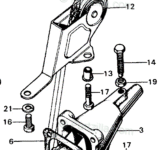
The cam chain guides are held in place by four knock pins (#13 below). Take a pair of pliers and gently twist the head to get some movement and then try to pull them out

1744766962624.png
 
That valve retainer is 3 parts. Outer ring, and two tapered collets that get wedged together by the ring. With the tubes and cam followers out of the way, you’ll just need to support the valve from the bottom and if it’s super gunked, you may have to tap the ring downwards with the handle of a screwdriver if just pressing the ring downwards doesn’t free them up.

Do this over a shop towel or 3. Those collets somehow bounce and will run and hide if they hit the floor.
So a little push on the valve stem should pop the outer ring off? Thank you for the warning. The area below my work bench is a place where important little pieces dream of hiding.
 
I'll look for NOS fasteners for this situation, but I'd like to ask if there are any other fasteners you would recommend replacing rather than reusing?
I used the original acorn nuts that came off the bike when I reinstalled the head as I didn't feel comfortable using the mini me replacement nuts. When I had the head ready to reinstall I torqued the head to the lower end of the torque range and I gradually increased the torque as I went until I got to the torque I wanted. I felt like it minimized stress on old studs and fasteners. In my case many of the fasteners showed a lot of wear and corrosion so I have gone through the parts manual and ordered a lot of new fasteners from Honda Parts Now where I can. Ordering can be a bit of hit and miss and very often they show something as available and after you place the order they come back and show some parts discontinued or back order with no ETA so they can't order it. They will give you the option to either cancel your order or go ahead and order the parts that are available. I also got some other fasteners from big box stores others I ordered from Ebay and other vendors. It has been a bit expensive especially adding on shipping but I prefer new where I can. I am going to try my hand at zinc plating some of bolts and such that are no longer available.
 
Yeah. Just separate the ring from the collets - honestly I’m surprised they didn’t just pop apart basically when the tension of the spring and cam follower was removed.
 
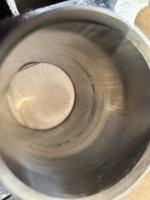
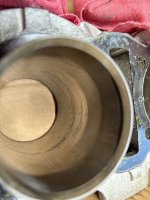
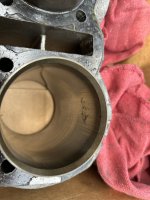
I was able to set eyes on the cylinders yesterday and found a rust ring in one and a small area of rust in the other. I'm interested to hear where everyone thinks I should go from here. Here are some shots of the cylinders.
IMG_0844.JPEGIMG_0846.JPEGIMG_0849.JPEG
 
Looks like a deep score mark in the first picture and the last pic show some pitting due to the rust. What is the condition of your pistons and the ring landings, are they standard size? It might be best to take the cylinders to a machine shop and get their opinion on how much they will have to remove to get rid of the score marks and rust. Over size pistons range from .25 to 1.00mm.
 
That looks like fresh hone and rings at a minimum - hard to tell without measuring and being able to tell if you can feel the scoring. Personally, being this deep into the engine already, I'd do at least a .25 overbore (or whatever piston/ring set you can find a good deal on), and call that a day.

Check 4into1 for piston sets if you're trying to save some scratch, they're essentially the same thing that those guys in Houston has at twice the price. If you want to go fancy, get some 1.0 over Wiseco - just be aware that if you go more than 1.0 over you need a different headgasket that is not easily available.
 
Thank you all for the recommendations. While doing my research I noticed the Wiseco product description says these are the same size as stock pistons. Then further down it says the kit is for a 1.0mm oversized bore. What gives?
 
They’re the same size as the 1.0 over “stock” or 4th oversize - still fit the same pin diameter, same crown height, etc.

Honda used to stock whole ranges of overbore pistons for all these models as it was a common practice to just bore and replace on each rebuild.

Essentially those Wiseco pistons don’t require any additional machine work apart from the proper bore (for a forged piston as AD pointed out). I’d have the machinist also do the rings and ring gaps as well.
 
And yet again I’ve learned something new. I’m so happy to have found such a knowledgeable group. There is a great machine shop that’s down the street. I’ll go see them tomorrow to get a better idea of what it will take to get rid of the damage.

Just out of curiosity, when do people choose to replace the entire sleeves? After you’ve bored them out too many times? I’m sure there is a limit to how much material you can remove right?
 
4mm is apparently the limit. Usually reserved for some pretty catastrophic damage to either the cylinder walls or (more typical) the head mating surface or base gasket surface are damaged to the point that too much material would have to be decked to square them back up.
 
Just out of curiosity, when do people choose to replace the entire sleeves? After you’ve bored them out too many times? I’m sure there is a limit to how much material you can remove right?
As EzPete mentioned, most Honda cylinders can be safely bored well beyond S4 (1.0mm). Piston availability (and cost) is the limiting factor but my 450 is S16 (4.0mm over, 497cc) with the stock sleeves, but unless you're looking to put high performance parts in the engine then no more than 1mm over to clean up the cylinders is the simplest route since parts are more readily available.

One of our sponsors, Scrambler Cycle, has these good quality sets at a good price, and the stock head gasket will work with them up to 1mm over

 
A new set of Wiseco pistons showed up today! I'll be sure to let the shop know they're forged so the tolerance is correct. The cylinder head was send off to Schumann Motor Works. I'm getting started on the bottom end and found the mating surface for the crankcase is chewed up. I'm surprised there weren't any leaks after the test ride. Eventually I'll create a post with pictures off all areas that look concerning to get suggestions on what to do.

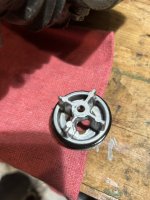
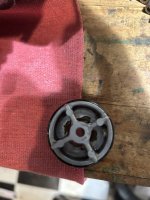
I found that the plating on the oil filter cap is deteriorated (photo below). I only found two replacements for sale online and one looks like it has something similar going on and the other doesn't have a photo of the front. Am I correct in thinking this should be replaced?

https://www.ebay.com/itm/226442554409

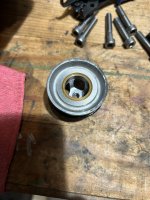
Would someone recommend the proper socket to remove the 16mm lock nut holding the oil filter rotor? The OEM one on partzilla is $60!

D14B32FB-32C3-4CF9-854B-3F9058746890_1_105_c.jpeg666516E2-A3F6-4F4D-9670-37AA935F8C69_1_105_c.jpeg
 
That oil filter wrench is available for $9-12 on Amazon.
 
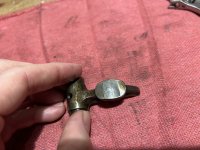
Hope every is having a good weekend. I took a closer look at the cams and followers today and noticed the left exhaust follower has a concerning looking gash. You can also see a skinny dished mark which runs parallel to the cam shaft. There is some light discoloration on the corresponding cam. Attached photos for the the more experienced eyes to inspect. At what point do you need to repair or replace a damaged follower or cam?

Right_Ex.JPEG
REx_Cam.JPEG
Right Ex
Left_Ex.JPEG
LEx_Cam.JPEG
Left Ex
Right_In.JPEG
Rin_Cam.JPEG
Right In
Left_In.JPEG
Lin_Cam.JPEG
Left In
 
Any "dished" followers will either need to dressed down to smooth again, or refurbished by one of a couple of services we know of, or replaced with good used or new (new ones are pricey and hard to find). The problem is lack of proper valve adjustment, since the dished area will mislead when using a feeler gauge and the clearance will not be accurate. The left exhaust follower and cam lobe are the last to get oil flow being the furthest from the pump and passages, which is why cautious and careful warmups are a requirement for these engines to survive in a healthy fashion. It takes 1 to 2 full minutes to get continuous oil flow up to the cams and followers on a cold start from overnight, and many assume this engine is like most and can be safely ridden away right after start-up which usually results in the minor damage you see in yours.

Your pictures of the top of the followers doesn't translate how badly they're dished. I've used a whetstone to dress down the surface of lightly worn followers before, but taking too much off the surface can result in accelerated wear. Cam lobes with minor scuffing or light galling can also be cleaned up with emery paper.
 
That right exhaust is looking really rough, IMO. They’ve got a hardened coating that it looks like it’s torn through.

A picture from a. Side angle would help, but that’s a long shot to get back. You can find them used on eBay from time to time. I broke down and bought a NOS set on mine - they’re no joke pricey.
 
Back
Top Bottom