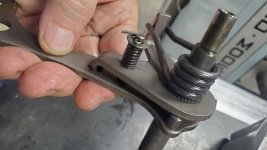
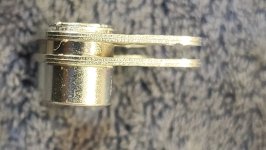
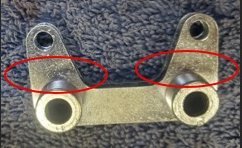
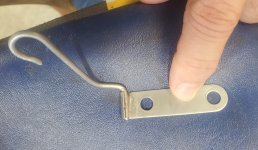
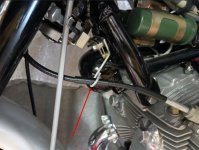
@ballbearian covered this in his build thread starting here. Member 66Sprint (who recently passed) came up with a nice solution to the over advance issue.



crazy, I only knew it because of my kids. When I grew up it was Rock-Paper-Scissors. You should have seen me trying to spell it. Thank gosh for the net, otherwise it would have been ugly.I had to look up Roshambo, never heard it before.
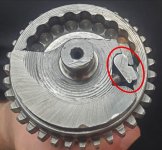

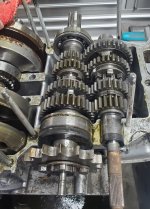
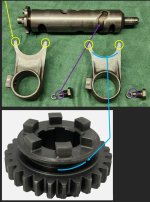
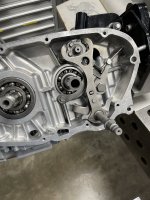
 Dogs are wear items but when these edges get too worn, you may want to replace the gear/gears. As you can see here these edges look sharp and precise. As they wear, these edges grow, as in the radius gets larger and less defined. If you look close, you can see that the sides of the dogs, lets call it their left and right side (not top or bottom?) are tapered in. They have a reverse cut which helps the dogs pull each other together under load. As the edges become rounded corners, there is less and less taper to grab to the dogs become less effective. Oh yes, the still work but shifting may need to be more authoritative with damage and age.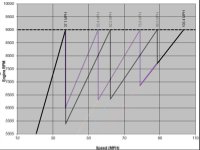
You are now punching way over my head. By that I mean there could well be a race sets of ratios and there might even be a 5 speed but those are just whispers to me as I knew that none of that was on my radar even if cool so I did no digging.Suzuki used very similar sprag mechanism for decades on gear change drum. If you asked me which way it went I wouldn't remember without looking at it.
Suzuki had a left and right with offset slot for spring.
Those transmission gears look brand new?
Didn't Honda make a close ratio set for the road race conversion? (and maybe a wide ratio/extra low first gear for desert racers?)
CB72/77 is one of the few motors I've never had in pieces but as the first 'real' bike I ever fell off has a special memory for me. (about 55 years ago)


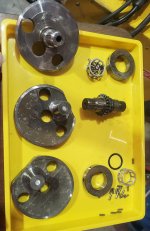
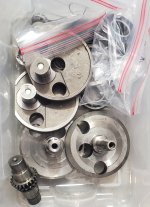
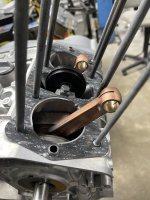
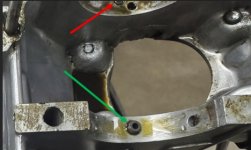
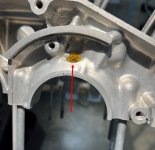
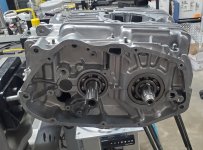
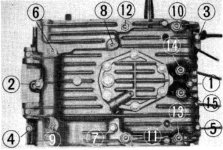
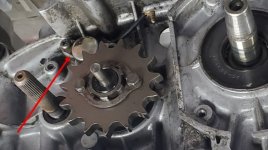
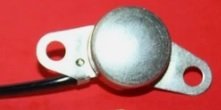
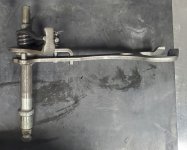
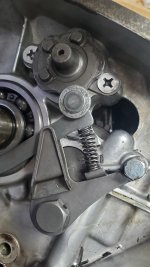
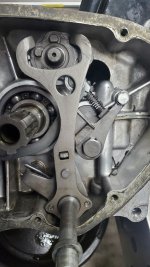
That looks pretty clean to me. My C77 selector was in a much more abused state lolGear Selector mechanism. Resplendent in dirt.
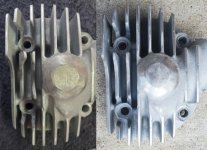
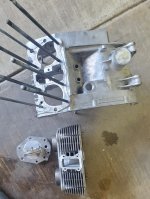
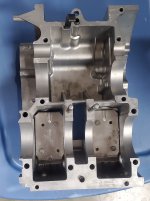
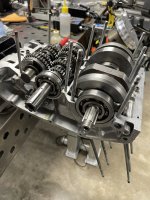
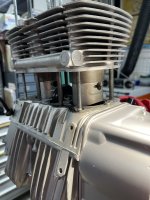
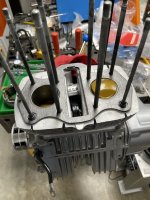

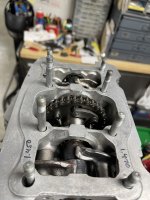
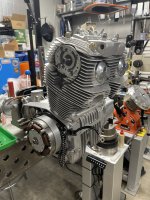
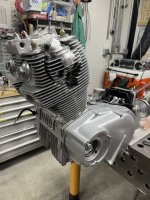
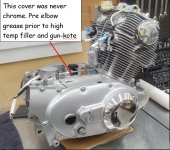
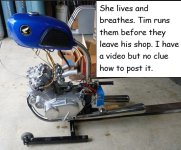
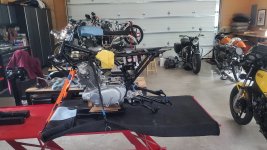

Very educational video, I found it quite interesting. I have watched other videos by the same guy and learn from them also.#30
More engine stuff.
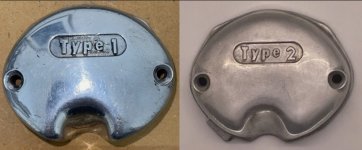
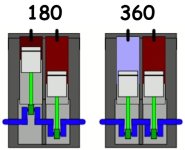
Not that it matters to 99.99% of us, but thought I'd mention that through the years, and for various reasons only known by Honda (not a slam, just me talking) our Type I engines are considered the 180° engines vs. the Type 2 being considered a 360°. This has to do with the crankshaft layout. These choices affect several things in the engine from power delivery to balance and more. See link below for some education.
Those in the know, most definitely not me, have the knowledge and only have to glance at the bike and can say what type engine that bike uses. I have to look at the points cover Rt side of the engine. You know, the cheat sheet.
View attachment 58646
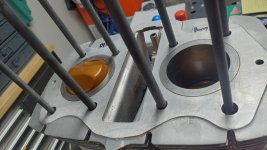
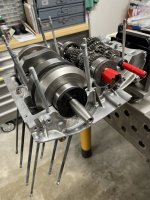
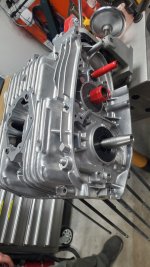
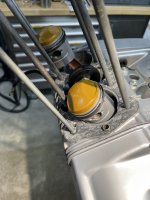
The engine in this bike is a Type 1 180 degree engine with the "whack a mole" pistons. I don't have an open picture of the Type 2 but you can see the difference here.
View attachment 58645View attachment 58647
I was going to pontificate about "why this firing order over another" but know that a far better explaination sits with much smarter people than I so follow this link to a gent well worth a listen too. In this case he discusses the various differences in vertical twin firing orders which encompasses the Honda Type I and Type 2 by default. His presentations are such that even this cave man gets it. And besides this video, he has many engine related videos you will enjoy, I promise.
Straightened some fins, cleaned 'er on up. OK, lets admit it is cleaner but the backgrounds affect the shine here too.
View attachment 58652
View attachment 58654View attachment 58655
View attachment 58656View attachment 58658
View attachment 58659View attachment 58660
View attachment 58661View attachment 58662
View attachment 58663View attachment 58664
View attachment 58665
Couple of more next entry.
Yes, at some point the head was cut 0.030" which gave pause to consider our goals here. At every turn, OE like and long life so several things transpiredLooks really good. I see you used 3 base gaskets, was this because of having the cylinder decked or were the piston were a little higher?
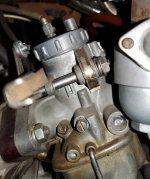 This is before disassembly.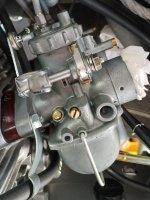
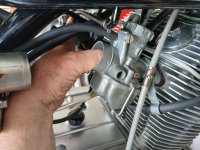
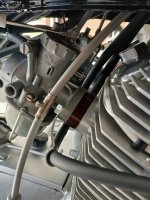
 Tried to find the "stick" guy again to give him a shout out but of course....What Guy? Kudos to him.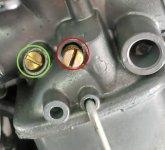

Awesome description. Kudos.#32
I was going to discuss carbs later by why not now as it is an engine ancillary right? And we are kind of, sort of there yes?
I’ve messed with many a carb in my life time ( which does not make me an expert) but because of that, jumping into them does not intimidate me and nor should it you.
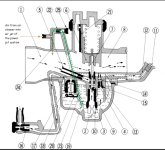
Luckily the Keihin Power Jet carbs found on this bike as well as the CB77, is not complicated. The only real difference I can see between the two bikes of this year, are the bore size of the carbs. A Keihin PW22 for the CB72 like this one, and a PW 26 for the 77. Of all the carbs I ever messed with, only the “rack-o-lamb” Honda CBX carbs were what I’d call a pain in the backside. And even then, really only a PITA because of all the added bits these carbs have not to mention the need to keep track of the idle-up feature of the choke mechanism. As we’ve discussed on the engine here, take lots of pictures and have a parts manual beside you. It all goes back together the same as it came apart. I keep a selection of hammers near at all times.
No matter what, IMO, the most important thing you can do is to clean the heck out of them. Each and every part. Prior to actual cleaning these were stripped to the bones with each part catalogued. Cleanliness is paramount to good function and future tunability of your carbs moving forward so spare nothing here. I used solvents, ultrasonic cleaning, fine sanding medium by hand (like 3m Scotch Brite) and some Vapor blasting to finish the outside of the bodies. As I’m chicken about the possibility of getting blasting medium into the passageways, I was very careful about that. Point being, no one thing was used to get them into shape in my case.
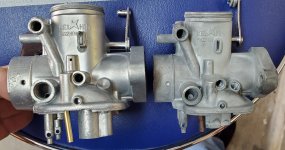
View attachment 58684This is before disassembly. View attachment 58682
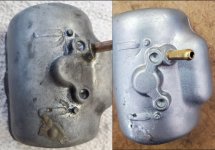
Ironically, I found nothing odd about these carbs internally other than one float bowl had rotted out so was full of holes. I’m told these can be found but none seem available when I look. I know I can have new ones printed as I went down that road but in the interim, I chose fuel proof epoxy.
I ended up with some marine stuff I tested for about a year and still seems OK. I sealed the leaking bowl internally effectively hiding the damage but beyond this. You have to look hard to find the repaired bowl from the outside. Otherwise the only thing I found to be an issue were the float heights.
Left, before clean and repair. Right, cleaned but not yet repaired. Today, it is hard to tell this was ever wonded.
View attachment 58683
View attachment 58686
I had to straighten part of the choke lever. As we go through the bike reassembly, this becomes a recurring them. Bend, then re-plate.
View attachment 58687
Each jet/part should be clean, each hole in every jet or tube should have clear unobstructed passage. Once you are convinced all that is good, and making sure your eyes are covered as a precaution please, go back and squirt carb cleaner through every passage making sure the cleaner comes out on all the places it should. Now blow each passage out with compressed air. It is imperative that the passages are clean. If after close inspection you still have doubt about any jet (or part) , buy new! I’m sure there are some fantastic jet copies out there but for me, the few extra bucks of the real thing give me a greater level of comfort of the new jets being the same as the day this bike was built. Paranoid much? LOL
There are only a few parts that can actually wear out over time and of those, the reality is for just the needle and seat and maybe, just maybe, the throttle slide itself. If you choose to keep the needle and seat you have, test them first. Easiest way for me to test is to install them back into the carb body with their floats and then blow through the fuel line inlet using your mouth as you don’t need much pressure here. The needle and seat only have to stop gravity fed fuel which ends up being very little pressure at the seat. With the float hanging down exerting no pressure on the needle at all, the air from your lungs should flow freely through the needle and seat. Now tilt the carb until the needle is pushed into its seat. Air flow should stop.
If you find your throttle slides have too much wear, which is possible but no common, replace them. Reason being that worn slides pass too much air around themselves creating havoc with the fueling system of the carburetor. I promise that if this is the case, you’ll go crazy trying to tune the idle, off idle, and general low speed running if the engine.
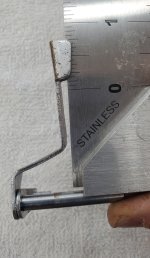
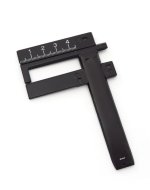
There are times I’ve found that you can eye-ball the float heights with a ruler and your Eye-Ometer. However there are times when, and I feel these baby Hondas with the round floats are it, you might want to purchase or make a tool to more accurately measure the float height. When you have a small bore engine trying to use a slightly large bore carb, low engine RPM doesn’t send the carb good strong signals so confusion can reign. I'm not sure why there are two styles of floats (and float bowls) but mine are the round type so making a tool makes measuring the float height easier and way more accurate. If the floats have flat sides, then this is easily achieved with out modifying your Vernier as I did to get the task done.
The CB72 floats are to be set at or dang close to 26.5mm
View attachment 58689 View attachment 58691
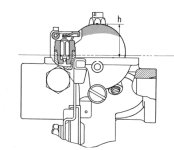
Notice the bulbous sides of these floats above? They stop you from using a plane old vernier if not for the extension seen added here. Right hand drawing shows we are measuring h from the surface of the gasket face flat of the body to the top of the float.
Commercial version and I'm sure there are others out there. This one can be found at 4into1.com
View attachment 58690
As you’ve just cleaned the carbs and they are in hand on the bench, make sure your idle speed screws are all the way out so that the slides can sit at their rock bottom in the carb body. Leave the screw turned out for now and continue assembly.
Jumping ahead to speak more about floats, running the engine for the first time was wonderful except for throttle response. The thing was lean. Jerking the carbs back off and the first thing I checked were the float heights. Sheesh but I must have been coming off of an all-nighter when I first set the floats on the bench because they were off. As in two mm or so. Hard to believe but I’m thinking the gaskets were in place (a no-no and I know better) Oddly when you stand back and think what the heck, how does a few mm mater? Well, it really does most particularly noticeable right off idle as the carb is doing its best to get the engine to pick up revs and then to draw the middle and high speed systems online in an effort to give the engine the fuel it needs at the correct time. If the fuel is too low in the bowl, it take more time and more pull to get the fuel out of the bowl and into the system to be used. Time is the issue here. The engine needs fuel when it needs it, not later.
When looking over the internal parts, do this for the floats as well. When they are in your hand, shake them. Listen for sloshing fuel. If you hear or feel any of that, replace the offending float. Note and as hinted, for some crazy reason, there are two types of floats for these carbs so snag the style you have.
Between us? Having spent some years using electronic fuel injection, I smilingly call a carburetor a “controlled leak”. Carbs are dead simple and in a pinch, I prefer them as it is hard to get one to fail but boy howdy can they be ornery to tune at times. Don’t forget that Honda and Keihin have done the heavy lifting here so all we need to do is to put things, like float levels, back where they belong all nice and clean like.
After the carbs were on the bike, I fed some fuel to it and the bike fired up almost instantly. BTW, hanging a small fuel container nearby gives you far greater access to the carbs just in case. You know, in case its best to remove them again. The CB’s fuel tank hides a lot even though you can still work and tune with the OE tank in place. As you may recall, we set the carb slide as low as they’d go so when you fire the engine, you will have to hold the throttle up a bit whilst allowing time for the engine to warm. A warm engine prefers a slightly different “tune” than a cold one so don’t rush it. Last I checked, the engines are nice and warm when we ride them right?
Back to the basics:
1) check, and set if needed, valve clearance.
2) check, and set if necessary, the ignition timing. Once those are known and you are happy, proceed with the carb!
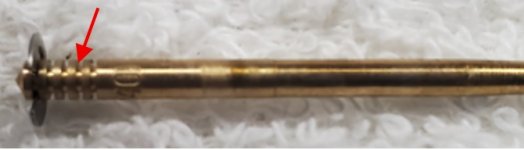
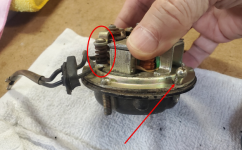
4) Now with the carbs bolted onto the engine, with good O rings on carb and manifold, verify your needle position one more time is there is any concern. So long as they are the same, proceed. In my case, I have my 22402 needles at second richest setting.
View attachment 58692
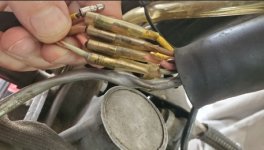
As can be seen here, my clip is in the slot position of the red arrow which raises the needles up in the slide to the second highest slot. In my case, I might even try the needle as high as it will go (last slot to the right of the arrow) but I’m getting ahead of myself. Needle height is a quick and easy change.
Once both slides are in, now it is time to mess with the throttle cables and how the slides respond to the twist of your wrist. (And yes, Keith Code’s books called A Twist of the Wrist are well worth the read) The goal here is to have both slides lift together. This is easy to do using your hand to touch the slides as you gently twist the throttle grip.
View attachment 58693
To get both slides to raise together, simply go to the adjuster on the carb that is not moving up when the other one does! Won’t take a lot, and before you know it, both slides move at the same time when opening the throttle.
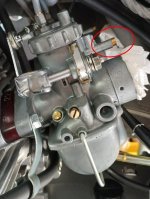
The small screwdriver at the top of the pict is touching the adjuster. Raising the adjuster forces the carb slide to raise earlier because you've removed a bit of slack. Again, this rarely take a lot of adjustment.
View attachment 58694
Now the fun part. Once the engine is finally warm, turn in the idle speed screws (brass screw as seen above which looks like the cable luber is pointing to) until the engine is idling about where it ought to be. The manual says below 1000 rpm but me, I like a little more. Make sure you have raised the slides by their screws equally for this first swing at it until you can let go of the throttle and the engine will idle by itself.
Now you need to "balance" the carbs. That means that each cylinder is doing roughly the same work. There are tools to really get this close but you can come dang close yourself without the tools by feeling for equal exhaust pulsing or by the sound of using a 3/4” tube in your ear held at right angles to the carb throat. Like the feeling exhaust pulses, adjust carbs to provide the same sound from each carb. I swear, works well.
View attachment 58695 View attachment 58696Tried to find the "stick" guy again to give him a shout out but of course....What Guy? Kudos to him.
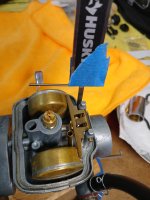
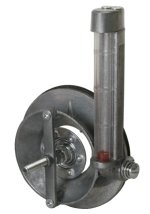
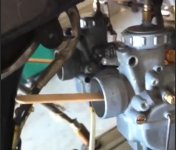
On the left, the commercially available Uni-Syn. Works well, super easy to use. Just place and hold it onto the front opening of the carb and watch the little red indicator move. The goal is to make the red indicator be at the same level of that vertical clear tube for each carb. Now on the right, this is something new to me which I found whilst looking around I saw this and LOVE its simplicity though I’ve never tried it. You use a couple of sticks stuck into each carb levered under the open leading edge of the slide. As you move the slide up or down, the sticks move up and down. When sticks are at the same level, you are golden. Again, I’ve never used it but love the idea. Between the tubes in my ears, tools like the Uni-Syn or sticks along with the ability to feel the exhaust pulsing, I’m covered. You will be too.
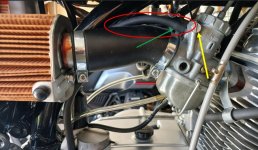
Once you have an acceptable idle all “synched up”, now mess with your idle mixture screws. Again, some brass looking screws seen in the GREEN circle. These are angled up slightly. The Red circle shows the engine speed adjuster.
This little baby in the green circle adjusts the air/fuel mixture at idle and can raise and lower the RPM. Most people suggest turning it in or out to find the highest RPM which I do at times but often once I've found that sweet spot, I then turn the screw back in 1/8th to 1/4 turn. (this is richer). This will most likely lose you a few rpm but often I find the gains of off idle response is a worth while trade. Unlike most cars and many motorcycles, there is no accelerator pump to help the carb/engine through this tough area of carburation. YMMV so give it a whirl and settle on what works best for you.
View attachment 58699
Once you are happy with the mixture, you will most likely want to go back and set the idle speed to what you want which is where you may have been initially. Make sure you adjust the idle speed screws equally but feel free to re-visit the synching thing if you feel you messed it up. Remember? Ear, Vacuum, Sticks, exhaust pulsing, all quick and simple to do.
Now, shut the engine down and with your hand, check that the slides still move together. Very often you’ll find that this has changed because your idle speed screw is holding one slide higher than it did when we started. (Don't forget the slides were sitting on the floor of the carb body when we began) Changing the idles screws typically raises one slide higher than the next putting cable slack into that side. So like before, just take the slack out again with the adjuster on top of the carb. This can be a bit of a tap dance but no matter what, it is all very easy.
OK, I'm toast for now so....Later!
PS, if someone has a nice float bowl no longer wanted....feel free to reach out. I'm trusting the Epoxy but there's always a but... TY
) but at this juncture I knew that this wasn't so large as to stop me from adjusting around it with the idle mixture screw. With the 35's the idle mixture screw was maybe 1/8th turn out from bottomed.
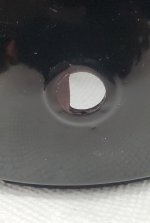
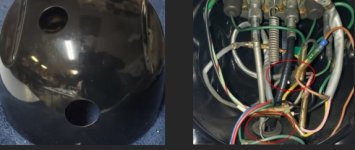

I'm going to run with your Chowdered from here on. TY for that."Chowdered" is also acceptable, as is "boogered"...
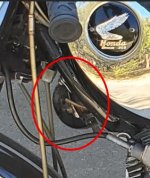
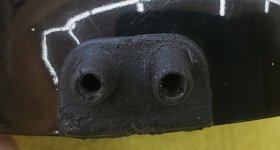
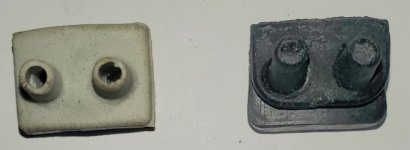
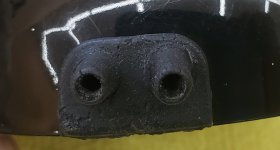
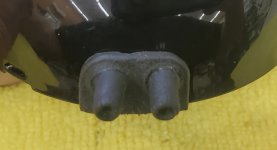
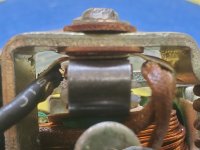
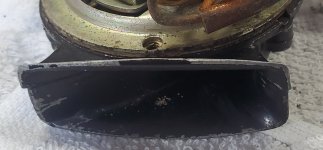
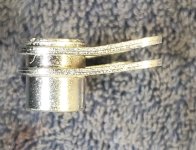
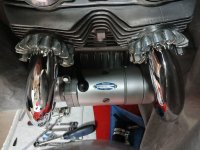
Wait until you see the intake tubes they made me. Unless of course I've already mentioned them. OK, now gimme some heads up on CFS. I still travel so I'm all ears. Stay well.CFS is my go-to for any breakfast at a restaurant. I'm like an idiot savant at CFS appreciation, except without the savant part
Thanks so much for the Clauss mention, I had no idea they existed, all those formerly unobtanium new rubber goods at apparently quite reasonable prices...thanks again for the heads up!

Darn!! You had to mention Chicken Fried Steak, NO not Country Fried Steak. Every time I make it home to Oklahoma I have to eat as much as I can, especially with a big order of fries and gravy over all of it and just a drop or two of Tabasco! YUMMMM!Back later but as my friends and I are going off to find "our" best CFS (Chicken Fried Steak) in Texas starting tomorrow...
Stop...I'll be a mess drooling the rest of the day until we light out for a slice of heaven.Darn!! You had to mention Chicken Fried Steak, NO not Country Fried Steak. Every time I make it home to Oklahoma I have to eat as much as I can, especially with a big order of fries and gravy over all of it and just a drop or two of Tabasco! YUMMMM!


Ez, without a doubt Mary's is on our list. Not only is it our intent to find good CFS but at the same time to look at museums ,or any collection of motorbikes, cars, and planes. We find one of those museums, we then look for a reputable CFS restaurant. Mary's is on the list! TY for the suggestion.It's a bit of a hike from Liberty Hill (or really from anywhere for that matter), but Mary's in Strawn has a pretty solid CFS contender.