1970 CL450 K3 Rebuild

I think I have a healthy dose of 'proceed with caution' now. :LOL:

Waiting on a couple hollow dowels to arrive. I have no clue what I did with them. I looked in every parts bag. I know they where not lost under my work bench because they were still in the upper half of the case in my photos of the tear down. I'm sure I'll find them as soon as bottom end is buttoned up.

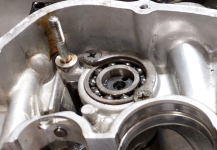
I dry fit the shift drum roller assembly last night and noticed that the ball bearing can't be pressed into place with just my hands. What is this proper way to seat that bearing?
 
I dry fit the shift drum roller assembly last night and noticed that the ball bearing can't be pressed into place with just my hands. What is this proper way to seat that bearing?
Are you referring to the ball bearing on the end of the shift drum? It is a snug fit, I never remove them unless there's a need to replace either piece.
 
Are you referring to the ball bearing on the end of the shift drum? It is a snug fit, I never remove them unless there's a need to replace either piece.
That's the one. I remember needing to tap on the other end of the shift drum to remove it. I don't have a socket or pipe large enough to match the diameter of the outside race. I'm guessing the right way to do it would be to assemble the shift drum, bearing, detent star, and neutral detent so that I can tap on the flat neutral detent to help seat the bearing?
 
Seat from the inside race - still kind of the same problem of a really awkward size/placement. You definitely don't want to seat it using the engine case as the backing though - aluminum is too brittle for that.
 
Seat from the inside race - still kind of the same problem of a really awkward size/placement. You definitely don't want to seat it using the engine case as the backing though - aluminum is too brittle for that.
That is exactly my concern. I just had an idea. I wonder if I can press it into place slowly with a screw clamp rather than tapping with a mallet. I think I will try that first.
 
If it came off without too much persuasion, it should go back on the same. Just make sure the surfaces are clean and lubed.
 
That is exactly my concern. I just had an idea. I wonder if I can press it into place slowly with a screw clamp rather than tapping with a mallet. I think I will try that first.
You might be thinking the bearing should sit flush with the crankcase - it does not. This is fully seated prior to removal.

1777562458307.png
 
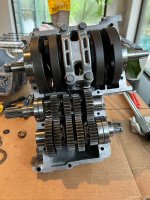
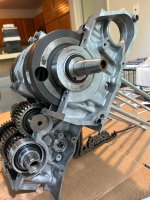
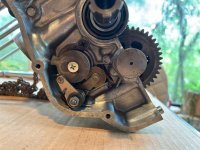
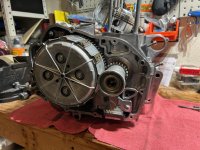
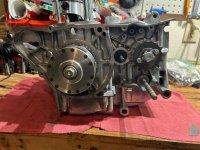
I am at a point where I feel comfortable buttoning up the bottom end today. The center bearing cap is torqued, cam chain is on, transmission installed, and made sure that all knock pins are fully seated. Before I add hondabond, I wanted to share some photos to get a final check from you all. IMG_3651.jpegIMG_3652.jpegIMG_3654.jpeg
 
You’re likely going to want a thin coat of Honda bond on the outside of those bearing race surfaces on the upper case.
 
I am at a point where I feel comfortable buttoning up the bottom end today. The center bearing cap is torqued, cam chain is on, transmission installed, and made sure that all knock pins are fully seated. Before I add hondabond, I wanted to share some photos to get a final check from you all.
I'd advise putting all the seals on shafts and clutch rod in place before putting the lower case on, better than driving them into the case later only to have one or more "skinned" during the effort and allowing the clutch rod seal to pop out more easily later. Put a thin smear of Hondabond all the way around the clutch rod seal outer surface to ensure it stays put later.
 
Thanks ExPete. I'll do that. I just realized that I think I have the outside left (right side in photo) crank bearing on the wrong way. There is an oil passage showing but no matching passage on the bottom half.

Will do AD, Thank you. Is there a consolidated torque spec file that you could share?
 
Will do AD, Thank you. Is there a consolidated torque spec file that you could share?
there might be somewhere here, but the FSM has the torque specs and honestly, I never use a torque wrench for the 6mm and 8mm bolts in the crankcase halves, just good "feel" on the ratchet. The crankshaft center cap bolts and head/cylinder studs are the most important areas for a torque wrench.

Jensen posted a torque value sheet in this thread:

 
The bottom end went together this past weekend without issue. I double checked the ring gaps and istalled the pistons last night. I'll review AD's 450 head assembly thread one more time before proceeding. Thanks again to everyone for the helpful tips. Everything is coming along nicely.

IMG_3681.jpegIMG_3680.jpeg
 
Don't forget the anti-seize on those stainless fasteners! And be careful with torque on those as well. I use a 1/4" stubby ratchet as a driver with those to keep the gorilla at bay.
 
The bottom end went together this past weekend without issue. I double checked the ring gaps and istalled the pistons last night. I'll review AD's 450 head assembly thread one more time before proceeding. Thanks again to everyone for the helpful tips. Everything is coming along nicely.
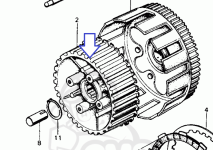
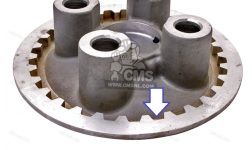
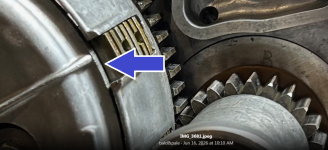
I'm looking at the gap between the pressure plate and first fiber disc and wondering if the splines in the pressure plate and inner hub are engaged. Thew gap looks wider than it should, like the pressure plate splines aren't lined up with the inner hub splines.

1781620092637.png

1781620177269.png

1781619978974.png

Hopefully it's just an illusion from the angle, but it would suck to have no clutch and have to pull the right crankcase cover again after it's in the frame.
 
Looks good — I can even see evidence of the Hondabond on the clutch rod seal. Am I correct to think those are Wiseco pistons?

Casual readers of this forum are going to start assuming that all dohc CB450's came with a gear oil pump! As well they should have.

Good eye. They sure are. I had to overbore the cylinders and figured why not.

I was very impressed with the pump design and thought it would be a great investment after purchasing essentially NOS cam followers. The modifications were simple and the install was a breeze. Happy to support Jay and the good folks of VHT.
 
I was very impressed with the pump design and thought it would be a great investment after purchasing essentially NOS cam followers. The modifications were simple and the install was a breeze. Happy to support Jay and the good folks of VHT.
The prototypes were already being discussed when I joined the forum and I was greatly impressed by the fact that the forum was connected to individuals who were developing new products for vintage machines. I couldn't agree more with the sentiment you expressed.

I've got 1200 miles (and counting) on the one I purchased from Jay — it should be more, but my commute is only 8 miles round trip.
 
Don't forget the anti-seize on those stainless fasteners! And be careful with torque on those as well. I use a 1/4" stubby ratchet as a driver with those to keep the gorilla at bay.
I'm guessing you are referring to the starter screws that I had left in there. Not sure why I didn't removed those because I decided not to use any of the stainless fasteners that came from the PO. I lightly oiled every new steel fastener.

That tip about using a small ratchet is a great idea. I am definitely a bit of a caveman mechanic, so I will absolutely take your advice.
 
I'm looking at the gap between the pressure plate and first fiber disc and wondering if the splines in the pressure plate and inner hub are engaged. Thew gap looks wider than it should, like the pressure plate splines aren't lined up with the inner hub splines.
This very well could be the case. I'll check to make sure the pressure plate is engaged this evening and report back.
 
This very well could be the case. I'll check to make sure the pressure plate is engaged this evening and report back.
If they aren't lined up the springs can't exert pressure on the stack of plates. All it takes to correct it is remove the 6mm bolts and springs, lift off the pressure plate far enough to rotate things to align the splines and bolt it back together (with good "feel" on those 6mm bolts for the springs of course, to further avoid any caveman antics :giggle: ).
 
If they aren't lined up the springs can't exert pressure on the stack of plates. All it takes to correct it is remove the 6mm bolts and springs, lift off the pressure plate far enough to rotate things to align the splines and bolt it back together (with good "feel" on those 6mm bolts for the springs of course, to further avoid any caveman antics :giggle: ).
As I removed the pressure plate, the stack came with it. Everything was stuck together from all the oil I used. It was definitely engaged, but it feels good to now be sure. I’ll be uploading more photos soon so please keep these observations coming!
 
As I removed the pressure plate, the stack came with it. Everything was stuck together from all the oil I used. It was definitely engaged, but it feels good to now be sure. I’ll be uploading more photos soon so please keep these observations coming!
Make sure you have the beveled plate in the correct orientation/order in the stack. If you accidentally flip either one you'll end up with a "fat" stack and the clutch won't quite disengage.
 
I had the chance to check this evening and the beveled edge is in fact facing the center of the engine. Much appreciated! I thought I would have a few hours to continue and put the head on this weekend but I'll have to wait. Really looking forward to getting the cam chain back on.
 
Back
Top Bottom