A C78 project

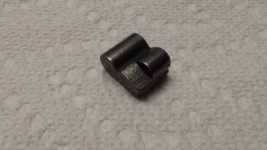
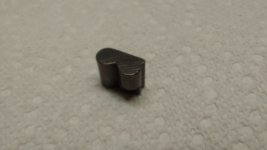
The only function of this rubber part is to avoid a clicking noise in the top end.
So the missing rubber has no effect on the advancer at high or idle RPM? Is the over-advance situation caused by worn parts and hence the need to restrict the weights?
 
Drats, I just lost my whole post.

Thanks for Bill's blog, the info and all pics helpful.

I used boron hardened 3/32 bit and roll pin to limit weight arcs.

17.5 x 2 =35 +10=45
 
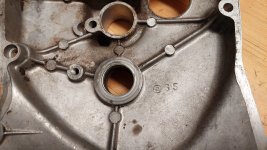
Cleaned up the alternator case and found a stamp inside. I thought most of the dates were in ink and used the dynasty dating system. Maybe this isn't a date of manufacture?
20251115_122138.jpg
 
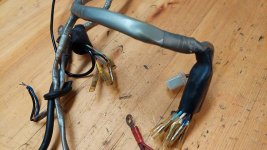
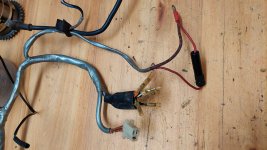
Tired of scraping grease and crud from engine parts, I moved on to cleaning up some of the electrics. Aside from a little dirt and grease, the main wiring harness was in good shape and the sheathing still fairly pliable.
20251115_121033.jpg
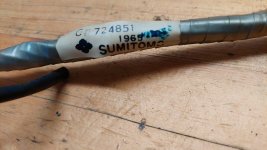
Harness is a 1965, probably the same for the bike.
20251115_120953.jpg
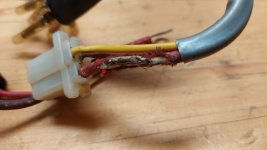
I went through all of the connectors and wires and only found one wire that needed attention. I think I will get some red shrink wrap and just cover the affected area. I don't really want cut the harness apart to replace the one wire.
20251115_121106.jpg
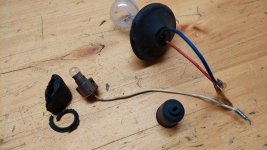
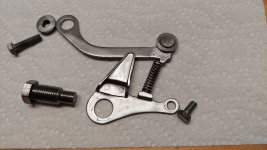
The rubber components for head light, parking light and brake switch did not fare well over the years. I think Clauss Studios has the brake switch cover but I'm not sure I will be able to find any of those other pieces and may have to McGiver something.
20251115_121401.jpg
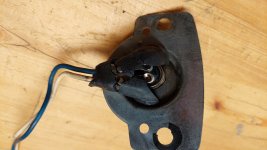
The tail light rubber was fossilized and crumbled in my hands. This will be the worst one to try to fix as the rubber encapsulated the contacts for the bulb.
20251115_121655.jpg
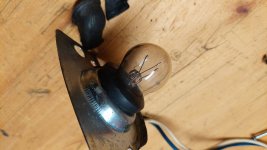
The rubber holding the bulb is also rock hard and I fear if I take the bulb out it will disintegrate. I might try to salvage this piece by soaking in a solution of oil of wintergreen and 70% alcohol
20251115_121801.jpg
 
I would replace the one wire. It can be done without cutting the silver sheath. Just solder the end of the replacement wire to the old one and pull it thru, might need to use a little heat on the sheathing bends to allow for easy pulling.
 
I would replace the one wire. It can be done without cutting the silver sheath. Just solder the end of the replacement wire to the old one and pull it thru, might need to use a little heat on the sheathing bends to allow for easy pulling.
Thanks, that would have been a good solution but you didn't see the all of the harness. That wire goes from the rectifier connector through some sheathing but also some bends and some wrapping, to finally reach the battery connection
20251115_145314.jpg
 
The tail light rubber was fossilized and crumbled in my hands. This will be the worst one to try to fix as the rubber encapsulated the contacts for the bulb.
Might find something in the automotive world that is used for alternator/battery connections. I found smaller ones on amazon for our starter/solenoid connections, Uxcel brand, I believe.
Now is also the time to put in an extra ground wire to that socket running up to a central or battery neg spot.
 
Might find something in the automotive world that is used for alternator/battery connections. I found smaller ones on amazon for our starter/solenoid connections, Uxcel brand, I believe.
Now is also the time to put in an extra ground wire to that socket running up to a central or battery neg spot.
Good idea since I plan to rubber mount the tail light due to cracks in the light and frame in that area.
 
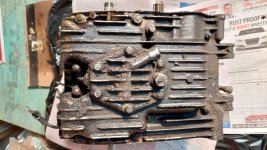
With no warm weather in sight I decided to brave the coolish (4C or 40F) garage and tackle the bottom end before it got worse. I was dreading this part since the cases were caked up with grease and oil. Started with the shift detent hardware, which is now soaking is some rust remover.
20251116_131101.jpg
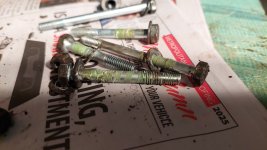
Next was to locate the bolts holding the cases together. Some I had to scrape out to get a socket on.
20251116_132702.jpg
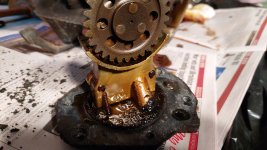
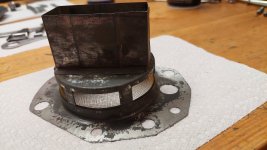
I got the oil pump out and it didn't look pretty, but I'm sure the bike never ran with the pump like this as there is no damage to the cams or pistons. In fact, oil could not have gotten through the filter there was some much crap in there.
20251116_133322.jpg20251117_172222.jpg
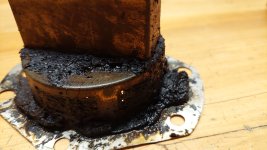
Talk about excessive Hondabond between the cases, this was all over the bolts and from the factory. Funny thing is that it is still pliable after 60 years.
20251116_134129.jpg
After a few whacks with a plactic hammer on the mounting lugs things were not coming apart. I then remembered Bill Silvers trick of using a piece of hardwood to cover the two bolts near the dipstick and give it a sharp wrap. The seal broke and I was able to split the cases. Glad to see some oil in the gear box area. Was not happy to see the sludge under the gears or the windage trays.
20251116_142009.jpg20251116_142000.jpg
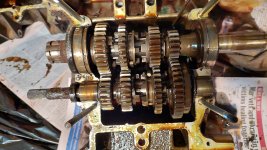
Gave the transmission pieces a preliminary wash to see if there was any major damage. At first glance the gears , shafts and dogs look ok.
20251116_150456.jpg20251116_150641.jpg
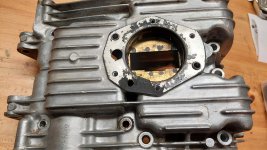
Everything will need to go into the Evaporust and then I will have a closer look. The kickstart shaft doesn't look too worn but there is a bit of play in the copper bushing. Now comes the fun part. The lower case took about 2 hours in the parts washer but I had to stop as I was putting more dirt back onto the piece. I need to buy some more solvent to continue cleaning. The case came out not bad, I could probably send it to the vapour blaster as is.
20251117_171955.jpg
 
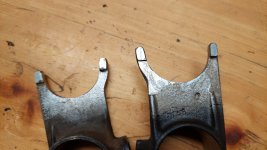
The shift forks looked very rough and at first I thought something was rubbing on the fork but that's impossible as the fork rides in the groove between the gears. So this is the machining of the 1960's?
20251117_181217.jpg 20251117_181241.jpg
Another area of failure as I understand is the kick start gear and pawl. My pawl looks to be ok and no wear as far as I can tell.
20251117_171351.jpg 20251117_171453.jpg
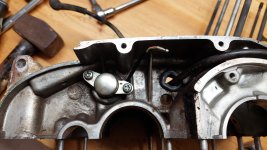
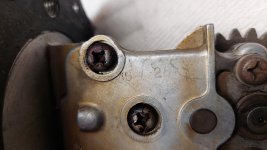
The neutral switch looked pristine after a clean up, but the screw heads were a bit mangled so I think the switch was changed out at some point.
20251117_182435.jpg
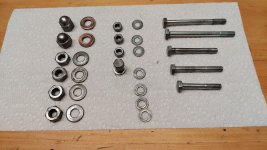
All that caked on oil to me means the engine was never apart and so the hardware was in good shape with no rounded corners. I found most screws were never taken out except for the rotor and point cover screws which were mangled.

I think I will use Jensen's method of documenting the hardware by taking a picture of the corresponding piece the hardware was taken from.
20251117_170359.jpg
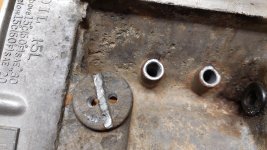
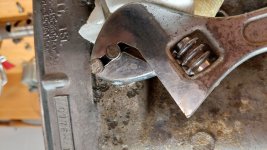
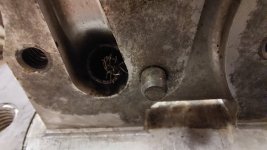
That pesky dip stick is still giving me trouble. I drilled a couple of holes into it and then inserted two stout nails. I took a large crescent wrench and grabbed the nails to undo the dip stick but no luck. It just bent the nails. Maybe for tomorrow I will try more PB blaster and some vise grips to get more grip on the nails.
20251117_183238.jpg 20251117_184335.jpg
 
Try some torch heat on that stuck dipstick and get the case hot in that area, plus a couple of taps to break the seal. May work if you haven’t tried that yet.
 
As Ballbearian mentioned I too would be inclined to replace the exposed wire as it seems to have started to corrode. Covering it with heat shrink is only a cosmetic finish and the wire will still be corroded under it.
 
The shift forks looked very rough and at first I thought something was rubbing on the fork but that's impossible as the fork rides in the groove between the gears. So this is the machining of the 1960's?
View attachment 52726 View attachment 52727
Another area of failure as I understand is the kick start gear and pawl. My pawl looks to be ok and no wear as far as I can tell.
View attachment 52729 View attachment 52730
The neutral switch looked pristine after a clean up, but the screw heads were a bit mangled so I think the switch was changed out at some point.
View attachment 52728
All that caked on oil to me means the engine was never apart and so the hardware was in good shape with no rounded corners. I found most screws were never taken out except for the rotor and point cover screws which were mangled.

I think I will use Jensen's method of documenting the hardware by taking a picture of the corresponding piece the hardware was taken from.
View attachment 52731
That pesky dip stick is still giving me trouble. I drilled a couple of holes into it and then inserted two stout nails. I took a large crescent wrench and grabbed the nails to undo the dip stick but no luck. It just bent the nails. Maybe for tomorrow I will try more PB blaster and some vise grips to get more grip on the nails.
View attachment 52733 View attachment 52734

With no warm weather in sight I decided to brave the coolish (4C or 40F) garage and tackle the bottom end before it got worse. I was dreading this part since the cases were caked up with grease and oil. Started with the shift detent hardware, which is now soaking is some rust remover.
View attachment 52713
Next was to locate the bolts holding the cases together. Some I had to scrape out to get a socket on.
View attachment 52714
I got the oil pump out and it didn't look pretty, but I'm sure the bike never ran with the pump like this as there is no damage to the cams or pistons. In fact, oil could not have gotten through the filter there was some much crap in there.
View attachment 52715View attachment 52716
Talk about excessive Hondabond between the cases, this was all over the bolts and from the factory. Funny thing is that it is still pliable after 60 years.
View attachment 52718
After a few whacks with a plactic hammer on the mounting lugs things were not coming apart. I then remembered Bill Silvers trick of using a piece of hardwood to cover the two bolts near the dipstick and give it a sharp wrap. The seal broke and I was able to split the cases. Glad to see some oil in the gear box area. Was not happy to see the sludge under the gears or the windage trays.
View attachment 52719View attachment 52721
Gave the transmission pieces a preliminary wash to see if there was any major damage. At first glance the gears , shafts and dogs look ok.
View attachment 52723View attachment 52724
Everything will need to go into the Evaporust and then I will have a closer look. The kickstart shaft doesn't look too worn but there is a bit of play in the copper bushing. Now comes the fun part. The lower case took about 2 hours in the parts washer but I had to stop as I was putting more dirt back onto the piece. I need to buy some more solvent to continue cleaning. The case came out not bad, I could probably send it to the vapour blaster as is.
View attachment 52725

That copper coloured part is actually the oil pump screen, cut the gasket between this part and the case with a very sharp knife to save the screen. Those screens are very hard to get.....
 
That copper coloured part is actually the oil pump screen, cut the gasket between this part and the case with a very sharp knife to save the screen. Those screens are very hard to get.....
I did use a knife to separate the screen from the lower case. I could see that it was flexing when I tried to lift it and did not want to warp the mating surface. Came out very easily with the knife. Just need to clean it now.
 
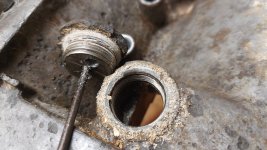
Used a torch to heat the case and tried to undo the dipstick with the two pins but it still wouldn't budge. A few whacks with a cold chisel and a 2lb hammer and it started to move. I can see why it did not want to let go.
20251118_163856.jpg
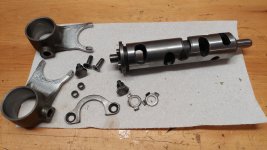
After soaking a few hours in Evaporust, the shift drum and forks came out in decent shape. A few rust pits in the drum but nothing on the areas that the forks ride on.
20251119_105808.jpg
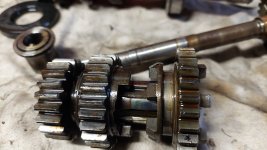
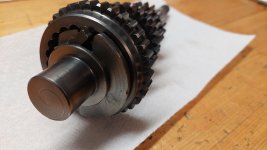
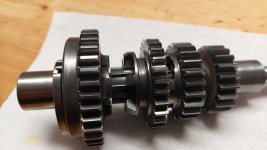
After cleaning it looks like the counter shaft and kick start gear are in very good shape. I think I only piece to change might be the bronze bushing for the K/S gear.
20251119_105849.jpg20251119_105856.jpg
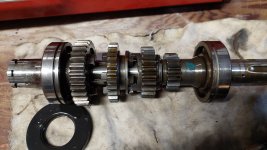
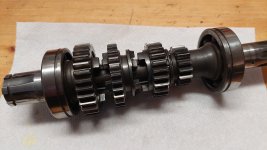
The main shaft was also good and bearings had no roughness to them after I shot carb cleaner in there and blew out with compressed air. Again some rust pitting on the shaft but nothing in any critical areas. Dogs on both shafts are good and show no signs of wear.
20251119_113021.jpg
One thing left to do is to assemble the transmission and check for the gear engagement. The dogs should overlap by at least 40% according to Bill Silver's guide. Hopefully mine is good because those cotters that make the gears engage more are commanding a premium price when you can find them.
 
One thing left to do is to assemble the transmission and check for the gear engagement. The dogs should overlap by at least 40% according to Bill Silver's guide. Hopefully mine is good because those cotters that make the gears engage more are commanding a premium price when you can find them.
I'm often surprised at how little engagement depth these transmission gears have in some cases, and 40% seems about right for most of the gears in my 450 engine build right now too. But when you watch how close the tolerance is between them when disengaged, they couldn't make the engagement depth any deeper without needing more width to accommodate the same distance the opposite direction for the forks that do two engagements.
 
Used a torch to heat the case and tried to undo the dipstick with the two pins but it still wouldn't budge. A few whacks with a cold chisel and a 2lb hammer and it started to move. I can see why it did not want to let go.
View attachment 52768
After soaking a few hours in Evaporust, the shift drum and forks came out in decent shape. A few rust pits in the drum but nothing on the areas that the forks ride on.
View attachment 52769
After cleaning it looks like the counter shaft and kick start gear are in very good shape. I think I only piece to change might be the bronze bushing for the K/S gear.
View attachment 52770View attachment 52771
The main shaft was also good and bearings had no roughness to them after I shot carb cleaner in there and blew out with compressed air. Again some rust pitting on the shaft but nothing in any critical areas. Dogs on both shafts are good and show no signs of wear.
View attachment 52772
One thing left to do is to assemble the transmission and check for the gear engagement. The dogs should overlap by at least 40% according to Bill Silver's guide. Hopefully mine is good because those cotters that make the gears engage more are commanding a premium price when you can find them.


I used the replacement O/S cotters on the CL77 build along with replacing about 75% of the gears, including all the bearings on the cams and both transmission shafts. My gear dogs were quite worn on a few of the gears and the engagement didn't meet the 40 % threshold. After the new cotters were installed there was 60-70% engagement.
Clearly your motor and transmission is in much better shape than the CL77 motor was when it was torn down.
 
I did use a knife to separate the screen from the lower case. I could see that it was flexing when I tried to lift it and did not want to warp the mating surface. Came out very easily with the knife. Just need to clean it now.
A very important piece that went through a few changes over the run of this model. The designers must have known that the oil, life blood, of the motor, needed extra help to be gathered towards the heart, pump. What a metaphor.
 
Those engagement dogs are straight cut, like my 64. Perhaps yours is an early 65 and not yet incorporating the undercut dogs. They would look more like dovetail joint pieces. Yours look to be in good shape.
 
A very important piece that went through a few changes over the run of this model. The designers must have known that the oil, life blood, of the motor, needed extra help to be gathered towards the heart, pump. What a metaphor.
Got the screen cleaned up, aside from a loss of zinc plating it looks to be quite usable. Being in a bath of oil, I don't think it's worth while to get it re-plated.
20251119_162054.jpg
 
I can see why you'd want to be very careful with that thing. These antiques require so much patience and proper care to do correctly.
 
Got some more pieces cleaned up today, including the shift drum detent, serviceable but with the usual rust pitting.
20251119_161324.jpg
cleaned the oil pump as well, but not on the inside yet. Most of the 6mm washers a fairly deformed, not sure if they were thinner back then or it's a case of over torquing.
20251119_161335.jpg

Found a date on the oil pump - 40-7-28, which translate to July 28, 1965. So I have a 1965 C78.

I should probably change the title of this thread to "A C78 project" since the frame is a C78.

Maybe one of the admins could oblige - thank you.

20251119_160158.jpg
 
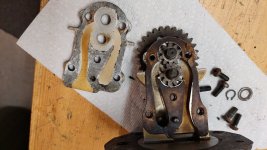
Besides working out the pump gear side clearances, (watch out for location of thin drive shims), there is a channel in lower case for pump output that is hard to clean and has thick sludge. I made a snake to get it clean.
Also ported the abrupt pump channel transition into the body exit for better flow. A tip I got from another 305 experienced builder long ago on a FB group. The very thin .17mm gasket was possibly re-used on mine, ICR. Minimal clearance mattered, not leaks. A very worn pump might do with just a thin coat of Hondabond. Specs covered here.
 
Besides working out the pump gear side clearances, (watch out for location of thin drive shims), there is a channel in lower case for pump output that is hard to clean and has thick sludge. I made a snake to get it clean.
Also ported the abrupt pump channel transition into the body exit for better flow. A tip I got from another 305 experienced builder long ago on a FB group. The very thin .17mm gasket was possibly re-used on mine, ICR. Minimal clearance mattered, not leaks. A very worn pump might do with just a thin coat of Hondabond. Specs covered here.
Good tips for refurbishing the oil pump. I had read your thread previously but it's always good to get a link to the exact location for the pertinent info.
 
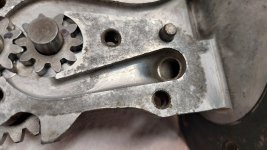
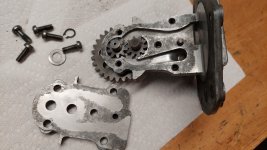
Got after the oil pump today, it was another brown mess, but no big globs of sludge.
20251120_155051.jpg
Made a tiny chimney sweep from a piece of bicycle brake cable and ran it through the oil channel.
20251120_163030.jpg20251120_163109.jpg
I then cleaned the rest up with brake fluid. The dots on the gears are so I could orient them the way they came - not sure if it makes a difference. The entrance to the channel looked pretty smooth with no burrs so I left it alone.
20251120_164245.jpg
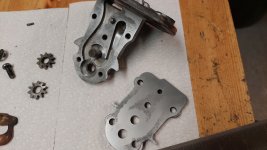
The area where the gasket sits has a little corrosion and I thought of using a piece of plate glass and some 1200 wet and dry but it was mentioned that the tolerances are tight so I will leave it alone.
20251120_164309.jpg

Just have to wait on my gasket set to finish up the pump. Does anyone know if the paper gasket for the pump in the complete gasket set is up to par or should I see if I can order an OEM one due to tolerances?
 
Looks pretty good. Since the problem is usually too much side clearance, either from gear wear or too thick of a gasket, a bit of sanding won't hurt and should reduce side clearance.
Measure the gear with a feeler under a straight edge and add the gasket thickness will give actual running clearance. If the new gasket in the kit isn't over .2mm thick, I'd use it.

The hard to clean part is the horizontal drilling in the lower engine case half.
 
Looks pretty good. Since the problem is usually too much side clearance, either from gear wear or too thick of a gasket, a bit of sanding won't hurt and should reduce side clearance.
Measure the gear with a feeler under a straight edge and add the gasket thickness will give actual running clearance. If the new gasket in the kit isn't over .2mm thick, I'd use it.

The hard to clean part is the horizontal drilling in the lower engine case half.
I should have taken a pic under the gears, mine had very little wear but I will measure the clearance with a straight edge and some feeler gauges. Sanding evenly will be a bit of a problem on the main piece as it doesn't look like the small locating pin or the gear axle are removable - I might try wrapping some wet & dry on a small piece of bar stock to work around those pins. I will take a look at the lower engine case tomorrow to see if that passage is plugged up or not.
 
I lightly cleaned up the surfaces and measured the side clearance of the pump gears. As far as I can ascertain it's at about .02mm. My set of feeler gauges only goes to .04mm and that was too thick. I took a strip from a plastic bag that was .02mm as measured with the micrometer and that was a snug fit. As you can see below, there is very little wear in the housing under the gears.
20251121_130722.jpg
If the gasket is .017mm plus the .02mm clearance I have, that would be a total of .037mm which is below the spec of .04mm to .08mm. Will this be an issue or should I just leave it like that since it's so close. The pump was not binding in any way before I took it apart, so I will wait for the new gasket to see if anything has changed.
20251121_131634.jpg
20251121_131800.jpg
 
The pump on mine was binding slightly after I cleaned everything up. I ended up using Motoseal gasket compound to thicken the gasket area. I think I also needed to trim the gasket close around the gear area. It has been a minute, so I don't recall everything I did to get it so the mechanism spun smoothly. The binding was from the two halves of the pump being put back together. I also dressed the gears and the shaft they ride on to help with the issue.
 
The pump on mine was binding slightly after I cleaned everything up. I ended up using Motoseal gasket compound to thicken the gasket area. I think I also needed to trim the gasket close around the gear area. It has been a minute, so I don't recall everything I did to get it so the mechanism spun smoothly. The binding was from the two halves of the pump being put back together. I also dressed the gears and the shaft they ride on to help with the issue.
So far the only binding I found was the end of the main shaft that the top gear runs on. Once I cleaned the area near the circlip everything fit together nicely. Might be a different story now once the gasket is in and the screws tightened.
 
So far the only binding I found was the end of the main shaft that the top gear runs on. Once I cleaned the area near the circlip everything fit together nicely. Might be a different story now once the gasket is in and the screws tightened.
That's when mine started to bind was once I tightened everything up again. Hopefully your fine and if not some adjustments can be made to fix the issue.
 
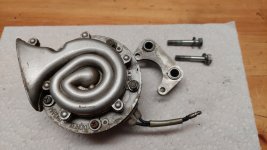
Back to cleaning up some hardware and various pieces. Took the mounting bracket off the horn to be able to zinc plate it. One male plug need to be soldered back on. The biggest battery on hand was one of those little square 9V but I still got a little croak out of the horn which is encouraging.
20251123_135402.jpg
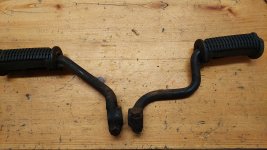
Shift pedal cleaned up really well and now has a layer of chrome polish on to protect it.
20251123_140257.jpg20251123_140919.jpg
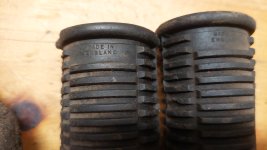
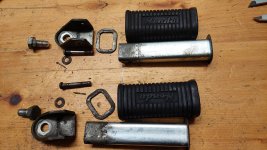
Main foot peg rubbers are cracked but no great loss as they were knock offs.
20251123_141131.jpg20251123_141213.jpg
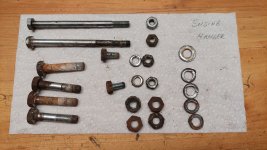
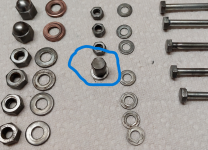
Frame bolts were not too bad except for the lower mounting bolts, a lot of corrosion. I dressed them a bit and I will see how they come back from the zinc plater. These are the original bolts without the markings on the head that were used for the newer ISO compliant hardware. I would like to keep as much original hardware as possible.
20251123_144246.jpg20251123_152129.jpg
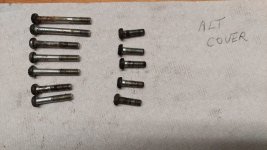
Side cover screws were in pretty good shape as there was a covering of oil that helped to preserve them. Only a couple are a little worn.
20251123_153055.jpg
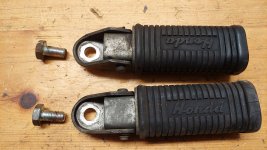
Passenger foot pegs are also in pretty good shape, even the rubber was pliable and held the pegs in the folded position. More parts to be plated.
20251123_163212.jpg20251123_163743.jpg
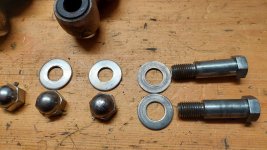
Rear shock mounting hardware took a beating. The bolts I can zinc plate but the chrome acorn nuts will either have to be re-chromed or I'll see if I can find replacements. The 10mm acorn nuts available today I think have a much smaller head than the originals.
20251123_165730.jpg
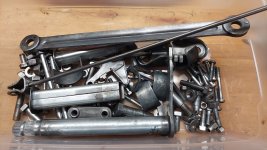
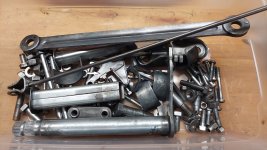
The parts for the zinc plater are growing...
20251123_215507.jpg
 
Back to cleaning up some hardware and various pieces. Took the mounting bracket off the horn to be able to zinc plate it. One male plug need to be soldered back on. The biggest battery on hand was one of those little square 9V but I still got a little croak out of the horn which is encouraging.
View attachment 52950
Shift pedal cleaned up really well and now has a layer of chrome polish on to protect it.
View attachment 52956View attachment 52957
Main foot peg rubbers are cracked but no great loss as they were knock offs.
View attachment 52958View attachment 52959
Frame bolts were not too bad except for the lower mounting bolts, a lot of corrosion. I dressed them a bit and I will see how they come back from the zinc plater. These are the original bolts without the markings on the head that were used for the newer ISO compliant hardware. I would like to keep as much original hardware as possible.
View attachment 52961View attachment 52962
Side cover screws were in pretty good shape as there was a covering of oil that helped to preserve them. Only a couple are a little worn.
View attachment 52963
Passenger foot pegs are also in pretty good shape, even the rubber was pliable and held the pegs in the folded position. More parts to be plated.
View attachment 52964View attachment 52965
Rear shock mounting hardware took a beating. The bolts I can zinc plate but the chrome acorn nuts will either have to be re-chromed or I'll see if I can find replacements. The 10mm acorn nuts available today I think have a much smaller head than the originals.
View attachment 52966
The parts for the zinc plater are growing...
View attachment 52967
For a high gloss finish you have to make the surface really smooth.


20251123_215507.jpgBtw, I see internal engine parts in there, but I would strongly advice you not to plate them, same for bolts that are used inside the engine cases.

You can put the JIS screws in a drill (use a nut to hold the screw, turn it, while polishing the head with waterproof sandpaper (2000) for a high gloss finish. Actually, I polisch everything with waterproof sandpaper 2000 before plating. The smoother the surface the higher the quality of the plating, the less surface area, the less chance on oxidation.
 
Last edited:
For a high gloss finish you have to make the surface really smooth.


View attachment 52972Btw, I see internal engine parts in there, but I would strongly advice you not to plate them, same for bolts that are used inside the engine cases.

You can put the JIS screws in a drill (use a nut to hold the screw, turn it, while polishing the head with waterproof sandpaper (2000) for a high gloss finish. Actually, I polisch everything with waterproof sandpaper 2000 before plating. The smoother the surface the higher the quality of the plating, the less surface area, the less chance on oxidation.
Good tip about spinning the screws with some 2000 grit paper. And you're right about the engine parts, I hadn't planned on plating the shift detent mechanism as it is in a bath of oil anyway. I threw it in the bin to get it off the workbench. I will go through the pieces again to see if I can smooth out a bit more.
 
There is a tall 6mm shouldered hex nut that is supposed to have a sealing aluminum or copper washer under it for the bottom of the case. Often forgotten or skipped, it can leak.
 
There is a tall 6mm shouldered hex nut that is supposed to have a sealing aluminum or copper washer under it for the bottom of the case. Often forgotten or skipped, it can leak.
I found that but thought it was one piece until I cleaned it and noticed that the nut was driven into the aluminum washer to the point that the two were fused together.
1764040729688.png
 
I was a bit under the weather a couple of days ago and did not get much done.

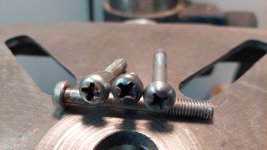
Decided to go through the hardware and clean up the bolts and screws before the task got too daunting due to volume. I started with the JIS screws by giving light taps on the head with a small hammer to flatten down any protusions. Next I reformed the "star" by taking a JIS impact bit and hammering into the screw head until I got a good fit to the point where the bit was snug in the JIS head. I then mounted a cap nut into the drill press and then threaded the screw in until it bottomed out. Started with some 320 grit, followed by 400 then 600 to finish.
On the left is the screw as it comes off, in the middle is after tapping down and reforming the "star" and on the right is the screw after polishing.
20251129_170025.jpg

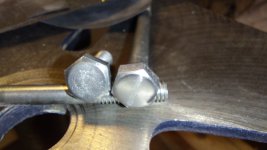
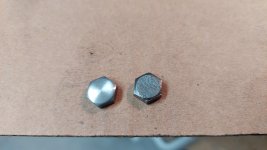
The bolts I had to either file or sand the edges depending on the damage. I could polish the top surface by mounting in the drill similar to the JIS screws. Some pitting could not be removed as it was too deep. I wanted to save as much hardware as possible because original hardware has no markings on the bolt heads nor the JIS head and are no longer available as far as I know.
20251129_173617.jpg 20251129_180654.jpg
 
Back
Top Bottom