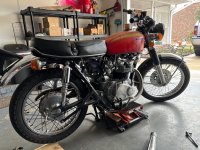
1972 CB450 K5 Hot Mess

Rob, I have used the Caswell liner a number of times and it is excellent. One caution is it can be very thick out of the can and doesn’t pour and flow well when inside the tank. When you open the can if it is really thick I believe there are some instructions supplied that suggest thinning it up to 10% before using.

I think I used acetone as the thinner and it worked well and it just evaporates off as the liner sets up.
I looked up their application instructions and they say "you can add a small amount of Xylene or lacquer thinner to the mix (no more than 5% - i.e. 1 fl oz in the motorcycle kit, 2 fl oz in the car kit)." Acetone would probably work but I will use lacquer thinner so I can be sure not to muck up anything. I want to be sure it is thin enough to evenly coat and not cure too fast. Not going to be using the tank right away so will have ample time to cure.
 
I looked up their application instructions and they say "you can add a small amount of Xylene or lacquer thinner to the mix (no more than 5% - i.e. 1 fl oz in the motorcycle kit, 2 fl oz in the car kit)." Acetone would probably work but I will use lacquer thinner so I can be sure not to muck up anything. I want to be sure it is thin enough to evenly coat and not cure too fast. Not going to be using the tank right away so will have ample time to cure.
I think I used a little more than the 5% to thin it out, as it barely poured and was really thick. If lacquer thinner is what is suggested its maybe what I used too, as I have lots of that in stock. Acetone I usually stock too, yet it has become more expensive now than the lacquer thinner, so it is what I use now to clean my paint gun.
 
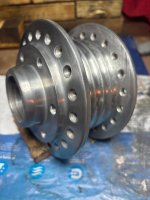
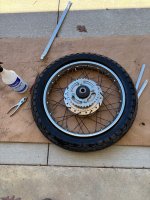
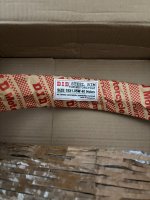
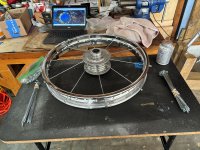
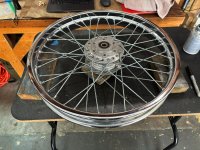
Update: While waiting for the new front rim and spokes to come in from DSS and new tires from Cedar Rapid Tires I decided to disassemble the front wheel. First thing I did was take photos of the wheel from both sides so I can be sure to re-lace it properly. Removed the front bearings with out too much difficulty with the help of Mr. Heat Gun and then knocked the bearings out. Bearings looked like they had been replaced or at least re-greased by the PO as the retainer was a bit banged up but came out easy with a drift punch. A little more heat and the bearings popped out. Then it was time to break out my Harbor Freight tools and first I cut the tire off the old rim with a sawzall while holding the tire up above the rim with a pry bar. I then used the handy dandy cut off tool which made short work of cutting the spokes so was able to get the hub loose so I could clean it up a bit. Stripped it with clean strip aircraft paint remover and the used some scotch bright discs in the drill and then polished on it with some 400 grit. I will need to polish a bit more and I haven't decided it I want to clear coat it or not but kinda leaning that way. After I cleaned up and called it a day FedEx arrived with the new tires, tubes and rim strips. After a lot of back and forth I went with the Duro HF314's and hopefully I will not regret the decision for buying cheaper tires but need to economize a bit. Anyway nothing earth shattering but progress.

IMG_5218.jpg IMG_5219.jpg
 
Last edited by a moderator:
Made some progress on pulling the dents but not as much as I hoped but certainly better. I will probably call it good and resort to body filler after cleaning varnish and rust out of the tank.
This question is going back aways, but what is your overall opinion of the crossbar plus hot glue dent removal process for these tanks? Would you try it again, go straight to filler, or do something else?

I tried it once and didn't make much progress. Then upgraded to tack welding a bolt to the bare tank. Made some progress and then gave it all back by burning through with my amateur welding. 😢 My XL350 came to me with a pretty big dent in the tank and I'm thinking about attempting to pull it out in the summer.
 
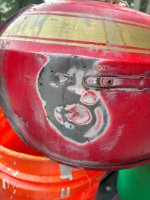
I used the cheap Harbor Freight kit and honestly think I got good results. I probably could get a bit more out with a better kit but don't want to invest more. See the before and after photos of what the dents looked like to begin with and where I am now. I also could have probably got more of the dent out if not for the emblem brace bent on the one side.

IMG_4161.JPGIMG_5175.jpg

Might be a little hard to see in the pictures but the dents are quite a bit more shallow after using the hot glue puller so I call it a win. If the dent is rounded with no sharp edges then it should pull out worth a try.
 
Might be a little hard to see in the pictures but the dents are quite a bit more shallow are using the hot glue puller so I call it a win.
I think you did very well. I was looking back at the old posts and it seems like I didn't find the final picture because looking at this picture, it seems shallower than what I recall seeing before. I may not have used enough glue when I tried it last time. Thanks, Rob!
 
I also used a pry bar that I wrapped a ball of tape on the end to pry from through the filler neck on the back of the dent while I was tightening the cross bar puller slowly. I had worked on the dent off and on a bit since when I first posted about it and the last picture I had took recently. Using the hot glue puller I don't know how many times I prepped glued and started pulling and the glue would just pull loose. I ended up buying more glue from an auto parts store. Do you have a picture of the dent in your tank posted?
 
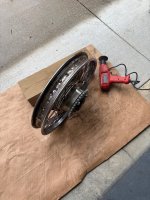
Worked on the rear wheel yesterday to get it ready for new rubber. It had a "newer" Dunlop tire on it which means it was probably mounted in the early 80's and still had really good tread but when I let the air out and tried to get it off the beads found it was hard a rock. Finally got it loose by walking it and using a pry bar. Cut the tire off using the Sawzall method and protected the edge of the rim with the pry bar. Once the tire was off and tube removed, found that the PO had cut an old inner tube strip to make a rim strip out of before mounting the Dunlop, no complaints as was done well, just an observation. There was some rust but not too bad so was able to clean the out pretty well with a wire brush on a drill. I was considering spraying the inside of the rim with some rust converter so appreciate any thoughts on that. I am going to try to get the new rear tire on tomorrow afternoon hopefully so I can get it on the bike later this week. Fall yard work is calling today with aerating and fertilizing that needs to be done. Gotta treat those weeds right!

IMG_5220.jpg
 
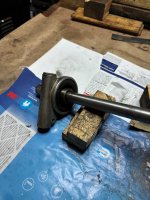
Question. I am wondering if I am missing something on removing the speedometer drive from the front wheel axle bolt. there is about a 1/4 inch side to side play but the it locks when I try to push it off the rest of the way. Its there some trick or is it just getting caught on a edge worn on the bolt. The drive seems to working well, looks like it is greased up good and the seal is in good shape so I hesitate to force it off. I will look over the FSM again but seems like it should just slide off but perhaps I am overlooking something.

IMG_5222.jpg
 
Another question, I was checking my rear wheel spoke to see what size spoke wrench it used and the only thing that fit was a 7/32 inch ignition wrench. Were spokes SAE back in the day? Tried a a 6mm too big and 5.5 mm too small. Thanks.
 
I have some Honda spoke wrenches (Kowa brand) and the numbers on them are 8, 9, 11 and 12 (these are not mm's). The higher the number the smaller the opening - sort of like wire gauges, the higher the number the thinner the wire. I measured the nipple on one of my CB450 spokes and it was 7/32". The one wrench I am missing is a #10 which would fit the CB450 nipples. I'm not sure how these numbers correlate to the spoke size.
20251014_134439.jpg
20251014_133743.jpg
 
Nipple flats seem to vary a lot even with the same gauge spokes, different manufactures, etc. I have a large collection of wrenches, even some custom ground or DIY ones from hard steel. The older nipples were brass, so don't round them from using too loose a wrench.
Anythink is better than rounding the flats, even vice grips for rusted stuck ones.
 
Luckily the spoke wrench question was more of an intellectual exercise at the moment for the rear wheel anyway as the wheel appears to be true and the spokes are singing happy songs when tapped.Pt looks like I will need to wait until I get the new spokes for the front wheel to see what size wrench I will need to try my hand at lacing it and truing the wheel which will be an interesting possibly frustrating experience but we will see. :unsure:
 
Decided to wrestle the rear tire on the rim today and while it wasn't easy it wasn't really that hard considering the last time I did this task was more decades ago then I like to recall. At any rate got the tube aired up a little and dusted with body power which smells very nice (corn starch, apparently talcum powder is a hard find these days) and got the first bead of the tire on the rim, oh crap forgot the new rim strip, OK got that on and the valve stem hole lined up properly. Let excess air out of the tube and worked it in the tire and rim and then got the valve stem worked through the strip and rim and a nut in place and then got the tube worked in tire. No pats on the back yet, so slowly worked the other tire bead on the rim and got it on pretty easily. OK wet the beads with some bubble solution and then add some air and see if I pinched the tube, Everything looking OK , so aired it up to about 30 PSI and it holds pressure, Yay me! Let the air out and wet the beads again and then put about 5-10 PSI in and the dribbled the tire for a bit to help it seat the beads properly. Aired it up to 30 PSI again and appears to be on the rime evenly, One issue with the Duro's I go was no balance marks on either tire so worked on balancing it and used two old 10 gram weights I had across from the valve stem and is very close to balanced. I may have another go at it tomorrow and see if I can fine tune it a bit.

IMG_5226.jpg
 
I'm a little surprised that you aren't replacing the spokes on the rear. Do you have a plan to clean them up a bit or are you planning to let them go as-is?

When I was reanimating my CB360, the goal was to replace as few things as possible. The list was long enough without worrying about rims and spokes and fenders. A few years ago I finally got around to the wheels. Kept the pitted rims, but had them powder coated black. The spokes were so rusted that it was likely a safety concern and I had no choice but to cut a handful of them.

Yours look solid and presumably you can turn the nuts, but maybe they can be cleaned up a bit with Coke and tinfoil or whatever home remedy you care to try.
 
I am using the rear wheel that came as extra parts with the donor engine when I bought it and the chrome on the rim is in decent shape and when I checked the wheel for true and run out on the balance stand it looked really good so I decided to use it as is and if it bugs me later I will replace the spokes or even get a new rim as well. Spokes are dull but not badly corroded and they all have a good tone when tapped with a wrench. Still waiting for the new front rim and spokes from DSS and we will see if I have the patience to lace it and get it true. Guess I am anxious to get it rolling on it's own wheels. :p
 
Received the front rim and spokes from DSS and took an extra 2 weeks to get through customs over what I had come to expect, I decided to give lacing the wheel a go today and thanks to having taken severalm pictures and watching a few videos I believe I have it laced up properly. Of course the real trick will be to get it trued up properly but I will take a win where I can. I put in on the balance stand and spum it a bit and there is some center wobble as well as side to side but I will see if I can get it out later or take it to a shop if needed.

IMG_5238.jpg IMG_5239.jpgIMG_5240.jpg
 
Well done. Working gradually with fingers only, going round and round to get threads even will get closer, then apply even one full turn to nipples to gradually bring up tension.
Thanks for the encouragement and guidance as it is the first time I have laced a wheel and I would like to true it myself if possible. :)
 
Well done. Working gradually with fingers only, going round and round to get threads even will get closer, then apply even one full turn to nipples to gradually bring up tension.
Update, haven't had a lot of time the last couple of days but worked on the wheel a bit yesterday. Loosened all the spokes back up and then threaded them up until about 1 thread was showing (had to get the stronger reading glasses) and then measured across the wheel with a tape and appears to be about 2-3 MM out of round. Blocked the wheel up about 1/4 inch to get closer to center on the hub and started tightening the spokes 1 full turn at a time using the wrench and made about 3 passes before feeling some of the spokes getting tension. Made another 2 passes just using the wrench and some spokes getting tighter and others still loose but I am thinking this will help pull the wheel towards center and when I measured seems like it was bit better. Put it aside to help with some chores but hope to get back to it today.

An update on the tank, I had put it in the shed full of rust 911 mix on top of a couple of 5 gallon buckets about a month ago and really hadn't messed with it until I realized that the rust 911 had opened up some serious leaks along one bottom seam and fill up one of the buckets about 1/3 way. With the weather colder and outside the Caswell tank sealer's recommended temp range so drained, pressure washed, rinsed, and made sure there was no flash rust and then dried with the shop vac and rinsed with some denatured alcohol. Mixed up a pint of kerosene with my secret blend of 2 stroke oil, motor oil and a large dash of 80/90 gear oil well mixed and coated the tank until I am ready to seal it later. I will rinse out with gas and then acetone before sealing and in the meantime going to see if I can pull the dents out a bit more and then do some bondo magic. Also going to sand and prime the tank but will hold off paint until after sealing. Random progress.
 
Last edited:
Worked on truing the front wheel and overall feel I have made good progress with the lateral and radial movement but not quite there yet. For spoke tightness I do not have a spoke torque wrench so depending on my ear and using the old wheels as samples of what to listen for and thankfully the tones are not in the range where I know I have suffered hearing loss from too many years of rock and roll and the sound of jet engines for 20 plus years. I finally started wearing ear plugs when using gas powered lawn equipment, better late than never. Here are a couple of videos, appreciate any comments of how close or how far off I am from those with more experience.

Lateral:


Radial:

 
Worked on truing the front wheel and overall feel I have made good progress with the lateral and radial movement but not quite there yet. For spoke tightness I do not have a spoke torque wrench so depending on my ear and using the old wheels as samples of what to listen for and thankfully the tones are not in the range where I know I have suffered hearing loss from too many years of rock and roll and the sound of jet engines for 20 plus years. I finally started wearing ear plugs when using gas powered lawn equipment, better late than never. Here are a couple of videos, appreciate any comments of how close or how far off I am from those with more experience.

Lateral:


Radial:

Good job Rob. Do you have a dial indicator for when you get really close?
 
Good move on counting threads for a benchmark starting place. I consecutively add exact full then half turns till it makes a muddy ring striking spokes. Fully tensioned spokes make a nice clear note, like a bell. I've never used a spoke torque wrench and am pretty confident that I can feel material limits of spokes, threads and nipples. Ultimate wheel strength depends on a fully tensioned wheel and it will stay true longer.
No dial gauge either. I just use a couple drops of WD40 or motor oil for lube.
I go back and forth adding a round of tension then truing. Sometimes will find a low spot has a corresponding high spot directly across the wheel. Groups of 4spokes (2 crossed pairs) react in tension across the wheel. Sometimes I will actually loosen a set of 2 or 4. Play the Tubular bells!
Marking the rim with a sharpie helps to keep your place. Don't pull up only from one side, it will offset the 'dish', rim not centered over the hub spoke flanges.
It gets down to 1/8th turn adjustments near the end. Use a snug fitting spoke wrench so you don't round the flats on the nipples. Too many size variations, so I have a collection of nipple grippers, as the Brits used to say, several have been modified.
 
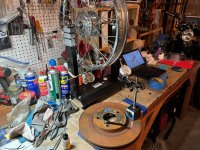
Update on the wheel truing, I ended up setting my dial indicator as @spideypop suggested as I was not trusting the old eyeballs as the gap got closer. Used an old brake rotor from my Ridgeline as a base for the magnetic base so no worries on it shifting around. I have got the side to side lateral run out to right at 0.010 inch and I also have the hop or radial movement down to about 0.010 to 0.015 inch. The weld is throwing it off a bit I think. I did a full pass tightening the spokes one more time and have a good tone on all of them. I think I will call it good. I will probably mount the tire in a couple of days when the weather is supposed to be a bit warmer. Got our first real cold spell last night so may take a bit to get used to it, say May or June! :rolleyes:

Yes I really need to clean up my bench, did I mention it got cold?

IMG_5256.jpg
 
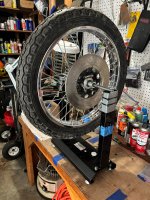
Listening to Tubular Bells while writing this so hopefully nothing demonic happens. Mounted the tire and tube on the front wheel without to much trouble and then went ahead and and bolted up the brake disc before trying to balance it. One downside on the Duro tires is there is no balance mark to line up with the valve stem hole. I did email Duro yesterday to inquire about this but have not heard back. Anyway aired the tire up and all looking good so put on the balance stand. I could tell is was quite a bit out on the first spin seeing it speed up and slow down on each revolution. I have a pack of the adhesive weights and I taped them to the light spot which was almost directly across from the valve stem. After taping over 3 ounces or 85 grams I stopped. Feeling my efforts to economize on the tires or also know as cheaping out had bit me in the butt I decided to call it a day. Overnight I decided I would mark the tire and move it on the rim 180 degrees and see what happens. Had to break the tire down and pull the tube before I could spin the tire and I swear I could hear it asking in a Clint Eastwood voice "Do you really think your going to get lucky punk". Ignoring the background noise I remounted the tire and aired it up and put it back on the balance stand and gave it a spin! Immediately noticed there was almost no speed up or slow down as it spun down. Ended up with about a 1/2 ounce out or 14 grams so calling it a win and probably used up several months allotment of luck or even more.

IMG_5257.jpg
 
Sure is a lot more convenient and comfortable than standing or sitting on a stool in my cold shop, in front of my vise with an old swingarm in it. Bearings spin better when the grease is warm too.
 
You're making me want to go out and get a stand to fix the balance issue on my CB350. If I lived closer to you, I'd be trying to figure out a barter deal that would allow me to have you balance my wheel!
It is the cheap stand from Harbor Freight and works well but the centers that snug into the bearings barely fit on my 450 so may not work on a bike with a smaller axle bolt. I also had to modify it a bit to keep the bar from rolling out one end or the other at the top. Not sure why they notched it there. Red neck engineering with some flat pieces of steel, duct tape and zip ties to hold in place keeps the bar from wondering. If you lived closer you would be welcome to stop by and use the stand or borrow it. It is really nice when we do have a chance to meet other members.
 
Sure is a lot more convenient and comfortable than standing or sitting on a stool in my cold shop, in front of my vise with an old swingarm in it. Bearings spin better when the grease is warm too.
On my S90 I tried balancing the wheels using the axle bolt across2 jack stands. It worked well enough I guess but honestly it doesn't go fast enough to make a difference. :p
 
On my S90 I tried balancing the wheels using the axle bolt across2 jack stands. It worked well enough I guess but honestly it doesn't go fast enough to make a difference. :p
Yup, just being able to spin to get the worst hops and wiggles out makes a big difference, plus pulling them all up for a tight wheel, makes it stronger and rides better.
 
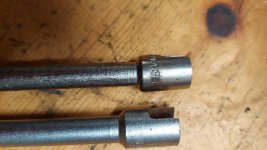
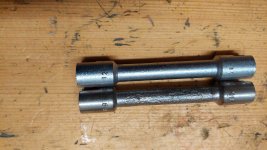
Ordered some lead spoke weights from from Dime City the other day and balanced the front tire which needed 15 grams or 1/2 ounce and the rear tire which ended up needing 45 grams or 1 1/2 ounce which is a bit more than I like but not too bad IMO. Also checked the tone on the rear spokes and after tuning the front wheel decided to tighten the spokes on the rear a bit. 1/8 turn on each spoke which didn't appear to change the run out and they all have a better tone when tapped. Torqued the front wheel axle with a very large Phillips screwdriver and a 12 inch crescent and calibrated elbow as I don't have a 23 MM deep well socket. Mounted both wheels on the bike and installed the chain and adjusted. After getting that I realized I needed to hook up the rear brake switch spring and the brake pedal return spring. After fooling with it a bit I remembered this being a frustrating task from the long ago time when I was much more flexible. As it was about time for dinner decide to clean up for the day. Picture with the tank and seat just sitting on the bike.

IMG_5292.jpg
 
Back
Top Bottom