A meticulous restoration of a CB72 '67 (and a SS50Z K3)

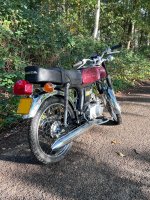
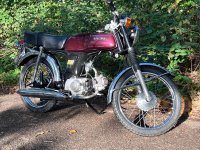
Now the SS50Z K3 is ready and paperwork is done, the bike is street legal. The insurance did cost me only 27,53 euro / year, insured as an old-timer with limited amount of km's (3000). I'm also not aloud to take the bike to to my work (no commuting).

Back to the CB72. In the beginning of this thread I disassembled the bike step by step, and the frame and a few other parts are painted.

It's time to define what I want with my the CB72:

- It has to be a rider, perfection is nice, but not the highest priority.
- The bike should be reliable, mechanical and electrical.
- Comfort is more important then originality since I'm not getting younger.

With this bike I start with the electrical stuff, my wishes are:

- Adding a front brake switch to make it more safe in daily use, either using a cable with a build in switch (I have a few), or placing a switch in the handlebar lever.
- Side-stand kill switch has to be added as well, just for my own safety (I tend to forget it sometimes).
- A USB connector for my phone or GPS would be a nice upgrade, able to charge the battery while riding.
- Sachse E-ignition with timing direct from the crank and dismissing the mechanical advancer (but I will keep the mechanical advancer and points in case of failure of the Sache unit).
- A modern voltage regulator is mandatory, since the original rectifier is too vulnerable and in-efficient.
- The wiring of the generator will connect directly to the main wire harness and voltage regulator, I don't want any unnecessary connectors in between (did the same with the CB450K0 and the CB400F and all of my mopeds)
- The headlight should be an H4 LED from Osram, since Osram is a reliable supplier, and has a 3000 K type for vintage bikes and cars (instead of a 6000 K white bright light).
- A modern relays will be added to switch the current for the headlights direct.
- Tail light will be a LED-type as well, same as on my CB400f and my CB450 K0, since it's proven reliability.
- Winkers will be re-installed as they where originally delivered with the bike, no need for upgrading to LED's.
- Adding a few extra ground wires will do no harm, and make the electrical system more reliable.

I'll add the extra wires (on paper) to the wire harness, next step is to decide the layout of the wiring by putting the wire harness in the empty frame, and a mounted headlight bucket. I will add the extra wires to the original wire harness, with the correct wire colors and connectors.
 
Last edited:
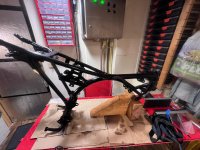
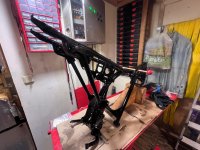
The frame is painted (too far gone), as the battery box, toolbox, main stand and a few other small bits. The fuel tank, headlight, headlight ears and bushes are still ok'sh, and in the process of making them presentable without destroying the original patina. The main color will be black, that's how the bike was sold. Winkers where also installed from new, the dutch type (on top of the steering tube, as part of the mirror mounts). I'm still in the process of deciding what to do with the mudguards and side covers, repaint or keeping the way they are.

The seat should be upholstered, way too soft for daily use. Chain and sprockets will be 520, X-ring, or better (I don't like doing maintenance to a rider on something that can be avoided). Front fork seals should be replaced, springs as well. Not certain what to do with the rear shocks. Either send them to Graham, or / and replacing them by more modern shocks (but shipping is way too expensive, but I have some colleagues living in the UK, who travel regularly to the Netherlands, so maybe they want to

Engine should be rebuild, adding Grahams transmission upgrade. Not sure of X-ing the gears or not (In the past I didn't had any difficulty's with the transmission ratio's). Oil filter set-up will be added (my own design), and a thermostatic regulated oil cooler also. Since this bike is only 250cc, and I can't avoid riding high way's, the bike will get hot, very hot when doing 70-80 mls/hour (at least that's my experience of riding the bike for several years in the past). Head work will be done by an external company, not decided which valves are being used.

The engine will be prepared for synthetic oil, 10W50 or 10W60. An upgraded oil pump will be part of the oil circuit, not decided what and how.

Meanwhile the C77'64 Dream parts are prepared for painting (taking part by part to my work for blasting), hoping that the CB72 is finished around beginning of spring, so I can proceed with the Dream build-up.

Since CB72 engine's and C77 engine's are in general the same, I will do the engine work on both engines at the same time, shortening the build-up time of the C77 dream (I don't like to do engine work in the spring / summer).
 
Sounds like you have plenty of fun to keep you occupied this winter. Please keep us posted with pics and I am interested in seeing your oil filter mod and how you handle the oil pump.
 
Since all papers were in order, time for a 40 km shake-down ride of the SS50Z K3 (and this is the last time I will be sharing the project SS50Z K3 :ROFLMAO: ). I always take some tools with, especially on a shake-down ride, but I didn't need any tools today.
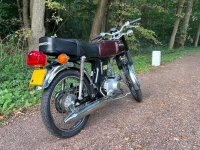
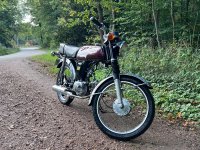
And since we like pictures :

IMG-20251009-WA0006.jpg

IMG-20251009-WA0004.jpg

IMG-20251009-WA0005.jpg

And a few in the sunlight:

IMG-20251009-WA0008.jpg

IMG-20251009-WA0007.jpg

The bike has to be broken-in, since I added a new piston and a rebored cylinder. The bike holds oil (not leaking a drip), is quick on the throttle, and no strange sounds. The first km's the bike shifted difficult in neutral, but that disappeared after 10 km or so. At a certain moment the clutch wasn't engaging, possibly do to the heat of the engine (the clutch actuator arm was a tight fit when I did build the engine). The bike shifted trough all gears (I replaced everything what was out of spec, including both shafts, a few gears and both shift forks and drum). The clutch is new, as is the crank. All small parts for the shifting mechanism including the shift arm are NOS too. The exhaust is used (original, came with the bike), and the seat (very good for it's age), came with the bike as well.

I started the shake-down ride with a battery voltage of 6,37V, and after the ride the battery voltage was 6,76 V, so the single phase, original selenium rectifier didn't gave up after all those years.

The engine did run a little difficult in the beginning (everything had to set), but after 30 km or so, the bike behaved well. The idling in the beginning was not stable, but at the end of the ride I had to adjust the idling (it was too high), so the engine got more efficient, or needed less fuel for the same rpm.

Although the bike is more or less the same as my CD50H, I will choose the CD50H any day. When I got 16, I had a choice between an SS50Z K3 and a CD50H, I chose for the CD50H, not only for the color, but also the chrome panels on the fuel tank. This SS50Z K3 is a more modern bike when it come to styling, but I like the more old-fashioned toaster tanks.

However, the SS50Z K3 was way more popular in my day's when I was young, everyone had to have one, and these bike where not cheap either. I tried to get my hands on the original up-swept muffler for this bike, but I refuse to pay 750 euro for a used one, so I settled for something I had lying around.

If my brother in law don't want the bike, it will be for sale in the spring. but there will be another engine under it, build from used, but good parts, so this engine can be either sold separately or goes back to the warehouse as a spare for my CD50.
 
Last edited:
Your SS50Z bike looks very close to the 1969 Honda S90 in its design and style of parts used. I just completed mine and the overall look of the two bikes are quite close. That kickstarter is quite the design to work around the muffler assembly.
 
That kickstarter is quite the design to work around the muffler assembly.

It's actually the kick-starter that goes with the up-swept exhaust, it will be replaced with the CD50H kick-starter correct for a low exhaust.

Is there any amateur racing of those like the C110s?

In the past, yes, but I'm not aware of it today.
That looks like a great way to spend a couple of hours and a great place to do it.

It was, Brody !
 
I wrote:

I'll add the extra wires (on paper) to the wire harness, next step is to decide the layout of the wiring by putting the wire harness in the empty frame, and a mounted headlight bucket. I will add the extra wires to the original wire harness, with the correct wire colors and connectors.

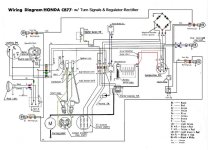
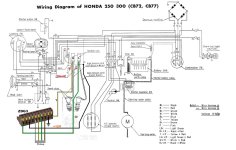
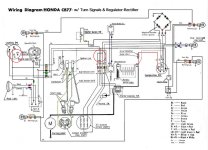
All electric work starts with a plan, and if possible, with a diagram. Years ago I added a very complete, Dutch / German CB72 diagram to my documents. This diagram has already the winkers, the front brake switch, and the headlight switch in the headlight bucket. As a bonus running lights are added.

CB77 schema plus winkers_groot.jpg

My original wish-list:

- Adding a front brake switch to make it more safe in daily use, either using a cable with a build in switch (I have a few), or placing a switch in the handlebar lever.
- Side-stand kill switch has to be added as well, just for my own safety (I tend to forget it sometimes).
- A USB connector for my phone or GPS would be a nice upgrade, able to charge the battery while riding.
- Sachse E-ignition with timing direct from the crank and dismissing the mechanical advancer (but I will keep the mechanical advancer and points in case of failure of the Sache unit).
- A modern voltage regulator is mandatory, since the original rectifier is too vulnerable and in-efficient.
- The wiring of the generator will connect directly to the main wire harness and voltage regulator, I don't want any unnecessary connectors in between (did the same with the CB450K0 and the CB400F and all of my mopeds)
- The headlight should be an H4 LED from Osram, since Osram is a reliable supplier, and has a 3000 K type for vintage bikes and cars (instead of a 6000 K white bright light).
- A modern relays will be added to switch the current for the headlights direct.
- Tail light will be a LED-type as well, same as on my CB400f and my CB450 K0, since it's proven reliability.
- Winkers will be re-installed as they where originally delivered with the bike, no need for upgrading to LED's.
- Adding a few extra ground wires will do no harm, and make the electrical system more reliable.

So that leaves the following add-on's:

- Side-stand kill switch has to be added as well, just for my own safety (I tend to forget it sometimes).
- A USB connector for my phone or GPS would be a nice upgrade, able to charge the battery while riding.
- Sachse E-ignition with timing direct from the crank and dismissing the mechanical advancer (but I will keep the mechanical advancer and points in case of failure of the Sache unit).
- A modern voltage regulator is mandatory, since the original rectifier is too vulnerable and in-efficient.
- The wiring of the generator will connect directly to the main wire harness and voltage regulator, I don't want any unnecessary connectors in between (did the same with the CB450K0 and the CB400F and all of my mopeds)
- The headlight should be an H4 LED from Osram, since Osram is a reliable supplier, and has a 3000 K type for vintage bikes and cars (instead of a 6000 K white bright light).
- A modern relays will be added to switch the current for the headlights direct.
- Tail light will be a LED-type as well, same as on my CB400f and my CB450 K0, since it's proven reliability.
- Adding a few extra ground wires will do no harm, and make the electrical system more reliable.

Next thing to do is to draw the wires needed for the above add-on's, but first the wiring diagram of the Sachse E-ignition and the voltage regulator and go from there.

Copied from the Sachse page, the installation wiring diagram with the ignition wired to the non-winker, non-front brake light version:

Sachse E-ignition wiring diagram.jpg

Next is to find a good voltage regulator for this bike, but wiring-wise they're all the same, the only real difference is with or without a sense-wire. Next step is to merge all diagrams and add-on's to complete functional wiring diagram. From the functional wiring diagram we will go to the rooting diagram, and finally to the "build" version (to determine the amount of wires in an umbilical / length of wires, type of connectors etc.).

I don't know why, but it feels like work, like electrical engineering ;)
 
Last edited:
I was a little surprised that I didn't got any comments on the diagram with winkers, because it shows some interesting features / changes. I circled the interesting area's in red. In this diagram, the pink wire from the dynamo is directly connected to the yellow wire from the dynamo. The pink wire isn't connected to the headlight switch, so SE (selenium rectifier) and DY (daylight ?) are not connected. The other thing that is interesting is the headlight switch, it has only 4 contacts, instead of 5, ML is missing. It's the same trick that people use for the CB450's, to get a little more power to charge the battery in daylight riding.

CB77 schema plus winkers_groot-rode cirkels.jpg
 
Due to the remote location of the key switch on the Superhawks, I can understand the addition of the headlight bucket lights switch. Makes me appreciate the simplicity of the Dreams and Benlys.
It makes sense to skip the switched connection of the pink and yellow, when there are all 4 winkers employed as running lights.
I'm also, not familiar with the key switch functions of the Superhawks and so not sure what the CH terminal of the keyswitch means. Does it only connect rectified power to the battery when the switch is on?
The lack of a ST terminal perhaps means there is no starter only function for cold weather priming of the carbs.
I'm out of my league here.

I plug my combination USB and voltage meter (with built in switch) into my charging pigtail direct to battery. There are 2 SAE disconnect plugs, one at battery and one up front at meter.

As far as the kickstand switch, I'd rather have an audible beeper that warned me when ignition is switched on and the stand is down. It would lessen another vulnerability to the ignition power circuit and it would quickly train me to lift the kickstand to avoid the beeper, like a good Pavlov's dog. Also prevent coil frying by me.
 
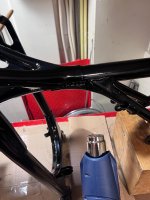
While I'm upgrading the CB72 wire harness, and cleaning out my shed, I finally started with the build. Making the painted frame durable (this will be my rainy weather bike), I started with pouring / spraying tectyl wax in all the tubes and welds, and using heat to let it penetrate between welded parts.

Afbeelding van WhatsApp op 2025-10-25 om 18.43.19_3d1d8079.jpg

The carton was clean when I started, it's pouring out everywhere.

Afbeelding van WhatsApp op 2025-10-25 om 18.43.19_47a1a8c7.jpg

The rear fork is done as well, inside the tubes, and inside the welded part at the front.

Afbeelding van WhatsApp op 2025-10-25 om 18.43.19_a58ca7a3.jpg

When heating up, the wax creeps through every little hole, by the force of capillary action it is sucked into the welds. I keep it warm until it comes out at the other side.
 
With shipping I mean shipping to the Europe continent and governmental taxes and overhead costs. The total costs are just too high for me, buying anything from the US right now. The other way around is the same I guess.

For example, if I would buy something of 430 USD (for example @Jays100 oil pump), and have it shipped to the Netherlands, I have to pay, depending on weight and size, 45 dollar for shipping. I like to insure such an expensive item, let's say the insurance costs are 25 USD, and have to add this to the total item costs, so the total item costs including insurance and shipping are 500 USD. The VAT is calculated over the total value in Euro's, and with the USD to Euro ratio makes it 430,05 Euro. The VAT is 21%, which makes it 520,35 Euro. But we are not finished. I have to pay import duty's, and depending on the sort of items, in this case motorcycle parts (4,5%), makes it 543,77 euro. On top of that I have to pay 22 euro for customs clearance costs, which makes it a grand total of 565,77 Euro.

So, the total costs when receiving the item are 565,77 euro, or 657,80 USD. The initial costs where 430 USD, which is a difference of 227,80 USD. In percentage this is an addition of 50,6% of the initial item value.

When I started with buying parts in the US, around 25 years ago, these items where shipped, with a ship. The shipment costs were very low, there was no VAT, and no addition costs. The shipments where reliable, so no insurance needed (I took the risk). There was no customs fee, no import duty's etc. I had cranks from the US shipped to the Netherlands for less then 20 USD total costs, while the average price of a CB450 crank was 100 USD. Inflation disregarded, the extra costs to get an item like a heavy crank to the Netherlands was 1/5 (or 20%) of the item price, which I find a fair amount.
 
Wow.
Sadly, the government's appetite for increasing taxes, duties and other user born costs are not likely to decline.
It does, however, increase the value of your previous purchased parts, as long as there are buyers.
You had the rare foresight to buy those parts lots when you did.
 
I started with pouring / spraying tectyl wax in all the tubes and welds, and using heat to let it penetrate between welded parts.

I guess the end result is a wax coating, rather than filling or blocking any pathways that water might take? You still want water to find a way out of it gets in, right?

Do you rotate the frame to help the wax reach all areas inside the tubing?
 
I guess the end result is a wax coating, rather than filling or blocking any pathways that water might take? You still want water to find a way out of it gets in, right?

Do you rotate the frame to help the wax reach all areas inside the tubing?

Yes, water can still escape, making sure that the tubes have openings. Actually, I made a few tiny holes (2mm) in area's where Honda didn't put them. Yes, I rotate the frame while spraying the was layer, see the pictures with the stains on the carton. These stains are due to spilling coating from the tubes, while rotating (over both axis).
 
Wow.
Sadly, the government's appetite for increasing taxes, duties and other user born costs are not likely to decline.
It does, however, increase the value of your previous purchased parts, as long as there are buyers.
You had the rare foresight to buy those parts lots when you did.
I don't know if it was a foresight. It was more that I like the CB450's and the 250 / 305's, and had a few of both, when I realised that parts would be obsolete within a few years. So, if I wanted to enjoy these bikes until I'm old, I had to get some parts to keep them on the road. The story's heard from people who where old enough to tell, these bikes broke down a lot, and one could never have enough engine parts. I listened, and searched the internet (which was just new), got myself a AMEX card, and asked US sellers politely if I was able to by parts from them (most wouldn’t do that due to the hassle). But times changed, and more and more US sellers shipped to the Netherlands. I got most of the parts from a few sellers, like Shopesales (every part started with 99 cents). I could stash-up what I bought at the seller, and the seller did send it when a certain weight was reached.
 
I keep hoping for a personal use gap in charges and fees, seems to be country specific.

While we don’t have VAT here in the US, we are now paying tariff/duty on imported goods and while I understand the theory, it still hurts the pocketbook.

I believe things will settle down but that doesn’t help the immediate need.
 
Last edited:
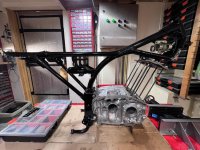
After making the frame stable with the (empty) engine bolted to it, I started to pre-build the bike, and started with the area’s important for the wire harness.

Afbeelding van WhatsApp op 2025-10-27 om 22.13.02_927ad910.jpg

Afbeelding van WhatsApp op 2025-10-27 om 22.13.03_e1b75fcc.jpg

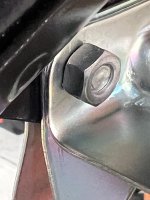
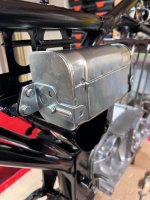
Coil brackets in place, and bolted with the correct bolts (no "8" on top of the bolds since it's an early Honda). I also added the correct, higher then the standard metric, JIS nut. The thread is the same, the width is the same, but the height differs.

Afbeelding van WhatsApp op 2025-10-27 om 22.13.03_e0db481f.jpg


Afbeelding van WhatsApp op 2025-10-27 om 22.13.03_e948739c.jpg

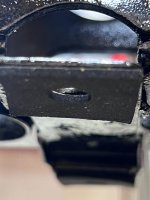
Added some foam rubber between the tool tray and the frame to create some space (I made a note when disassembly that the bolt of the tool-tray hit the air-filter cover).

Afbeelding van WhatsApp op 2025-10-27 om 22.13.03_4e7b37a7.jpg

Afbeelding van WhatsApp op 2025-10-27 om 22.13.03_bf750caf.jpg

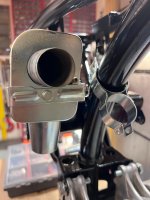
The air-filter cover has a lid, with the correct pattern.


Afbeelding van WhatsApp op 2025-10-27 om 22.13.03_b3d1ae68.jpg

I also added the clamp for the winker relay. Next steps are adding other parts step by step, then find a position for the relay's for the lights, the Sachse ignition box, and the voltage regulator / rectifier, followed by adding the wiring harness, and work from there.
 
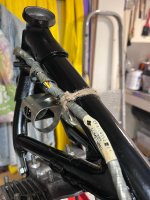
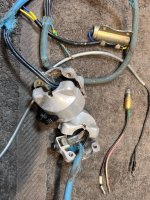
Tonight I added an old wiring loom to the frame. I'm going to use an old wiring loom because I want to make certain changes to adept the wish list in post 359. This wiring loom is from a '66 bike, which is the correct wiring loom for this bike. Since the wiring loom in far from complete, it also means a lot of work to complete the wiring.

Afbeelding van WhatsApp op 2025-10-29 om 21.18.05_05eb4a38.jpg

The switches are wired by a PO with the wrong wires, so more work to do in the electrical department.

Afbeelding van WhatsApp op 2025-10-29 om 21.18.05_3b160c1e.jpg

Afbeelding van WhatsApp op 2025-10-29 om 21.18.05_c7524c8a.jpg

The lower part in in good shape, and that's good news, because I don't intend to change a lot at that point, other then adding the wiring for the sidestand switch.

Afbeelding van WhatsApp op 2025-10-29 om 21.18.06_c36ec76b.jpg

Time to look in the box with electrical spares, looking for a winker relay.

Afbeelding van WhatsApp op 2025-10-29 om 21.18.06_9ed1a910.jpg

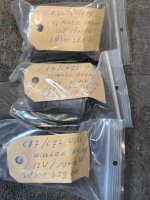
I found three of them, one very early type, with a 259 number (10+10 Watt), another 10+10W unit, but withy a 268 number, and last but not least, an 18W+18W winker relay with a 268-611 number. The 18W model was also used on a CB450 K0, but as far as I know, this one is from a police bike (CB72), including the very early, and special winker relay holder.

Afbeelding van WhatsApp op 2025-10-29 om 21.18.06_f034fa8d.jpg

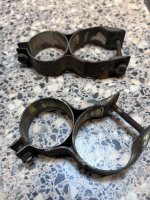
The lower one is from a '61 bike, and is build different. The top one is the same as on the CB72 I'm building now. Both need new plating (yellow). The used bolts are JIS 5 mm.

Afbeelding van WhatsApp op 2025-10-29 om 21.18.06_35d5e8cc.jpg

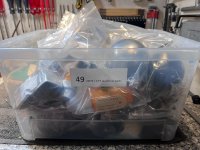
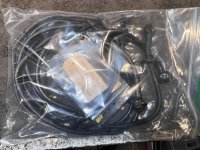
I also found a bag of starter motor cables, I remember someone was asking the length. I think it was @MIBOWL.
 
It's nice you have donor harnesses to rewire the controls with original color wiring. Are you just putting the sidestand switch on the solenoid power?
 
It's nice you have donor harnesses to rewire the controls with original color wiring. Are you just putting the sidestand switch on the solenoid power?
Don't know jet, it has to be a robust solution, depending on what kind of method I use. I was playing with the idea using an inductive proximity switch, it's contactless and very robust, and uses only 100 mA. The prox can energize a relay, that switches the ignition or battery. I have plenty of proxes lying around, and are accepting 10 to 30V.
 
Last edited:
For energizing the electrical system when you get near the bike?
wow, that was quick, I was still adding text :ROFLMAO:

No, just to detect the sidestand (metal). the (inductive) prox switches when it "sees" metal. Most proxes are IP69 (IP rating says something about dust / water protection, read here: https://www.iec.ch/ip-ratings) and can withstand harsh environments.
 
Last edited:
wow, that was quick, I was still adding text :ROFLMAO:
Well, I'm here almost all day even when I'm in my garage. I saw your edits, I suspected you were thinking like modern cars with the key fob that activates everything when you get near it. I'm not overly enamored with the idea but it is an interesting gadget to add, and I like thinking up gadgets.
 
Well, I'm here almost all day even when I'm in my garage. I saw your edits, I suspected you were thinking like modern cars with the key fob that activates everything when you get near it. I'm not overly enamored with the idea but it is an interesting gadget to add, and I like thinking up gadgets.
A prox switch has a range of mm's, depending on the model / size. Nice gadget you are mentioning, I'll check it out.
 
I'm envious of your nice clean cases, not to mention the large number of parts you managed to amass over the years.
 
I'm envious of your nice clean cases, not to mention the large number of parts you managed to amass over the years.

The CB72 I'm building up was my rider, many years ago, the engine was restored somewhere in 1989 (not by me), but I found that date when I took the engine head off. It was written at the bottom.
 
I'll check it out.
I didn't mean anything specific lately, just that I enjoy dreaming up the occasional gadget now and then. I do have a thought I'm working on for my drag bike but it's still a crude idea, needs a lot of development.

I once built a phone lifter for my desk at the mortgage office when I worked there for about 3 years. I got tired of walking all the way over to my desk to answer the phone if I was filing or making copies 20 to 30 feet away, so I used an aftermarket keyless entry module (control unit) to remotely control a door lock actuator to move a combination of rods to lift the handset up to answer the phone from a distance using my bluetooth earpiece. The owner liked the phone to be answered within the first 3 rings and it saved me walking back and forth all the time. The assembly of parts is inside the black builder's box that the phone base is sitting on top of. Forgive the grainy video from 2006


Jensen, you need to sign your work like all the great Dutch Masters.
Just not the ones on the cigar box :giggle:
 
I didn't mean anything specific lately, just that I enjoy dreaming up the occasional gadget now and then. I do have a thought I'm working on for my drag bike but it's still a crude idea, needs a lot of development.

I once built a phone lifter for my desk at the mortgage office when I worked there for about 3 years. I got tired of walking all the way over to my desk to answer the phone if I was filing or making copies 20 to 30 feet away, so I used an aftermarket keyless entry module (control unit) to remotely control a door lock actuator to move a combination of rods to lift the handset up to answer the phone from a distance using my bluetooth earpiece. The owner liked the phone to be answered within the first 3 rings and it saved me walking back and forth all the time. The assembly of parts is inside the black builder's box that the phone base is sitting on top of. Forgive the grainy video from 2006


Just not the ones on the cigar box :giggle:

I was already looking for a Bluetooth switch or something like that :)
 
I was already looking for a Bluetooth switch or something like that :)
The earpiece (blue blinking light on the oval shaped device in the video foreground) was the bluetooth connection to the telephone's audio. The lifter was radio frequency remote controlled, I kept the transmitter in my pocket and clicked it (like you would to unlock your car) to make the lifter raise the phone handset so it would answer the incoming call.
 
The earpiece (blue blinking light on the oval shaped device in the video foreground) was the bluetooth connection to the telephone's audio. The lifter was radio frequency remote controlled, I kept the transmitter in my pocket and clicked it (like you would to unlock your car) to make the lifter raise the phone handset so it would answer the incoming call.

Smart thinking !
 
Getting stuff wasn't that hard, keeping track of what is what, and what is where. As I'm getting older, I'm preparing for the time I can't remember what I have, and where it is :ROFLMAO:
It's true, I'm already there to some extent. But you have everything labeled so it would just require a lot of repetitive reading LOL
 
It's true, I'm already there to some extent. But you have everything labeled so it would just require a lot of repetitive reading LOL

That's what you think, unfortunately, there is a lot of stuff still unlabelled. Luckily, the winter-months / long dark evenings are the time to do something about that.
 
The CB72 I'm building up was my rider, many years ago, the engine was restored somewhere in 1989 (not by me), but I found that date when I took the engine head off. It was written at the bottom.

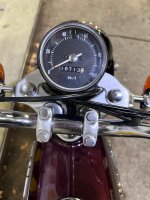
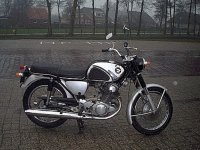
Below, the only picture I have from the bike, it was taken many years ago (1991). I bought it, rode it, and then came the older CB72's, the projects, and the CB450's, and last but not least, my family. This bike was my first CB72, and I'm still glad I bought it, because it's an original Dutch bike. The PO did replace the steering tube by a, more US-style one, and placed the front winkers next to the headlight. The winker relay was placed directly behind the coils. From the data I acquired at that time, it shows that I rode the bike for around 5000 km, before taking the bike apart. I took it apart because the engine started to smoke, but failed to assemble again, due to the reasons above.

1967 CB72_large.jpg

The picture quality is moderate, but normal at that time with the camera's I could afford.
 
Last edited:
Lots of young man memories there, I bet.

Yes, but, at that time, I didn't appreciate a bike like that. I looked at it as a supersized, faster Honda CD50H, my moped. More then once I went beyond the red-zone in fourth gear, pushing the engine to it's limits. Maybe that has something to do with the smoking exhaust :cool: .

Well, I didn't came across a lot of damage when splitting the cases, so maybe it's only the valve guides and piston rings.
 
Back
Top Bottom