How to Rebuild the VB Carburetors

Now I know, but I don't know Is this good news? I either have leaks, lack of power, or rough running... even though the mileage is low. I replaced the O-rings under the air-cut flaps today and will install new inlet manifolds - we'll see! Regards!
 
Hi!
I reinstalled the carburetors and new intake manifolds. The bike seems to be running, there's no backfire, but it still seems to lack acceleration, especially from halfway through the throttle. Turning the mixture screws doesn't help much. After removing the spark plug, when I started one cylinder, even turning the mixture screw all the way in doesn't stall the engine – is this normal? Thank you so much!
 
Hi!
I reinstalled the carburetors and new intake manifolds. The bike seems to be running, there's no backfire, but it still seems to lack acceleration, especially from halfway through the throttle. Turning the mixture screws doesn't help much. After removing the spark plug, when I started one cylinder, even turning the mixture screw all the way in doesn't stall the engine – is this normal? Thank you so much!
If the mixture screws have little effect, you likely need to adjust the idle speed.
 
Ok - its for me mixture srews:) Maybye You probably know I try tu adapt old type of float (with steel badges) to my VB30 E Keihin...and unfortunately, I have to say I'm giving up. The mixture is too lean, and when I try to raise the level, it immediately starts leaking from the overflow hoses or vent tubes. The original plastic floats also leaked, so I'm afraid to buy new ones for fear of the same thing happening. I have to look for a carburetor :) Thank You so much!
 
Hallo!
As we know, the popularity of these models (at least in Europe) stemmed, among other things, from the fact that they could be driven with a standard car license. Then, however, the engine displacement and power ratings began to be limited, along with restrictions on exhaust emissions and noise. Hence, versions throttled to meet specific country requirements are common. This was most often achieved by blocking a baffle in the intake manifold or other fuel system components; later, electronics came into play. So, I consider this KEIHIN VB30E version to be just such an invention – no float level adjustment, no needle jet adjustment, no replaceable float valve seat, and no air-cut valves. We bought this motorcycle in 2009 in Germany with 17,000 km on the clock, and from the beginning, I had reservations about its performance. I thought it was a matter of cleaning and adjusting the carburetors, valve clearances, etc. I've done everything I could, and it still isn't right. You're absolutely right that originals are the best – OEM floats and valves will cost around $400 – that would double the value of the bike, but I don't trust this strange design of the Keihin VB30E, especially after I started leaking fuel from the vent tubes directly onto the hot engine. I'll look into installing other carburetors (at least on a trial basis). Thanks for the feedback!
 
...so I bought a VB 30B carbs (ready to install) in UK and I hope that is good choice:) (considering how great the Seller's comments are...Naturally I'll write when arrive...Thx.
 
Hello!
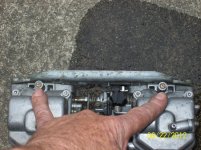
After receiving the carburetors from the UK, I had them installed. Unfortunately, it didn't go well, as fuel was leaking from the overflow hoses again. Furthermore, since it was a Keihin VB30B from an earlier model, it turned out that the synchronization screw was even worse positioned than in my VB30D. So I just took the floats from there and returned them to my carburetor.

These are the floats with the adjusting plates, but I didn't adjust anything; I just installed them because I could see that if I wanted to increase the level, it wouldn't be possible because the float wouldn't close the valve. After installing them, I found that I had no leaks and the engine was running fine! This time, I borrowed a synchronization tool and, using the "one vacuum clock" method, synchronized the carburetors. The engine started to rev really well and is very close to the target. Now I have another question about the mixture composition – I've turned the mixture screws out 2.5 turns and it still feels lean. Have you heard of raising the idle jet on this carburetor by adding a small shim (as you know, the idle jet doesn't have adjustment grooves)? Thanks for any info!
 
The mixture screws are used to adjust the mixture at idle. They have little to no effect at throttle settings above idle.

The needles you speak of are associated with the secondary main jet (assuming 3 jet carbs) and yes, folks have shimmed them to achieve a richer mixture.

You say it "feels lean". What do your spark plugs show you?

Jim will be along soon, it's still early out there.
 
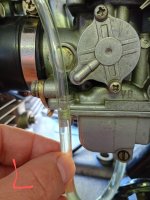
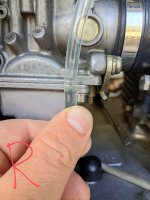
Thx! I checked float level by transparent hose, and right level was minimal under the left who is on float gasket hight. After that I rode little and the best carb behavior is with 3 turns out mixture screws. On 2,5 turns dont have that dynamics....So I must drive longer distance on this and look on spark plugs color....IMG_20250830_132132221_MFNR_HDR (1).jpgIMG_20250830_131808139_HDR (1).jpg
 
It's hard to tell the float level in the pictures due to camera angle. The level should be just below the bowl/body parting line.
2.5-3 turns out on the mixture screws indicates the idle/slow jet is either partially plugged or may be replaced with a smaller incorrect one.
 
Ok. I must to minimally correct left float level, because is little above gasket line. Jets are originalns #73. Thx a lot! There is much better than was:)
 
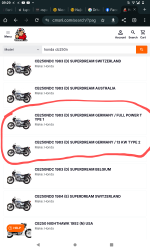
However, I still have a question: what was the difference between the CB250N Type 1 (full power) and CB250N Type 2 (13kW) versions—as we can see on the CMSNL website—and how much power did the full version have? How was the power reduced, and isn't it related to the carburetors? I previously had a throttled Honda NTV, but that one had intake manifold flaps. Thx!Screenshot_20250831-092942 (1).png
 
Ok. I see that versions on Japan market had 19kW, and I think that is possible power for that engine and It's been throttled to 13kW for Europe, so I wonder if I'd be able to unblock it - so it wold be difficult if it is different camshaft:( because this would probably require changes to the ignition timing....Cheers!
 
Last edited:
Cześć!
Pewnie masz rację – ten silnik do kroku w stronę sportową, wysokoobrotowych maszyn, a ja nie mam z nim doświadczenia, bo myślę, że jeśli wkręcę go do 7000-8000 obr./min, to długo nie pożyje. Zawsze niskoobrotowe M-72 (tzw. rosyjskie BMW), Hondę Cx 500, a teraz Hondę Cm 200 i Hondę PC 800, i są dostępne zupełnie inne cechy (czerwone pole w PC 800 do 7500 obr./min) – dlatego bardziej mogą się je wkręcać na dużą prędkość. Poza tym widzę, że w CB trzeba zmienić biegi zupełnie inaczej – odejść, jak to możliwe, a szósty bieg w szerokim zakresie. To mnie denerwuje, bo ruszam z pierwszego biegu i nieważne, jak mocno wkręcany, motocykl i tak gaśnie… muszą się mieć urządzenia na coś takiego. Dzięki!
------------------------------------------------------
For the English speaking crowd:

Hi!
You're probably right – this engine is a step towards sporty, high-revving machines, and I don't have experience with it, because I think if I rev it to 7000-8000 rpm, it won't last long. The M-72 (the so-called Russian BMW) has always been low-revving, the Honda Cx 500, and now the Honda CM 200 and Honda PC 800, and they have completely different characteristics (the redline on the PC 800 is up to 7500 rpm) – so they're more responsive at high speeds. Besides, I see that in a CB, you have to shift gears completely differently – back off as much as possible, and sixth gear in a wide range. This annoys me because I start off in first gear, and no matter how hard I rev it, the bike stalls… there must be a device for that. Thanks!
 

Attachments

  • IMG_20250917_092235797_MFNR_HDR.jpg
    IMG_20250917_092235797_MFNR_HDR.jpg
    1.6 MB · Views: 4
Last edited by a moderator:
I hit 'Like' because of the beautiful Polish scenery and the lovely native tongue, too bad I can't understand it.
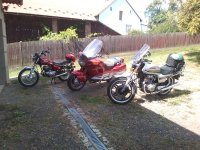
Thx, I'm writing in English - so maybye translator do some job. After these huge problems with carbs IMG_20250824_124614.jpg (which were mainly the result of my limited experience in this area) - I'm finally back on track, although there's still a slight dip between 3000-4000 rpm, but I don't think I can eliminate it. I've never had this in my other Hondas. Cheers!
 
Back
Top Bottom