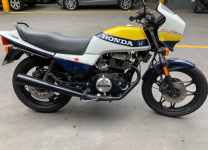
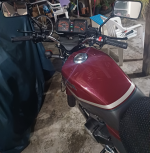
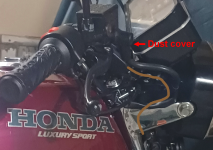
The "Not a Project" CB450DX (project log + pics)

Just went 5h without internet in the middle of a workday, which is also election day right here. ******* great. Well, at least I took my lunch and went for a ride. Still having issues, though.

First: some updates:
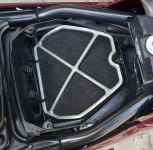
Well, my air box looked pretty good, pretty much the same way I left it when I cleaned after buying the bike:
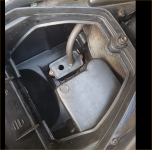
1728267364750.png

Difference between the filter I was using and the new one (on the right) - Sorry, terrible pic.
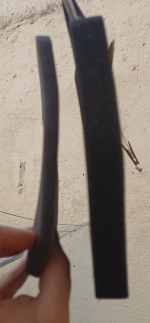
1728267383463.png

Here's how it looked with the new filter, had to press the entire thing down a little bit when assembling the cap/snorkel etc.View attachment 37909
1728267411733.png

Bike felt pretty much the same after, didn't feel any different.

On setting the mixture: I found it was already set as the idle didn't go any higher no matter how hard I tried. I just returned it to where it was, if just a little bit richer. All is good.

Another thing I've been noticing and stopped now to try to "diagnose" when setting the mixture:
After the bike idles for a few minutes without giving it any throttle, if I give it just a smidge and let it go, the RPM goes down, almost dies, but keeps alive, only happens if you let it idle for a good amount of time without touching the throttle. It doesn't die after I properly set the idle, and when at operating temperature it also barely does it, so I'm OK with it. Setting the mixture seems to have helped with this juuust a little bit.
>I believe this is due to the original ignition coil which has seen better days. The bad one I bought before showed pretty much the same behavior.

Good progress.(y)
The carbs don't have a second stage, they are CV, constant velocity, design. What you're describing with the sudden power surge over 5K is typically the CDI or the stator. Need to test those. It sounds like the timing advance is holding retarded until you get enough rpm to generate a strong enough signal to make it advance.
Man, that's a bummer.
I'm going to go to the mechanic and talk to him about checking the stator and everything else, see if he has any other pointers to what could be the issue.
I have found a new sealed Honda CDI (around $100), so pretty expensive at this point (it's the 6th day of the month and I'm almost in the red lol), so I might just pay him the hours to check the wiring and stator before I pull that trigger.
Only those who listen to sports/talk shows here in America :ROFLMAO: And many if not most of them are also on FM radio now too.

They must be good quality as a brand, lots of drag racers use their magnetos

Wow, we hate having only about 10%. Do you have a product like Sta-Bil available? https://www.goldeagle.com/brands/sta-bil/

LOL, they can certainly become more than you expect, and in a hurry sometimes too.
We have some stabilizers like Motul ones, and some old-school additives (STP) that some people (mostly old folks, to be honest) put in their gas. As I already buy the premium gas, I don't bother with that kind of thing. We have some gasoline with additives at the pump as well but they're not even close to the "Premium Gas" in terms of quality/octane and there's basically also no regulation on which additives they can use, and also how much, so god knows what's on there other than the dye to make them have a different color.
I only put gas at the exact same station where I always got gas for my 66cc 2 stroke, as that little annoying thing is the most sensitive sh#t ever when it comes to bad gas (it will 4 stroke), and even that PoS only ran on premium gas.
But I do know that ethanol ***** with gaskets and that sort of thing, I also always keep my gas tank full to avoid it gathering too much water and stuff and rusting inside. If they pass the law to make the gas be absurdly, unacceptable, mind-boggling 35% ethanol, I won't lie, I might have to sell this bike and accept I lost (and if possible move the **** out of this country)
You mentioned resistance of plug wires. This means you are using carbon wires. Don't do this, get solid core wires because the automotive wires degrade from constant UV exposure in about a year or two and your bike will start running funny.

What is the primary resistance of that coil? You can measure it by putting a multimeter across the two-pin plug DISCONNECTED FROM CDI.
The current ignition coil on the bike is the original Honda one. I haven't finished making the adapter for the Fiat one yet.
The primary if I recall correctly was between 0.8ohm and 1.2 ohm (not the greatest multimeter tbh)
The secondary was its issue. It was showing between 14 and 15.5k ohm (service manual tells me it should be 8k, 8.8k ohm max)

The resistance between the 2 pin-plug on the Fiat coil is 1 ohm. (I tried measuring between the spark plug connectors and the pins before, didn't work, weird)

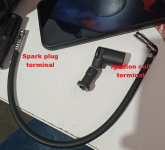
On the spark plug wires, I've just dissected one of them (I bought 4 anyway, barely $10 so it's fine) and it seems that you're right, I don't see any place for a resistor on the cable, so the wire itself is resistant. Interesting, here's a pic of it:
1728268904555.png

I'll keep in mind to replace these cables down the line, I'll also order some new spark plug terminals as these look like they're pretty terrible.
 
Last edited:
Oh, another thing I want to test: try to reach high RPMs with the petcock on "Reserve". Very small chance of it being the issue since I cleaned it and rebuilt it, but I want to try everything before spending more money.
EDIT: Heh, we made it to page 2. It is definitely a project.
 
The new filter will be harder to get on and thicker because as you see it's compressed in there. Make sure you oil this filter! The oil is the filter. The foam is simply just to hold the oil! They're not meant to be run dry! Sorry for many exclamation points, but this is dead serious and very few people seem to take care of foam filters properly.

Stalling in funny ways like that can be the ignition coil, but you mention goofing with the mixture and idle screws. You do understand that the mixture and idle speed are set AFTER the bike was fully warmed up? After 10-20 minutes just turn the mixture screws in slowly until they seat or RPM lowers. If you get them where they seat and no RPM changes you have a clogged idle circuit and/or bent tip on the mixture screw... fix this problem. When RPM starts lower go back out a 1/2 turn or so. Blip the throttle and reset idle speed. The initial mixture setting in the manual is to get the bike to start, not a gospel setting. Always blip the throttle after adjusting those screws.

I would not get worried about secondary reading. You're more concerned with the primary reading. And secondary will read differently if caps are on there or not. It seems within spec, but with the age of it who knows? Also keep in mind you need either... spark caps WITH resistor (NGK XD05F caps or equivalent) OR regular spark wires and caps no resistor (like you showed in the picture) WITH resistor plugs (like DR8ESL). You can probably run with both a cap and a resistor despite forum lore because the Canadian models did exactly this... but never actually tried it. Conversely, it will probably run OK with no resistor plug or cap but may cause problems if you have a phone charger, GPS, cell phone reception, bluetooth, etc. I say probably because I've never tested riding around with no 5k or 10k resistor in circuit.

Before you go crazy oil that filter first. Get whatever foam oil filter kit from the dealer/garage. Avoid sprays they don't penetrate the filter very well. The filter being oiled DOES affect air/fuel mixture.
 
The new filter will be harder to get on and thicker because as you see it's compressed in there. Make sure you oil this filter! The oil is the filter. The foam is simply just to hold the oil! They're not meant to be run dry! Sorry for many exclamation points, but this is dead serious and very few people seem to take care of foam filters properly.

Stalling in funny ways like that can be the ignition coil, but you mention goofing with the mixture and idle screws. You do understand that the mixture and idle speed are set AFTER the bike was fully warmed up? After 10-20 minutes just turn the mixture screws in slowly until they seat or RPM lowers. If you get them where they seat and no RPM changes you have a clogged idle circuit and/or bent tip on the mixture screw... fix this problem. When RPM starts lower go back out a 1/2 turn or so. Blip the throttle and reset idle speed. The initial mixture setting in the manual is to get the bike to start, not a gospel setting. Always blip the throttle after adjusting those screws.

I would not get worried about secondary reading. You're more concerned with the primary reading. And secondary will read differently if caps are on there or not. It seems within spec, but with the age of it who knows? Also keep in mind you need either... spark caps WITH resistor (NGK XD05F caps or equivalent) OR regular spark wires and caps no resistor (like you showed in the picture) WITH resistor plugs (like DR8ESL). You can probably run with both a cap and a resistor despite forum lore because the Canadian models did exactly this... but never actually tried it. Conversely, it will probably run OK with no resistor plug or cap but may cause problems if you have a phone charger, GPS, cell phone reception, bluetooth, etc. I say probably because I've never tested riding around with no 5k or 10k resistor in circuit.

Before you go crazy oil that filter first. Get whatever foam oil filter kit from the dealer/garage. Avoid sprays they don't penetrate the filter very well. The filter being oiled DOES affect air/fuel mixture.
Filter is already oiled (Motul 710, worked pretty great, much better than the very thick one I had tried to use before), I wrung out the excess and left it sitting for a few hours. I didn't notice any difference which I guess is good. Doesn't look like its wet from the pictures but I assure you, it is.

On the idle, yep, I set it while warm, same for the mixture. I only noticed changes when closing it, so it was already set at the highest rpm it went. It's all good now. I followed LDR's instructions.

Nice to know about the ignition coil. I also took the secondary and primary reading without the spark plug caps/terminals (following the service manual). The only thing other than the stalling on idle which I believe is due to the ignition coil is the pops when decelerating at around 3~4k rpm.

To be honest, I run the bike with absolutely nothing on it, however, when I make the change to the Fiat coil I'm going to put some iridium plugs that are resistored (can't find ones that aren't), so it should remain at 5k even without resistored caps/wires.

I talked to my mechanic and he strongly believed that the engine "laziness" to go over 5k rpm is due to the carburetor (which was fully restored but not setup on the bike, I just put it in and it worked, like magic) the mechanic asked me to get it checked with the carburetor shop before doing anything else. I'm taking it there at the end of this week to get it properly set-up on the bike itself, and equalized/synchronized. At least it won't be too expensive and if something more than just setting it up needs to be done, it'll be under warranty, and whatever happens, I won't have to touch the carburetor again (hopefully).

If the engine still shows issues, then I'm getting the stator and CDI checked and we'll go from there.
 
Filter is already oiled (Motul 710, worked pretty great, much better than the very thick one I had tried to use before), I wrung out the excess and left it sitting for a few hours. I didn't notice any difference which I guess is good. Doesn't look like its wet from the pictures but I assure you, it is.

On the idle, yep, I set it while warm, same for the mixture. I only noticed changes when closing it, so it was already set at the highest rpm it went. It's all good now. I followed LDR's instructions.

Nice to know about the ignition coil. I also took the secondary and primary reading without the spark plug caps/terminals (following the service manual). The only thing other than the stalling on idle which I believe is due to the ignition coil is the pops when decelerating at around 3~4k rpm.

To be honest, I run the bike with absolutely nothing on it, however, when I make the change to the Fiat coil I'm going to put some iridium plugs that are resistored (can't find ones that aren't), so it should remain at 5k even without resistored caps/wires.

I talked to my mechanic and he strongly believed that the engine "laziness" to go over 5k rpm is due to the carburetor (which was fully restored but not setup on the bike, I just put it in and it worked, like magic) and asked me to get it checked with the carburetor shop before doing anything else. I'm taking it there at the end of this week to get it properly set-up on the bike itself, and equalized/synchronized. At least it won't be too expensive and whatever happens, I won't have to touch the carburetor again (hopefully).

If the engine still shows issues, then I'm getting the stator and CDI checked and we'll go from there.
Laziness is probably CDI/stator issues. Popping on decel may simple mean that pilot mixture screw needs to go OUT/loose another 1/2 turn or so. Give it a try.
 
Laziness is probably CDI/stator issues. Popping on decel may simple mean that pilot mixture screw needs to go OUT/loose another 1/2 turn or so. Give it a try.
To be honest, I also still think it may be the CDI/Stator, but I'd rather follow the mechanic's instructions on this and then get him to check the stator/CDI. The bike is running great anyway, and I already have more than I need below 5k rpms, so I'm not in a hurry to get this fixed too.
If it's the stator, then it's probably fine, I know it's charging the battery super nice, so may just need some love, cleaning and etc. If it's the CDI then that will cost me a bit more, and will be done at the start of next month.

Getting the carbs properly set-up isn't a bad idea as well (should've done it sooner). I'm also super hyped to visit the carburetor shop, they have those digital tools that I'm super interested in, and I'll take it there when I have time so I can learn from the guy as much as I can.
And since I'm only paying for hours on setting up the carburetor, it'll be cheap, anything other than set-up (or parts needed) will be covered under warranty free of charge.

I will try the mixture screw, I don't have much hope as the popping happened even before I restored the carburetor which indicates to me that something else is causing it (exhaust is not stock as well so there's that, even if it 100% looks like the stock one).
 
Just be warned, practically nobody tests these right. A resistance test is not good enough. You need a Peak Voltage Adapter/PVA to check it dynamically and a timing light to verify full advance at a specific RPM. Ask him if he has these tools and knows how, if not then come back to this thread we'll tell you how to do it. Otherwise you are wasting your time and money and it gets real expensive real quick with ignition problems.

Non-stock exhaust can cause popping on decel. So that may not be the issue. Also more open exhausts can cause funny running that can't be tuned out. Not always, but sometimes, depends on the exhaust. If it's a loud and practically open exhaust it will always have dead spots and possibly sluggish acceleration and top speed and no amount of jetting will magically fix it. Speaking from personal experience here with the 400 automatics. Jim can chime in if the phenomenon is similar on the 400/450 manuals but I'd imagine it's probably a similar situation. It tends to be true for a lot of bikes out there. Just something to think about.
 
Here is the ignition test: https://www.vintagehondatwins.com/f...sis-for-1978-86-cb-cm-400-450-manual-trans.6/

Again, a PVA and timing light are critical. As is using a good quality ignition coil with new spark plugs. Must be NGK or ND. The bike doesn't run as well with other brands. If you can't get a PVA in your country let me know and we can work something out. Maybe you can get an "electronics hobbyist kit" for early christmas present from VHT ;)
 
I will try to get you some PVA readings for the 400/450T this evening. I noticed that thread does not have it. It's about the same output as the 400A just the colours will be different. I do know that White to Ground and Blue to Ground should be outputting about 100-200V AC (note NOT DC) during cranking and running. It will increase as RPM increases. I don't recall the colours for the advancer coil on the 400T, but when hooked up to this with the PVA it likely will read about ~0.7-1.0V AC during idle and increase to about 2V or more as RPM goes up. If you're seeing no voltage or something like 0.1V out of any of this stuff then the windings are bad and it needs rewound or you need to find a known good spare from a junkyard.
 
The secondary resistance of the Fiat coil is likely due to more windings. The 8K spec is related to the original coil only. Aftermarket coils have more/less windings, more winding mean more wire length so resistance goes up. I'd be worried if it showed below 8K.
 
The secondary resistance of the Fiat coil is likely due to more windings. The 8K spec is related to the original coil only. Aftermarket coils have more/less windings, more winding mean more wire length so resistance goes up. I'd be worried if it showed below 8K.
I have NOT mesaured the secondary resistance for the Fiat coil. I only measured the secondary resistance for the original Honda coil, sorry if I wasn't clear on that.
1728346587569.png
I tried measuring the secondary on the Fiat, but nothing came up. I'll try again later tonight when I get off work. Maybe I didn't set the scales right.

Just be warned, practically nobody tests these right. A resistance test is not good enough. You need a Peak Voltage Adapter/PVA to check it dynamically and a timing light to verify full advance at a specific RPM. Ask him if he has these tools and knows how, if not then come back to this thread we'll tell you how to do it. Otherwise you are wasting your time and money and it gets real expensive real quick with ignition problems.

Non-stock exhaust can cause popping on decel. So that may not be the issue. Also more open exhausts can cause funny running that can't be tuned out. Not always, but sometimes, depends on the exhaust. If it's a loud and practically open exhaust it will always have dead spots and possibly sluggish acceleration and top speed and no amount of jetting will magically fix it. Speaking from personal experience here with the 400 automatics. Jim can chime in if the phenomenon is similar on the 400/450 manuals but I'd imagine it's probably a similar situation. It tends to be true for a lot of bikes out there. Just something to think about.
The exhaust is "original-like" (the pics I posted before should show it), it should have the same dimensions and everything, but I can't be 100% on that, can't easily find an original one (word from old guys around is that they go bad after around 40~60 thousand kilometers). But as far as I've ridden, it at least doesn't have any dead spots or sluggish acceleration anywhere, and to be honest, I also like the pops.

Here is the ignition test: https://www.vintagehondatwins.com/f...sis-for-1978-86-cb-cm-400-450-manual-trans.6/

Again, a PVA and timing light are critical. As is using a good quality ignition coil with new spark plugs. Must be NGK or ND. The bike doesn't run as well with other brands. If you can't get a PVA in your country let me know and we can work something out. Maybe you can get an "electronics hobbyist kit" for early christmas present from VHT ;)
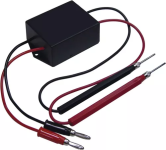
I'm looking into the PVA, does it look something like this?
1728347280612.png
Description says it's basically a stabilizer so you can get correct readings over the highest voltage without oscilations. About 25$, doable.

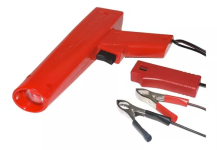
On timing lights, I was able to find this generic one, but it specifies that it has no adjustments for advance (not sure if it's a dealbreaker or not) - This one, I'll admit, I don't know how it works, but I'll look into it:
1728347798051.png
Pretty freaking expensive, to be honest. Over 70$.

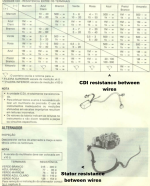
Also, on the readings for the CDI and Stator, I think the Brazilian service manual has them, along with their maximum tolerances (on the cdi test, they have 2 numbers, one for measuring on x100 and another for x1000 [xk]):
1728347348957.png

Since the guy I'm taking to get the carbs setup only deals with old bikes and even has the digital stuff for the carburetors, I expect him to have all of these tools, so I'm also going to check with him if he does this kind of testing, I'll be sure to ask about the specific tools as well. I'm honestly kind of tired of my "trusted" mechanic at this point.

I might have to travel for work these next few weeks, so time is becoming a bit of an issue. If I end up traveling, I'll get a good bonus and I'm fine with paying for someone to do this, especially while I'm out of town and won't be able ride the bike anyway (warranty is also a plus, I guess).

If the stator needs re-wiring/replacing, it should be fine, I already looked into this before even buying the bike and I saw that they do trade-ins, they send you a new one and you send your old one to them.
The CDI however, there's only 3 new Honda ones in stock, but if push comes to shove I'll just buy one of yours @Maraakate.
 
You don't need the advance feature unless doing automotive work where there is only a tiny viewing window to the flywheel and you want to test upper rpm advance. On bikes the whole rotor is visible to full advance marks.
That is way more expensive for a basic model like that. Here we have amazon with $25-30 prices.
 
You don't need the advance feature unless doing automotive work where there is only a tiny viewing window to the flywheel and you want to test upper rpm advance. On bikes the whole rotor is visible to full advance marks.
That is way more expensive for a basic model like that. Here we have amazon with $25-30 prices.
Third world country, third world prices, it is what it is.
 
Yes, you have found the PVA. Get that tool.

The resistance tables are mostly useless in the books for the CDIs. You'll get odd results depending on the meter and most people don't set the range correctly and think something is wrong.

If you can get OEM brand new CDI down there that might be the way to go. Depends on the price they want for it. If it's used don't bother.
 
I prefer the non adjustable timing light over the adjustable. Had one that even set to zero would sometimes self advance a few degrees for a few seconds.
 
Yes, you have found the PVA. Get that tool.

The resistance tables are mostly useless in the books for the CDIs. You'll get odd results depending on the meter and most people don't set the range correctly and think something is wrong.

If you can get OEM brand new CDI down there that might be the way to go. Depends on the price they want for it. If it's used don't bother.
You know what... I ******* bought a new CDI.
God bless old Honda stock.

While at it, I got my wallet ready to buy a new wiring harness as well in case it's needed (not OEM, but there's a few good brands that make a reproduction of it, half the price of the CDI) - To be fair, I don't expect to find very good things when I strip out the harness (with strip out, I mean taking off the electrical tape that is all over it) to install the new CDI.
 
It's not electrical tape. It's harness tape which is different. Honda actually has a part number for it.

Your harness is probably fine except for a few connectors. The most common ones I see bad are the red and red w/ white tracer wires that have the fibreglass sleeving that run from the 2 pin canon plug on the right side of the bike above the battery in the little "boot" and then from there it runs over to the voltage regulator/rectifier.

Unless the bike has been stored in extremely bad conditions I wouldn't worry too much.
 
It's not electrical tape. It's harness tape which is different. Honda actually has a part number for it.

Your harness is probably fine except for a few connectors. The most common ones I see bad are the red and red w/ white tracer wires that have the fibreglass sleeving that run from the 2 pin canon plug on the right side of the bike above the battery in the little "boot" and then from there it runs over to the voltage regulator/rectifier.

Unless the bike has been stored in extremely bad conditions I wouldn't worry too much.
Maybe 30 years ago, but nowadays? It's 100% electrical tape. It has been tampered with by a lot of mechanics at this point... Unfortunately.

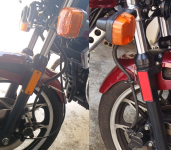
Also, I installed the reflector tape on the front forks. I chose to go with the Red tape instead of the original Orange - This might have been a mistake, I never stopped to think that orange fits in nicely with the turn signals, while Red doesn't...

Here's a a pic of one side vs the other (I initially planned on putting red on both sides). I think I'll just buy the orange tape and then replace both sides.
1728410963712.png
 
Here's the part number, any dealer can order it for you: 4100-0002. It's cheap so worth getting if you need it later for some reason.
 
No it's harness tape it always was. If you want the part number I can get it for you later.
Trust me when I say most mechanics around here don't bother and just put electric tape on it, seen it myself, although I'll buy a harness tape from MercadoLivre (seems like a textile type one with rubber adhesive, anti-flames and stuff), I might just take out all tape and put a new one when installing the new CDI.
Ask around for Orange safety reflective tape. Construction shops might know.
Already bought an orange one from the same brand as my red one. They have all the colors, I chose red because I thought it would fit the bike better. Dumb mistake. Orange one is already on its way with the harness tape, CDI has also been sent, should arrive in a few days.

A bit off-topic, but today a friend of mine brought his new (to him) 1998 Virago 250, we cleaned the carb, handlebars and its accessories along with their cables (nightmare kind of stuff, the throttle BARELY tried coming back after turning it, I also re-routed them), cut the spark plug wires and re-threaded the caps, bled the brakes, basically everything I had enough tools to do (other than changing the oil, the previous owner did it before selling and had the receipts for it, including which oil was used).

And let me tell you man... I respect the 450 even more now, I don't even know if the Virago 250 is terrible or if this is just a terrible example, because this one has been treated absolutely terribly throughout the years, and the fact that it has philips/JIS screws for absolutely everything didn't help. Replaced so many stripped-out screws everywhere, from the engine case to the frame and plastics.

Tall handlebars were added by the previous owner, along with a sissy bar... Bike is kind of all over the place. Needs a lot of love.

Against all odds, the engine is 10/10, sounds healthy and awesome, starts very easily. And now doesn't bog down after a thorough clean and descarbonization of the carb (which had all of its jets clean, a freaking miracle, considering how bad the bowl was).
Also, the fake second exhaust is such a joke. Fully plastic. Gotta give it to Yamaha though, for a 25 year old bike, the plastics still look good (other than the side panels, which had almost all of their clips broken)

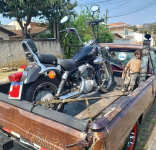
Here's a pic of how the bike arrived, bonus points for the rat pickup:
1728422793684.png

He still has a long way to go before the bike is actually good, but that's a good start, I'd say. He paid dirt cheap for it at least.

I absolutely hated the handlebars and the footpegs position, but my friend told me he loved it, so who am I to judge.

Tonight, I'll just have a midnight ride, work has been a nightmare.
 
The biggest problem with JIS screws besides the screwdriver issue is that you really ought to use t-handles for some of these screws. Sometimes it helps to "shock" them with a punch and hammer. The problem with allens is that they promote over tightening, especially on carburetors and clutch covers.
 
CDI arrived, I put it on the bike. It kind of feels better and easier to start, but it might be placebo.

Also, unfortunately, lots of electric tape all over the harness, but nothing too major... Except the rectifier. All wires from it are jerry rigged, no conectors (sigh). I also have a connector not connected to anything coming from the harness. If I recall correctly, it's a red and yellow connector. I have no idea what it does as everything on the bike works (even the hazard lights!)... I am sure it's not the fuel gauge/meter/etc though.

I think the popping also stopped, although I haven't ridden it much (I had tried to loosen the mixture before, didn't work, continued popping). I'll have to ride it more to truly confirm, weather has not been helping me.

However, the "lazy engine" issue still continues, exactly the same.

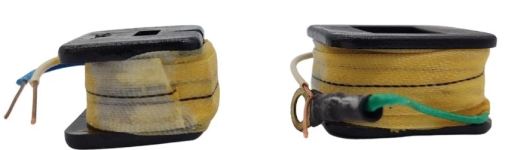
Is there any chance these little coils are the cause of the issue? Around here these are called Spark Coils (they have a main/master and an auxiliar one):
1728968216296.png
I ask because a friend I met at the mechanic has them at his garage, he ended up buying an entire new stator so he can give them to me for free (and they're also very cheap and easy to find)

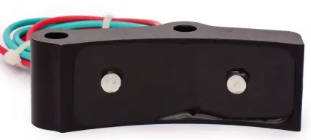
There's also this one, that seens to be called Pulse Coil, but they seem VERY HARD to find new:
1728969757702.png

(It's this one, isn't it? I'm already expecting it to be the hardest one to find at this point)

The "CB ignition coil" will likely be for an SOHC4 or early Honda. And therefore anywhere from 2 to 5 ohm on the primary which won't work with these bikes.
Totally unrelated, but just for curiosity, I tested my bad igntion coil (the one I bought before and the bike barely ran) - It's primary resistance was 5 ohms (makes sense why it didn't work). You were right on target.

Also, I tried running the bike with that black wire under the tank disconnected, and man, that was pretty cool to know in case I ever need it. Just had to choke her to kill the engine as was expected. I did connect it afterwards of course.
 
Last edited:
The windings on the stator could be weak, yes. You need a peak voltage adapter to verify that when it's running. You can do resistance tests but that will only tell you if a winding is completely open or if it's shorted. If the is running, but poorly, it will show you if it's outputting less voltage than it should be.

The pulse coil was never available as a separate part. You need the whole stator assembly for that.

Lazy acceleration can be caused many things. I know your mechanic friend is saying he cleaned those carbs, but did he use a rebuild kit? If he did, you have problems. It will never run right with aftermarket carb rebuild kits. They always have float needles (technically called float valves) that either leak or the float height is off, the brass jets are never machined to the same tolerances and there is no reason to replace the brass jets -- they don't wear out, if the jet needle was replaced with aftermarket it will never run right either because the originals are machined very precisely and the kit makers never make them this nice and those jet needles are actually are different every single year the bike was made.

You have to find out about the carb. Measuring the stator windings can be useful and getting a PVA at some point will also be useful to test for an ignition issue while running.
 
The windings on the stator could be weak, yes. You need a peak voltage adapter to verify that when it's running. You can do resistance tests but that will only tell you if a winding is completely open or if it's shorted. If the is running, but poorly, it will show you if it's outputting less voltage than it should be.

The pulse coil was never available as a separate part. You need the whole stator assembly for that.
I'll look into getting the PVA.

I'm sure the pulse coil wasn't available through Honda but it is available separately over here. It's made by the same company that restores the stators (you send yours to them, they rewire everything, and put resin on it, should be better than oem, very good reviews)
And I thought you said the CDI was new? If it's been messed up because it's used you can't trust that.
CDI is new. I didn't mention anything about that I think. I meant there was electrical tape and stuff on the bikes wiring harness. Fortunately, everything related to the CDI was okay, just plug and play. All connectors were good.

Lazy acceleration can be caused many things. I know your mechanic friend is saying he cleaned those carbs, but did he use a rebuild kit? If he did, you have problems. It will never run right with aftermarket carb rebuild kits. They always have float needles (technically called float valves) that either leak or the float height is off, the brass jets are never machined to the same tolerances and there is no reason to replace the brass jets -- they don't wear out, if the jet needle was replaced with aftermarket it will never run right either because the originals are machined very precisely and the kit makers never make them this nice and those jet needles are actually are different every single year the bike was made.

You have to find out about the carb. Measuring the stator windings can be useful and getting a PVA at some point will also be useful to test for an ignition issue while running.
The thing is: I really don't think it is the carb. It doesn't make sense to me.

I didn't take it to my mechanic, I took it to a machine shop specialized in carburetors to restore the entire carb. No needles or jets were changed, they just welded and restored the float needle seat hole (which had a pretty bad crack in it), they also put it in new floats and float needles and cleaned it fully along with a chemical bath (on those supersonic tubs) and the bike itself runs perfectly fine.

Check out this album to see what was done (30+ pictures):

They have a lot of experience dealing with these carbs, when I left mine over there it was the third 450 carburetor on there, they also took note of the model and year of the bike as well as there is different settings for different years even on our brazilian bikes.

If it was the carbs, I'm sure it would have some other symptoms, but it accelerates perfectly across all RPMs below 5k (and if I hold it on 5k RPM and then it goes, it also accelerates perfectly above that) and it acts exactly according to how much throttle I'm giving it.

That being said, I'm still taking it to get equalized/sync'd and looked at just to be sure, should've done that sooner to be honest. The carbs came "pre-equalized" from the machine shop already but I still want to get them perfectly set-up on the engine. And anything that might be needed will be covered under warranty as well.

I also tried doing pulls with half choke or less, same exact issue. I also tried to do some very extended pulls on 5th gear to test the carbs and whatnot, everything worked perfectly.

What LDR said makes the most sense to me, to be honest, as it's exactly what I feel, bike runs fine until 5k RPM, and if I hold it there for a bit, the power surges very strongly and it just goes. Not to mention that sometimes it doesn't do this and just goes, showing no issues.
What you're describing with the sudden power surge over 5K is typically the CDI or the stator. Need to test those. It sounds like the timing advance is holding retarded until you get enough rpm to generate a strong enough signal to make it advance.
Looking at the brazilian FSM, it describes the timing advance as reaching its maximum from 4500 to 5350 rpm, which is right around where I lose power:
1729001871635.png
(Avanço inicial = Initial advance, Avanço máximo = Maximum advance, and then there are the RPMs for for the initial and maximum advance)
 
Regarding the shop... it means nothing. Find out if they used OEM float needles. This matters because your carb has a fixed float that is not adjustable. You'd be amazed at how many people live with poor performance on these vintage bikes and assume it is normal. I have plenty of bikes that come to me for this exact reason. Practically all the problems are caused by inferior aftermarket parts and poor tuning.

You need a timing light to verify the full advance. You can measure the advance coil (there is one on these bikes) with an ohmmeter to see if the winding is open. Timing light will show you definitively if full advance is being hit and if so at what RPM.

Usually crapping out around that range is related to a bad CDI, but since you replaced it with new very likely that no advance is the issue.
 
Regarding the shop... it means nothing. Find out if they used OEM float needles. This matters because your carb has a fixed float that is not adjustable. You'd be amazed at how many people live with poor performance on these vintage bikes and assume it is normal. I have plenty of bikes that come to me for this exact reason. Practically all the problems are caused by inferior aftermarket parts and poor tuning.
I haven't checked the exact float needle, but I did check the float heights when I got the carburetor, and I remember measuring them and they were perfect. I will ask them when I take the bike to them. Unfortunately a lot of personal stuff (and the weather) is getting in the way of me taking the bike there right now.

You need a timing light to verify the full advance. You can measure the advance coil (there is one on these bikes) with an ohmmeter to see if the winding is open. Timing light will show you definitively if full advance is being hit and if so at what RPM.

Usually crapping out around that range is related to a bad CDI, but since you replaced it with new very likely that no advance is the issue.
To be honest, I'm thinking of just sending the entire stator to be rebuilt/rewired and restored. The tools (PVA + Timing light/gun) would cost me exactly the amount I'd have to spend to get the stator restored. Restoring the stator will only leave me with the clutch untouched (other than cranks, and the rest of the bottom end which requires splitting the cases).
But before I do this, I'll reach out to a car mechanic that's close by, I'm sure he has timing lights so maybe he can lend me the tools for me to test and make sure timing is the issue.

If I go ahead with restoring the stator, I'll probably also go ahead with a new harness and rectifier since the bike will be off for at the very least 2 weeks, that way I can 100% restore all its electronics (I'll keep the original stuff for sure).
 
OK, yeah I mean if the tools are going to cost the same as rewinding then why not? If you can borrow a timing light or limp it to a shop they should be able to tell you. Takes 10 minutes to do, and 9 minutes of that is removing and installing the flywheel cover and gear shifter.
 
I got great news.

The sun finally came out this morning and I was able to sneak a 30 minute ride before work to test the new CDI again... And for some reason the problem seems completely fixed now.

I had done a very small ride before at night, I don't think I rode for more than 5 minutes.

Did a lot of pulls, and man... What a bike, what an engine. It's very controlled and easy (while also remaining strong) until 4k rpm, but after that it really comes alive and shows it's teeth, not only in it's strength and torque but also the exhaust notes.

It seems the problem is completely fixed. I don't feel any power surge, it all feels completely smooth all across the rev range, it doesn't get lazy or anything of the sorts.

It feels just as strong as before, but there's no punch around 5/6k rpm, it's barely noticeable now, instead of getting punched with the power surge, it starts to build up from around 4500rpm and when it reaches its peak torque at around 6500rpm, you barely feel it since it built up to it.

Today was the first day ever that I felt comfortable getting really close to 8000rpm (which the manual tells me not to reach during break-in).

Now I just want to finish the adapter of the Fiat ignition coil and see if it works, and then take it to the shop to get the carbs looked at and equalized.

I will also do a very early oil + filter change (I guess some people call this the "sacrificial" oil change?).
I got around 270kms on the current oil but I will make the change no later than 350kms.

I use the exact mineral oil that the manual from back then tells me to, it's dirt cheap nowadays, Mobil Super Moto 20w50.

I thought a couple of times about changing it to a synthetic oil but everytime I do some research I get mixed results so I just stick to the manual.

Changing the oil early seems like a good idea since the engine got new pistons, rings and valves.
 
I'm glad it is running better but you need to check the timing with a timing light to verify if full advance is even working or if its breaking down from vibration due to windings barely holding on (happens more than you think).

Synthetic is fine, but it can be a waste of money to do so. It's your call. It is true that it can last longer from breakdown and with you being closer to the equator and short trips this is considered "severe duty" this can help with engine health and possibly extending your drain interval. Will not harm anything.

I ride a lot as well, but I change mine fairly frequently because a gallon of Shell Rotella T4 15W40 is so cheap. Literally half the price (or even more) than synthetics.
 
The early oil change is best. There's lots of little crap accumulated during and engine build inside the engine and you're just cleaning it out.
Good to hear the engine seems to be squared away but as Frank suggests get the timing advance checked.
I won't use synthetic oil in mine, the EBC clutch friction had a tag saying they were not suitable for it. Plus as often as oil/filter gets changed there's zero advantage to using a more expensive oil. That's why I've stuck with conventional oil.
 
Interesting, never heard about the EBC warning. On a stock bike maybe it's OK? I used Maxima Synthetic (he dropped it off with the bike) for that Nighthawk 450 a month or so ago and it shifted very well.
 
Interesting, never heard about the EBC warning. On a stock bike maybe it's OK? I used Maxima Synthetic (he dropped it off with the bike) for that Nighthawk 450 a month or so ago and it shifted very well.
Short term usage never seems to be a problem, clutch slippage seems to occur after @10K miles
 
I seem to recall Ken's 450 (or someones bike on here) that had a hell of a time getting things to run properly with aftermarket EBC clutch components.
 
I'm glad it is running better but you need to check the timing with a timing light to verify if full advance is even working or if its breaking down from vibration due to windings barely holding on (happens more than you think).

Synthetic is fine, but it can be a waste of money to do so. It's your call. It is true that it can last longer from breakdown and with you being closer to the equator and short trips this is considered "severe duty" this can help with engine health and possibly extending your drain interval. Will not harm anything.

I ride a lot as well, but I change mine fairly frequently because a gallon of Shell Rotella T4 15W40 is so cheap. Literally half the price (or even more) than synthetics.
Yep, I'll still be checking the advance with the timing light. I confirmed the carb shop has one, will be a little bit more expensive but now that I'm not too much in a hurry I should be okay with money.
I was thinking of going with Motul 7100 20w50 which is quite expensive. The Mobil Super Moto costs literally 1/4 of the price of the Motul.
The early oil change is best. There's lots of little crap accumulated during and engine build inside the engine and you're just cleaning it out.
Good to hear the engine seems to be squared away but as Frank suggests get the timing advance checked.
I won't use synthetic oil in mine, the EBC clutch friction had a tag saying they were not suitable for it. Plus as often as oil/filter gets changed there's zero advantage to using a more expensive oil. That's why I've stuck with conventional oil.
When doing my research, clutch slipping was the main issue that came up with people that did not have a good time with the synthetics. Another (very) old-school mechanic that is specialized in 400/450's brought up issues with the engine not being engineered to handle the synthetic oil gases and that kind of thing (although I don't think that would be a big issue, if an issue at all)

Owner's manual of the 450 tells me to change the oil every 3000kms (1864 miles) but I'll be going for a change every 1000kms (621 miles) as I feel that is much safer. (Even the modern-day CG160/150s guys do a change every thousand kms and disregard the 3000 the manual tells them to, especially the dudes who work on delivery)
They also tell you to change the filter every 6000kms (so every other oil change) and I'm just going to change both every 1000kms as well, if I'm going to get below the bike to take out one screw, I might as well take two.

One little thing that I noticed is that the owners manual shows you how to do a normal oil change like I'm used to (get the bike hot, drain, etc), while the FSM tells you to, after draining the oil, use the starter with ignition off to make the engine spin for a few seconds and get the oil from the radiator and its hoses out. Not sure if I feel good about doing that, so I probably won't folow those instructions and will just follow the owners manual, I have no problem with letting it drain for a few hours, and I'd rather put the oil drain screw back when all the metal has cooled down anyway.

I think I'll just be going mineral and oil+filter every thousand kilometers, should be fine. And considering the engine's previous owners, probably way better than she was used to.
 
Oh yeah, and the next oil change might also be a sacrificial one because of the clutch.
It has never slipped on me, but the adjuster close to the engine lever (to stretch the cable) is basically at max.
When I got the bike I noticed that the clutch lever had way more than 10-20mm of slack (which is what's specified in the manual) and the bike was trying to go when I put it in 1st and had the clutch pulled all the way.
I zero'd the adjuster on the lever and did all the adjusting on the engine side (so if I had any issues from then on, I could use the lever adjuster). It's pretty much as far as it'll go on the engine, even if the clutch hasn't slipped yet, and the lever adjuster is still unused, completely screwed-in on the lever.

I've ridden around 500kms since then and did not adjust it again so for now it's fine, the only times I really use the clutch is on very low speed situations or when starting to move on 1st gear, and I consider myself pretty conservative on these situations (probably because I was used to riding a 3hp engine before the CB).

Not sure if I gotta put new clutch pads (or are they called discs?) or if there's something else I can adjust - I thought about new springs as well as they're easy to find but that's a bridge I'll cross when I get to it.

This is one of the few moments where my motorized bike trumps the CB. I could change all the clutch pads on the motorized bike in less than 5 minutes with an 5mm allen, a flat screwdriver and a hammer lol.
 
Looking at the Motul 7100 it's a full syn oil, I'd stick with the Mobil oil. Motul makes some very good products and the price tag reflects it.
Oil/filter changes every 1K is excessive. You have to remember that oil technology has and continues to advance, the FSM was written 20+ years ago and at the time was accurate. I would be looking at 2K intervals. When I was travelling the US I did oil/filter changes every 3,000 miles(4800km), even now I'm doing it at 2,000 miles.
Personally I haven't been really concerned with draining the oil cooler, I accept that I'll retain 1/2 pint(1/4 liter) of dirty oil but I'd rather not spin the crank with no oil pressure/supply. Removing the cooler from the case to drain it is not good since the O-ring gasket has been out of production for decades.
I automatically replace the clutch springs when replacing the friction discs. Never had to replace the steels.
 
Looking at the Motul 7100 it's a full syn oil, I'd stick with the Mobil oil. Motul makes some very good products and the price tag reflects it.
Oil/filter changes every 1K is excessive. You have to remember that oil technology has and continues to advance, the FSM was written 20+ years ago and at the time was accurate. I would be looking at 2K intervals. When I was travelling the US I did oil/filter changes every 3,000 miles(4800km), even now I'm doing it at 2,000 miles.
Personally I haven't been really concerned with draining the oil cooler, I accept that I'll retain 1/2 pint(1/4 liter) of dirty oil but I'd rather not spin the crank with no oil pressure/supply. Removing the cooler from the case to drain it is not good since the O-ring gasket has been out of production for decades.
I automatically replace the clutch springs when replacing the friction discs. Never had to replace the steels.
On the 400A I do it somewhere around 1500-2000 typically. I don't get concerned about the oil cooler either. Sometimes I do 1000 miles if I'm bored and have a gallon of 15W40 sitting around.
 
Motul makes some very good products and the price tag reflects it.
I definitely agree with that. I only ever used Motul 710 full synthetic 2 stroke oil on my engine and a few years ago I was deeply involved in my city's moped scene.
It was absurd how much better my engine ran, not to mention it would usually last 2/3 times more than others because of much less carbonization.
Looking at the Motul 7100 it's a full syn oil, I'd stick with the Mobil oil. Motul makes some very good products and the price tag reflects it.
Oil/filter changes every 1K is excessive. You have to remember that oil technology has and continues to advance, the FSM was written 20+ years ago and at the time was accurate. I would be looking at 2K intervals. When I was travelling the US I did oil/filter changes every 3,000 miles(4800km), even now I'm doing it at 2,000 miles.
Personally I haven't been really concerned with draining the oil cooler, I accept that I'll retain 1/2 pint(1/4 liter) of dirty oil but I'd rather not spin the crank with no oil pressure/supply. Removing the cooler from the case to drain it is not good since the O-ring gasket has been out of production for decades.
I automatically replace the clutch springs when replacing the friction discs. Never had to replace the steels.
Another thing that I keep in mind is that 1000 kilometers may take a long time for me to get, my timeline for changing the oil will be 8~10 months, which might come first - This will, of course, probably change once I get my license.

Also, the full oil change will cost me around $14 bucks of oil (300ml will also remain) + $5 bucks for the filter, so I'm ok with that. I'll raise it to 1500~2000 kms after the next 2 changes.

I also think the oil left on the radiator will be fine - By the way, the one thing I don't like about the US CBs is the oil cooler, the radiator just looks better imo, but then again you guys got front air suspension which is much cooler and makes a bigger difference, so...
Fortunately, in case I ever need them, around here I can still find the o-rings for the hoses of the radiators of the CB. (Although I don't think I'll ever take them out).

Nice to know about the springs, I'll buy a set when I get the friction discs.

Oh, and I'm not that close to the Equator line, I'm about as far from it as the US/Mexico border, although it has been fairly warm over here, even if it's (or should be) the coldest capital in the country.
 
I've never really noticed a huge difference with the air suspension, but maybe if you're not on a lot of smooth rides it helps?

I like the oil cooler being one piece on the automatics and CB450SC/Nighthawk 450s. Nothing really to go bad unless you disturb removing it, which is there no reason to unless rebuilding the engine and even then you can rebuild the engine without removing the oil cooler.
 
Just wanted to throw in a quick update. I just turned 26 and my gift was my employer making me travel for a few weeks so I'm still far from home and far away from the bike.
Bike is still running great, never had the advance issue again. Coming close to reaching 430 kilometers since the top end rebuild with the new pistons and valves, and 776 kilometers in total since I bought the bike. Had the opportunity to ride it a bit this week as I came back home for 2 days to do some exams for my license (and I finally passed the psychological/crazy one, which I failed last year lol) - Currently sitting at home with a lot of rain, waiting to travel again later today.

Still stalls a little bit if I give it the tiniest amount of throttle at idle after not touching the throttle for a bit, but I got pretty used to it, and it doesn't die, just hesitates a little bit and then the rpm goes up, after the first blip, it doesn't do it for a while - I convinced myself I haven't set the mixture right and I'll try to reset and try that again when I come back - I gave up taking the bike to the carburetor shop that I was planning to. I talked to the guy, and the dude wanted to charge me for all sorts of stuff, from valve adjustments to compression tests and gapping the spark plugs.

Which I get is needed, everything needs to match so the carburetors can be really synchronized, but my issue with it was that I told him that I did all of that and he wouldn't give me a price or even remotely believe that I knew what I was doing (literally asked me the clearances I put on the valves). Refused to give me a price, be it with everything included or not, and add that to the fact that it was very far away and I don't feel too good about going far with the bike without a license... Yeah, no.

There's another place very close by that is specialized in carburetors, I'm going to give them a call soon to first figure out if they work on motorcycles, and then see if they can at least give me a price. I might still not do it because of the reasons below:

I also took a deep look into my finances a few days ago (I really got nothing else to do other than think at this point), realized that I'm actually better than I expected, and I decided to go all-in on buying tools this month and December (lots of extra hours).

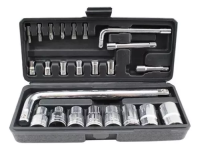
I realized the best purchase I made this entire year was this, along with some spark plug sockets for it:
1730726213344.png
It was ultra, super, mega cheap on sale, and has worked wonders for me (especially as someone who only ever had open/combination wrenches), and surprisingly, nothing ever stripped, and I even used the sockets to remove bearings from my 2 stroke engine. As my best purchase was tools... Well, christmas is going to be full of tools as well.


I'm going to post a picture of what's on my cart right now, but here's a small explanation.
That L wrench is awesome, but having a smaller, ratchetting one would be very convenient (oil drain bolt on the CB450 comes to mind).
Another thing that's been on my mind for quite a while is a torque wrench, not having one is the #1 thing that stops me from doing more advanced work on the engines. Also gotta learn about bolts torsion and that kind of thing as I recently learned torque wrenches are not a magic tool when it comes to big bolts and that kind of stuff - I also want to buy a smaller one that can handle less torque.
I also want to buy a few kits of electric plugs and conectors (mainly faston) along with some heat-shrinking tubes - The rectifier on my bike is connected with splices basically, and I want to make that... At least better. So a kit along with some pliers is on the table too.
A compression tester as well, self-explanatory. Will be good for my (and my friends) 2 stroke engines as well.
Last but not least, and most expensive of them, vacuum gauge for syncing the carbs.
Not included in the picture, but also the timing lights and PVA (which are already on the way, bought these a few weeks ago from China, was much cheaper than buying here, and since the bike is fine, I can wait).

1730730114243.png

Also, I've been lurking a bit on my work computer and now VHT is showing up on my browser's start page, so I leaked the forum like 3 times this past week when sharing my screen on video calls lol.
 
Also, I've been lurking a bit on my work computer and now VHT is showing up on my browser's start page, so I leaked the forum like 3 times this past week when sharing my screen on video calls lol.
Cool! But please don't get fired because of it...
 
Cool! But please don't get fired because of it...
It's fine, they know about my love for these old bikes, and they certainly don't want to pay for extra luggage for me to bring my own computer.
Also, as an IT guy... They either trust me with an administrator user or I'm not able to do my job (I mean, if I'm good enough to have an admin user on our clients systems, I should be good enough to be an admin on my own work computer).
 
Came back home from work finally! Still working, but at least I can slip in some riding every now and then.

However, the bike wasn't running that great, the sympton I reported before of it dying when I touched the throttle at idle (after not giving it throttle for a while) was either getting more serious, or just annoying me more than usual (using the starter at a green light is never fun). It was also having a bit of trouble going higher than 6k rpm but not like before where it would just flat-out refuse to go above 6000 rpm and stay there, it would just be slow and kind of weak. All signs pointed to the carburetor. Guess I really messed up when I touched the mixture screw last time, but it was never right to begin with, so I'm fine with it.

Got a few days off... Had to go to a wedding out of state... Oh well.

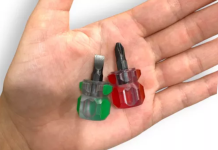
Before I went, I bought two itty bitty tiny screwdrivers that are made for sewing machines, seriously small:
1732340378997.png

Closed the petcock and ran the bike till it died and wouldn't start, then drained the rest through the carbs screws. Took out the mixture screws and their small spacer (or whatever it's called) that sits above the spring - Sprayed some WD-40 on the holes, put them back on the carbs and left them entirely closed.

Was having a pretty good time at the wedding until I received a picture of my bike on the ground. My uncle dropped it when he went to pick up his Z900 at the same garage. Got ultra mad that they wasted time taking a picture before getting the bike up. Fortunately since it had the carbs dry and petcock closed, no gas was spilled, no mess created. I didn't even want to know more, deal with it when I get home.

Got home.
Bent handlebars. Left side cover scratched. Thankfully no scratches in the tank or elsewhere.
So much for me babying it....

But OK, let me make the best of it. Learned all there is to learn about the brazilian CB400/450's handlebars. And now let me tell you about it, because I think it's neat (and also how I ended up buying 3 handlebars).

Learned the CB450E (Sport) version [this is the one that had the Nelson Piquet edition, very cool bike] (not to be confused with the CBR450SR) used kind of weird tal. L-shaped semi handlebars:
1732341343976.png
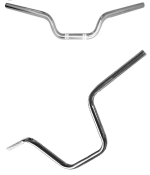
Then there were my set of handlebars which we'll call "medium" (on top) and the (very) tall set of handlebars (that were used on the CB 400 II and CB 450 Custom, on the bottom).
1732344412963.png

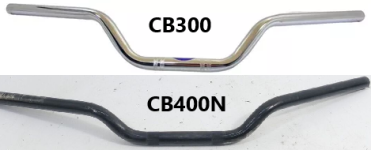
And of course, the European CB400N handlebars, which were never available here, were really smaller (we'll call them the small ones). They looked somewhat like the CBX 250/CB250/CB300 Twister handlebars but with slightly less rise - The CB300 bars also support the use of bar-end weights and protectors... Neat!

1732341937391.png

Well. This was wednesday. I took the bent bars out of the bike and that was it. Looked at my options:

The original/medium bars would only arrive in 3~5 days (probably sunday), the tall bars would arrive the next day, Thursday.

Bought the medium and tall handlebars.

Thursday came and before the tall handlebar even arrived I noticed they wouldn't work because of the front brake hose - The other stuff I could probably re-route and maybe make it work, but not the front brake. Could just return them without an issue, but I just talked to my Virago 250 friend and I'm going to install them on his bike, free of charge, just for the fun of it (people install these tall handlebars on literally any bike, even Royal Enfields) - It arrived and I tried it anyway, just wouldn't fit.

And then I bought the CB300 handlebars because they would arrive Friday. Oh, consumerism and capitalism.

As soon as the CB300 handlebars arrived I got to work installing them, used the same method I use on all my bicycles: allign the handlebar rise with the forks and that's it.

I'll admit, they looked VERY nice on the bike:
1732343009148.png
Sorry for the blurry picture.

I used a random left grip I had laying around as I wasn't sure I was going to keep this bar on the bike.
As soon as I finished installing it, the original/medium 450DX handlebars arrived... 3 days early. OK.

Had to pull the clutch cable down at the engine to make it work better, but did not feel different, throttle was also the same. However I had to set the front brake hose in a zig-zag pattern before it reached the piece that splits into 2 (this bike has twin front discs).

After setting the mixture (which I'll talk about on the next post) I took a ride with them.
Damn, the bike felt nice. I hated the left grip as the one I use is a custom one (same as the one in the throttle) and SO MUCH NICER, but damn, the bike felt much more compliant and much more "at my hands" (I don't know a better expression to use for this) turns were just easier, just took a bit more effort.
It was weird, but very easy, and within 30 seconds I got used to it.
The riding position itself (aka my back) didn't feel better and certainly not more confortable, but not immediately worse either, but guiding the bike certainly felt pretty good and "more compliant" if that makes sense.

I arrived home after a few kilometers, and immediately decided to take it all off xD
I really hated the zig-zag pattern on the front brake hose, and I wouldn't be able to live with that, and there was really nothing wrong with the original handlebars to start with.
1732344010799.png
I made an outline of the pattern the hose followed into the piece that splits it. Couldn't and wouldn't live with that.

Well, it is what it is: Had a lot of fun.
I put on the new medium handlebars with no issues, all the cables are stretched and feel great. We'll see how tomorrow goes.
 
Last edited:
Now, for the mixture part:

I could've sworn I read on a service manual that the starting point for the mixture screws were 2 and a half turns.
Looked at my service manuals, even the owner manual... Nothing. Maybe I missed it or looked on the wrong place, or maybe I read it here or saw it on a YouTube video. I honestly don't know.
Decided to go with my gut, I put the bike on the center stand and just set it at 2 and 3/4 of a turn, didn't touch the idle screw. Opened the petcock, let it fill for a couple of minutes.

Came back, turned key, ignition on, half choke, pressed starter... It fired right up. 1500 rpms on choked idle. Left it idling for a bit, blipped the throttle, fully expecting it to stall and die... And it worked, no issues, choke off, did the same, no issues.

Left it idling for a bit just hearing its symphony, came back, blipped the throttle again... No problem, RPM went up, came back down to idle rpm (which with the choke off was around 1100~1200rpm), not a single problem.

Took a ride with the bike, the decel pops seem to have come back at 3~4k rpms, but other than that... No issues at all. Didn't stall a single time even when I arrived and purposely left it on for literally 3 minutes (with a fan blasting the engine) and then blipped it very slightly.
It was also as strong as it ever was, reaching high rpms very easily even on 3rd/4th gear (this was at 10PM so the streets on my neighborhood had barely any cars).
I'm going to try loosening the mixture screw 1/2 a turn like @Maraakate suggested. Now I have a screwdriver where I can actually pay attention and note exactly how much I'm turning (I had to use my fingers last time).

There's some lyrics that speak to me on a spiritual level from a The Story So Far song: "Highs and lows are how I flow" and man this bike certainly has its highs and lows, just like I do, but rides like the one I had today make it very much worth it.
It's been a good night and day. Needed this after all the work away from home and socializing at the wedding. I love this bike.
It's 4AM now, gotta sleep, hope you all had a great few weeks, I got a lot of stuff to catch up on the forum these next few days.
 
Sounds like you're making good progress. I don't remember if it was asked or mentioned in this thread; are you using an aftermarket exhaust? If yes then it may pop on decel no matter what you do. If not, but the pipe has been drilled to be louder then it can cause popping on decel. Loose joints where things connect at the exhaust can cause it as well.

Tom may have a copy of the manual here in PDF form. If so, then it should mention at the end of the Fuel chapter what the initial setting should be.
 
Hey, guys.
Long time, no see.
Life has been crazy, and so has been the bike. Sorry for always writing like I'm telling a story but I just love doing it like this.

First of all, I rebuilt the front suspension with the same mechanic as before (also the same one who sold me the bike with its previous owner), and it needed new cylinders. The bike still had the original ones, it was so soft it was starting to get on my nerves. It was expensive, but okay. Now it's still a bit soft but not even close to before, I also went with Motul 10w fork oil. Thankfully, no leaks, looks good, rides good.
Standing up on the bike, if I push it down, the whole bike goes down, front and back together, maybe even "balanced", also, never bottomed out any of them. If I remember correctly from my MTB days where we would set preload/sag and that kind of stuff, this meant "pretty good".

On the last few months I've been getting more and more annoyed at my mechanic, and to be honest, for no real reason at all... Except that he was the one who sold me the bike and it had a ton of problems, hidden ones, sure, but he said "he knew her and its owner", he never promised me any warranty, but still... Disappointed at the very least, since I paid a pretty high price...

And then carburetor issues came back to bite me in the ass, and I decided that dude is never seeing the bike again. Couldn't freaking believe it, since the carburetor restoration was the most expensive thing I had done to the bike by far, it was more expensive than opening it up to .75 overbore with new pistons, valves, guides, seals, etcetera...

Bike would run fine until half the throttle, after half it would just burp and lose power. It started doing that after I came back from another one of my trips (this one was very short though, around 3 days, and I had drained the carbs and closed the petcock before I went out).
Drained the carbs, cleaned them, sprayed lubricant, took them apart, they were 10000% clean, still sprayed a little bit of carb cleaner, nothing worked. I even added a bit of 2 stroke oil to the gas (synthetic, motul 710, around 2ml/s per liter, very little). Also checked the foam filter, tried running the old one with no oil, tried running without it, no difference.

Talked to the place that did the restoration... They wanted me to take the bike to another guy that was VERY far, talked to said guy, he didn't want to give me a price for the check-up since the very least he'd need to do was valve adjustments before touching the carbs. I understand him, but I wouldn't take the bike there without having at least a "ballpark" figure, especially considering how far it was and that I would have to take the bike there, even riding on a highway of sorts with the bike in its state. I asked more than 3 times, no reply, ok, **** it.

At least the bike was running good and I could use it to go to my girlfriend's house and back.
I usually ride at low rpms (I try to stay over 2.5k rpm and below 4k) because there are SO MANY speed cameras around and if I stay on the "right gear" I go over the speed limit so easy I barely notice (most streets around here are 40km/h speed limit, aka 24mp/h), so I usually ride in 3rd/4th gear at these speeds, slow and steady, bike never complained.
So it wasn't really a big issue to me, if anything came up I would usually just downshift and do what needs to be done, but one day I was on a very uphill section of a "faster" street (50 km/h speed limit - 31mph) and I didn't downshift and just opened the throttle. It burped, it slowed down, made me nervous as hell and man did that hit the wrong nerves on my head, even if I was already aware of that issue.

This was just before Christmas, something like 19th of December, and I was at my lunch break (that ended up getting extended to almost 2 hours).
So I literally stopped, opened Google Maps and started doing a tour of all the mechanics and motorcycle shops on a 7km radius from my house. I already knew most of these places won't touch carburetors with a 10 foot pole, but I knew they always had someone to recomend. Went to around 10 mechanics, 2 of them said they could "take a look" for me, but 5 of them recommended me the same guy.
And he wasn't that far from me (just a little bit out of the radius I was comfortable going), it was around 3PM, so I said, **** it, lemme go visit.

Arrived there... And oh man, within seconds I knew I was probably at the right place.
Lots of XL350s, XLX's, old XR's, two Teneré 600's, two normal XT600E's, along with the obligatory CG125/150/160's, and a (to me) ginormous old GSXR-750... And a dusty Super Blackbird (CBR1100XX) that they turned on just as I was arriving... Oh my god, how that bike roars.

Told him the history of the bike, I also asked for a valve adjustment before anything (since the bike had basically 550kms since the rebuild, had already been adjusted at 250kms, but **** it, everything was new so probably wouldn't hurt) he wrote some of the stuff down, told me he'd call me.
The only thing I asked was if he'd be able to do it before the end of the year, and I was FULLY expecting only to see the bike again in January, he simply said "yeah, we'll call you".

On the morning of 24th of December, I woke up with a voice note from a random number on WhatsApp...
"Bike's done, come pick it up, we'll close for 30 days and I don't want your bike to be here"

Started working, 30 minutes in, called lunch, made sure my coworkers would cover me, and got in an Uber to the shop.
There the bike was, as beautiful as ever.
As soon as I arrived, dude said "[old mechanic] told you to take the carburetors elsewhere, didn't he?" as soon as I confirmed, he looked at another mechanic and went "Told you, that dude doesn't know anything about carbs"
He basically told me he had to rebuild the carb and do some other stuff to it using the lathe as the piston was going up much sooner than it should and excess fuel was being dumped into the engine.
I tried to pay for the repair, he wouldn't accept it and told me to "ride it first before paying, but take care".
Well, I stalled it in 1st gear getting out of the shop (too many people looking, I guess).
And I'm glad he told me to take care, because man... I can finally say for sure that the engine is running at the best it ever ran. Even the "lag" from accelerating is gone, it replies instantaneously, punches you in the chest, all that fun stuff. Wild. When I did a half turn and stopped to breathe and gather my senses to come back to the shop a random dude asked me if I wanted to sell it. Nah.

Paid for the repairs, and the bike is still going strong with no issues, seems very happy all around the rpm range. Still pops on decel around 2~3k rpm, but I'm putting that down to the old ignition coil and exhaust.
Well, one small issue. The center stand stop rubber has fallen off, and it started making noise. I already bought a new one and just zip-tied the center stand for now with a little piece of rubber from an old bike tyre I had laying around as a stop.

Other than that, I also finished my first thousand kilometers on it. As I write this, I have done 1046kms since I bought it, 701kms since the rebuild.

I'm waiting for the shop to open again on the 24th so I can take it there to install some protectors I got when I bought the bike, but I did install the engine fin protectors, check it out in the picture - I still gotta remove that red reflective tape and install the orange one, red just doesn't look good with the orange blinkers close to it.

 
Back
Top Bottom