CB360G yard find — ongoing project log

Tried a few more things this morning.
  • Verified that the turn signal relay was not wired into anything. (There are no signal lights currently on this bike.) Removed relay entirely. No change.
  • Bypassed the kill switch. Disconnected horn and lighting, except rear stoplight. Pulsing persisted with brake applied.
  • Replaced LED stoplight with incandescent bulb. Pulsing is much less noticeable, but still present.
I will next try to assess current draw and report back. The whole bike spent a long time exposed to the elements before it was given to me and the tail light assembly had a lot of rust inside. In fact, the reflector was partially eaten away by rust, but I've ignored this mainly because the neutral light pulses regardless of whether or not the taillight and stoplight are on.
 
I've heard the older bikes can have difficulty charging at slow rpm. You did mention turning off headlamp cures it. The old filament headlamps are probably biggest load, followed by the ignition coils. Ignition coils can introduce weird noise.
Switching to a LED headlamp would probably offer a fix, considering they draw about 1/10 of current than the old filament. You might try putting scope on voltage by flickering brake bulb and look for aberration. Try capacitive coupling mode and look for high frequency noise by switching thru some of the higher scope scan rates. Scope voltage with and without headlamp on to look for differences. I do like Jensen's idea of getting a scope measure of current.
 
Speaking of current measurement, probing across the various fuses can act like a current sense resistor, plus they can give a measure per circuit.
 
You did mention turning off headlamp cures it. The old filament headlamps are probably biggest load, followed by the ignition coils. Ignition coils can introduce weird noise.
Thanks for your input. You're right and I had all but forgotten because I haven't been able to duplicate that result since mentioning it early on. I've been seeing flickering with the headlight removed, even when running just coils + neutral indicator or coils + stop light. Every test from post #175 through this point of the thread was made with the headlight completely removed from the circuit. The LED tail light flickering is worse, which I want to attribute to the fact that an LED will actually turn off and on whereas the incandescent bulb will emit light with varying intensity. Currently, I have an incandescent bulb installed.

My plan will be to measure current draw at my next opportunity. I set up four ~10 Ohm resistors in parallel to serve as the load, which measures at about 3.0 Ohms with my multimeter (rather than the expected 2.5 Ohms). Hopefully that's not too large because my multimeter doesn't measure small resistances with much precision and the accuracy of the current estimate depends on knowledge of the load. I think I will reinstall the headlight so I can compare the draw under various conditions.

I am planning to do the current draw tests with the stator disconnected. Is there a way to evaluate the stator output by measuring the current draw with the stator connected?
 
Hmm, forgot about the charge going in ;) So yes, just right at battery would not work unless you disconnect stator charge. You could just pick the signal off after that, so putting load resistor after the connection to regulator. The smaller fuses after should be after that. And measuring across fuses after is probably really small unknown resistance so involves some guess work. Multimeters do not do well at measuring anything less than 10ohms. I prefer to determine resistance against known resistance and measure voltage drop in a comparison.

2.5 ohms is not small enough. Figure you got about 5A from a 65W bulb, coil is probably around 1-5A intermittent, misc around 1-2A(filament brake light, misc lights). So figure about 10A full scale, you want a load resistor consuming only 1/10 of your voltage. That would be 0.1ohm. V = IR, 10V/0.1 = 1V. So if you had a 10V battery, that would drop it to 9V at full scale 10A, probably reasonable. So you can see 2.5ohms would not work good.

You could make your own out of a thin piece of wire(like from a length of old magnet wire), but then you need to determine ohms of it. I'd put it in series with known resistor value and measure voltages to figure that out.

But that sounds like work, and I'd suggest trying out measurement across fuses. You could use multimeter or scope and use the headlamp turned on and off as a gauge to determine resistance of the fuses. The headlamp should be rated in watts, or you could measure amps it draws with multimeter.

It seems unlikely to me that some ripple from stator/regulator is causing that severe flickering, especially if you say still flickering with headlamp off. So I'd suggest again taking scope and looking at voltages where the flickering is occurring(like at brake light) to try and get an idea. Look for any weird spikes at higher frequencies, maybe the ignition is freaking things out. And just verify the voltage is roughly looking like what it should like from the battery - 12v with a little ripple. Your scope should hopefully be able to measure small voltages across the fuses and give you some view of current draw. Determine which fuse feeds ignition coils and that will be fun to try and view the current on that as it should spike on and off.

I have not actually tried much of the measurements across the fuses, maybe I'll try that to verify. I did pick up a clamp on HAL sensor based current probe, and that has been a ton of fun with my ignition experiments to actually see the coil current.
 
2.5 ohms is not small enough.
Thanks — what you say makes sense. I have a small pack of resistors that included eight 10 Ohm resistors, but the next smallest is 100 Ohms, so I decided to order something. I found a 0.12 Ohm audio resistor on eBay and I'll make tests after that arrives. It's the smallest that seller offers and the increments are very close together (0.12, 0.15, 0.18, etc.) so hopefully it will be fairly accurate.

The main fuse is 15A, the headlight fuse is 7A, and the taillight fuse is also 7A. I will be able to turn off the HL and TL when I test, so initially I'll just use the load resistor on the battery positive side. If there is a need to isolate the HL or TL paths, I could just remove the corresponding fuse and continue measuring at the battery. That should provide the same information indirectly, right?
 
Referencing an earlier post, the Coils on the 360 Stator are arranged in a set of 4 and a set of 2. On low beam, 4 coils are used, on High beam, all 6.

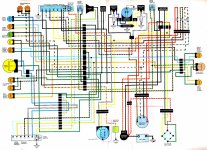
Honda color Schematic Older Model .jpg

Technically, the generator is a current generator. The voltage is determined by the resistance of the system. To keep the voltage from getting too high, the stock regulator shorts the output to ground, proportionately to maintain the max voltage.

So 4 coils deliver 4x the current of a single winding, and when you put the high beams on, you get 6 coils of current. Voltage output = Current output x System Resistance (Good ole Ohm's law). Current is proportional to RPM on this type system. The output on the alternator is single phase AC. Some bikes use a different configuration (My BMW F800GT) and have 3 sets of 2 coils. This type puts out 3 phase AC. Similar process, but wiring is different. Other bikes (My CB750) don;t use permanent magnets. An adjustable output field coil is used to vary magnetic strength to control output. As a general rule, all permanent magnet alternators use various means to shunt the output to ground to regulate, while a field excited alternator (like most cars) use variable voltage to the field coils to vary output. The systems each have their own advantages and disadvantages.
 
@Mydlyfkryzis, Thanks, love that color coded schematic. These schematics tend to melt my brain! So, does the headlamp work off the AC from generator directly? Bypass the AC to DC bridge and regulator? I see lines going up from alternator to 'headlight control switch', but then my brain starts to melt down having to guess what the switch does - along with the other switch labeled 'dimmer', ugh! I was wondering what was up with these alternators with their strange non-asymmetric arrangement.
 
So, does the headlamp work off the AC from generator directly? Bypass the AC to DC bridge and regulator? I see lines going up from alternator to 'headlight control switch', but then my brain starts to melt down having to guess what the switch does - along with the other switch labeled 'dimmer', ugh!
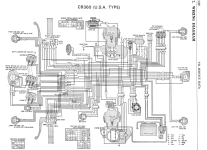
The headlight runs on DC — the wires from the stator are connected to each other with the switch, but not to the headlight. You are correct to observe that the color schematic above does not explain the function of the switches, but this information is in the FSM. The full wiring diagram looks like this and even better in the pdf.

Screenshot_20240518-063644~2.png

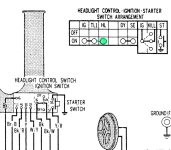
Notice the boxed areas outside the wiring diagram for each switch. The headlight switch in this case (360G) has an omission that is corrected in green in the next image (also correct on p. 107 in my FSM).

Screenshot_20240518-063826~2.png

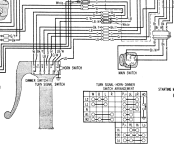
When the headlight is turned on the Y and W/Y wires (DY & SE) are connected, which allows the current output from all six coils to be combined. This is done to compensate for the greater demand when the headlight is running and, presumably, to avoid overworking the regulator when greater power generation is not needed. On this model (1974 CB360G) I don't believe the dimmer switch affects the combination of the stator outputs — it's controlled by the headlight ON/OFF switch.

Screenshot_20240518-070209~2.png

Something I hadn't thought about prior to seeing it on the scope is that the rotor on the 360G has six poles (3x N—S), which is the reason the frequency of the voltage output from the stator is three times that of the crank. I gather that the corresponding windings on each of the six stator coils have alternating orientations (CCW vs. CW) so that all six coils produce current in the same direction within the wire itself. As a South Pole passes by three of the coils, a North Pole will be passing by the other three coils.
 
Last edited:
When the headlight is turned on the Y and W/Y wires (DY & SE) are connected, which allows the current output from all six coils to be combined. This is done to compensate for the greater demand when the headlight is running and, presumably, to avoid overworking the regulator when greater power generation is not needed. On this model (1974 CB360G) I don't believe the dimmer switch affects the combination of the stator outputs — it's controlled by the headlight ON/OFF switch.

That sounds right, and works also the same for the 450's.
 
So 4 coils deliver 4x the current of a single winding, and when you put the high beams on, you get 6 coils of current. Voltage output = Current output x System Resistance (Good ole Ohm's law). Current is proportional to RPM on this type system. The output on the alternator is single phase AC. Some bikes use a different configuration (My BMW F800GT) and have 3 sets of 2 coils. This type puts out 3 phase AC. Similar process, but wiring is different. Other bikes (My CB750) don;t use permanent magnets. An adjustable output field coil is used to vary magnetic strength to control output. As a general rule, all permanent magnet alternators use various means to shunt the output to ground to regulate, while a field excited alternator (like most cars) use variable voltage to the field coils to vary output. The systems each have their own advantages and disadvantages.
Thank you! Great explainer for a fundamentals challenged semi-permanent novice like me.
 
What drives people to make color schematics for these old bikes?
It's obvious, you stare at the original for too long and you will go blind
or insane. You find yourself coloring the lines with pens.

And then you have to come to terms with how very strange some of the things
they did then with filament lights and selenium diodes and SCRs.
Apparently they didn't have normal diodes then or power FET transistors.

Things changed rapidly back the 60s, 70s, 80s in regard to electronics. So each
bike seems different.

So back to subject, the regulators were made with SCR's. That's strange, SCR's
turn turn off only after a phase change. So the way these work is that
when it goes over the target voltage of say 14v or so, the SCR is turned on,
it acts as a switch, a short, back to the stator coils. A shunt regulator - basically
shorting to ground, back to the coils producing the voltage/current. The SCR is not
a perfect switch, and it has a on-resistance, so it will heat up. But the bulk of the
current is fed back to the stator coils and they consume the power(as heat).
Since the SCR only turns off with polarity/phase change, it has to operate on the alternating
side of the circuit - before the diode bridge rectifier.

A typical modern car alternate works differently - instead of magnets they use
rotor coils to generate the magnetic field. The regulation is done by adjusting this.
The down side is that the rotor is spinning, so a slip ring or spinning contact is used
to drive this, and that is mechanical and subject to wear and breakdown.
The upside is it controls the amps generated at the source instead of just burning up
excess as heat.

I notice it is always suggested to upgrade away from original rectifier/regulator on
these old bikes. I would guess these new unit use power transistors
to burn off as heat excess power. The SCR's are crude as they turn on and you cannot
turn them off until a phase change unlike a transistor that you can operate in a linear
mode - say use them after the AC to DC bridge rectification. That has drawbacks also,
as operating in a linear mode, while nice for regulation, it has to burn up the excess
power in the transistor - so needs big heat sinks to do this.

But they didn't have these back in the day, so they did stuff like having the separate
coils turned on for more power when you turned on the 2nd bright headlight.
I've just now realized this, I was always confused why they had this odd stator arrangement
with extra non-symmetrical coils. Once you get to the 80's you see they got over this
and you see they get away from this with 3-phase stators(the 3 phase simply gets you
a more even output).

I certainly was confused by the stator coils running to the headlight switch, thinking
maybe they used AC on the headlamp. No, it's just a switch to add more stator coils
for extra power from extra coils - a crude form of regulation.

The dimmer switch, nearest I can tell this somehow adjusts the backlighting on the
incandescent lamps on the gauges. I don't have that on my 80's CM400. I guess it was
a 60's 70's thing.

There was some discussion on how the regulator works and mentioned SCR's used.
That confused me, as why would you use a AC phase change switch to burn off excess
current? Well they didn't have power FET transistors back then. But I don't know,
maybe they do sell updated ones using SCR's. I'm guessing that is just wrong, that
most modern day updates use FET or IGBT transistors(and heat sinks) to burn off excess power
after the diode bridge rectification, it's just going to be more precise(better regulation).
But I could be wrong, you have to burn up the excess power as heat somewhere, and using the coils
might make sense.

So you see a modern alternator works better by just not generating the power in the first
place - but does have the disadvantage of the rotor slip ring contact wear.

Back to subject at hand, load resistors to measure current
those need to be larger wattage kind, have some bulk to them to dissipate heat. Like 10W
or something, a tiny 1W resistor is going to start smoking with heat.
If you do get small 1W resistors a work around would be to arrange a jumper bypass
and only turn it on when you do the measure. Heat does build up slowly over time.

I'd still suggest measuring voltage with scope over the fuses - they have some resistance,
small, hopefully enough to act as a current measure load resistor. I'll have to try this
on my bike to see how well or bad this works.

That's cool that you picked up a scope. I've been waiting for multimeter with scope to
appear for like $20. Totally doable, you don't need 100's of megahertz for most stuff,
100khz would be great for a lot of things. It's sad that a multimeter only seems to
update at about a 2Hz rate.
 
Back to subject at hand, load resistors to measure current those need to be larger wattage kind, have some bulk to them to dissipate heat. Like 10W or something, a tiny 1W resistor is going to start smoking with heat. If you do get small 1W resistors a work around would be to arrange a jumper bypass and only turn it on when you do the measure. Heat does build up slowly over time.
Good point. I didn't look at the power rating when I ordered the audio resistors. I have now received the pair of 0.12 Ohm resistors and they are rated for 1 W. If I connect them in parallel they will act as a current divider and would be good for about 5.66 A continuously. Hopefully that's good enough for short tests.

I'll do as you suggest with a bypass to avoid burning them out, but I was also able to order another inexpensive 0.1 Ohm, 20 W resistor that should arrive in a few days.

I'd still suggest measuring voltage with scope over the fuses - they have some resistance, small, hopefully enough to act as a current measure load resistor.
I think this is a good idea as long as the resistance of the fuse can be determined accurately. Otherwise, it will be difficult to turn the voltage measurement into a current measurement with any degree of accuracy.

That's cool that you picked up a scope. I've been waiting for multimeter with scope to appear for like $20.
Prices seem to be coming down. I just saw a small scope on Amazon for about $40 that has a 200 kHz bandwidth.

I wasn't even thinking about motorcycles when I bought mine, but that's probably the primary use it will see. I wanted a unit with a signal generator and data output to use in teaching differential equations — of which circuits provide interesting real world examples. It has a USB and I mistakenly thought it would output the sample data, but it appears to only output screenshots.
 
Last edited:
Good point. I didn't look at the power rating when I ordered the audio resistors. I have now received the pair of 0.12 Ohm resistors and they are rated for 1 W

Sorry, I forgot to mention that. If the resistor heats up, the resistance will be higher too, this goes rapidly.
 
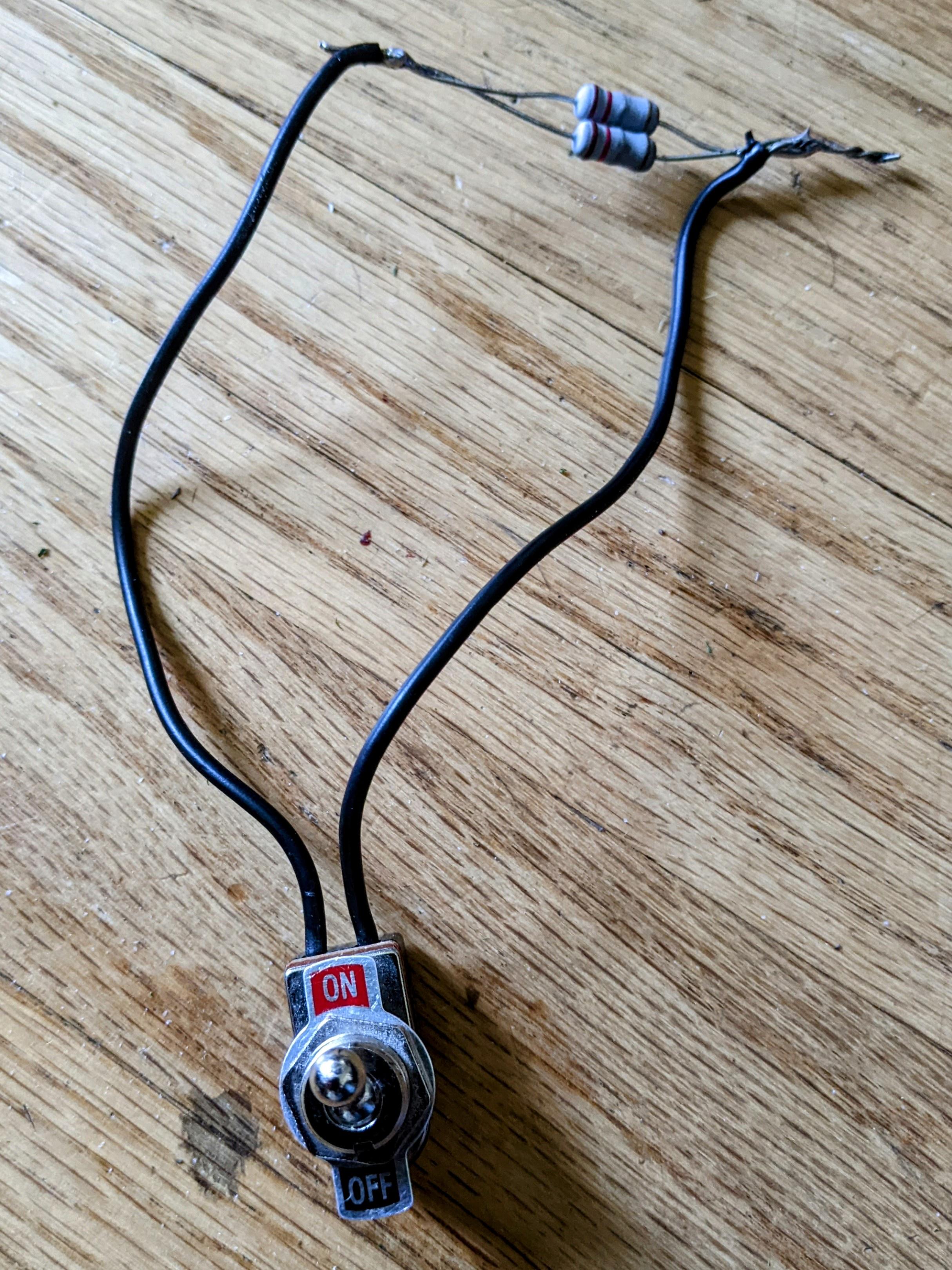
I used the two 0.12 Ohm resistors in parallel along with an ON/OFF switch to bypass them based on the recommendation of @kbongos to conduct the current draw tests that @jensen had suggested earlier. The stator was disconnected for all testing and I was running the bike using the small 5 Ah AGM battery. I think this worked okay for the short time that I was capturing data.

xuhcQf5.jpg


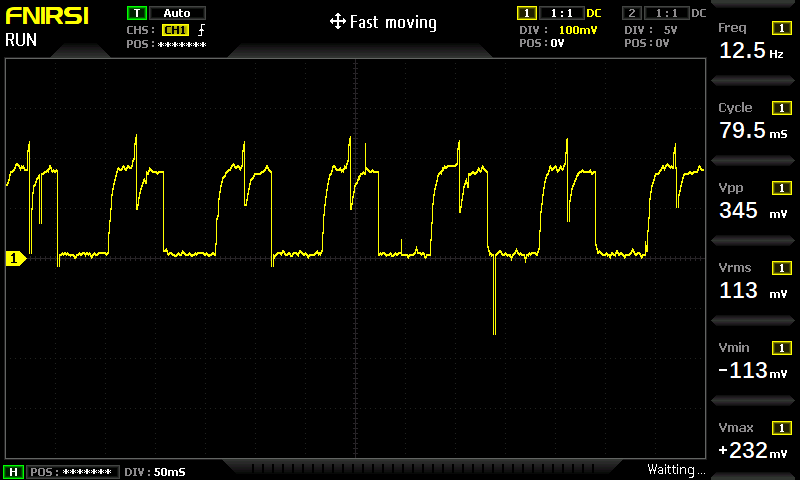
Test 1: Ignition Only at Idle
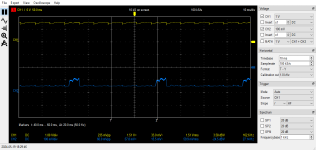
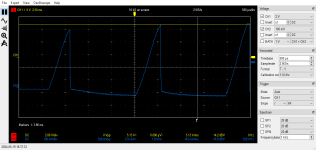
Baseline voltage is small. The upper voltage (ignoring the spikes) is about 200 mV, corresponding to 3.33 Amps based on an assumed 0.06 Ohm resistance.

Gyx6DvQ.png


Correct me if I am wrong, but I would assume that the first rise after a flat section should be the left coil charging. The left plug fires and there is a sudden drop, but then the right coil charges and the right plug fires, leading back to another flat section. Does that seem correct?

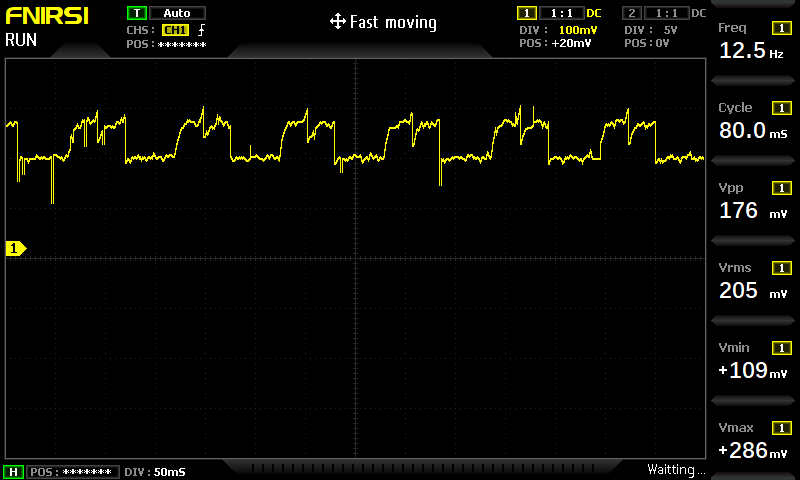
Test 2: Ignition + Low Beam/Tail Light at Idle
The baseline voltage is approximately 180 mV and corresponds to about 3 Amps (headlight). The upper voltage level is roughly 260 mV, which leads to a maximum current draw of about 4.33 Amps. The fact that the upper voltage level doesn't increase by 180 mV suggests to me that the headlight dims as the coils draw current, which could explain the pulsing lights. I received a new Protek AGM 12 Ah battery, so I can redo the tests with that battery for comparison.

OFDBMff.png


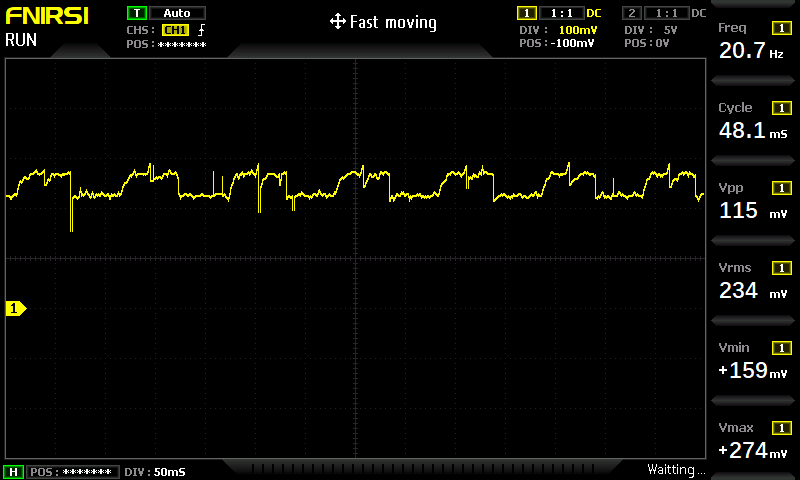
Test 3: Ignition + Low Beam/Tail Light/Stop Light at Idle
The baseline voltage is approximately 220 mV and corresponds to about 3.67 Amps. The upper voltage level still seems to be about 260 mV with a maximum current draw of about 4.33 Amps.

e73VfJH.png


Intepretation of findings are welcome. Thanks to @jensen, @kbongos, and @Mydlyfkryzis for all of the input thus far.
 
Are you sure that the coils are wired to the harness in the right way ? I don't know about the CB360G, but on my CB450 K0, the stator coil pairs are not the same, nor in resistance, nor in wire thickness, nor in amount of windings. I remember writing about it on the other site. Maybe I have to copy it to this site as well. However, this bike is a later bike, don't know if Honda did change a lot between these bikes.

Since you have a dual channel scope, why not use one channel for the current draw as shown, and the other channel for the voltage over the battery / taillight / headlight etc. ?
 
Are you sure that the coils are wired to the harness in the right way ?
I have measured the coil resistances and as I recall the results matched what I've found posted elsewhere on various sites and what I've seen myself on other stators, including the 450k7. I haven't disturbed the factory 4-blade connector (three stator leads plus neutral switch).

Since you have a dual channel scope, why not use one channel for the current draw as shown, and the other channel for the voltage over the battery / taillight / headlight etc. ?
Good suggestion. I can do that. Should be interesting, especially the battery voltage.
 
I have measured the coil resistances and as I recall the results matched what I've found posted elsewhere on various sites and what I've seen myself on other stators, including the 450k7. I haven't disturbed the factory 4-blade connector (three stator leads plus neutral switch).

The 450 K0 has bullet connectors, and lots of room for error due to the faded wire colors.


Years ago I found an explanation of how an ignition coil works, I copied it and kept it, maybe interesting stuff for this thread.

Three properties are of great importance for an ignition coil and the generation of high voltage:

The self-inductance L
The induced voltage U
The stored energy

The self-inductance L

When the contact points are broken, there is a sudden change in voltage and current. The primary coil of the ignition coil responds to this by generating a voltage itself. The (coefficient of) self-inductance L of the primary coil of the ignition coil is the driving force in generating a significantly higher voltage than the 12V that is offered. The self-inductance can be defined (in the first order approximation) as:

L = n2/Rm

Therein is

L the self-inductance in Henry
n the number of turns of the coil
Rm magnetic resistance seen through the coil in AV-1s-1 (A = ampere, V = volt and s = second)

For most ignition coils the value is between 4 and 10 mHenry.

In addition, it is easy to imagine that the way in which the coil is wound in the ignition coil, the presence of a magnetizable core and a dielectric also has an influence on the self-inductance. These influences are not included in the formula.

The induced voltage U

The voltage generated when the contact points become loose is

U = -L dI/dt

In which:

U is the self-induction voltage in volts.
dI/dt is the change in current per unit time in amperes per sec
L is the proportionality factor, the coefficient of self-inductance in Henry.

This formula clearly shows that electronic ignition has advantages over conventional ignition with contact points. The current change is much faster and not contaminated by sparking across the tips. The ignition coil therefore generates a higher and nicer high voltage.

The minus sign in the right part of the equation indicates that the induction voltage U has such a direction that it counteracts the cause of its formation. The self-inductance L can take on values between 0 Henry (the conductor does not encompass its own field) and ~ Henry (the conductor encompasses 100% of its own field). In practice, of course, both extremes do not occur. To obtain the greatest possible self-inductance, it is important to ensure that the conductor covers its own field as well as possible. This is usually achieved by winding the conductor into a coil, possibly around a core of magnetizable material.

The storage of energy

The moment the voltage goes from 0 to 12 Volts by closing the dots, current flows in the primary coil.
The energy per unit time is then:

Energy = ½ x L x I2 Joule, where

L The coefficient of self-inductance
I The current (at moment t) in amperes.

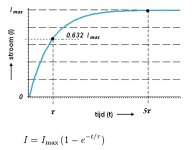
ignition coil current build-up.jpg


This shape is determined by the time constant τ = L/R. At time t = τ the current has increased to 0.632 Imax. At t = 5 τ the final value has practically been reached, after which the current no longer changes.

In practice, the coil needs 10 - 15 milliseconds to fully charge and reach Imax

The total energy stored in the ignition coil is (mathematically) the integral from 0 to t of the above formulas, and in practical terms represents the area under the curve.
This plate is particularly important for the ignition coil in the car. At a low speed, the ignition coil has enough time to reach maximum current and thus store the energy. As the speed increases, the available time will decrease and the current will no longer reach the maximum power and energy. If these values fall below the required values for spark formation, there is a problem.

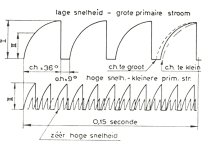
bobine 2.jpg
The currents in the primary circuit at different speeds. ch = contact angle and oh = opening angle

It can clearly be seen that the area under the curve becomes smaller as the speed increases. as a result, the available energy for spark formation also decreases.
A scope is required to show such a current flow.

It will be clear that the maximum voltage that an ignition coil delivers in a currentless situation is only part of the criteria for choosing an ignition coil. The difficult thing is that suppliers are not generous in providing properties other than peak voltage.

How does this whole thing work together?

The contact points are closed and a current flows through the ignition coil. The ignition coil is charged with an amount of energy. This energy is essentially available for spark formation. The contact points come loose and there is a sudden change in voltage and current. This generates an induction voltage of 250 – 500 volts in the primary coil. This voltage would lead to severe arcing at the contact points and loss of energy for arcing. This is where the capacitor comes into the picture. The capacitor absorbs the energy very quickly and prevents spark formation and thus energy loss. The induction voltage in the primary coil also generates an induction voltage in the secondary coil, but now of 20,000 – 30,000 volts. The value depends on the primary induction voltage and the number of turns in the primary and secondary coil. The high voltage causes the spark at the spark plug. Under normal operating conditions this already happens at approximately, 8000 volts. The energy loss of a spark at 8000 volts is only a fraction of the amount of energy available. A series of sparks (10-15) are therefore created until the voltage has dropped below the required spark voltage or too little energy is available. The game proceeds this way for each cylinder.
 
Thanks for sharing this, @jensen. Among other things, this appears to be in line with what the scope shows for my CB360G, although the graphs in the article you shared seem to consider one coil only, rather than two.
 
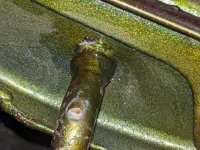
Let me interrupt this circuit theory thread with a separate issue that popped up today. Recall that I had been working on cleaning Red Kote out of the tank when I replaced the top bridge and started investigating the light flicker. I encountered some flash rust after cleaning the tank, so made a second round of cleaning with little brass screws and phosphoric acid. This did a pretty good job and then, yesterday, I rinsed the tank with water, shook out all the little brass screws, and dried the tank as quickly as I could with an electric leaf blower. I then installed the tank and filled it with gas.

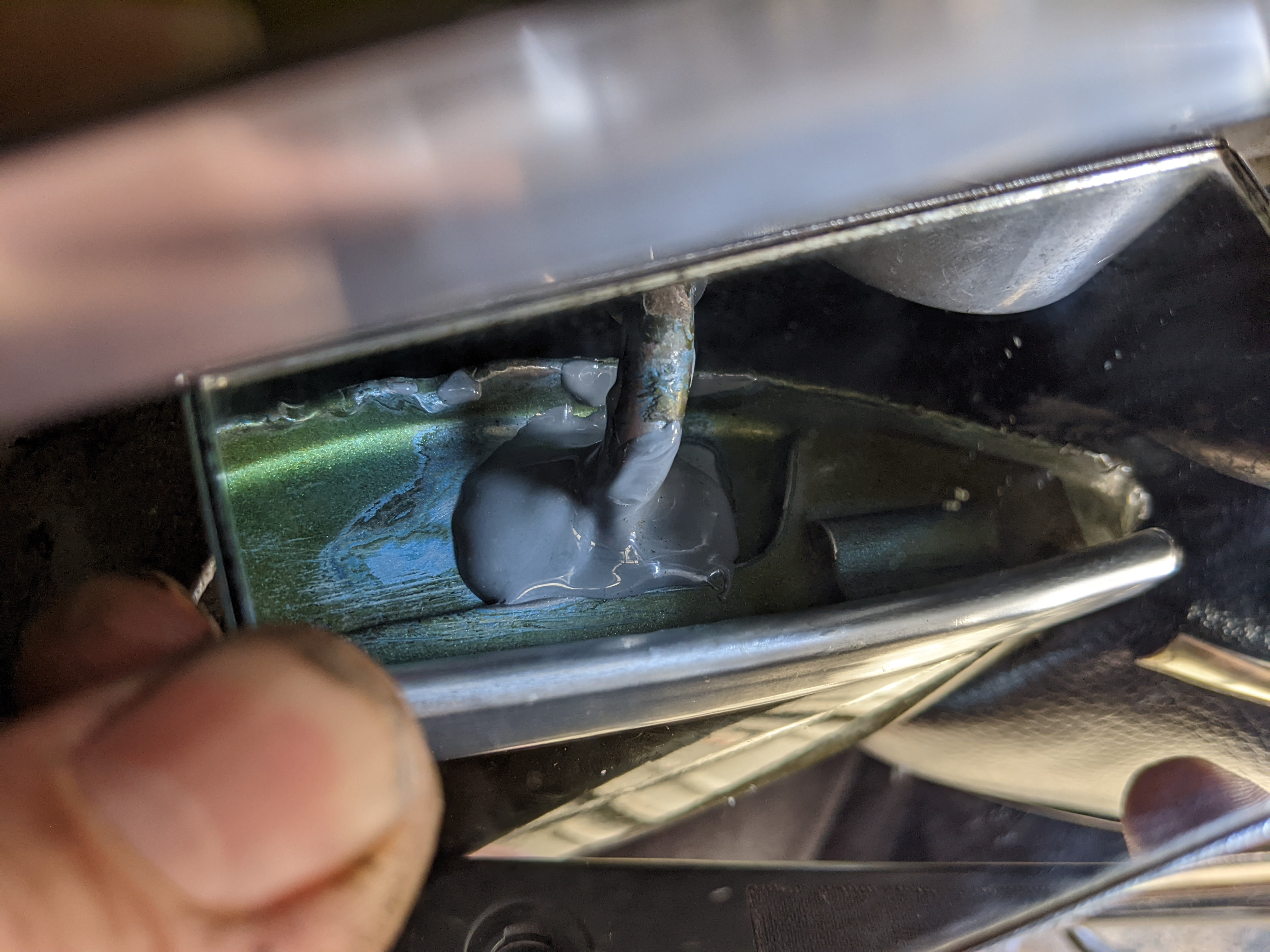
The acetone I used to dissolve the lining spilled a little bit while I was using it and I found it was extremely harmful to the chrome trim (plastic) at the bottom of the tank. The trim was ruined. So, today I went to install new trim on the tank and while working with the tank I noticed my left hand was wet with gasoline. I am now pretty sure the tank is weeping around the cross-over tube under the left side. I drained and removed the tank and my plan is to remove the paint from that area and seal it with JB TankWeld. I'm tempted to remove the cross-over tubes entirely, but I'll think I'll leave them for now.

PXL_20240519_204142304.jpg
 
Let me interrupt this circuit theory thread with a separate issue that popped up today. Recall that I had been working on cleaning Red Kote out of the tank when I replaced the top bridge and started investigating the light flicker. I encountered some flash rust after cleaning the tank, so made a second round of cleaning with little brass screws and phosphoric acid. This did a pretty good job and then, yesterday, I rinsed the tank with water, shook out all the little brass screws, and dried the tank as quickly as I could with an electric leaf blower. I then installed the tank and filled it with gas.

The acetone I used to dissolve the lining spilled a little bit while I was using it and I found it was extremely harmful to the chrome trim (plastic) at the bottom of the tank. The trim was ruined. So, today I went to install new trim on the tank and while working with the tank I noticed my left hand was wet with gasoline. I am now pretty sure the tank is weeping around the cross-over tube under the left side. I drained and removed the tank and my plan is to remove the paint from that area and seal it with JB TankWeld. I'm tempted to remove the cross-over tubes entirely, but I'll think I'll leave them for now.

View attachment 32803
I'll never catch up to you guys on the theory talk but it's interesting and appreciated.

Bummer on the leak. If the JB don't do it maybe solder with a small butane hand torch (another HF cheapy).
 
The gas tank - patch with super glue and baking soda? Seriously, try it some time.

So I did try my hand at measuring over my 3 fuses to use as current measure load resistors.

They seem to work very well for that purpose, if you think about, makes perfect sense,
they have to consume enough to work, but not get in the way. So for example with multimeter
I measured 280mV across the 7A fuse with filament headlamp on, consuming around 4A.

Now the measure across the 3 fuses can be interesting, but limited. But you could also
just arrange a add on fuse with some wire and arrange it where you want to measure current.
It's easier to find fuses compared to low ohm resistors.

If you have more than one channel on the scope, realize they will share a common
negative/ground path, so they are not truly independent. But if your load resistor is anchored
to ground then that can work.

It's unfortunate the output of the regulator does not go straight to the battery. Mine goes thru
the 15A fuse, and maybe up to the front to key switch, possibly thru connectors. It's a
little confusing, my CM400 schematic shows Bk, G, R/W connections coming from regulator. G being ground,
other two being positive. I would expect just a single positive output. And preferably a nice chunky
short wire going to the battery and not up and down the bike harness, thru connectors and maybe the main
switch. That's disturbing. Your car alternator doesn't do that, thru switches or connectors,
it's pretty much a short fat wire trip to the battery. And then the 360 and older 500 wiring is worse
as you have the stator coil wires making trips up to the switches and back again.

Makes me wonder if the blinking is just part of that problem. Like you should get to know where those
coil and regulator wires go and if they go thru any connectors or switches, make sure those are solid. The charging
current going thru the 15A fuse should be scrutinized. The battery is the main buffer to even out those
charging spikes. If that battery is behind a bunch of switches, connectors and fuse, then those things
can go bad from large currents degrading them. Maybe scope right at filament that is blinking could see this. But a little ripple from regulator is too be expected.

I had a car headlamp connector at the lamp that was melting the plastic connector due to oxidized degraded
contacts. Head light would stop working, I'd jiggle it and it works again. After this happened again and
again, I took a closer look to see the melting and determined I needed to clean that contact as a proper fix.

So my CM400 manual indicates it does use SCR's for regulation. It's 3 phase so a little different, but still
a lot in common. I see 6 charging cycles, whereas your 360 we see 3 charging cycles per crank rotation.

Now if it's just some ripple, at faster than 60hz, why do we even see this? Old filament lamps work just
fine at 60Hz and your brain generally doesn't see any 60Hz flicker. Maybe some of that is the type of
filament, I recall annoying flicker in florescent lighting.

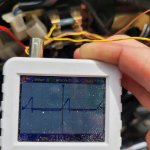
Here are some screen shots. Here is mini scope seeing charging pulses across 15A fuse.
20240519_124936.jpg20240519_124952.jpg
And then the Hantek scope.
I'm using the DC-CDI on this bike recently to verify that works, you can see it consuming power
after fire time at each crank rev to charge up the CDI.
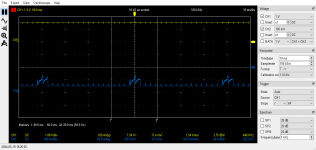
20240519_182625.png20240519_182946.png
The regulator output consists of short sudden bursts of amperage(up to around 4A) delivered to
the battery. The coil is delivering it's amps and then the SCR cuts it off suddenly at a target voltage level.

The last one here is with the current probe around the fat positive wire at the battery, at 10A/v setting.
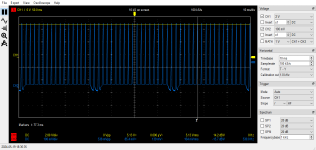
20240519_183635.png20240519_183733.png
 
If you have more than one channel on the scope, realize they will share a common negative/ground path, so they are not truly independent. But if your load resistor is anchored to ground then that can work.
Good point — I had seen that in the manual, but being new to the device I still lose track of some details easily. I read that the motherboard can be burned out if the two channels do not have a common ground.

It's unfortunate the output of the regulator does not go straight to the battery... Makes me wonder if the blinking is just part of that problem.
I installed a Rick's Electrics high-output rotor and reg/rec on my CB450k7 and the rec/reg output is wired directly to the battery. I have no issues with flickering there. However, I imagine the lights would pulse if I disconnected the stator and I should test this theory to confirm.

The current measurements with my CB360G do not seem to identify any points of concern. I suppose it could be that the rotor has lost some magnetism (a possibility raised by @crazypj) and that is the reason for pulsing at idle, even though there is definitely enough power generation for ignition since it will run with the battery completely disconnected.
 
I think Jensen is on the right track. If you assume the generator is good, then the flickering can only be caused by a intermittent load, IE: the ignition.

Easy way to eliminate the generator circuit. Disconnect the generator, run the engine on battery only. If the flickering continues, it is not the generator or regulator or rectifier. If is an intermittent load. That leaves only the ignition circuit.

If it is the coils, the resistance may look right, but if you have an alternate set, try them, or else, disconnect one set of points and see if it flickers, then reconnect and disconnect the other side. It may pinpoint which coil may be bad, or which ignition circuit.
 
Thanks, Richard, I appreciate your input. Let me provide more information related to the points you raise.

I think Jensen is on the right track. If you assume the generator is good, then the flickering can only be caused by a intermittent load, IE: the ignition.
This makes sense and fits in with the current measurements (post #217) in the following sense. The first screenshot captures the intermittent load of ignition. The second captures baseline draw for the headlight plus the intermittent load of the coils. The peak draw should be the sum of the peak ignition current plus the baseline headlight current, but in reality it is lower. This means one or both of ignition and headlight are not getting the same power that they do independently and offers a reasonable explanation for the dimming. Note that these current measurements were made with the stator disconnected — running on battery only.

It's also interesting to note that @crazypj mentioned that he thought 4 A covers ignition plus neutral, so the 3.33 A that I observed is reasonable.

Easy way to eliminate the generator circuit. Disconnect the generator, run the engine on battery only. If the flickering continues, it is not the generator or regulator or rectifier. If is an intermittent load. That leaves only the ignition circuit.
I tried disconnecting the rec/reg (post #174) and then additionally the stator (post#175) and the flickering persisted. So, I agree, ignition must be the source of the fluctuations in power to the lights in combination with power generated by the stator and rotor.

If it is the coils, the resistance may look right, but if you have an alternate set, try them, or else, disconnect one set of points and see if it flickers, then reconnect and disconnect the other side. It may pinpoint which coil may be bad, or which ignition circuit.
Not everything I have tried made it into the thread. I swapped out the coils with brand new coils and it made no difference. After that test I put the old coils back. I have also disconnected each coil separately with the motor running above idle to see if one side or the other was to blame. No difference.

I have a spare CB350 stator and I think they're compatible, so I could probably try this. I'm also considering replacing the rotor with a high output rotor from Rick's Electrics. I have one in my CB450k7 and it works well with the OEM stator.

I'm also planning to install a 12Ah AGM battery to get rid of the little 5Ah battery I've been using.
 
Looking at your post #217, I think we see the coils dwell current(time points are connected). Since it is a 180 crank the dwell time butt up against each other and make up 1/2 the crank full 360 degrees. So at 1200RPM, we get 20hz ripple out of this, definitely in the more visible timescale. So that is a current measure. Have you seen that reflected in the voltage measure? Actually I think we did in some of the measures.
 
Thanks, Richard, I appreciate your input. Let me provide more information related to the points you raise.


This makes sense and fits in with the current measurements (post #217) in the following sense. The first screenshot captures the intermittent load of ignition. The second captures baseline draw for the headlight plus the intermittent load of the coils. The peak draw should be the sum of the peak ignition current plus the baseline headlight current, but in reality it is lower. This means one or both of ignition and headlight are not getting the same power that they do independently and offers a reasonable explanation for the dimming. Note that these current measurements were made with the stator disconnected — running on battery only.

It's also interesting to note that @crazypj mentioned that he thought 4 A covers ignition plus neutral, so the 3.33 A that I observed is reasonable.


I tried disconnecting the rec/reg (post #174) and then additionally the stator (post#175) and the flickering persisted. So, I agree, ignition must be the source of the fluctuations in power to the lights in combination with power generated by the stator and rotor.


Not everything I have tried made it into the thread. I swapped out the coils with brand new coils and it made no difference. After that test I put the old coils back. I have also disconnected each coil separately with the motor running above idle to see if one side or the other was to blame. No difference.

I have a spare CB350 stator and I think they're compatible, so I could probably try this. I'm also considering replacing the rotor with a high output rotor from Rick's Electrics. I have one in my CB450k7 and it works well with the OEM stator.

I'm also planning to install a 12Ah AGM battery to get rid of the little 5Ah battery I've been using.
Brody,could it be your condensers going bad ?
 
Brody,could it be your condensers going bad ?
They test okay. I have another set of condensers (both sets are from 4-into-1) and all four capacitors test in the range of 235–240 nF (0.235–0.240 μF) with my multimeter.

To add to that question, how about the plug / caps combination (in terms of resistance) ?
I just went to check this, but only checked the caps – my mistake. The left cap measured 5.13 kΩ and the right 4.79 kΩ. I'm using ND W24ES–U plugs (resistorless), same as in my CB450k7. I'll check the plugs next time I'm out in the garage.

Addendum: In the garage again and the right plug measured 2.5Ω with the left plug at 5.4Ω. Not sure about the large relative difference between the two, but both are negligible with respect to the caps.
 
Last edited:
I now have a new Protek 12Ah AGM battery installed, which involved a few other small steps. I had previously modified the battery positive cable for the 5Ah blade connector AGM battery, so that had to be replaced with a used piece from eBay. I relocated the battery ground, which I had incorrectly placed under the sprocket cover when assembling the bike back in 2014. This led to another round of find-the-nut and I improved on the time I logged while finding the same nut on the 450. I also moved the rec/reg from the side of the battery box to the former location of the OEM regulator. I removed the LED tail+stop light and installed an incandescent bulb.

RbTh3TR.jpg


vtMl7uA.jpg


BqkWyHB.jpg


I finished the repair of the tank yesterday using JB Tank Weld and chose to apply it around both cross-over tubes as a precaution. I have enjoyed the 350 tank, but will keep an eye out for a decent 360 tank for the long run. The repair is shown in the mirror reflection below, after the tank was filled with gas. I will monitor this over the next few days to see if the leak has been addressed.

IbAkTrv.jpg
 
I believe the light flicker issue can be put to rest. Three changes seem to mitigate the problem substantially:
  • the 5Ah battery has been replaced with a 12Ah battery;
  • the LED tail+stop light was replaced with an incandescent bulb;
  • the headlight switch toggling between partial and full stator output has been bypassed, so all six coils are used at all times.
I still see some faint pulsing in the neutral indicator and headlight, but it is minimal and not distracting in any way. I should try with the LED taillight for comparison.

Thanks to everyone's input, the conclusion seems to be that the intermittent load due to ignition causes fluctuations in current draw and voltage throughout the circuit. The magnitude of these fluctuations will be affected by the capacity of the battery as well as the power output of the charging system. Weak charging and a small battery capacity are a poor combination.

My CB450k7 has a high output rotor, which may explain why it is able to power the LED stoplight without any issue. I think I would like to install one on the CB360G after observing the current setup a bit longer.
 
Are you swapping the stator as well ? Could you make a picture of your rotor ?
I'm on the fence (meaning undecided) about the stator. With the 450, I kept the OEM stator and it works well with the high output rotor, so I was thinking to do the same here. I am open to suggestions.

I hope a borrowed picture is adequate for the time being.

Screenshot_20240521-130422.png
 
So I did try my hand at measuring over my 3 fuses to use as current measure load resistors.

They seem to work very well for that purpose, if you think about, makes perfect sense,
they have to consume enough to work, but not get in the way. So for example with multimeter
I measured 280mV across the 7A fuse with filament headlamp on, consuming around 4A.
Thanks, Karl. The fact that the fuses worked well for current draw tests was not lost on me — thanks for working that out first hand. All of the tests performed in this thread are likely to be useful again in the future — and they were fun for me.

My multimeter allows AC or DC current measurement up to 10A. I don't know what it captures when both types are present. Do you know? What settings did you use for the 280mV and 4A readings?

Is your Hantek a virtual scope that pairs with a computer? Does it allow export/saving of the actual data samples? I was looking at some of their models, but it seemed they all use Windows and I use Mac.
 
Thank you, I am enjoying your thread. I've got an assortment of inexpensive multimeters. Some of them have special functions like AC-current, or transistor tests or capacitance testing, etc. Once in a while those special modes come in handy, like the capacitance tester. But mostly I am just using them for basics like resistance or DC-voltage. Current is nice but you can burn out the fuses in these multimeters fairly easily if not careful like me ;)

I'm not sure what you would see measuring current or voltage with both AC and DC. Hopefully it would just show the AC component when on AC, or the DC component when on DC measurement, or something to that effect. But I would prefer to just go to a scope for something like that. Then you can see it and believe it a little more, but even scope measures can be deceiving.

So the headlamp and 280mV I just measured with multimeter as that was easiest, and then 4A is just a rough guess as I know I put a halogen bulb in there that draws something around 4A. I could have used the multimeter on 10A measure and got a reading. I will maybe come back to that in the future. It's really not easy to get these measures with the bike running and getting hot and fumbling with laptops, connections and all.
So the scope is a Hantek-6022BL, 2-ch. Picked it up specifically to learn about ignition on these bikes.

It allows to capture and display 4K samples, export as a CSV file, or screen shots. Now I wish it could just stream the data continuously to the PC recorded, but it doesn't. I believe the picoscope has better capability in this regard. Still 4K samples is OK, it's just annoying to have to fumble with the laptop to get it to save.

Hooks to laptop via USB. Comes with some Windows software, but I use some alternative open source OpenHantek software that seems a little better. I use it on Windows but am fond of Linux as well. Looks like they have a MacOS port of it. This scope does have it's limitations, but I'm happy enough with it for the price.
The PicoScope is a popular one for automotive diagnostics, more capable than the Hantek.
Also got a clamp style current probe Hantek CC-65. That has a switch that selects either 0-10A or 0-100A scale. Very pleased with that, works great, sure beats messing with load resistors. Scope readings of the ignition coil current are great fun.

I've got a thread over here with my ramblings learning about ignition:
 
I've been lurking and enjoying that thread despite still being the type of caveman that relies on mechanical points for the creation of spark.
I was going to get a CL350 recently, just so I could experience the points once again, but that fell thru. I have fond memories of tinkering with them when I was young, had a Honda 125 1-cylinder when I was about 16 then got a CB500 4 banger around 17 years old. I recall cleaning them with a nail file and I'd tinker with the spacing and listen to them until I felt it was running better. Really didn't know what I was doing, but that's how you learn. Went to college, to be a EE. Made me learn Diff-E-Q's, ugh. I enjoyed the Integrations more, especially the 2 and 3 dimension ones, much more visual. Your coil is integrating your dwell ramping up the current. And your differential is just reversing that ;)
 
I grew up with points on all my vehicles. The pluses of points: Mechanically simple, can adjust if needed, understandable operation. The Cons: The need adjustment frequently, When you install them, they are new and work great, but are immediately deteriorating as you drive/ride.

I converted my CB360t to electronic ignition. The old days, I had to constantly (1-2 times a month) adjust them to keep the tune in the engine. Since I put in the electronic ignition, the timing has been right on since 2014. I have not touched the ignition at all. I go to the bike, turn on the fuel, turn on the ignition, and a little choke, and no matter how long it has been sitting, it starts right up and runs well. If you let the points sit for 6 months, it is likely the contacts have corroded and the spark may be weak if not absent. I was always cleaning and adjusting them. A good electronic ignition, while not field repairable, will need far less attention than points ever will.

The other tool that made my 360 run well was the coaxial screwdriver for adjusting the carb sync.
Sync Tool 200-1714_01.jpg

With well synced carbs and the electronic ignition, the bike remains in tune like it never did before. The bike is/was reliable, it never stranded me, but the upgrades have made it much easier to get on and ride without having to adjust or compensate.

So I was a points fan until electronic ignition actually became more reliable.
 
After finishing work on the electrical testing, tank cleaning, and, ultimately, a JB TankWeld repair around the crossover tubes, I wanted to actually ride the bike a few days ago and found it to be uncooperative.

I started it up, backed out of the garage, and then put it into first, when it lurched and stalled. I had taken the sprocket cover off when I relocated the battery ground wire and replaced everything without readjusting the clutch. My first thought (maybe yours, too) was that the steel ball bearing fell out while I had the cover off. No such luck. After confirming that the steel ball was in place, I readjusted the clutch and tried shifting into first on the center stand. It engaged immediately, without me releasing the lever. I then applied the rear brake and stalled the motor.

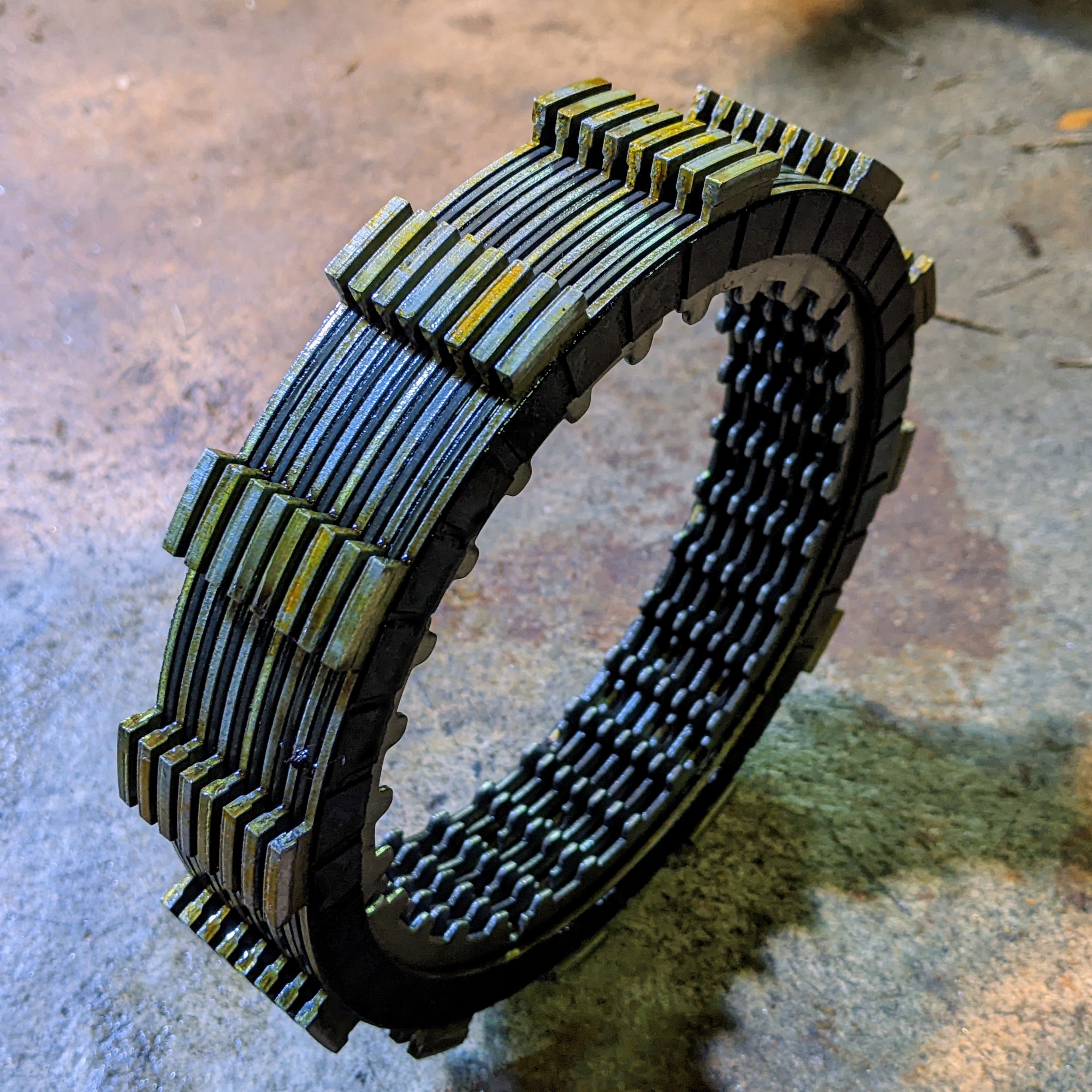
This morning I drained the oil to examine the clutch. The one funny thing I found on disassembly was that all of the plates and discs came out as one mass and held together very well. I was able to pry them apart without much difficulty, but I suppose this was the reason for the sticking clutch. I'm using Rotella T4 15W40.

WGnxiMH.jpg


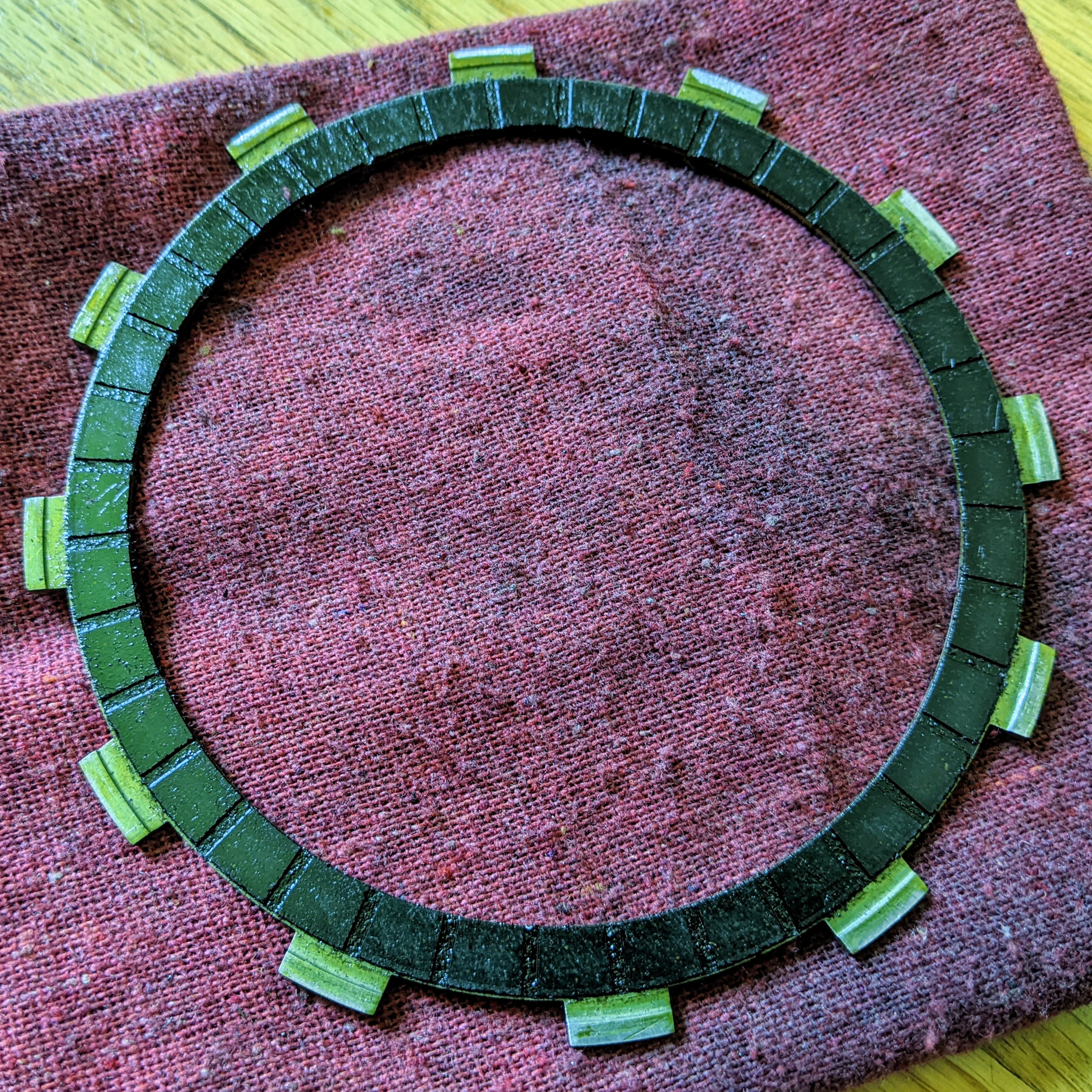
The steel plates look flat and clean. I measured one of the friction discs in a few different places and was getting 2.7mm, right in the middle of the 2.62–2.78mm range in the FSM. The service limit is shown at 2.3mm.

Uh6xUu9.jpg


According to my records, I installed new clutch springs, new friction discs, and a set of used plates in 2017.
 
Last edited:
I grew up with points on all my vehicles. The pluses of points: Mechanically simple, can adjust if needed, understandable operation. The Cons: The need adjustment frequently, When you install them, they are new and work great, but are immediately deteriorating as you drive/ride.

I converted my CB360t to electronic ignition. The old days, I had to constantly (1-2 times a month) adjust them to keep the tune in the engine. Since I put in the electronic ignition, the timing has been right on since 2014. I have not touched the ignition at all. I go to the bike, turn on the fuel, turn on the ignition, and a little choke, and no matter how long it has been sitting, it starts right up and runs well. If you let the points sit for 6 months, it is likely the contacts have corroded and the spark may be weak if not absent. I was always cleaning and adjusting them. A good electronic ignition, while not field repairable, will need far less attention than points ever will.

The other tool that made my 360 run well was the coaxial screwdriver for adjusting the carb sync.
View attachment 33059

With well synced carbs and the electronic ignition, the bike remains in tune like it never did before. The bike is/was reliable, it never stranded me, but the upgrades have made it much easier to get on and ride without having to adjust or compensate.

So I was a points fan until electronic ignition actually became more reliable.
So what brand or type of electronic ignition did you install? Does it do the advance? If so, do you remove or replace mechanical advance? Or is it more of a electronic points only replacement?
 
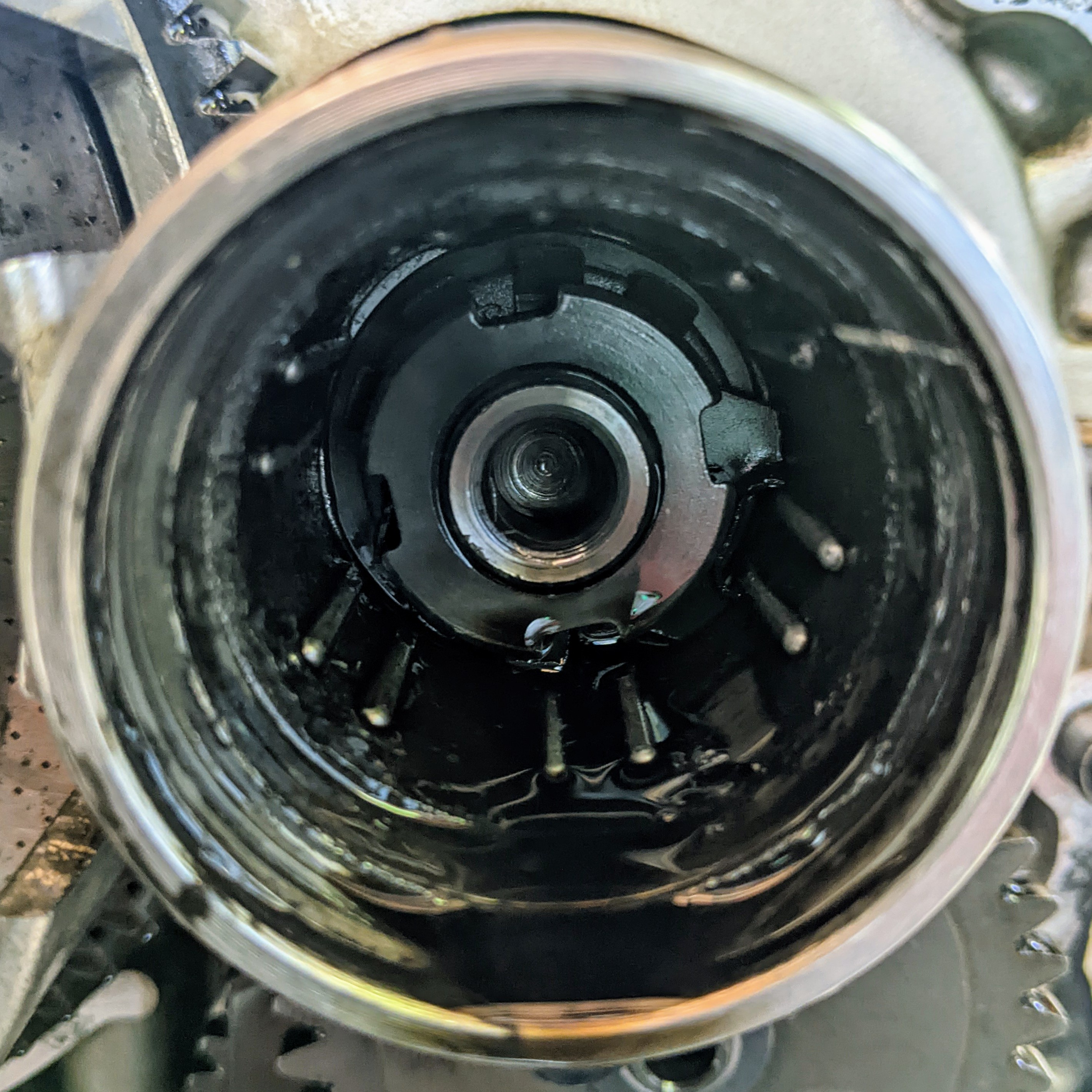
I checked the oil spinner while the side cover is off. I've probably got less than 1000 miles on this oil and it looks pretty clean in there to me.

m33KDIM.jpg


I have a new theory about why most of us find those spinners loaded with gunk when we take ownership of old bikes: the previous owner didn't find much in there the first few times they changed the oil, so they gave up on checking it thereafter.
 
Back
Top Bottom