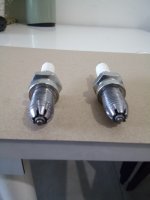
Spark plugs are jumping around!!

Leonardo Sá

Member
Joined
Apr 29, 2025
Total Posts
35
Total likes
23
Location
Brasil
Hello friends, good morning!!! Greetings from Brazil to all of you! Today I want to share with you a tip for modifying spark plugs! The project isn't mine, it's from a friend on YouTube! I upgraded the spark plugs on my 1989 CB 450 and the results surprised me! It's about "jumping" spark plugs!!! Where the ground electrode of the spark plug is removed and small cuts are made in the spark plug thread, so that multiple ground points appear for the high-voltage spark, which comes from the central electrode! This results in a more homogeneous combustion of the air/fuel mixture! and consequently a gain in power and the engine runs more smoothly at idle!!! You can find the manufacturing process on YouTube, on the channel dk INSPETOR GAMBIARRA, search for "jumping spark plugs, how they are made"!! I'll post here a photo of the spark plugs I made that are currently on my motorcycle! Friends, I'm an aircraft mechanic, and the spark plugs for jet engines use spark plugs similar to those used for jumping spark plugs! I'm a dedicated student of motorcycle mechanics and electrical systems, constantly researching new projects to improve older motorcycles, making adaptations and tests, because unfortunately, most of the parts for these motorcycles are no longer available... but GOD gave us the talents and abilities to create and modify things... and we keep improving our projects... the important thing is to keep our motorcycles running so we can ride them and have fun with them!!! If anyone has any questions or would like to exchange ideas about motorcycles, feel free to send me a message via WhatsApp +55 19 978291309, or by email: [email protected].
1000930063-jpg.58879
1000930062.jpg
 
Plugs sit at a downward angle in most of our engines and the strap (hook-shaped ground path) is positioned close to the center of the combustion chamber. The goal is to achieve the most complete combustion. The same applies to the carefully chosen gap between the electrode and the strap.

Notice how the modification changes things. It's true that there are now several different paths to ground with similar potentials, but the gap has been increased will beyond the factory specification and the geometry of the spark path has been changed substantially. Instead of a spark happening in the center of the combustion chamber, it will now be pulled away from the center and will find a ground path that heads towards the outer radius of the plug in a more or less random direction(s). Because the gap is larger, the coil must work harder to jump the gap, producing more heat.

There are also potential issues with the materials involved as the strap is generally a more heat resistant material than what is used for the threads, e.g., iridium versus plated steel.

A similar idea in a commercially available plug would be the Nippon Denso U-groove plugs. Their design keeps the strap, so the spark will still occur near the center of the combustion chamber.

Apparently there are other plug designs that use multiple ground paths, but they accomplish this with multiple straps to keep the optimal location for the spark. I believe one benefit of this is that the wear is rotated across all of the straps since the spark can find a different path each time.

I have no doubt that the modified plugs will still work, but I'm skeptical about any gains in performance. At idle, the dwell time is greatest and the coils can likely charge well enough to make spark. This could become a problem at high rpm as the dwell time shrinks.

I take it you have already logged some miles on the modified plugs?
 
Plugs sit at a downward angle in most of our engines and the strap (hook-shaped ground path) is positioned close to the center of the combustion chamber. The goal is to achieve the most complete combustion. The same applies to the carefully chosen gap between the electrode and the strap.

Notice how the modification changes things. It's true that there are now several different paths to ground with similar potentials, but the gap has been increased will beyond the factory specification and the geometry of the spark path has been changed substantially. Instead of a spark happening in the center of the combustion chamber, it will now be pulled away from the center and will find a ground path that heads towards the outer radius of the plug in a more or less random direction(s). Because the gap is larger, the coil must work harder to jump the gap, producing more heat.

There are also potential issues with the materials involved as the strap is generally a more heat resistant material than what is used for the threads, e.g., iridium versus plated steel.

A similar idea in a commercially available plug would be the Nippon Denso U-groove plugs. Their design keeps the strap, so the spark will still occur near the center of the combustion chamber.

Apparently there are other plug designs that use multiple ground paths, but they accomplish this with multiple straps to keep the optimal location for the spark. I believe one benefit of this is that the wear is rotated across all of the straps since the spark can find a different path each time.

I have no doubt that the modified plugs will still work, but I'm skeptical about any gains in performance. At idle, the dwell time is greatest and the coils can likely charge well enough to make spark. This could become a problem at high rpm as the dwell time shrinks.

I take it you have already logged some miles on the modified plugs?
Thank you for interacting with us, great friend! Yes, I've been using the spark plugs for two months now, and I can guarantee that the motorcycle's performance has improved significantly! I know what you described in your comment is true; there are studies on this, but the practice is quite different. I can prove this because I have the spark plugs on my motorcycle and even took a trip with it last week. I traveled about 500km to visit a relative, and the motorcycle surprised me with its performance on the road! Try it out, watch the video where the guy explains in detail how to make a bouncing spark plug, and see the results!
 
I always enjoy your posts and interacting with you as well. I watched the video and I am still skeptical. The author uses dramatic music and makes some claims, but doesn't provide any evidence other than the jumping spark in the dark video. I also notice that the comments section for that video seems to be turned off, but it is enabled for other videos. Doesn't that seem a little suspicious?

What specifically do you feel has improved in the performance? For example, if it's idling smoother that should be noticeable in a video comparing the two sets of plugs, right?
 
Back
Top Bottom