My ‘71 CL350

I can’t stress how sure I was the installing the axel, but at the early morning hours after seeing this, about to leave on a cross state trip with Mrs. Copyright, tired and stressed, was completely second guessing myself as we drove away in the dark and heavy rain. Got my Cardio in. Thank you lol🤣
I just couldn't see the protruding flats on the nutted end in your 2nd pic in post #95.
FYI, fork legs, bottom end caps and direction (they have arrows) and tightening sequence all matter. See wheel install notes in owner's manual.
Don't skip a hug for Mrs. Copyright.
 
Rested after the long fast day trip, 5 hours each way, 3 hours hiking.

Going to do some evaluation.

The pic in question is prior to disassembly.

I sadly do not have a copy of owners. Something I must have failed print off at work. I’ll be re-requesting it when I get back to work from my mini vacation. I was working out of the Shop Manual which did not mention tightening sequence, but did not just torque one bolt fully moving to the next. Hand tightened all, then criss crossed bringing it to torque. What is the proper sequence?

hugs yes, and stopped at a nice spot for her to get some sushi. I got opted for a ribeye. hehe It was all for her. I am NOT a sushi guy. lol
 
Axel nut flats on left side.
I can't find where in owner's it was written, but I know it's right, about caps and nuts.
 
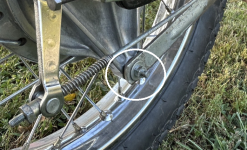
You shouldn't have a flat washer under the bolt head for the front brake torque arm, the fingers on the lock tab are to be bent up to the flats of the bolt head to hold it from coming loose. They won't work properly with the washer there.
 
You shouldn't have a flat washer under the bolt head for the front brake torque arm, the fingers on the lock tab are to be bent up to the flats of the bolt head to hold it from coming loose. They won't work properly with the washer there.
Thank you so much on that catch!

I will point to the bolt and nuts on the F brake arms. It is actually a flange nut on them. I will be heading into town tomorrow to get proper nuts and washers. I bought a good bit at the start of this journey but they all found proper abandoned homes. Going to buy plenty and replace with spares of many sizes.
 
Idle Hands. Nope. Something to always be done.

After taking a day from pinching the tube when mounting the rear tire I needed to keep at my project, my CL350. As I have had in my mind, many many times in the past few months, the light at the end of the tunnel grows, getting closer, brighter.

I took to cleaning the rear brake panel this evening. Mother Metal compound, 000 steel wool, snd elbow grease.

Before


After


Not a huge difference in photo, but looks nice, to me.

Being that the nearest “Power Sports”, Honda dealer recently closed, I went to a local Harley shop for a new inner tube for the rear wheel. They did not have what I needed, but ordered me one for a little cheeper than what I would get online, and quicker. Though we have a scout camp this weekend, will be able to possibly re-tackle the rear tire. In the mean time, work on the chain. I have a 120 link chain to brake into what I need. Tomorrow maybe.

Lastly, my ignition timing light showed up this evening. I’ll wait till the tire is back on for this fine tuning.
 
I use talcum powder all over the tube and in the tire case. Makes everything slippery and less pinch chance. Youtubers like their soapy water to leave in there promoting more rust. No thanks.
A good vulcanized tube patch is a permanent repair. Fill naked tube to firmish and hang up for 24hours to test. New tube valve cores are often leakers. Dust patch with talc.
Old clear coat on aluminum is a pain. Stripper or sanding, either one stinks.
 
I considered just patching it, but with all I have done on this build, and counting, want to have a good fresh starting point on all the consumables. Now, I will still be patching the tube as a backup if needed in a ‘pinch’, just not this pinch.🤣 and yes, baby powder all day.

I questioned if I should be clear coating what I have cleaned, to keek from looking like this again…
 
I don't clear coat anything I polish, but my bike sits in a pretty well insulated garage and never gets ridden in the rain. It does slowly dull over time even in those conditions, but it shines back up easily with a light rubbing. The shinier it is, the more closed the pores of the aluminum are so less likely to tarnish as easily. But of course, you don't want it too shiny either or it looks beyond how they were new. Unless you just like really, really shiny stuff :LOL:

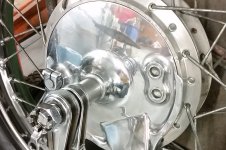
The hub behind the backing plate is original polish and for whatever reason, not yellowed.

r-brake plate ploished.jpg
 
I don't clear coat anything I polish, but my bike sits in a pretty well insulated garage and never gets ridden in the rain. It does slowly dull over time even in those conditions, but it shines back up easily with a light rubbing. The shinier it is, the more closed the pores of the aluminum are so less likely to tarnish as easily. But of course, you don't want it too shiny either or it looks beyond how they were new. Unless you just like really, really shiny stuff :LOL:

The hub behind the backing plate is original polish and for whatever reason, not yellowed.

View attachment 49130
That looks really nice. Wow. I like a good shine, but that is beyond me.😁

I don’t PLAN on doing any rain riding at all, and only have a big 100 year old barn to keep in out of the weather climates, to an extent. Do intend to keep up on keeping mine rust free and somewhat polishes. Esp rims fenders and bars.

Would love to see a pic of your back as a whole. That hub is impressive.
 
I did clear coat the hub ribs in the middle before I laced the wheels. The ribs were never polished and I used a nylon abrasive bristle brush to remove all the gray, masked off all but between the spoke flanges.
Z9nKB7L.jpg
 
That looks really nice. Wow. I like a good shine, but that is beyond me.😁

I don’t PLAN on doing any rain riding at all, and only have a big 100 year old barn to keep in out of the weather climates, to an extent. Do intend to keep up on keeping mine rust free and somewhat polishes. Esp rims fenders and bars.

Would love to see a pic of your back as a whole. That hub is impressive.
Thanks! The wheels on my bike were 'okay' when I bought it in late 2016 so I let the hubs go, I'm not very good at lacing rims so I avoided doing the full hub and spoke cleanup. I did have the rest of the bike apart though, made changes to the frame here and there and refurbished/refinished most everything else along the way. Here's the synopsized project thread if you want to see it from start to finish, and the maintenance thread for some of the work and changes done along the way in recent years. All the polishing done on my bike was accomplished with a rag wheel from the hardware store on my bench grinder and some polishing rouge sticks my father left me. Good surface prep like filing gouges and rough spots (if necessary), old clear coat removal (if necessary), and light sanding with progressively finer paper helps you get the best results.
 
Thanks! The wheels on my bike were 'okay' when I bought it in late 2016 so I let the hubs go, I'm not very good at lacing rims so I avoided doing the full hub and spoke cleanup. I did have the rest of the bike apart though, made changes to the frame here and there and refurbished/refinished most everything else along the way. Here's the synopsized project thread if you want to see it from start to finish, and the maintenance thread for some of the work and changes done along the way in recent years. All the polishing done on my bike was accomplished with a rag wheel from the hardware store on my bench grinder and some polishing rouge sticks my father left me. Good surface prep like filing gouges and rough spots (if necessary), old clear coat removal (if necessary), and light sanding with progressively finer paper helps you get the best results.
Oh wow. Good insight. And glancing over the included threads, will make for good reading after the scouts pack in for the night tonight. Thank you
 
I did clear coat the hub ribs in the middle before I laced the wheels. The ribs were never polished and I used a nylon abrasive bristle brush to remove all the gray, masked off all but between the spoke flanges.
Z9nKB7L.jpg
Looks really nice. Makes sence. I have NO experience with spoke lacing and will be looking around on ideas for getting into the middle of the hub with the spokes still on.
 
Looks really nice. Makes sence. I have NO experience with spoke lacing and will be looking around on ideas for getting into the middle of the hub with the spokes still on.
My main point was that is the only place I'd clear over aluminum. A long curved handle bristle brush works but is slow going, on the ribs. Once the gray oxidation gets under the clear coat it's a bear.
AD is right, a good shine is easier to maintain.
 
This is not an update on my build.

Last minute work trip, I am in West Lafayette Indiana next to Purdue University. Just as we got into town this evening had a 73’ CB450 stop next to me at a stop light. Yes, had to research later tank paint to come to that year, but was in great condition. I am not sure if anyone passes a vintage Honda and wondered if they are on here, if you may have seen one of their posts, or even for some of you, have helped them on this forum. Well, for my first time, I have questioned if maybe this person has either been gifted the knowledge from folks here, or maybe help someone through an issue or problem, or given guidance.

Update… Received a call that my rear tube was in. I look forward to installing once I get back and caught up on home duties.
 
So I have been at a stand still. Once back from a work trip and caught up on all the mowing and garden stuff, had a Saturday to for a day enjoyment. First, up early to fire up the smoker for a pork butt, and while maintaining heat and adding hickory and cherry as needed, get back to my CL350.

I pinched another rear tire tube, right next to the valve stem. ☹️ Opted to have a shop install it. They had to order the tube.

I did take the bulk chain and break it, removing what links I did not need. It was my first time using a chain breaker and well…
First I laid out the old chain on the table and lined up the new one. The outer plates on the chain did not align for perfect link removal. Questioned myself, then the chain. The counted links on the old chain, several times. Then practiced using the chain breaker on last 2 links of the new chain. Counted the links on the new chain several times to # on the old. Marked it and went for it. Easy peasy. Then held up both chains to see the new one was shorter, almost a whole link. Cursed to the gremlins. Recounted the new chain. Slapped my forehead when the answer came. The older, much older chain, with wear IS longer due to the stress.

Recent lessons learned.
Trust(or second/third guess) your actions when being thorough on counts/measurements. Old(er) parts will stretch, wear down, or degrade in one form or another.
Also, if arching your break pads on a CL350, do the rear 18inch first. You’ll thank me. The space in which to work in, in the drum is much more cumbersome than the front 19inch.

And the answer to the biggest question all who has read this post…. BEST DAMN PULLED PORK I have smoked so far.

Should get my tire back later this week, installed this weekend, maybe. Then getting to use my ignition timing light.
 
The easiest way for me to cut to the correct length is to back off the chain adjusters completely, put the chain on the front sprocket and then feed it over the rear sprocket so that the chain covers the top half of the sprocket. The rest of the chain is pulled tight and fed over the bottom half of the sprocket. Where the two ends of the chain meet is where you cut. You can mark the link to be cut with a twist tie.
 
The easiest way for me to cut to the correct length is to back off the chain adjusters completely, put the chain on the front sprocket and then feed it over the rear sprocket so that the chain covers the top half of the sprocket. The rest of the chain is pulled tight and fed over the bottom half of the sprocket. Where the two ends of the chain meet is where you cut. You can mark the link to be cut with a twist tie.
I don’t know about that method. Where is the second guessing one’s self. The panic. The fear you may have screwed up. Or actually screwing up. 😂

Duly Noted for the future.

This is going in the manual in the “notes” page under this chapter. Thank you. I really need to add many notes of things I have learned here at VHT to my manual.
 
I don’t know about that method. Where is the second guessing one’s self. The panic. The fear you may have screwed up. Or actually screwing up. 😂

Duly Noted for the future.

This is going in the manual in the “notes” page under this chapter. Thank you. I really need to add many notes of things I have learned here at VHT to my manual.
I'm late to this, but you can't ever trust an old chain for length measurement. Each link pin wears as well as the inside of each link, and all the wear adds up to added length. When buying a bulk length chain and cutting it to fit, always push the wheel as far forward as the chain adjusters will allow when unscrewed all the way (except for the tapered tip that engages the end of the swingarm). Sorry to hear of it after the fact.
 
I'm late to this, but you can't ever trust an old chain for length measurement. Each link pin wears as well as the inside of each link, and all the wear adds up to added length. When buying a bulk length chain and cutting it to fit, always push the wheel as far forward as the chain adjusters will allow when unscrewed all the way (except for the tapered tip that engages the end of the swingarm). Sorry to hear of it after the fact.
No worries. It was after the initial ‘oh crap’ thoughts, the wear across the links, logic, kicked in.
It’s one of those, I did it just fine, but now know there are better/quicker methods now.
 
Screwing up is part of the learning process - ask me how I know :ROFLMAO:
I am a firm believer in learning from mistakes. If you try something new to you, and happen to get it right the first go you just get lucky, but little to nothing learned. When you screw up, learn, then rectify the issue, you get to stand back and feel great. Maybe celebrate later with a nice glass of ‘fill in the blank’. And if you don't rectify it same day, sulk with a nice glass (or two) of ‘fill in the blank’ while getting great feed back, tips, tricks, and enragement from peers here.
 
I am a firm believer in learning from mistakes. If you try something new to you, and happen to get it right the first go you just get lucky, but little to nothing learned. When you screw up, learn, then rectify the issue, you get to stand back and feel great. Maybe celebrate later with a nice glass of ‘fill in the blank’. And if you don't rectify it same day, sulk with a nice glass (or two) of ‘fill in the blank’ while getting great feed back, tips, tricks, and enragement from peers here.
I failed to stress all while doing one’s own research. The FSM has been priceless, but only goes so far outside of folks who have done the work. That said, I doubt there is not a soul who can replace the front left wheel bearing on a ‘92 Ranger faster than me. Or need tips on fixing the computer in an ‘06 Infiniti transmission. I am here for you. Don’t get me started on coffee roasting machines. 😁
 
Got my rear tire back from the shop. *Tail between my legs*. Installed the brakes and everything and got it back on with only a slight momentarily snag of the threads of the axel catching on the left side washer.

The chain. Because I has already removed it completely, there was no linking it to the old and seating it. But, this turned out to be a good thing. More on that, but first…
I love my bike. I love the scrambler high pipes, but what a pain in the butt it is to do many things on the left side, HAVING to remove the exhaust.
So, in order to seat the chain on the drive sprocket, pipes had to come off to get behind the clutch cover. I am glad I did. The plate which holds the sprocket in place was missing a bolt. Luckily I had a spare bolt of that size.
Chain install went smooth.

While having the pipes off, this time, took the opportunity to remove and get into my starter motor, to look at the bushings and armature. Bushings were good and cleaned up the armature. Still a no go sadly. Not going to lie, first time in a starter motor and to have made no progress with it was discerning.

All back together, except for the chain guard my son stepped on while the spray paint was still drying. To be fair, it was in the open, its black, and it was after dark.

Here are a few picks for the veterans to notice what I may have missed. The bolt on the left step arm has been replaced, not in this photo. Please excuse all the dust, grease, and grime. She is a dirty girl at the moment and needs another good cleaning.


Well, here she is after a 10mile test ride on back gravel roads. I will say, the difference of feeling with the new tires is much more than I would have imagined, in a pleasant way. Idle after warm up roughly 1300rpm. Starts on first kick most times. Second the others. Great throttle response. Rear brake great, front still needs a little adjustment.

 
You didn't show any pics of the starter effort, so I hope you didn't just pull the starter motor and put it back without going into the left crankcase cover where the alternator is to get the small sprocket back on the shaft of the starter motor. Boomer modifies his front sprocket cover to allow removal with the pipes still on the bike, you might consider doing it too. Also, the rear brake torque arm should have the rubber washer on the outside of the arm, then the flat washer, then the nut and finally, a cotter pin to keep it from coming off in case it comes loose.

1759770162227.png

honda-cl350-scrambler-1971-k3-usa-rear-brake-panel_bighu0028f4014_5cb1.gif
 
You didn't show any pics of the starter effort, so I hope you didn't just pull the starter motor and put it back without going into the left crankcase cover where the alternator is to get the small sprocket back on the shaft of the starter motor. Boomer modifies his front sprocket cover to allow removal with the pipes still on the bike, you might consider doing it too. Also, the rear brake torque arm should have the rubber washer on the outside of the arm, then the flat washer, then the nut and finally, a cotter pin to keep it from coming off in case it comes loose.

View attachment 50722

honda-cl350-scrambler-1971-k3-usa-rear-brake-panel_bighu0028f4014_5cb1.gif
Thanks for the catch on the ribber washer. That was my fail of putting things back as they came off. I have caught many things put back wrong thus far. Trigger happy on the pic, the cotter pin is in. I have plenty to replace once fixing this. Also plenty of spare washers. It is dumbfounding how many missing washers, bolts, and screws there were on the CL.

I didn't get any pics of the starter motor. I kept telling my self to go in and wash my hands so I could take pics. I have gone through 2 boxes of gloves in this project, and need to pick up another. But yes, removed the left crank case cover prior to removing the starter motor, and did replace the sprocket and chain when reinstalling the motor.

I will be looking into how Boomer modified his cover to remove with the pipes on.
 
Beyond just cleaning commutator surface and checking brush contact, you can use an ohmmeter to check continuity of field windings and commutator. If any broken wires visible, then solder them.
 
So, where have I and the CL350 been? Well, it is kind of a long and frustrating process. One I am sure some folks here have been through. The Dredded "QUIET TITLE. Not due the lack of title from getting the bike, but due to a clerical error on the original title. When I bought this from the PO, he was literally boxed up with a Uhaul leaving the state. Where this completely falls on me is I waited a year to title it. I did not want to insure a motor vehicle that was nowhere near running when purchased, and waited till it was drivable. So, unless I am able to locate the PO to retitle it to fix the clerical errors, then sign it back over to me, this is my route.

Now, this is not all terrible. It is just time and extra costs. Paperwork has been filed with the courts, certified letters sent, Highway Patrol has proven it is not on a stolen registry, it is just the wait now. It is pretty cold, so the wait at the moment is not killing me... that much.

All of this aside, I have put 90-ish miles on the gravel backroads to areas I have never seen, passing cows and bison, ponds, over and around some rolling hills, past many miles of stacked stone fences, old bridges over large creeks, past several abandon one room school houses and 2 cemeteries, one which is all but nearly forgotten about by humanity.
My biggest complaint at the moment is having street tires on gravel and dirt.

I may have a few outings till it is time to winterize and put it away for winter. Expecting to be fully titled by next season.
 
You must have antifreeze in your blood, my daughter and her family live in Olathe so I keep up with the weather there and it's getting quite chilly. I liked the description of your ride and there must be a bit of a poet in your soul. Perhaps another set of tires and wheels would be a good investment for exploring off the beaten path. :)
 
You must have antifreeze in your blood, my daughter and her family live in Olathe so I keep up with the weather there and it's getting quite chilly. I liked the description of your ride and there must be a bit of a poet in your soul. Perhaps another set of tires and wheels would be a good investment for exploring off the beaten path. :)
As I do enjoy the cooler temps, not going over 40mph, mostly 25-30, helps a good bit. That, warm cloths and a large thermos of coffee.
Poet, no. The description given does not do it justice.
Another set of rims and tires is on the 2026 wish list. 😉
 
So yes, I do have a new project up and coming, ‘72 Yamaha DT2 250, two actually, to piece together into one. It will be a project undertaking for me and my son, but the ‘71 cl350 is still closest to my heart.

It is running very well and still have not put it down for the winter. Had a nice day after Christmas ride for several hours in 70 degree weather.

Over the time here, seeing pics and videos, look at my CL and am looking to install original turn signals as well as brake light. After that hunt down side covers. I kind of blame you all, well, most of you, swaying me without even knowing or trying, to take it back to its original glory. Also, from just have one vintage bike, yo being forever on the lookout for another. I guess this is my new hobby now. Not a bad one to have in my opinion. For thst, I thank you all for your inspiration, stories, guidance, and help.

To he continued…
 
Over the time here, seeing pics and videos, look at my CL and am looking to install original turn signals as well as brake light. After that hunt down side covers. I kind of blame you all, well, most of you, swaying me without even knowing or trying, to take it back to its original glory. Also, from just have one vintage bike, yo being forever on the lookout for another. I guess this is my new hobby now. Not a bad one to have in my opinion. For thst, I thank you all for your inspiration, stories, guidance, and help.
Happy to help cement your status as a vintage Honda addict, the addiction is always more fun when shared. (y)
 
As mentioned earlier, I had come to the conclusion of replacing my turn signals with originals. I had purchased via ebay both fron and rear sets with minor scratches and rust, minus the rear siginal stay bracket which I had soaked in evaporust after removing thr signal and rubber holder for a week to not only break down the rust, but remove the paint by taking a wire brush to daily while soaking. Once bare metal and dried applied several light coats of flat black rust oleum enamel spray paint, a close match to the powder coating of the frame, as I had also done with the chain guard and battery box. You can see I had tapped up the ends with painters tape. Sorry, but did not take before or during pics of this process, but here is the final results.


Also cleaned up most of the rust and pitting from the signals them selves.


I look forward to swapping out the signals to get these on. I have no doubt it will look different to me, subjectively nicer. I will be using the LEDs from my current signals in them.

I also ebay-ed an original tail light. I will wait on this for now.
 
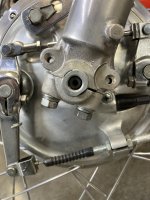
Going over things on my cl350, realized I am one tooth position off on having the front brake arm and brake cam alignment dots aligned.

As I have been riding like this with no noticeable diminished brake actuation, should I pull the front wheel and realign?
 
Going over things on my cl350, realized I am one tooth position off on having the front brake arm and brake cam alignment dots aligned.

As I have been riding like this with no noticeable diminished brake actuation, should I pull the front wheel and realign?
I'm curious which direction it's off one spline from the dot. If it's so the arm is further forward where the cable attaches, it would probably be fine. If it's one spline behind the dot it would help reduce lever travel as the shoes wear more.
 
Well VHT….

It was a sad day in Mudville. I mean Osage County Kansas.

Loading my bike up into the back of my ‘93 Ranger flatbed, slipped on the ramp running my bike up, dropping it onto the side wood panel. Tank got a large dent. Luckily that is the extent of the damage, but still hurts.

Barely fit in the bed 🤣

Being a lined tank I know popping it out may shatter the lining in little fragments, if that has not already happened. Too large for a strip and bondo job.
My thought is to get another tank with minimal scratches, surface rust, and small enough dents to fill. Strip, fill if needed, paint, and re-decal from cbdecals. Would repaint the fork ears and likely get side coves to paint at the same time.
This will not happen right away, but is the goal.
 
That is terrible. I wonder if there are professional services that could help pull that dent. If the dent could be popped cleanly, relining the inside would be worth it.
 
That is terrible. I wonder if there are professional services that could help pull that dent. If the dent could be popped cleanly, relining the inside would be worth it.
potentially, maybe. Getting a tank, restoring would be more cost effecting and give me the push to do the fork ears as well.
 
Back
Top Bottom