Master cylinder leak from the top 1981 CM400A

Windmill John

Veteran Member
Joined
Jun 4, 2022
Total Posts
753
Total likes
328
Location
East Sussex, England
Just wondering if there’s something obvious I’ve missed.
When the bars are turned, I noticed a puddle on the floor; bike not on the road yet.
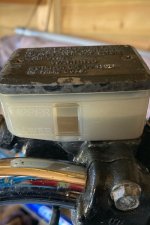
I could see fluid leaking round the lid and running down. I removed the lid and could see some corrosion in the cap; first picture after I’d started cleaning it.
That might be a red herring and just wondering why it leaked. If overfilled, it looks like the two breather slits in the lid are to stop a vacuum from forming in the area below the rubber gaitor.
I was close to the full mark, but not above it….. possibly. But overfilling shouldn’t cause a leak, because you’d always end up with a leak depending on how the bike was parked.
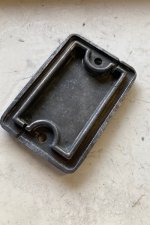
What am I missing, or is/was it just corrosion, which is now all cleaned off; second picture.
IMG_2026-05-16-161129.jpeg
IMG_2026-05-16-161136.jpeg
 
Last edited by a moderator:
Just wondering if there’s something obvious I’ve missed.
When the bars are turned, I noticed a puddle on the floor; bike not on the road yet.
I could see fluid leaking round the lid and running down. I removed the lid and could see some corrosion in the cap; first picture after I’d started cleaning it.
That might be a red herring and just wondering why it leaked. If overfilled, it looks like the two breather slits in the lid are to stop a vacuum from forming in the area below the rubber gaitor.
I was close to the full mark, but not above it….. possibly. But overfilling shouldn’t cause a leak, because you’d always end up with a leak depending on how the bike was parked.
What am I missing, or is/was it just corrosion, which is now all cleaned off; second picture.
View attachment 57689
View attachment 57690
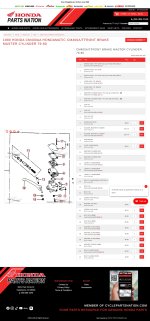
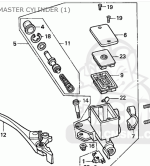
There should be a metal shim plate between the cap and the diaphragm... #10 in the screen-shot... 1778949385760.jpeg
 
on a couple of masters ive had on CB s, no shin but rubber cap, between base and lid. I supposed to stop splashing. Also is the master the original or another Honda model or even a after market. Im having trouble with a replacement Chinese master unit, that doesn't seem to to have enough guts, but would add my bike somewhere along the line, has had a twin cb400 front fork upgrade down. Now was the original 250 master, man enough to deal with the twin calipers. awaiting a master unit witch seems to match the original and made for 350 upwards.
 
My Hornet master cylinder looks very similar to yours. Mine has a convoluted rubber thing (9)that sits on top of the fluid in the master cylinder, metal plate (23) sits on top of that. Rubber thing forms the seal between the cap and the reservoir. Often wondered how this all functioned, just seemed to be a messy way of going about things. No obvious breather vents.


1779042101155.png
 
If you open the cap of any master cylinder you will see a diaphragm similar to # 9 in the diagram above. It acts as seal preventing out side air and humidity from contaminating the brake fluid (DOT 3 will suck up moisture) and it acts as bellows so that as fluid is displace by brake shoe/pad wear it will get pulled down into the reservoir so there is no negative pressure pulling the fluid back up..
 
Just wondering if there’s something obvious I’ve missed.
When the bars are turned, I noticed a puddle on the floor; bike not on the road yet.
I could see fluid leaking round the lid and running down. I removed the lid and could see some corrosion in the cap; first picture after I’d started cleaning it.
That might be a red herring and just wondering why it leaked. If overfilled, it looks like the two breather slits in the lid are to stop a vacuum from forming in the area below the rubber gaitor.
I was close to the full mark, but not above it….. possibly. But overfilling shouldn’t cause a leak, because you’d always end up with a leak depending on how the bike was parked.
What am I missing, or is/was it just corrosion, which is now all cleaned off; second picture.
View attachment 57689
View attachment 57690
The seal/diaphragm is either hard and or cracked, and you may have air in the system which could grow with temperature, pushing fluid up and out of master cylinder, if the cap/gasket diaphragm is not a tight seal. That is all I could think of. Hope you figure it out.
 
Went in the shed and again the outside of the master cylinder is wet. I’ve wiped it now, but as you can see from the picture, the level is not high.
I genuinely cannot tell if it is cracked, or due to 40 degree temperature in the shed, it is being pushed up. But at that level!?
The seal and cap look good, I’m getting tempted to buy a new lid and seal…. and maybe even a new cylinder!!!! Rather not. Any more thoughts appreciated.
IMG_2026-05-28-122635.jpeg
 
The convoluted rubber bellows is to totally seal reservoir, it should not be getting atmospheric air below it.
The shape is to allow bellows to move as fluid level drops.
If the screws are over tightened, the plastic bit distorts and can't seal. (it was a problem even in the 80's)
Even though bellows looks good, you may need a new one which will not be compressed?
The actual cover very rarely needs replacing.
Cracks in plastic are easy to see, usually a 'whiter' line.
Only ever seen top cover damaged by bike sliding down the road, but, that's pretty unusual and obvious..
I saw on BBC America your in a heatwave, pretty early in the year for 100f+ (I'm old and don't to metric temperature)
 
on a couple of masters ive had on CB s, no shin but rubber cap, between base and lid. I supposed to stop splashing. Also is the master the original or another Honda model or even a after market. Im having trouble with a replacement Chinese master unit, that doesn't seem to to have enough guts, but would add my bike somewhere along the line, has had a twin cb400 front fork upgrade down. Now was the original 250 master, man enough to deal with the twin calipers. awaiting a master unit witch seems to match the original and made for 350 upwards.
You need master cyl for dual disc, the piston is a different size to move more fluid.
When I did my 550 around 1979/80 I fitted CB650 master cyl (I burned out set of stock pads with single disc, scared myself enough to fit second one plus 'race' Ferodo pads)
Was only getting 4,000 miles on front brake pads, 100,000 on rear shoes, they don't wear much when tyre is barely touching road :LOL:
 
Looking at the picture again, I think that may be a replacement reservoir piece?
They tend to go hazy just with age, if bike has been left outside the UV makes plastic go 'powdery'
The original had more ribbing and different 'window' section if I'm remembering right?
I was working in Bridgend, (South Wales) either Leslie Griffiths Motors or Two Wheel Services from late 77/early78 and swapped between the shops for years until I moved to a Suzuki dealers in Swansea.
The Honda and Suzuki shops were on opposite corners of cross roads, I had customers who moved with me mainly because they didn't trust anyone else to so OCD with their bikes..
I've been here nearly 30 years and still have some issues speaking 'murricun. :LOL:
 
They let you in!? 😉
Obviously on the bike I do my own work. But the car… find a good mechanic and stick with him 👍
I’ve just received the o ring from beneath the cylinder. I’ve ordered a new diaphragm and will fit both when it’s here.
 
You are going to be flushing and filling with new fluid at some point...Maybe put some type of dye in there to see where it is coming from if it is not obvious...It may be coming from the o-ring for the reservoir, but if it is wet at the bottom/lever pivot area, it may be coming from the piston seals in the cylinder itself...
 
There is an O ring on the bottom of that plastic reservoir that gets very crusty with age and old dried up fluid so it can leak too. Are you sure it is coming from the topside cover?

It is part #6 back up in post number #2 of this blog.
 
I’ve already received the base O ring and about to receive the replacement diaphragm; I’ll be changing both.
if, as I have been doing, I jam a bit of tissue round the base of the reservoir, there is a tiny bit of moisture appearing.
but the side of the reservoir was wet too. Yes it has been 40 degrees in the shed the last week or so..
I‘m going to go with the let’s change both and hope for a cure ploy.
 
I only remember changing a few of the base O-rings on the 250's (most stolen bike in Britain at one time, insurance paid for scrapes to be fixed)
I think it was easier to get 'nylon' reservoir off if it was lifted and twisted at the same time.
I had a bit of broken power hacksaw blade (about inch and three eighths wide) sharpened to get under the nylon to pry it up a bit (still have it 45 years later, only about 3" long now after being used to scrape gaskets for years) yes, I have other gasket scrapers Snap On are expensive and not really that great, old 1/2"wood chisel is better.
 
Yes I’ve heard getting off can be hard, but putting on, harder. Oh I’m so looking forward to it 🙄
I would hope that lowering and twisting at the same time will be the fix.
I will apply a little Corrosion Block to the O ring before fitting.
 
All done. Getting it off involved some force and application of levers as mentioned above.
Putting it back on was quite easy. After cleaning up the cylinder and the mounting, which had powdery corrosion, I applied a little Corrosion Block to the face of the body of the master cylinder and very lightly coated the new O ring with Corrosion block for longevity and to aid fitting. With a slight twist, the cylinder popped back into place. New fluid and a bleed, all good. Still a bit of spongy feeling to the lever, but it has the original long hose, so I’m thinking wear. Of course I’ve no idea how the brake was meant to feel when new as I’ve not ridden the bike yet, so will test then.
 
Back
Top Bottom