
Leaky Petcock - CB450

stl360+450

Veteran Member
Joined
Aug 6, 2021
Total Posts
5,116
Total likes
2,653
Location
St. Louis, Missouri, USA
I bought a new petcock for my 1974 CB450 back in May of 2021. The old one was leaking and was not OEM, so I trashed it when I installed the new one. I didn't have any issues for the first 5 or so months, but it started leaking over the past week, while in the OFF position. The leak is through the two fuel spouts that feed the carburetors, not through the bowl or any other seals on the petcock itself. After noticing some gas on the garage floor this morning, I disconnected the carbs and put longer hoses on the petcock, suspended over an oil pan. When I came home from work (8 hours later) there was about 1.5" of gas in the oil pan, so I drained the remaining contents of the tank into a gas can.

I believe it is a Honda petcock, purchased on eBay for about $55. I am planning to buy a rebuild kit, but I am wondering why it would fail after such a short period of time. For what it's worth, I have been using non-ethanol gas since August.
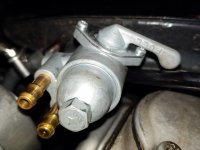
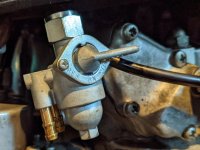
PXL_20211105_223515132.jpg PXL_20211105_223417916.NIGHT.jpg
 
My guess is the seals got hard from sitting if it's really an OEM part. However... you need to drain your oil to be sure it isn't fuel contaminated, if you had gas on the floor it could also have been seeping into the venturis and past an open intake valve.
 
However... you need to drain your oil to be sure it isn't fuel contaminated, if you had gas on the floor it could also have been seeping into the venturis and past an open intake valve.

Thanks, Tom. I understand the concern, but why wouldn't the overflow tube prevent gas from getting to the intake? The leak from the petcock was not rapid, but a drip every so often. This oil has been in the bike only since last Friday when I installed the new oil pump, so it'd be a shame to waste it. Is there any check I could do on the oil short of a full drain?
 
The low drip rate could mean the overflow tubes took care of it, but they also have small passages. Since the oil is relatively fresh, I would still drain it and see if it passes the sniff test; if no scent of gasoline, I would put it back in. Not sure if you can get a good scent off the dipstick, but you may be able to draw some out through the fill port; getting a suction hose into the oil through there can be difficult, though.
 
The low drip rate could mean the overflow tubes took care of it, but they also have small passages. Since the oil is relatively fresh, I would still drain it and see if it passes the sniff test; if no scent of gasoline, I would put it back in. Not sure if you can get a good scent off the dipstick, but you may be able to draw some out through the fill port; getting a suction hose into the oil through there can be difficult, though.

Thanks for the suggestion. I will thoroughly clean out my oil pan before draining the oil and check it out, hopefully tomorrow morning.

I was thinking of trying to check for the gas smell with the alternator cover removed, but given that you and Tom think it's probably worth draining the oil, I will play it safe. Oil is cheap in the grand scheme.
 
You can also inspect the oil for viscosity and color to see if gas got in it.

If it's olive oil tinted and not honey gold yellow then that's a sign. Also if you put a drop on a paper towel and it soaks in and bleeds like water then that is a sign. Just compare against oil from the jug.

But, from the description of your leak it would seem likely youve got gas in your oil.
 
You can also inspect the oil for viscosity and color to see if gas got in it.

If it's olive oil tinted and not honey gold yellow then that's a sign. Also if you put a drop on a paper towel and it soaks in and bleeds like water then that is a sign. Just compare against oil from the jug.

But, from the description of your leak it would seem likely youve got gas in your oil.

Thanks. It'll be good to have multiple points of comparison.
 
Really not much to it, if the back side of the lever is flat and smooth and the rubber seal is good, it pretty much has to work. You can sometimes flip the disc over to get a new sealing surface while you wait for new parts.
 
^^^Cheap insurance - cams and followers and/or cam bearings are a lot more money and grief. I know personally... (but not from fuel contamination, wasn't that simple :rolleyes: )
 
The Keihin star on the drain bowl bolt head (also likely on the platform above the 2 spigots) indicates OEM. $55 is a good price. Where did you get it?


Sent from my iPhone using Tapatalk
 
The Keihin star on the drain bowl bolt head (also likely on the platform above the 2 spigots) indicates OEM. $55 is a good price. Where did you get it?

After checking my eBay history, the seller was everett_powersports, who I have purchased a lot of stuff from. I took apart the petcock today and the rubber seal is still quite flexible behind the lever. I'm waiting for the rebuild kit before I put it back on the bike.
 
You also may want to see why your float valves didn't stop the carbs from overflowing; could be an issue when the petcock is on, even when riding.

I've been wondering that myself. I reset the float heights at 20mm over the summer. I had replaced the float seats in the past and am now using aftermarket float needles. Would K&L be a trusted manufacturer for replacement needles and seats?
 
By in large they should be fine but as with anything aftermarket and sometimes OEM they need to be checked that they actually work right. With every float needle I check that the tip has a straight edge on it and I polish the 4 ribs. For seats I polish the bore and the seat.
 
You can also test the float valves by taking the bowl off, lifting the float until the valve needle stops moving, then opening the petcock. You shouldn't have to compress the spring of the little pin in the needle (but it's hard not to). Replace the bowl, then repeat the test on the other side. This is how I set the float levels, so I know the level is correct and the needle is shutting off the flow.
 
You can also test the float valves by taking the bowl off, lifting the float until the valve needle stops moving, then opening the petcock. You shouldn't have to compress the spring of the little pin in the needle (but it's hard not to). Replace the bowl, then repeat the test on the other side. This is how I set the float levels, so I know the level is correct and the needle is shutting off the flow.

Thanks! I have checked the float valves in the past in the way that you describe. I'm not sure that I follow what you do to check the level in this manner, though. Are you checking how much fuel is in the bowl when you remove it or are you measuring/evaluating the float height when you have seated the needle by lifting the float to stop fuel flow?
 
No, I made a float gauge, per the diagram in the service manual, out of thin stainless, and use that to hold the float up. If the needle just gets damp, I raise the float until there is no flow; if there's no sign of fuel on it, I carefully lower the gauge to see how far the float has to move to start fuel flow. If either amount of float motion is less than 1/2mm, I close it up.
 
No, I made a float gauge, per the diagram in the service manual, out of thin stainless, and use that to hold the float up. If the needle just gets damp, I raise the float until there is no flow; if there's no sign of fuel on it, I carefully lower the gauge to see how far the float has to move to start fuel flow. If either amount of float motion is less than 1/2mm, I close it up.

Ah, I see now. One of the things I like about these carbs is the fact that they can be serviced while mounted and this adds to that for me. Thanks again.
 
The rebuild kit resolved the leaky petcock. The offending seal was the circular washer with the four holes in it, despite still being soft, pliable, and less than a year in service.

I had also ordered new K&L needle/seat sets and planned to replace the sets on each carb, but made two discoveries when I took the carbs off the bike. First, I should probably get bifocals the next time I buy new glasses and, second, I had put one of the needles in upside down! I know I had removed the float pin and needle with the carbs mounted on the bike at one point and my best guess is that the needle flipped around in my hand as I installed it on the bottom side of the carb body afterwards. That more than explains why the leaky petcock led to contamination of the oil with gasoline.
 
The rebuild kit resolved the leaky petcock. The offending seal was the circular washer with the four holes in it, despite still being soft, pliable, and less than a year in service.

I had also ordered new K&L needle/seat sets and planned to replace the sets on each carb, but made two discoveries when I took the carbs off the bike. First, I should probably get bifocals the next time I buy new glasses and, second, I had put one of the needles in upside down! I know I had removed the float pin and needle with the carbs mounted on the bike at one point and my best guess is that the needle flipped around in my hand as I installed it on the bottom side of the carb body afterwards. That more than explains why the leaky petcock led to contamination of the oil with gasoline.

Good of you to admit it, many would have just blamed the petcock. (y)
 
Back
Top Bottom