


@Danager4792 saw this on FB and I have to say, this is a creative idea. Sadly it isn't exactly correct for the design of our 180° twins' ignition systems.
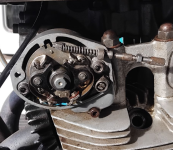
On-the-fly timing adjustment with spring tension adjustment retention. Of course, that implies you could adjust both cylinders' timing together, except we all know a few things about our ignition systems that prevent this from being easily used (if at all), even if you notch the points cover to allow it permanently. As one smart commenter mentioned, the points gaps can change when moving the plate (unless you have one of those rare engines where the points plate fit is snug) and of course, the required gap manipulation to get both sides correctly timed with both sets of points on the same plate. Kudos for the creativity though. Too bad the OP was also oblivious to the right points wire terminal positioning which hasn't yet bitten him, or the unrelated but incorrect positioning of the left exhaust valve adjuster shaft and the use of an outside valve adjuster lock nut on the inside of the points area.
On-the-fly timing adjustment with spring tension adjustment retention. Of course, that implies you could adjust both cylinders' timing together, except we all know a few things about our ignition systems that prevent this from being easily used (if at all), even if you notch the points cover to allow it permanently. As one smart commenter mentioned, the points gaps can change when moving the plate (unless you have one of those rare engines where the points plate fit is snug) and of course, the required gap manipulation to get both sides correctly timed with both sets of points on the same plate. Kudos for the creativity though. Too bad the OP was also oblivious to the right points wire terminal positioning which hasn't yet bitten him, or the unrelated but incorrect positioning of the left exhaust valve adjuster shaft and the use of an outside valve adjuster lock nut on the inside of the points area.


