Engine dies at idle on longer rides

AmericanIron

Well-known Member
Joined
Nov 8, 2025
Total Posts
52
Total likes
43
Location
Seattle, WA
At risk of over-using the resources of this forum, going to ask another question. A little context as to why solving this is a high priority: I'm a new motorcycle rider, since buying my CB175 in October. After taking a basic riding course and getting my learner's endorsement, I'm now just starting to ride in traffic and going over 20 mph. Very much a beginner. After doing all the standard basic maintenance and tune-up, the bike idles and rides pretty well from a cold start and after riding up to about 15 minutes. However, when it gets on to about 20 minutes or more, the engine frequently dies while at idle.

This has been happening since I first started riding, through all the maintenance items, through two sets of carbs and two sets of mufflers (the new, quieter mufflers actually make this more of a problem because I won't notice the engine has died until I do something like attempt to roll in power while turning a corner). The engine always restarts easily and continues to make good power. As you can imagine, as a new rider this is hugely distracting. I need to solve it before going out in traffic again. Here's everything I can think of that might be relevant:

- I am temporarily running off a pair of $30 Amazon carbs until I do a proper rebuild of the original Keihins. This problem was the same when I was running off the Keihins.

- I keep the idle at about 1,400 rpm. For my last ride I increased the idle significantly in an attempt to prevent the stalling, but it happened all the same. Now wondering if increasing the idle speed is not the right short-term approach to stalling.

- Ignition has been gone through and spark is strong at idle

- Carbs have been synched and adjusted to the best of my ability. Right hand carb has become non-responsive to air bleed adjustment (it continues to run with the air bleed screw completely removed, though stalls with the screw bottomed out.) I find it surprising that the the previous Keihin carb, also on the right side, exhibited similar behavior of the air bleed screw. Coincidence? Is that carb slide lifted to the point that it's off the idle circuit?

- Fuel tank is sediment free and fuel valve screen is clean

- Compression is 150 psi both sides

- Throttle cables are in good shape and carb slides rest on the adjustment screws at idle, with approx 1/8" slack at the carb end.

I am out of ideas as to why a warm engine runs fine after 15 minutes but not 25 minutes. Anybody got one? Be grateful for advice on this.
 
Small engines like these are more susceptible to minor carburetor issues and even a slight imbalance in carburetion at idle can help these engines stall. My first thought is to get one of the sets of carbs completely and thoroughly clean and properly responsive to idle adjustments before moving on to other possibilities.
 
Might re-check your valve adjustments to ensure they're not too tight and not closing all the way when hot.
Valves are properly adjusted .002". However, both intake valves were at zero clearance when I did the adjustment after bringing the bike home. I do wonder about the condition of the intake valves, particularly on the slightly weaker right cylinder. OTOH, got 150 compression on both so I'd think that rules out significant valve problems. Feel free to correct me if I'm wrong on this.
 
Why do your plugs look like? Float levels?
Fuel feed hose routing?
 
Why do your plugs look like? Float levels?
Fuel feed hose routing?
Plugs are rich. But since changing the carbs I've got more time fiddling with idle in the driveway than riding. If I put in new plugs, how long do I need to ride before doing a reading?

Haven't checked the float levels on the Amazon carbs. And that gets into the question of messing with the cheap carbs vs rebuilding the originals.

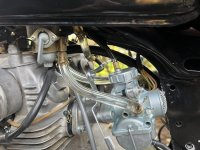
Feed hoses are as direct as possible with no inline fuel filters:

IMG_9966.jpeg
 
+1 on checking plugs and perhaps going a wee bit looser on the valves.

I would try to reduce the chance that it's overheating, either from too lean a mixture or tight exhaust valve clearances.
 
If I put in new plugs, how long do I need to ride before doing a reading?
Some people use the plugs to check the mixture at or close to wide open throttle by riding on fresh plugs and shutting off the motor while moving so as to get a true picture of the behavior in that running state. These are plug chops.

In normal use, the plugs tell a longer tale of buildup at some speeds and burnoff at others. If you're spending a lot of time idling, the plugs may show more carbon and if you run along at high speed for a while they may clean off. If the plugs keep working, things aren't as bad as they might be. If they get really white/burnt, you may be too lean all the way around.

If your plugs are fouling quickly, it could explain the fact that the bike stalls in short order, because the ignition cannot overcome the carbon to combust the poorly mixed air and gas at low speed.
 
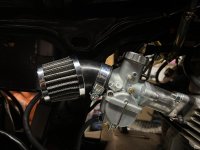
Are you running them with no filters like that?
 
Ah yeah. Ok - this makes total sense now.

Pods are problematic. It can be mitigated by lengthening the intake plenum or creating a pre-carb crossover but they’re going to need to be rejetted most likely.

Those right side filters are a pain to find, but they can be rebuilt if you can find the cage. I just did one for my 160.
 
Ah yeah. Ok - this makes total sense now.

Pods are problematic. It can be mitigated by lengthening the intake plenum or creating a pre-carb crossover but they’re going to need to be rejetted most likely.

Those right side filters are a pain to find, but they can be rebuilt if you can find the cage. I just did one for my 160.
Huh. Is there something about the right-side filters that makes them more scarce than the left-side ones? The do seem to be harder to find.

Glad to know I'm not the only one on Team no-Pods. You do not have to be an internal combustion engineer, you do not have to be a fluid dynamics professor, you do not have to be a salt flats race bike builder -- to realize that these things can't possibly work well in any but the highest rpm range of the powerband. It's frustrating that Honda's engineers created complex and expensive air cleaner assemblies without a replaceable element. OTOH, it was also expensive for Honda to do it this way. The fact that they made these highly-engineered assemblies, and then modified them every year or two, speaks to their importance in how the bikes performed. That's my take on it, for whatever it's worth.

I look forward to trying mine out with original induction/exhaust. And, yeah, we'll have to learn to build/rebuild our own in the near future.
 
Glad to know I'm not the only one on Team no-Pods.
All you have to do is read around here or any of mine or Tx-Pete's posts on Reddit to know that most of us here have long since been against pod filters, primarily on CV carbs but they can alter any Honda's intake delivery negatively, especially when they're bought for looks and with no understanding of the loss of rideability. The cafe crowd is often also the those guys in Houston crowd and they all think they can make them work, but few of them ever get the bike to run nearly as well as stock.
The fact that they made these highly-engineered assemblies, and then modified them every year or two, speaks to their importance in how the bikes performed.
Yes, Honda's history in road racing gave them the advanced intelligence on how to make high output engines that were also docile and reliable, all while also being as affordable as any during the era our bikes are from. I'm sure you're aware of some of the fabulous GP road race engines they built in the '60s that were engineering marvels, all still pretty amazing today.
 
All you have to do is read around here or any of mine or Tx-Pete's posts on Reddit to know that most of us here have long since been against pod filters, primarily on CV carbs but they can alter any Honda's intake delivery negatively, especially when they're bought for looks and with no understanding of the loss of rideability. The cafe crowd is often also the those guys in Houston crowd and they all think they can make them work, but few of them ever get the bike to run nearly as well as stock.

Yes, Honda's history in road racing gave them the advanced intelligence on how to make high output engines that were also docile and reliable, all while also being as affordable as any during the era our bikes are from. I'm sure you're aware of some of the fabulous GP road race engines they built in the '60s that were engineering marvels, all still pretty amazing today.
Guess I'm in the right place. Good to know.
 
Back
Top Bottom