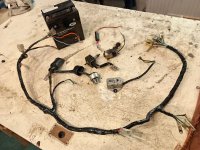
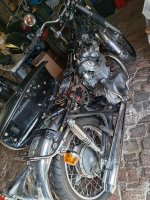
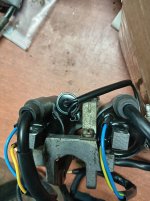
Electrical problems!

SomersetChris

Well-known Member
Joined
Dec 30, 2022
Total Posts
62
Total likes
34
Location
Clevedon, Somerset, England
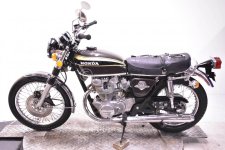
My barn find USA import 1972 CB450K6 has an electrical problem, despite only showing 8000 miles & not being used for a very long time.
The original wiring looks good & I am going through it as methodically as I can - checking connectors & earth points.

I have a good AGM battery, checked the battery to engine & frame earths, ignition & handlebar kill switch both work - but there is a small voltage difference between the black harness wires & earth with the ignition off?

I have removed the coil mount, coils & condenser, cleaned the earth points, checked the points wiring, cleaned the contacts & checked the gaps & reassembled.

There is also a voltage drop between battery +ve & black with the ignition on, no spark at the points & no lights!
I can't start the engine, so all tests are static.

The rectifier is not the selenium type & passes all the usual tests - all work one-way only, 1.1, 0.55 & 0.56

The alternator stator coils have resistances of 1.1, 0.9 & 0.3 ohms between pairs of wires. No earth leaks.

The regulator measures 1.13k ohms between green & black, infinite resistance between green & yellow, black & yellow.
Using the diode test between the green & black gives 0.73 & 0.72 in both directions - not sure if that means anything.

Before I replace anything, does anybody think that there is a problem with a particular component, from these readings?

I would like to get this bike running before I spend a load of money on it & would be very grateful for any useful advice.
Thanks to anyone who contributes!!CB450 #1.jpg
 
Last edited:
I have refurbished the seat but the bike is now partly stripped - worst part is the paintwork on the frame & tank.
Hoses & rubber parts are perished or rock hard.
The ignition (key) switch seems to be okay - no connection when off & no resistance when on. Handlebar switch is the same.
I'd love to find something obvious.
I want to hear the motor running before I start buying more parts, but need sparks!
 
You shouldn’t be getting anything between black and earth with the ignition off.

Ignition on, does it crank at all with the electric starter?

Have you checked voltage at the coil? Ohm reading on coils?
 
It could be Galvanic action at the main frame ground generating a small Voltage. Open the heavy ground connection from the battery to the engine and frame and clean the surfaces. maybe use a good contact cleaner before putting the bolt back in.

If you have the stock regulator, resistance measurements don't mean much, since it is a non-linear device (SCR). Stator readings look good, but it wouldn't have any effect on spark or starting, it only provides power to recharge the battery. Also, you may need to clean the run/stop switch if the coils aren't getting good battery Voltage. You can measure this at the points, with them propped open with a non-conductor; there is normally some drop, but you seem to have a bad connection between the battery and key switch. Those wires are soldered to the back of the switch, and the solder could crack and fail. Use the wiring diagram to follow the power from the battery through the switch, but don't power the coils continuously as they will overheat and fail.
 
Last edited:
My barn find USA import 1972 CB450K6 has an electrical problem, despite only showing 8000 miles & not being used for a very long time.
The original wiring looks good & I am going through it as methodically as I can - checking connectors & earth points.

I have a good AGM battery, checked the battery to engine & frame earths, ignition & handlebar kill switch both work - but there is a small voltage difference between the black harness wires & earth with the ignition off?

I have removed the coil mount, coils & condenser, cleaned the earth points, checked the points wiring, cleaned the contacts & checked the gaps & reassembled.

There is also a voltage drop between battery +ve & black with the ignition on, no spark at the points & no lights!
I can't start the engine, so all tests are static.

The rectifier is not the selenium type & passes all the usual tests - all work one-way only, 1.1, 0.55 & 0.56

The alternator stator coils have resistances of 1.1, 0.9 & 0.3 ohms between pairs of wires. No earth leaks.

The regulator measures 1.13k ohms between green & black, infinite resistance between green & yellow, black & yellow.
Using the diode test between the green & black gives 0.73 & 0.72 in both directions - not sure if that means anything.

Before I replace anything, does anybody think that there is a problem with a particular component, from these readings?

I would like to get this bike running before I spend a load of money on it & would be very grateful for any useful advice.
Thanks to anyone who contributes!!View attachment 55884
Hi,

What do you call a voltage drop ? 1V, 3V or more ? If rubbers are hardened, the plastic (PVC) of the umbilical of the wire harness is also hardened. The isolation of the wiring itself can be damaged as well due to UV and aging. However, since you are specific (I really like it that in your first post in this thread is already measurement information !), would first check the ignition switch soldering (like WintrSol suggesting), but also the connectors for oxidation.

Follow the voltage from the + battery to the ignition switch, and then to the users. Before you do so, disconnect the wires to the coils !

I would first tart with taking ALL connections apart, clean them, and lubricate them with acid-free Vaseline. Before you re-connect the bullet connectors, make sure that the fit is tight, bullet connectors do loose their grip over time.

The alternator readings are ok, but with such low resistances the measurement error is at least 0,2 V, depending on your meter.

I see that the dynamo cover is wrong, it's exclusively for the CB450 K0 and K1, and worth a lot of money in good condition, so I think that the original cover is replaced somewhere in it's life, in most cases that means that the bike fell over at a certain point (or was in an accident), but it could also be replaced because this cover is nicer then the original one (esthetic choice of the PO's). Overall it's a nice bike. Did you hear the engine run ? If not, I would take off the fuel tank, valve covers (not the side covers, but the large covers front an back, clutch cover, clean the oil filter, change the oil, lubricate the cams by hand, turn the engine with the starter motor (take out the spark plugs and disconnect the coils), until you see oil peeing out the the left exhaust cam. Replace the spark plugs with BR7EIX or BR8EIX and change the spark plug caps for non resistance caps.

Replacing the spark plugs, spark plug caps and cleaning the carbs, and fuel tank before you start the engine saves you a lot of trouble.

This is what I would do when re-starting a bike with only 8000 mls in 50+ years (well, I would actually take the engine apart, clean the crank internals and rebuild anyway, but that's me).
 
  • Like
Reactions: J-T
The photo of the bike before I started working on it does look better than the real thing! Tank paint is not good & frame is pretty rusty in places.
I have disconnected, cleaned & reconnected most bullets & earth points.The valve covers have been off to inspect the cam lobes & carbs are off. Fresh oil in the engine.
On the first check the battery +ve to engine & frame showed 12.4v but +ve to black wire feeding the handlebar switch was only 10v, 10v at the coils too.
The ignition switch gives continuity when on, none when off. Same at the handlebar switch.
The worrying thing is a small voltage when the ignition is off! Something is bridging the battery +ve (red) to the black wires that are only supposed to be connected by the ignition switch.
I am going to try disconnecting then reconnecting components to see if I can isolate the culprit - regulator, rectifier & stator are on my list. A fault in the loom would be harder to find.
There are no sparks at the points & I have removed the coil & condenser carrier, cleaned the earth contacts & reassembled. Condenser is rusty & one HT lead turns in the coil - lots of possibilities!
The hydraulic front brake is seized & probably a throw away - but I want to see some sign of life from ignition & engine, before addressing all those.
Looks like this will take longer than I had hoped!
 
Last edited:
It’s going to come back to the ignition switch being corroded. Or dirty internal contacts. Your coils won’t fire on 10v.

Fully charge the battery to 12.8+, the ignition switch on that model should be the type you can pop the back off. I know there’s a few threads where guys have documented that process pretty well - but those have all been mid-thread stuff I think.
 
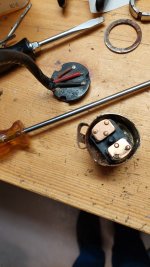
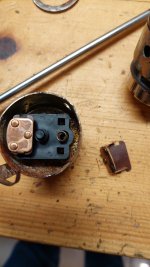
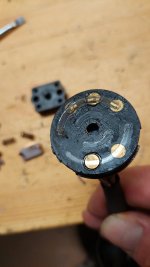
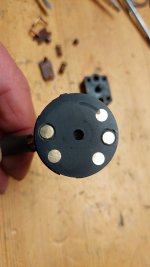
I wasn't getting any voltage coming out of my CB450 switch so I took it apart. Normally it's the contacts that are worn or corroded. It's not difficult, you just need to gently pry up the 3 tabs on the back of the switch enough to get the bakelite contact plate out of the switch. Inside are two copper plates that make the contacts as you turn the key. The indents you feel when you turn the key are from a spring and a small steel ball that sits under the insulator beneath the contact plate. On mine I used some wet and dry paper on a piece of this glass to resurface the contact area. Clean everything up, put some dialectric grease and re-assemble.

20241015_173613.jpg 20241015_173715.jpg 20241016_133046.jpg 20241016_133337.jpg
 
Just how much Voltage with the key off? As I wrote above, Galvanic action at the ground wire to the frame can generate a Volt or two, so if you are measuring from the engine/frame to the black wires, it would show up there. From the battery (-) to the black wires there should be none.
 
That ignition switch looks familiar, I took one apart on a 70s Honda many years ago. Will have a look in this one soon.

I have disconnected the ignition switch, stator, rear brake switch, regulator, recifier & solenoid.

The plan was to reconnect these one at a time, testing before & after - but there is still 10v between red & black at the point where the ignition switch would connect!
There is a small voltage (less than 1v) between black & battery -ve, tested at several connectors.

So next I am going to remove the loom's protective cover, to check the condition of the red wire in particular - from battery to ignition switch connector.

I realise that there may well be more than one problem as this bike has been neglected for many years.
What a pain!
 
Well I got very cold out in my garage - an old stone barn - so I moved the job indoors!
I'd already disconnected most components, so not much more work to remove the main loom from the bike.
I stripped all the outer "protective" cover from the loom to check the wiring - very good inside, despite the outer stuff peeling & cracked.
I've wrapped it back up in a new layer of harness tape after checking it carefully.
The ignition switch wasn't bad, but I've cleaned it inside & re-soldered the brown & white external connection as there were a few broken strands of wire.
The solenoid is my main suspect here, shame that I didn't test that with my meter before taking it apart - it has all the electrical connections needed to create the pro blem I had!
Because I hadn't heard it click when connected, I took it apart to check inside. The top half was difficult to remove - case wasn't stuck, something inside. When I got the top off the contacts didn't look so good, so I cleaned them up. The sprung plunger moved freely. I think the contact "bridge" was stuck in place & making a permanent, not very good contact,
Anyway, on the bench with the battery, ignition switch, rectifier. regulator & solenoid connected, everything tests as it should - putting it back on the bike will prove if it works.
I do realise that I have yet to find out if the coils & condensers are okay, but this seems like progress!
wiring 4.jpg
 
At least taking it apart and checking all the wiring, connections and components eliminated the unknowns and will increase your confidence in the electrical system by a big factor so time and effort well spent IMO.
 
At least taking it apart and checking all the wiring, connections and components eliminated the unknowns and will increase your confidence in the electrical system by a big factor so time and effort well spent IMO.
Thanks, it did feel good to bench test what I had worked on & hear the solenoid click.
Getting the bike running will let me test a lot more!
 
definitely a good move to rule out the harness as an issue. That said, if there’s been constant voltage running through that solenoid, it’s also been feeding the coils so you’ll want to measure those out.
 
The saga continues.

I've recovered the seat, fitted new fork gaiters, un-seized the rear wheel & fitted new tyre & tube & brake shoes, new tyre & tube at the front & all new brake components.
Various other new parts sourced from all around the globe - what would we do without the internet?
Set the tappets, points & static timing.
Stripped & checked the main wiring loom & electrical bits.
Stripped & cleaned the carbs, rebuilt with new jets etc.

The bike is still a pig to start - lots of kicking!
It runs erratically for a while & then cuts out. The engine does sound nice when it's running though.
Sparks are regular but very feeble, one exhaust hotter than the other.

I've been checking earth connections, especially the coils & mount, along with the supply voltage at various points.
I found that the voltage on the black & white feed to the coils is normal, around 12v, but when I checked the yellow & blue wires that connect the coils to condensers & points, one side was about half voltage - 6v!
This looks like a duff coil to me, any other opinions out there?

So close & yet so far!
IMG_20260405_154104.jpg
 
The bike is still a pig to start - lots of kicking!
Electric start not working? you probably already know this, but most Hondas prefer the throttle to be left at idle or only just slightly above, choke on, during a cold start. Opening the throttle is usually counterproductive, and the choke is usually only necessary for as long as it takes to start firing and it can be opened to about halfway almost as soon as it's running in moderate temps.
Sparks are regular but very feeble
What is the battery voltage at rest? I see it's a gel battery and doesn't look new.
 
You test a coil by checking their resistance. Not the voltage.

Primary circuit. Black to yellow/blue will be X.Xk Ohm

Secondary black to high tension lead is X.xk ohm.

Fill in the values.

Also - why did you replace the original jets? Unless the replacement jets were OEM Keihin, you're just adding another known problematic variable. New chineseum is far inferior to just cleaning the old jets/needles.
 
Last edited:
Electric start not working? you probably already know this, but most Hondas prefer the throttle to be left at idle or only just slightly above, choke on, during a cold start. Opening the throttle is usually counterproductive, and the choke is usually only necessary for as long as it takes to start firing and it can be opened to about halfway almost as soon as it's running in moderate temps.

What is the battery voltage at rest? I see it's a gel battery and doesn't look new.
Battery is 12.7v when charged - I do this fairly regularly using an Optimate 3.
It seems like there is a short to earth somewhere & the battery ends up at about 10.5v after a session of trying to get the bike running & then searching for the problem!
Worryingly I seem to get different readings for the same checks on different occasions but have yet to find any faulty wiring - will check the battery in my test meter next.
I have disconnected the battery to solenoid lead, to remove that from the list of possible problems - it was very corroded inside & I was surprised that it appears to work sometimes, the starter button definitely needs attention & doe not do it's job!
 
You test a coil by checking their resistance. Not the voltage.

Primary circuit. Black to yellow/blue will be X.Xk Ohm

Secondary black to high tension lead is X.xk ohm.

Fill in the values.

Also - why did you replace the original jets? Unless the replacement jets were OEM Keihin, you're just adding another known problematic variable. New chineseum is far inferior to just cleaning the old jets/needles.
I had been checking the voltage around the wiring loom & got some odd results aroung the ignition low tension wiring, checking for a short or broken wire.
The carbs were not good inside, one had a fair bit of corrosion & alloy very eaten away. I got carb rebuild kits from a supplier I've used before, for my CL77 & 450K1 with good results.
I used my ultrasonic cleaner for the main parts,
What I do find strange about this bike is that most of it is in decent condition, engine sounds good & chrome parts are pretty good - but some parts are very corroded &/or seized or perished with age - rear brake drum, front brake cylinder & caliper, one carb, solenoid, all rubber parts, battery box.
I'll measure the coil resistances next session,
 
You test a coil by checking their resistance. Not the voltage.

Primary circuit. Black to yellow/blue will be X.Xk Ohm

Secondary black to high tension lead is X.xk ohm.

Fill in the values.

Also - why did you replace the original jets? Unless the replacement jets were OEM Keihin, you're just adding another known problematic variable. New chineseum is far inferior to just cleaning the old jets/needles.
I tested the coils resistances & if I'm reading the meter correctly,
the black/white to blue & yellow wires are 4.7 & 4.5 ohms.
The black/white to end of HT leads are 12.5k & 13.1k ohms.
Do those readings sound okay?

I could not get a reading at all from the plug caps! Internal break down perhaps?
I'll try some from another bike that runs!
 
Electric start not working? you probably already know this, but most Hondas prefer the throttle to be left at idle or only just slightly above, choke on, during a cold start. Opening the throttle is usually counterproductive, and the choke is usually only necessary for as long as it takes to start firing and it can be opened to about halfway almost as soon as it's running in moderate temps.

What is the battery voltage at rest? I see it's a gel battery and doesn't look new.
I checked the battery about 20 hours after charging & it's holding 12.55v, seems reasonable?
It was fitted to my K1 when I got that 4 years ago & it was holding 13v then!
 
I tested the coils resistances & if I'm reading the meter correctly,
the black/white to blue & yellow wires are 4.7 & 4.5 ohms.
The black/white to end of HT leads are 12.5k & 13.1k ohms.
Do those readings sound okay?

I could not get a reading at all from the plug caps! Internal break down perhaps?
I'll try some from another bike that runs!
The primary looks OK - the secondary is not ideal, and the caps should be 5K ohm so an open circuit there is really not great.

try snipping about a centimeter of the end of the HT lead off, then reattach the cap and measure that total. Should be under 15K all in
 
This was mentioned earlier, but are you running resistor plugs or non-resistor plugs? The caps should be chosen accordingly, resistor caps with non-resistor plugs or non-resistor caps with resistor plugs.
 
The primary looks OK - the secondary is not ideal, and the caps should be 5K ohm so an open circuit there is really not great.

try snipping about a centimeter of the end of the HT lead off, then reattach the cap and measure that total. Should be under 15K all in
I think the plug caps are almost non-conductive - resistance off the scale!
I'll be trying new caps & there is enough HT lead to chop some off the end - not much evidence of metal strands showing there.
 
Back
Top Bottom