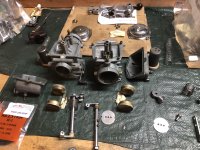
CL350 Vintage racer project

The machining doesn't look too difficult. Even a drill press with a X/Y compound and an endmill bit would do it.

Have you considered a symmetric spoke pattern? The only times I see it done is on race bikes mostly.
 
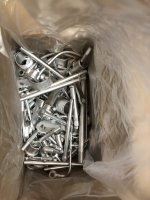
Thanks fxray, I think some of what you’re seeing is a “trick of the light”. That picture was taken before I was done with that batch of hardware. It had just come out of the ultrasonic cleaner and was rinsed in hot water so it dried almost immediately and left a little bit of a powdery residue on the surface. After that I hit the stuff lightly with a wire wheel and polish it up a bit with Autosol or similar. Looks better when it’s done. If it shows some tendency to rust again I will go through the process and toss it in the plating bath.IMG_7171.jpeg
 
The machining doesn't look too difficult. Even a drill press with a X/Y compound and an endmill bit would do it.

Have you considered a symmetric spoke pattern? The only times I see it done is on race bikes mostly.
No, it’s probably not a big deal to do the job. Unfortunately, I don’t have a drill press here and don’t really have any room for one in my small, crowded workshop (although it would probably come in pretty handy).

I’m not an expert on spoke patterns, the only way I know to do it is the standard pattern so I am sticking with that. In my world, K.I.S.S. always applies.
 
This project is not really meant to be a nut and bolt restoration. I’m checking the condition of the hardware to be sure it’s sound and cleaning it up as best I can. Most of the stuff I have seen is a little rusty but I was able to make it presentable and put it back in service. A few items were too badly pitted or had the flats rounded off (or was missing) and I got replacements.
I am also in the midst of a restoration project on a 1967 Triumph T120 TT Special. That project I am trying to bring the hardware back to original condition. The Triumph hardware of that era was cadmium plated which is difficult to find these days as the process is not particularly environmentally friendly. I found a plater somewhat locally and had the stuff redone, not an inexpensive proposition IMG_3985.jpeg
This guy just plates stuff in batches so it all went in together. It was quite an undertaking to catalog all these pieces and then separate them back out again into the correct assemblies. Lots of photos and pages of notes. Hopefully some day it will all be worth it 😀.
 
I'm just one of very few obsessed with that spoke pattern, but I've seen others and I know how to do it but never built race wheels for anyone.

Thanks for this thread it's interesting and inspiring. Maybe I'll finish the 450 big drum wheel I inherited from the race builder that I got his bike from.
 
I'm just one of very few obsessed with that spoke pattern, but I've seen others and I know how to do it but never built race wheels for anyone.

Thanks for this thread it's interesting and inspiring. Maybe I'll finish the 450 big drum wheel I inherited from the race builder that I got his bike from.
Thanks, it’s inspiring for me as well. Like many of these types of projects it’s not being done as an “investment”. There’s no way on earth that I could ever get the full value of time or money back from this that I have put in. But that’s not really the point.
I’m learning so many new things and (hopefully) advancing my knowledge and skills with this project. I have found that to be very rewarding in its own way. If I can get this thing out on the racetrack and get through a session without having a problem that’s going to be a victory in my eyes.
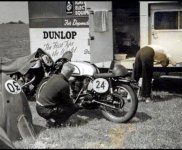
I’m getting a sense of what it must have felt like as a privateer back in the days before the mega-bucks corporate sponsors took over the scene. When the paddock was just a grass field where racers would be set up with any and all sorts of vehicles, fiddling with their bikes between races. Miles away from the modern day paddock.IMG_7173.jpeg
 
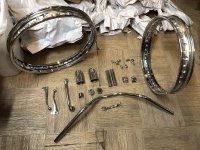
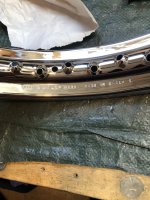
Another thing that is getting harder to find due to environmental factors is good chrome work. Getting chrome parts restored to original condition will also set you back a few shekels.
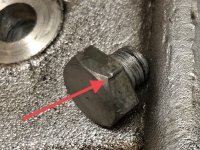
There are repop items available but most of the value is in the originality of the parts and having the OEM markings and stampings preserved. Case in point, the Dunlop rims of the ‘67 Triumph. This is also true of the nuts and bolts on the bikes. British motorcycles had subtle variations in the hardware that are not replicated by new replacement parts. Case in point is this oilway plug bolt. Note the beveled area on the corners of the flats. It’s a minute detail but when doing a restoration it makes it look a little more original.
IMG_3535.jpeg
IMG_4337.jpeg

IMG_4336.jpeg
 
Last edited:
They’re not really extensions, just aluminum “soft jaws” so the teeth don’t mar the surface of parts. I made them out of scrap aluminum I had lying around. I had to add the back part as a counterweight to keep them from constantly falling out.
 
IMG_7215.jpeg

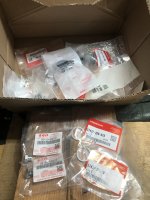
More lovely new OEM parts. I’ve got some carburetor parts coming from CMSNL. I’ll compare them with the original stuff I have and let you know how they stack up.
 
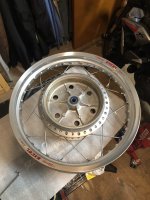
That looks really good. I'm liking the nipples in the rim dimples, the angles look good. Hubba hubba.
Credit all goes to Buchanan, they did a really nice job. Let them know what you have and what you want to do and they will do the rest. Everything went together with no drama at all.
 
Credit all goes to Buchanan, they did a really nice job. Let them know what you have and what you want to do and they will do the rest. Everything went together with no drama at all.
I think you sourced the rims from them as well, which is even better for everything to fit right.
Those guys must have a phenomenal data base, after all the years they've been doing this. I started building bicycle wheels way back before there were computer spoke calculator programs. The early ones didn't always work so great.
There is just no substitute for experience.

Now you can start to finger true and tension (no nipple wrench needed) till it's all perfect and dished. Then progressive passes of 1/4 turn, going all the way around till you finally reach the correct 'ping' of spoke tension.
Most enjoyable winter work, if you ask me.
 
Yes, I got rims and spokes from Buchanan. They contacted me once to give them the flange thickness at the spoke holes from the Suzuki hub. When the stuff came it went together nicely, and I’m no master at wheel building (although now I’m getting better at it). The spokes on the Suzuki hub are a little long so will need to be ground down.
It is interesting work requiring patience and attention to detail. I used a spoke torque wrench to get them even. Then go around again and make final adjustments for true.
 
Yes, I got rims and spokes from Buchanan. They contacted me once to give them the flange thickness at the spoke holes from the Suzuki hub. When the stuff came it went together nicely, and I’m no master at wheel building (although now I’m getting better at it). The spokes on the Suzuki hub are a little long so will need to be ground down.
It is interesting work requiring patience and attention to detail. I used a spoke torque wrench to get them even. Then go around again and make final adjustments for true.
Did Buchanan's sell you their nice spoke wrench ? 👍
 
Yes, I got rims and spokes from Buchanan. They contacted me once to give them the flange thickness at the spoke holes from the Suzuki hub. When the stuff came it went together nicely, and I’m no master at wheel building (although now I’m getting better at it). The spokes on the Suzuki hub are a little long so will need to be ground down.
It is interesting work requiring patience and attention to detail. I used a spoke torque wrench to get them even. Then go around again and make final adjustments for true.
(y) The neck next to the bend is the most stressed area and point of fatigue failure. Those guys rock.
I'd much rather grind a bit off, rather than be short of filling the nipple base. The bases can shear if not filled mostly.
 
(y) The neck next to the bend is the most stressed area and point of fatigue failure. Those guys rock.
I'd much rather grind a bit off, rather than be short of filling the nipple base. The bases can shear if not filled mostly.
Makes sense, on the spokes for the GT hub the diameter at the neck is larger than the rest of the spoke.
The rear hub spokes were almost all perfect lengths. I only had to grind a tiny amount from a handful of them.
 
Hey Emlupi,
Did you strip paint off the engine cases before you sent them for vapor blast or did they do it before blasting? Are you planning on painting the engine cases? If so, will it be before or after assembly? I'm working on a 71cb350.

Who is Schumann? The schumanns I found were not machine/engine shops. I haven't popped the valves out of the head yet to determine if more than a lap is needed but figured I'd ask.

I read in a previous post about less than decent quality gaskets and orings. What's the general concensus on where & what to buy? I did a 72cl350 back in 2011 and in less than 1500 miles the cam case gasket began seeping....very depressing to me.

Thanks & happy new year!
Art
 
Who is Schumann? The schumanns I found were not machine/engine shops. I haven't popped the valves out of the head yet to determine if more than a lap is needed but figured I'd ask.
This is Chris Schumann, a younger guy who is into vintage engines and does excellent head work. Many of us here have used his services.


I read in a previous post about less than decent quality gaskets and orings. What's the general concensus on where & what to buy? I did a 72cl350 back in 2011 and in less than 1500 miles the cam case gasket began seeping....very depressing to me.
Yep it sucks. Since OEM Honda gaskets are generally NLA for most of our bikes, I've used Vesrah and NE brand gaskets from 4into1 and had good results with both. I do use some sealer as insurance in certain areas known to allow seepage.
 
I read in a previous post about less than decent quality gaskets and orings. What's the general concensus on where & what to buy? I did a 72cl350 back in 2011 and in less than 1500 miles the cam case gasket began seeping....very depressing to me.
Maybe me in my Mousetown build. Same place and same NE gasket, even with a generous coat of copper seal, but did not surface sand the two faces on plate glass with a sheet of sandpaper. A re-torque did help some.
Maybe it will miraculously stop after sitting this winter, or maybe get worse.
 
Hey Emlupi,
Did you strip paint off the engine cases before you sent them for vapor blast or did they do it before blasting? Are you planning on painting the engine cases? If so, will it be before or after assembly? I'm working on a 71cb350.

Who is Schumann? The schumanns I found were not machine/engine shops. I haven't popped the valves out of the head yet to determine if more than a lap is needed but figured I'd ask.

I read in a previous post about less than decent quality gaskets and orings. What's the general concensus on where & what to buy? I did a 72cl350 back in 2011 and in less than 1500 miles the cam case gasket began seeping....very depressing to me.

Thanks & happy new year!
Art
No, I didn’t strip any paint off the engine cases. I cleaned the heavy grease and grime off of everything before I sent them out because if I left it for the blaster to do the cost is higher. I hate paying others to do things I can do myself. I have no intention of painting the cases. I believe the bare aluminum will shed heat better without a coat of paint on it. This bike will be a vintage racer and not a show pony.
Ancientdad pretty much covered the story with Chris Schumann. He has an Ebay shop and is on Facebook where you can contact him.
I have tried to source OEM gaskets where possible but that is difficult/ impossible for some. The rest I have tried to source from reputable parts suppliers like David Silver Spares and CMSNL. With luck and some careful assembly I hope it will pay off. I take the advice of the experienced members of this forum to help me along the way.
 
IMG_7246.jpeg
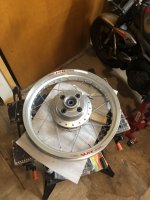
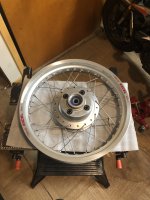
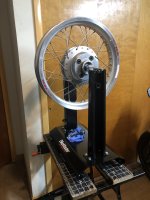
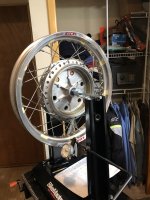
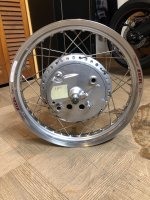
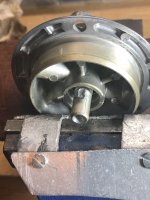
Front wheel is completed, here with the brake panels in place for some final fitting. Need to get some time with the machinist to shave down the axle “spouts” to fit the 750 forks.
 
I read in a previous post about less than decent quality gaskets and orings. What's the general concensus on where & what to buy?
I've used some ridiculously cheap 350 gaskets off eBay and no leaks or fit issues, but would not recommend to most folks unless they're going the cheap route... but they do get the job done
 
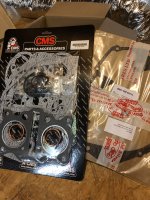
These are the items that are unavailable at the OEM suppliers. The CMS gaskets are NE branded.
Interesting that CMSNL would choose NE brand for their pre-packaged aftermarket gasket sets, I'm a little surprised they didn't use Vesrah which is a brand that has been around as long as these bikes have been. But, I've used more than a few NE gaskets with no issues either.
 
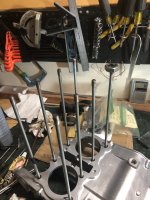
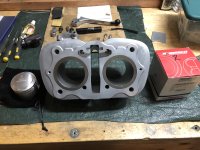
That's so pretty. Don't neglect to high pressure air check those oil passages. I'll go back to see if your crank sludge traps and internal passages to the big end rod bearings were cleaned.

EDIT: Oh yeah, back on page 3 #215.
 
I fully intend to
That's so pretty. Don't neglect to high pressure air check those oil passages. I'll go back to see if your crank sludge traps and internal passages to the big end rod bearings were cleaned.

EDIT: Oh yeah, back on page 3 #215.
I fully intend to thoroughly wash and flush out the cases including all the oil passages. Don’t want to take a chance at leaving any blasting media hiding in places where serious damage can be done.
 
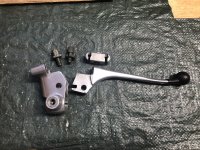
Double dang, those rare parts look pretty good.
To be fair, the parts were in really good condition when I got them. There were a couple of minor components missing but I was able to find them or source alternatives. Ebay was my friend in that capacity.
I also got some OEM cables with the rest of it but, being over 50 years old, the sheathing is dried, brittle and has a couple of cracks so I had to get replacements. I will keep the old ones as backup.
A little bit of very light sanding, a quick hit with a fine wire cup in the Dremel, and some polish and it looks pretty good. Even the rubber boot on the end of the lever is in really good shape.
 
To be fair, the parts were in really good condition when I got them. There were a couple of minor components missing but I was able to find them or source alternatives. Ebay was my friend in that capacity.
I also got some OEM cables with the rest of it but, being over 50 years old, the sheathing is dried, brittle and has a couple of cracks so I had to get replacements. I will keep the old ones as backup.
A little bit of very light sanding, a quick hit with a fine wire cup in the Dremel, and some polish and it looks pretty good. Even the rubber boot on the end of the lever is in really good shape.
Glad you were able to find good cables. If the flatwire coil outer housing has not rusted inside or been kinked, it is possible to save it via some grey heat shrink tubing. Of course, the inner wire needs careful inspection for wear on any of it's strands, then needing replacement.
I bet those boots are like hen's teeth.
This is so very cool. Soon, you'll be chaulking the shoes and checking the arcs.
 
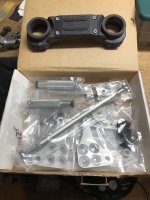
The gusset plates were added sometime after the K0 series, and the box must've been retained only to mount the small assembly tube.
I've made them and welded them in on early frames that didn't have them.
Usually go a few millimeters away from edges so not to damage bearing seats.
It makes an 'extra' box section
 
I like the friction dampers on the KO's, all the 305's and even the CB160. The later 350's do have a threaded spot on the lower triples, must be for an add on piston type damper.
 
The later 350's do have a threaded spot on the lower triples, must be for an add on piston type damper.
The SL350K0 came new with that one, left off the K1 and later

No Reserve: 1969 Honda SL350 K0 for sale on BaT Auctions - sold ...
 
The SL350K0 came new with that one, left off the K1 and later
That must be it. Kind of surprised Honda drilled and tapped most all others I've seen on other models that didn't come with dampers. I don't know enough about race bike prep, if one is commonly used.
 
IMG_7280.jpegIMG_7281.jpeg

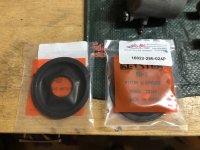
New carb diaphragms. Going through my collection of parts to find the best stuff for rebuilding the carburetors. The old felt washers are pretty dried out, should these be oiled before reassembly?
 
I figured oil wouldn't last very long and impregnated them with some light bodied teflon bicycle grease on my fingertips or silicone dielectric grease.
 
Back
Top Bottom