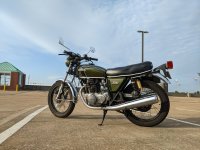
CB360G yard find — ongoing project log

You’d be able to see a wobble. That outer bearing may also be a factor.
With stator removed, you shouldn’t be able to feel any movement up/down.
 
It sounded intermittent, like only a certain spot was making contact. Does the new rotor have a starter clutch attatched to it's backside? I know you said you removed the internals, but was that only the sprocket or the clutch mechanism bolted on with the 3 screws?
Perhaps the new rotor fits on the taper very slightly deeper than the original and contact is happening on the backside.
Hard to imagine contact around the circumference of the new stator but ....perhaps.
Don't know if this is a good idea but a very light coat of dark paint around and behind the new rotor to reveal any area of contact. Here is maybe an even worse idea; A long peice of fuel tubing in your ear to use as a stethascope while spinning motor with a drill to locate the tapping.
 
It sounded intermittent, like only a certain spot was making contact. Does the new rotor have a starter clutch attatched to it's backside? I know you said you removed the internals, but was that only the sprocket or the clutch mechanism bolted on with the 3 screws?
Perhaps the new rotor fits on the taper very slightly deeper than the original and contact is happening on the backside.
Hard to imagine contact around the circumference of the new stator but ....perhaps.
Don't know if this is a good idea but a very light coat of dark paint around and behind the new rotor to reveal any area of contact. Here is maybe an even worse idea; A long peice of fuel tubing in your ear to use as a stethascope while spinning motor with a drill to locate the tapping.
Thanks, Tom! In the videos, the OEM rotor still has the starter clutch housing bolted on, but without the moving parts. The sprocket and chain are removed. For the aftermarket rotor, it's the rotor only (and key).

It was a mechanic's stethoscope that helped me isolate the sound to the rotor side. I wasn't able to narrow it down further, but could try again. I've also inserted feeler gauges around the aftermarket rotor without turning the crank and feel some drag at 0.008", but never felt that it was too tight. I didn't try turning it then for fear of binding it.

I've looked for witness marks without definitive results, so the paint idea isn't a bad one. I think I'll try Jay's idea about a sloppy crank and then go from there.
 
Steel feelers are magnetic, need to use brass.
I had read after coming in for the day that some stainless steel feelers are not magnetic, so I wasn't sure, but mine are definitely magnetic. Fresh out of new, crisp $1000 bills (mine are all old and/or wrinkly), I substituted a strip of thick paper from a file folder and still felt that the gap is pretty tight all the way around, whether using the OEM rotor or the aftermarket rotor. Part of that might be due to the curvature of the rotor — the strip was about as wide as a typical feeler gauge. I could not feel much difference in the resistance moving around the circumference.

You’d be able to see a wobble. That outer bearing may also be a factor.
With stator removed, you shouldn’t be able to feel any movement up/down.
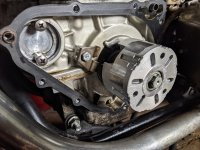
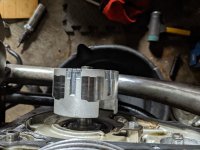
I removed the rotor, stator, and stator cover to feel the crank with my hands. It feels solid. I tried jiggling left/right, up/down, and diagonals, but could not sense any movement. My next step was to install the OEM stator and OEM rotor. Turning the motor over by hand with this combination was smooth and noise-free, so I put the rest of the parts back on the bike and started it up in order to make a video of the rotor at idle. I don't see any wobble, although the edge of the rotor is not completely uniform, so there is some flickering due to lighting and so on that one might perceive as a wobble. My phone was resting on a rectangular motorcycle lift/stand to mitigate any motion of the camera, but a little off-center (low).


I succumbed to a strong desire to order a fresh OEM rotor from CMS last night, so my current plan will be to swap that in when it arrives and see how the bike runs. I should also say that the main reason I was getting concerned about this noise is that the bike would start and run fine, but would start to act strangely after warming up. On the most recent ride to Target (2.3 miles each way), I had to hold the throttle up to keep it from dying at idle and it gave the impression of being overheated. I was afraid that whatever contact was occurring gets worse with heat, so I let the bike cool down for a bit and made a quick dash home. It's possible that other factors contributed, but the noise had been bothering me for a while and was the first possible culprit that came to mind.

Thanks, everyone, for the thoughtful replies.
 
Last edited:
Interference? Like if rotor is coming in contact with coil poles? Maybe look for scraping between the two? Put some paint or marker to see if it is scraping/touching? If so maybe you could file down?
 
Interference? Like if rotor is coming in contact with coil poles? Maybe look for scraping between the two? Put some paint or marker to see if it is scraping/touching? If so maybe you could file down?
Yes, contact between the poles and rotor is the only thing that makes sense to me so far as an explanation for the weird clattering sound observed with the aftermarket rotor.

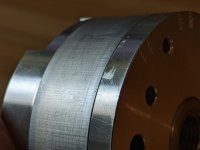
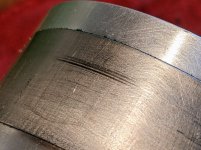
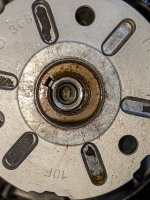
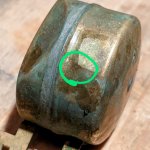
Inspecting the rotor this morning, I notice two possible contact areas, one on the backside and one near the front edge. The mark on the backside leads the one near the front by about ninety degrees.

PXL_20250728_114858713.jpg

PXL_20250728_114930024.jpg
 
Hoping you have found the area of contact. Kbongo's and others suggestion to mark with paint to further id the contact sounds good. I remember you stating the stator and mounting should be checked also.
I wonder if the aftermarket rotor is off-center or otherwise asymmetrical, if the stator could possibly be misaligned in the cover, or if the stator cover could be off slightly (locating dowels are intact).
Maybe use a Q-tip to dab on some paint in the suspect area, instead of spraying.
 
Maybe use a Q-tip to dab on some paint in the suspect area, instead of spraying.
I like that idea better than putting paint over the whole surface of the rotor. This rotor is compatible with 350s, too, so I may assemble my spare 350 motor enough to turn the crank (no followers, etc.) and experiment more in a low-stakes environment.
 
I tried spray painting the rotor and installing it in my spare 350 motor. I couldn't make that work because the paint doesn't adhere well and a lot of it gets scraped off while installing the rotor. Maybe Scotch tape would be better, I dunno.

While cleaning the paint off with a Scotch-Brite pad, I also polished the scuffs away, hoping to start anew in the 350 motor. Turning it over by hand, I hear the same noise as in the 360. I then gave it a whirl with a drill and could hear contact. I spun it for maybe 30 seconds which is much less than the total run time in the 360 and didn't observe anything crazy on the rotor afterwards despite it sounding ugly to my ear.

I think I'm going to move on from that aftermarket rotor. It's so hot here that I haven't tested the bike yet, but hope to soon. The replacement OEM rotor from CMS should be here Friday.
 
It can't be the crank since the OEM rotor is fine.

My theory is the aftermarket keyway slot is not deep enough and off centers the rotor when tightened down. A different, or less high key may work.
 
Man what you found is just crazy! Never seen that before.
I didn't want to believe it at first and talked myself out of this possible cause for months.

My theory is the aftermarket keyway slot is not deep enough and off centers the rotor when tightened down. A different, or less high key may work.
I've been wondering about the keyway also. I confirmed via CMS that the 350 and 360 use the same key. I used the resident keys for my tests on the 360 and spare 350 motors and they seem to sit pretty deep in the slot on the shaft, but I should try to examine the keyway on the rotor more carefully. I suppose I could install it without the key on the spare motor, since I wouldn't be making use of the timing marks. At one point, I dropped the key behind the stator in the spare motor and ended up using a pair of chopsticks to retrieve it. That took a while — I was never good at the board game Operation.
 
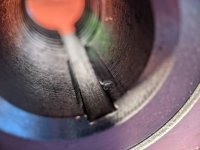
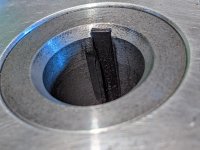
I've now looked at the keyway and I think I have to own this one. I must have installed the rotor slightly off at some point and messed up the keyway when I tightened the rotor bolt.

PXL_20250729_194242878.NIGHT.jpg

PXL_20250729_194525780.NIGHT.jpg

I did test it without the key in my spare motor. Still heard the funny sound and saw witness marks on the rotor after spinning it as fast as my drill would allow.

PXL_20250729_195656245.jpg
 
Displace metal from the key may still be causing the problem. Rolled sandpaper with your drill may remove it or at least prove it. Might need a file to clear it.
Use a piece of coat hanger bent into tight J to mount the sandpaper.
 
Displace metal from the key may still be causing the problem. Rolled sandpaper with your drill may remove it or at least prove it. Might need a file to clear it.
Use a piece of coat hanger bent into tight J to mount the sandpaper.
Thanks for the advice. I'm not currently planning to use the damaged rotor, but will take this into account if I change my mind.
 
The OEM rotor from CMS arrived yesterday and I installed it this morning.

PXL_20250731_132747057.jpg PXL_20250731_132854778.NIGHT.jpg PXL_20250731_132916243.NIGHT.jpg

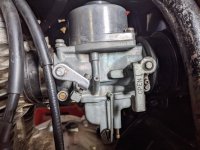
After switching to non-ethanol fuel about two or three years ago, I have had less reason to clean my carburetors (borrowed from a CB450). I noticed that they could use a clean this morning and did that, too, soaking the disassembled parts in Berryman's chem-dip, rinsing them, and then blowing air through orifices.

PXL_20250731_154332619.NIGHT.jpg
 
Still looks so odd seeing 450 carbs on your 360. :giggle:
One of my friends always says the same thing about the CB350 tank.

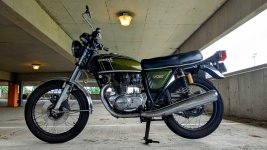
Not sure if you would have noticed a pair of olive drab NOS CB360 tanks (located in Utah) on eBay around May of this year. I ended up buying one of them as a backup for this bike. The paint was obviously not original and was scratched and scuffed, but the tank itself is otherwise in good shape.
 
Last edited:
I guess the carbs would stand out to me more than a cosmetic change like the gas tank.
Not sure if you would have noticed a pair of olive drab NOS CB360 tanks (located in Utah) on eBay around May of this year. I ended up buying one of them as a backup for this bike. The paint was obviously not original and was scratched and scuffed, but the tank itself is otherwise in good shape.
I haven't spent any significant time on eBay in quite a while, most of my parts searching is over for now. Glad you found a decent tank as a backup.
 
Personally I've never seen a 250 or 360 crank 'bent' or twisted out of shape even after some pretty severe accidents.
I would use a needle file to remove key-way burrs, rolled up 'emery' isn't going to keep things 'square'.
Remove key and gently lap tapers together with extra fine valve grinding paste or even Solvol Autosol, it will show if you have good contact across width.
Quick and dirty way to check rotor is just 'stick' it underneath a steel shelf.
It barely holds it's own weight, it's good.
 
With the carb cleaning and OEM rotor install out of the way, I rode the 360 to work this morning.

PXL_20250814_200730184.NIGHT~2.jpg

It was fighting me a little and as I got further from home I felt that the right carb might be overflowing. I checked for drips and saw none, but that side was bogging down slightly. Once I arrived, I pulled the right bowl and it was full to the top, more than it should be. I figured the needle was not seating or the float height had gotten disturbed during the cleaning, but when I got home I discovered a bit of gas in the float, enough to raise the fuel level to an over-rich condition


I haven't found the leak yet, but had an aftermarket float on hand and installed that. Will ride it again tomorrow.

 
With the carb cleaning and OEM rotor install out of the way, I rode the 360 to work this morning.

View attachment 48388

It was fighting me a little and as I got further from home I felt that the right carb might be overflowing. I checked for drips and saw none, but that side was bogging down slightly. Once I arrived, I pulled the right bowl and it was full to the top, more than it should be. I figured the needle was not seating or the float height had gotten disturbed during the cleaning, but when I got home I discovered a bit of gas in the float, enough to raise the fuel level to an over-rich condition


I haven't found the leak yet, but had an aftermarket float on hand and installed that. Will ride it again tomorrow.
Beautiful bike!
 
I rode the bike to work on Friday with the new float and things were much improved, although the off-idle response on the right carb was not good. In fact, a quick lift of the right throttle arm would promptly stall the motor, while the motor speed would pick up smoothly in response to a lift of the left throttle arm alone. I had noticed this on Thursday, but hoped it was related to the fuel level.

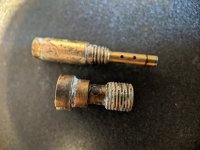
This pointed to the idle circuit on the right carb and when I removed the jets I believe I found the culprit. There was a white residue on the jets (particularly on the threads) that I believe was leftover from the Berryman's chem-dip. I must not have cleaned something well enough and it gummed up.

PXL_20250815_214848165.NIGHT.jpg

I cleaned things up and reassembled this morning and found that the response is smooth from both sides independently as well as together. No test ride as of yet, this was just on the center stand. I prefer the carb setups without a throttle linkage (e.g., CB350 & CB450 carbs) because I think it is helpful for diagnosing these kinds of issues, especially when there are no vacuum ports and no easy access to a dyno.
 
Last edited:
Amazingly, the float in the left carb sunk shortly after the one in the right. I guess the quality control at the float factory was very good in the early 70s to get them all to last 50 years and then fail within weeks of one another in the exact same way, namely, via the formation of micro-cracks on the top side of the float.

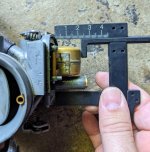
I replaced the sunk float and reset the float height to 22mm, slightly leaner than the stock setting for these carbs when used on a CB450.

PXL_20250906_183957386.NIGHT~2.jpg
 
Amazingly, the float in the left carb sunk shortly after the one in the right. I guess the quality control at the float factory was very good in the early 70s to get them all to last 50 years and then fail within weeks of one another in the exact same way, namely, via the formation of micro-cracks on the top side of the float.

I replaced the sunk float and reset the float height to 22mm, slightly leaner than the stock setting for these carbs when used on a CB450.
Thanks for posting that lovely image with your float gauge. It will give me a reference later when I am going back through my carbs!
 
I hope replacements are available. I've not tried to solder float leaks but heard of others doing it.
There are replacements, including from 4-into-1, but it seems a shame to pitch a float after it develops a leak.

I repaired both of these, but the type of micro-cracks I observed (see post #381) aren't well-suited for a solder fix. My approach involves drilling small weep holes in the center of each face, in order to remove the gas from the inside. Then, I seal the small cracks with JB Weld by applying it and then wiping it off, hopefully leaving just enough to seal the crack. The last step is to solder the two weep holes that I introduced earlier.
 
In one of Jay's recent threads, he outlined a carb setup for the dohc 450 models that uses Mikuni PE32 carburetors. He introduced spacers for the carburetors that allow one to use the stock air boxes and I thought that was a cool idea.

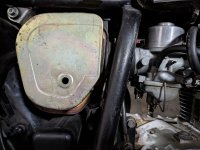
I finally got around to testing the fit of the OEM air boxes on my CB360G with the non-OEM Keihin 723A carburetors. It almost fits as is and a small spacer should allow me to ditch the pod filters and go back to real air boxes. The spacing is short essentially by the width of the clamp that would hold the air box snug on the carb intake.

411.jpg

The next step is figuring out how to produce the spacers.
 
Last edited:
Is it feasible to move the air boxes and correct the angle a bit too?
Conceivably, but the tunnel between the two air boxes might pose a bigger challenge than the spacer. A spacer should also allow for a small correction of the angle.

This may sound like a bad idea, but I've been thinking of using a dense hardwood like Osage Orange or an exotic Ebony for the spacer material. I can work with wood, but would probably have to go to a machine shop for aluminum.
 
At least heat shouldn't be a problem. Thick plastic, like a cutting board would also work like wood. Are you thinking to do this on the filter box end?
 
Conceivably, but the tunnel between the two air boxes might pose a bigger challenge than the spacer. A spacer should also allow for a small correction of the angle.

This may sound like a bad idea, but I've been thinking of using a dense hardwood like Osage Orange or an exotic Ebony for the spacer material. I can work with wood, but would probably have to go to a machine shop for aluminum.

Do you talk about a spacer between the carburettor and the cylinder, or between the carburettor and the air box ? A 3D printed part from PEEK would fit between the carburettor and the cylinder, and since PEEK is heat resistant, an isolator and resistant to chemicals, I would go that way.
 
Do you talk about a spacer between the carburettor and the cylinder, or between the carburettor and the air box ? A 3D printed part from PEEK would fit between the carburettor and the cylinder, and since PEEK is heat resistant, an isolator and resistant to chemicals, I would go that way.
True and moving the air boxes very much could cause problems with the side covers too. It looks like about 5mm would do it, maybe a bit more.
 
At least heat shouldn't be a problem. Thick plastic, like a cutting board would also work like wood. Are you thinking to do this on the filter box end?
As in Jay's thread, I was thinking a spacer between the carburetor insulator and the head. On the air box side, things seem more complicated because the tube from the air box would need to go over the spacer, but the spacer would need to go over and seal the carb intake.

Do you talk about a spacer between the carburettor and the cylinder, or between the carburettor and the air box ? A 3D printed part from PEEK would fit between the carburettor and the cylinder, and since PEEK is heat resistant, an isolator and resistant to chemicals, I would go that way.
I was imagining a spacer between the insulator and the head. I hadn't been thinking about the chemical resistance and I agree: PEEK would be a good solution. I will look into local/online 3D printing services and maybe into the machine shop solution for aluminum.
 
As in Jay's thread, I was thinking a spacer between the carburetor insulator and the head. On the air box side, things seem more complicated because the tube from the air box would need to go over the spacer, but the spacer would need to go over and seal the carb intake.


I was imagining a spacer between the insulator and the head. I hadn't been thinking about the chemical resistance and I agree: PEEK would be a good solution. I will look into local/online 3D printing services and maybe into the machine shop solution for aluminum.
A good isolator keeps the carburettors cool, so I would use PEEK, or another type of resin based material.
 
Back
Top Bottom