CB360 No spark

guattereuze

New Member
Joined
Mar 25, 2026
Total Posts
8
Total likes
5
Location
Toronto
Hi everyone,

I'm hoping all you wiser and more experienced folks can double check my troubleshooting and confirm my diagnosis. Edit: I did consult a number of posts in this thread list, but just wanted to make sure I was on the right track.

So, I brought back my 74 CB360 from the shop last week. It had been there far too long, and I will partially expand upon the laundry list of "fixes" they did. After driving about 35kms on a warmer than usual day, I parked outside the house and went inside for dinner; when I came back out to ride around some more, I couldn't kick start the bike--only got the kick start anyway. As one would expect, I was very disappointed and I vow to never give another cent to that mechanic again.

Anyway, I start troubleshooting and the most obvious culprit is the lack of spark from both plugs when checking them against the fins. I have a new battery and new ignition coils, but I charged the battery up just to be sure. I make sure the kill switch is off, and still, no sparks when I kick it. The points also have no sparks, but when I check with the multimeter, the points, ignition coils, and the wire/boots all read 12.3ish volts when the ignition is off--11ish volts with ignition on.

I ordered a new condenser to cover my bases, but to my limited knowledge the lack of spark and the positive voltage point towards something going on with the kill switch wiring and/or function, right? The mechanics did a day's worth of wiring work and mentioned they had some issues with starting it because of a short/connection issue, so that's another clue.

One weird thing I did notice was that when the ignition was on and I switched the kill switch on and off, sometimes the right plug would give a little spark... As though it were mocking me--the nerve!

All that said, your collective input and double check would be much appreciated!

Thanks
Guatt
 
Last edited:
Turning the kill switch on and off equates to the points opening and closing. When you mentioned charging the new battery, what amperage rate charger did you use? A 12 amp battery should never be charged at a rate higher than 1 amp, and not for more than about a half hour at 1 amp, 0.5 amp would be better. Overcharging these small batteries is easy to do when you're not familiar, and it can quickly ruin even a new battery. 12.3v at rest is not enough for a new battery, it should read at least 12.6 at rest at least a half hour off the charger.

I realize you paid someone to do some work, but was points and timing included in that? It's very possible that shop is not as familiar with vintage as they claim and may very well watched a video from someone like those guys in Houston to work on your bike.
 
Hi, ancientdad, thanks for the reply. The charger is indeed a 1 amp charger. I cited 12.3v from memory, so I could be a little off and the voltage was actually 12.63 or something along those lines--sorry for the lack of specifics on that.

The lead mechanic has been wrenching on bikes since the 70s, so he's familiar with vintage bikes. He told me a number of times that he worked on the timing and points.
 
The kill switch isn’t material to this, if you’re getting 12v at the coil - although I would look into the voltage drop you’re seeing.

I’d check resistance to ground from the negative battery terminal to the engine block - and just overall grounds in general. These bikes never had enough ground points from the factory, and if you’ve got weak ground at the block, you’ll have no spark.
 
If the contact points are clean and adjusted, and you can get weak spark form rocking the kill switch on and off, I would check for corrotion on and around the kill switch.
Corrosion increases resistence and can create short curcuits, The handlebar on a CB360 should be grounded, which means it in theory could short 12v to ground if the kill switch is corroded,
or just weaken the voltage due to higher resistance, last year I had a voltage drop like that on a friends CBX400 that lead to it just one day not starting, the only problem was no spark 12v at the coil, everything else working as entended, found corrosion on the main fuze, cleaned it and it started again.
"12V mesured with no load, does not mean you can draw the needed amperage"

Also if I remember correctly the spark plug should be the non Resistor type so you can end up getting 5 ohm resistance on the spark plug and the plug cap, pointer ignitions do not like that.
shop manual mentions BE8S or W24ES spark plugs wheras the NGK plug is a non resistor type.
 
The kill switch isn’t material to this, if you’re getting 12v at the coil - although I would look into the voltage drop you’re seeing.

I’d check resistance to ground from the negative battery terminal to the engine block - and just overall grounds in general. These bikes never had enough ground points from the factory, and if you’ve got weak ground at the block, you’ll have no spark.
Thanks, EzPete. I'll check the ground(s). And report back
 
If the contact points are clean and adjusted, and you can get weak spark form rocking the kill switch on and off, I would check for corrotion on and around the kill switch.
Corrosion increases resistence and can create short curcuits, The handlebar on a CB360 should be grounded, which means it in theory could short 12v to ground if the kill switch is corroded,
or just weaken the voltage due to higher resistance, last year I had a voltage drop like that on a friends CBX400 that lead to it just one day not starting, the only problem was no spark 12v at the coil, everything else working as entended, found corrosion on the main fuze, cleaned it and it started again.
"12V mesured with no load, does not mean you can draw the needed amperage"

Also if I remember correctly the spark plug should be the non Resistor type so you can end up getting 5 ohm resistance on the spark plug and the plug cap, pointer ignitions do not like that.
shop manual mentions BE8S or W24ES spark plugs wheras the NGK plug is a non resistor type.
Thanks for the input, Beans. As I'm checking for grounds in general I'll take a look at the handlebars and the kill switch. As I stated in an earlier post, I'll report back my findings and post some pictures
 
*Update*
Checking the bike with the multimeter with my industrial electrician dad over my shoulder checking my work. Multimeter reads 12.45 when measuring the coils--battery isn't fully charged.

Per EzPete's recommendation I checked resistance to ground at the engine block. Reads around 00.4 / 00.5 ohms. Unsure if that's a weak ground or within the normal range.

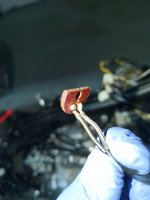
I took apart the right hand controls and it was obvious no one has really looked at the wiring in there since this bike was in the factory. Took some tedious work, but I found one of the kill switch's wires was ornamentally placed on the soldered point. Looks like it may have become corroded and became loose?
1000011920.jpg
 
Hmmm, the 360 had a recall/service bulletin (I think anyway) regarding handlebar switch shorting.
Someone closer to the 360 world would know this better, or have that SB?
 
Hmmm, the 360 had a recall/service bulletin (I think anyway) regarding handlebar switch shorting.
Someone closer to the 360 world would know this better, or have that SB?
I just went through all of our service bulletins and unfortunately we do not have that one.
 
Per EzPete's recommendation I checked resistance to ground at the engine block. Reads around 00.4 / 00.5 ohms. Unsure if that's a weak ground or within the normal range.
good ground on a motorcycle should be within .5 to 1.5 ohms, so it is perfect. idealy it would be 0 but we live on earth.
 
Here’s a detail of a 1974 360 recall from the NTSB:
HONDA CAMPAIGN NO 360 '2.POSSIBILITY THE MAIN WIRE HARNESS MAY BECOME CHAFEDBY THE FORWARD EDGE OF THE LEFT FRONT FUEL TANK MOUNTING BRACKET.IF THISCONDITION EXISTS, CHAFING MAY SHORT CIRCUIT OR SEVER WIRES WITHIN THE HARNESSAND CAUSE ELECTRICAL FUSES TO BURN OUT.'CORRECT BY INSPECTING AND INSTALLINGHOLDER TO PREVENT CHAFING OF WIRE HARNESS'.
 
Here’s a detail of a 1974 360 recall from the NTSB:
HONDA CAMPAIGN NO 360 '2.POSSIBILITY THE MAIN WIRE HARNESS MAY BECOME CHAFEDBY THE FORWARD EDGE OF THE LEFT FRONT FUEL TANK MOUNTING BRACKET.IF THISCONDITION EXISTS, CHAFING MAY SHORT CIRCUIT OR SEVER WIRES WITHIN THE HARNESSAND CAUSE ELECTRICAL FUSES TO BURN OUT.'CORRECT BY INSPECTING AND INSTALLINGHOLDER TO PREVENT CHAFING OF WIRE HARNESS'.
Jeez, you didn't have to yell.... 🤣
 
Back
Top Bottom