CB350 K3: Idle Revs too high when engine is warm

BHSarc

Veteran Member
Joined
Mar 16, 2025
Total Posts
134
Total likes
132
Location
Grand Rapids, MI
Hello all,
I see this issue mentioned on occasion. My idle is fine after initial warm up. Around 1100 RPM.
I take it for a ride and about 10 minutes later my idle starts increasing. I notice it as I coast towards a stop sign. I engage the clutch to shift down but the RPM's won't drop below 2500 or maybe 3,000. I can force it down by unclutching and just go slower while in gear. But.. when I come to a stop (clutch engaged) the RPM's will go up on their own.

My carbs are clean. Stupid clean.
Just checked my floats and they are 25.7 to 26mm (carb held at an angle, float just touching the float pin).
My throttle cable is silky smooth / no resistance.
Static timing is OK.
I just re-synced the carb throttle plates using the small, guitar wire method.
I spray carb cleaner around the intake "manifolds" looking for leaks... nothing changes.

Is there a common cause to this issue? Or.. is it just a weird thing where many possibilities exist and good luck hunting it down? Is it a sign of a lean mixture? Should I check my valve clearances again?

Thanks for any advice.
Brian
 
Idle adjustment is set too high and mixture is off is the likely culprit. Possibly the advance mechanism sticking.
 
A small update... it did turn out to be a crack in 1 of the intake manifold boots. Left side, bottom of the boot. Covered up by the hose clamp.
I noticed it by actually pushing back & forth on the carbs while spraying a little carb cleaner at them.
 
What style clamps were you using?

My impression is that the OEM clamps are less likely to cut into the rubber manifold, while a traditional hose clamp can be overtightened to the point that it cuts the rubber.
 
What style clamps were you using?

My impression is that the OEM clamps are less likely to cut into the rubber manifold, while a traditional hose clamp can be overtightened to the point that it cuts the rubber.
They were newer after market manifolds using standard hose clamps.
The crack did not line up with the edge of the clamp. It was basically in the middle of the clamp surface.
I noticed the after-market manifolds feel very flexible when compared to some original Honda manifolds I happen to have on a spare CL350 engine. Perhaps time has made the Honda manifolds stiffer but there's a significant difference in the rigidity of the two sets. I replaced my new aftermarket manifolds with the old Honda ones. For now, there's no leaks.
 
Ahhh, I had this same issue. I got some cheapo paper air filters from the aftermarket that don't seal properly. I didn't know why it was happening though, this was helpful to read. I wanted to rip the paper out of the stock filters and replace it with foam anyway, I guess I kind of have to now.
 
Would that mean that the crack/tear lined up on or near the edge on the carburetor neck?
Good question. I tossed the old ones and the garbage man has already come around.
My memory says the crack was before the end / lip of the carb. The manifold has a counterbore (a stepped hole). The carb is supposed to bottom out in that stepped hole which then aligns the lip in the manifold with the groove around the carb.
My tear was close to that lip / groove area of the manifold. It just happened to be right in the middle of my hose clamp (width wise). It was on the underside of the manifold and covered by the hose clamp.
Hope my explanation made sense.
 
Well, back to the drawing board. Replacing the manifold boots had to be worthwhile in that there was an actual crack and carb cleaner made the idle change when sprayed at the crack.
But.. the high revs when warm returned.
So I replaced the timing advance with an old spare I have from a CL350 engine. Both advances moved smoothly and seemed to close completely without effort. But.. why not.
The 2nd advance did improve the RPM stability at cold idle. Much smoother, less RPM variation.
But, when the engine gets hot, if you blip the throttle the RPM's go to whatever you blip them to & stay there... for a long while. Perhaps a full minute.
Since heat seems to be the common attribute, and the problem is not yet fixed, I suppose I should check the valve clearances.
I'll do that this weekend.
 
Well, back to the drawing board. Replacing the manifold boots had to be worthwhile in that there was an actual crack and carb cleaner made the idle change when sprayed at the crack.
But.. the high revs when warm returned.
So I replaced the timing advance with an old spare I have from a CL350 engine. Both advances moved smoothly and seemed to close completely without effort. But.. why not.
The 2nd advance did improve the RPM stability at cold idle. Much smoother, less RPM variation.
But, when the engine gets hot, if you blip the throttle the RPM's go to whatever you blip them to & stay there... for a long while. Perhaps a full minute.
Since heat seems to be the common attribute, and the problem is not yet fixed, I suppose I should check the valve clearances.
I'll do that this weekend.
You're sure there was no slack in either of the springs on the replacement advancer? Even a tiny bit of slack in one spring can cause some delay in retarding the timing to idle position.
 
Well, back to the drawing board. Replacing the manifold boots had to be worthwhile in that there was an actual crack and carb cleaner made the idle change when sprayed at the crack.
But.. the high revs when warm returned.
So I replaced the timing advance with an old spare I have from a CL350 engine. Both advances moved smoothly and seemed to close completely without effort. But.. why not.
The 2nd advance did improve the RPM stability at cold idle. Much smoother, less RPM variation.
But, when the engine gets hot, if you blip the throttle the RPM's go to whatever you blip them to & stay there... for a long while. Perhaps a full minute.
Since heat seems to be the common attribute, and the problem is not yet fixed, I suppose I should check the valve clearances.
I'll do that this weekend.

i had exact same thing with mine, I noticed that the manifolds didn't really seal/press up against the head very well, the way the 2 screws are on each side left a warp/gap in the middle. so I put hondabond on the gasket to fill up that gap and it solved my hanging idle.
 
In the past, when I have experienced a hanging idle, I could sometimes get the motor to drop back to the low idle by flipping the kill switch to off and back to run quickly. Not sure if it helps point one direction or the other, but at least you wouldn't have to wait for it to come down on its own

Air leaks could show up when the motor is cold and go away when hot or the reverse, so it's worth it to check when the symptom is showing up.

If your original boots lack flexibility it's harder to get a good seal. I believe the genuine Honda insulators are available from CMSNL currently. 4-into-1 lists them as unavailable right now. The Honda style clamps are pretty cheap and will be less likely to cause tears or otherwise damage the boots.

Static timing is OK.
Spot on okay, or close enough okay?
 
In the past, when I have experienced a hanging idle, I could sometimes get the motor to drop back to the low idle by flipping the kill switch to off and back to run quickly. Not sure if it helps point one direction or the other, but at least you wouldn't have to wait for it to come down on its own

Air leaks could show up when the motor is cold and go away when hot or the reverse, so it's worth it to check when the symptom is showing up.

If your original boots lack flexibility it's harder to get a good seal. I believe the genuine Honda insulators are available from CMSNL currently. 4-into-1 lists them as unavailable right now. The Honda style clamps are pretty cheap and will be less likely to cause tears or otherwise damage the boots.


Spot on okay, or close enough okay?
Answer to timing (Static only, using a test light).
They are within the thickness of the timing lines.. to me that's pretty good. And.. when that's true.. my point gaps are within spec. Also.. no visible sparks at the points when running.
I don't have a strobe light for dynamic testing.. perhaps I should. Seems all I do since buying this thing is buy tools I haven't needed in 20+ years.
I'm going to check rocker clearances next. It's been about 100 miles since I did the top end last fall. Perhaps they've changed.
 
I have a cheapish dynamic light from Harbor Freight and it works fine for me. I trust static timing for the most part (dohc 450s excluded), but you could use a dynamic light to see if the hanging idle is related to advanced timing or not. It's a good way to rule out one component.
 
Well... checked the valves and they're good. .002" on intakes and .004" on exhaust.
Started checking my timing (static).. and it checked out fine. So out of frustration of not finding my culprit I decided to just re-time the thing. Rotated the points plate to the right, loosened the points and made the gaps huge. And just started over from scratch.
When it was done the left points are at .013" and the right points are at .017" (yes, .001" over). But.. the timing is spot on and the points have no sparks.
And.. my RPM's are calm again. Let it warm up and dialed in the idle at 1400 (after reading the oil flow thread I've decided a slightly higher idle seems safe).
Then a 1 mile ride. RPM's stayed calm.
A 4 mile ride.. (good & warm now). Idle was down to about 1200.. adjusted to 1400.
Then a 15 mile ride. And all was well with the world.
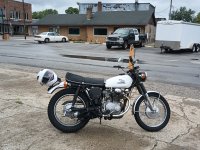
May 24th 2026.jpg
 
Nice! Do you have a project thread? The bike is looking good — where did those mufflers come from?

What's with that yellow pole behind your motorcycle? Looks like a hazard!
 
Nice! Do you have a project thread? The bike is looking good — where did those mufflers come from?

What's with that yellow pole behind your motorcycle? Looks like a hazard!
The mufflers came from Z1 Enterprises.
I thought the black + chrome went well with the bike. I picked the shorter length for just a little noise but not like my previous 12'ers. Those were just too loud for my old ears.
 
Final update: For my specific problem of hi revs after warm up, it seems that re-setting the timing was the solution. I've ridden it 3-4 times since then (around 110 miles total) and have not had a relapse of hi-revs.
In fact.. after last year's top end rebuild, this is about the best the bike has run since I've owned it. I'm almost wondering if this might be the year I can rely on this bike? ;-)
I still have the very small oil leak from behind the cam holder on the left cylinder... it only leaks when running & the drip rate is very, very slow.. perhaps 1 drip in about 7-8 minutes. It never has an effect on the actual oil level / dipstick.
I think, for this year, I'm going to set that issue aside and just try to have a summer of "normal" with this bike. Wiping off a small oil film after a ride is a small price to pay to not have the sense that something urgently needs to be done.
 
Back
Top Bottom